The PARADIGM Project II: Characterising Nuclear and Diffuse Radio Components in Local U/LIRGs
Pith reviewed 2026-05-20 03:58 UTC · model grok-4.3
pith:B6VKT6RB Add to your LaTeX paper
What is a Pith Number?\usepackage{pith}
\pithnumber{B6VKT6RB}
Prints a linked pith:B6VKT6RB badge after your title and writes the identifier into PDF metadata. Compiles on arXiv with no extra files. Learn more
The pith
In local U/LIRGs, radio-excess sources show lower nuclear luminosity ratios at 33 GHz over 6 GHz, indicating AGN non-thermal emission rather than enhanced star formation.
A machine-rendered reading of the paper's core claim, the machinery that carries it, and where it could break.
Core claim
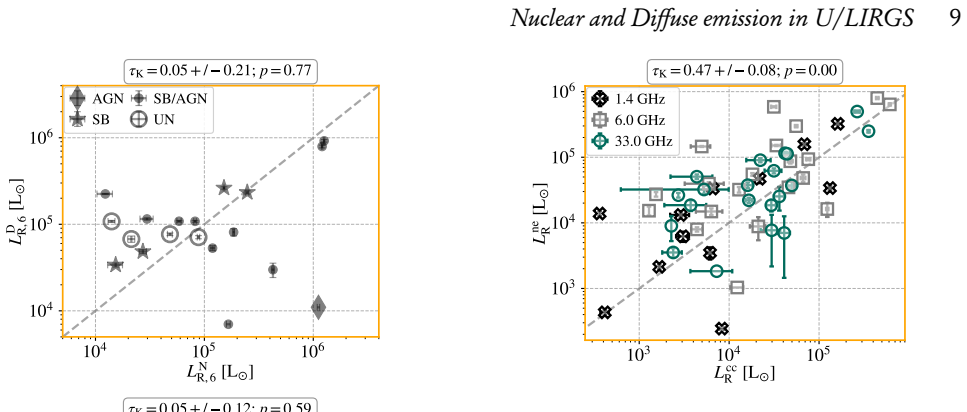
Using e-MERLIN and VLA observations at 1.4, 6.0, and 33.0 GHz, the study decomposes radio emission in local U/LIRGs into nuclear (compact cores and nuclear extended) and large-scale (total and diffuse) components. Sources with radio excess, indicated by lower q_IR values, display reduced nuclear luminosity ratios L_R,33^N / L_R,6^N. Since 33.0 GHz traces recent star formation, the deficit of high-frequency nuclear emission suggests that the radio excess is dominated by non-thermal emission at lower frequencies, likely AGN-related, rather than by boosted star formation.
What carries the argument
Multi-frequency radio interferometry decomposition of emission into nuclear compact cores, nuclear extended structures, and large-scale diffuse components across scales from tens of parsecs to kiloparsecs.
If this is right
- Nuclear emission components correlate with total radio and infrared luminosities that increase with merger stage.
- Diffuse emission at larger scales shows no clear dependence on nuclear processes.
- Nuclear emission contributes about 50 percent of total radio emission on average.
- Total multiscale diffuse emission contributes about 80 percent to total radio power.
Where Pith is reading between the lines
- This decomposition approach could be applied to higher-redshift merging systems to track how AGN and star formation contributions evolve with cosmic time.
- The results imply that radio excess in mergers is more often a signature of black-hole accretion than of intense nuclear starbursts, which would revise estimates of AGN duty cycles in gas-rich interactions.
- Higher-sensitivity 33 GHz imaging could test whether any hidden star formation is masked by the observed frequency deficit.
Load-bearing premise
That 33 GHz emission primarily traces recent star formation with little AGN contribution at that frequency.
What would settle it
If independent star-formation rate estimates from infrared or other tracers predict higher 33 GHz nuclear luminosities than observed in the radio-excess subsample, the AGN interpretation would be supported; the opposite match would weaken it.
Figures





read the original abstract
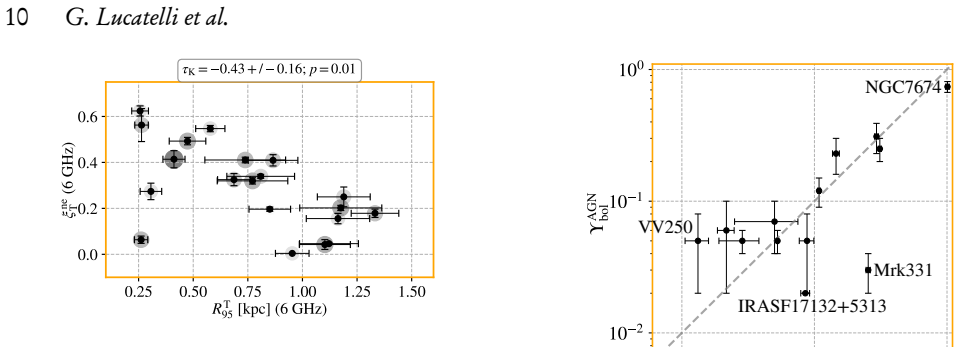
Disentangling SF and AGN emission is essential for understanding galaxy evolution, yet remains challenging in merging systems where both processes are enhanced and spatially intertwined. Galaxy mergers drive gas inflows that simultaneously fuel nuclear SBs and BH accretion, shaping morphology from nuclear ($\lesssim 250$~pc) to large-scale ($\gtrsim 500$~pc) regions. Radio interferometry provides an unobscured view, but separating compact nuclear SBs, AGN, and diffuse SF requires multiscale, multi-frequency observations. We present a systematic method to characterise multiscale radio properties in 15 local ($z\lesssim 0.1$) U/LIRGs ($L_{\mathrm{IR}} > 10^{11}\mathrm{L}_{\odot}$). Using \emph{e}-MERLIN and VLA at 1.4, 6.0 and 33.0~GHz, we probe physical scales from $\sim 10$--$250$~pc to $\sim 0.5$--$3.0$~kpc. We decompose radio emission into nuclear (compact cores and nuclear extended) and large-scale (total and diffuse) components, comparing morphological properties (emission fractions, sizes, luminosities, surface densities) and investigating correlations with source classes, merger stages, and $L_{\mathrm{IR}}$. We find: i) nuclear emission contributes $\sim$50\% of total radio emission on average; ii) total multiscale diffuse emission (SF-related) contributes $\sim$80\% to total power; iii) nuclear emission components act together to correlate with total radio and infrared luminosities, which increase with merger stage, whilst diffuse emission at larger scales shows no clear dependence on nuclear processes; iv) sources with radio excess (lower $q_{\mathrm{IR}}$) show lower nuclear luminosity ratios $L_{\mathrm{R,33}}^{\mathrm{N}}/L_{\mathrm{R,6}}^{\mathrm{N}}$, indicating a deficit of high-$\nu$ radio emission; since 33.0~GHz traces recent SF, this suggests the radio excess is dominated by non-thermal emission at lower $\nu$, likely AGN-related, rather than enhanced SF.
Editorial analysis
A structured set of objections, weighed in public.
Referee Report
Summary. The manuscript presents results from the PARADIGM Project II on 15 local (z ≲ 0.1) U/LIRGs observed with e-MERLIN and VLA at 1.4, 6.0, and 33.0 GHz. It describes a systematic decomposition of radio emission into nuclear (compact cores + nuclear extended, ≲250 pc) and large-scale diffuse (≳500 pc) components, reporting that nuclear emission contributes ~50% of total radio power on average while diffuse emission contributes ~80%. The authors find correlations of nuclear components with total radio/IR luminosities and merger stage, but no such dependence for diffuse emission, and that radio-excess sources (lower q_IR) exhibit lower nuclear luminosity ratios L_R,33^N / L_R,6^N, which they interpret as evidence that the radio excess is dominated by non-thermal AGN emission at lower frequencies rather than enhanced star formation.
Significance. If the decomposition and interpretation are robust, the work provides a useful multi-scale framework for separating SF and AGN radio contributions in merging systems, with direct relevance to galaxy evolution studies. The multi-frequency approach across ~10 pc to kpc scales and the sample of 15 objects allow statistical statements about component fractions and merger-stage trends. The specific finding on luminosity ratios in radio-excess sources could serve as a diagnostic if the assumption that 33 GHz traces recent SF holds. The systematic method and direct observational comparisons are strengths.
major comments (1)
- [Abstract / results on nuclear luminosity ratios] Abstract, finding (iv) and associated results section: The central interpretation that lower nuclear L_R,33^N / L_R,6^N ratios in low-q_IR sources indicate AGN dominance (rather than enhanced SF) rests on the assumption that 33 GHz nuclear emission is dominated by free-free from recent star formation after decomposition. The multi-frequency decomposition does not include explicit spectral-index modeling or higher-frequency constraints to isolate possible non-thermal AGN contributions (flat-spectrum cores, synchrotron self-absorption, or dust-related free-free) at nuclear scales. This leaves open the possibility that the observed ratio reflects spectral curvature or resolution-dependent flux recovery instead of a true SF deficit, which is load-bearing for the claim about the origin of radio excess.
minor comments (2)
- [Methods / notation] The notation for nuclear luminosities (L_R,33^N, L_R,6^N) should be explicitly defined in the methods or early results section to avoid ambiguity when comparing components.
- [Results / tables] A brief summary table of the 15 sources, including basic properties, merger stage, q_IR, and the measured component fractions/luminosity ratios, would improve traceability of the reported averages and correlations.
Simulated Author's Rebuttal
We thank the referee for their careful and constructive review of our manuscript. We address the major comment below and have revised the manuscript accordingly to strengthen the supporting analysis and clarify the assumptions underlying our interpretation.
read point-by-point responses
-
Referee: Abstract, finding (iv) and associated results section: The central interpretation that lower nuclear L_R,33^N / L_R,6^N ratios in low-q_IR sources indicate AGN dominance (rather than enhanced SF) rests on the assumption that 33 GHz nuclear emission is dominated by free-free from recent star formation after decomposition. The multi-frequency decomposition does not include explicit spectral-index modeling or higher-frequency constraints to isolate possible non-thermal AGN contributions (flat-spectrum cores, synchrotron self-absorption, or dust-related free-free) at nuclear scales. This leaves open the possibility that the observed ratio reflects spectral curvature or resolution-dependent flux recovery instead of a true SF deficit, which is load-bearing for the claim about the origin of radio excess.
Authors: We agree that the interpretation of lower nuclear luminosity ratios in radio-excess sources as evidence for AGN-related non-thermal emission at lower frequencies relies on 33 GHz primarily tracing free-free emission from recent star formation in the decomposed nuclear components. This assumption is grounded in the established use of 33 GHz as an SF tracer in the literature for U/LIRGs, where free-free emission increasingly dominates above ~10 GHz once compact non-thermal sources are isolated. However, to directly address the concern regarding the lack of explicit spectral-index modeling, we have added a new analysis in the revised results section computing spectral indices between the 6 GHz and 33 GHz nuclear luminosities for each source. This shows that radio-excess objects (low q_IR) exhibit steeper nuclear spectra, consistent with a relative deficit of high-frequency emission rather than enhanced SF. We have also expanded the discussion to explicitly consider possible non-thermal AGN contributions, synchrotron self-absorption, and resolution effects at nuclear scales, while acknowledging the absence of higher-frequency (>33 GHz) data as a limitation. The abstract has been revised to qualify the statement. These changes make the claim more robust without altering the core findings. revision: yes
Circularity Check
No significant circularity in observational analysis
full rationale
This is an observational astronomy paper that reports direct measurements and correlations from multi-frequency radio interferometry data on 15 local U/LIRGs. The central findings (nuclear emission fractions, luminosity ratios, and trends with merger stage or q_IR) are empirical results obtained by decomposing observed flux into nuclear compact, nuclear extended, and diffuse components at 1.4/6/33 GHz. No equations, predictions, or first-principles derivations are presented that reduce to fitted parameters or self-referential definitions. The interpretation linking lower L_R,33^N / L_R,6^N to AGN-related non-thermal emission rests on the external standard assumption that 33 GHz traces free-free emission from recent star formation, which is not constructed or defined within the paper itself. No self-citation load-bearing steps, uniqueness theorems, or ansatzes are invoked to force the results. The analysis is self-contained against external benchmarks and contains independent content from the data.
Axiom & Free-Parameter Ledger
axioms (1)
- domain assumption 33 GHz radio emission traces recent star formation
Lean theorems connected to this paper
-
IndisputableMonolith/Foundation/RealityFromDistinction.leanreality_from_one_distinction unclear?
unclearRelation between the paper passage and the cited Recognition theorem.
nuclear emission contributes ~50% of total radio emission on average; total multiscale diffuse emission (SF-related) contributes ~80% to total power
What do these tags mean?
- matches
- The paper's claim is directly supported by a theorem in the formal canon.
- supports
- The theorem supports part of the paper's argument, but the paper may add assumptions or extra steps.
- extends
- The paper goes beyond the formal theorem; the theorem is a base layer rather than the whole result.
- uses
- The paper appears to rely on the theorem as machinery.
- contradicts
- The paper's claim conflicts with a theorem or certificate in the canon.
- unclear
- Pith found a possible connection, but the passage is too broad, indirect, or ambiguous to say the theorem truly supports the claim.
Reference graph
Works this paper leans on
-
[1]
, year = 1943, month = jan, volume =
Nuclear Emission in Spiral Nebulae. , year = 1943, month = jan, volume =. doi:10.1086/144488 , adsurl =
-
[2]
, year = 1959, month = jul, volume =
Emission Nuclei in Galaxies. , year = 1959, month = jul, volume =. doi:10.1086/146694 , adsurl =
-
[3]
, year = 1963, month = jul, volume =
Optical Identification of 3C 48, 3C 196, and 3C 286 with Stellar Objects. , year = 1963, month = jul, volume =. doi:10.1086/147615 , adsurl =
-
[4]
and Graham-Smith, Francis , year=
Burke, Bernard F. and Graham-Smith, Francis , year=. An Introduction to Radio Astronomy , DOI=
-
[5]
and Graham-Smith, Francis and Wilkinson, Peter N
Burke, Bernard F. and Graham-Smith, Francis and Wilkinson, Peter N. , booktitle =. doi:10.1017/9781316987506 , isbn =
-
[6]
and Graham-Smith, Francis and Wilkinson, Peter N
Burke, Bernard F. and Graham-Smith, Francis and Wilkinson, Peter N. , year=. An Introduction to Radio Astronomy , publisher=
-
[7]
An introduction to radio astronomy, 4th edition
-
[8]
Thompson, A. Richard and Moran, James M. and Swenson, George W. , booktitle =. doi:10.1002/9783527617845 , file =
-
[9]
Astronomical Data Analysis Software and Systems XVI , year = 2007, editor =
CASA Architecture and Applications. Astronomical Data Analysis Software and Systems XVI , year = 2007, editor =
work page 2007
-
[10]
CASA, the Common Astronomy Software Applications for Radio Astronomy
CASA, the Common Astronomy Software Applications for Radio Astronomy. , keywords =. doi:10.1088/1538-3873/ac9642 , archivePrefix =. 2210.02276 , primaryClass =
work page internal anchor Pith review doi:10.1088/1538-3873/ac9642
-
[11]
An Accurate Flux Density Scale from 1 to 50 GHz
An Accurate Flux Density Scale from 1 to 50 GHz. , keywords =. doi:10.1088/0067-0049/204/2/19 , archivePrefix =. 1211.1300 , primaryClass =
work page internal anchor Pith review Pith/arXiv arXiv doi:10.1088/0067-0049/204/2/19
-
[12]
An Accurate Flux Density Scale from 50 MHz to 50 GHz
An Accurate Flux Density Scale from 50 MHz to 50 GHz. , keywords =. doi:10.3847/1538-4365/aa6df9 , archivePrefix =. 1609.05940 , primaryClass =
work page internal anchor Pith review Pith/arXiv arXiv doi:10.3847/1538-4365/aa6df9
-
[13]
eMCP: e-MERLIN CASA pipeline
-
[14]
Pallavi Patil and Mark Whittle and Kristina Nyland and Carol Lonsdale and Mark Lacy and Amy E Kimball and Colin Lonsdale and Wendy Peters and Tracy E. Clarke and Andreas Efstathiou and Simona Giacintucci and Minjin Kim and Lauranne Lanz and Dipanjan Mukherjee and Emil Polisensky , title =. 2022 , month =. doi:10.3847/1538-4357/ac71b0 , url =
-
[15]
The VLA-COSMOS 3 GHz Large Project: The infrared-radio correlation of star-forming galaxies and AGN to z 6. , keywords =. doi:10.1051/0004-6361/201629430 , archivePrefix =. 1703.09723 , primaryClass =
work page internal anchor Pith review Pith/arXiv arXiv doi:10.1051/0004-6361/201629430
-
[16]
The VLA-COSMOS 3 GHz Large Project: The cosmic star formation history since z~5
The VLA-COSMOS 3 GHz Large Project: Cosmic star formation history since z 5. , keywords =. doi:10.1051/0004-6361/201629436 , archivePrefix =. 1703.09724 , primaryClass =
work page internal anchor Pith review Pith/arXiv arXiv doi:10.1051/0004-6361/201629436
-
[17]
Calibrating the relation of low-frequency radio continuum to star formation rate at 1 kpc scale with LOFAR , DOI= "10.1051/0004-6361/201833905", url= "https://doi.org/10.1051/0004-6361/201833905", journal =
-
[18]
Monthly Notices of the Royal Astronomical Society , volume =
Ghasemi-Nodehi, M and Tabatabaei, Fatemeh S and Sargent, Mark and Murphy, Eric J and Khosroshahi, Habib and Beswick, Rob and Bonaldi, Anna and Schinnerer, Eva , title = ". Monthly Notices of the Royal Astronomical Society , volume =. 2022 , month =. doi:10.1093/mnras/stac1393 , url =
-
[19]
COLDz: Probing Cosmic Star Formation With Radio Free-Free Emission. , keywords =. doi:10.3847/1538-4357/ac34f5 , archivePrefix =. 2111.01153 , primaryClass =
-
[20]
Dense gas is not enough: environmental variations in the star formation efficiency of dense molecular gas at 100 pc scales in M 51. , keywords =. doi:10.1051/0004-6361/201834915 , archivePrefix =. 1902.10437 , primaryClass =
work page internal anchor Pith review Pith/arXiv arXiv doi:10.1051/0004-6361/201834915 1902
-
[21]
A Radio Continuum Study of Dwarf Galaxies: 6 cm Imaging of LITTLE THINGS , journal =
Luke Hindson and Ged Kitchener and Elias Brinks and Volker Heesen and Jonathan Westcott and Deidre Hunter and Hong-Xin Zhang and Michael Rupen and Urvashi Rau. A Radio Continuum Study of Dwarf Galaxies: 6 cm Imaging of LITTLE THINGS , journal =. 2018 , month =. doi:10.3847/1538-4365/aaa42c , url =
-
[22]
A Comparison between Nuclear Ring Star Formation in LIRGs and in Normal Galaxies with the Very Large Array. , keywords =. doi:10.3847/1538-4357/ac05c2 , archivePrefix =. 2107.00412 , primaryClass =
-
[23]
Galaxy structural analysis with the curvature of the brightness profile. , keywords =. doi:10.1093/mnras/stz2154 , archivePrefix =. 1907.10188 , primaryClass =
-
[24]
J. R. Callingham and R. D. Ekers and B. M. Gaensler and J. L. B. Line and N. Hurley-Walker and E. M. Sadler and S. J. Tingay and P. J. Hancock and M. E. Bell and K. S. Dwarakanath and B.-Q. For and T. M. O. Franzen and L. Hindson and M. Johnston-Hollitt and A. D. Kapińska and E. Lenc and B. McKinley and J. Morgan and A. R. Offringa and P. Procopio and L. ...
-
[25]
Conway and Moshe Elitzur and Rodrigo Parra , title =
John E. Conway and Moshe Elitzur and Rodrigo Parra , title =. 2018 , month =. doi:10.3847/1538-4357/aadcf9 , url =
-
[26]
Tracing the nuclear and diffuse extended emission of a bright LIRG
Sub-arcsecond LOFAR imaging of Arp 299 at 150 MHz. Tracing the nuclear and diffuse extended emission of a bright LIRG. , keywords =. doi:10.1051/0004-6361/202140822 , archivePrefix =. 2108.07291 , primaryClass =
-
[27]
No strong radio absorption detected in the low-frequency spectra of radio-loud quasars at z > 5.6 , DOI= "10.1051/0004-6361/202347582", url= "https://doi.org/10.1051/0004-6361/202347582", journal =
-
[28]
Monthly Notices of the Royal Astronomical Society , volume =
de Albernaz Ferreira, Leonardo and Ferrari, Fabricio , title = ". Monthly Notices of the Royal Astronomical Society , volume =. 2017 , month =. doi:10.1093/mnras/stx2266 , url =
-
[29]
Conselice, C. J. and Bershady, M. A. and Jangren, A. , title = ". , eprint =. doi:10.1086/308300 , adsurl =
-
[31]
Gadotti, D. A. , title = ". Monthly Notices of the Royal Astronomical Society , archivePrefix = "arXiv", eprint =. doi:10.1111/j.1365-2966.2007.12723.x , adsurl =
-
[32]
Gadotti, D. A. , title = ". Monthly Notices of the Royal Astronomical Society , archivePrefix = "arXiv", eprint =. doi:10.1111/j.1365-2966.2008.14257.x , adsurl =
-
[33]
A Global 86GHz VLBI Survey of Compact Radio Sources
A Global 86 GHz VLBI Survey of Compact Radio Sources. , keywords =. doi:10.1088/0004-6256/136/1/159 , archivePrefix =. 0803.4035 , primaryClass =
work page internal anchor Pith review Pith/arXiv arXiv doi:10.1088/0004-6256/136/1/159
-
[34]
J. C. Algaba and M. Nakamura and K. Asada and S. S. Lee , title =. 2017 , month =. doi:10.3847/1538-4357/834/1/65 , url =
-
[35]
Renormalization Theory and Effective Field Theories,
Curve and surface fitting with splines. doi:10.1093/oso/9780198534419.001.0001 , url =
-
[36]
AGN outflows and feedback twenty years on
AGN outflows and feedback twenty years on. Nature Astronomy , keywords =. doi:10.1038/s41550-018-0403-6 , archivePrefix =. 1802.10306 , primaryClass =
work page internal anchor Pith review Pith/arXiv arXiv doi:10.1038/s41550-018-0403-6
-
[37]
Star formation sustained by gas accretion , url =
S. Star formation sustained by gas accretion , url =. , number =. 2014 , bdsk-url-1 =. doi:10.1007/s00159-014-0071-1 , id =
-
[38]
A Cosmological Framework for the Co-Evolution of Quasars, Supermassive Black Holes, and Elliptical Galaxies. I. Galaxy Mergers and Quasar Activity. , keywords =. doi:10.1086/524362 , archivePrefix =. 0706.1243 , primaryClass =
work page internal anchor Pith review Pith/arXiv arXiv doi:10.1086/524362
-
[40]
Observational Evidence of Active Galactic Nuclei Feedback
Fabian, A.C. Observational Evidence of Active Galactic Nuclei Feedback. 2012. doi:https://doi.org/10.1146/annurev-astro-081811-125521
work page internal anchor Pith review doi:10.1146/annurev-astro-081811-125521 2012
-
[41]
The suppression of star formation by powerful active galactic nuclei
The suppression of star formation by powerful active galactic nuclei. , keywords =. doi:10.1038/nature11096 , archivePrefix =. 1310.4147 , primaryClass =
work page internal anchor Pith review Pith/arXiv arXiv doi:10.1038/nature11096
- [42]
-
[43]
ApJ , year = 1970, month = jun, volume =
On the Disks of Spiral and S0 Galaxies. ApJ , year = 1970, month = jun, volume =. doi:10.1086/150474 , adsurl =
-
[44]
The GOODS-N Jansky VLA 10 GHz Pilot Survey: Sizes of Star-Forming $\mu$Jy Radio Sources
The GOODS-N Jansky VLA 10 GHz Pilot Survey: Sizes of Star-forming JY Radio Sources. , keywords =. doi:10.3847/1538-4357/aa62fd , archivePrefix =. 1702.06963 , primaryClass =
work page internal anchor Pith review Pith/arXiv arXiv doi:10.3847/1538-4357/aa62fd
-
[45]
High-resolution radio observations of submillimetre galaxies. , keywords =. doi:10.1111/j.1365-2966.2008.12869.x , archivePrefix =. 0712.3047 , primaryClass =
-
[46]
Eric F. Bell , title =. 2003 , month =. doi:10.1086/367829 , url =
-
[47]
A Closer View of the Radio-FIR Correlation: Disentangling the Contributions of Star Formation and Active Galactic Nucleus Activity. , keywords =. doi:10.1088/0004-637X/724/1/779 , archivePrefix =. 1010.0435 , primaryClass =
work page internal anchor Pith review Pith/arXiv arXiv doi:10.1088/0004-637x/724/1/779
-
[49]
An extremely prolific supernova factory in the buried nucleus of the starburst galaxy IC 694
An extremely prolific supernova factory in the buried nucleus of the starburst galaxy IC 694. , keywords =. doi:10.1051/0004-6361/200912964 , archivePrefix =. 0909.3959 , primaryClass =
work page internal anchor Pith review Pith/arXiv arXiv doi:10.1051/0004-6361/200912964
-
[50]
The Radio Spectral Energy Distribution and Star Formation Rate Calibration in Galaxies
The Radio Spectral Energy Distribution and Star-formation Rate Calibration in Galaxies. , keywords =. doi:10.3847/1538-4357/836/2/185 , archivePrefix =. 1611.01705 , primaryClass =
work page internal anchor Pith review Pith/arXiv arXiv doi:10.3847/1538-4357/836/2/185
-
[51]
A multi-scale study of infrared and radio emission from Scd galaxy M33
A multi-scale study of infrared and radio emission from Scd galaxy M 33. , keywords =. doi:10.1051/0004-6361:20066731 , archivePrefix =. astro-ph/0701897 , primaryClass =
work page internal anchor Pith review Pith/arXiv arXiv doi:10.1051/0004-6361:20066731
-
[52]
High-resolution radio continuum survey of M 33. II. Thermal and nonthermal emission. , keywords =. doi:10.1051/0004-6361:20078174 , archivePrefix =. 0708.2484 , primaryClass =
work page internal anchor Pith review Pith/arXiv arXiv doi:10.1051/0004-6361:20078174
-
[53]
Condon, J. J. and Matthews, A. M. , journal =. 2018 , month = jul, number =. arXiv , doi =:1804.10047 , groups =
work page internal anchor Pith review Pith/arXiv arXiv 2018
-
[54]
The IRAS Revised Bright Galaxy Sample (RBGS)
The IRAS Revised Bright Galaxy Sample. , keywords =. doi:10.1086/376841 , archivePrefix =. astro-ph/0306263 , primaryClass =
work page internal anchor Pith review Pith/arXiv arXiv doi:10.1086/376841
-
[55]
GOALS: The Great Observatories All-Sky LIRG Survey
GOALS: The Great Observatories All-Sky LIRG Survey. , keywords =. doi:10.1086/600092 , archivePrefix =. 0904.4498 , primaryClass =
work page internal anchor Pith review Pith/arXiv arXiv doi:10.1086/600092
-
[56]
The Nuclear Structure in Nearby Luminous Infrared Galaxies: HST NICMOS Imaging of the GOALS Sample
The Nuclear Structure in Nearby Luminous Infrared Galaxies: Hubble Space Telescope NICMOS Imaging of the GOALS Sample. , keywords =. doi:10.1088/0004-6256/141/3/100 , archivePrefix =. 1012.4012 , primaryClass =
work page internal anchor Pith review Pith/arXiv arXiv doi:10.1088/0004-6256/141/3/100
-
[57]
Hubble Space Telescope ACS Imaging of the GOALS Sample: Quantitative Structural Properties of Nearby Luminous Infrared Galaxies with L _ IR > 10 ^ 11.4 L _. , keywords =. doi:10.1088/0004-637X/768/2/102 , archivePrefix =. 1303.3977 , primaryClass =
work page internal anchor Pith review Pith/arXiv arXiv doi:10.1088/0004-637x/768/2/102
-
[59]
2011, MNRAS, 418, 2292, doi: 10.1111/j.1365-2966.2011.19566.x
Romero-Ca\ nizales, C. and Mattila, S. and Alberdi, A. and Pérez-Torres, M. A. and Kankare, E. and Ryder, S. D. , title = ". MNRAS , volume =. 2011 , month =. doi:10.1111/j.1365-2966.2011.18886.x , url =
-
[60]
Unveiling the AGN in IC 883: discovery of a parsec-scale radio jet
Unveiling the AGN in IC 883: discovery of a parsec-scale radio jet. , keywords =. doi:10.1093/mnras/stx224 , archivePrefix =. 1701.07025 , primaryClass =
work page internal anchor Pith review Pith/arXiv arXiv doi:10.1093/mnras/stx224
-
[61]
The nuclear starburst in Arp 299-A: from the 5.0 GHz VLBI radio light-curves to its core-collapse supernova rate. A&A , keywords =. doi:10.1051/0004-6361/201118446 , archivePrefix =. 1201.3220 , primaryClass =
work page internal anchor Pith review Pith/arXiv arXiv doi:10.1051/0004-6361/201118446
-
[62]
Subarcsecond international LOFAR radio images of Arp 220 at 150 MHz. A kpc-scale star forming disk surrounding nuclei with shocked outflows. A&A , keywords =. doi:10.1051/0004-6361/201628702 , archivePrefix =. 1607.02761 , primaryClass =
work page internal anchor Pith review Pith/arXiv arXiv doi:10.1051/0004-6361/201628702
-
[63]
e-MERLIN and VLBI observations of the luminous infrared galaxy IC 883: a nuclear starburst and an AGN candidate revealed. , keywords =. doi:10.1051/0004-6361/201218816 , archivePrefix =. 1205.2257 , primaryClass =
work page internal anchor Pith review Pith/arXiv arXiv doi:10.1051/0004-6361/201218816
-
[64]
Radio continuum properties of luminous infrared galaxies. Identifying the presence of an AGN in the radio. , keywords =. doi:10.1051/0004-6361/201424125 , archivePrefix =. 1408.4177 , primaryClass =
work page internal anchor Pith review Pith/arXiv arXiv doi:10.1051/0004-6361/201424125
-
[65]
A 33 GHz Survey of Local Major Mergers: Estimating the Sizes of the Energetically Dominant Regions from High-resolution Measurements of the Radio Continuum. , keywords =. doi:10.3847/1538-4357/aa789a , archivePrefix =. 1705.10801 , primaryClass =
work page internal anchor Pith review Pith/arXiv arXiv doi:10.3847/1538-4357/aa789a
-
[66]
Astrophysics Update 2 , year = 2006, editor =
Ultraluminous Infrared Galaxies. Astrophysics Update 2 , year = 2006, editor =. doi:10.1007/3-540-30313-8_9 , adsurl =
-
[67]
, year = 1996, month = jan, volume =
Luminous Infrared Galaxies. , year = 1996, month = jan, volume =. doi:10.1146/annurev.astro.34.1.749 , adsurl =
-
[68]
Deciphering an evolutionary sequence of merger stages in infrared-luminous starburst galaxies at z 0.7. , keywords =. doi:10.1051/0004-6361/201834522 , archivePrefix =. 1901.05013 , primaryClass =
work page internal anchor Pith review Pith/arXiv arXiv doi:10.1051/0004-6361/201834522 1901
-
[69]
Detailed Decomposition of Galaxy Images. II. Beyond Axisymmetric Models. , keywords =. doi:10.1088/0004-6256/139/6/2097 , archivePrefix =. 0912.0731 , primaryClass =
work page internal anchor Pith review Pith/arXiv arXiv doi:10.1088/0004-6256/139/6/2097 2097
-
[70]
Morphology and Molecular Gas Fractions of Local Luminous Infrared Galaxies as a Function of Infrared Luminosity and Merger Stage. , keywords =. doi:10.3847/0004-637X/825/2/128 , archivePrefix =. 1605.05417 , primaryClass =
work page internal anchor Pith review Pith/arXiv arXiv doi:10.3847/0004-637x/825/2/128
-
[72]
AGN impact on the molecular gas in galactic centres as probed by CO lines. , keywords =. doi:10.1093/mnras/stac313 , archivePrefix =. 2202.00697 , primaryClass =
-
[73]
Iwasawa, K. and Sanders, D. B. and Teng, S. H. and U, V. and Armus, L. and Evans, A. S. and Howell, J. H. and Komossa, S. and Mazzarella, J. M. and Petric, A. O. and Surace, J. A. and Vavilkin, T. and Veilleux, S. and Trentham, N. , doi =. A&A , keywords =. arXiv , arxivId =:1103.2755 , file =
work page internal anchor Pith review Pith/arXiv arXiv
-
[74]
Stellar and Gaseous Nuclear Disks Observed in Nearby (U)LIRGs
Stellar and Gaseous Nuclear Disks Observed in Nearby (U)LIRGs. , keywords =. doi:10.1088/0004-637X/784/1/70 , archivePrefix =. 1401.7338 , primaryClass =
work page internal anchor Pith review Pith/arXiv arXiv doi:10.1088/0004-637x/784/1/70
-
[75]
The Multiphase Structure and Power Sources of Galactic Winds in Major Mergers
Rupke, David S.N. and Veilleux, Sylvain , doi =. ApJ , keywords =. arXiv , arxivId =:1303.6866 , file =
work page internal anchor Pith review Pith/arXiv arXiv
-
[76]
The Role of Starburst-Active Galactic Nucleus Composites in Luminous Infrared Galaxy Mergers: Insights from the New Optical Classification Scheme. , keywords =. doi:10.1088/0004-637X/709/2/884 , archivePrefix =. 0911.3728 , primaryClass =
work page internal anchor Pith review Pith/arXiv arXiv doi:10.1088/0004-637x/709/2/884
-
[77]
S. Veilleux and M. Meléndez and E. Sturm and J. Gracia-Carpio and J. Fischer and E. González-Alfonso and A. Contursi and D. Lutz and A. Poglitsch and R. Davies and R. Genzel and L. Tacconi and J. A. De Jong and A. Sternberg and H. Netzer and S. Hailey-Dunsheath and A. Verma and D. S.N. Rupke and R. Maiolino and S. H. Teng and E. Polisensky , doi =. Fast m...
-
[78]
Massive Molecular Outflows and Evidence for AGN Feedback from CO Observations
Massive molecular outflows and evidence for AGN feedback from CO observations. , keywords =. doi:10.1051/0004-6361/201322464 , archivePrefix =. 1311.2595 , primaryClass =
work page internal anchor Pith review Pith/arXiv arXiv doi:10.1051/0004-6361/201322464
-
[79]
Vardoulaki, E. and. A&A , keywords =. doi:10.1051/0004-6361/201832982 , eprint =
-
[80]
The Great Observatories All-Sky LIRG Survey: Comparison of Ultraviolet and Far-Infrared Properties
Howell, Justin H. and Armus, Lee and Mazzarella, Joseph M. and Evans, Aaron S. and Surace, Jason A. and Sanders, David B. and Petric, Andreea and Appleton, Phil and Bothun, Greg and Bridge, Carrie and Chan, Ben H.P. and Charmandaris, Vassilis and Frayer, David T. and Haan, Sebastian and Inami, Hanae and Kim, Dong Chan and Lord, Steven and Madore, Barry F....
work page internal anchor Pith review Pith/arXiv arXiv
-
[81]
doi:10.1051/0004-6361/201322489 , eprint =
A&A , keywords =. doi:10.1051/0004-6361/201322489 , eprint =
-
[82]
The physical properties of local (U)LIRGs: A comparison with nearby early- and late-type galaxies. , keywords =. doi:10.1051/0004-6361/202038605 , archivePrefix =. 2102.03913 , primaryClass =
-
[83]
Multi-phase outflows in Mkn 848 observed with SDSS-MaNGA Integral Field Spectroscopy
Perna, M. and Cresci, G. and Brusa, M. and Lanzuisi, G. and Concas, A. and Mainieri, V. and Mannucci, F. and Marconi, A. , doi =. A&A , keywords =. arXiv , arxivId =:1901.02027 , file =
work page internal anchor Pith review Pith/arXiv arXiv 1901
-
[84]
doi:10.1051/0004-6361/201731865 , journal =
-
[85]
The Role of Merger Stage on Galaxy Radio Spectra in Local Infrared-Bright Starburst Galaxies
The Role of Merger Stage on Galaxy Radio Spectra in Local Infrared-bright Starburst Galaxies. , keywords =. doi:10.1088/0004-637X/777/1/58 , archivePrefix =. 1308.4415 , primaryClass =
work page internal anchor Pith review Pith/arXiv arXiv doi:10.1088/0004-637x/777/1/58
discussion (0)
Sign in with ORCID, Apple, or X to comment. Anyone can read and Pith papers without signing in.