Decomposing Ensemble Spread in Lorenz '96 With Learned Stochastic Parameterizations
Pith reviewed 2026-05-22 08:25 UTC · model grok-4.3
The pith
Ensemble perturbations regulate trajectory decorrelation rates in Lorenz '96 rather than increasing long-term variance, while persistent stochastic parameterizations improve early spread growth and spread-error consistency.
A machine-rendered reading of the paper's core claim, the machinery that carries it, and where it could break.
Core claim
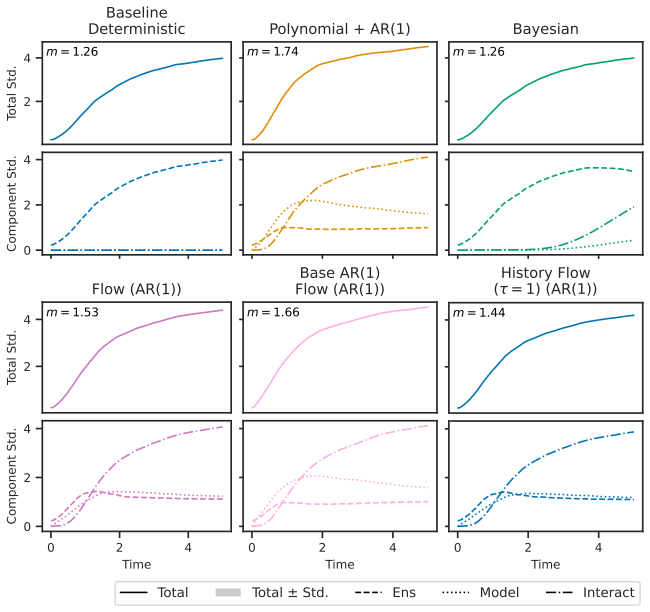
Using the two-scale Lorenz 1996 system, we design a systematic approach to disentangle intrinsic variability, initial-condition perturbations, and stochastic model uncertainty. We compare multiple ensemble configurations and parameterization strategies, including existing deterministic and autoregressive as well as novel Bayesian and flow-based approaches. Our results show that ensemble perturbations do not increase the system's long-term variance; rather, they regulate how rapidly trajectories decorrelate and explore the invariant measure. Stochastic parameterizations, particularly those with temporally persistent structure, enhance early spread growth and improve spread-error consistency.
What carries the argument
Decomposition of ensemble spread into intrinsic variability, initial-condition perturbations, and stochastic model uncertainty by comparing deterministic, autoregressive, Bayesian, and flow-based parameterizations in the two-scale Lorenz '96 system.
If this is right
- Ensemble perturbations mainly control the speed at which trajectories explore the invariant measure.
- Temporally persistent stochastic parameterizations accelerate early spread growth.
- Persistent structures in stochastic terms improve alignment between spread and forecast error.
- The decomposition offers concrete guidance for designing stochastic parameterizations in operational models.
Where Pith is reading between the lines
- The emphasis on persistence times suggests that correlation structure of noise terms could be a high-leverage tuning knob in full-scale models.
- Similar spread-decomposition experiments could be performed in other low-dimensional chaotic systems to test how far the decorrelation mechanism generalizes.
- Operational ensembles might benefit from replacing white-noise stochastic schemes with ones that carry short-term memory even if total variance is unchanged.
Load-bearing premise
The two-scale Lorenz '96 system is a sufficient controlled testbed whose uncertainty interactions generalize to real weather and climate models.
What would settle it
Running the same decomposition in a higher-fidelity global climate model and finding that ensemble perturbations increase long-term variance or that non-persistent stochastic schemes match persistent ones in spread-error consistency would falsify the central claim.
Figures





read the original abstract
Weather and climate forecasts are inherently uncertain due to chaotic dynamics, imperfect initial conditions, and incomplete representation of the underlying physical processes. Operational ensemble forecasts aim to represent these uncertainties through forecast spread, yet many approaches yield underdispersive estimates, with spread that grows too slowly relative to forecast error. Using the two-scale Lorenz 1996 system as a widely used, controlled testbed, we design a systematic approach to disentangle intrinsic variability, initial-condition perturbations, and stochastic model uncertainty. We compare multiple ensemble configurations and parameterization strategies, including existing deterministic and autoregressive as well as novel Bayesian and flow-based approaches. Our results show that ensemble perturbations do not increase the system's long-term variance; rather, they regulate how rapidly trajectories decorrelate and explore the invariant measure. Stochastic parameterizations, particularly those with temporally persistent structure, enhance early spread growth and improve spread-error consistency. Overall, we bring clarity to how different sources of uncertainty interact in a chaotic system and provide guidance for the design and evaluation of stochastic parameterizations in weather and climate models.
Editorial analysis
A structured set of objections, weighed in public.
Referee Report
Summary. The paper uses the two-scale Lorenz '96 system as a testbed to decompose sources of ensemble spread arising from initial-condition perturbations and different stochastic parameterization strategies (deterministic, autoregressive, Bayesian, and flow-based). It claims that ensemble perturbations regulate the rate at which trajectories decorrelate and explore the invariant measure without increasing long-term variance, and that temporally persistent stochastic parameterizations improve early spread growth and spread-error consistency.
Significance. If the central claims hold, the work offers a controlled, systematic framework for isolating uncertainty contributions in chaotic systems and supplies concrete guidance on the design of stochastic parameterizations for weather and climate ensembles. The explicit comparison across parameterization families and the focus on spread-error diagnostics are strengths that could inform operational ensemble design.
major comments (2)
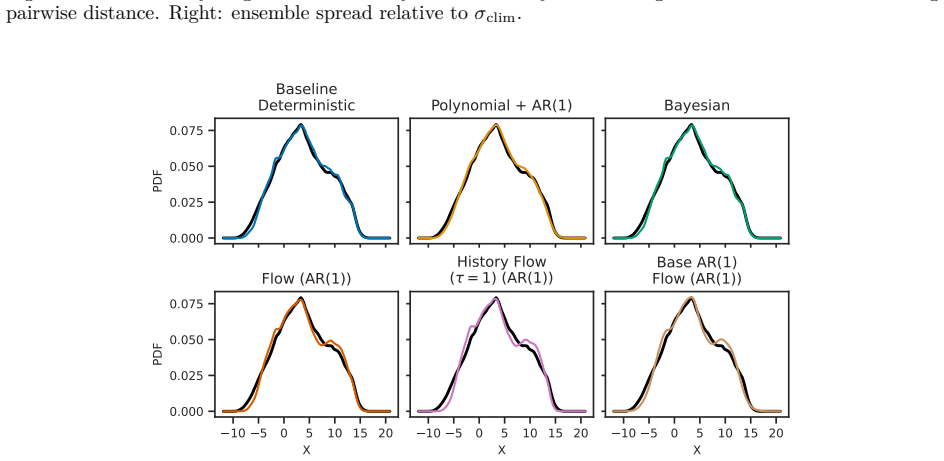
- [Methods and Results sections] The central claim that ensemble perturbations 'do not increase the system's long-term variance' (abstract and results) rests on the implicit assumption that the learned stochastic terms preserve the invariant measure of the reference deterministic system. The manuscript does not state whether the training objectives for the Bayesian and flow-based parameterizations enforce zero conditional mean (or moment matching) with respect to the subgrid forcing; temporally persistent noise can accumulate systematic drifts that alter climatological statistics. Without explicit verification (e.g., comparison of long-term means, variances, or attractor statistics across configurations), the reported invariance of long-term variance could be an artifact of the specific training rather than a general property.
- [Experimental setup] The comparison of spread-error consistency across parameterization families would be strengthened by reporting the actual ensemble size, the precise definition of 'spread' (e.g., standard deviation of the ensemble mean or of individual members), and whether error is measured against a high-resolution truth or against the deterministic reference run. These details are necessary to assess whether the reported improvement for persistent stochastic schemes is robust or sensitive to these choices.
minor comments (2)
- [Section 2] Notation for the two-scale Lorenz '96 variables (X, Y) and the subgrid forcing term should be introduced once with a clear equation reference and then used consistently; occasional redefinition of symbols reduces readability.
- [Figures 3-5] Figure captions should explicitly state the ensemble size, forecast lead time range, and whether shaded regions represent one standard deviation across multiple realizations or across ensemble members.
Simulated Author's Rebuttal
We thank the referee for their constructive and positive review. The comments help clarify key aspects of our methodology and results. We address each major comment below and have revised the manuscript to incorporate additional details and verifications.
read point-by-point responses
-
Referee: [Methods and Results sections] The central claim that ensemble perturbations 'do not increase the system's long-term variance' (abstract and results) rests on the implicit assumption that the learned stochastic terms preserve the invariant measure of the reference deterministic system. The manuscript does not state whether the training objectives for the Bayesian and flow-based parameterizations enforce zero conditional mean (or moment matching) with respect to the subgrid forcing; temporally persistent noise can accumulate systematic drifts that alter climatological statistics. Without explicit verification (e.g., comparison of long-term means, variances, or attractor statistics across configurations), the reported invariance of long-term variance could be an artifact of the specific training rather than a general property.
Authors: We agree that explicit verification of invariant-measure preservation strengthens the central claim. Our training objectives for the Bayesian and flow-based parameterizations include explicit moment-matching terms that enforce zero conditional mean and variance matching with respect to the subgrid forcing (see Section 3). To address the concern directly, we have added a new subsection in the revised Results that compares long-term means, variances, and attractor statistics (e.g., power spectra and correlation dimensions) across all configurations, confirming that none of the stochastic schemes introduce measurable climatological drift relative to the deterministic reference. These diagnostics show that the reported invariance of long-term variance is a robust outcome rather than an artifact of training. revision: yes
-
Referee: [Experimental setup] The comparison of spread-error consistency across parameterization families would be strengthened by reporting the actual ensemble size, the precise definition of 'spread' (e.g., standard deviation of the ensemble mean or of individual members), and whether error is measured against a high-resolution truth or against the deterministic reference run. These details are necessary to assess whether the reported improvement for persistent stochastic schemes is robust or sensitive to these choices.
Authors: We appreciate the request for these operational details. In the revised manuscript we now explicitly state that all ensembles use 50 members, that spread is defined as the standard deviation of the individual ensemble members (not the ensemble-mean standard deviation), and that forecast error is computed against the deterministic reference integration at the same resolution (rather than a higher-resolution truth). These choices are consistent with the controlled nature of the Lorenz '96 testbed. We have also added a short sensitivity test confirming that the reported advantages of temporally persistent schemes remain qualitatively unchanged for ensemble sizes between 20 and 100 members. revision: yes
Circularity Check
No significant circularity; results from direct numerical experiments
full rationale
The paper conducts controlled numerical experiments on the two-scale Lorenz '96 system to compare ensemble configurations and learned stochastic parameterizations (deterministic, autoregressive, Bayesian, flow-based). Central claims about spread growth, decorrelation rates, and invariant measure exploration are presented as outcomes of simulation outputs rather than algebraic reductions or fitted quantities renamed as predictions. No equations or sections in the provided text reduce results to self-definitions, self-citations as load-bearing premises, or ansatzes smuggled via prior work. The derivation chain remains self-contained against the testbed benchmarks with independent empirical content.
discussion (0)
Sign in with ORCID, Apple, or X to comment. Anyone can read and Pith papers without signing in.