Effective Constrained Scalar--Gauss--Bonnet Inflation Motivated by f(R,mathcal{G}) Gravity
Pith reviewed 2026-06-29 09:13 UTC · model grok-4.3
The pith
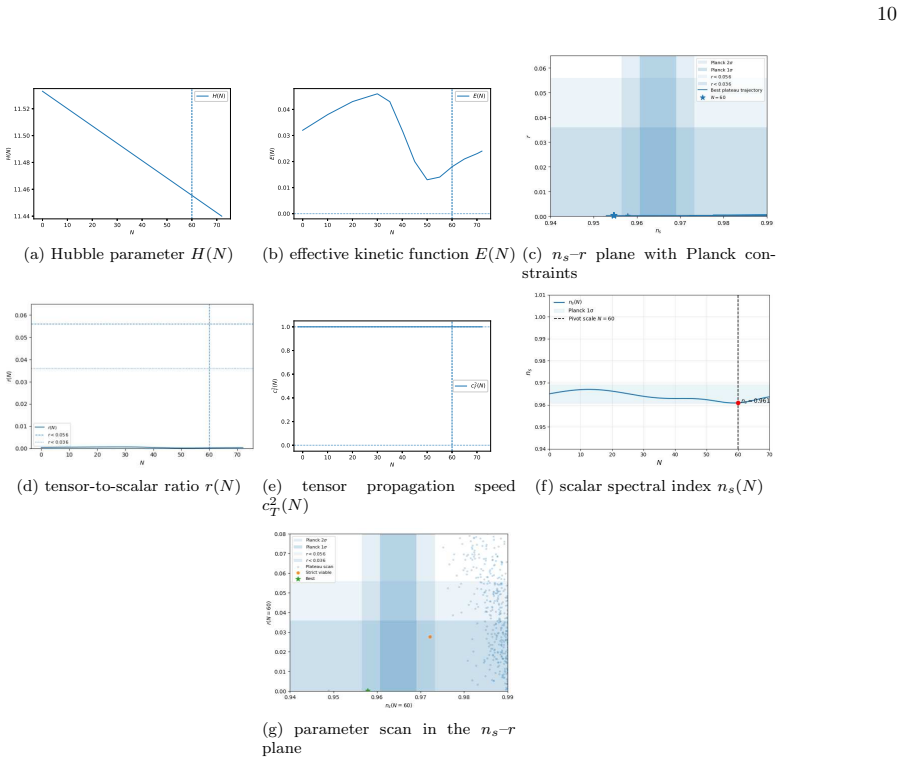
A constrained scalar-Gauss-Bonnet model from f(R,G) gravity produces ns approximately 0.958 and r approximately 2.7 times 10 to the minus 4 while the exact constraint removes the scalar perturbation mode.
A machine-rendered reading of the paper's core claim, the machinery that carries it, and where it could break.
Core claim
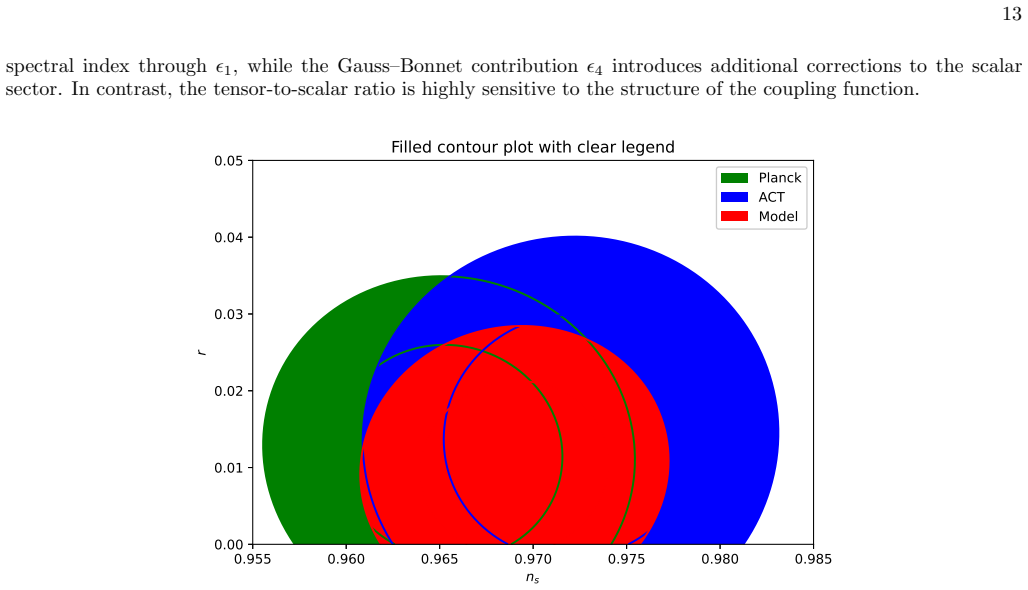
The paper claims that the effective constrained scalar--Gauss--Bonnet framework provides a flexible and observationally viable description of inflation. The Hubble parametrization mainly controls the scalar sector through the slow-roll parameter epsilon1, while the Gauss-Bonnet-induced contribution epsilon4 can significantly affect the scalar tilt and strongly suppress primordial tensor modes, naturally leading to very small values of r. A representative benchmark solution yields ns approximately 0.958 and r approximately 2.7 times 10 to the minus 4, marginally compatible with current Planck, ACT, and BICEP/Keck constraints. In the exactly constrained theory the Lagrange-multiplier constrain
What carries the argument
Unified parametrizations of the Hubble expansion rate and the Gauss-Bonnet coupling function within a generalized slow-roll formalism, combined with the Lagrange-multiplier constraint that forces the lapse perturbation to vanish.
Load-bearing premise
The generalized slow-roll formalism remains a valid effective description of the softly constrained theory even though the exact constrained limit has no propagating scalar modes.
What would settle it
A direct linear-order calculation in the exactly constrained theory that finds a nonzero propagating scalar mode would falsify the claim that the constraint eliminates the scalar degree of freedom.
Figures

read the original abstract
We develop an effective framework for inflation in a constrained scalar--Gauss--Bonnet theory motivated by a restricted sector of $f(R,\mathcal{G})$ gravity. Using unified parametrizations of the Hubble expansion rate and the Gauss--Bonnet coupling function within a generalized slow-roll formalism, we derive analytical expressions for the scalar spectral index $n_s$ and tensor-to-scalar ratio $r$, and study their dependence on the model parameters. We show that the Hubble parametrization mainly controls the scalar sector through the slow-roll parameter $\epsilon_1$, while the Gauss--Bonnet-induced contribution $\epsilon_4$ can significantly affect the scalar tilt and strongly suppress primordial tensor modes, naturally leading to very small values of $r$. A representative benchmark solution yields $n_s \simeq 0.958$ and $r \simeq 2.7 \times 10^{-4}$, marginally compatible with current Planck, ACT, and BICEP/Keck constraints. We further investigate the scalar perturbation structure of the exactly constrained theory, where the Lagrange-multiplier constraint forces the lapse perturbation to vanish and, together with the gravitational momentum constraint, implies $\dot{\mathcal{R}}=0$, eliminating the propagating scalar degree of freedom at linear order. This exact result clarifies that the generalized slow-roll treatment should be interpreted as an effective softly constrained description. We also discuss perturbative stability conditions, including the positivity of the relevant kinetic coefficients and propagation speeds. Our results demonstrate that the effective constrained scalar--Gauss--Bonnet framework provides a flexible and observationally viable description of inflation while clarifying the distinction between the exact constrained limit and its effective slow-roll realization.
Editorial analysis
A structured set of objections, weighed in public.
Referee Report
Summary. The manuscript develops an effective framework for inflation in a constrained scalar-Gauss-Bonnet theory motivated by a restricted sector of f(R,G) gravity. Using unified parametrizations of the Hubble expansion rate and Gauss-Bonnet coupling within a generalized slow-roll formalism, it derives analytical expressions for the scalar spectral index ns and tensor-to-scalar ratio r. The Hubble parametrization controls the scalar sector via ε1 while the GB-induced ε4 strongly suppresses r. A benchmark solution yields ns ≃ 0.958 and r ≃ 2.7×10^{-4}, claimed to be marginally compatible with Planck, ACT, and BICEP/Keck data. The paper analyzes the exactly constrained theory, where the Lagrange-multiplier constraint forces the lapse perturbation to vanish and, with the momentum constraint, implies \dot R =0, eliminating the propagating scalar degree of freedom at linear order; the slow-roll results are therefore interpreted as applying only to an effective 'softly constrained' description. Perturbative stability conditions are also discussed.
Significance. If the effective softly constrained description holds and the generalized slow-roll expressions remain valid, the framework provides a mechanism for naturally small r via the ε4 term while producing viable ns, offering an observationally compatible inflationary model with analytical control. The explicit distinction drawn between the exact constrained limit (no scalar mode) and the effective treatment is a clarifying contribution. The provision of analytical ns,r expressions and a concrete benchmark are positive features.
major comments (2)
- [Abstract and perturbation structure paragraph] Abstract and perturbation structure paragraph: The observational compatibility claim rests on the generalized slow-roll formalism (via ε1 and ε4) remaining valid in the 'softly constrained' regime. The manuscript shows that the exact constrained theory forces lapse perturbation =0 and \dot R =0, removing the propagating scalar mode. No explicit softening mechanism (dynamical multiplier, higher-derivative regulator, or potential term) is supplied to demonstrate that the same ε1,ε4 expressions continue to govern the curvature power spectrum once a scalar mode is restored. This assumption is load-bearing for the ns,r predictions and benchmark.
- [Generalized slow-roll formalism] Generalized slow-roll formalism and benchmark: The analytical expressions for ns and r are stated and a benchmark is given, but the specific functional forms of the parametrizations, the full derivation steps from the unified Hubble and GB functions to the slow-roll parameters, and the explicit data comparison are not supplied. This prevents independent verification of marginal compatibility with Planck/ACT/BICEP/Keck bounds.
minor comments (1)
- Notation for the slow-roll parameters ε1 and ε4 could be defined more explicitly when first introduced to improve readability for readers unfamiliar with the generalized formalism.
Simulated Author's Rebuttal
We thank the referee for their careful reading of the manuscript and for the constructive comments. We address each major comment below and will revise the manuscript accordingly to improve clarity and completeness.
read point-by-point responses
-
Referee: The observational compatibility claim rests on the generalized slow-roll formalism (via ε1 and ε4) remaining valid in the 'softly constrained' regime. The manuscript shows that the exact constrained theory forces lapse perturbation =0 and ˙R =0, removing the propagating scalar mode. No explicit softening mechanism (dynamical multiplier, higher-derivative regulator, or potential term) is supplied to demonstrate that the same ε1,ε4 expressions continue to govern the curvature power spectrum once a scalar mode is restored. This assumption is load-bearing for the ns,r predictions and benchmark.
Authors: We agree that the validity of the generalized slow-roll expressions in the softly constrained regime is a key assumption underlying the ns and r predictions. The manuscript already emphasizes the distinction between the exact constrained theory (no propagating scalar mode) and the effective description, but we acknowledge that no explicit softening mechanism is detailed. In the revision we will add a subsection outlining possible realizations of the soft constraint, including small explicit breaking terms motivated by the underlying f(R,G) sector and effective-field-theory considerations, to better support the applicability of the ε1,ε4 formalism to the benchmark results. revision: yes
-
Referee: The analytical expressions for ns and r are stated and a benchmark is given, but the specific functional forms of the parametrizations, the full derivation steps from the unified Hubble and GB functions to the slow-roll parameters, and the explicit data comparison are not supplied. This prevents independent verification of marginal compatibility with Planck/ACT/BICEP/Keck bounds.
Authors: We apologize for the lack of explicit detail on the functional forms and derivations. The unified parametrizations of the Hubble rate and Gauss-Bonnet coupling are introduced in the text, but the step-by-step passage to the slow-roll parameters and the direct comparison with observational bounds were not expanded. We will add an appendix that supplies the explicit parametrization functions, the complete derivation of ε1 and ε4, the resulting analytic expressions for ns and r, and the numerical evaluation against the Planck, ACT, and BICEP/Keck constraints for the benchmark parameter set. revision: yes
Circularity Check
No significant circularity; derivations self-contained
full rationale
The paper derives analytical expressions for ns and r from the generalized slow-roll parameters ε1 (Hubble parametrization) and ε4 (GB coupling) within an explicitly stated effective framework. The benchmark values are presented as a representative choice within the model parameter space that happens to lie near observational bounds, not as a parameter-free first-principles output. The abstract explicitly distinguishes the exact constrained limit (no propagating scalar mode) from the effective softly-constrained description used for the slow-roll calculation, so the central claims do not reduce to their inputs by construction. No self-citation load-bearing steps, uniqueness theorems, or ansatz smuggling appear in the provided text. The derivation chain remains independent of the target observables.
Axiom & Free-Parameter Ledger
free parameters (1)
- Parameters controlling the unified parametrizations of Hubble expansion rate and Gauss-Bonnet coupling
axioms (2)
- domain assumption Generalized slow-roll formalism applies to the effective softly constrained scalar-Gauss-Bonnet theory
- domain assumption Lagrange-multiplier constraint forces lapse perturbation to vanish and, with the momentum constraint, implies ḋR=0 at linear order
Reference graph
Works this paper leans on
-
[1]
perturbatively consistent within the gene ralized slow-roll approximation
removes the unwanted higher-derivative mode at the level of the background construction, but by itself it does not con stitute a complete proof of perturbative stability. A perturbatively consistent inflationary solution must also satisfy t he positivity of the kinetic coefficients and sound speeds of the propagating scalar and tensor perturbations. The refo...
2018
-
[2]
975, r< 0
95 ≲ns ≲ 0. 975, r< 0. 036. Configurations violating any of these conditions were excluded from the viable parameter space. For the numerical scan, the parameters were varied within the follo wing representative ranges: H0 ∈ [5, 20], A ∈ [0, 0. 5], p ∈ [10− 3, 10− 1], B ∈ [10− 7, 10− 3], m ∈ [1, 3], γh ∈ [10− 9, 10− 5], δ ∈ [10− 7, 10− 3], b ∈ [1, 4], c ∈ ...
-
[3]
A. H. Guth, Phys. Rev. D 23, 347 (1981) . 18
1981
-
[4]
A. D. Linde, Phys. Lett. B 108, 389 (1982)
1982
-
[5]
Albrecht and P
A. Albrecht and P. J. Steinhardt, Phys. Rev. Lett. 48, 1220 (1982)
1982
-
[6]
V. F. Mukhanov and G. V. Chibisov, JETP Lett. 33, 532 (1981)
1981
-
[7]
V. F. Mukhanov and G. V. Chibisov, Sov. Phys. JETP 56, 258 (1982)
1982
-
[8]
A. R. Liddle and D. H. Lyth, Cosmological inflation and large scale structure (2000)
2000
-
[9]
B. A. Bassett, S. Tsujikawa, and D. Wands, Rev. Mod. Phys. 78, 537 (2006) , arXiv:astro-ph/0507632
work page internal anchor Pith review Pith/arXiv arXiv 2006
-
[10]
D. Baumann, in Theoretical Advanced Study Institute in Elementary Partic le Physics: Physics of the Large and the Small (2011) pp. 523–686, arXiv:0907.5424 [hep-th]
work page internal anchor Pith review Pith/arXiv arXiv 2011
-
[11]
D. H. Lyth and A. Riotto, Phys. Rept. 314, 1 (1999) , arXiv:hep-ph/9807278
work page internal anchor Pith review Pith/arXiv arXiv 1999
-
[12]
A. D. Linde, Lect. Notes Phys. 738, 1 (2008) , arXiv:0705.0164 [hep-th]
work page internal anchor Pith review Pith/arXiv arXiv 2008
-
[13]
Planck 2018 results. VI. Cosmological parameters
N. Aghanim et al. (Planck), Astron. Astrophys. 641, A6 (2020) , [Erratum: Astron.Astrophys. 652, C4 (2021)], arXiv:1807.06209 [astro-ph.CO]
work page internal anchor Pith review Pith/arXiv arXiv 2020
-
[14]
Planck 2018 results. X. Constraints on inflation
Y. Akrami et al. (Planck), Astron. Astrophys. 641, A10 (2020) , arXiv:1807.06211 [astro-ph.CO]
work page internal anchor Pith review Pith/arXiv arXiv 2020
-
[15]
S. Aiola et al. (ACT), JCAP 12, 047 (2020) , arXiv:2007.07288 [astro-ph.CO]
-
[16]
M. S. Madhavacheril et al. (ACT), Astrophys. J. 962, 113 (2024) , arXiv:2304.05203 [astro-ph.CO]
work page internal anchor Pith review Pith/arXiv arXiv 2024
-
[17]
Bitaj, N
M. Bitaj, N. Rashidi, and K. Nozari, JHAP 3, 23 (2023)
2023
- [18]
- [19]
-
[20]
Unified cosmic history in modified gravity: from F(R) theory to Lorentz non-invariant models
S. Nojiri and S. D. Odintsov, Phys. Rept. 505, 59 (2011) , arXiv:1011.0544 [gr-qc]
work page internal anchor Pith review Pith/arXiv arXiv 2011
-
[21]
A. De Felice and S. Tsujikawa, Living Rev. Rel. 13, 3 (2010) , arXiv:1002.4928 [gr-qc]
work page internal anchor Pith review Pith/arXiv arXiv 2010
-
[22]
T. P. Sotiriou and V. Faraoni, Rev. Mod. Phys. 82, 451 (2010) , arXiv:0805.1726 [gr-qc]
work page internal anchor Pith review Pith/arXiv arXiv 2010
-
[23]
S. Capozziello and M. De Laurentis, Phys. Rept. 509, 167 (2011) , arXiv:1108.6266 [gr-qc]
work page internal anchor Pith review Pith/arXiv arXiv 2011
-
[24]
Modified Gravity and Cosmology
T. Clifton, P. G. Ferreira, A. Padilla, and C. Skordis, Phys. Rept. 513, 1 (2012) , arXiv:1106.2476 [astro-ph.CO]
work page internal anchor Pith review Pith/arXiv arXiv 2012
- [25]
-
[26]
S. Nojiri, S. D. Odintsov, and M. Sasaki, Phys. Rev. D 71, 123509 (2005) , arXiv:hep-th/0504052
work page internal anchor Pith review Pith/arXiv arXiv 2005
-
[27]
Solar system constraints on f(G) gravity models
A. De Felice and S. Tsujikawa, Phys. Rev. D 80, 063516 (2009) , arXiv:0907.1830 [hep-th]
work page internal anchor Pith review Pith/arXiv arXiv 2009
-
[28]
Cosmological inflation in $F(R,\mathcal{G})$ gravity
M. De Laurentis, M. Paolella, and S. Capozziello, Phys. Rev. D 91, 083531 (2015) , arXiv:1503.04659 [gr-qc]
work page internal anchor Pith review Pith/arXiv arXiv 2015
- [29]
- [30]
-
[31]
S. Capozziello and F. Bajardi, Int. J. Mod. Phys. D 31, 2230009 (2022) , arXiv:2201.04512 [gr-qc]
-
[32]
Modified Gravity Theories on a Nutshell: Inflation, Bounce and Late-time Evolution
S. Nojiri, S. D. Odintsov, and V. K. Oikonomou, Phys. Rept. 692, 1 (2017) , arXiv:1705.11098 [gr-qc]
work page internal anchor Pith review Pith/arXiv arXiv 2017
-
[33]
Singularity-free cosmological solutions in quadratic gravity
P. Kanti, J. Rizos, and K. Tamvakis, Phys. Rev. D 59, 083512 (1999) , arXiv:gr-qc/9806085
work page internal anchor Pith review Pith/arXiv arXiv 1999
-
[34]
Circular Polarization of Primordial Gravitational Waves in String-inspired Inflationary Cosmology
M. Satoh, S. Kanno, and J. Soda, Phys. Rev. D 77, 023526 (2008) , arXiv:0706.3585 [astro-ph] . 19
work page internal anchor Pith review Pith/arXiv arXiv 2008
-
[35]
Slow-roll inflation with a Gauss-Bonnet correction
Z.-K. Guo and D. J. Schwarz, Phys. Rev. D 81, 123520 (2010) , arXiv:1001.1897 [hep-th]
work page internal anchor Pith review Pith/arXiv arXiv 2010
-
[36]
Observational constraints on slow-roll inflation coupled to a Gauss-Bonnet term
S. Koh, B.-H. Lee, W. Lee, and G. Tumurtushaa, Phys. Rev. D 90, 063527 (2014) , arXiv:1404.6096 [gr-qc]
work page internal anchor Pith review Pith/arXiv arXiv 2014
-
[37]
S. D. Odintsov and V. K. Oikonomou, Phys. Rev. D 98, 044039 (2018) , arXiv:1808.05045 [gr-qc]
work page internal anchor Pith review Pith/arXiv arXiv 2018
- [38]
- [39]
- [40]
-
[41]
S. D. Odintsov, V. K. Oikonomou, P. Tsyba, O. Razina, and D. Rakhatov, (2026), arXiv:2604.18861 [gr-qc]
work page internal anchor Pith review Pith/arXiv arXiv 2026
-
[42]
K. Mudrunka and K. Nakayama, JCAP 02, 070 (2026) , arXiv:2504.01365 [gr-qc]
-
[43]
R. P. Woodard, Found. Phys. 44, 213 (2014) , arXiv:1401.0254 [astro-ph.CO]
work page internal anchor Pith review Pith/arXiv arXiv 2014
-
[44]
Scalar-tensor theories and modified gravity in the wake of GW170817
D. Langlois, R. Saito, D. Yamauchi, and K. Noui, Phys. Rev. D 97, 061501 (2018) , arXiv:1711.07403 [gr-qc]
work page internal anchor Pith review Pith/arXiv arXiv 2018
-
[45]
Ghost-free Gauss-Bonnet Theories of Gravity
S. Nojiri, S. D. Odintsov, and V. K. Oikonomou, Phys. Rev. D 99, 044050 (2019) , arXiv:1811.07790 [gr-qc]
work page internal anchor Pith review Pith/arXiv arXiv 2019
- [46]
-
[47]
G. W. Horndeski, Int. J. Theor. Phys. 10, 363 (1974)
1974
-
[48]
Healthy theories beyond Horndeski
J. Gleyzes, D. Langlois, F. Piazza, and F. Vernizzi, Phys. Rev. Lett. 114, 211101 (2015) , arXiv:1404.6495 [hep-th]
work page internal anchor Pith review Pith/arXiv arXiv 2015
-
[49]
Degenerate Higher-Order Scalar-Tensor (DHOST) theories
D. Langlois, in 52nd Rencontres de Moriond on Gravitation (2017) pp. 221–228, arXiv:1707.03625 [gr-qc]
work page internal anchor Pith review Pith/arXiv arXiv 2017
-
[50]
Dark Energy and Modified Gravity in Degenerate Higher-Order Scalar-Tensor (DHOST) theories: a review
D. Langlois, Int. J. Mod. Phys. D 28, 1942006 (2019) , arXiv:1811.06271 [gr-qc]
work page internal anchor Pith review Pith/arXiv arXiv 2019
-
[51]
Generalized Galileon cosmology
A. De Felice and S. Tsujikawa, Phys. Rev. D 84, 124029 (2011) , arXiv:1008.4236 [hep-th]
work page internal anchor Pith review Pith/arXiv arXiv 2011
-
[53]
P. A. R. Ade et al. (BICEP2, Keck Array), Phys. Rev. Lett. 121, 221301 (2018) , arXiv:1810.05216 [astro-ph.CO]
work page internal anchor Pith review Pith/arXiv arXiv 2018
- [54]
-
[55]
Power spectra from an inflaton coupled to the Gauss-Bonnet term
Z.-K. Guo and D. J. Schwarz, Phys. Rev. D 80, 063523 (2009) , arXiv:0907.0427 [hep-th]
work page internal anchor Pith review Pith/arXiv arXiv 2009
-
[56]
B. P. Abbott et al. (LIGO Scientific, Virgo), Phys. Rev. Lett. 119, 161101 (2017) , arXiv:1710.05832 [gr-qc]
work page internal anchor Pith review Pith/arXiv arXiv 2017
-
[57]
Planck constraints on single-field inflation
S. Tsujikawa, J. Ohashi, S. Kuroyanagi, and A. De Felice , Phys. Rev. D 88, 023529 (2013) , arXiv:1305.3044 [astro-ph.CO]
work page internal anchor Pith review Pith/arXiv arXiv 2013
-
[58]
A. A. Starobinsky, Phys. Lett. B 91, 99 (1980)
1980
-
[59]
Inflationary non-Gaussianities in the most general second-order scalar-tensor theories
A. De Felice and S. Tsujikawa, Phys. Rev. D 84, 083504 (2011) , arXiv:1107.3917 [gr-qc]
work page internal anchor Pith review Pith/arXiv arXiv 2011
-
[60]
Generalized G-inflation: Inflation with the most general second-order field equations
T. Kobayashi, M. Yamaguchi, and J. Yokoyama, Prog. Theor. Phys. 126, 511 (2011) , arXiv:1105.5723 [hep-th]
work page internal anchor Pith review Pith/arXiv arXiv 2011
-
[61]
T. Kobayashi, Rep. Prog. Phys. 82, 086901 (2019) , arXiv:1901.04778 [gr-qc]
-
[62]
Cuscuton: A Causal Field Theory with an Infinite Speed of Sound
N. Afshordi, D. J. H. Chung, and G. Geshnizjani, Phys. Rev. D 75, 083513 (2007) , arXiv:hep-th/0609150
work page internal anchor Pith review Pith/arXiv arXiv 2007
-
[63]
Gravitino Dark Matter and low-scale Baryogenesis
A. De Felice, R. Kase, and S. Tsujikawa, Phys. Rev. D 92, 124060 (2015) , arXiv:1507.05584 [gr-qc]
work page internal anchor Pith review Pith/arXiv arXiv 2015
-
[64]
Minimal theory of massive gravity
A. De Felice and S. Mukohyama, Phys. Lett. B 752, 302 (2016) , arXiv:1506.01594 [hep-th]
work page internal anchor Pith review Pith/arXiv arXiv 2016
-
[65]
Degenerate higher derivative theories beyond Horndeski: evading the Ostrogradski instability
D. Langlois and K. Noui, J. Cosmol. Astropart. Phys. 02, 034 (2016) , arXiv:1510.06930 [gr-qc]
work page internal anchor Pith review Pith/arXiv arXiv 2016
-
[66]
D. Langlois, M. Mancarella, K. Noui, and F. Vernizzi, J. Cosmol. Astropart. Phys. 02, 064 (2019) , 20 arXiv:1803.09484 [gr-qc]
discussion (0)
Sign in with ORCID, Apple, or X to comment. Anyone can read and Pith papers without signing in.