REVIEW 3 major objections 4 minor 92 references
This paper claims that a Restricted Boltzmann Machine trained on quantum-sampled determinants can propose compact, physically relevant configuration subspaces for selected configuration interaction, letting a DMET-embedded calculation reach
Reviewed by Pith at T0; open to challenge. T0 means a machine referee read the full paper against a public rubric. the ladder, T0–T4 →
T0 review · deepseek-v4-flash
2026-08-01 10:45 UTC pith:BAZF4VAB
load-bearing objection The core method has real hardware evidence behind it, but the paper's central 'DMET-SQD failed' comparison is built on a baseline the authors themselves label 'Not Converged,' so the abstract overstates the case. the 3 major comments →
Machine-Learned Compact Subspace Generation for Quantum Selected Configuration Interaction within Density Matrix Embedding Framework
The pith
A machine-rendered reading of the paper's core claim, the machinery that carries it, and where it could break.
Core claim
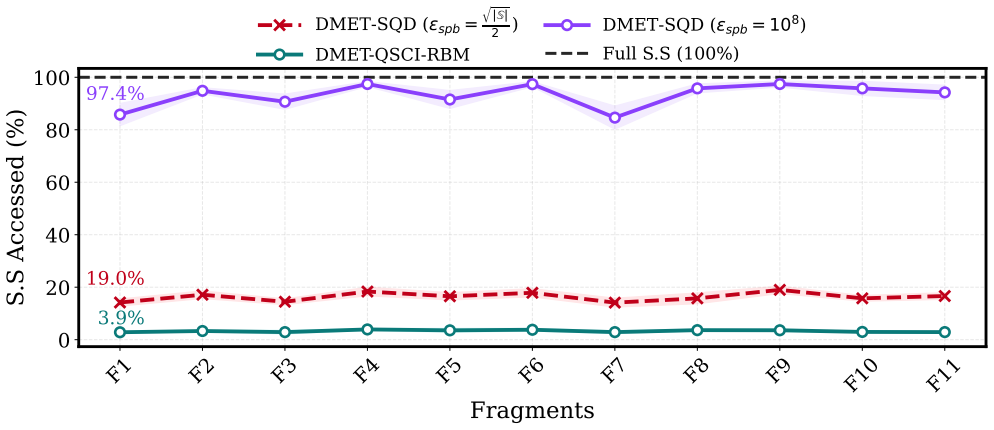
The central discovery is that machine-learned configuration generation, trained with equal weights on the current determinant memory rather than on the CI coefficients themselves, produces a determinant subspace whose energy per accessed determinant is far higher than configuration-recovery-based selection. The paper demonstrates this on the 11-fragment Carmofur–SARS-CoV-2 Mpro complex, where QSCI-RBM reaches chemical accuracy at roughly 3.9% of the symmetry-preserving space, and on small molecules, where chemical accuracy is reached at 2.12% (C2H4) and 0.06% (CH5NO) of the full symmetry space. A second finding is that energy accuracy is governed by the quality and compactness of the accumul
What carries the argument
The carrying mechanism is an iterative RBM-guided subspace expansion. A Restricted Boltzmann Machine—an energy-based generative model with visible and hidden binary units—is retrained each iteration on the current determinant memory (all retained determinants weighted equally, excluding the Hartree-Fock reference). Its Gibbs samples are filtered for electron-number and spin symmetry and for novelty, unioned with the memory, and diagonalized after spin-string proliferation, which forms the tensor product of the unique α- and β-spin strings to surface cross-paired determinants never explicitly sampled. The top determinants by squared CI coefficient are then appended persistently to the memory.
Load-bearing premise
The load-bearing premise is that Gibbs-sampled determinants from an RBM trained with equal weights on the current memory, after spin-string proliferation, actually span the dominant correlation space; if the learned proposals are no better than random symmetry-valid determinants, the compactness advantage disappears and the method reduces to a random sampler—and the paper itself leaves open whether the high-excitation hardware samples contribute meaningfully to the converged
What would settle it
Run QSCI-RBM side by side with a version where the RBM is replaced by uniform random selection of symmetry-valid determinants at the same memory size and shot budget; if the random version matches or beats the RBM version at equal subspace fraction on C2H4 or the protein fragments, the compactness claim fails. A second check: retrain the RBM on |c|²-weighted determinants instead of equal weights and see whether the subspace needed for chemical accuracy shrinks, grows, or stays the same.
If this is right
- If determinant-memory quality rather than µ self-consistency governs accuracy, DMET loops can be halted after a few chemical-potential values, cutting rounds of quantum sampling.
- Classical diagonalization cost per fragment falls roughly in proportion to subspace size, giving about a 5× reduction versus the non-converged SQD baseline and about 25× versus the converged one.
- Chemical accuracy can be reached without MP2 or other perturbative seeding, directly from hardware samples and their proliferated partners.
- The chemical-potential residual is not a reliable convergence proxy for truncated-subspace solvers; subspace-quality metrics must accompany it.
- On small molecules, the approach beats the CCSD reference error for C2H4 and reaches chemical accuracy for CH5NO while accessing only 0.06% of a 6×10^9-determinant space.
Where Pith is reading between the lines
- The key untested assumption is that the RBM's proposals beat random symmetry-valid selection; a direct ablation replacing the RBM with uniform random proposals at equal memory size would settle whether the compactness comes from learning or from the iterative memory/proliferation machinery.
- Because the hardware samples concentrate at excitation orders 4–7, the method may be most useful in multi-reference regimes beyond doubles-restricted perturbation theory; testing on a strongly correlated system with known higher-order dominance would sharpen that claim.
- The paper's own admission that hyperparameters were chosen empirically suggests subspace size at chemical accuracy is an upper bound, not a tuned optimum; a systematic search could push compactness further or reveal sensitivity.
- Cross-fragment transfer of the learned distribution is unexamined; if the RBM must be retrained from scratch per fragment and µ-iteration, the classical overhead of training could offset some diagonalization savings at scale.
Editorial analysis
A structured set of objections, weighed in public.
Referee Report
Summary. The manuscript proposes QSCI-RBM, an iterative RBM-guided subspace-expansion protocol for sample-based quantum diagonalization (SQD/QSCI), and integrates it into a DMET embedding loop as the impurity solver (DMET-QSCI-RBM). The RBM is trained on the current determinant memory with equal per-determinant weights; Gibbs sampling proposes new determinants, which are symmetry-filtered, proliferated over spin strings, and selected into a persistent memory by CI-coefficient thresholding. The method is first validated on C2H4 and CH5NO against FCI, then applied to the Carmofur/SARS-CoV-2 Mpro complex fragmented into 11 DMET impurities with a (16e,16o) active space on IBM Heron hardware. The central reported result is that DMET-QSCI-RBM reaches chemical accuracy relative to DMET-CASCI in two independent runs (errors 9.325e-4 and 4.257e-4 Ha) while accessing ~3.9% of the symmetry space, whereas a truncated DMET-SQD baseline at εspb = sqrt(|S|)/2 accessed ~19% without reaching chemical accuracy and an effectively untruncated DMET-SQD baseline (εspb = 1e8) converged only at ~97% of the symmetry space.
Significance. If the compactness claim holds, the result is practically significant: it addresses the classical diagonalization cost that dominates SQD-based DMET simulations and demonstrates a hardware-scale application to a protein-ligand complex. The paper has several strengths: two independent hardware re-solves at the final chemical-potential point; comparison against a DMET-CASCI reference; small-molecule validation against FCI; transparent reporting of the halted runs and the reuse of shared hardware sampling data for the first two DMET chemical-potential iterations. However, the main comparative claim against standard DMET-SQD rests on a non-converged baseline, and the paper does not establish that the RBM itself, rather than the iterative CI-threshold memory update, is responsible for the improved compactness. Both of these points are load-bearing for the abstract's claims.
major comments (3)
- [§4.3, Table 1, Fig. 8] The central comparison against standard DMET-SQD is not established. The εspb = sqrt(|S|)/2 run is explicitly labeled 'Not Converged' and was halted after five µ-iterations 'owing to prohibitive QPU time cost.' Non-monotonic E(µ) over five iterations is not evidence that the run would never converge; a truncated SCI solver can oscillate before eventually converging. The abstract's statement that standard DMET-SQD 'failed to reach chemical accuracy' therefore overstates what the data show. The comparison is also asymmetric: DMET-QSCI-RBM itself was halted after three µ-iterations. Please either continue the truncated SQD run to convergence (or run it at a less restrictive cap that still limits the subspace) or soften all claims to 'did not reach chemical accuracy within the attempted iterations.' This is not a presentation issue; it underpins the headline compactness advantage.
- [§2.1, Eq. (4); §4.7] The paper's mechanism claim — that the RBM 'learns the underlying probability distribution of dominant determinants' — is not directly supported. Step 5 trains the RBM with equal weights wφ = 1 on the current memory, not on |cφ|², so the RBM is not learning the ground-state determinant distribution. The persistent memory is instead updated by CI-coefficient thresholding (Eq. (4)), and the paper does not provide an ablation separating the contribution of RBM-proposed determinants from that of the raw hardware samples plus spin-string proliferation. Section 4.7 explicitly leaves open whether the high-excitation hardware samples 'contribute meaningfully to the converged ground-state wavefunction.' Without an ablation (e.g., replacing the RBM proposals with random spin-adapted determinants or with the raw hardware singletons at fixed memory size), the observed compactness cannot be attribute
- [§4.4–4.5, Fig. 9] The DMET-QSCI-RBM result is reported at a halted chemical-potential trajectory (residual ~1.4e-4, not self-consistent), and the paper draws a strong conclusion that µ-convergence is not necessary for energy accuracy. This conclusion is based on two runs at a single non-equilibrium µ. The observation is interesting, but the paper should either demonstrate stability of the energy under continuation of the µ loop or explicitly frame the result as a proof-of-principle at a non-equilibrium embedding potential. The abstract and conclusion should state symmetrically that both DMET-SQD (εspb = sqrt(|S|)/2) and DMET-QSCI-RBM were halted before self-consistency, and that the advantage is measured at this halting point.
minor comments (4)
- [§3.3 and Supplementary A] The molecule is called 'methanolamine' in the main text and 'methoxyamine' in the Supplementary Material; the chemical formula CH5NO corresponds to methoxyamine. Please unify the nomenclature.
- [§4.1, §4.2, Figs. 8–9] The text says all Carmofur experiments used 'IBM Boston Heron R3', but the captions of Figs. 8 and 9 say 'IBM Heron Fez'. The Supplementary calibration table also lists Boston. Please correct the captions.
- [§2.1, Eq. (5)] The notation S.S. is used interchangeably with |S| in several places, and the caption of Fig. 10 refers to 'S.S' without defining it. Please define the symmetry space once and use consistent notation.
- [Table 1] The non-converged DMET-SQD energy lies below the DMET-CASCI reference energy by 22 mHa. A one-sentence explanation (e.g., effect of the non-converged chemical potential or of the truncated subspace on the embedding energy) would prevent the apparent variational violation from confusing readers.
Circularity Check
RBM proposal loop is partially self-referential but non-load-bearing; central energies are externally benchmarked; the DMET-SQD 'failure' claim rests on a halted, non-converged baseline.
specific steps
-
fitted input called prediction
[Sec. 2.1, Steps 5-10 and Eq. (4)]
"every retained determinant assigned equal sampling weight wφ =1 for all |φ⟩ ∈M(t) \ {|φHF⟩}, regardless of its associated CI coefficient magnitude ... the top-K new configurations exceeding the threshold τsv are permanently appended to the memory"
The RBM is trained on the determinant memory M(t), which is itself defined by the algorithm's own CI-coefficient threshold (Eq. 4: keep determinants with |⟨φ|Ψ⟩|² > τsv). The abstract's claim that the RBM 'learn[s] the underlying probability distribution of dominant determinants' and enables 'targeted generation of high-probability configurations' therefore reduces, by construction, to resampling the same top-|c|² set used to build the memory. The RBM's 'predictions' are not independent of the selection criterion. This is a partial self-referential loop. However, the reported energies are not obtained from the RBM: they come from exact diagonalization of the projected Hamiltonian, and are checked against external FCI (Sec. 3) and DMET-CASCI (Table 1) references, so the central energy claim
full rationale
The central derivation of the final energies is not circular: DMET-QSCI-RBM obtains fragment energies by classically diagonalizing the projected Hamiltonian over the accumulated determinant space, and the results are benchmarked against FCI (C2H4, CH5NO) and DMET-CASCI (Carmofur-Mpro, Table 1). No reference energy is used to fit any parameter, and no uniqueness theorem or prior result by the authors is invoked to force the outcome. The RBM is used only as a proposal generator; the energy is variational and externally checked. The main circularity-adjacent issue is the RBM training loop: the memory that defines 'dominant determinants' is itself produced by the algorithm's CI thresholding, so the RBM's 'learned high-probability generation' is partly a restatement of that selection criterion. The paper even admits this in Sec. 2.1: the RBM 'does not attempt to learn the exact ground-state probability distribution |cφ|2' and assigns equal weights. This weakens the 'learned distribution' narrative but does not invalidate the energy comparison. In addition, several limitations are explicitly flagged and should be weighed as correctness risk, not circularity: the DMET-SQD baseline with εspb=√|S|/2 was halted after five µ-iterations 'owing to the prohibitive QPU time cost' and is labeled 'Not Converged' (Sec. 4.3); the DMET-QSCI-RBM µ-search was also deliberately halted after three values (Sec. 4.4); and Sec. 4.7 states that whether high-excitation hardware samples 'contribute meaningfully to the converged ground-state wavefunction is not separately established here.' These are empirical/interpretive limitations, not derivation-circularity. Self-citations (e.g., refs. 61, 67, 89) are contextual and not load-bearing: the εspb bound is derived independently in Supp. C. Overall, the paper's main energy claims are self-contained and externally validated, so the circularity score is low.
Axiom & Free-Parameter Ledger
free parameters (5)
- RBM hyperparameters (learning rate, #hidden, Gibbs chain, SVD threshold) =
not reported
- CI coefficient threshold τsv / top-K =
not reported
- εspb thresholds for DMET-SQD baselines =
sqrt(|S|)/2 and 1e8
- Number of μ-iterations and repeated runs =
3 μ-values (0, 1e-4, 9.7e-4), 2 hardware runs
- Active space size (16e,16o) and 8 bath orbitals =
8 HOMO + 8 LUMO
axioms (6)
- domain assumption DMET low-level HF bath and truncation to top 8 fractionality orbitals captures the essential fragment-environment entanglement.
- domain assumption Spin-string proliferation over pooled α/β strings (Eq. 5) produces physically relevant determinants.
- ad hoc to paper RBM trained with contrastive divergence and equal memory weights generalizes to the dominant unseen determinants.
- ad hoc to paper A halted μ-search with residual ~1.4e-4 yields energies comparable to self-consistent DMET.
- domain assumption LUCJ samples plus dynamical decoupling/post-selection are representative of the dominant subspace.
- domain assumption The (16e,16o) active space and conjugate-cap fragmentation give a chemically meaningful DMET-CASCI reference.
read the original abstract
Sample-based Quantum Diagonalization (SQD), an extension of Quantum Selected Configuration Interaction (QSCI), has emerged as a promising hybrid quantum-classical paradigm for computing molecular ground state energies. By leveraging quantum sampling instead of variational optimization, QSCI avoids barren plateaus and enables direct reconstruction of correlated electronic wavefunctions. However, existing configuration recovery techniques primarily enforce symmetry constraints without guaranteeing optimal selection of the most physically relevant configurations, often leading to unnecessarily large subspaces and increased classical diagonalization costs. In this work, we introduce a machine-learned compact subspace generation protocol based on Restricted Boltzmann Machines (RBMs), termed QSCI-RBM, and integrate it within the Density Matrix Embedding Theory (DMET) framework. The RBM is trained on quantum-sampled configurations to learn the underlying probability distribution of dominant determinants, enabling the targeted generation of high-probability configurations. We apply this framework to the simulation of a protein-ligand complex involving the inhibitor Carmofur bound to the SARS-CoV-2 main protease ($M^{\text{pro}}$). Our results demonstrate that DMET-QSCI-RBM achieves energies within the chemical accuracy threshold by accessing only approximately 4% of the configuration subspace. In contrast, standard DMET-SQD simulations failed to reach chemical accuracy while accessing up to 20% of the subspace, even as the chemical potential itself nearly converged. These findings highlight that RBM-assisted configuration generation produces significantly more compact subspaces while preserving physical accuracy, thereby reducing classical computational overhead and enabling the scalable quantum embedding simulation of complex biological systems.
Figures


Reference graph
Works this paper leans on
-
[2]
Gao, H., Imamura, S., Kasagi, A. & Yoshida, E. Distributed implementation of full configuration interaction for one trillion determinants.J. Chem. Theory Comput.20, 1185–1192, DOI: 10.1021/acs.jctc.3c01190 (2024)
-
[3]
D., Ma, D., Olsen, J., Gagliardi, L
V ogiatzis, K. D., Ma, D., Olsen, J., Gagliardi, L. & de Jong, W. A. Pushing configuration-interaction to the limit: Towards massively parallel mcscf calculations.The J. Chem. Phys.147, 184111, DOI: 10.1063/1.4989858 (2017)
-
[4]
Commun.16, 11016, DOI: 10.1038/s41467-025-65967-7 (2025)
Shayit, A.et al.Numerically exact configuration interaction at quadrillion-determinant scale.Nat. Commun.16, 11016, DOI: 10.1038/s41467-025-65967-7 (2025)
-
[5]
Bartlett, R. J. & Musiał, M. Coupled-cluster theory in quantum chemistry.Rev. Mod. Phys.79, 291–352, DOI: 10.1103/RevModPhys.79.291 (2007)
-
[6]
Evangelista, F. A. Adaptive multiconfigurational wave functions.The J. Chem. Phys.140, 124114, DOI: 10.1063/1. 4869192 (2014). 18/31
doi:10.1063/1 2014
-
[7]
Quantum measurements and the abelian stabilizer problem.arXiv:quant-ph/9511026DOI: 10.48550/arXiv
Kitaev, A. Quantum measurements and the abelian stabilizer problem.arXiv:quant-ph/9511026DOI: 10.48550/arXiv. quant-ph/9511026 (1995). 8.Preskill, J. Quantum computing in the nisq era and beyond.Quantum2, 79, DOI: 10.22331/q-2018-08-06-79 (2018)
-
[9]
Commun.5, 4213, DOI: 10.1038/ncomms5213 (2014)
Peruzzo, A.et al.A variational eigenvalue solver on a photonic quantum processor.Nat. Commun.5, 4213, DOI: 10.1038/ncomms5213 (2014)
-
[10]
Anurag, K. S. V .et al.Resource estimation for vqe on small molecules: Impact of fermion mappings and hamiltonian reductions.J. Comput. Chem.47, e70379, DOI: https://doi.org/10.1002/jcc.70379 (2026)
-
[11]
Belaloui, N. E.et al.Ground-state energy estimation on current quantum hardware through the variational quantum eigensolver: A practical study.J. Chem. Theory Comput.21, 6777–6792, DOI: 10.1021/acs.jctc.4c01657 (2025)
-
[12]
Kirsopp, J. J. M.et al.Quantum computational quantification of protein–ligand interactions.Int. J. Quantum Chem.122, e26975, DOI: https://doi.org/10.1002/qua.26975 (2022)
-
[13]
Phys.4, 245, DOI: 10.1038/s42005-021-00751-9 (2021)
Kawashima, Y .et al.Optimizing electronic structure simulations on a trapped-ion quantum computer using problem decomposition.Commun. Phys.4, 245, DOI: 10.1038/s42005-021-00751-9 (2021)
-
[14]
R., Boixo, S., Smelyanskiy, V
McClean, J. R., Boixo, S., Smelyanskiy, V . N., Babbush, R. & Neven, H. Barren plateaus in quantum neural network training landscapes.Nat. Commun.9, 1 (2018)
2018
-
[15]
Commun.12, 6961, DOI: 10.1038/s41467-021-27045-6 (2021)
Wang, S.et al.Noise-induced barren plateaus in variational quantum algorithms.Nat. Commun.12, 6961, DOI: 10.1038/s41467-021-27045-6 (2021)
-
[16]
Adv.11, eadu9991, DOI: 10.1126/sciadv.adu9991 (2025)
Robledo-Moreno, J.et al.Chemistry beyond the scale of exact diagonalization on a quantum-centric supercomputer.Sci. Adv.11, eadu9991, DOI: 10.1126/sciadv.adu9991 (2025)
-
[17]
Kanno, K.et al.Quantum-selected configuration interaction: Classical diagonalization of hamiltonians in subspaces selected by quantum computers.Phys. Rev. Res.8, 023268, DOI: 10.1103/dmn4-snfx (2026)
-
[18]
Davidson, E. R. The iterative calculation of a few of the lowest eigenvalues and corresponding eigenvectors of large real-symmetric matrices.J. Comput. Phys.17, 87–94, DOI: 10.1016/0021-9991(75)90065-0 (1975)
-
[19]
Shirakawa, T.et al.Closed-loop calculations of electronic structure on a quantum processor and a classical supercomputer at full scale (2025). 2511.00224
arXiv 2025
-
[20]
O., Kamoshita, M., Mizukami, W., Sudo, S
Nakagawa, Y . O., Kamoshita, M., Mizukami, W., Sudo, S. & Ohnishi, Y .-y. Adapt-qsci: Adaptive construction of an input state for quantum-selected configuration interaction.J. Chem. Theory Comput.20, 10817–10825, DOI: 10.1021/acs.jctc.4c00846 (2024)
-
[21]
Sugisaki, K., Kanno, S., Itoko, T., Sakuma, R. & Yamamoto, N. Hamiltonian simulation-based quantum-selected configuration interaction for large-scale electronic structure calculations with a quantum computer.Phys. Chem. Chem. Phys.27, 20869–20884, DOI: 10.1039/D5CP02202A (2025)
-
[22]
Mikkelsen, M. & Nakagawa, Y . O. Quantum-selected configuration interaction with time-evolved state.Phys. Rev. Res.7, 043043, DOI: 10.1103/75pv-hbrx (2025)
-
[23]
Barison, S., Robledo Moreno, J. & Motta, M. Quantum-centric computation of molecular excited states with extended sample-based quantum diagonalization.Quantum Sci. Technol.10, 025034, DOI: 10.1088/2058-9565/adb781 (2025)
-
[24]
Liepuoniute, I.et al.Quantum-centric computational study of methylene singlet and triplet states.J. Chem. Theory Comput.21, 5062–5070, DOI: 10.1021/acs.jctc.5c00075 (2025)
-
[25]
Kaliakin, D., Shajan, A., Liang, F. & Merz, K. M. J. Implicit solvent sample-based quantum diagonalization.The J. Phys. Chem. B129, 5788–5796, DOI: 10.1021/acs.jpcb.5c01030 (2025)
-
[26]
Phys.8, 396, DOI: 10.1038/s42005-025-02305-9 (2025)
Kaliakin, D.et al.Accurate quantum-centric simulations of intermolecular interactions.Commun. Phys.8, 396, DOI: 10.1038/s42005-025-02305-9 (2025)
-
[27]
Alexeev, Y .et al.Quantum-centric supercomputing for materials science: A perspective on challenges and future directions.Futur. Gener. Comput. Syst.160, 666–710, DOI: 10.1016/j.future.2024.04.060 (2024)
-
[28]
Elgammal, K. & Maußner, M. Additive binding energies in asphalt on a quantum processor via quantum-selected configuration interaction (qsci) (2026). 2605.27640. 29.Yu, J.et al.Quantum-centric algorithm for sample-based krylov diagonalization (2025). 2501.09702
Pith/arXiv arXiv 2026
-
[30]
Commun.16, 5014, DOI: 10.1038/s41467-025-59716-z (2025)
Yoshioka, N.et al.Krylov diagonalization of large many-body hamiltonians on a quantum processor.Nat. Commun.16, 5014, DOI: 10.1038/s41467-025-59716-z (2025). 19/31
-
[31]
Piccinelli, S.et al.Quantum chemistry with provable convergence via randomized sample-based quantum diagonalization. 2508.02578 (2025)
arXiv 2025
-
[32]
Asthana, A. Quantum krylov algorithm using unitary decomposition for exact eigenstates of fermionic systems using quantum computers (2025). 2512.11788
arXiv 2025
-
[33]
Huggins, W. J.et al.Unbiasing fermionic quantum monte carlo with a quantum computer.Nature603, 416–420, DOI: 10.1038/s41586-021-04351-z (2022)
-
[34]
Yoshida, Y .et al.Auxiliary-field quantum monte carlo method with quantum selected configuration interaction (2025). 2502.21081
Pith/arXiv arXiv 2025
-
[35]
Danilov, D., Robledo-Moreno, J., Sung, K. J., Motta, M. & Shee, J. Enhancing the accuracy and efficiency of sample-based quantum diagonalization with phaseless auxiliary-field quantum monte carlo (2025). 2503.05967
Pith/arXiv arXiv 2025
-
[36]
Walkup, R.et al.Scaling sample-based quantum diagonalization on gpu-accelerated systems using openmp offload (2026). 2601.16169
arXiv 2026
-
[37]
Doi, J., Shirakawa, T., Kawashima, Y ., Yunoki, S. & Horii, H. Gpu-accelerated selected basis diagonalization with thrust for sqd-based algorithms (2026). 2601.16637
arXiv 2026
-
[38]
Vaquero-Sabater, N.et al.Noise and configuration recovery impact on quantum selected configuration interaction (2026). 2605.23697
Pith/arXiv arXiv 2026
-
[39]
Kirby, W.et al.Observation of improved accuracy over classical sparse ground-state solvers using a quantum computer (2026). 2603.03496
Pith/arXiv arXiv 2026
-
[40]
Reinholdt, P.et al.Critical limitations in quantum-selected configuration interaction methods.J. Chem. Theory Comput. 21, 6811–6822, DOI: 10.1021/acs.jctc.5c00375 (2025)
-
[41]
Raisuddin, O. M., Zhang, H., Motta, M. & Faulstich, F. M. From promise to practice: Benchmarking quantum chemistry on quantum hardware (2025). 2512.01012
arXiv 2025
-
[42]
Weaving, T., Mingare, A., Ralli, A. & Coveney, P. V . Towards compact wavefunctions from quantum-selected configuration interaction (2025). 2509.02525
Pith/arXiv arXiv 2025
-
[43]
Pellow-Jarman, A.et al.Hivqe: Handover iterative variational quantum eigensolver for efficient quantum chemistry calculations. 2503.06292 (2025)
Pith/arXiv arXiv 2025
-
[44]
Yoo, P.et al.Extending the handover-iterative vqe to challenging strongly correlated systems: n2 and fe-s cluster (2026)
2026
- [45]
-
[46]
Smith, T.et al.Quantum-centric simulation of hydrogen abstraction by sample-based quantum diagonalization and entanglement forging (2025). 2508.08229
Pith/arXiv arXiv 2025
-
[47]
McFarthing, S., Pellow-Jarman, A. & Petruccione, F. Noise-resilient quantum chemistry with half the qubits (2026). 2602.01165
arXiv 2026
-
[48]
Yoshida, Y ., Murokoshi, T., Kuroda, N. & Mizukami, W. Doubling the size of quantum selected configuration interaction based on seniority-zero space and its application to qc-qsci-afqmc (2026). 2602.07912
arXiv 2026
-
[49]
Carleo, G. & Troyer, M. Solving the quantum many-body problem with artificial neural networks.Science355, 602–606, DOI: 10.1126/science.aag2302 (2017). https://www.science.org/doi/pdf/10.1126/science.aag2302
-
[50]
Nomura, Y ., Darmawan, A. S., Yamaji, Y . & Imada, M. Restricted boltzmann machine learning for solving strongly correlated quantum systems.Phys. Rev. B96, 205152, DOI: 10.1103/PhysRevB.96.205152 (2017)
-
[51]
Herzog, B., Casier, B., Leb `egue, S. & Rocca, D. Solving the schr ¨odinger equation in the configuration space with generative machine learning.J. Chem. Theory Comput.19, 2484–2490, DOI: 10.1021/acs.jctc.2c01216 (2023)
-
[52]
Coe, J. P. Machine learning configuration interaction.J. Chem. Theory Comput.14, 5739–5749, DOI: 10.1021/acs.jctc. 8b00849 (2018)
doi:10.1021/acs.jctc 2018
-
[53]
Patra, C.et al.Physics informed generative machine learning for accelerated quantum-centric supercomputing (2025). 2512.06858
arXiv 2025
-
[54]
Møller, C. & Plesset, M. S. Note on an approximation treatment for many-electron systems.Phys. Rev.46, 618–622, DOI: 10.1103/PhysRev.46.618 (1934). 20/31
-
[55]
Knizia, G. & Chan, G. K.-L. Density matrix embedding: A simple alternative to dynamical mean-field theory.Phys. Rev. Lett.109, 186404, DOI: 10.1103/PhysRevLett.109.186404 (2012)
-
[56]
Georges, A., Kotliar, G., Krauth, W. & Rozenberg, M. J. Dynamical mean-field theory of strongly correlated fermion systems and the limit of infinite dimensions.Rev. Mod. Phys.68, 13–125, DOI: 10.1103/RevModPhys.68.13 (1996)
-
[57]
Wouters, S., Jim´enez-Hoyos, C. A., Sun, Q. & Chan, G. K.-L. A practical guide to density matrix embedding theory in quantum chemistry.J. Chem. Theory Comput.12, 2706–2719, DOI: 10.1021/acs.jctc.6b00316 (2016)
-
[58]
Canc`es, E., Faulstich, F. M., Kirsch, A., Letournel, E. & Levitt, A. Analysis of density matrix embedding theory around the non-interacting limit.Commun. on Pure Appl. Math.78, 1359–1410, DOI: https://doi.org/10.1002/cpa.22244 (2025). 59.Negre, A.et al.New perspectives on density-matrix embedding theory (2025). 2503.09881
Pith/arXiv arXiv 2025
-
[60]
Shajan, A.et al.Towards quantum-centric simulations of extended molecules: sample-based quantum diagonalization enhanced with density matrix embedding theory. 2411.09861 (2024)
Pith/arXiv arXiv 2024
-
[61]
Patra, A. K.et al.Quantum simulation of ligand-like molecules through sample-based quantum diagonalization in density matrix embedding framework (2026). 2511.22158
Pith/arXiv arXiv 2026
-
[62]
Wang, Q.et al.Sample-based quantum diagonalization as parallel fragment solver for the localized active space self-consistent field method (2025). 2512.14936
arXiv 2025
- [63]
-
[65]
Nusspickel, M. & Booth, G. H. Systematic improvability in quantum embedding for real materials.Phys. Rev. X12, 011046, DOI: 10.1103/PhysRevX.12.011046 (2022). 66.Iijima, N.et al.Towards accurate quantum chemical calculations on noisy quantum computers (2023). 2311.09634
Pith/arXiv arXiv 2022
-
[67]
Anurag, K. S. V .et al.Bridging the nisq and fault-tolerant regimes: Generative-ml-assisted quantum selected ci for molecular simulations (2026). 2606.30551
Pith/arXiv arXiv 2026
-
[68]
Bauman, N. P. & Kowalski, K. Coupled cluster downfolding methods: The effect of double commutator terms on the accuracy of ground-state energies.The J. Chem. Phys.156, 094106, DOI: 10.1063/5.0076260 (2022)
-
[69]
Bauman, N. P.et al.Coupled cluster downfolding theory in simulations of chemical systems on quantum hardware.arXiv DOI: 10.48550/arXiv.2507.01199 (2025)
-
[70]
Kowalski, K. & Bauman, N. P. Resource-adaptive quantum flow algorithms for quantum simulations of many-body systems: sub-flow embedding procedures.arXivDOI: 10.48550/arXiv.2410.11992 (2024)
work page internal anchor Pith review Pith/arXiv arXiv doi:10.48550/arxiv.2410.11992 2024
-
[71]
Hermes, M. R., Pandharkar, R. & Gagliardi, L. Variational localized active space self-consistent field method.J. Chem. Theory Comput.16, 4923–4937, DOI: 10.1021/acs.jctc.0c00222 (2020)
-
[72]
Otten, M.et al.Localized quantum chemistry on quantum computers.J. Chem. Theory Comput.18, 7205–7217, DOI: 10.1021/acs.jctc.2c00388 (2022)
-
[73]
Reports14, 2422, DOI: 10.1038/s41598-024-52926-3 (2024)
Lim, H.et al.Fragment molecular orbital-based variational quantum eigensolver for quantum chemistry in the age of quantum computing.Sci. Reports14, 2422, DOI: 10.1038/s41598-024-52926-3 (2024)
-
[74]
Sci.14, 3190–3205, DOI: 10.1039/ D2SC06875C (2023)
Ma, H.et al.Multiscale quantum algorithms for quantum chemistry.Chem. Sci.14, 3190–3205, DOI: 10.1039/ D2SC06875C (2023)
2023
-
[75]
Xu, E., Shimomoto, Y ., Ten-no, S. L. & Tsuchimochi, T. Many-body-expansion based on variational quantum eigensolver and deflation for dynamical correlation.The J. Phys. Chem. A128, 2507–2521, DOI: 10.1021/acs.jpca.4c00351 (2024)
-
[76]
Blumenthal, E. Building intuition for dynamical mean-field theory: A simple model and the cavity method.arXivDOI: 10.48550/arXiv.2507.16654 (2025)
-
[77]
Ye, H.-Z., Tran, H. K. & Van V oorhis, T. Bootstrap embedding for large molecular systems.J. Chem. Theory Comput.16, 5035–5046, DOI: 10.1021/acs.jctc.0c00438 (2020)
-
[78]
Liu, Y .et al.Bootstrap embedding on a quantum computer.J. Chem. Theory Comput.19, 2230–2247, DOI: 10.1021/acs. jctc.3c00012 (2023)
doi:10.1021/acs 2023
-
[79]
Hardikar, T.et al.Quanta-bind: A quantum computing pipeline for modeling strongly correlated metal-protein interactions. In2024 IEEE International Conference on Quantum Computing and Engineering (QCE), 538–544 (2024), DOI: 10.1109/ QCE60285.2024.00069 (2024). 21/31
arXiv 2024
-
[80]
Cho, M.et al.Quemb: A toolbox for bootstrap embedding calculations of molecular and periodic systems.J. Phys. Chem. A129, 6538–6551, DOI: 10.1021/acs.jpca.5c02983 (2025)
-
[81]
Fujii, K.et al.Deep variational quantum eigensolver: A divide-and-conquer method for solving a larger problem with smaller size quantum computers.PRX Quantum3, 010346, DOI: 10.1103/PRXQuantum.3.010346 (2022)
-
[82]
Senicourt, V .et al.Tangelo: An open-source python package for end-to-end chemistry workflows on quantum computers. 2206.12424 (2022)
Pith/arXiv arXiv 2022
-
[83]
The ffsim developers.ffsim: Faster simulations of fermionic quantum circuits, v0.0.56. qiskit-community (2025). Accessed: 2025-11-11. 84.Javadi-Abhari, A.et al.Quantum computing with qiskit. 2405.08810 (2024)
Pith/arXiv arXiv 2025
-
[85]
IBM Quantum. Qiskit ibm runtime v0.36.1. https://github.com/Qiskit/qiskit-ibm-runtime (2025). Accessed: 2026-05-01. 86.Sun, Q.et al.The python-based simulations of chemistry framework (pyscf). 1701.08223 (2017)
Pith/arXiv arXiv 2025
-
[87]
InAdvances in Neural Information Processing Systems 32, 8024–8035 (2019)
Paszke, A.et al.PyTorch: An imperative style, high-performance deep learning library. InAdvances in Neural Information Processing Systems 32, 8024–8035 (2019)
2019
-
[88]
Methods17, 261–272, DOI: 10.1038/s41592-019-0686-2 (2020)
Virtanen, P.et al.SciPy 1.0: Fundamental Algorithms for Scientific Computing in Python.Nat. Methods17, 261–272, DOI: 10.1038/s41592-019-0686-2 (2020)
discussion (0)
Sign in with ORCID, Apple, or X to comment. Anyone can read and Pith papers without signing in.