REVIEW 3 major objections 4 minor 16 references
Enumerating iterated tilted algebras in type $A$
T0 review · 3 major / 4 minor · reviewed 2026-08-12 · deepseek-v4-flash
Pith's one-line read This paper proves that iterated tilted algebras of type A_n are classified, up to isomorphism, by non-crossing spanning trees of a convex (n+1)-gon taken up to cyclic rotation.
desk verdict A genuinely new bijection between iterated tilted algebras in type A_n and rotation classes of non-crossing spanning trees, with a solid combinatorial core but a load-bearing relation rule imported from an unpublished preprint. read the letter →
The pith
A machine-rendered reading of the paper's core claim, the machinery that carries it, and where it could break.
The reading
What carries the argument
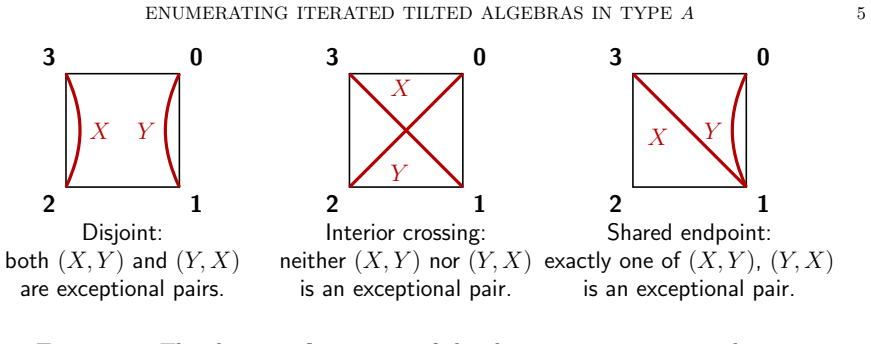
The central object is the function $F$, which assigns to any non-crossing spanning tree $T$ of the $(n+1)$-gon a quiver with relations whose vertices are the edges of $T$: at each polygon vertex, the incident tree edges are listed in counterclockwise order and become arrows in that order, and a length-two path is declared zero exactly when its two arrows come from two different polygon vertices. The load-bearing theorem is Theorem 4.14, which says that $F(T)$ and $F(T')$ are isomorphic as quivers with relations if and only if $T$ and $T'$ differ by a cyclic rotation, and that every such isomorphism is induced by the rotation. This $F$ carries the argument because Proposition 4.4 identifies $F(T(\chi))$ with the Hom–Ext quiver of the exceptional collection $\chi$, so the rotation-classification of trees becomes the isomorphism-classification of Hom–Ext quivers, and hence of iterated tilted algebras.
What would settle it
Find two non-crossing spanning trees of the same $(n+1)$-gon that are not related by a cyclic rotation but whose $F(T)$ quivers with relations are isomorphic; Theorem 4.14 predicts such a pair cannot exist. Concretely, enumerate all non-crossing spanning trees of the hexagon ($n=5$), compute $F(T)$ for each, and check whether the number of isomorphism classes of $F(T)$ equals the number of rotation classes of trees.
Extended reading notes
Core claim
The central claim is Theorem 4.15: isomorphism classes of iterated tilted algebras in type $A_n$ are in bijection with non-crossing spanning trees on a convex $(n+1)$-gon up to rotation, and the number of such classes is given by a closed formula splitting into even and odd $n$. The proof assembles a chain of known bijections: complete exceptional collections in $\mathrm{mod}\,\Lambda$ correspond to non-crossing spanning trees via the chord model; shift-equivalence classes of simple-minded collections and of hearts correspond to exceptional collections; Ext quivers of hearts correspond to graded gentle trees; and gentle tree algebras are exactly iterated tilted algebras. The new step is Theorem 4.14: two complete exceptional collections have isomorphic Hom–Ext quivers if and only if their trees differ by a cyclic rotation of the polygon, and every such isomorphism is induced by that rotation. This makes the algebraic relation 'same Hom–Ext quiver' coincide exactly with the geometric relation 'same rotation class of tree.'
Load-bearing premise
The load-bearing premise is Proposition 4.4's rule: a two-arrow path in the Hom–Ext quiver is zero exactly when its two arrows are read at two different polygon vertices; this rule is imported from an unpublished manuscript, and if it is wrong the classification of Hom–Ext quivers by rotation classes collapses.
Editorial extensions
If this is right
- The number of isomorphism classes of iterated tilted algebras of a type $A_n$ quiver is exactly the count of non-crossing spanning trees of the $(n+1)$-gon up to rotation, with the stated even/odd formula.
- Two complete exceptional collections in $\mathrm{mod}\,\Lambda$ have isomorphic Hom–Ext quivers precisely when their polygon trees are rotations of one another, so rotation classes label Hom–Ext quiver isomorphism classes.
- The classical classification of iterated tilted algebras as gentle tree algebras now comes with an explicit count and with a canonical choice of the $I^+$ ideal in every isomorphism class.
- The number of complete exceptional sequences in type $A_n$ can be written as the Coxeter number $n+1$ times a sum over Hom–Ext quiver isomorphism classes of linear-extension counts divided by automorphism-group sizes (Theorem 4.16).
- For a fixed tree $T$, the stabilizer of $T$ under cyclic rotation is naturally isomorphic to the automorphism group of $F(T)$, so rotation-symmetries of the tree are exactly quiver automorphisms.
Reading between the lines
- The same strategy—encode an exceptional collection as a geometric tree and prove that Hom–Ext quiver isomorphism is exactly a geometric symmetry—may generalize to other Dynkin types, where the role of the polygon tree would be played by some other non-crossing combinatorics; the paper raises this question but does not settle it.
- If the relation-generation statement from the cited unpublished source were replaced or corrected, the classification would remain valid as long as the 'two vertices iff zero' rule survives; the reinsertion lemma shows that this rule is what forces uniqueness of the isomorphism, so any change to it would directly alter the counting.
- A computational check for small $n$ (e.g. $n=5$, the hexagon) enumerating all non-crossing spanning trees up to rotation and comparing their $F(T)$ quivers would independently confirm the bijection and the formula; such a check is a natural test of the paper's inductive reconstruction.
Editorial analysis
A structured set of objections, weighed in public.
Referee Report
Summary. The paper claims that isomorphism classes of iterated tilted algebras of type A_n are in bijection with non-crossing spanning trees of a convex (n+1)-gon up to cyclic rotation, and hence are counted by OEIS A296532. The argument proceeds by assembling a chain of bijections: iterated tilted algebras correspond to gentle trees, gentle trees correspond to Ext quivers of hearts, Ext quivers correspond to Hom-Ext quivers of complete exceptional collections, and, in type A_n, these Hom-Ext quivers are classified by rotation classes of non-crossing spanning trees. The latter classification is the paper's main new combinatorial contribution, proved via an explicitly defined quiver-with-relations F(T) and an inductive reconstruction theorem.
Significance. If the main results are correct, the paper fills a genuine gap by giving the first count of iterated tilted algebras in type A_n, and it does so through an attractive bridge between representation theory and polygon combinatorics. The combinatorial core, Theorem 4.14, is proven by a clear induction and is checkable in isolation; the definition of F(T) is simple and the rotation classification is a clean statement. The paper also makes good use of Araya's geometric model. However, the central identification of Hom-Ext quivers with F(T) is not self-contained, because it imports a relation-generation theorem from the unpublished preprint [IM25], and the earlier bridge Lemma 3.1 is only sketched. The main classification is therefore conditional on an external result whose hypotheses and proof are not reproduced here.
major comments (3)
- [1.5, Proposition 4.4] The relation comparison in Proposition 4.4 is load-bearing but not self-contained. The proof invokes [IM25] for the statement that relations in a Hom-Ext quiver are generated by length-two compositions of irreducible arrows that vanish, and the definition of the Hom-Ext quiver in Section 1.5 also defers to [IM25]. Since the paper uses an ungraded variant of that quiver and the generation theorem is neither stated nor proved, Theorem 4.1—and hence Theorem 4.15—is reliable only to the extent that [IM25] is correct and applies verbatim. The authors should either state and prove the generation theorem in the setting used here, or clearly label it as an imported external assumption.
- [3, Lemma 3.1] The inverse construction in Lemma 3.1 is too compressed for a step that carries the bijection between Hom-Ext quivers of exceptional collections and ungraded Ext quivers of hearts. In particular, the claim that a zero composition together with a direct arrow in Q(S) would contradict the tree property via Theorem 1.1 is asserted without proof, and the operation that removes arrows and adds relations is not shown to be independent of choices or to induce a well-defined bijection on isomorphism classes. Since Lemma 3.1 is needed for Theorem 3.4, a fuller proof or a precise reference for this inversion is required.
- [4.7, Theorem 4.16] The formula for the number of complete exceptional sequences inherits the same external dependency: the proof uses [IM25, Theorem 3.4] to identify exceptional sequences with linear extensions of a partial order on (Q_chi, R_chi). If the relation-generation theorem of [IM25] is unavailable or inapplicable to the ungraded Hom-Ext quivers used in this paper, Theorem 4.16 is not established. This is a secondary result, but it should be marked as conditional or given a self-contained proof.
minor comments (4)
- [4.1] The polygon orientation changes from "counterclockwise" in Section 1.1 to "clockwise" at the start of Section 4.1 without comment; since the arrow rule and the right-hand rule in Remark 4.3 depend on orientation, the two conventions should be explicitly reconciled.
- [3, Lemma 3.1] The phrase "By Araya's definition, defined in Section 1.1" should refer to a specific numbered statement, such as Araya's Lemma 3.2, rather than a prose definition.
- [4.6, Theorem 4.15] The formula is quoted from OEIS A296532 but no citation or reference to the sequence entry is given; please add one, and indicate whether the formula is taken as known or derived in this paper.
- [1.1] The notation for interval modules X_{i,j} is clear, but later in Section 4 variables such as p, q, and r are used for polygon vertices without restating their ranges; a short remark that all such indices are taken modulo n+1 would improve readability.
Circularity Check
One load-bearing step imports the Hom–Ext relation-generation theorem from the authors' unpublished [IM25]; the rest of the classification has independent combinatorial content.
-
self citation load bearing
[Section 4.2, proof of Proposition 4.4 (relation comparison); see also Section 1.5 and Definition 4.2.]
"By [IM25], the relations in the Hom-Ext quiver are generated by length-two compositions of irreducible arrows that vanish. Consider a length-two path e→f→g in (Q_χ, R_χ)."
The relation-generation statement is the load-bearing bridge from the Hom-Ext quiver (Qχ,Rχ) to the combinatorial quiver F(T(χ)): Proposition 4.4 needs to know that every relation is a length-two composition of irreducible arrows before it can check the p=q/p≠q criterion. That statement is not proved here; it is imported from [IM25], an unpublished preprint whose second author is the present coauthor Maresca. Thus the central identification F(T(χ)) ≅ (Qχ,Rχ)—and hence Theorem 4.1 and the count in Theorem 4.15—rests on a same-author citation rather than on a derivation contained in this paper.
full rationale
Most of the derivation chain is self-contained or uses external published results. Araya's bijection [Ara13] and the OEIS count are external; Theorem 4.14 is proven by induction on boundary-leaf deletion without invoking [IM25]. The only serious same-author dependency is the relation-generation theorem of [IM25] used in Proposition 4.4. That is a verification gap—the preprint is unpublished and coauthored by Maresca—and it is load-bearing for the central bijection. It is not, however, a fitted-input-as-prediction or a definitional identity: no parameter is fit, and the relation rule of F(T) is a genuine combinatorial condition checked against vanishing Hom/Ext spaces. The [Mar24] citations are also self-citations but are corroborated by independent [KY14], [SPP22], and [BRT12] in the same argument. Overall score 4 reflects one load-bearing self-citation with substantial independent content elsewhere.
Assumptions & free parameters
assumptions (7)
- standard math Gabriel's theorem: indecomposable modules of a type A_n quiver are interval modules, matching chords of an (n+1)-gon.
- domain assumption Araya's Theorem 2.5: complete exceptional collections correspond bijectively to non-crossing spanning trees of the (n+1)-gon.
- domain assumption Qiu's Theorem 2.11: Ext quivers of hearts of bounded t-structures are precisely associated quivers of graded gentle trees.
- domain assumption Koenig-Yang correspondence: simple-minded collections, silting objects, algebraic t-structures, and co-t-structures are in bijection.
- domain assumption Maresca's Theorem 1.4: shift-equivalence classes of simple-minded collections, exceptional collections, and shift-equivalence classes of algebraic t-structures are in bijection.
- domain assumption [IM25] results: relations in Hom-Ext quivers are generated by zero length-two compositions of irreducible arrows, and the linear extension formula for exceptional sequences.
- domain assumption The formula for the number of non-crossing spanning trees of the (n+1)-gon up to rotation (OEIS A296532).
Cite this review
Pith. "Pith review of Enumerating iterated tilted algebras in type $A$." pith.science (2026). https://pith.science/paper/BBYYMVSY
@misc{pith2026260808222,
  author       = {Pith},
  title        = {Pith review of: Enumerating iterated tilted algebras in type $A$},
  year         = {2026},
  howpublished = {\url{https://pith.science/paper/BBYYMVSY}},
  note         = {Machine review of arXiv:2608.08222}
}
abstract
We show that isoclasses of iterated tilted algebras in type $A_n$ are in bijection with non-crossing spanning trees up to rotation on a convex n+1-gon. This is done by constructing a relationship between iterated tilted algebras up to isomorphism and exceptional sets up to isomorphic Hom-Ext quiver.
Figures


Figures from the paper (3 more)


Reference graph
Works this paper leans on
-
[1]
Generalized tilted algebras of type
Assem, Ibrahim and Happel, Dieter , journal=. Generalized tilted algebras of type. 1981 , publisher=
work page 1981
-
[2]
Unzerlegbare
Gabriel, Peter , journal=. Unzerlegbare. 1972 , publisher=
1972
-
[3]
Exceptional Collections, Clusters, t-Structures, and the Relationship Between Them , author=. 2024 , school=
work page 2024
-
[4]
Qiu, Yu , journal=. Ext-quivers of hearts of. 2013 , publisher=
work page 2013
-
[5]
Iterated tilted algebras of type
Assem, Ibrahim and Skowro. Iterated tilted algebras of type. Mathematische Zeitschrift , volume=. 1987 , publisher=
work page 1987
-
[6]
Iterated tilted algebras of types
Assem, Ibrahim , journal=. Iterated tilted algebras of types. 1983 , publisher=
work page 1983
-
[7]
Documenta Mathematica , volume=
Derived equivalences between skew-gentle algebras using orbifolds , author=. Documenta Mathematica , volume=
-
[8]
Mathematische Zeitschrift , volume=
From m-clusters to m-noncrossing partitions via exceptional sequences , author=. Mathematische Zeitschrift , volume=. 2012 , publisher=
work page 2012
Show all 16 references
-
[9]
Communications in Algebra , volume=
Iterated tilted algebras of affine type , author=. Communications in Algebra , volume=. 1987 , publisher=
1987
-
[10]
Combinatorics of exceptional sequences in type
Garver, Alexander and Igusa, Kiyoshi and Matherne, Jacob P and Ostroff, Jonah , journal=. Combinatorics of exceptional sequences in type
-
[11]
Exceptional sequences over path algebras of type
Araya, Tokuji , journal=. Exceptional sequences over path algebras of type. 2013 , publisher=
2013
-
[12]
Documenta Mathematica , volume=
Silting objects, simple-minded collections, t -structures and co- t -structures for finite-dimensional algebras , author=. Documenta Mathematica , volume=
-
[13]
arXiv preprint arXiv:1307.7573 , year=
The number of complete exceptional sequences for a Dynkin algebra , author=. arXiv preprint arXiv:1307.7573 , year=
-
[14]
Igusa, Kiyoshi and Maresca, Ray , journal=. The
-
[15]
Compositio Mathematica , volume=
Functorially finite hearts, simple-minded systems in negative cluster categories, and noncrossing partitions , author=. Compositio Mathematica , volume=. 2022 , publisher=
2022
-
[16]
Classification silted algebras for a quiver of Dynkin type
Liu, Yu-Zhe and Zhang, Houjun , journal=. Classification silted algebras for a quiver of Dynkin type
Reviewed August 12, 2026 · model on record in the stance chip above.
Discussion (0). Continue with ORCID to comment.