pith. sign in

arxiv: 2606.27145 · v1 · pith:BDML32TBnew · submitted 2026-06-25 · 🧮 math.GT

On L-space surgeries on two-bridge links

Pith reviewed 2026-06-26 01:52 UTC · model grok-4.3

classification 🧮 math.GT
keywords L-space surgerytwo-bridge linkHeegaard Floer homologyTuraev torsiontaut foliationhyperbolic 3-manifoldsatellite knot
0
0 comments X

The pith

The sets of L-space surgeries on all two-bridge links are classified, yielding the first hyperbolic examples that cannot be expressed as finite unions of rectangles in Q squared.

A machine-rendered reading of the paper's core claim, the machinery that carries it, and where it could break.

The paper determines the exact sets of surgeries that produce L-spaces on every two-bridge link. It identifies the first hyperbolic links whose surgery sets resist description as unions of finitely many rectangles in the rational plane. The argument introduces a diagrammatic condition that forces links to be persistently foliar, so that nontrivial surgeries support coorientable taut foliations. It also supplies a simplified model of Heegaard Floer homology for rational surgeries on two-component L-space links and computes Turaev torsions to settle the remaining cases. The classification produces an optimal volume bound for the resulting hyperbolic L-spaces and identifies all L-space satellite knots whose pattern link is two-bridge.

Core claim

We classify the sets of L-space surgeries on all two-bridge links, providing the first examples of hyperbolic links for which such sets cannot be described as unions of finitely many rectangles in Q^2. The proof relies on a sufficient diagrammatic condition for links in S^3 to be persistently foliar, a simplified model for the Heegaard Floer homology of rational surgeries on two-component L-space links, and explicit computations of Turaev torsions to determine L-space surgeries in the case of generalised L-space links.

What carries the argument

A diagrammatic condition for persistently foliar links that implies every nontrivial surgery supports a coorientable taut foliation, together with a simplified Heegaard Floer model for two-component L-space links and Turaev torsion computations.

If this is right

  • An optimal uniform bound holds on the volume of any hyperbolic L-space obtained by surgery on a two-bridge link.
  • All L-space satellite knots whose pattern is a two-bridge link are classified.
  • The diagrammatic condition and simplified model apply to L-space surgery questions on links beyond the two-bridge case.
  • New obstructions to L-space surgeries arise from the foliation condition and the Heegaard Floer model.

Where Pith is reading between the lines

These are editorial extensions of the paper, not claims the author makes directly.

  • The same diagrammatic test could be applied to other link families to produce further non-rectangular examples.
  • The existence of non-rectangular surgery sets on hyperbolic links suggests that rectangle unions are not the general shape for such sets.
  • The volume bound may serve as a benchmark when comparing L-spaces from other link classes or surgery operations.

Load-bearing premise

The diagrammatic condition for persistently foliar links, the simplified Heegaard Floer model, and the Turaev torsion computations together determine the L-space surgeries for every two-bridge link without gaps.

What would settle it

A two-bridge link on which an explicit Heegaard Floer calculation produces an L-space surgery outside the sets predicted by the diagrammatic condition and torsion computations.

Figures

Figures reproduced from arXiv: 2606.27145 by Diego Santoro, Hugo Zhou.

Figure 1
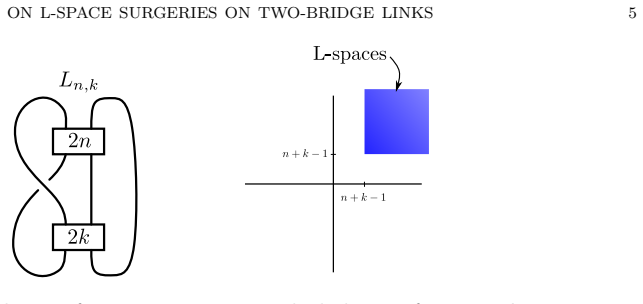
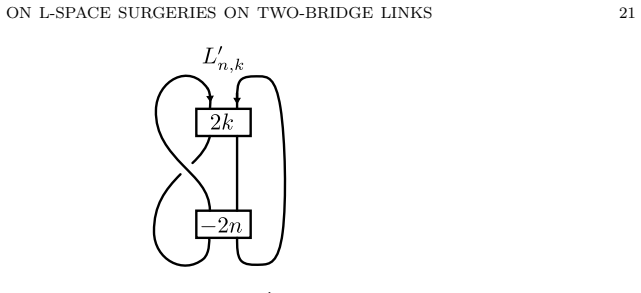
Figure 1. Figure 1: The only two-bridge links, up to mirror, with non-trivial L￾space surgeries. Theorem 1.2. A two-bridge link L has a non-trivial L-space surgery if and only if it is isotopic, up to mirror, to Ln,k or L ′ n,k, for some n, k ≥ 0. Moreover, every non-trivial surgery on any other two-bridge link supports a coorientable taut foliation. The links Ln,k and L ′ n,k are depicted in [PITH_FULL_IMAGE:figures/full_fi… view at source ↗
Figure 2
Figure 2. Figure 2: The set of L-space surgeries on the link Ln,k, for n ≥ 1, k ≥ 1. We are also able to complement Theorem 1.3 by showing that every non-L-space surgery on Ln,k supports a coorientable taut foliation. Theorem 1.4. Let n, k ≥ 1, and let M be a Dehn surgery on the link Ln,k. Then M is not an L-space if and only if it supports a coorientable taut foliation. We prove Theorems 1.3 and 1.4 in Section 9.1. When k = … view at source ↗
Figure 3
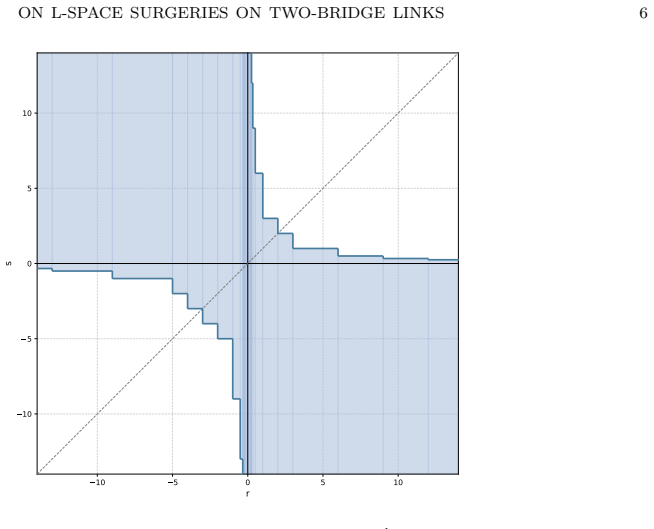
Figure 3. Figure 3: The set of L-space surgeries on the link L ′ 3,1 . Since two-bridge links are symmetric, the set is invariant under the reflection across the line r = s. – If r ∈ [PITH_FULL_IMAGE:figures/full_fig_p006_3.png] view at source ↗
Figure 4
Figure 4. Figure 4: The link L8n7. Every L-space surgery on a two-bridge link is surgery on it. on L from being an L-space. Combining these arguments with the simplified model for rational link surgery, we are able to produce obstructions to L-space surgeries on Ln,k in Section 7. 1.2. Some consequences. We conclude the introduction by collecting some conse￾quences of the main results of this paper. 1.2.1. Hyperbolic volumes.… view at source ↗
Figure 5
Figure 5. Figure 5: The two-bridge link L(a1, . . . , an). When it has two compo￾nents, we orient it as illustrated. We adopt the convention that a negative left-handed crossing is a right-handed crossing, and viceversa. was partially supported by FWF project P 34318 and by ERC Advanced Grant Knot￾Surf4d. HZ is supported by an AMS-Simons travel grant. The authors thank the Max Planck Institute for Mathematics in Bonn for its … view at source ↗
Figure 5
Figure 5. Figure 5: We introduce the following moves on linear plumbing graphs. • blow-down: a vertex with weight ϵ ∈ {±1} can be removed in the following ways, according to its valence: · · · a ϵ b · · · → · · · a − ϵ b − ϵ · · · · · · a ϵ → · · · a − ϵ We call blow-up the inverse operation. • 0-chain absorption: a vertex with weight 0 can be removed as shown: · · · a 0 b · · · → · · · a + b · · · · · · a 0 → · · · a Definit… view at source ↗
Figure 6
Figure 6. Figure 6: The figure shows the set A and its partition into the sub￾sets Am. The multiples of q in each Am are labelled by the integers 1, . . . , |Am|. Above each multiple iq, we indicate the sign of the corre￾sponding hi . where Am = A ∩ [(m − 1)p ′ , mp′ ], 1 ≤ m ≤ q. Moreover, since for each fixed m there are exactly p multiples of q in [(m − 1)p ′ , mp′ ], the sets A1 and Aq have cardinality |A1| = |Aq| = p − 1… view at source ↗
Figure 7
Figure 7. Figure 7: The orientation on the link L ′ n,k used to compute its Alexan￾der polynomial. Proposition 2.13. For n, k ≥ 1, the multivariable Alexander polynomial ∆′ n,k of L ′ n,k is ∆′ n,k .= nX−1 i=0 x −i y i ! rk − nX−2 i=0 x −i y i+1! rk−1. Proof. The argument is similar to the one in Proposition 2.12. We begin by assuming n ≥ 2, so that q ≥ 2, and apply Hoste’s algorithm to the multiples of q in A1 ∪ A2. This yie… view at source ↗
Figure 8
Figure 8. Figure 8: Left: Construction of Γ from D. Right: Colouring the com￾plementary regions of Γ via a checkerboard colouring of the complemen￾tary regions of Γ ′ . This definition generalises that of a persistently foliar knot, introduced by Delman and Roberts in [DR20]. Observe that every non-trivial surgery on a persistently foliar link supports a coorientable taut foliation, obtained by capping off the leaves of the t… view at source ↗
Figure 9
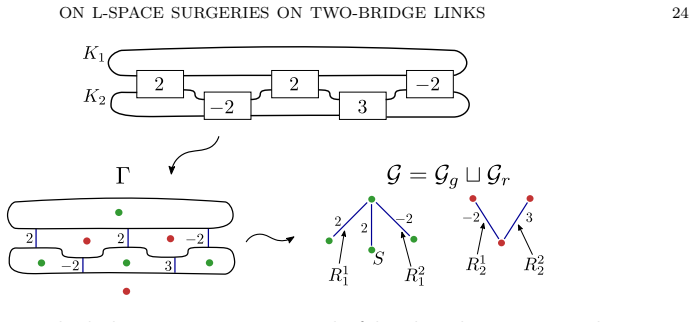
Figure 9. Figure 9: The link K1 ⊔ K2 is persistently foliar by Theorem 3.5. The picture shows the graphs Γ and G = Gg ⊔ Gr obtained from the diagram. For i = 2, the edges R1 i and R2 i satisfy the first condition of the theorem. For i = 1, K1 passes only through twist regions with an even number of crossings, and since R1 1 and R2 1 have opposite weights, the second condition of the theorem is satisfied. regions correspond na… view at source ↗
Figure 10
Figure 10. Figure 10: Local models for a branched surface, with cusp directions. Remark 3.1. If the diagram D has sufficiently many twist regions compared to the number of components of L, then the hypothesis on the existence of the vertex S in the statement Theorem 3.5 is always satisfied. Indeed, an Euler characteristic argument as in [San26b, Lemma 4.3] shows that, given any collection of 2n distinct edges of G, there exist… view at source ↗
Figure 11
Figure 11. Figure 11: Regular neighbourhood of a branched surface. ∂vNB, and NB ∩ ∂M. The horizontal boundary is transverse to the interval fibers of NB, while the vertical boundary intersects them, if at all, in one or two proper closed subintervals contained in their interiors. 3.1.1. From branched surfaces to laminations. A common strategy to construct foliations on a 3-manifold is to find intermediate objects, called lamin… view at source ↗
Figure 12
Figure 12. Figure 12: The link L associated to the diagram on the left, where a ≥ 0 and b ̸= 0. The twice-punctured discs bounded by the crossing circles are coloured. Remark 3.3. When all twist regions in D have even weight, the components K′ 1 , . . . , K′ n of L are all embedded in the projection sphere. When this does not happen, it is useful to consider an auxiliary link L ′ , whose exterior is a mutant of the exterior of… view at source ↗
Figure 13
Figure 13. Figure 13: The 2-complex Σ. We use different colours to show the different surfaces defined in the construction of Σ. Such a situation would imply that L is persistently foliar, proving the theorem. Let M denote the exterior of L, with ∂iM being the boundary component correspond￾ing to K′ i , for i = 1, . . . n. For each of these boundary components, we fix a boundary parallel torus Ti = ∂iM × {1}, where ν∂iM = ∂iM … view at source ↗
Figure 14
Figure 14. Figure 14: A cusp on T. Lemma 3.15. The complement of a regular neighbourhood of Σ in M is homeomorphic to the disjoint union of two balls, X1 and X2, and products T1 ×[0, 1], . . . , Tn ×[0, 1]. □ We now assign coorientations to the surfaces composing Σ, which we will use to determine a smoothing of Σ. We denote by δ1M, . . . , δmM the boundary components of M corresponding to the crossing circles J1, . . . Jm. Obs… view at source ↗
Figure 15
Figure 15. Figure 15: Coorientation of the elements in S induced by a colouring of the complementary regions of Γ. To simplify the figure, we have not shown the fourth element in S in the 2-complex on the right. Lemma 3.17. In the notations above, assume that L satisfies the hypotheses of Theo￾rem 3.5. Then there exists an element S ∈ S and pairwise distinct crossing discs D j i for i = 1, . . . , n and j = 1, 2, satisfying D … view at source ↗
Figure 16
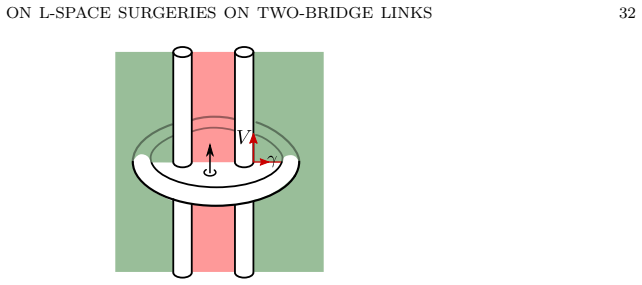
Figure 16. Figure 16: The figure shows the arc γ and the vector V used to coorient the crossing disc. In this case, we are assuming that the twist region associated with the disc has weight 2. If the weight were −2, the disc would be cooriented in the opposite way. cross product γ˙(0) × V points into X1. If ε = 1, we coorient D j i so that V is positively transverse to D j i , and negative otherwise [PITH_FULL_IMAGE:figures/f… view at source ↗
Figure 17
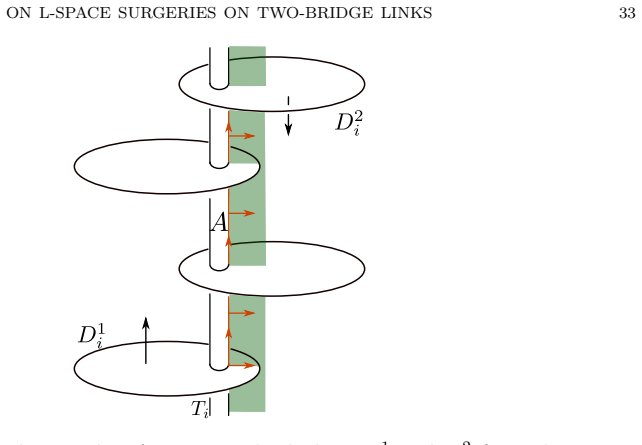
Figure 17. Figure 17: The annulus A intersects both discs D1 i and D2 i from the positive side. The arc δ and the vector field x(t) along it are coloured in light red. In this example, D1 i has weight 2 and D2 i has weight −2. and the regions in S pointing into X1. Parametrise δ with [0, 1], and notice that ˙δ(0) is positive with respect to the coorientation of D1 i , being it c 1 i -cooriented. Fix a metric on M, and consider… view at source ↗
Figure 18
Figure 18. Figure 18: The picture shows the link L and the weights of the crossing circles. We also describe how to assign coorientations to the surfaces of S, using green/red dots, and the crossing discs. We use blue circles to indicate the curves of intersection c j i where we want to create the cusps of the branched surface. Notice that by Addendum 3.22 we can create two cusps on the discs with odd weight, and we can remove… view at source ↗
Figure 19
Figure 19. Figure 19: The figure shows the link L associated to a diagram of L = L(3, 2, 2, 3), with weights of the crossing circles and coorientations. By proceeding as in Lemma 3.19 we can coorient the boundary parallel tori so to create cusps on the curves c j i , denoted with blue cirlces. Since the region S satisfies the hypothesis of Addendum 3.22, we can conclude that L is persistently foliar [PITH_FULL_IMAGE:figures/f… view at source ↗
Figure 20
Figure 20. Figure 20: The link L and the coorientations of the surface in S and the crossing discs. The coorientations of the discs force, as in the proof of Lemma 3.19, local coorientations on the boundary parallel tori in a neighbourhood of the curves c j i , and the reader can check that these local coorientations extend compatibly. We conclude using Addendum 3.22 to show that L is persistently foliar. satisfy the hypothese… view at source ↗
Figure 21
Figure 21. Figure 21: Notice that, since |w(D1)| = α + 1 > 2 the disc D1 is auto￾matically c-cooriented, and also in this case we can use Addendum 3.22 to conclude that L is persistently foliar. with α, β ≥ 2 even, m ≥ 5, and all the others indices having absolute value equal to 2, we consider the edges R1, R2 ∈ R1 and Rm−1, Rm ∈ R2 of G. These edges satisfy the hypotheses of Theorem 3.5, and since m ≥ 5, we can use Lemma 4.2 … view at source ↗
Figure 22
Figure 22. Figure 22: Left: The three-component link Ln. The link Ln,k is ob￾tained as (− 1 k )-surgery on the component K′ 3 . Right: A fiber surface for the link Ln. The positive (resp. negative) side of the surface is coloured in pink (resp. blue) [PITH_FULL_IMAGE:figures/full_fig_p041_22.png] view at source ↗
Figure 23
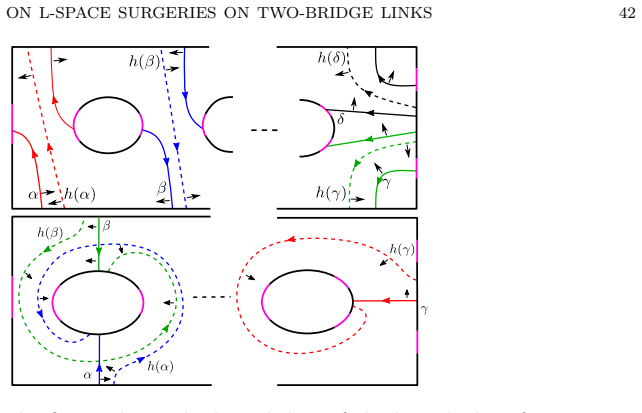
Figure 23. Figure 23: An abstract drawing of the fiber surface F, together with the curves ci and di . To simplify the picture we do not draw the 1-handles; we understand that the pink-coloured arcs are pairwise identified in the obvious way. cores of the Hopf bands, see [Gab85, Corollary 1.4] for details. In our case, this implies that the monodromy is given by the diffeomorphism h = τcn · · · τc1 τ −1 dn+2 τdn+1 · · · τd1 wh… view at source ↗
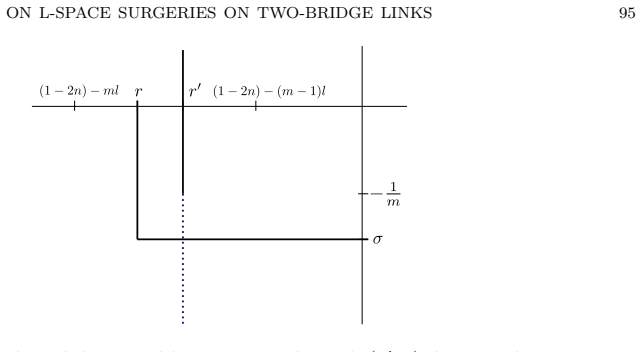
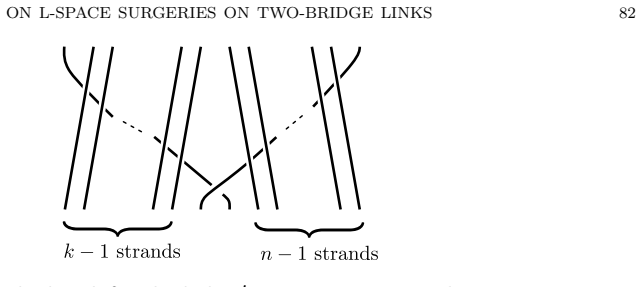
Figure 24
Figure 24. Figure 24: One proves, arguing as in [San26a, Proposition 3.20], that this branched [PITH_FULL_IMAGE:figures/full_fig_p041_24.png] view at source ↗
Figure 24
Figure 24. Figure 24: The figure shows the branch loci of the branched surfaces constructed in the proofs of Propositions 4.6 and 4.7, and the cusp direc￾tions along them. where the coefficients are computed with respect to the framing induced by the Seifert surface F, which in general does not agree with the canonical framing. More precisely the correspondence between coefficients with respect to the Seifert and canonical fra… view at source ↗
Figure 25
Figure 25. Figure 25: The p q -surgery on K ⊂ Y is realised by a Morse surgery on the knot K#Oq/r ⊂ Y #L(q, r). In [Zem23], the definition of the type-D module XΛ(L) L was extended to links in general 3-manifolds, and more generally to bordered manifolds Y with torus is an in￾variant of Y . As a consequence, we XΛ(L) L is natural with respect to performing Dehn surgeries, in the following sense: Theorem 6.7 ([Zem23, Theorem 9.… view at source ↗
Figure 26
Figure 26. Figure 26: The simplified model HΛ(L) of the link surgery complex for the ( 1 2 , 1)- surgery on a link L = K1 ∪ K2 with lk(K1, K2) = 1. Inside each disk, there are four vertices corresponding to the summands H∗(Cε(s, k)), where the numbers indicate the values of ε ∈ E2. The pair (s, k) is indicated nearby, where we suppress k2 and record only k1 ∈ Z/2Z. We also suppress the subindex of the map ΦM⃗ ε . We now show C… view at source ↗
Figure 27
Figure 27. Figure 27: The symmetrised Alexander polynomial ∆n,k. Each blue dot (resp. red dot) in coordinates (i, j) represents a term −x iy j (resp. x iy j ) in ∆n,k. The diagram depicts the case when n − k = 3. −(xy) − n+k−1 2 k X−1 i=0 x i y k−i−1 ! [PITH_FULL_IMAGE:figures/full_fig_p070_27.png] view at source ↗
Figure 28
Figure 28. Figure 28: On the left, the symmetrised Alexander polynomial ∆4,3. On the right, the H-function of L4,3. Values of H(s) that differ from those of the unlink (after shifting) by 1 are indicated in brown, while the one that differs by 2 is indicated in orange. The region of s for which s+1 corresponds to a lattice point in ∆˜ 4,3 = (xy) 1/2∆4,3 is shaded. A pair of very good points ± [PITH_FULL_IMAGE:figures/full_fig… view at source ↗
Figure 29
Figure 29. Figure 29: The figure shows part of the L-space surgeries slopes of a link with two unknotted components in S 3 , with linking number l, and whose (r, s)-surgery is an L-space. Remark 8.2. Observe that a direct computation using Mayer-Vietoris shows that if L ⊂ S 3 is a two-component link, with exterior EL, then Sl∗ (EL) = Sl(EL) \ ( x = lk(L) 2 y ) , where we parametrise H1(∂EL; Z) with the canonical meridian-longi… view at source ↗
Figure 30
Figure 30. Figure 30: The link L. Repeating the same argument starting with the rectangle {r} × [−∞, s] one shows that L is a generalised (+, −)L-space link, and that, for m < 0, the knot K′ ⊂ S 3 whose exterior is S 3 •, 1 m is an L-space knot [PITH_FULL_IMAGE:figures/full_fig_p078_30.png] view at source ↗
Figure 31
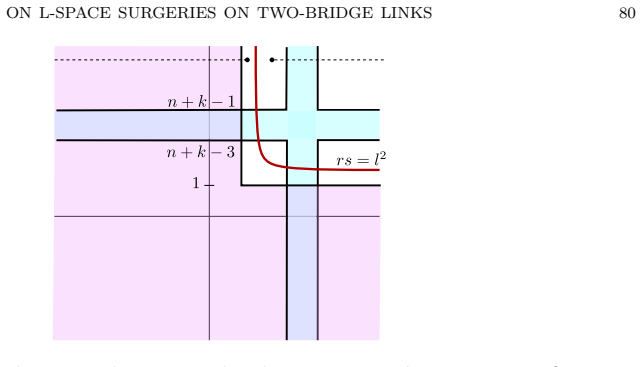
Figure 31. Figure 31: The rational points in the plane correspond to surgery coef￾ficients for the link Ln,k. The coloured regions corresponds to the non-L￾space surgeries provided by Proposition 4.6 and Proposition 7.1, and the red curve is one of the two connected components of the curve rs = l 2 . If the dot represents the coefficients (r, s) of an L-space surgery, then the dotted half-line would correspond to additional L-… view at source ↗
Figure 32
Figure 32. Figure 32: The braid β. The link L ′ n,k is isotopic to its closure union the braid axis. are L-spaces. Proof. We know from the proof of Proposition 9.2 that (k − n − 1, k − n − 1)-surgery on L ′ n,k is an L-space. We assume for now that k > n + 1, so that Lemma 8.9 implies that the knot K−m ⊂ S 3 , obtained by (− 1 m )-surgery on one component of L ′ n,k, is an L-space knot. The knot K−m can be explicitly described… view at source ↗
Figure 33
Figure 33. Figure 33: The link L. the mirror L ′ n′ ,k′ of L ′ n,k — where n ′ = k + 1 and k ′ = n − 1 by Lemma 9.1 — we can apply the same reasoning as above and deduce that S 3 1 m ,s (L ′ n,k) = S 3 − 1 m ,−s (L ′ n′ ,k′) is an L-space if and only if −s ≥ 1 − 2n ′ − ml = −1 − 2k − ml ⇔ s ≤ 2k + 1 + ml, which concludes the proof of the proposition when k > n + 1. To prove it in general, we need two observations. First, note … view at source ↗
Figure 34
Figure 34. Figure 34: In b), we shows a strongly invertible description of the surgery presentation given in a). In c) we draw the quotient of the surgery description by the involution, and d) shows the effect of an isotopy that straightens the black arcs. By rational tangle replacements along these arcs, we obtain the link in e), whose double branched cover is the man￾ifold Y0. In f) − h) we perform isotopies to show that thi… view at source ↗
Figure 35
Figure 35. Figure 35: The solid vertical line passing through (r ′ , 0) denotes the L￾spaces surgeries, while the dashed part denotes the non-L-space ones, as proved in Corollary 9.17. If S 3 r,σ(L) is an L-space, then all the surgeries on the horiziontal solid arc starting from (r, σ) are L-space and this produces a contradiction. Since m and q are coprime, we have that gcd(pm, qm) = 1. Moreover, by construction we also have … view at source ↗
read the original abstract

We classify the sets of $L$-space surgeries on all two-bridge links, providing the first examples of hyperbolic links for which such sets cannot be described as unions of finitely many rectangles in $\mathbb{Q}^2$. The proof relies on several different techniques, each of which is applicable in greater generality: we introduce a sufficient diagrammatic condition for links in $S^3$ to be persistently foliar, a property that implies that every non-trivial surgery on such links supports a coorientable taut foliation. We define a simplified model for the Heegaard Floer homology of rational surgeries on two-component $L$-space links, following the work of Manolescu-Ozsv\'ath, Liu, and Zemke, and use it to obtain obstructions to $L$-space surgeries. Finally, we use explicit computations of Turaev torsions to determine $L$-space surgeries in the case of generalised $L$-space links. Among the consequences of our results, we obtain an optimal uniform bound on the volume of any hyperbolic $L$-space that is surgery on a two-bridge link, together with a classification of all $L$-space satellite knots whose associated two-component pattern link is a two-bridge link.

Editorial analysis

A structured set of objections, weighed in public.

Desk editor's note, referee report, simulated authors' rebuttal, and a circularity audit. Tearing a paper down is the easy half of reading it; the pith above is the substance, this is the friction.

Referee Report

0 major / 3 minor

Summary. The manuscript classifies the sets of L-space surgeries on all two-bridge links, providing the first examples of hyperbolic links for which such sets cannot be described as unions of finitely many rectangles in Q^2. The proof relies on three techniques: a sufficient diagrammatic condition for links in S^3 to be persistently foliar (implying every non-trivial surgery supports a coorientable taut foliation), a simplified model for the Heegaard Floer homology of rational surgeries on two-component L-space links (following Manolescu-Ozsváth, Liu, and Zemke), and explicit computations of Turaev torsions to determine L-space surgeries for generalised L-space links. Consequences include an optimal uniform bound on the volume of any hyperbolic L-space that is surgery on a two-bridge link, together with a classification of all L-space satellite knots whose associated two-component pattern link is a two-bridge link.

Significance. If the classification holds, the result is significant for low-dimensional topology: it completes the picture for two-bridge links (a large, well-studied class) and supplies the first hyperbolic-link counterexamples to the “finite rectangles” description previously observed for knots and some links. The three techniques are each stated to apply more generally, and the manuscript supplies explicit computations, volume bounds, and a satellite-knot classification; these concrete outputs strengthen the contribution.

minor comments (3)
  1. [Introduction] The introduction of the diagrammatic condition for persistently foliar links would benefit from an explicit statement of the condition (e.g., as a numbered definition or theorem) together with a short example of a two-bridge link satisfying it.
  2. [Heegaard Floer section] In the section describing the simplified HF model, the precise relationship between the model and the earlier work of Manolescu-Ozsváth, Liu, and Zemke should be stated as a numbered proposition or lemma so that the obstructions derived from it are clearly traceable.
  3. [Turaev torsion section] The Turaev-torsion computations for generalised L-space links are central to one case of the classification; a brief table or list indicating which two-bridge links fall into this case would improve readability.

Simulated Author's Rebuttal

0 responses · 0 unresolved

We thank the referee for their positive summary, significance assessment, and recommendation of minor revision. The report correctly identifies the main contributions: the classification for two-bridge links, the first hyperbolic-link counterexamples to the finite-rectangles description, and the three general techniques (persistent foliations, simplified HF model, Turaev torsions) together with the volume bound and satellite-knot classification. No specific major comments appear in the report, so we have no points to address point-by-point. We will incorporate any minor editorial suggestions in the revised version.

Circularity Check

0 steps flagged

No significant circularity; derivation uses independent external techniques

full rationale

The paper's classification rests on three distinct methods: a new diagrammatic condition for persistently foliar links (implying taut foliations), a simplified Heegaard Floer model for two-component L-space links (explicitly following Manolescu-Ozsváth, Liu, and Zemke), and explicit Turaev torsion computations for generalised L-space links. None of these steps is shown to reduce by definition or self-citation to the target classification; the cited prior works are independent and the techniques are described as complementary and applicable more generally. No fitted parameters, self-definitional loops, or load-bearing self-citations appear in the argument structure.

Axiom & Free-Parameter Ledger

0 free parameters · 0 axioms · 0 invented entities

Abstract provides no information on free parameters, axioms, or invented entities; all fields left empty.

pith-pipeline@v0.9.1-grok · 5739 in / 1259 out tokens · 32654 ms · 2026-06-26T01:52:19.811644+00:00 · methodology

discussion (0)

Sign in with ORCID, Apple, or X to comment. Anyone can read and Pith papers without signing in.

Reference graph

Works this paper leans on

88 extracted references · 27 canonical work pages

  1. [1]

    Hyperbolic four-manifolds with vanishing

    Agol, Ian and Lin, Francesco , journal=. Hyperbolic four-manifolds with vanishing. 2020 , publisher=

  2. [2]

    Foliations, orders, representations,

    Boyer, Steven and Clay, Adam , journal=. Foliations, orders, representations,. 2017 , publisher=

  3. [3]

    Boyer, Steven and Gordon, Cameron McA and Watson, Liam , journal=. On. 2013 , publisher=

  4. [4]

    Dodecahedral

    Battista, Ludovico and Ferrari, Leonardo and Santoro, Diego , journal=. Dodecahedral

  5. [5]

    preprint , year=

    New geometric splittings of classical knots and the classification and symmetries of arborescent knots , author=. preprint , year=

  6. [6]

    Approximating

    Bowden, Jonathan , journal=. Approximating. 2016 , publisher=

  7. [7]

    2003 , publisher=

    Knots , author=. 2003 , publisher=

  8. [8]

    Fibered and strongly quasi-positive

    Cavallo, Alberto and Liu, Beibei , journal=. Fibered and strongly quasi-positive. 2021 , publisher=

  9. [9]

    arXiv preprint arXiv:2412.05755 , year=

    L-space satellite operators and knot Floer homology , author=. arXiv preprint arXiv:2412.05755 , year=

  10. [10]

    Characters in Low-Dimensional Topology , volume=

    Taut foliations from double-diamond replacements , author=. Characters in Low-Dimensional Topology , volume=. 2020 , publisher=

  11. [11]

    Dawra, Nakul , year =. On the

  12. [12]

    Geometry & Topology , volume=

    Fixed-point-free pseudo-Anosov homeomorphisms, knot Floer homology and the cinquefoil , author=. Geometry & Topology , volume=. 2024 , publisher=

  13. [13]

    Ghiggini, Paolo , journal=. Knot. 2008 , publisher=

  14. [14]

    2014 , publisher=

    Greene, Joshua Evan , journal=. 2014 , publisher=

  15. [15]

    International Mathematics Research Notices , volume=

    Triple linking numbers and Heegaard Floer homology , author=. International Mathematics Research Notices , volume=. 2023 , publisher=

  16. [16]

    1990 , publisher=

    Gabai, David and Kazez, William H , journal=. 1990 , publisher=

  17. [17]

    Annals of Mathematics , volume=

    Essential laminations in 3-manifolds , author=. Annals of Mathematics , volume=. 1989 , publisher=

  18. [18]

    Surgery on links of linking number zero and the

    Gorsky, Eugene and Liu, Beibei and Moore, Allison H , journal=. Surgery on links of linking number zero and the

  19. [19]

    Algebraic & Geometric Topology , volume=

    Gorsky, Eugene and N. Algebraic & Geometric Topology , volume=. 2016 , publisher=

  20. [20]

    On the set of

    Gorsky, Eugene and N. On the set of. Advances in Mathematics , volume=. 2018 , publisher=

  21. [21]

    Gorsky, Eugene and N\'emethi, Andr\'as , TITLE =. Int. Math. Res. Not. IMRN , FJOURNAL =. 2015 , NUMBER =. doi:10.1093/imrn/rnv075 , URL =

  22. [22]

    Compositio Mathematica , volume=

    L-spaces, taut foliations, and graph manifolds , author=. Compositio Mathematica , volume=. 2020 , publisher=

  23. [23]

    Hanselman, Jonathan and Rasmussen, Jacob and Watson, Liam , TITLE =. J. Amer. Math. Soc. , FJOURNAL =. 2024 , NUMBER =. doi:10.1090/jams/1029 , URL =

  24. [24]

    Algebraic & Geometric Topology , volume=

    Fundamental shadow links realized as links in S^3 , author=. Algebraic & Geometric Topology , volume=. 2021 , publisher=

  25. [25]

    Gabai, David , TITLE =. J. Differential Geom. , FJOURNAL =. 1983 , NUMBER =

  26. [26]

    Gabai, David , journal=

  27. [27]

    A note on

    Hoste, Jim , journal=. A note on. 2020 , publisher=

  28. [28]

    A survey of

    Juh. A survey of. New ideas in low dimensional topology , pages=. 2015 , publisher=

  29. [29]

    (1,1) non-

    Lyu, Qingfeng , journal=. (1,1) non-

  30. [30]

    2017 , publisher=

    Kazez, William and Roberts, Rachel , journal=. 2017 , publisher=

  31. [31]

    Geometry & Topology , volume=

    Laminar branched surfaces in 3--manifolds , author=. Geometry & Topology , volume=. 2002 , publisher=

  32. [32]

    Proceedings of symposia in pure mathematics , volume=

    Boundary train tracks of laminar branched surfaces , author=. Proceedings of symposia in pure mathematics , volume=. 2003 , organization=

  33. [33]

    Journal of the European Mathematical Society , year=

    Lattice homology, formality, and plumbed L-space links , author=. Journal of the European Mathematical Society , year=

  34. [34]

    Duke Math

    Zemke, Ian , TITLE =. Duke Math. J. , FJOURNAL =. 2025 , NUMBER =. doi:10.1215/00127094-2024-0044 , URL =

  35. [35]

    1996 , PAGES =

    Kawauchi, Akio , TITLE =. 1996 , PAGES =

  36. [36]

    Cosmetic surgery in

    Lidman, Tye and Moore, Allison , journal=. Cosmetic surgery in

  37. [37]

    Transactions of the London Mathematical Society , volume=

    L-space surgeries on 2-component L-space links , author=. Transactions of the London Mathematical Society , volume=. 2021 , publisher=

  38. [38]

    Quantum Topol

    Liu, Yajing , TITLE =. Quantum Topol. , FJOURNAL =. 2017 , NUMBER =. doi:10.4171/QT/96 , URL =

  39. [39]

    Liu, Yajing , TITLE =. Algebr. Geom. Topol. , FJOURNAL =. 2022 , NUMBER =. doi:10.2140/agt.2022.22.473 , URL =

  40. [40]

    Notions of positivity and the

    Hedden, Matthew , journal=. Notions of positivity and the. 2010 , publisher=

  41. [41]

    Inventiones mathematicae , volume=

    Right-veering diffeomorphisms of compact surfaces with boundary , author=. Inventiones mathematicae , volume=. 2007 , publisher=

  42. [42]

    arXiv preprint arXiv:1011.1317 , year=

    Heegaard Floer homology and integer surgeries on links , author=. arXiv preprint arXiv:1011.1317 , year=

  43. [43]

    Advances in Mathematics , volume=

    Alternating knots with unknotting number one , author=. Advances in Mathematics , volume=. 2017 , publisher=

  44. [44]

    2007 , publisher=

    Ni, Yi , journal=. 2007 , publisher=

  45. [45]

    Ozsv\'ath, Peter and Szab\'o, Zolt\'an , TITLE =. Ann. of Math. (2) , FJOURNAL =. 2004 , NUMBER =. doi:10.4007/annals.2004.159.1027 , URL =

  46. [46]

    Ozsv\'ath, Peter and Szab\'o, Zolt\'an , TITLE =. Ann. of Math. (2) , FJOURNAL =. 2004 , NUMBER =. doi:10.4007/annals.2004.159.1159 , URL =

  47. [47]

    and Szab\'o, Zolt\'an , TITLE =

    Ozsv\'ath, Peter S. and Szab\'o, Zolt\'an , TITLE =. Algebr. Geom. Topol. , FJOURNAL =. 2008 , NUMBER =. doi:10.2140/agt.2008.8.101 , URL =

  48. [48]

    Algebraic & Geometric Topology , volume=

    A note on cabling and L--space surgeries , author=. Algebraic & Geometric Topology , volume=. 2011 , publisher=

  49. [49]

    and Szab\'o, Zolt\'an , TITLE =

    Ozsv\'ath, Peter S. and Szab\'o, Zolt\'an , TITLE =. Algebr. Geom. Topol. , FJOURNAL =. 2011 , NUMBER =. doi:10.2140/agt.2011.11.1 , URL =

  50. [50]

    and Szab\'o, Zolt\'an , TITLE =

    Ozsv\'ath, Peter and Stipsicz, Andr\'as I. and Szab\'o, Zolt\'an , TITLE =. Quantum Topol. , FJOURNAL =. 2014 , NUMBER =. doi:10.4171/QT/56 , URL =

  51. [51]

    Ozsv. On knot. Topology , volume=. 2005 , publisher=

  52. [52]

    Geometry & Topology , volume=

    Holomorphic disks and genus bounds , author=. Geometry & Topology , volume=. 2004 , publisher=

  53. [53]

    Topology , volume=

    Closed incompressible surfaces in alternating knot and link complements , author=. Topology , volume=. 1984 , publisher=

  54. [54]

    Lisca, Paolo and Mati\'c, Gordana , TITLE =. Algebr. Geom. Topol. , FJOURNAL =. 2004 , PAGES =. doi:10.2140/agt.2004.4.1125 , URL =

  55. [55]

    Quantum Topol

    Hedden, Matthew and Levine, Adam Simon , TITLE =. Quantum Topol. , FJOURNAL =. 2024 , NUMBER =. doi:10.4171/qt/188 , URL =

  56. [56]

    Ozsv\'ath, Peter and Szab\'o, Zolt\'an , TITLE =. Adv. Math. , FJOURNAL =. 2004 , NUMBER =. doi:10.1016/j.aim.2003.05.001 , URL =

  57. [57]

    Ozsv\'ath, Peter and Szab\'o, Zolt\'an , TITLE =. Algebr. Geom. Topol. , FJOURNAL =. 2008 , NUMBER =. doi:10.2140/agt.2008.8.615 , URL =

  58. [58]

    Transactions of the American Mathematical Society , volume=

    A calculus for plumbing applied to the topology of complex surface singularities and degenerating complex curves , author=. Transactions of the American Mathematical Society , volume=

  59. [59]

    Compositio Mathematica , volume=

    L-space intervals for graph manifolds and cables , author=. Compositio Mathematica , volume=. 2017 , publisher=

  60. [60]

    Proceedings of the London Mathematical Society , volume=

    Taut foliations in punctured surface bundles, II , author=. Proceedings of the London Mathematical Society , volume=. 2001 , publisher=

  61. [61]

    Proceedings of the London Mathematical Society , volume=

    Taut foliations in punctured surface bundles, I , author=. Proceedings of the London Mathematical Society , volume=. 2000 , publisher=

  62. [62]

    Floer simple manifolds and

    Rasmussen, Jacob and Rasmussen, Sarah Dean , journal=. Floer simple manifolds and. 2017 , publisher=

  63. [63]

    Knoten mit zwei Br

    Schubert, Horst , journal=. Knoten mit zwei Br. 1956 , publisher=

  64. [64]

    2002 , PAGES =

    Turaev, Vladimir , TITLE =. 2002 , PAGES =. doi:10.1007/978-3-0348-7999-6 , URL =

  65. [65]

    Zemke, Ian , TITLE =. J. Topol. , FJOURNAL =. 2019 , NUMBER =. doi:10.1112/topo.12085 , URL =

  66. [66]

    A general

    Zemke, Ian , journal=. A general

  67. [67]

    arXiv preprint arXiv:2109.11520 , year=

    Bordered manifolds with torus boundary and the link surgery formula , author=. arXiv preprint arXiv:2109.11520 , year=

  68. [68]

    Proceedings of the London Mathematical Society , volume=

    The volume of hyperbolic alternating link complements , author=. Proceedings of the London Mathematical Society , volume=. 2004 , publisher=

  69. [69]

    and Thurston, Dylan P

    Lipshitz, Robert and Ozsvath, Peter S. and Thurston, Dylan P. , TITLE =. Mem. Amer. Math. Soc. , FJOURNAL =. 2018 , NUMBER =. doi:10.1090/memo/1216 , URL =

  70. [70]

    and Thurston, Dylan P

    Lipshitz, Robert and Ozsv\'ath, Peter S. and Thurston, Dylan P. , TITLE =. Geom. Topol. , FJOURNAL =. 2015 , NUMBER =. doi:10.2140/gt.2015.19.525 , URL =

  71. [71]

    , TITLE =

    Lipshitz, Robert and Ozsv\'ath, Peter and Thurston, Dylan P. , TITLE =. Studia Sci. Math. Hungar. , FJOURNAL =. 2025 , NUMBER =

  72. [72]

    , TITLE =

    Lisca, Paolo and Stipsicz, Andr\'as I. , TITLE =. J. Symplectic Geom. , FJOURNAL =. 2007 , NUMBER =. doi:10.4310/jsg.2007.v5.n4.a1 , URL =

  73. [73]

    Rational

    Rasmussen, Sarah Dean , journal=. Rational. 2020 , publisher=

  74. [74]

    Santoro, Diego , TITLE =. Algebr. Geom. Topol. , FJOURNAL =. 2024 , NUMBER =. doi:10.2140/agt.2024.24.3455 , URL =

  75. [75]

    Santoro, Diego , TITLE =. Algebr. Geom. Topol. , FJOURNAL =. 2026 , NUMBER =. doi:10.2140/agt.2026.26.1115 , URL =

  76. [76]

    Advances in Mathematics , volume =

    Taut foliations from knot diagrams , author =. Advances in Mathematics , volume =. 2026 , issn =. doi:https://doi.org/10.1016/j.aim.2026.110906 , url =

  77. [77]

    , TITLE =

    Stallings, John R. , TITLE =. Algebraic and geometric topology (. 1978 , ISBN =

  78. [78]

    2022 , publisher=

    Thurston, William P , volume=. 2022 , publisher=

  79. [79]

    Saito, Toshio , TITLE =. Osaka J. Math. , FJOURNAL =. 2004 , NUMBER =

  80. [80]

    Mathematische Annalen , volume=

    On unknotting tunnels for knots , author=. Mathematische Annalen , volume=. 1991 , publisher=

Showing first 80 references.