REVIEW 5 major objections 5 minor 1 cited by
FedPhD: Federated Pruning with Hierarchical Learning of Diffusion Models
T0 review · 5 major / 5 minor · reviewed 2026-08-06 · deepseek-v4-flash
Pith's one-line read FedPhD achieves at least a 34% improvement in FID over federated baselines while using about 56% of the compute and communication.
desk verdict Plausible integration of hierarchical FL, SH weighting, and structured pruning for federated diffusion models, but the headline FID gain is mostly the E=1 schedule and the SH mechanism is never isolated. read the letter →
The pith
A machine-rendered reading of the paper's core claim, the machinery that carries it, and where it could break.
The reading
What carries the argument
The central mechanism is the Statistical Homogeneity (SH) score, a value that measures how close a client's or edge server's label distribution is to a target reference (uniform by default), defined as two minus the Euclidean distance to that reference. This score feeds into the global aggregation weights, the edge-level aggregation weights, and the edge-server selection probability, so that models with label mixes closer to the reference are weighted more heavily and clients prefer servers with more homogeneous accumulated distributions. The second mechanism is structured pruning: dependency-aware grouping of U-Net layers, with group-norm regularization whose scale grows for layers far from the middle of the network, removes entire channels and cuts parameters and MACs by up to 44% with minimal quality loss.
What would settle it
Run FedPhD on an imbalanced dataset such as CIFAR-10 with a long-tailed class distribution under three variants: SH weighting with a uniform reference, SH weighting with the true global distribution as reference, and no SH weighting at all; if the uniform-reference version does not improve FID over simple frequent aggregation, the claimed advantage of homogeneity-aware aggregation is disproved.
Extended reading notes
Core claim
The central claim is that combining hierarchical aggregation, homogeneity-aware weighting, and structured pruning makes federated training of diffusion models both robust to non-IID data and communication-efficient. The paper argues that frequent aggregation at edge servers counters the weight divergence that degrades FedAvg on non-IID data, that the statistical-homogeneity (SH) score computed from label distributions should govern both model aggregation weights and edge-server selection, and that dependency-aware structured pruning can cut 44% of U-Net parameters with only minor FID degradation. In the computation-equivalence comparison, the best FedPhD variant reaches FID 16.74 and IS 4.24 on CIFAR-10 and FID 7.48 and IS 2.88 on CelebA, versus FedAvg's FID 24.50 and 14.89, while using roughly 44% fewer parameters and MACs.
Load-bearing premise
The load-bearing premise is that rewarding label distributions close to the uniform reference improves global image quality, which the paper leaves untested for inherently imbalanced global datasets like its attribute-based CelebA split.
Editorial extensions
If this is right
- Federated training of diffusion models on non-IID data becomes practical at the edge, since frequent edge-level aggregation mitigates the divergence that degrades FedAvg on such data.
- A pruning ratio of up to 44% in the U-Net costs only about 1% FID on CIFAR-10 and about 2% on CelebA, so model size, computation, and communication can be cut by nearly half without materially hurting image quality.
- The homogeneity-aware weighting scheme outperforms FedAvg, FedProx, MOON, and SCAFFOLD under matched computation budgets, suggesting distribution-aware aggregation is more effective for generative diffusion training than proximal or contrastive corrections.
- The benefit persists as client count grows: FedPhD's FID degrades by only about 0.4 when going from 20 to 50 clients, compared with about 3.5 for baselines.
Reading between the lines
- An untested extension is to set the SH reference to the true global label distribution when it is imbalanced, since the paper's default uniform reference may be the wrong target for attribute-based datasets; a simple ablation with a non-uniform qu(y) would settle this.
- Because the edge-selection probability rewards both high SH and low load, FedPhD implicitly balances client-to-server assignment, and the resulting load distribution could be compared more formally against randomized assignment.
- The paper's privacy discussion suggests noise injection and secure aggregation for label distributions but does not implement them; measuring how much differential-privacy noise the SH score can tolerate before the aggregation benefit disappears would be a concrete next experiment.
- The safe 44% pruning ratio is measured on a U-Net for DDIM at 100 steps; latent diffusion or text-to-image architectures may have different redundancy profiles, so the pruning limit is likely architecture-specific.
Editorial analysis
A structured set of objections, weighed in public.
Referee Report
Summary. The paper proposes FedPhD, a hierarchical federated learning framework for training diffusion models. It combines structured pruning (DepGraph/group-norm) with a homogeneity-aware aggregation and edge-server selection scheme based on a Statistical Homogeneity score. Experiments on CIFAR-10 and CelebA using DDIM report FID/IS improvements and reduced communication/computation costs relative to several federated learning baselines, along with a pruning-ratio sweep and a scalability study.
Significance. If the reported results were fully supported, FedPhD would be a useful contribution: it combines hierarchical aggregation, structured pruning, and distribution-aware aggregation for federated diffusion training, which to my knowledge is a novel combination. The experimental scope (two datasets, pruning-ratio analysis, scalability to 100 clients) is substantive. However, the headline claim of 'at least a 34% improvement in FID' is contradicted by the paper's own Table I, and the absence of a hierarchical no-SH control prevents attribution of the observed gains to the proposed mechanism. The method's core idea is worth pursuing, but the current evidence is insufficient to support the abstract's efficiency claims.
major comments (5)
- [Abstract; Section V-B; Table I] The claim of 'at least a 34% improvement in FID' is not supported by the reported numbers. In the 'Computation Equivalence' block of Table I, FedPhD obtains CIFAR-10 FID 16.74, which is 2.7% better than FedAvg(E=1) (17.21) and 24.4% better than MOON (22.13); on CelebA it is 12.9% better than FedAvg(E=1) (9.55) and 33.8% better than MOON (12.56). Only the FedPhD(OS) variant on CelebA exceeds a 34% improvement (40.4% versus MOON). The paper should state the specific baseline and per-dataset margins used for the 'at least 34%' claim. Moreover, Section V-B states FedPhD achieves a CelebA FID of 7.48, but Table I lists 7.48 as FedPhD(OS) and 8.32 as FedPhD; the text conflates the two variants, which overstates the non-OS method's result.
- [Section V-A.2; Section V-B] No hierarchical baseline with the same schedule (R=10000, E=1, re=1, rg=5, Ne=2, N=20) but without SH weighting and selection is reported. Setting a=0 in Eqs. (22) and (24) recovers sample-size aggregation, and Eq. (25) reduces to load-balanced random assignment; this control would isolate the effect of the homogeneity-aware aggregation. Without it, the improvement over FedAvg(E=1) cannot be attributed to the SH mechanism rather than to the hierarchical topology and frequent edge aggregation.
- [Table I, 'Fixed Communication Rounds' block; Section V-A.2] FedPhD results are missing from the fixed-communication-round block of Table I, even though the text states that these experiments are conducted for all baselines. Since FedPhD uses R=10000 with rg=5 (2000 central aggregations) while baselines use R=2000 with E=5, the fixed-round block is the only comparison that controls for the number of central aggregation events. Without FedPhD rows in this block, the claimed communication-efficiency advantages cannot be evaluated at equal central-round budgets.
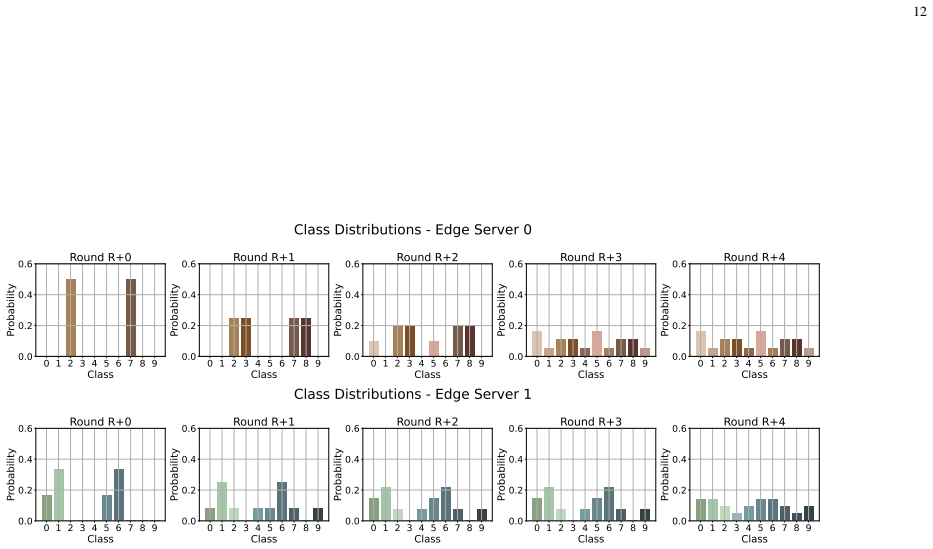
- [Section IV-B, Eqs. (18)-(25); Appendix A] The SH score in Eq. (18) is computed against the uniform distribution qu, with a remark that qu can be changed if the global distribution is non-uniform. However, all experiments use a uniform qu, including CelebA, whose attribute distribution is imbalanced (Fig. 3b). Maximizing closeness to uniform under an imbalanced target distribution can bias the aggregated model away from the true data distribution. The authors should either estimate qu from the global label distribution or report a control with qu set to the empirical global distribution, to validate the SH mechanism.
- [Appendix D] The hyperparameters a, b, lambda_g, Rs, and sp are selected by grid search without a separate validation set or sensitivity analysis. Because a and b directly control the aggregation weights in Eqs. (22) and (24), the reported FID values may reflect tuned parameters rather than a robust design. A sensitivity study (for example, sweeping a and b over coarse grids and reporting FID, or using a validation split) is needed to establish that the performance is not an artifact of specific tuned values.
minor comments (5)
- [Section IV-A, Eq. (17)] The regularization term uses both K and k without defining K as the number of prunable dimensions; clarify the index sets for k.
- [Algorithm 1 and Section IV-C] The textual references to line numbers (e.g., 'lines 24-26', 'line 19', 'lines 4-5') do not match the displayed numbering of Algorithm 1; correct these cross-references.
- [Section V-C and Introduction] The paper states in the introduction that FedPhD achieves a '44% less communication, computation, and storage' requirement, while Section V-C reports 44% and 40% reductions for communication and computation, and later mentions 'up to 88%' communication reduction; reconcile these figures and specify the comparison baseline for each percentage.
- [Table I caption] The caption 'Computation Equivalence (A/B Local Epochs)' is confusing because A and B are total local epochs (10,000 and 5,000), not communication rounds or local epochs per round; please rephrase the block headings.
- [Figure 1] The caption uses K=20 clients while the experimental section uses N=20; unify the client-count notation.
Circularity Check
No significant circularity: FedPhD is an empirical framework with heuristic aggregation formulas; the main concerns (comparison schedule, test-set grid search) are experimental-design issues, not self-referential reductions.
full rationale
I find no circularity in the paper's derivation chain. FedPhD does not derive a prediction from a fit; it proposes heuristic aggregation and pruning mechanisms and evaluates them empirically. The SH score in Eqs. (18)-(25) is defined via closeness to a uniform label distribution, but FID is an independently measured image-quality metric, so no equation defines performance in terms of the method's own inputs. Hyperparameters a, b, lambda_g, Rs, and sp are tuned by grid search on the same benchmarks, and Table I reports 'the best outcomes across A communication rounds and local epochs'; this is test-set selection rather than a genuinely out-of-sample prediction, and it weakens the strength of the empirical claim, but it does not make the result equivalent to its inputs by construction. The paper also contains no load-bearing self-citations: references [20], [30], and [31] are external prior work, not authored by the present authors, and no uniqueness theorem is invoked. The abstract's 'at least 34% improvement' is internally challenged by the FedAvg(E=1) row (FID 17.21 vs. FedPhD 16.74 on CIFAR-10), and the comparison schedule confounds aggregation frequency with the proposed SH mechanism, but these are correctness and experimental-design concerns, not circularity. Accordingly, the appropriate circularity score is 0.
Assumptions & free parameters
free parameters (5)
- a (SH weight) =
grid searched in [0, 50K]; example a=15000 in Fig. 5
- b (SH offset) =
chosen to keep numerators positive; exact value not reported
- lambda_g (group regularization scale) =
grid searched 1e-2 to 1e-5
- Rs (sparse training rounds) =
grid searched [10, 100]
- sp (pruning ratio) =
44% used in main comparisons; 25%, 61%, 74% explored
assumptions (5)
- domain assumption The uniform label distribution is the target for homogeneity-aware aggregation (qu in eq. 18).
- domain assumption SH score measures how well the global model approximates an IID-trained model.
- domain assumption Frequent edge-level aggregation alleviates non-IID divergence in FL training of DMs.
- domain assumption DepGraph dependency matrix S correctly identifies prunable groups for the U-Net.
- domain assumption Clients and edge servers can share label distributions without compromising privacy.
Cite this review
Pith. "Pith review of FedPhD: Federated Pruning with Hierarchical Learning of Diffusion Models." pith.science (2026). https://pith.science/paper/BEH45CYH
@misc{pith2026250706449,
  author       = {Pith},
  title        = {Pith review of: FedPhD: Federated Pruning with Hierarchical Learning of Diffusion Models},
  year         = {2026},
  howpublished = {\url{https://pith.science/paper/BEH45CYH}},
  note         = {Machine review of arXiv:2507.06449}
}
abstract
Federated Learning (FL), as a distributed learning paradigm, trains models over distributed clients' data. FL is particularly beneficial for distributed training of Diffusion Models (DMs), which are high-quality image generators that require diverse data. However, challenges such as high communication costs and data heterogeneity persist in training DMs similar to training Transformers and Convolutional Neural Networks. Limited research has addressed these issues in FL environments. To address this gap and challenges, we introduce a novel approach, FedPhD, designed to efficiently train DMs in FL environments. FedPhD leverages Hierarchical FL with homogeneity-aware model aggregation and selection policy to tackle data heterogeneity while reducing communication costs. The distributed structured pruning of FedPhD enhances computational efficiency and reduces model storage requirements in clients. Our experiments across multiple datasets demonstrate that FedPhD achieves high model performance regarding Fr\'echet Inception Distance (FID) scores while reducing communication costs by up to $88\%$. FedPhD outperforms baseline methods achieving at least a $34\%$ improvement in FID, while utilizing only $56\%$ of the total computation and communication resources.
Figures


Figures from the paper (5 more)



Forward citations
Cited by 1 Pith paper
-
Cooperative Perception: A Resource-Efficient Framework for Multi-Drone 3D Scene Reconstruction Using Federated Diffusion and NeRF
The framework claims drone swarms can reconstruct 3D scenes by sharing semantic labels and poses, with a federated diffusion model generating missing views for NeRF training.
Reference graph
Works this paper leans on
-
[1]
Denoising diffusion probabilistic models,
J. Ho, A. Jain, and P. Abbeel, “Denoising diffusion probabilistic models,” Advances in neural information processing systems , vol. 33, pp. 6840– 6851, 2020
2020
-
[2]
Denoising diffusion implicit models,
J. Song, C. Meng, and S. Ermon, “Denoising diffusion implicit models,” in International Conference on Learning Representations , 2021. [Online]. Available: https://openreview.net/forum?id=St1giarCHLP
2021
-
[3]
Score-based generative modeling through stochastic differential equations,
Y . Song, J. Sohl-Dickstein, D. P. Kingma, A. Kumar, S. Ermon, and B. Poole, “Score-based generative modeling through stochastic differential equations,” in International Conference on Learning Representations, 2021. [Online]. Available: https://openreview.net/ forum?id=PxTIG12RRHS
2021
-
[4]
High- resolution image synthesis with latent diffusion models,
R. Rombach, A. Blattmann, D. Lorenz, P. Esser, and B. Ommer, “High- resolution image synthesis with latent diffusion models,” in Proceedings of the IEEE/CVF conference on computer vision and pattern recognition, 2022, pp. 10 684–10 695
2022
-
[5]
Diffusion models: A comprehensive survey of methods and applications,
L. Yang, Z. Zhang, Y . Song, S. Hong, R. Xu, Y . Zhao, W. Zhang, B. Cui, and M.-H. Yang, “Diffusion models: A comprehensive survey of methods and applications,” ACM Computing Surveys , vol. 56, no. 4, pp. 1–39, 2023
2023
-
[6]
Communication-efficient learning of deep networks from decentralized data,
B. McMahan, E. Moore, D. Ramage, S. Hampson, and B. A. y Arcas, “Communication-efficient learning of deep networks from decentralized data,” in Artificial intelligence and statistics . PMLR, 2017, pp. 1273– 1282. 9
work page 2017
-
[7]
When foundation model meets federated learning: Motivations, challenges, and future directions,
W. Zhuang, C. Chen, and L. Lyu, “When foundation model meets federated learning: Motivations, challenges, and future directions,” arXiv preprint arXiv:2306.15546, 2023
arXiv 2023
-
[8]
Federated learning for generalization, robustness, fairness: A survey and benchmark,
W. Huang, M. Ye, Z. Shi, G. Wan, H. Li, B. Du, and Q. Yang, “Federated learning for generalization, robustness, fairness: A survey and benchmark,” IEEE Transactions on Pattern Analysis and Machine Intelligence, 2024
2024
Show all 31 references
-
[9]
Feddiff: Diffusion model driven federated learning for multi-modal and multi-clients,
D. Li, W. Xie, Z. Wang, Y . Lu, Y . Li, and L. Fang, “Feddiff: Diffusion model driven federated learning for multi-modal and multi-clients,” IEEE Transactions on Circuits and Systems for Video Technology, 2024
2024
-
[10]
Fedst: Federated style transfer learning for non-iid image segmentation,
B. Ma, X. Yin, J. Tan, Y . Chen, H. Huang, H. Wang, W. Xue, and X. Ban, “Fedst: Federated style transfer learning for non-iid image segmentation,” in Proceedings of the AAAI Conference on Artificial Intelligence, vol. 38, no. 5, 2024, pp. 4053–4061
2024
-
[11]
Mitigating data heterogeneity in federated learning with data augmentation,
A. B. de Luca, G. Zhang, X. Chen, and Y . Yu, “Mitigating data heterogeneity in federated learning with data augmentation,” arXiv preprint arXiv:2206.09979, 2022
2022 arXiv
-
[12]
Dense: Data-free one-shot federated learning,
J. Zhang, C. Chen, B. Li, L. Lyu, S. Wu, S. Ding, C. Shen, and C. Wu, “Dense: Data-free one-shot federated learning,” Advances in Neural Information Processing Systems , vol. 35, pp. 21 414–21 428, 2022
2022
-
[13]
Exploring one-shot semi-supervised federated learning with pre-trained diffusion models,
M. Yang, S. Su, B. Li, and X. Xue, “Exploring one-shot semi-supervised federated learning with pre-trained diffusion models,” in Proceedings of the AAAI Conference on Artificial Intelligence , vol. 38, no. 15, 2024, pp. 16 325–16 333
2024
-
[14]
Phoenix: A federated generative diffusion model,
F. V . Stanley Jothiraj and A. Mashhadi, “Phoenix: A federated generative diffusion model,” in Companion Proceedings of the ACM on Web Conference 2024 , ser. WWW ’24. New York, NY , USA: Association for Computing Machinery, 2024, p. 1568–1577. [Online]. Available: https://doi....
2024
-
[15]
Training diffusion models with federated learning,
M. de Goede, B. Cox, and J. Decouchant, “Training diffusion models with federated learning,” arXiv preprint arXiv:2406.12575 , 2024
2024 arXiv
-
[16]
Federated learning with diffusion models for privacy- sensitive vision tasks,
Y . L. Tun, C. M. Thwal, J. S. Yoon, S. M. Kang, C. Zhang, and C. S. Hong, “Federated learning with diffusion models for privacy- sensitive vision tasks,” in 2023 International Conference on Advanced Technologies for Communications (ATC) . IEEE, 2023, pp. 305–310
2023
-
[17]
Federated learning with non-iid data,
Y . Zhao, M. Li, L. Lai, N. Suda, D. Civin, and V . Chandra, “Federated learning with non-iid data,” arXiv preprint arXiv:1806.00582 , 2018
2018 arXiv
-
[18]
On the convergence of fedavg on non-iid data,
X. Li, K. Huang, W. Yang, S. Wang, and Z. Zhang, “On the convergence of fedavg on non-iid data,” in International Conference on Learning Representations , 2020. [Online]. Available: https://openreview.net/forum?id=HJxNAnVtDS
2020
-
[19]
Optimizing federated learning on non-iid data with reinforcement learning,
H. Wang, Z. Kaplan, D. Niu, and B. Li, “Optimizing federated learning on non-iid data with reinforcement learning,” in IEEE INFOCOM . IEEE, 2020, pp. 1698–1707
2020
-
[20]
A communication-efficient hierarchical federated learning framework via shaping data distribution at edge,
Y . Deng, F. Lyu, T. Xia, Y . Zhou, Y . Zhang, J. Ren, and Y . Yang, “A communication-efficient hierarchical federated learning framework via shaping data distribution at edge,” IEEE/ACM Transactions on Networking, 2024
2024
-
[21]
Federated optimization in heterogeneous networks,
T. Li, A. K. Sahu, M. Zaheer, M. Sanjabi, A. Talwalkar, and V . Smith, “Federated optimization in heterogeneous networks,” Proceedings of Machine learning and systems , vol. 2, pp. 429–450, 2020
2020
-
[22]
Model-contrastive federated learning,
Q. Li, B. He, and D. Song, “Model-contrastive federated learning,” in Proceedings of the IEEE/CVF conference on computer vision and pattern recognition, 2021, pp. 10 713–10 722
2021
-
[23]
Scaffold: Stochastic controlled averaging for federated learn- ing,
S. P. Karimireddy, S. Kale, M. Mohri, S. Reddi, S. Stich, and A. T. Suresh, “Scaffold: Stochastic controlled averaging for federated learn- ing,” in International conference on machine learning . PMLR, 2020, pp. 5132–5143
2020
-
[24]
Federated foundation models: Privacy-preserving and collaborative learning for large models,
S. Yu, J. P. Mu ˜noz, and A. Jannesari, “Federated foundation models: Privacy-preserving and collaborative learning for large models,” arXiv preprint arXiv:2305.11414, 2023
2023 arXiv
-
[25]
Structural pruning for diffusion models,
G. Fang, X. Ma, and X. Wang, “Structural pruning for diffusion models,” Advances in neural information processing systems , vol. 36, 2024
2024
-
[26]
Vector quantized diffusion model for text-to-image synthesis,
S. Gu, D. Chen, J. Bao, F. Wen, B. Zhang, D. Chen, L. Yuan, and B. Guo, “Vector quantized diffusion model for text-to-image synthesis,” in Proceedings of the IEEE/CVF Conference on Computer Vision and Pattern Recognition, 2022, pp. 10 696–10 706
2022
-
[27]
Post-training quantiza- tion on diffusion models,
Y . Shang, Z. Yuan, B. Xie, B. Wu, and Y . Yan, “Post-training quantiza- tion on diffusion models,” in Proceedings of the IEEE/CVF Conference on Computer Vision and Pattern Recognition , 2023, pp. 1972–1981
2023
-
[28]
Knowledge diffusion for distillation,
T. Huang, Y . Zhang, M. Zheng, S. You, F. Wang, C. Qian, and C. Xu, “Knowledge diffusion for distillation,” Advances in Neural Information Processing Systems, vol. 36, 2024
2024
-
[29]
Depgraph: Towards any structural pruning,
G. Fang, X. Ma, M. Song, M. B. Mi, and X. Wang, “Depgraph: Towards any structural pruning,” in Proceedings of the IEEE/CVF conference on computer vision and pattern recognition , 2023, pp. 16 091–16 101
2023
-
[30]
Sample-level data selection for federated learning,
A. Li, L. Zhang, J. Tan, Y . Qin, J. Wang, and X.-Y . Li, “Sample-level data selection for federated learning,” in IEEE INFOCOM 2021-IEEE Conference on Computer Communications . IEEE, 2021, pp. 1–10
2021
-
[31]
Feddisco: Fed- erated learning with discrepancy-aware collaboration,
R. Ye, M. Xu, J. Wang, C. Xu, S. Chen, and Y . Wang, “Feddisco: Fed- erated learning with discrepancy-aware collaboration,” in International Conference on Machine Learning . PMLR, 2023, pp. 39 879–39 902. APPENDIX Algorithm 2 FL-based DM training on client n at round r 1: Inpu...
2023
Reviewed August 6, 2026 · model on record in the stance chip above.
Discussion (0). Sign in to comment.