CATCH-ME if you RAG: a dataset of Contextually Annotated multi-Turn Counterspeech against Hate and Misinformation Exchanges
Pith reviewed 2026-06-26 17:27 UTC · model grok-4.3
The pith
A new expert-curated multilingual dataset supplies the first large-scale multi-turn counterspeech dialogues against overlapping hate and misinformation, with span annotations for RAG systems.
A machine-rendered reading of the paper's core claim, the machinery that carries it, and where it could break.
Core claim
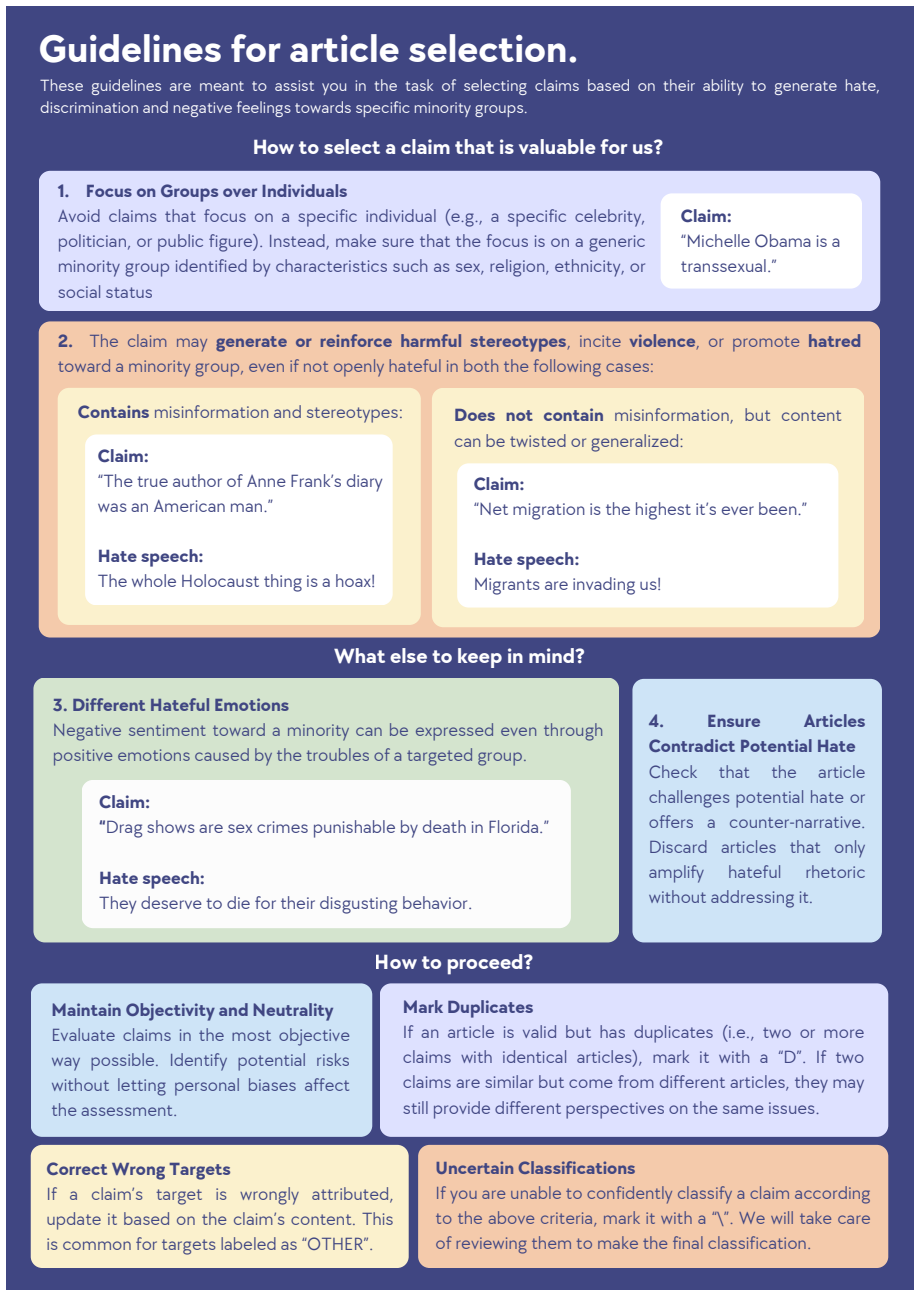
The paper introduces CATCH-ME, the first large-scale, expert-curated, multilingual dataset of dialogues tackling the intersection of hate and misinformation. The dialogues are multi-turn, span five languages, target seven marginalized groups, are grounded in fact-checking articles and NGO reports, and include document- and chunk-level span annotations, making the resource directly applicable for RAG systems. This fills the gap left by scarce existing counterspeech datasets that are limited to single-turn English dialogues.
What carries the argument
The CATCH-ME dataset of expert-curated multi-turn dialogues with document- and chunk-level span annotations anchored in verified external knowledge sources.
If this is right
- Models trained on the dataset can produce counterspeech that is more persuasive and factually grounded than zero-shot outputs.
- The span annotations enable direct integration into RAG pipelines for retrieval-based generation.
- The resource supports evaluation across five languages and seven targeted groups.
- It provides training data for multi-turn rather than single-turn interactions.
Where Pith is reading between the lines
- The dataset could be used to test whether counterspeech quality improves when models retrieve from the provided fact-check anchors versus unguided generation.
- Similar annotation schemes might be applied to other overlapping online harms such as conspiracy theories paired with targeted abuse.
- Platform moderation tools could incorporate retrieval from the dataset to suggest responses in live multi-turn exchanges.
Load-bearing premise
Expert-curated multi-turn dialogues accurately capture real-life interactions at the hate-misinformation overlap and that such examples are required to steer models away from repetitive or vague outputs.
What would settle it
A controlled comparison in which models fine-tuned on this dataset show no reduction in repetitiveness or vagueness, and no gain in factual grounding, relative to zero-shot baselines or existing single-turn English datasets.
Figures

read the original abstract
Online hate speech and misinformation frequently overlap, yet NLP research has mainly treated them in isolation. While LLMs represent a scalable solution for assisting humans in the generation of counterspeech for both threats, zero-shot models frequently generate repetitive and vague responses, underscoring the need for high-quality examples to steer model generation. However, existing counterspeech datasets against the overlap of hate and misinformation are scarce and limited to single-turn English dialogues, while real-life interactions span across multiple turns and languages. To bridge this gap, we introduce the first large-scale, expert-curated, multilingual dataset of dialogues tackling the intersection of hate and misinformation. To ensure factual grounding, the dialogues are also anchored in verified external knowledge (i.e., fact-checking articles and NGO reports) and include document- and chunk-level span annotations, making it directly applicable for RAG systems. Covering five languages and targeting hate directed at seven marginalized groups, this novel resource enables the training and evaluation of more persuasive, factually grounded counterspeech models.
Editorial analysis
A structured set of objections, weighed in public.
Referee Report
Summary. The paper introduces CATCH-ME, claimed to be the first large-scale expert-curated multilingual dataset of multi-turn dialogues addressing counterspeech at the intersection of hate speech and misinformation. Dialogues are anchored in verified external knowledge (fact-checking articles and NGO reports) with document- and chunk-level span annotations for direct use in RAG systems, covering five languages and seven marginalized groups.
Significance. If the curation methodology, factual grounding, and annotations are rigorously documented and validated, the dataset would address a clear gap in existing counterspeech resources, which are described as limited to single-turn English dialogues. This could support improved training of models for persuasive, factually grounded responses in multi-turn settings.
major comments (2)
- [Dataset construction] Dataset construction section: The paper provides no description of the method used to derive or validate the multi-turn dialogue structures against observed real-world interaction data, which is load-bearing for the central claim that the resource enables training of models that transfer to real exchanges at the hate-misinformation overlap.
- [Abstract] Abstract and introduction: The claim of being the 'first' large-scale expert-curated multilingual multi-turn dataset at this intersection requires an explicit, exhaustive comparison table against prior counterspeech datasets; without it the novelty assertion cannot be evaluated.
minor comments (1)
- [Abstract] Abstract: The statement that zero-shot models 'frequently generate repetitive and vague responses' is presented without supporting citations or pilot experiments.
Simulated Author's Rebuttal
We thank the referee for their detailed and constructive feedback. We address each major comment below and will revise the manuscript accordingly to strengthen the presentation of our contributions.
read point-by-point responses
-
Referee: [Dataset construction] Dataset construction section: The paper provides no description of the method used to derive or validate the multi-turn dialogue structures against observed real-world interaction data, which is load-bearing for the central claim that the resource enables training of models that transfer to real exchanges at the hate-misinformation overlap.
Authors: We agree that additional detail on dialogue construction is warranted. The multi-turn structures were designed by the expert curators (including representatives from fact-checking organizations and NGOs with direct experience in counterspeech) to reflect recurring patterns in real-world online exchanges at the hate-misinformation intersection. In the revised manuscript we will expand the Dataset Construction section with a dedicated subsection describing the iterative expert-driven process used to build the dialogues, including how turn-taking, escalation, and factual rebuttal sequences were modeled on observed interaction dynamics. This will clarify the basis for the transfer claim while remaining transparent that the dialogues are expert-synthesized rather than directly extracted from a scraped corpus. revision: yes
-
Referee: [Abstract] Abstract and introduction: The claim of being the 'first' large-scale expert-curated multilingual multi-turn dataset at this intersection requires an explicit, exhaustive comparison table against prior counterspeech datasets; without it the novelty assertion cannot be evaluated.
Authors: We accept this point. The revised manuscript will include a new comparison table (placed in the Introduction or a dedicated Related Work subsection) that systematically contrasts CATCH-ME with all prior counterspeech datasets on dimensions including language coverage, number of turns, expert curation, factual grounding via external verified sources, span-level annotations, target groups, and scale. This table will make the novelty claim directly evaluable. revision: yes
Circularity Check
Dataset release paper with no derivation chain or self-referential predictions
full rationale
The paper introduces a new multilingual multi-turn counterspeech dataset with span annotations for RAG use. It contains no equations, fitted parameters, uniqueness theorems, or predictions derived from prior results. The central contribution is the resource itself (expert curation of dialogues anchored in external fact-checks), which does not reduce to any input by construction. No self-citation load-bearing steps or ansatz smuggling appear in the provided text. This matches the default non-circular case for dataset papers.
Axiom & Free-Parameter Ledger
Reference graph
Works this paper leans on
-
[1]
Entropy-based Attention Regularization Frees Unintended Bias Mitigation from Lists
Attanasio, Giuseppe and Nozza, Debora and Hovy, Dirk and Baralis, Elena. Entropy-based Attention Regularization Frees Unintended Bias Mitigation from Lists. Findings of the Association for Computational Linguistics: ACL 2022. 2022. doi:10.18653/v1/2022.findings-acl.88
-
[2]
2022 , month =
Simone Fontana , title =. 2022 , month =
2022
-
[3]
2022 , month =
The Associated Press , title =. 2022 , month =
2022
-
[4]
Proceedings of the First Workshop on Multilingual Counterspeech Generation , pages=
Trenteam at multilingual counterspeech generation: Multilingual passage re-ranking approaches for knowledge-driven counterspeech generation against hate , author=. Proceedings of the First Workshop on Multilingual Counterspeech Generation , pages=
-
[5]
2026 , eprint=
Assisted Counterspeech Writing at the Crossroads of Hate Speech and Misinformation , author=. 2026 , eprint=
2026
-
[6]
Proceedings of the 58th annual meeting of the association for computational linguistics , pages=
Unsupervised cross-lingual representation learning at scale , author=. Proceedings of the 58th annual meeting of the association for computational linguistics , pages=
-
[7]
Proceedings of the 18th conference of the european chapter of the association for computational linguistics: system demonstrations , pages=
Ragas: Automated evaluation of retrieval augmented generation , author=. Proceedings of the 18th conference of the european chapter of the association for computational linguistics: system demonstrations , pages=
-
[8]
arXiv preprint arXiv:2506.05176 , year=
Qwen3 Embedding: Advancing Text Embedding and Reranking Through Foundation Models , author=. arXiv preprint arXiv:2506.05176 , year=
-
[9]
arXiv preprint arXiv:2407.15831 , year=
NV-Retriever: Improving text embedding models with effective hard-negative mining , author=. arXiv preprint arXiv:2407.15831 , year=
-
[10]
Advances in neural information processing systems , volume=
Qlora: Efficient finetuning of quantized llms , author=. Advances in neural information processing systems , volume=
-
[11]
Proceedings of the 2022 Conference on Empirical Methods in Natural Language Processing , pages=
Conqrr: Conversational query rewriting for retrieval with reinforcement learning , author=. Proceedings of the 2022 Conference on Empirical Methods in Natural Language Processing , pages=
2022
-
[12]
arXiv preprint arXiv:2407.21783 , year=
The llama 3 herd of models , author=. arXiv preprint arXiv:2407.21783 , year=
-
[13]
Proceedings of the 2024 Conference on Empirical Methods in Natural Language Processing , pages=
Segment any text: A universal approach for robust, efficient and adaptable sentence segmentation , author=. Proceedings of the 2024 Conference on Empirical Methods in Natural Language Processing , pages=
2024
-
[14]
Findings of the Association for Computational Linguistics: EMNLP 2023 , pages=
Enhancing conversational search: Large language model-aided informative query rewriting , author=. Findings of the Association for Computational Linguistics: EMNLP 2023 , pages=
2023
-
[15]
2024 , month = jul # " 18", howpublished =
2024
-
[16]
1995 , publisher=
Okapi at TREC-3 , author=. 1995 , publisher=
1995
-
[17]
2024 , eprint=
BGE M3-Embedding: Multi-Lingual, Multi-Functionality, Multi-Granularity Text Embeddings Through Self-Knowledge Distillation , author=. 2024 , eprint=
2024
-
[18]
2023 , eprint=
Making Large Language Models A Better Foundation For Dense Retrieval , author=. 2023 , eprint=
2023
-
[19]
arXiv preprint arXiv:2308.11596 , year=
Seamlessm4t: Massively multilingual & multimodal machine translation , author=. arXiv preprint arXiv:2308.11596 , year=
-
[20]
Department of Peace Operations (DPO)
A conceptual analysis of the overlaps and differences between hate speech, misinformation and disinformation , author=. Department of Peace Operations (DPO). Office of the Special Adviser on the Prevention of Genocide (OSAPG). United Nations , year=
-
[21]
new media & society , volume=
Global misinformation trends: Commonalities and differences in topics, sources of falsehoods, and deception strategies across eight countries , author=. new media & society , volume=. 2025 , publisher=
2025
-
[22]
, author=
The proof and measurement of association between two things. , author=. 1961 , publisher=
1961
-
[23]
Biochemia medica , volume=
Interrater reliability: the kappa statistic , author=. Biochemia medica , volume=. 2012 , publisher=
2012
-
[24]
, author=
A new readability yardstick. , author=. Journal of applied psychology , volume=. 1948 , publisher=
1948
-
[25]
Derivation of new readability formulas (automated readability index, fog count and flesch reading ease formula) for navy enlisted personnel , author=
-
[26]
Proceedings of the 46th International ACM SIGIR Conference on Research and Development in Information Retrieval , pages=
End-to-end multimodal fact-checking and explanation generation: A challenging dataset and models , author=. Proceedings of the 46th International ACM SIGIR Conference on Research and Development in Information Retrieval , pages=
-
[27]
Accountable and Explainable Methods for Complex Reasoning over Text , pages=
Generating fact checking explanations , author=. Accountable and Explainable Methods for Complex Reasoning over Text , pages=. 2024 , publisher=
2024
-
[28]
Understanding Counterspeech for Online Harm Mitigation
Chung, Yi-Ling and Abercrombie, Gavin and Enock, Florence and Bright, Jonathan and Rieser, Verena. Understanding Counterspeech for Online Harm Mitigation. Northern European Journal of Language Technology. 2024. doi:10.3384/nejlt.2000-1533.2024.5203
-
[29]
NLP for Counterspeech against Hate and Misinformation ( CSHAM )
Russo, Daniel and Bonaldi, Helena and Chung, Yi-Ling and Abercrombie, Gavin and Guerini, Marco. NLP for Counterspeech against Hate and Misinformation ( CSHAM ). Proceedings of the 63rd Annual Meeting of the Association for Computational Linguistics (Volume 5: Tutorial Abstracts). 2025. doi:10.18653/v1/2025.acl-tutorials.6
-
[30]
Proceedings of the twelfth ACM international conference on web search and data mining , pages=
Exfakt: A framework for explaining facts over knowledge graphs and text , author=. Proceedings of the twelfth ACM international conference on web search and data mining , pages=
-
[31]
on the impact of pre-aggregation on the evaluation of highly subjective tasks , author=
It’s the end of the gold standard as we know it. on the impact of pre-aggregation on the evaluation of highly subjective tasks , author=. CEUR workshop proceedings , volume=. 2020 , organization=
2020
-
[32]
2022 , publisher=
Digital work in the planetary market , author=. 2022 , publisher=
2022
-
[33]
2020 , publisher=
Behind the screen: Content moderation in the shadows of social media , author=. 2020 , publisher=
2020
-
[34]
The Risk of Racial Bias in Hate Speech Detection
Sap, Maarten and Card, Dallas and Gabriel, Saadia and Choi, Yejin and Smith, Noah A. The Risk of Racial Bias in Hate Speech Detection. Proceedings of the 57th Annual Meeting of the Association for Computational Linguistics. 2019. doi:10.18653/v1/P19-1163
-
[35]
Proceedings of the third workshop on abusive language online , year=
Challenges and frontiers in abusive content detection , author=. Proceedings of the third workshop on abusive language online , year=
-
[36]
A systematic review of hate speech automatic detection using natural language processing , journal =
Md Saroar Jahan and Mourad Oussalah , keywords =. A systematic review of hate speech automatic detection using natural language processing , journal =. 2023 , issn =. doi:https://doi.org/10.1016/j.neucom.2023.126232 , url =
-
[37]
Serrano, Sofia and Smith, Noah A. Is Attention Interpretable?. Proceedings of the 57th Annual Meeting of the Association for Computational Linguistics. 2019. doi:10.18653/v1/P19-1282
-
[38]
A ttention is not E xplanation
Jain, Sarthak and Wallace, Byron C. A ttention is not E xplanation. Proceedings of the 2019 Conference of the North A merican Chapter of the Association for Computational Linguistics: Human Language Technologies, Volume 1 (Long and Short Papers). 2019. doi:10.18653/v1/N19-1357
-
[39]
RU 22 F act: Optimizing Evidence for Multilingual Explainable Fact-Checking on R ussia- U kraine Conflict
Zeng, Yirong and Ding, Xiao and Zhao, Yi and Li, Xiangyu and Zhang, Jie and Yao, Chao and Liu, Ting and Qin, Bing. RU 22 F act: Optimizing Evidence for Multilingual Explainable Fact-Checking on R ussia- U kraine Conflict. Proceedings of the 2024 Joint International Conference on Computational Linguistics, Language Resources and Evaluation (LREC-COLING 2024). 2024
2024
-
[40]
Proceedings of the 18th International Natural Language Generation Conference , pages=
Face the Facts! Evaluating RAG-based Pipelines for Professional Fact-Checking , author=. Proceedings of the 18th International Natural Language Generation Conference , pages=
-
[41]
Proceedings of the 2020 Truth and Trust Online (TTO 2020) , pages=
e-fever: Explanations and summaries for automated fact checking , author=. Proceedings of the 2020 Truth and Trust Online (TTO 2020) , pages=. 2020 , publisher=
2020
-
[42]
Findings of the Association for Computational Linguistics: ACL 2025 , pages=
EuroVerdict: A Multilingual Dataset for Verdict Generation Against Misinformation , author=. Findings of the Association for Computational Linguistics: ACL 2025 , pages=
2025
-
[43]
D e C lar E : Debunking Fake News and False Claims using Evidence-Aware Deep Learning
Popat, Kashyap and Mukherjee, Subhabrata and Yates, Andrew and Weikum, Gerhard. D e C lar E : Debunking Fake News and False Claims using Evidence-Aware Deep Learning. Proceedings of the 2018 Conference on Empirical Methods in Natural Language Processing. 2018. doi:10.18653/v1/D18-1003
-
[44]
Proceedings of the 1st Workshop on CounterSpeech for Online Abuse (CS4OA) , pages=
From generic to personalized: Investigating strategies for generating targeted counter narratives against hate speech , author=. Proceedings of the 1st Workshop on CounterSpeech for Online Abuse (CS4OA) , pages=
-
[45]
arXiv preprint arXiv:2303.08774 , year=
Gpt-4 technical report , author=. arXiv preprint arXiv:2303.08774 , year=
-
[46]
arXiv preprint arXiv:1609.07843 , year=
Pointer sentinel mixture models , author=. arXiv preprint arXiv:1609.07843 , year=
-
[47]
N ewsroom: A Dataset of 1.3 Million Summaries with Diverse Extractive Strategies
Grusky, Max and Naaman, Mor and Artzi, Yoav. N ewsroom: A Dataset of 1.3 Million Summaries with Diverse Extractive Strategies. Proceedings of the 2018 Conference of the North A merican Chapter of the Association for Computational Linguistics: Human Language Technologies, Volume 1 (Long Papers). 2018. doi:10.18653/v1/N18-1065
-
[48]
Towards Knowledge-Grounded Counter Narrative Generation for Hate Speech
Chung, Yi-Ling and Tekiro g lu, Serra Sinem and Guerini, Marco. Towards Knowledge-Grounded Counter Narrative Generation for Hate Speech. Findings of the Association for Computational Linguistics: ACL-IJCNLP 2021. 2021. doi:10.18653/v1/2021.findings-acl.79
-
[49]
Procesamiento del lenguaje natural , volume=
Automatic counter-narrative generation for hate speech in spanish , author=. Procesamiento del lenguaje natural , volume=
-
[50]
Generating Counter Narratives against Online Hate Speech: Data and Strategies
Tekiro g lu, Serra Sinem and Chung, Yi-Ling and Guerini, Marco. Generating Counter Narratives against Online Hate Speech: Data and Strategies. Proceedings of the 58th Annual Meeting of the Association for Computational Linguistics. 2020. doi:10.18653/v1/2020.acl-main.110
-
[51]
A Benchmark Dataset for Learning to Intervene in Online Hate Speech
Qian, Jing and Bethke, Anna and Liu, Yinyin and Belding, Elizabeth and Wang, William Yang. A Benchmark Dataset for Learning to Intervene in Online Hate Speech. Proceedings of the 2019 Conference on Empirical Methods in Natural Language Processing and the 9th International Joint Conference on Natural Language Processing (EMNLP-IJCNLP). 2019. doi:10.18653/v...
-
[52]
Proceedings of the AAAI Conference on Artificial Intelligence , volume=
Pinpointing fine-grained relationships between hateful tweets and replies , author=. Proceedings of the AAAI Conference on Artificial Intelligence , volume=
-
[53]
Countering Misinformation via Emotional Response Generation
Russo, Daniel and Kaszefski-Yaschuk, Shane and Staiano, Jacopo and Guerini, Marco. Countering Misinformation via Emotional Response Generation. Proceedings of the 2023 Conference on Empirical Methods in Natural Language Processing. 2023. doi:10.18653/v1/2023.emnlp-main.703
-
[54]
This is fake news
“This is fake news”: Investigating the role of conformity to other users’ views when commenting on and spreading disinformation in social media , author=. Computers in Human Behavior , volume=. 2019 , publisher=
2019
-
[55]
Political Behavior , volume=
When corrections fail: The persistence of political misperceptions , author=. Political Behavior , volume=. 2010 , publisher=
2010
-
[56]
2018 , school=
(Dis) continuing the continued influence effect of misinformation , author=. 2018 , school=
2018
-
[57]
, author=
Fear, misinformation, and innumerates: how the Wakefield paper, the press, and advocacy groups damaged the public health. , author=. Vaccine , volume=
-
[58]
The lancet , volume=
RETRACTED: Ileal-lymphoid-nodular hyperplasia, non-specific colitis, and pervasive developmental disorder in children , author=. The lancet , volume=. 1998 , publisher=
1998
-
[59]
Memory & cognition , volume=
Explicit warnings reduce but do not eliminate the continued influence of misinformation , author=. Memory & cognition , volume=. 2010 , publisher=
2010
-
[60]
Studies in Communication and Media , number=
Countering misinformation: Strategies, challenges, and uncertainties , author=. Studies in Communication and Media , number=. 2019 , publisher=
2019
-
[61]
Proceedings of the 15th ACM Web Science Conference 2023 , pages=
Characterizing and predicting social correction on twitter , author=. Proceedings of the 15th ACM Web Science Conference 2023 , pages=
2023
-
[62]
2014 , publisher=
How people read on the web: The eyetracking evidence , author=. 2014 , publisher=
2014
-
[63]
``Liar, Liar Pants on Fire'': A New Benchmark Dataset for Fake News Detection
Wang, William Yang. ``Liar, Liar Pants on Fire'': A New Benchmark Dataset for Fake News Detection. Proceedings of the 55th Annual Meeting of the Association for Computational Linguistics (Volume 2: Short Papers). 2017. doi:10.18653/v1/P17-2067
-
[64]
Proceedings of the 52nd Annual Meeting of the Association for Computational Linguistics (Volume 1: Long Papers) , pages=
Language-aware truth assessment of fact candidates , author=. Proceedings of the 52nd Annual Meeting of the Association for Computational Linguistics (Volume 1: Long Papers) , pages=
-
[65]
Management science , volume=
The implied truth effect: Attaching warnings to a subset of fake news headlines increases perceived accuracy of headlines without warnings , author=. Management science , volume=. 2020 , publisher=
2020
-
[66]
Proceedings of the International AAAI Conference on Web and Social Media , volume=
Do explanations increase the effectiveness of AI-crowd generated fake news warnings? , author=. Proceedings of the International AAAI Conference on Web and Social Media , volume=
-
[67]
30th USENIX Security Symposium (USENIX Security 21) , pages=
Adapting security warnings to counter online disinformation , author=. 30th USENIX Security Symposium (USENIX Security 21) , pages=
-
[68]
Computers & security , volume=
Misinformation warnings: Twitter’s soft moderation effects on COVID-19 vaccine belief echoes , author=. Computers & security , volume=. 2022 , publisher=
2022
-
[69]
Transactions of the Association for Computational Linguistics , volume=
A survey on automated fact-checking , author=. Transactions of the Association for Computational Linguistics , volume=. 2022 , publisher=
2022
-
[70]
Communication Research Reports , volume=
Playing nice: Modeling civility in online political discussions , author=. Communication Research Reports , volume=. 2015 , publisher=
2015
-
[71]
Personality and Social Psychology Bulletin , volume=
Further progress in understanding the effects of derogatory ethnic labels: The role of preexisting attitudes toward the targeted group , author=. Personality and Social Psychology Bulletin , volume=. 1996 , publisher=
1996
-
[72]
Proceedings of the international AAAI conference on web and social media , volume=
If you have a reliable source, say something: effects of correction comments on covid-19 misinformation , author=. Proceedings of the international AAAI conference on web and social media , volume=
-
[73]
Frontiers in Psychology , volume=
Changing conspiracy beliefs through rationality and ridiculing , author=. Frontiers in Psychology , volume=. 2016 , publisher=
2016
-
[74]
American politics research , volume=
Debating the truth: The impact of fact-checking during electoral debates , author=. American politics research , volume=. 2017 , publisher=
2017
-
[75]
2015 , publisher=
Hate speech law: A philosophical examination , author=. 2015 , publisher=
2015
-
[76]
Proceedings of the 2024 CHI Conference on Human Factors in Computing Systems , pages=
Counterspeakers’ perspectives: Unveiling barriers and ai needs in the fight against online hate , author=. Proceedings of the 2024 CHI Conference on Human Factors in Computing Systems , pages=
2024
-
[77]
IEEE INFOCOM 2021-IEEE conference on computer communications , pages=
Setting the record straighter on shadow banning , author=. IEEE INFOCOM 2021-IEEE conference on computer communications , pages=. 2021 , organization=
2021
-
[78]
Proceedings of the ACM on human-computer interaction , volume=
You can't stay here: The efficacy of reddit's 2015 ban examined through hate speech , author=. Proceedings of the ACM on human-computer interaction , volume=. 2017 , publisher=
2015
-
[79]
PNAS nexus , volume=
Deplatforming did not decrease Parler users’ activity on fringe social media , author=. PNAS nexus , volume=. 2023 , publisher=
2023
-
[80]
Internet Policy Review , volume=
Expanding the debate about content moderation: Scholarly research agendas for the coming policy debates , author=. Internet Policy Review , volume=. 2020 , publisher=
2020
discussion (0)
Sign in with ORCID, Apple, or X to comment. Anyone can read and Pith papers without signing in.