REVIEW 5 major objections 5 minor 46 references
F^2TTA: Free-Form Test-Time Adaptation on Cross-Domain Medical Image Classification via Image-Level Disentangled Prompt Tuning
T0 review · 5 major / 5 minor · reviewed 2026-08-06 · deepseek-v4-flash
Pith's one-line read The paper introduces Free-Form Test-Time Adaptation (F2TTA) and an image-level disentangled prompt-tuning framework, I-DiPT, that adapts a frozen classifier to random-length fragments, reporting +11.15% and +3.76% accuracy over SourceOnly.
desk verdict A genuinely new TTA setting with strong empirical results, but the core mechanism story has a token-assignment inconsistency that needs fixing. read the letter →
The pith
A machine-rendered reading of the paper's core claim, the machinery that carries it, and where it could break.
The reading
What carries the argument
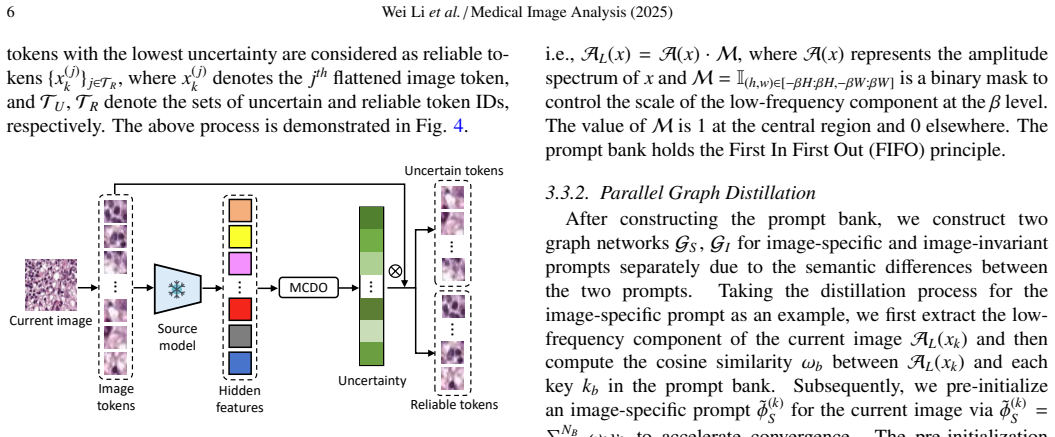
The load-bearing machinery is a pair of prompt sequences inserted into every multi-head self-attention layer of a vision transformer using prefix tuning. The image-specific prompt (sequence length 8) adapts the model to the current test image, and the image-invariant prompt (sequence length 4) is shared across all images and stores cross-domain knowledge. Two mechanisms make these prompts work from a single image: Uncertainty-oriented Masking estimates per-token uncertainty by running the frozen source model several times with random dropout, masks the most uncertain tokens to train the image-specific prompt and the most reliable tokens to train the image-invariant prompt, and enforces a consistency loss against the full-image prediction of the source model; Parallel Graph Distillation keeps a FIFO bank of historical prompts keyed by the low-frequency amplitude spectrum of previous images, pre-initializes the current prompts by similarity-weighted combination, and distills knowledge through two separate graph attention networks, using an exponential moving average for the invariant prompt to prevent overwriting.
What would settle it
Run I-DiPT on the same breast cancer streams but select the masked tokens randomly instead of by uncertainty, holding the 30% mask ratio and all other hyperparameters fixed; if overall accuracy stays near 83.8%, the uncertainty-based selection and the claimed disentanglement are not the source of the improvement. A complementary check is to compare how well the image-invariant prompt's representations transfer to a held-out domain versus the image-specific prompt's representations after adaptation, since the invariant prompt should generalize markedly better if the mechanism works.
Extended reading notes
Core claim
The central claim is that in F2TTA, where shifts between fragments cannot be predicted, the right unit of adaptation is the image, not the domain. I-DiPT therefore adapts the frozen source model to every incoming image with an image-specific prompt and learns domain-invariant representations with an image-invariant prompt, and the two are kept semantically separate by UoM and PGD. The paper reports that this combination outperforms both single-domain and continual TTA baselines: over the eight test streams on breast cancer, I-DiPT reaches 83.79% overall accuracy on all domains versus 72.64% for SourceOnly and 78.70% for the best baseline (DPCore); on glaucoma it reaches 73.17% versus 69.41% for SourceOnly. The authors interpret the result as evidence that explicitly learning invariant, image-level representations is what makes adaptation robust when domain fragments are short and randomly interleaved.
Load-bearing premise
The load-bearing premise is that the per-token uncertainty of the frozen source model, measured by repeated forward passes with random dropout, marks which image content is domain-specific and which is domain-invariant, so masking uncertain tokens for one prompt and reliable tokens for the other actually disentangles the two; if that mapping fails, the consistency losses simply copy the source model's full-image prediction into both prompts and the reported gains are not explained by learned invariance.
Editorial extensions
If this is right
- Evaluation practice for TTA on medical images should include free-form streams with random fragment lengths and orders, because complete-domain streaming hides the stress that F2TTA exposes.
- I-DiPT reports +11.15% overall accuracy and +2.86% AUC over SourceOnly on all breast cancer domains, and +3.76% accuracy on glaucoma, while updating only about 0.9M parameters, roughly 1% of the ViT-B/16 backbone.
- Accuracy rises steadily across the stream, from about 80.6% on the first eighth to 88.9% on the last eighth of the breast cancer stream, suggesting the model accumulates useful domain-invariant knowledge rather than being reset at each fragment boundary.
- Single-domain and continual TTA baselines that assume complete-domain or periodic shifts show little gain or degrade in F2TTA (Tent drops to about 54.2% overall accuracy on breast cancer), so previously reported CTTA robustness does not carry over to fragmented clinical data.
Reading between the lines
- Not tested in the paper: replacing the uncertainty-ranked token selection with random masking at the same ratio would isolate whether the disentanglement, rather than the masked consistency loss itself, drives the gain; the paper's ablations compare with and without UoM but not with random masks.
- If the low-frequency amplitude of an image indeed acts as a style or domain signature, the prompt bank in PGD could serve as an online domain-change detector for other adaptation methods, giving them early warning at fragment boundaries.
- The mechanism assumes only per-token uncertainty and a frozen transformer backbone, so a natural extension, which the authors do not explore, is to apply I-DiPT to segmentation models or 3D medical volumes where the same content-versus-style separation is needed.
- A further consequence, if the results are right: clinical deployment studies that evaluate TTA on complete-domain batches likely overestimate the real-world robustness of existing methods, since fragmented arrival is the common case.
Editorial analysis
A structured set of objections, weighed in public.
Referee Report
Summary. The paper introduces Free-Form Test-Time Adaptation (F2TTA), a test-time adaptation setting in which unlabeled test data arrive in arbitrary-length, randomly ordered domain fragments with unpredictable shifts between fragments. The authors propose I-DiPT, which attaches an image-specific prompt and an image-invariant prompt to a frozen ViT backbone: the image-specific prompt adapts the model to each test image, while the image-invariant prompt is intended to learn domain-invariant representations. To handle the limited signal from a single image, they propose Uncertainty-oriented Masking (UoM), which selects uncertain and reliable image tokens via Monte Carlo dropout and applies a masked consistency loss, and Parallel Graph Distillation (PGD), which distills knowledge from a prompt bank through two graph networks. Experiments on Camelyon17 and a multi-dataset glaucoma fundus benchmark report that I-DiPT outperforms SourceOnly and several STTA/CTTA baselines under the F2TTA protocol, with ablations, sensitivity analyses, and computational cost comparisons.
Significance. If the reported results are valid, the paper makes a useful contribution: it identifies a realistic deployment scenario for medical image classifiers (free-form fragments with unpredictable domain shifts), and I-DiPT is a parameter-efficient method that improves accuracy and AUC over strong baselines on two medical datasets. The paper is detailed and reproducible in spirit: the algorithm is fully specified, the evaluation uses eight random test streams, ablations isolate the main components, and code is released. The central weakness is that the mechanism claimed to provide the improvement (uncertainty-based disentanglement) is not directly validated, and the main evaluation protocol for Camelyon17 risks patient-level data leakage. Both issues are load-bearing for the paper’s central claims and require substantial additional evidence or correction.
major comments (5)
- [Sec. 4.1.1] The Camelyon17 dataset is split at the patch level ("we randomly split all samples to 60% as the training set, 15% as the validation set, and 25% as the testing set at the patch level"). Camelyon17 contains multiple 96×96 patches extracted from the same patients, and several of the five sites are drawn from the same underlying patient cohort. A random patch-level split therefore places patches from the same patient (and often spatially overlapping or adjacent patches) in both the source training set and the target test domains. This can artificially inflate the apparent domain-shift performance because the source model may have memorized patient-specific tissue appearance rather than learning site-invariant features. The authors should re-run the main comparisons and ablations using a patient-disjoint split (e.g., the official WILDS patient-wise split) and report whether the advantage of I-DiPT persists.
- [Sec. 3.2.2, Eq. (5), Algorithm 1] The token-to-prompt assignment in UoM is inconsistent with the stated disentanglement motivation. The text argues that invariant representations are "stable under domain shifts" and image-specific representations are "sensitive to the shifts" (Sec. 3.2), which suggests that the image-invariant prompt should be trained on the reliable (low-uncertainty) tokens and the image-specific prompt on the uncertain (high-uncertainty) tokens. However, Algorithm 1 and Eq. (5) show the reverse: after masking uncertain tokens, the remaining reliable tokens are used to update the image-specific prompt, while after masking reliable tokens, the remaining uncertain tokens are used to update the image-invariant prompt. This is a direct contradiction between the paper’s mechanism and its implementation. The authors must either correct the assignment to match the stated motivation or revise the motivation/explanation and provide evidence that the implemented assignment induces the intended disentanglement.
- [Sec. 3.2, Table 3] The ablation does not isolate the contribution of uncertainty-based token selection. Setting 2 vs Setting 1 in Table 3 changes both the loss (pseudo-labeling vs masked consistency) and the token-selection strategy (no masking vs uncertainty-based masking). A control experiment using random masking at the same K% (30%) with the same consistency loss is needed to determine whether the observed gain (77.46 vs 67.80) comes from the uncertainty signal or simply from generic masked consistency learning. Furthermore, the paper provides no direct measure of domain invariance (e.g., accuracy of a domain classifier trained on the prompt features, or a cross-image/cross-fragment consistency metric). Without either a random-masking control or an invariance measurement, the claim that I-DiPT "learns domain-invariant representations" is not supported by the evidence; Eq. (5) itself only enforces per-image consistency with the source model’s full-image prediction and contains no cross-domain objective.
- [Sec. 4.4.2, Fig. 8(b)] The only evidence for the disentanglement mechanism is the qualitative attention-map visualization in Fig. 8(b), which shows a handful of example images. This visualization is not quantified, and it is not established that the attention differences reflect domain-specific versus domain-invariant content rather than a generic artifact of the different masks. The authors should add a quantitative evaluation of token selection (e.g., whether the selected tokens correspond to semantic regions associated with domain shift, or a comparison of representation similarity across domains with and without UoM) to support the claimed disentanglement.
- [Sec. 4.1.2] The glaucoma dataset (SMCDG) split is described as a per-domain random 60/15/25 split of images, but the SMCDG compilation includes multiple images per patient within some constituent datasets. The authors should clarify whether the split is patient-disjoint and, if so, how patient identifiers were handled; if it is not patient-disjoint, the same leakage concern as for Camelyon17 applies and a patient-disjoint evaluation should be provided.
minor comments (5)
- [Sec. 3.3.2] In the pre-initialization formula for the image-specific prompt, φ̃_S^(k) = Σ_b ω_b v_b, the value v_b is defined as the tuple (φ_S^(b), φ_I^(b)), making the equation dimensionally inconsistent. It should be φ̃_S^(k) = Σ_b ω_b φ_S^(b) (and similarly for the invariant prompt).
- [Sec. 3.2.1, Eq. (4)] The notation p(·) is described as converting the token feature to a scalar value, but then the norm ‖p(e_dj)−µ_j‖ is used; if p returns a scalar, this norm is an absolute value. Please clarify the exact form of p and of the norm in Eq. (4).
- [Tables 1 and 2] The results are reported as mean ± std over eight streams, but no statistical significance tests are provided. Given the small per-domain sample sizes in the glaucoma benchmark, a paired test (e.g., Wilcoxon signed-rank) across the eight streams would strengthen the claims of improvement.
- [Sec. 4.3.1] The paper states that the compared methods were re-implemented; it would be helpful to state explicitly whether the re-implementations used the authors’ own hyperparameter settings or the original papers’ settings, and to include the hyperparameters used for the baselines.
- [Sec. 5 (Discussion)] The Discussion acknowledges the plasticity–memorability trade-off and biological variation as limitations, which is good; the patch-level split issue should also be acknowledged as a limitation, or moved earlier into the experimental setup, so that readers can judge the validity of the results.
Circularity Check
No circularity found: I-DiPT's central results are measured on held-out test streams, hyperparameters are validation-tuned, and self-citations are background rather than load-bearing.
full rationale
I walked the paper's derivation chain. The adaptation objective (Eq. 5) is a masked-consistency loss: each prompt is trained to match predictions of the frozen source model on the full image, and final predictions are then obtained with both prompts on the full image. No term in this objective is fitted to test labels, to the reported headline accuracies, or to the benchmark metrics; hyperparameters such as D, K%, N_B, beta, and gamma are set on validation sets (Sec. 4.2, Sec. 4.4.2, Sec. 4.4.3), and the numbers in Tables 1-3 are evaluations on separately generated test streams. The claim that UoM disentangles domain-specific from domain-invariant content is an unvalidated empirical assumption, and the token-to-prompt assignment in Sec. 3.2.2 is indeed hard to reconcile with the paper's own motivation, since invariant representations are described as stable/reliable while the image-invariant prompt receives the uncertain-token set. That is a correctness or validity concern, not circularity: the output is not equivalent to the input by construction, and the masked-consistency training contains no free parameter that encodes the benchmark result. The paper's self-citations (Gu et al. 2023a; Zhang et al. 2025; Li et al. 2024b) appear as background, motivation, or future-work pointers, not as load-bearing uniqueness theorems, and the reported gains are established against seven external TTA methods on two public datasets. I therefore find no significant circularity.
Assumptions & free parameters
free parameters (9)
- masking_ratio_K =
30%
- prompt_bank_size_NB =
20
- low_frequency_scale_beta =
0.1
- ema_decay_gamma =
0.9
- prompt_lengths_LS_LI =
LS=8, LI=4
- graph_node_dim_Dg =
512
- mcdp_passes_D =
10
- adaptation_learning_rate =
1e-3
- dirichlet_delta =
1
assumptions (4)
- domain assumption Test data arrives in random domain fragments of arbitrary length and random order, with source-domain fragments also present.
- domain assumption Token-wise MCDO uncertainty separates domain-specific from domain-invariant features.
- domain assumption Low-frequency amplitude components encode domain style, so similar low-frequency images should share useful prompts.
- domain assumption Consistency between masked-token predictions and full-image source-model predictions provides useful adaptation signal.
Cite this review
Pith. "Pith review of F^2TTA: Free-Form Test-Time Adaptation on Cross-Domain Medical Image Classification via Image-Level Disentangled Prompt Tuning." pith.science (2026). https://pith.science/paper/BGMVG5MR
@misc{pith2026250702437,
  author       = {Pith},
  title        = {Pith review of: F^2TTA: Free-Form Test-Time Adaptation on Cross-Domain Medical Image Classification via Image-Level Disentangled Prompt Tuning},
  year         = {2026},
  howpublished = {\url{https://pith.science/paper/BGMVG5MR}},
  note         = {Machine review of arXiv:2507.02437}
}
abstract
Test-Time Adaptation (TTA) has emerged as a promising solution for adapting a source model to unseen medical sites using unlabeled test data, due to the high cost of data annotation. Existing TTA methods consider scenarios where data from one or multiple domains arrives in complete domain units. However, in clinical practice, data usually arrives in domain fragments of arbitrary lengths and in random arrival orders, due to resource constraints and patient variability. This paper investigates a practical Free-Form Test-Time Adaptation (F$^{2}$TTA) task, where a source model is adapted to such free-form domain fragments, with shifts occurring between fragments unpredictably. In this setting, these shifts could distort the adaptation process. To address this problem, we propose a novel Image-level Disentangled Prompt Tuning (I-DiPT) framework. I-DiPT employs an image-invariant prompt to explore domain-invariant representations for mitigating the unpredictable shifts, and an image-specific prompt to adapt the source model to each test image from the incoming fragments. The prompts may suffer from insufficient knowledge representation since only one image is available for training. To overcome this limitation, we first introduce Uncertainty-oriented Masking (UoM), which encourages the prompts to extract sufficient information from the incoming image via masked consistency learning driven by the uncertainty of the source model representations. Then, we further propose a Parallel Graph Distillation (PGD) method that reuses knowledge from historical image-specific and image-invariant prompts through parallel graph networks. Experiments on breast cancer and glaucoma classification demonstrate the superiority of our method over existing TTA approaches in F$^{2}$TTA. Code is available at https://github.com/mar-cry/F2TTA.
Figures


Figures from the paper (8 more)


Reference graph
Works this paper leans on
-
[1]
author Bocquet, F. , author Campone, M. , author Cuggia, M. , year 2022 . title The challenges of implementing comprehensive clinical data warehouses in hospitals . journal International Journal of Environmental Research and Public Health volume 19 . :10.3390/ijerph19127379
-
[2]
author Brigham, E.O. , author Morrow, R.E. , year 1967 . title The fast fourier transform . journal IEEE Spectrum volume 4 , pages 63--70 . :10.1109/MSPEC.1967.5217220
-
[3]
author Bándi, P. , author Geessink, O. , author Manson, Q. , author Van Dijk, M. , author Balkenhol, M. , author Hermsen, M. , author Ehteshami Bejnordi, B. , author Lee, B. , author Paeng, K. , author Zhong, A. , author Li, Q. , author Zanjani, F.G. , author Zinger, S. , author Fukuta, K. , author Komura, D. , author Ovtcharov, V. , author Cheng, S. , au...
-
[5]
author Dalal, N. , author Triggs, B. , year 2005 . title Histograms of oriented gradients for human detection , in: booktitle 2005 IEEE Computer Society Conference on Computer Vision and Pattern Recognition (CVPR'05) , pp. pages 886--893 vol. 1 . :10.1109/CVPR.2005.177
-
[6]
author Dosovitskiy, A. , author Beyer, L. , author Kolesnikov, A. , author Weissenborn, D. , author Zhai, X. , author Unterthiner, T. , author Dehghani, M. , author Minderer, M. , author Heigold, G. , author Gelly, S. , author Uszkoreit, J. , author Houlsby, N. , year 2021 . title An image is worth 16x16 words: Transformers for image recognition at scale ...
work page 2021
-
[7]
author D’Amore, J.D. , author McCrary, L.K. , author Denson, J. , author Li, C. , author Vitale, C.J. , author Tokachichu, P. , author Sittig, D.F. , author McCoy, A.B. , author Wright, A. , year 2021 . title Clinical data sharing improves quality measurement and patient safety . journal Journal of the American Medical Informatics Association volume 28 , ...
-
[8]
author Fischer, M. , author Bartler, A. , author Yang, B. , year 2024 . title Prompt tuning for parameter-efficient medical image segmentation . journal Medical Image Analysis volume 91 , pages 103024 . :https://doi.org/10.1016/j.media.2023.103024
arXiv 2024
-
[9]
author Gan, Y. , author Bai, Y. , author Lou, Y. , author Ma, X. , author Zhang, R. , author Shi, N. , author Luo, L. , year 2023 . title Decorate the newcomers: Visual domain prompt for continual test time adaptation , in: booktitle Proceedings of the AAAI conference on artificial intelligence , pp. pages 7595--7603
work page 2023
Show all 46 references
-
[10]
, author Lempitsky, V
author Ganin, Y. , author Lempitsky, V. , year 2015 . title Unsupervised domain adaptation by backpropagation , in: booktitle Proceedings of the 32nd International Conference on International Conference on Machine Learning - Volume 37 , publisher JMLR.org . p. pages 1180–1189
2015
-
[11]
, author Shi, X
author Gao, Y. , author Shi, X. , author Zhu, Y. , author Wang, H. , author Tang, Z. , author Zhou, X. , author Li, M. , author Metaxas, D.N. , year 2022 . title Visual prompt tuning for test-time domain adaptation . journal arXiv preprint arXiv:2210.04831
2022 arXiv
-
[12]
, author Wang, G
author Gu, R. , author Wang, G. , author Lu, J. , author Zhang, J. , author Lei, W. , author Chen, Y. , author Liao, W. , author Zhang, S. , author Li, K. , author Metaxas, D.N. , author Zhang, S. , year 2023 a. title Cddsa: Contrastive domain disentanglement and style augment...
2023
-
[13]
, author Zhang, J
author Gu, R. , author Zhang, J. , author Wang, G. , author Lei, W. , author Song, T. , author Zhang, X. , author Li, K. , author Zhang, S. , year 2023 b. title Contrastive semi-supervised learning for domain adaptive segmentation across similar anatomical structures . journal...
2023
-
[14]
, author Liu, M
author Guan, H. , author Liu, M. , year 2022 . title Domain adaptation for medical image analysis: A survey . journal IEEE Transactions on Biomedical Engineering volume 69 , pages 1173--1185 . :10.1109/TBME.2021.3117407
2022
-
[17]
, author Matsuo, Y
author Iwasawa, Y. , author Matsuo, Y. , year 2021 . title Test-time classifier adjustment module for model-agnostic domain generalization , in: editor Ranzato, M. , editor Beygelzimer, A. , editor Dauphin, Y. , editor Liang, P. , editor Vaughan, J.W. (Eds.), booktitle Advance...
2021
-
[18]
, author Gal, Y
author Kendall, A. , author Gal, Y. , year 2017 . title What uncertainties do we need in bayesian deep learning for computer vision? , in: editor Guyon, I. , editor Luxburg, U.V. , editor Bengio, S. , editor Wallach, H. , editor Fergus, R. , editor Vishwanathan, S. , editor Ga...
2017
-
[19]
, author Abid, M
author Kiefer, R. , author Abid, M. , author Steen, J. , author Ardali, M.R. , author Amjadian, E. , year 2023 . title A catalog of public glaucoma datasets for machine learning applications: A detailed description and analysis of public glaucoma datasets available to machine ...
2023
-
[20]
, author Yoon, J
author Lee, D. , author Yoon, J. , author Hwang, S.J. , year 2024 . title Becotta: input-dependent online blending of experts for continual test-time adaptation , in: booktitle Proceedings of the 41st International Conference on Machine Learning , publisher JMLR.org
2024
-
[21]
, author Zhu, Y
author Li, K. , author Zhu, Y. , author Yu, L. , author Heng, P.A. , year 2024 a. title A dual enrichment synergistic strategy to handle data heterogeneity for domain incremental cardiac segmentation . journal IEEE Transactions on Medical Imaging volume 43 , pages 2279--2290 ....
2024
-
[22]
, author Zhang, J
author Li, W. , author Zhang, J. , author Heng, P.A. , author Gu, L. , year 2024 b. title Comprehensive generative replay for task-incremental segmentation with concurrent appearance and semantic forgetting , in: editor Linguraru, M.G. , editor Dou, Q. , editor Feragen, A. , e...
2024
-
[23]
, author Kooi, T
author Litjens, G. , author Kooi, T. , author Bejnordi, B.E. , author Setio, A.A.A. , author Ciompi, F. , author Ghafoorian, M. , author van der Laak , J.A. , author van Ginneken , B. , author Sánchez, C.I. , year 2017 . title A survey on deep learning in medical image analysi...
2017 doi
-
[24]
, author Xu, R
author Liu, J. , author Xu, R. , author Yang, S. , author Zhang, R. , author Zhang, Q. , author Chen, Z. , author Guo, Y. , author Zhang, S. , year 2024 . title Continual-mae: Adaptive distribution masked autoencoders for continual test-time adaptation , in: booktitle 2024 IEE...
2024
-
[25]
, author Yuan, W
author Liu, P. , author Yuan, W. , author Fu, J. , author Jiang, Z. , author Hayashi, H. , author Neubig, G. , year 2023 . title Pre-train, prompt, and predict: A systematic survey of prompting methods in natural language processing . journal ACM Comput. Surv. volume 55 . :10....
2023 doi
-
[26]
, author Dou, Q
author Liu, Q. , author Dou, Q. , author Yu, L. , author Heng, P.A. , year 2020 . title Ms-net: Multi-site network for improving prostate segmentation with heterogeneous mri data . journal IEEE Transactions on Medical Imaging volume 39 , pages 2713--2724 . :10.1109/TMI.2020.2974574
2020
-
[27]
, author Sanchez, P
author Liu, X. , author Sanchez, P. , author Thermos, S. , author O’Neil, A.Q. , author Tsaftaris, S.A. , year 2022 . title Learning disentangled representations in the imaging domain . journal Medical Image Analysis volume 80 , pages 102516 . :https://doi.org/10.1016/j.media....
2022
-
[28]
, author Wu, J
author Niu, S. , author Wu, J. , author Zhang, Y. , author Wen, Z. , author Chen, Y. , author Zhao, P. , author Tan, M. , year 2023 . title Towards stable test-time adaptation in dynamic wild world , in: booktitle The Eleventh International Conference on Learning Representatio...
2023
-
[29]
, author Khan, S
author Shamshad, F. , author Khan, S. , author Zamir, S.W. , author Khan, M.H. , author Hayat, M. , author Khan, F.S. , author Fu, H. , year 2023 . title Transformers in medical imaging: A survey . journal Medical Image Analysis volume 88 , pages 102802 . :https://doi.org/10.1...
2023
-
[30]
, author Wang, X
author Sun, Y. , author Wang, X. , author Liu, Z. , author Miller, J. , author Efros, A.A. , author Hardt, M. , year 2020 . title Test-time training with self-supervision for generalization under distribution shifts , in: booktitle Proceedings of the 37th International Confere...
2020
-
[31]
, author Cucurull, G
author Veli c kovi \'c , P. , author Cucurull, G. , author Casanova, A. , author Romero, A. , author Lio, P. , author Bengio, Y. , year 2017 . title Graph attention networks . journal arXiv preprint arXiv:1710.10903
2017 arXiv
-
[32]
, author Shelhamer, E
author Wang, D. , author Shelhamer, E. , author Liu, S. , author Olshausen, B.A. , author Darrell, T. , year 2021 . title Tent: Fully test-time adaptation by entropy minimization , in: booktitle 9th International Conference on Learning Representations, ICLR 2021, Virtual Event...
2021
-
[33]
, author Zhang, X
author Wang, L. , author Zhang, X. , author Su, H. , author Zhu, J. , year 2024 a. title A comprehensive survey of continual learning: Theory, method and application . journal IEEE Transactions on Pattern Analysis and Machine Intelligence volume 46 , pages 5362--5383 . :10.110...
2024
-
[34]
, author Fink, O
author Wang, Q. , author Fink, O. , author Van Gool, L. , author Dai, D. , year 2022 a. title Continual test-time domain adaptation , in: booktitle 2022 IEEE/CVF Conference on Computer Vision and Pattern Recognition (CVPR) , pp. pages 7191--7201 . :10.1109/CVPR52688.2022.00706
2022
-
[35]
, author Zhang, D
author Wang, S. , author Zhang, D. , author Yan, Z. , author Zhang, J. , author Li, R. , year 2023 . title Feature alignment and uniformity for test time adaptation , in: booktitle 2023 IEEE/CVF Conference on Computer Vision and Pattern Recognition (CVPR) , pp. pages 20050--20...
2023
-
[36]
, author Zhao, J
author Wang, X. , author Zhao, J. , author Marostica, E. , author Yuan, W. , author Jin, J. , author Zhang, J. , author Li, R. , author Tang, H. , author Wang, K. , author Li, Y. , author Wang, F. , author Peng, Y. , author Zhu, J. , author Zhang, J. , author Jackson, C.R. , a...
2024
-
[37]
, author Zhang, Z
author Wang, Z. , author Zhang, Z. , author Ebrahimi, S. , author Sun, R. , author Zhang, H. , author Lee, C.Y. , author Ren, X. , author Su, G. , author Perot, V. , author Dy, J. , author Pfister, T. , year 2022 b. title Dualprompt: Complementary prompting for rehearsal-free ...
2022
-
[38]
, author Chen, C
author Yang, H. , author Chen, C. , author Jiang, M. , author Liu, Q. , author Cao, J. , author Heng, P.A. , author Dou, Q. , year 2022 . title Dltta: Dynamic learning rate for test-time adaptation on cross-domain medical images . journal IEEE Transactions on Medical Imaging v...
2022
-
[39]
, author Dvornek, N.C
author Yang, J. , author Dvornek, N.C. , author Zhang, F. , author Chapiro, J. , author Lin, M. , author Duncan, J.S. , year 2019 . title Unsupervised domain adaptation via disentangled representations: Application to cross-modality liver segmentation , in: editor Shen, D. , e...
2019
-
[40]
, author Wu, J
author Yang, S. , author Wu, J. , author Liu, J. , author Li, X. , author Zhang, Q. , author Pan, M. , author Gan, Y. , author Chen, Z. , author Zhang, S. , year 2024 . title Exploring sparse visual prompt for domain adaptive dense prediction , in: booktitle Proceedings of the...
2024
-
[41]
, author Wang, H
author Zeng, L.L. , author Wang, H. , author Hu, P. , author Yang, B. , author Pu, W. , author Shen, H. , author Chen, X. , author Liu, Z. , author Yin, H. , author Tan, Q. , author Wang, K. , author Hu, D. , year 2018 . title Multi-site diagnostic classification of schizophre...
2018 doi
-
[42]
, author Zhang, L
author Zeng, Q. , author Zhang, L. , author Liu, Y. , author Zhu, C. , author Zhang, F. , year 2024 . title Graph-guided test-time adaptation for glaucoma diagnosis using fundus photography . journal arXiv preprint arXiv:2407.04396
2024
-
[43]
, author Pei, J
author Zhang, J. , author Pei, J. , author Xu, D. , author Jin, Y. , author Heng, P.A. , year 2025 . title Dc²t: Disentanglement-guided consolidation and consistency training for semi-supervised cross-site continual segmentation . journal IEEE Transactions on Medical Imaging v...
2025
-
[44]
, author Mehra, A
author Zhang, Y. , author Mehra, A. , author Hamm, J. , year 2024 . title Dynamic domains, dynamic solutions: Dpcore for continual test-time adaptation . journal arXiv preprint arXiv:2406.10737
2024 arXiv
-
[45]
, author Lin, Z
author Zhao, Y. , author Lin, Z. , author Sun, K. , author Zhang, Y. , author Huang, J. , author Wang, L. , author Yao, J. , year 2022 . title Setmil: Spatial encoding transformer-based multiple instance learning for pathological image analysis , in: editor Wang, L. , editor D...
2022
-
[46]
, author Ni, R
author Zhu, C. , author Ni, R. , author Xu, Z. , author Kong, K. , author Huang, W.R. , author Goldstein, T. , year 2021 . title Gradinit: Learning to initialize neural networks for stable and efficient training , in: editor Ranzato, M. , editor Beygelzimer, A. , editor Dauphi...
2021
-
[47]
, author Bolsterlee, B
author Zhu, J. , author Bolsterlee, B. , author Song, Y. , author Meijering, E. , year 2025 . title Improving cross-domain generalizability of medical image segmentation using uncertainty and shape-aware continual test-time domain adaptation . journal Medical Image Analysis vo...
2025
-
[48]
, author Li, K
author Zhu, Y. , author Li, K. , author Yu, L. , author Heng, P.A. , year 2024 . title Memory-efficient prompt tuning for incremental histopathology classification , in: booktitle Proceedings of the Thirty-Eighth AAAI Conference on Artificial Intelligence and Thirty-Sixth Conf...
2024 doi
-
[49]
write newline
" write newline "" before.all 'output.state := FUNCTION n.dashify 't := "" t empty not t #1 #1 substring "-" = t #1 #2 substring "--" = not "--" * t #2 global.max substring 't := t #1 #1 substring "-" = "-" * t #2 global.max substring 't := while if t #1 #1 substring * t #2 gl...
Reviewed August 6, 2026 · model on record in the stance chip above.
Discussion (0). Sign in to comment.