Parasitic Masquerade: Societal Scale Human-Machine Interaction
Pith reviewed 2026-06-26 21:59 UTC · model grok-4.3
The pith
In a societal model of human-machine interaction, parasitic coupling can appear as healthy learning while information flows predominantly from humans to machines.
A machine-rendered reading of the paper's core claim, the machinery that carries it, and where it could break.
Core claim
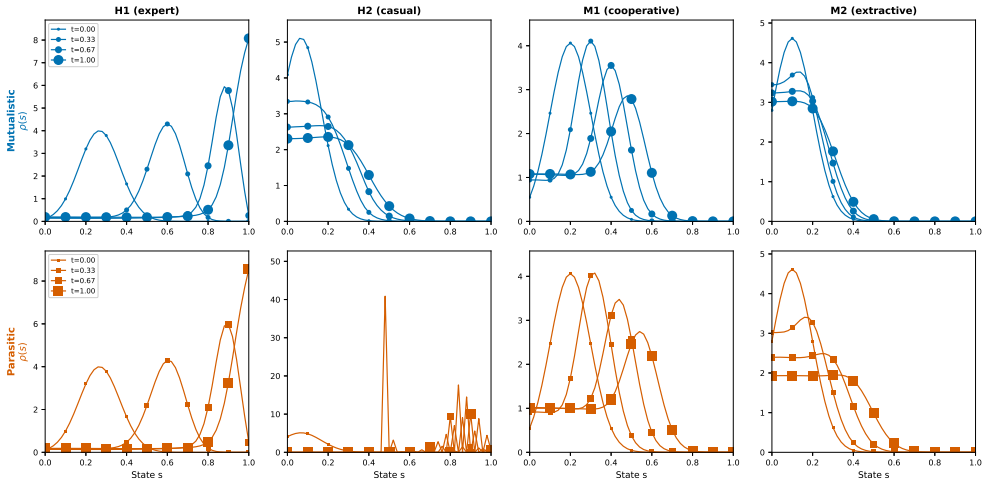
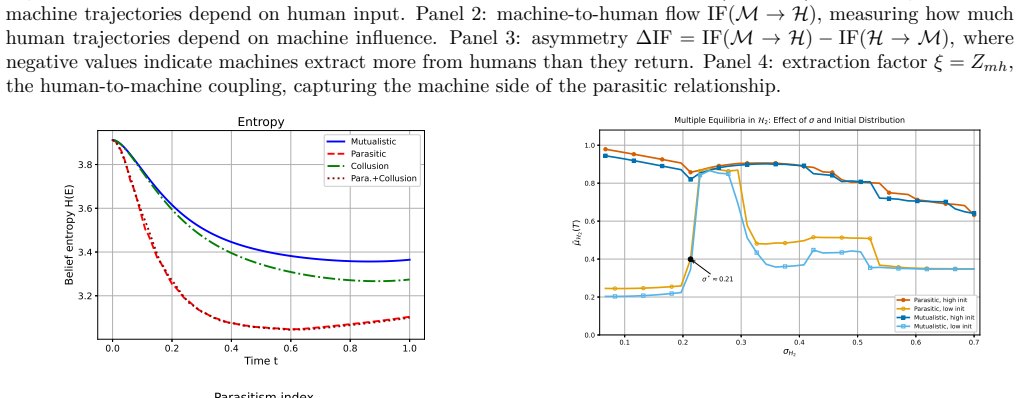
Parasitism can masquerade as productive learning, with knowledge distribution and actions appearing healthy while being driven by machine coupling rather than independent investigation. The human-to-machine channel dominates across all scenarios, with the asymmetry intensifying under parasitism. The system exhibits coexisting mutualistic and parasitic equilibria, where environmental noise can induce a tipping point that shifts agents past the cognitive cost barrier. These emergent phenomena arise from the collective interaction structure.
What carries the argument
Graphon Mean-Field Game (GMFG) that models interaction among four groups of internally-homogeneous but externally-heterogeneous agents, together with measures of information-flow direction and belief entropy.
If this is right
- Knowledge distribution and actions can appear healthy while being sustained by machine coupling rather than independent investigation.
- The human-to-machine information channel dominates in every scenario and the asymmetry grows stronger under parasitism.
- Mutualistic and parasitic equilibria coexist within the same system.
- Environmental noise can induce tipping points that move agents past the cognitive cost barrier.
Where Pith is reading between the lines
- Monitoring information-flow asymmetry might detect hidden parasitic dynamics before they become obvious in performance metrics.
- Interventions aimed at collective interaction structures could matter more than changes to individual agent rules.
- Similar masquerading effects could appear in other large-scale coupled systems beyond the four-group setup.
Load-bearing premise
The model assumes four internally-homogeneous but externally-heterogeneous agent groups and that the Graphon Mean-Field Game framework with its information-flow and entropy measures sufficiently captures real societal dynamics.
What would settle it
Measuring the direction of information flow and belief entropy in real-world human-AI interaction data to check whether the human-to-machine channel dominates and intensifies under conditions that resemble parasitism.
Figures




read the original abstract
This work extends recent developments in studying human--machine interaction by scaling from individual game-theoretic models to a societal-level model. We adopt a Graphon Mean-Field Game (GMFG) that models the interaction among four groups of internally-homogeneous but externally-heterogeneous agents in a shared environment. Our results show that parasitism can masquerade as productive learning, with knowledge distribution and actions appearing healthy while being driven by machine coupling rather than independent investigation. To detect this, we measure the direction of information flow and belief entropy of the environment, revealing that human to machine channel dominates across all scenarios, with the asymmetry intensifying under parasitism. We further demonstrate that the system exhibits coexisting mutualistic and parasitic equilibria, where environmental noise can induce a tipping point that shifts agents past the cognitive cost barrier. These emergent phenomena are not designed into any individual agent but arise from the collective interaction structure, underscoring the need to study the sociology of humans and machines holistically as a complex system.
Editorial analysis
A structured set of objections, weighed in public.
Referee Report
Summary. The manuscript extends individual game-theoretic models of human-machine interaction to a societal scale via a Graphon Mean-Field Game (GMFG) involving four internally-homogeneous but externally-heterogeneous agent groups. It claims that parasitic machine couplings can masquerade as productive learning (healthy knowledge distribution and actions), detectable via dominant human-to-machine information flow and belief entropy asymmetry that intensifies under parasitism; the system also exhibits coexisting mutualistic/parasitic equilibria with noise-induced tipping points past a cognitive cost barrier, all emerging from collective structure rather than individual design.
Significance. If the information-flow and entropy diagnostics prove independent of the parasitism definition and the GMFG equilibria are derived rather than fitted, the work would usefully illustrate how mean-field scaling can reveal emergent socio-technical phenomena not visible in smaller models, supporting holistic complex-systems analysis of human-AI interactions.
major comments (2)
- [Abstract and GMFG model section] Abstract and GMFG model section: the reported equilibria, tipping points, and information-flow asymmetry are stated as model-derived results, yet no derivation steps, explicit functional forms for the directed information-flow measure (e.g., mutual-information term, graphon integral, or entropy gradient), simulation parameters, or error analysis are supplied. This prevents checking whether the human-to-machine dominance is an independent diagnostic or follows directly from the asymmetric coupling parameters used to encode parasitism.
- [Information-flow and belief-entropy diagnostics] Information-flow and belief-entropy diagnostics: the central claim that these measures reveal masquerade requires demonstrating that the reported dominance and its intensification under parasitism are not algebraic consequences of the mean-field interaction structure and the parasitic coupling definition. Without the explicit equations, the measures risk being tautological with the model assumptions rather than falsifiable detectors.
minor comments (2)
- [Abstract] The abstract introduces the 'cognitive cost barrier' as a free parameter without defining its functional dependence on the GMFG payoffs or initial conditions.
- [Model assumptions] The four-group homogeneity assumption is stated but its implications for the graphon construction and mean-field limit are not elaborated.
Simulated Author's Rebuttal
We thank the referee for the constructive feedback highlighting the need for greater transparency in the GMFG derivations and diagnostic independence. We address each major comment below and will incorporate the requested clarifications and additions in a revised manuscript.
read point-by-point responses
-
Referee: [Abstract and GMFG model section] Abstract and GMFG model section: the reported equilibria, tipping points, and information-flow asymmetry are stated as model-derived results, yet no derivation steps, explicit functional forms for the directed information-flow measure (e.g., mutual-information term, graphon integral, or entropy gradient), simulation parameters, or error analysis are supplied. This prevents checking whether the human-to-machine dominance is an independent diagnostic or follows directly from the asymmetric coupling parameters used to encode parasitism.
Authors: We agree the main text omits the full derivation steps and explicit forms. In revision we will add an appendix with: (i) the complete GMFG equilibrium derivation via the graphon mean-field limit of the four-group system, (ii) the explicit directed information-flow measure defined as the graphon integral of mutual information between human and machine belief-update processes, (iii) the entropy-gradient terms, (iv) all simulation parameters (group sizes, noise variances, cognitive-cost thresholds), and (v) Monte-Carlo error analysis. On independence, the asymmetric coupling appears only in the payoff functions; the flow measure is computed after solving the coupled HJB-FP system at equilibrium. We will include a supplementary calculation showing that symmetric couplings yield balanced flows while the reported dominance appears only under the parasitic payoff structure, confirming the measure is not algebraically imposed by the coupling definition. revision: yes
-
Referee: [Information-flow and belief-entropy diagnostics] Information-flow and belief-entropy diagnostics: the central claim that these measures reveal masquerade requires demonstrating that the reported dominance and its intensification under parasitism are not algebraic consequences of the mean-field interaction structure and the parasitic coupling definition. Without the explicit equations, the measures risk being tautological with the model assumptions rather than falsifiable detectors.
Authors: We accept that the current text does not sufficiently separate the diagnostics from the model assumptions. The revision will supply the explicit post-equilibrium equations for both measures and a short proof that they are not tautological: the parasitic definition modifies only the individual cost functionals, while the flow and entropy quantities are functionals of the resulting mean-field distributions. We will demonstrate this by exhibiting the symmetric-coupling limit (identical costs) in which the measures become balanced, and by showing that the intensification occurs only after the equilibrium is reached. These additions will render the diagnostics falsifiable and applicable to other interaction models. revision: yes
Circularity Check
No significant circularity detected
full rationale
The provided abstract and context describe adoption of a Graphon Mean-Field Game (GMFG) framework for four agent groups, followed by measurement of information flow direction and belief entropy to detect human-to-machine dominance under parasitism. The text explicitly states that emergent phenomena 'are not designed into any individual agent but arise from the collective interaction structure.' No equations, parameter definitions, or self-citations are quoted that would reduce the reported dominance or tipping points to algebraic consequences of the parasitism coupling by construction. The derivation chain is presented as independent within the mean-field model and does not match any enumerated circularity pattern.
Axiom & Free-Parameter Ledger
free parameters (1)
- cognitive cost barrier
axioms (2)
- domain assumption Four internally-homogeneous but externally-heterogeneous agent groups suffice to model societal human-machine interaction
- domain assumption Direction of information flow and belief entropy are reliable detectors of parasitic vs. productive coupling
Reference graph
Works this paper leans on
-
[1]
2025 , publisher=
Hu-Bolz, Jiejun and Stovold, James , booktitle=. 2025 , publisher=
2025
-
[2]
Japanese journal of mathematics , volume=
Mean field games , author=. Japanese journal of mathematics , volume=. 2007 , publisher=
2007
-
[3]
SIAM Journal on Control and Optimization , volume=
Graphon mean field games and their equations , author=. SIAM Journal on Control and Optimization , volume=. 2021 , publisher=
2021
-
[4]
Nature Human Behaviour , volume=
A new sociology of humans and machines , author=. Nature Human Behaviour , volume=. 2024 , publisher=
2024
-
[5]
Hu-Bolz, Jiejun and Stovold, James , year=
-
[6]
IEEE Transactions on Systems, Man, and Cybernetics: Systems , volume=
Beyond the Surface of Digital Contact Tracing: Delving into the Interconnected World of Technology, Individuals, and Society , author=. IEEE Transactions on Systems, Man, and Cybernetics: Systems , volume=. 2024 , publisher=
2024
-
[7]
Science , volume=
Evans, James and Bratton, Benjamin and Ag. Science , volume=. 2026 , publisher=
2026
-
[8]
Nayebi, Aran , booktitle=
-
[9]
Artificial Intelligence , volume=
Pedreschi, Dino and Pappalardo, Luca and Ferragina, Emanuele and Baeza-Yates, Ricardo and Barab. Artificial Intelligence , volume=. 2025 , publisher=
2025
-
[10]
Bulletin of Mathematical Biology , volume=
Evolutionary game dynamics with environmental feedback in a network with two communities , author=. Bulletin of Mathematical Biology , volume=. 2024 , publisher=
2024
-
[11]
Human-Computer Interaction to Human-Computer-Context Interaction: Towards a Conceptual Framework for Conducting User Studies for Shifting Interfaces , year =
Van Hove, Stephanie and De Letter, Jolien and De Ruyck, Olivia and Conradie, Peter and All, Anissa and Saldien, Jelle and De Marez, Lieven , booktitle =. Human-Computer Interaction to Human-Computer-Context Interaction: Towards a Conceptual Framework for Conducting User Studies for Shifting Interfaces , year =
-
[12]
and Rosch, Eleanor and Thompson, Evan , doi =
Varela, Francisco J. and Rosch, Eleanor and Thompson, Evan , doi =. The Embodied Mind: Cognitive Science and Human Experience , year =
-
[13]
Journal of Combinatorial Theory, Series B , volume=
Limits of dense graph sequences , author=. Journal of Combinatorial Theory, Series B , volume=. 2006 , publisher=
2006
-
[14]
Investigating game attention using the Distraction Recognition Paradigm , volume =
Joe Cutting and Paul Cairns , doi =. Investigating game attention using the Distraction Recognition Paradigm , volume =. Behaviour & Information Technology , number =
-
[15]
2006 , publisher=
Wicked problems & social complexity , author=. 2006 , publisher=
2006
-
[16]
Fostering creativity in the mixed-initiative evolutionary dungeon designer , year =
Alvarez, Alberto and Dahlskog, Steve and Font, Jose and Holmberg, Johan and Nolasco, Chelsi and \". Fostering creativity in the mixed-initiative evolutionary dungeon designer , year =. Proceedings of the 13th International Conference on the Foundations of Digital Games , doi =
-
[17]
and Rahat, Alma A
Walton, Sean P. and Rahat, Alma A. M. and Stovold, James , journal =. Evaluating Mixed-Initiative Procedural Level Design Tools Using a Triple-Blind Mixed-Method User Study , volume =
-
[18]
and Evans, Ben J
Walton, Sean P. and Evans, Ben J. and Rahat, Alma A. M. and Stovold, James and Vincalek, Jakub , journal =
-
[19]
Scholarpedia , volume=
Granger causality , author=. Scholarpedia , volume=
-
[20]
Transfer entropy in physical systems and the arrow of time , author=. Phys. Rev. E , volume=
-
[21]
C. W. J. Granger , journal =. Investigating Causal Relations by Econometric Models and Cross-spectral Methods , urldate =
discussion (0)
Sign in with ORCID, Apple, or X to comment. Anyone can read and Pith papers without signing in.