REVIEW 3 major objections 6 minor 30 references
Probing quantum critical phase from neural network wavefunction
T0 review · 3 major / 6 minor · reviewed 2026-08-12 · deepseek-v4-flash
Pith's one-line read Neural-network wavefunctions capture a quantum phase flip in hydrogen chains.
desk verdict A solid NNQMC methods paper with credible TLL results, but the Fermi-liquid transition claim rests on single-size evidence and needs harder support before it carries weight. read the letter →
The pith
A machine-rendered reading of the paper's core claim, the machinery that carries it, and where it could break.
The reading
What carries the argument
The load-bearing object is the real-space neural-network wavefunction — a Slater determinant of neural-network orbitals (FermiNet form for open chains, DeepSolid's generalized Bloch form for periodic chains) — optimized by variational Monte Carlo. The argument then runs through one- and two-particle reduced density matrices sampled from that wavefunction, which yield natural-orbital occupations, spin-spin correlations, the spin structure factor $S_\sigma(q)$, and the momentum distribution $n(k)$. The quantitative diagnostic is the low-$q$ slope of $S_\sigma(q)$, which fixes the Luttinger parameter $K_\sigma$ through $\lim_{q\to 0} S_\sigma(q)/q = K_\sigma/\pi$, together with the peak position of $S_\sigma(q)$ and the sharpness of $n(k)$ near $k = \pi/2$. The mechanism offered for the transition is self-doping, read off from orbital-occupation data and Wannier orbitals.
What would settle it
Recompute the periodic-chain observables for $N = 48$ and $N = 96$: if the spin-structure-factor peak returns to $q = \pi$ and the momentum-distribution step at $k = \pi/2$ flattens as the system grows, the claimed Fermi-liquid transition would be a finite-size artifact rather than a bulk phase. The decisive check is whether the discontinuity in $n(k)$ at $k = \pi/2$, extrapolated to the thermodynamic limit, is nonzero.
Extended reading notes
Core claim
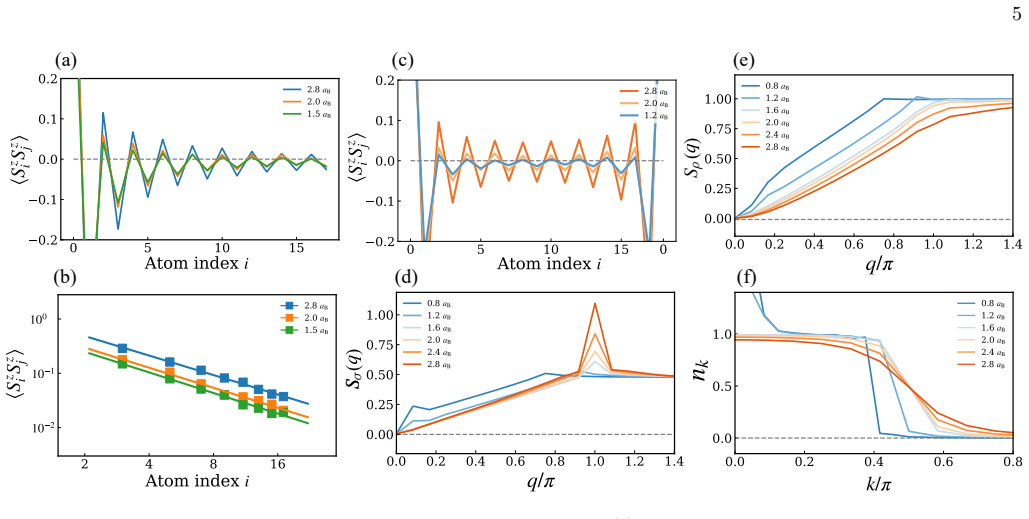
The authors claim that a fully correlated real-space neural-network wavefunction supplies the correct quantum-critical physics of the one-dimensional hydrogen chain, and that this is the first time neural networks capture Tomonaga-Luttinger liquid behavior. At interatomic distances $R > 1.6 a_{\rm B}$, the spin-spin correlation decays algebraically with exponent $\eta \approx 1.16$, the spin structure factor peaks at $q = \pi$ and disperses linearly near $q = 0$ with a Luttinger parameter $K_\sigma \approx 1.07$, and the momentum distribution is continuous at $k = \pi/2$ — the signatures of a Tomonaga-Luttinger liquid. At $R < 1.6 a_{\rm B}$, the spin-structure-factor peak shifts away from $q = \pi$, a kink appears at the same wave vector in the charge structure factor, and $n(k)$ sharpens at $k = \pi/2$ while building a peak above unity near $k = 0$; the authors interpret these abrupt changes as a breakdown of the Tomonaga-Luttinger liquid and the emergence of a Fermi-liquid-like phase. They connect this transition to self-doping, in which electrons occupy orbitals above 1s when atoms approach within about one Bohr radius, and support it with occupation numbers and Wannier orbitals sampled from the wavefunction.
Load-bearing premise
The Fermi-liquid identification rests on the assumption that the shifted spin-structure-factor peak and the sharpened momentum distribution seen at one periodic system size ($N = 24$, no finite-size extrapolation) are genuine Fermi-surface signatures rather than finite-size effects, an incommensurate spin-density wave, or a Tomonaga-Luttinger liquid with a large Luttinger parameter.
Editorial extensions
If this is right
- For interatomic distances above about 1.6 Bohr radii, hydrogen chains exhibit Tomonaga-Luttinger liquid behavior: algebraic spin correlations with $\eta \approx 1.16$, a linear spin structure factor at small $q$ with $K_\sigma \approx 1.07$, and a gapped charge mode.
- Below about 1.6 Bohr radii, the same chains show Fermi-liquid-like signatures—the spin structure factor peak leaving $q = \pi$, a kink in the charge structure factor, and a sharper momentum distribution at $k = \pi/2$—marking a quantum phase transition driven by self-doping.
- One-band lattice models based only on the hydrogen 1s orbital are inadequate for the small-distance regime, where electrons occupy higher orbitals and interactions extend beyond nearest neighbors.
- The reduced density matrix sampling framework can be carried over to other observables, including spectral densities and transition reduced density matrices relevant to photoemission, within the same real-space neural-network ansatz.
- Neural-network quantum Monte Carlo can therefore serve as a probe of quantum critical phases and transitions in realistic correlated systems without relying on basis-set extrapolation.
Reading between the lines
- A natural next calculation is to track the momentum-distribution step at $k = \pi/2$ and the $S_\sigma(q)$ peak shift with increasing cell size, which would separate the bulk Fermi-liquid transition from finite-size effects in the one-size ($N = 24$) periodic calculation.
- The same reduced density matrix protocol could be applied to other quasi-one-dimensional materials, such as doped chains or nanotubes, where Tomonaga-Luttinger liquid behavior coexists with multi-band physics.
- The authors do not directly resolve spin-charge separation; extracting the spectral function, for example through transition reduced density matrices as they suggest, would give a sharper test of whether the low-energy excitations are spinons and holons in the Tomonaga-Luttinger liquid regime.
Signed reviews
Editorial analysis
A structured set of objections, weighed in public.
Referee Report
Summary. This paper applies real-space neural-network quantum Monte Carlo (FermiNet for open chains, DeepSolid for periodic chains) to equispaced hydrogen chains over a range of interatomic distances R, and develops Monte Carlo sampling of 1- and 2-RDMs, spin and charge structure factors, and momentum distributions. After validating against published AFQMC/MRCI+Q energies (within ~1 mEh) and demonstrating Peierls dimerization and natural-orbital correlation signatures, the paper reports that for R>1.6 a_B the chains exhibit Tomonaga-Luttinger-liquid behavior: spin-spin correlations decaying as eta=1.16(5) close to the Heisenberg value, K_sigma=1.067 from the small-q slope of S_sigma(q), a gapped charge structure factor, and continuous n(k). For R<1.6 a_B the authors claim a transition to a Fermi-liquid-like phase, marked by a shift of the S_sigma(q) peak away from q=pi, a kink in S_rho(q), a sharpened n(k) at k=pi/2, and n(k)>1 near k=0, which they attribute to a self-doping mechanism involving orbitals above 1s.
Significance. If the Fermi-liquid claim holds, this is a significant result: it would identify a strictly one-dimensional ab initio system that escapes TLL universality and exhibits a quasi-particle-like Fermi surface, with implications for 1D materials and for the validity of one-band models. The paper's methodological contribution is also substantial: the importance-sampled RDM and structure-factor estimators provide a general route to extract second-quantized observables from continuous-space neural-network wavefunctions, and the energy benchmarks against AFQMC/MRCI+Q (within 1 mEh) plus the quantitative agreement of eta with the DMRG value 1.11(1) are concrete, reproducible checks. The TLL part of the paper is solid, and its falsifiable predictions (transition near 1.6 a_B, incommensurate spin peak, multi-band occupancy below the transition) make it a useful anchor for future work. The central new physical claim, however, is currently supported only by single-size, qualitative evidence, and the reported transition distance is not yet connected to the proposed self-doping mechanism.
major comments (3)
- [§III.C, Fig. 3(d-f)] The Fermi-liquid identification rests entirely on N=24 PBC data, with no finite-size scaling and no error bars reported for S_sigma(q) or n(k), and the paper does not state the set of interatomic distances computed or the procedure by which R_c=1.6 a_B is bracketed. The claim in §III.B that 'In SI Sec. I C we verify that this is not an artifact of finite size' is not checkable from the present version, since no supplementary material accompanies it. This matters because in a TLL with K_sigma near 1 and weak charge coupling, n(k) is continuous yet can be extremely steep at N=24, and the apparent S_sigma(q) peak shift could be a discrete-k mesh artifact (Delta q = 2 pi/24) or an incommensurate finite-size oscillation; similarly, n(k)>1 near k=0 needs a band-resolved or normalization check, since a single-band momentum distribution is bounded by unity. Please (i) plot S_sigma(q) and n(k) with statistical error bars; (ii) repeat for N=16, 24, 32, and 48, stating whether twisted boundary conditions are averaged over theta and including the average if so; (iii) extract the apparent n(k) jump height Z at k=pi/2 and the S_sigma(q) peak position q_max as functions of 1/N, since a Z(N) decaying as a power law in N is the TLL expectation whereas a Z(N) extrapolating to a nonzero constant would support the Fermi-liquid reading; and (iv) state the R values used and how R_c=1.6 a_B is determined. Without these, the abstract's claim of 'abrupt changes' and the transition itself are not established.
- [§III.C vs. Fig. 4(d)] The self-doping mechanism is claimed to drive the transition at R<1.6 a_B, but the orbital-occupation evidence is only reported to depart from the one-band description below roughly 1.0 a_B: the text states that a non-negligible amount of electrons occupies orbitals above 1s, 2s, and 2p 'for separation less than 1.0 a_B' and that the lowest localized orbital contains less than 90% of the electrons only 'for atomic distances smaller than 1.0 a_B.' The 1.0 to 1.6 a_B window, in which the TLL-to-Fermi-liquid transition is claimed, is therefore not covered by the mechanism evidence. Please report the orbital occupations at R=1.2, 1.4, and 1.6 a_B and correlate the onset of multi-band occupation with the changes in S_sigma(q) and n(k), or revise the statement of the mechanism.
- [§III.C] The theoretical identification of the small-R phase as a Fermi liquid needs an argument or direct evidence beyond the sharpening of n(k). In one dimension, interacting electronic systems generically form (possibly multi-component) TLLs, and neither multiple Fermi points (refs. 24-25) nor the presence of extended interactions (ref. 2) by itself restores a nonzero quasiparticle weight; the natural alternative reading of the data is a weakly interacting TLL whose continuous but steep n(k) and incommensurate S_sigma(q) peak are finite-size effects (subject to the test in the first major comment), or an incommensurate spin-density-wave state. The paper itself labels the R=1.0 chain a 'band conductor' in Fig. 4(a), which is weaker than 'Fermi liquid.' Please either (i) soften the terminology to 'Fermi-liquid-like' or 'band conductor' throughout, or (ii) provide an additional diagnostic that directly probes quasiparticles, e.g., a momentum-resolved spectral function using the RDM/photoemission route cited as ref. 28, or momentum distributions at larger L from an independent method such as DMRG for R=1.2-1.4 a_B.
minor comments (6)
- [§III.A] The text reads 'the well-known Peiers instability'; this should be 'Peierls instability.'
- [§III.C, second paragraph] The sentence 'For the momentum distribution (Fig. 3(d))' should refer to Fig. 3(f), which is the panel showing n(k).
- [§III.B] The spin-sector parameter K_sigma is a Luttinger parameter, not a central charge; the sentence 'the slope of the spin structure factor is related to the central charge K_sigma' should be reworded, since the central charge of this TLL is c=1.
- [§III.B] Only the critical exponent at 2.8 a_B is quoted (eta=1.16(5)); to support the claim that eta and K_sigma are unchanged for medium-to-large R, please report the fitted values, uncertainties, and fitting ranges for every computed interatomic distance, either in the text or in a table.
- [§II.C] The twisted-boundary-condition k-point formula k=(2m pi + theta)/N is dimensionally inconsistent; the lattice constant a should appear in the denominator, i.e., k=(2m pi + theta)/(N a).
- [Supplementary material] The manuscript cites 'SI Sec. I C' and 'SI Sec. II' for the finite-size verification and the magnetic-perturbation test, but no supplementary material accompanies this version, so those supporting checks are not verifiable as submitted.
Circularity Check
No significant circularity: observables are sampled from a variational wavefunction and matched to independent TLL/CFT benchmarks; the claimed transition is read off from independently sampled S_sigma(q) and n(k), with no fitted parameter renamed as a prediction.
full rationale
The paper's derivation chain is: (1) optimize a neural-network wavefunction by variational energy minimization; (2) sample 1-RDM/2-RDM, spin/charge structure factors, and momentum distribution from the optimized wavefunction; (3) compare sampled correlations with standard TLL/CFT predictions and interpret qualitative changes in S_sigma(q) and n(k) as a transition to a Fermi-liquid-like phase. No step fits a parameter to the quantity later called a prediction: K_sigma and eta are extracted from the sampled data and compared with independent CFT/Hubbard values, not used to define the phase. The Fermi-liquid identification rests on a qualitative change of independently sampled observables; whether that change survives the thermodynamic limit is a finite-size/correctness issue, not a circular one. Self-citations (refs. 13, 15, 27) concern the DeepSolid/RDM methodology, but the methodology is externally benchmarked in this work against AFQMC, MRCI+Q, and DMRG results (Fig. 2; Fig. 3(b)), so the citations are real evidence rather than load-bearing circularity. No uniqueness theorem is imported, and no ansatz is smuggled in via citation. One flagged tension is in Sec. III C / Fig. 4(d): the self-doping occupation excess is reported mainly below 1.0 a_B, while the claimed transition is at 1.6 a_B; this is an explanatory gap and a finite-size concern, but it is not a definitional reduction of the result to its inputs.
Assumptions & free parameters
free parameters (3)
- Critical exponent η (spin-spin correlation decay) =
1.16(5) at R=2.8 a_B (OBC N=18)
- Luttinger parameter Kσ =
1.067 at R=2.8 a_B (PBC N=24)
- Transition distance R_c (TLL to Fermi liquid) =
≈ 1.6 a_B
assumptions (3)
- standard math The spin-spin correlation of a one-dimensional Heisenberg chain decays as (-1)^i i^{-η} ln i, with η=1 (conformal field theory prediction).
- domain assumption The hydrogen chain at large interatomic distance belongs to the same universality class as the Heisenberg model (TLL with Kσ=1).
- domain assumption The neural network ansatz (FermiNet/DeepSolid) is expressive enough to approximate the ground state to the accuracy needed for the computed observables.
Cite this review
Pith. "Pith review of Probing quantum critical phase from neural network wavefunction." pith.science (2026). https://pith.science/paper/BKGPVUH5
@misc{pith2026241119938,
  author       = {Pith},
  title        = {Pith review of: Probing quantum critical phase from neural network wavefunction},
  year         = {2026},
  howpublished = {\url{https://pith.science/paper/BKGPVUH5}},
  note         = {Machine review of arXiv:2411.19938}
}
read the original abstract
One-dimensional (1D) systems and models provide a versatile platform for emergent phenomena induced by strong electron correlation. In this work, we extend the newly developed real space neural network quantum Monte Carlo methods to study the quantum phase transition of electronic and magnetic properties. Hydrogen chains of different interatomic distances are explored systematically with both open and periodic boundary conditions, and fully correlated ground state many-body wavefunction is achieved via unsupervised training of neural networks. We demonstrate for the first time that neural networks are capable of capturing the quantum critical behavior of Tomonaga- Luttinger liquid (TLL), which is known to dominate 1D quantum systems. Moreover, we reveal the breakdown of TLL phase and the emergence of a Fermi liquid behavior, evidenced by abrupt changes in the spin structure and the momentum distribution. Such behavior is absent in commonly studied 1D lattice models and is likely due to the involvement of high-energy orbitals of hydrogen atoms. Our work highlights the powerfulness of neural networks for representing complex quantum phases.
Figures


Figures from the paper (1 more)

Reference graph
Works this paper leans on
-
[1]
First, the neural network is trained with an unsuper- vised learning process according to the variational prin- ciple. After training, electronic and magnetic properties are extracted from the optimal many-body neural net- work wavefunction, either by direct stochastic samplings or via 1- and 2-RDMs. The behaviors of different quan- tum phases are then pr...
-
[2]
BreakdownofLut- tinger liquid state in a one-dimensional frustrated spin- less fermion model
A.K.ZhuravlevandM.I.Katsnelson. BreakdownofLut- tinger liquid state in a one-dimensional frustrated spin- less fermion model. Physical Review B , 61(23):15534– 15537, June 2000
work page 2000
-
[3]
Ling-FangLin, YangZhang, GonzaloAlvarez, MichaelA. McGuire, Andrew F. May, Adriana Moreo, and Elbio Dagotto. Stability of the interorbital-hopping mecha- nism for ferromagnetism in multi-orbital Hubbard mod- els. Communications Physics, 6(1):1–9, August 2023
work page 2023
-
[4]
kicks in. The conventional understanding of the hy- drogenchainisbasedontheone-bandmodels, whereonly the hydrogen 1s orbital is considered [20, 22, 23]. The one-band models can well capture the physics of large- distancechainsasdiscussedintheprevioussection. How- ever, as the electrons become more diffusive, they start to occupy bands formed by orbitals h...
-
[5]
T. B. Prayitno and R. Fahdiran. Phase transition in 8 one-dimensional hydrogen chain: A dependence on basis orbitals, cut off radius, and doping.Journal of Physics: Conference Series, 1402(4):044080, December 2019
work page 2019
-
[6]
Simons Collaboration on the Many-Electron Problem, Mario Motta, Claudio Genovese, Fengjie Ma, Zhi-Hao Cui, RandySawaya, GarnetKin-LicChan, NataliaChep- iga, PhillipHelms, CarlosJiménez-Hoyos, AndrewJ.Mil- lis, Ushnish Ray, Enrico Ronca, Hao Shi, Sandro Sorella, Edwin M. Stoudenmire, Steven R. White, and Shiwei Zhang. Ground-State Properties of the Hydroge...
work page 2020
-
[7]
Johannes Hachmann, Wim Cardoen, and Garnet K. Chan. Multireference correlation in long molecules with the quadratic scaling density matrix renormalization group. The Journal of chemical physics , 125(14):144101– 144101–12, 2006
work page 2006
-
[8]
W. A. Al-Saidi, Shiwei Zhang, and Henry Krakauer. Bond breaking with auxiliary-field quantum Monte Carlo. The Journal of Chemical Physics , 127(14):144101, 10 2007
work page 2007
Show all 30 references
-
[9]
A Blocked Linear Method for Optimizing Large Parameter Sets in Vari- ational Monte Carlo
Luning Zhao and Eric Neuscamman. A Blocked Linear Method for Optimizing Large Parameter Sets in Vari- ational Monte Carlo. Journal of Chemical Theory and Computation, 13(6):2604–2611, June 2017
2017
-
[10]
Strong electronic correlation in the hydro- gen chain: A variational Monte Carlo study
Lorenzo Stella, Claudio Attaccalite, Sandro Sorella, and Angel Rubio. Strong electronic correlation in the hydro- gen chain: A variational Monte Carlo study. Physical Review B, 84(24):245117, December 2011
2011
-
[11]
Sinitskiy, Loren Greenman, and David A
Anton V. Sinitskiy, Loren Greenman, and David A. Mazziotti. Strong correlation in hydrogen chains and lattices using the variational two-electron reduced den- sity matrix method. The Journal of Chemical Physics , 133(1):014104, July 2010
2010
-
[12]
Full-configuration- interaction study of the metal-insulator transition in model systems: Peierls dimerization in Hn rings and chains
Emmanuel Giner, Gian Luigi Bendazzoli, Stefano Evangelisti, and Antonio Monari. Full-configuration- interaction study of the metal-insulator transition in model systems: Peierls dimerization in Hn rings and chains. The Journal of Chemical Physics , 138(7):074315, February 2013
2013
-
[13]
Spencer, Alexander G
David Pfau, James S. Spencer, Alexander G. D. G. Matthews, and W. M. C. Foulkes. Ab initio solution of the many-electron Schrödinger equation with deep neu- ral networks. Physical Review Research , 2(3):033429, September 2020
2020
-
[14]
David Pfau, Simon Axelrod, Halvard Sutterud, Ingrid von Glehn, and James S. Spencer. Accurate computation of quantum excited states with neural networks.Science, 385(6711):eadn0137, 2024
2024
-
[15]
Ab initio calculation of real solids via neural network ansatz.Nature Communi- cations, 13(1):7895, December 2022
Xiang Li, Zhe Li, and Ji Chen. Ab initio calculation of real solids via neural network ansatz.Nature Communi- cations, 13(1):7895, December 2022
2022
-
[16]
Gino Cassella, Halvard Sutterud, Sam Azadi, N. D. Drummond, DavidPfau, JamesS.Spencer, andW.M.C. Foulkes. Discovering quantum phase transitions with fermionic neural networks.Phys. Rev. Lett., 130:036401, Jan 2023
2023
-
[17]
Electric polariza- tion from a many-body neural network ansatz
Xiang Li, Yubing Qian, and Ji Chen. Electric polariza- tion from a many-body neural network ansatz. Phys. Rev. Lett., 132:176401, Apr 2024
2024
-
[18]
Neural-network quantum states for periodic systems in continuous space
Gabriel Pescia, Jiequn Han, Alessandro Lovato, Jian- feng Lu, and Giuseppe Carleo. Neural-network quantum states for periodic systems in continuous space. Phys. Rev. Res., 4:023138, May 2022
2022
-
[19]
Ceperley, Garnet Kin-Lic Chan, John A
Mario Motta, David M. Ceperley, Garnet Kin-Lic Chan, John A. Gomez, Emanuel Gull, Sheng Guo, Carlos A. Jiménez-Hoyos, Tran Nguyen Lan, Jia Li, Fengjie Ma, Andrew J. Millis, Nikolay V. Prokof’ev, Ushnish Ray, Gustavo E. Scuseria, Sandro Sorella, Edwin M. Stouden- mire, Qiming S...
2017
-
[20]
Kądzielawa, Andrzej Biborski, and Józef Spałek
Andrzej P. Kądzielawa, Andrzej Biborski, and Józef Spałek. Discontinuous transition of molecular-hydrogen chain to the quasiatomic state: Combined exact di- agonalization and ab initio approach. Phys. Rev. B , 92:161101, Oct 2015
2015
-
[21]
Kądzielawa, and Józef Spałek
Andrzej Biborski, Andrzej P. Kądzielawa, and Józef Spałek. Atomization of correlated molecular-hydrogen chain: A fully microscopic variational monte carlo solu- tion. Phys. Rev. B , 98:085112, Aug 2018
2018
-
[22]
Critical behaviour of spin-s Heisenberg antiferromagnetic chains: Analytic and numerical results
I.Affleck, D.Gepner, H.J.Schulz, andT.Ziman. Critical behaviour of spin-s Heisenberg antiferromagnetic chains: Analytic and numerical results. Journal of Physics A: Mathematical and General, 22(5):511, March 1989
1989
-
[23]
Sandvik, Leon Balents, and David K
Anders W. Sandvik, Leon Balents, and David K. Campbell. Ground state phases of the half-filled one- dimensional extended hubbard model. Phys. Rev. Lett. , 92:236401, Jun 2004
2004
-
[24]
Holger Frahm and V. E. Korepin. Critical exponents for the one-dimensional Hubbard model.Physical Review B, 42(16):10553–10565, December 1990
1990
-
[25]
Exact correlation amplitude for the Heisen- berg antiferromagnetic chain
Ian Affleck. Exact correlation amplitude for the Heisen- berg antiferromagnetic chain. Journal of Physics A: Mathematical and General, 31(20):4573, May 1998
1998
-
[26]
Daul and R
S. Daul and R. M. Noack. Ferromagnetic transition and phase diagram of the one-dimensional hubbard model with next-nearest-neighbor hopping. Phys. Rev. B , 58:2635–2650, Aug 1998
1998
-
[27]
Superconductivity from doping a spin- liquid insulator: A simple one-dimensional example
Michele Fabrizio. Superconductivity from doping a spin- liquid insulator: A simple one-dimensional example. Physical Review B, 54(14):10054–10060, October 1996
1996
-
[28]
Jan Hermann, James Spencer, Kenny Choo, Antonio Mezzacapo, W. M. C. Foulkes, David Pfau, Giuseppe Carleo, and Frank Noé. Ab initio quantum chem- istry with neural-network wavefunctions.Nature Reviews Chemistry, 7(10):692–709, October 2023
2023
-
[29]
Deep learning quantum Monte Carlo for solids.arXiv e- prints, page arXiv:2407.00707, June 2024
Yubing Qian, Xiang Li, Zhe Li, Weiluo Ren, and Ji Chen. Deep learning quantum Monte Carlo for solids.arXiv e- prints, page arXiv:2407.00707, June 2024
2024 arXiv
-
[30]
Stefano Di Sabatino, J. A. Berger, Lucia Reining, and Pina Romaniello. Photoemission spectra from reduced density matrices: The band gap in strongly correlated systems. Phys. Rev. B , 94:155141, Oct 2016
2016
Reviewed August 12, 2026 · model on record in the stance chip above.
Discussion (0). Continue with ORCID to comment.