The Lumina Project: CMB Optical Depth Fluctuations from Patchy Reionization
Pith reviewed 2026-05-20 08:36 UTC · model grok-4.3
The pith
Line-of-sight optical depth through patchy reionization exceeds volume-weighted estimates by 7 percent.
A machine-rendered reading of the paper's core claim, the machinery that carries it, and where it could break.
Core claim
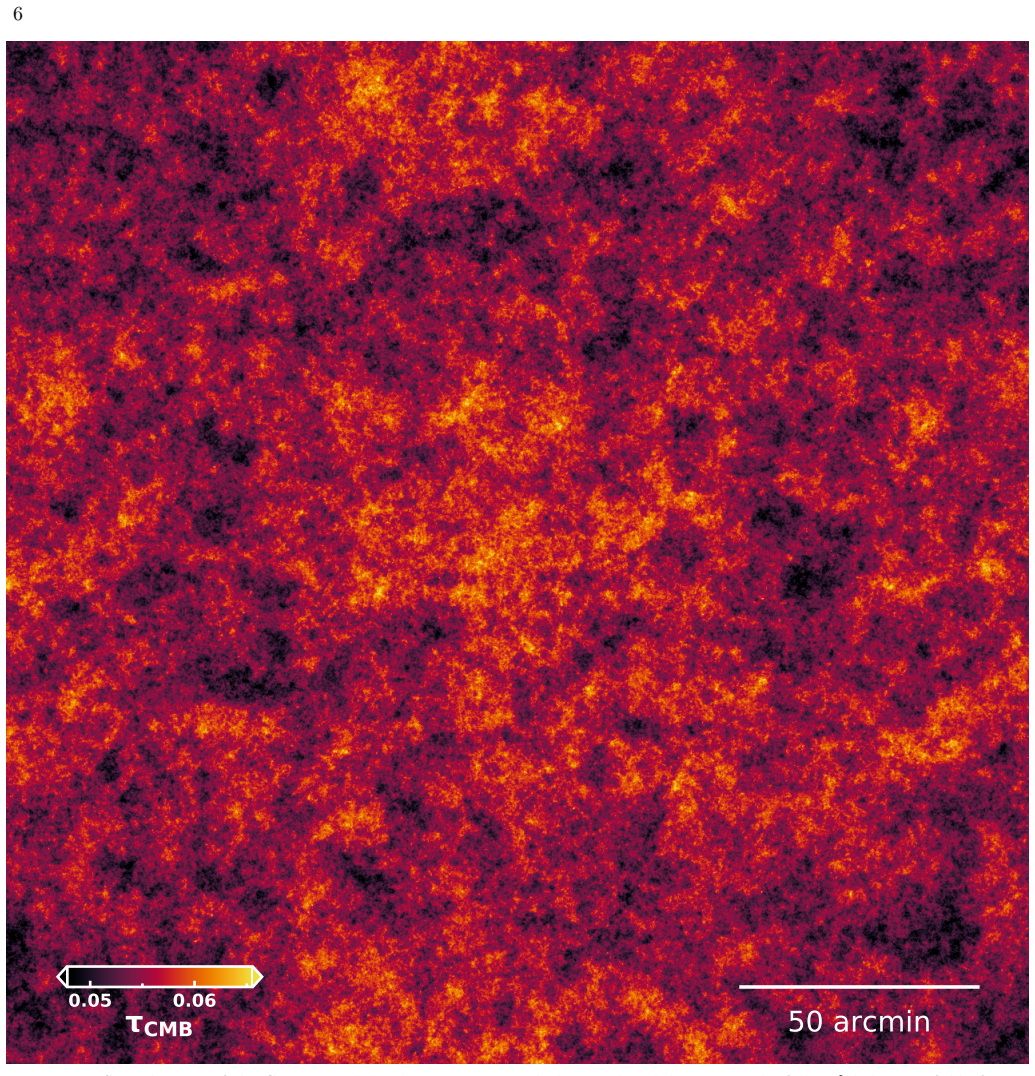
Using the Lumina radiation-hydrodynamical simulation, the sightline-averaged optical depth in the light cone is 0.0550, which exceeds the global volume-weighted value of 0.0515 by approximately 7 percent. This enhancement is largely captured by the global mass-weighted prediction of 0.0544. The excess accumulates primarily near redshift 8, where the combination of high density and ionization patchiness is strongest, and the resulting optical depth field shows non-Gaussian fluctuations with at least 5 percent sightline-to-sightline scatter.
What carries the argument
Explicit line-of-sight integration through on-the-fly light cones that couple the density field to the patchy ionization morphology.
If this is right
- Precision comparisons to CMB optical-depth constraints should use mass-weighted electron fractions or explicit light-cone integration rather than volume-weighted ionized fractions alone.
- The excess optical depth accumulates primarily near z_LOS = 8.0 where high physical density and strong ionization-field patchiness coincide.
- The tau_LOS field is non-Gaussian and exhibits at least 5 percent sightline-to-sightline scatter tracing rare early-ionized overdensities.
- Smoothing the ionization field on scales of 3 cMpc or larger suppresses the density-ionization correlation and biases tau_CMB low.
Where Pith is reading between the lines
- Current global reionization models that rely on volume-weighted averages may systematically underestimate the total electron scattering optical depth to the CMB.
- High-precision CMB experiments might eventually measure the non-Gaussian scatter in optical depth to probe the morphology of reionization directly.
- Adjusting for this density-ionization correlation could shift the inferred redshift of reionization by a small but measurable amount.
Load-bearing premise
The simulation volume, resolution, and included physics are sufficient to capture the coupling between density and patchy ionization without dominant numerical artifacts.
What would settle it
A higher-resolution simulation or one with different feedback physics that yields a significantly smaller or larger difference between light-cone and volume-weighted optical depths would challenge the 7 percent enhancement.
Figures



read the original abstract
Patchy reionization couples the ionized-bubble morphology to the underlying density field, making the CMB Thomson optical depth sensitive to both the global ionization history and anisotropic fluctuations on the sky. Using the large-volume radiation-hydrodynamical Lumina simulation, we compute $\tau_{\rm CMB}$ in two ways: (i) from global volume- and mass-weighted ionization histories, and (ii) from explicit line-of-sight integrations through on-the-fly light cones. We find that the sightline-averaged optical depth in the light cone, $\langle \tau_{\rm LOS} \rangle = 0.0550$, exceeds the value inferred from a global volume-weighted history, $\tau_{{\rm CMB},V} = 0.0515$, by $\approx 7\%$. This enhancement is largely captured by the global mass-weighted prediction, $\tau_{{\rm CMB},m} = 0.0544$, indicating that precision comparisons to CMB optical-depth constraints should use mass-weighted electron fractions or explicit light-cone integration rather than volume-weighted ionized fractions alone. The excess optical depth accumulates primarily near $z_{\rm LOS} = 8.0^{+1.9}_{-1.3}$, where the combination of high physical density and strong ionization-field patchiness is greatest. The resulting $\tau_{\rm LOS}$ field is non-Gaussian and exhibits $\gtrsim 5\%$ sightline-to-sightline scatter, with fluctuations tracing rare early-ionized overdensities and large-scale structure. Coarse-graining experiments show that smoothing the ionization field on $\gtrsim 3 {\rm cMpc}$ scales suppresses the density-ionization correlation and biases $\tau_{\rm CMB}$ low relative to the resolved calculation. Finally, angular power spectra and real-space correlation functions decomposed into HII, HeII, and HeIII auto- and cross-contributions reveal scale-dependent departures from simple hydrogen-helium co-tracing and evolving characteristic scales with redshift.
Editorial analysis
A structured set of objections, weighed in public.
Referee Report
Summary. The manuscript uses the large-volume radiation-hydrodynamical Lumina simulation to compute the CMB Thomson optical depth τ_CMB from patchy reionization. It compares values obtained from global volume-weighted (τ_CMB,V = 0.0515) and mass-weighted (τ_CMB,m = 0.0544) ionization histories against explicit line-of-sight integrations through on-the-fly light cones, reporting that the sightline-averaged ⟨τ_LOS⟩ = 0.0550 exceeds the volume-weighted value by ≈7%. The excess accumulates primarily near z_LOS ≈ 8, the resulting τ_LOS field is non-Gaussian with ≳5% scatter, and angular power spectra are decomposed into HII, HeII, and HeIII contributions. Coarse-graining tests indicate that smoothing the ionization field on ≳3 cMpc scales suppresses the density-ionization correlation.
Significance. If the central result holds, the work provides a concrete quantitative demonstration that density-ionization correlations during patchy reionization enhance the effective CMB optical depth by ~7% relative to volume-weighted global histories, with mass-weighted averages recovering most of the effect. This has direct implications for precision CMB analyses and reionization modeling. Strengths include the use of a large-volume radiation-hydrodynamical simulation with explicit on-the-fly light-cone integrations and the decomposition of power spectra into ionization-species auto- and cross-correlations.
major comments (1)
- The central 7% enhancement claim (⟨τ_LOS⟩ = 0.0550 vs. τ_CMB,V = 0.0515) depends on the simulation accurately capturing density-ionization correlations on the scales that contribute near z_LOS ≈ 8. The abstract describes a coarse-graining test at ≳3 cMpc but provides no explicit resolution or volume convergence study for the light-cone versus global-history difference itself. Without such tests, it remains possible that under-resolved small-scale bubbles or overdensity sampling artificially affects the reported excess optical depth.
minor comments (1)
- The asymmetric error bar on z_LOS = 8.0^{+1.9}_{-1.3} is presented clearly in the abstract but would benefit from a brief explanation of its derivation in the main text for readers unfamiliar with the light-cone construction.
Simulated Author's Rebuttal
We thank the referee for their careful reading of the manuscript and for the constructive major comment, which highlights an important aspect of robustness. We address the point in detail below and will update the manuscript to incorporate additional convergence discussion and tests.
read point-by-point responses
-
Referee: The central 7% enhancement claim (⟨τ_LOS⟩ = 0.0550 vs. τ_CMB,V = 0.0515) depends on the simulation accurately capturing density-ionization correlations on the scales that contribute near z_LOS ≈ 8. The abstract describes a coarse-graining test at ≳3 cMpc but provides no explicit resolution or volume convergence study for the light-cone versus global-history difference itself. Without such tests, it remains possible that under-resolved small-scale bubbles or overdensity sampling artificially affects the reported excess optical depth.
Authors: We agree that explicit convergence tests would further strengthen confidence in the reported 7% enhancement. The existing coarse-graining analysis already demonstrates that the density-ionization correlation driving the excess optical depth is suppressed for smoothing scales ≳3 cMpc, implying that the effect arises primarily from structures well within the resolved range of the simulation rather than from the smallest bubbles. The Lumina volume is large enough to provide good sampling of the overdensities that dominate near z_LOS ≈ 8, and the light-cone integrations are performed at the native grid resolution. Nevertheless, we acknowledge the referee's point that a dedicated study isolating the light-cone versus global-history difference has not yet been presented. In the revised manuscript we will add a new subsection that quantifies convergence by (i) repeating the light-cone analysis on sub-volumes of varying size and (ii) comparing results at the fiducial resolution against a lower-resolution counterpart, thereby directly testing the sensitivity of the 7% difference to volume sampling and small-scale resolution. We expect these tests to confirm that the enhancement is robust. revision: yes
Circularity Check
No circularity: optical depth values obtained by direct integration through simulation outputs
full rationale
The paper's central quantitative results—⟨τ_LOS⟩ = 0.0550, τ_CMB,V = 0.0515, and τ_CMB,m = 0.0544—are computed by explicit line-of-sight integration and global averaging over the Lumina radiation-hydrodynamical simulation outputs. These quantities are not obtained by fitting parameters to the target differences, nor are they defined in terms of each other. The reported 7% enhancement and its partial recovery by the mass-weighted history emerge from the simulated density-ionization correlations rather than being imposed by construction. No load-bearing step invokes a self-citation chain, uniqueness theorem from prior author work, or smuggled ansatz to justify the comparison methods. Coarse-graining tests and power-spectrum decompositions are likewise direct post-processing of the same simulation data. The derivation chain is therefore self-contained and independent of the target result.
Axiom & Free-Parameter Ledger
axioms (1)
- domain assumption The radiation-hydrodynamical simulation accurately captures the morphology of ionized bubbles and their correlation with the underlying density field.
Lean theorems connected to this paper
-
IndisputableMonolith/Foundation/RealityFromDistinction.leanreality_from_one_distinction unclear?
unclearRelation between the paper passage and the cited Recognition theorem.
We compute τ_CMB in two ways: (i) from global volume- and mass-weighted ionization histories, and (ii) from explicit line-of-sight integrations through on-the-fly light cones. … ⟨τ_LOS⟩ = 0.0550 exceeds … τ_CMB,V = 0.0515 by ≈7 %. This enhancement is largely captured by … τ_CMB,m = 0.0544.
-
IndisputableMonolith/Cost/FunctionalEquation.leanwashburn_uniqueness_aczel unclear?
unclearRelation between the paper passage and the cited Recognition theorem.
Coarse-graining experiments show that smoothing the ionization field on ≳3 cMpc scales suppresses the density–ionization correlation
What do these tags mean?
- matches
- The paper's claim is directly supported by a theorem in the formal canon.
- supports
- The theorem supports part of the paper's argument, but the paper may add assumptions or extra steps.
- extends
- The paper goes beyond the formal theorem; the theorem is a base layer rather than the whole result.
- uses
- The paper appears to rely on the theorem as machinery.
- contradicts
- The paper's claim conflicts with a theorem or certificate in the canon.
- unclear
- Pith found a possible connection, but the passage is too broad, indirect, or ambiguous to say the theorem truly supports the claim.
Reference graph
Works this paper leans on
-
[1]
Introducing the THESAN project: radiation-magnetohydrodynamic simulations of the epoch of reionization. , keywords =. doi:10.1093/mnras/stab3710 , archivePrefix =. 2110.00584 , primaryClass =
-
[2]
doi:10.1093/mnras/staa3773 , eprint =
, keywords =. doi:10.1093/mnras/staa3773 , eprint =
-
[3]
The THESAN project: predictions for multitracer line intensity mapping in the epoch of reionization. , keywords =. doi:10.1093/mnras/stac1557 , archivePrefix =. 2111.02411 , primaryClass =
-
[4]
The THESAN project: properties of the intergalactic medium and its connection to reionization-era galaxies. , keywords =. doi:10.1093/mnras/stac257 , archivePrefix =. 2110.01628 , primaryClass =
-
[5]
The THESAN project: Lyman- emission and transmission during the Epoch of Reionization. , keywords =. doi:10.1093/mnras/stac713 , archivePrefix =. 2110.02966 , primaryClass =
-
[6]
doi:10.1093/mnras/stae839 , archivePrefix =
The THESAN project: public data release of radiation-hydrodynamic simulations matching reionization-era JWST observations , journal =. doi:10.1093/mnras/stae839 , archivePrefix =. 2309.06475 , primaryClass =
-
[7]
The THESAN project: ionizing escape fractions of reionization-era galaxies. , keywords =. doi:10.1093/mnras/stad210 , archivePrefix =. 2205.02238 , primaryClass =
-
[8]
The THESAN project: environmental drivers of Local Group reionization. , year = 2026, volume =. doi:10.1093/mnras/stag500 , archivePrefix =. 2507.16245 , primaryClass =
-
[9]
The THESAN project: Lyman-alpha emitters as probes of ionized bubble sizes
The THESAN project: Lyman-alpha emitters as probes of ionized bubble sizes. The Open Journal of Astrophysics , year = 2026, month = apr, volume =. doi:10.33232/001c.160756 , archivePrefix =. 2510.18946 , primaryClass =
work page internal anchor Pith review Pith/arXiv arXiv doi:10.33232/001c.160756 2026
-
[10]
Madau, Piero and Haardt, Francesco and Rees, Martin J. , title =. The Astrophysical Journal , year =. doi:10.1086/306975 , adsurl =
-
[11]
Reionization of the Inhomogeneous Universe , journal =
Miralda-Escud. Reionization of the Inhomogeneous Universe , journal =. 2000 , volume =. doi:10.1086/308330 , adsurl =
-
[12]
Finlator, Kristian and Oh, S. Peng and. Gas clumping in self-consistent reionization models , journal =. 2012 , volume =. doi:10.1111/j.1365-2966.2012.22114.x , adsurl =
-
[13]
Monthly Notices of the Royal Astronomical Society , year =
Sobacchi, Emanuele and Mesinger, Andrei , title =. Monthly Notices of the Royal Astronomical Society , year =. doi:10.1093/mnras/stu377 , eprint =
-
[14]
Kaurov, Alexander A. and Gnedin, Nickolay Y. , title =. The Astrophysical Journal , year =. doi:10.1088/0004-637X/810/2/154 , adsurl =
-
[15]
Davies, Frederick B. and Furlanetto, Steven R. , title =. Monthly Notices of the Royal Astronomical Society , year =. doi:10.1093/mnras/stw931 , adsurl =
-
[16]
Rahmati, Alireza and Pawlik, Andreas H. and Rai. On the evolution of the H\,. Monthly Notices of the Royal Astronomical Society , year =. doi:10.1093/mnras/stt066 , eprint =
-
[17]
Hui, Lam and Gnedin, Nickolay Y. , title =. Monthly Notices of the Royal Astronomical Society , year =. doi:10.1093/mnras/292.1.27 , eprint =
-
[18]
Verner, D. A. and Ferland, Gary J. and Korista, Kirk T. and Yakovlev, D. G. , title =. The Astrophysical Journal , year =
-
[19]
The Aurora radiation-hydrodynamical simulations of reionization: calibration and first results
The Aurora radiation-hydrodynamical simulations of reionization: calibration and first results. , keywords =. doi:10.1093/mnras/stw2869 , archivePrefix =. 1603.00034 , primaryClass =
work page internal anchor Pith review Pith/arXiv arXiv doi:10.1093/mnras/stw2869
-
[20]
Cosmic Reionization on Computers: Physical Origin of Long Dark Gaps in Quasar Absorption Spectra. , keywords =. doi:10.3847/1538-4357/ac8d0a , archivePrefix =. 2204.05338 , primaryClass =
-
[21]
LyC escape from SPHINX galaxies in the Epoch of Reionization. , keywords =. doi:10.1093/mnras/stac1942 , archivePrefix =. 2207.03232 , primaryClass =
-
[22]
The SPHINX cosmological simulations of the first billion years: the impact of binary stars on reionization. , keywords =. doi:10.1093/mnras/sty1655 , archivePrefix =. 1801.07259 , primaryClass =
work page internal anchor Pith review Pith/arXiv arXiv doi:10.1093/mnras/sty1655
-
[23]
SPICE: the connection between cosmic reionization and stellar feedback in the first galaxies. , keywords =. doi:10.1093/mnras/stae1125 , archivePrefix =. 2310.16895 , primaryClass =
-
[24]
Cosmic Dawn (CoDa): the First Radiation-Hydrodynamics Simulation of Reionization and Galaxy Formation in the Local Universe. , keywords =. doi:10.1093/mnras/stw2036 , archivePrefix =. 1511.00011 , primaryClass =
work page internal anchor Pith review Pith/arXiv arXiv doi:10.1093/mnras/stw2036
-
[25]
Cosmic Dawn II (CoDa II): a new radiation-hydrodynamics simulation of the self-consistent coupling of galaxy formation and reionization. , keywords =. doi:10.1093/mnras/staa1266 , archivePrefix =. 1811.11192 , primaryClass =
-
[26]
The short ionizing photon mean free path at z = 6 in Cosmic Dawn III, a new fully coupled radiation-hydrodynamical simulation of the Epoch of Reionization. , keywords =. doi:10.1093/mnras/stac2383 , archivePrefix =. 2202.05869 , primaryClass =
-
[27]
Cosmic Reionization on Computers. I. Design and Calibration of Simulations. , keywords =. doi:10.1088/0004-637X/793/1/29 , archivePrefix =. 1403.4245 , primaryClass =
work page internal anchor Pith review Pith/arXiv arXiv doi:10.1088/0004-637x/793/1/29
-
[28]
Jiang, Hanchun and Namikawa, Toshiya , year=. Impact of the reionization history on constraining primordial gravitational waves in future all-sky cosmic microwave background experiments , volume=. Physical Review D , publisher=. doi:10.1103/physrevd.111.083555 , number=
-
[29]
The Cosmic Microwave Background Optical Depth Constrains the Duration of Reionization. , keywords =. doi:10.3847/2041-8213/ade141 , archivePrefix =. 2505.15899 , primaryClass =
-
[30]
Planck 2018 results. VI. Cosmological parameters. , keywords =. doi:10.1051/0004-6361/201833910 , archivePrefix =. 1807.06209 , primaryClass =
work page internal anchor Pith review Pith/arXiv arXiv doi:10.1051/0004-6361/201833910 2018
-
[31]
Reconstructing Patchy Reionization from the Cosmic Microwave Background
Reconstructing patchy reionization from the cosmic microwave background. , keywords =. doi:10.1103/PhysRevD.79.043003 , archivePrefix =. 0812.1566 , primaryClass =
work page internal anchor Pith review Pith/arXiv arXiv doi:10.1103/physrevd.79.043003
-
[32]
B-mode CMB Polarization from Patchy Screening during Reionization
, keywords =. doi:10.1103/PhysRevD.79.107302 , archiveprefix =. 0902.4413 , primaryclass =
work page internal anchor Pith review Pith/arXiv arXiv doi:10.1103/physrevd.79.107302
-
[33]
Reionization optical depth determination from Planck HFI data with ten percent accuracy. , keywords =. doi:10.1051/0004-6361/201936630 , archivePrefix =. 1908.09856 , primaryClass =
-
[34]
Inference of the optical depth to reionization from low multipole temperature and polarization Planck data. , keywords =. doi:10.1093/mnras/stab2215 , archivePrefix =. 2103.14378 , primaryClass =
-
[35]
The Reionization Parameter Space Consistent with the Thomson Optical Depth from Planck
The Reionization Parameter Space Consistent with the Thomson Optical Depth from Planck. Research Notes of the American Astronomical Society , keywords =. doi:10.3847/2515-5172/aad68a , archivePrefix =. 1808.00553 , primaryClass =
work page internal anchor Pith review Pith/arXiv arXiv doi:10.3847/2515-5172/aad68a
-
[36]
AMBER: A Semi-numerical Abundance Matching Box for the Epoch of Reionization. , keywords =. doi:10.3847/1538-4357/ac5116 , archivePrefix =. 2109.10375 , primaryClass =
-
[37]
Patchy Kinetic Sunyaev-Zel'dovich Effect with Controlled Reionization History and Morphology. , keywords =. doi:10.3847/1538-4357/ac8481 , archivePrefix =. 2203.04337 , primaryClass =
-
[38]
SCORCH. II. Radiation-hydrodynamic Simulations of Reionization with Varying Radiation Escape Fractions. , keywords =. doi:10.3847/1538-4357/aaef75 , archivePrefix =. 1712.04464 , primaryClass =
work page internal anchor Pith review Pith/arXiv arXiv doi:10.3847/1538-4357/aaef75
-
[39]
Parametrizing the Reionization History with the Redshift Midpoint, Duration, and Asymmetry
Parametrizing the Reionization History with the Redshift Midpoint, Duration, and Asymmetry. , keywords =. doi:10.3847/2041-8213/aabff0 , archivePrefix =. 1804.00672 , primaryClass =
work page internal anchor Pith review Pith/arXiv arXiv doi:10.3847/2041-8213/aabff0 2041
-
[40]
Evidence for asymmetric reionization histories from a joint analysis of the cosmic microwave background and astrophysical data. , keywords =. doi:10.1103/PhysRevD.111.043532 , archivePrefix =. 2405.09506 , primaryClass =
-
[41]
Rapid Reionization by the Oligarchs: The Case for Massive, UV-bright, Star-forming Galaxies with High Escape Fractions. , keywords =. doi:10.3847/1538-4357/ab7cc9 , archivePrefix =. 1907.13130 , primaryClass =
-
[42]
(Re)Solving reionization with Ly : how bright Ly Emitters account for the z ≍ 2-8 cosmic ionizing background. , keywords =. doi:10.1093/mnras/stac801 , archivePrefix =. 2110.11967 , primaryClass =
-
[43]
Census of Ly Emission from 600 Galaxies at z = 5─14: Evolution of the Ly Luminosity Function and a Late Sharp Cosmic Reionization. , keywords =. doi:10.3847/1538-4365/adc690 , archivePrefix =. 2501.05834 , primaryClass =
-
[44]
Age dependence of Ly escape fraction of Ly emitters and their significant role in cosmic reionization. , keywords =. doi:10.1093/mnras/staf1377 , archivePrefix =. 2506.03242 , primaryClass =
-
[45]
Rapid late-time reionization: constraints and cosmological implications. arXiv e-prints , keywords =. doi:10.48550/arXiv.2508.21069 , archivePrefix =. 2508.21069 , primaryClass =
-
[46]
A New Constraint on the Optical Depth from the Reionization History Independent of CMB Large-Scale E-Mode Polarization. arXiv e-prints , keywords =. doi:10.48550/arXiv.2601.09644 , archivePrefix =. 2601.09644 , primaryClass =
-
[47]
Cosmic Microwave Background Constraints on the Duration and Timing of Reionization from the South Pole Telescope. , keywords =. doi:10.1088/0004-637X/756/1/65 , archivePrefix =. 1111.6386 , primaryClass =
work page internal anchor Pith review Pith/arXiv arXiv doi:10.1088/0004-637x/756/1/65
-
[48]
Measuring the reionization optical depth without large-scale CMB polarization. , keywords =. doi:10.1103/PhysRevD.109.103519 , archivePrefix =. 2312.06482 , primaryClass =
-
[49]
doi:10.1088/1475-7516/2025/06/008 , archiveprefix =
, keywords =. doi:10.1088/1475-7516/2025/06/008 , archiveprefix =. 2407.04607 , primaryclass =
-
[50]
Addressing Tensions in CDM Cosmology by an Increase in the Optical Depth to Reionization. , keywords =. doi:10.1103/6r54-8lv4 , archivePrefix =. 2504.16932 , primaryClass =
-
[51]
Inferring reionization and galaxy properties from the patchy kinetic Sunyaev-Zel'dovich signal. , keywords =. doi:10.1093/mnras/stad2961 , archivePrefix =. 2307.01265 , primaryClass =
-
[52]
Inevitable imprints of patchy reionization on the cosmic microwave background anisotropy. , keywords =. doi:10.1093/mnras/staa3221 , archivePrefix =. 2005.05327 , primaryClass =
-
[53]
The duration of reionization constrains the ionizing sources
The duration of reionization constrains the ionizing sources. , keywords =. doi:10.1093/mnrasl/sly052 , archivePrefix =. 1712.06619 , primaryClass =
work page internal anchor Pith review Pith/arXiv arXiv doi:10.1093/mnrasl/sly052
-
[54]
The Impact of baryonic physics on the kinetic Sunyaev-Zel'dovich Effect
The Impact of Baryonic Physics on the Kinetic Sunyaev-Zel dovich Effect. , keywords =. doi:10.3847/1538-4357/aaa0da , archivePrefix =. 1710.02792 , primaryClass =
work page internal anchor Pith review Pith/arXiv arXiv doi:10.3847/1538-4357/aaa0da
-
[55]
, year = 2017, month = jul, volume =
Detecting Patchy Reionization in the Cosmic Microwave Background. , year = 2017, month = jul, volume =. doi:10.1103/PhysRevLett.119.021301 , adsurl =
-
[56]
The Global History of Reionisation
The global history of reionization. , keywords =. doi:10.1093/mnras/stw3026 , archivePrefix =. 1605.05374 , primaryClass =
work page internal anchor Pith review Pith/arXiv arXiv doi:10.1093/mnras/stw3026
-
[57]
Planck intermediate results. XLVII. Planck constraints on reionization history. , keywords =. doi:10.1051/0004-6361/201628897 , archivePrefix =. 1605.03507 , primaryClass =
work page internal anchor Pith review Pith/arXiv arXiv doi:10.1051/0004-6361/201628897
-
[58]
The Evolution of the Intergalactic Medium
The Evolution of the Intergalactic Medium. , keywords =. doi:10.1146/annurev-astro-082214-122355 , archivePrefix =. 1512.00086 , primaryClass =
work page internal anchor Pith review Pith/arXiv arXiv doi:10.1146/annurev-astro-082214-122355
-
[59]
Contemporary Physics , keywords =
Cosmic reionisation. Contemporary Physics , keywords =. doi:10.1080/00107514.2019.1631548 , archivePrefix =. 1907.06653 , primaryClass =
-
[60]
Precision Epoch of Reionization studies with next-generation CMB experiments
Precision epoch of reionization studies with next-generation CMB experiments. , keywords =. doi:10.1088/1475-7516/2014/08/010 , archivePrefix =. 1406.4794 , primaryClass =
work page internal anchor Pith review Pith/arXiv arXiv doi:10.1088/1475-7516/2014/08/010 2014
-
[61]
Living Reviews in Computational Astrophysics , keywords =
Modeling cosmic reionization. Living Reviews in Computational Astrophysics , keywords =. doi:10.1007/s41115-022-00015-5 , archivePrefix =. 2208.02260 , primaryClass =
-
[62]
Simulating cosmic reionization: How large a volume is large enough?
Simulating cosmic reionization: how large a volume is large enough?. , keywords =. doi:10.1093/mnras/stt2497 , archivePrefix =. 1310.7463 , primaryClass =
work page internal anchor Pith review Pith/arXiv arXiv doi:10.1093/mnras/stt2497
-
[63]
Patchy Screening of the Cosmic Microwave Background by Inhomogeneous Reionization
Patchy screening of the cosmic microwave background by inhomogeneous reionization. , keywords =. doi:10.1103/PhysRevD.87.047303 , archivePrefix =. 1210.5507 , primaryClass =
work page internal anchor Pith review Pith/arXiv arXiv doi:10.1103/physrevd.87.047303
-
[64]
Cross-correlating the Patchy Screening and Kinetic Sunyaev─Zel'dovich Effects as a New Probe of Reionization. , keywords =. doi:10.3847/1538-4357/ae0e68 , archivePrefix =. 2501.07623 , primaryClass =
-
[65]
Reconstructing patchy helium reionization using the cosmic microwave background and large-scale structure. , keywords =. doi:10.1088/1475-7516/2024/10/034 , archivePrefix =. 2312.00118 , primaryClass =
-
[66]
Reionization on Large Scales. III. Predictions for Low-l Cosmic Microwave Background Polarization and High-l Kinetic Sunyaev-Zel'dovich Observables. , keywords =. doi:10.1088/0004-637X/776/2/83 , archivePrefix =. 1211.2832 , primaryClass =
work page internal anchor Pith review Pith/arXiv arXiv doi:10.1088/0004-637x/776/2/83
-
[67]
Reionization on Large Scales. II. Detecting Patchy Reionization through Cross-correlation of the Cosmic Microwave Background. , keywords =. doi:10.1088/0004-637X/776/2/82 , archivePrefix =. 1211.2822 , primaryClass =
work page internal anchor Pith review Pith/arXiv arXiv doi:10.1088/0004-637x/776/2/82
-
[68]
Improving the convergence properties of the moving-mesh code AREPO
Improving the convergence properties of the moving-mesh code AREPO. , keywords =. doi:10.1093/mnras/stv2380 , archivePrefix =. 1503.00562 , primaryClass =
work page internal anchor Pith review Pith/arXiv arXiv doi:10.1093/mnras/stv2380
-
[69]
E pur si muove: Galilean-invariant cosmological hydrodynamical simulations on a moving mesh. , keywords =. doi:10.1111/j.1365-2966.2009.15715.x , archivePrefix =. 0901.4107 , primaryClass =
-
[70]
The AREPO Public Code Release. , keywords =. doi:10.3847/1538-4365/ab908c , archivePrefix =. 1909.04667 , primaryClass =
-
[71]
Simulating galaxy formation with black hole driven thermal and kinetic feedback
Simulating galaxy formation with black hole driven thermal and kinetic feedback. , keywords =. doi:10.1093/mnras/stw2944 , archivePrefix =. 1607.03486 , primaryClass =
work page internal anchor Pith review Pith/arXiv arXiv doi:10.1093/mnras/stw2944
-
[72]
The MillenniumTNG Project: the hydrodynamical full physics simulation and a first look at its galaxy clusters. , keywords =. doi:10.1093/mnras/stac3620 , archivePrefix =. 2210.10060 , primaryClass =
-
[73]
Ly Emission at z = 7─13: Clear Evolution of Ly Equivalent Width Indicating a Late Cosmic Reionization History. , keywords =. doi:10.3847/1538-4357/ad38c2 , archivePrefix =. 2312.06804 , primaryClass =
-
[74]
Peering into cosmic reionization: Ly visibility evolution from galaxies at z = 4.5-8.5 with JWST. , keywords =. doi:10.1051/0004-6361/202449644 , archivePrefix =. 2402.11220 , primaryClass =
-
[75]
Minimum size of 21-cm simulations. , keywords =. doi:10.1093/mnras/staa1323 , archivePrefix =. 2004.06709 , primaryClass =
-
[76]
Early galaxy formation and its large-scale effects. , keywords =. doi:10.1016/j.physrep.2018.10.002 , archivePrefix =. 1809.09136 , primaryClass =
-
[77]
Galaxy Formation and Reionization: Key Unknowns and Expected Breakthroughs by the James Webb Space Telescope. , keywords =. doi:10.1146/annurev-astro-120221-044656 , archivePrefix =. 2110.13160 , primaryClass =
-
[78]
Cosmic Microwave Background Anisotropies. , keywords =. doi:10.1146/annurev.astro.40.060401.093926 , archivePrefix =. astro-ph/0110414 , primaryClass =
-
[79]
Implications of WMAP 3 Year Data for the Sources of Reionization
Implications of WMAP 3 Year Data for the Sources of Reionization. , keywords =. doi:10.1086/505644 , archivePrefix =. astro-ph/0604447 , primaryClass =
work page internal anchor Pith review Pith/arXiv arXiv doi:10.1086/505644
-
[80]
The cosmic microwave background and the ionization history of the Universe. , keywords =. doi:10.1111/j.1365-2966.2006.10983.x , archivePrefix =. astro-ph/0606552 , primaryClass =
discussion (0)
Sign in with ORCID, Apple, or X to comment. Anyone can read and Pith papers without signing in.