Discovery of CO Clouds Associated with the X-ray Jets of SS 433: Evidence for Shock-Cloud Interaction Enhancing Nonthermal X-ray Emission
Pith reviewed 2026-06-27 15:54 UTC · model grok-4.3
The pith
Molecular clumps coincide with SS 433 jet re-brightening regions, providing evidence that shock-cloud interactions amplify magnetic fields to produce nonthermal X-rays.
A machine-rendered reading of the paper's core claim, the machinery that carries it, and where it could break.
Core claim
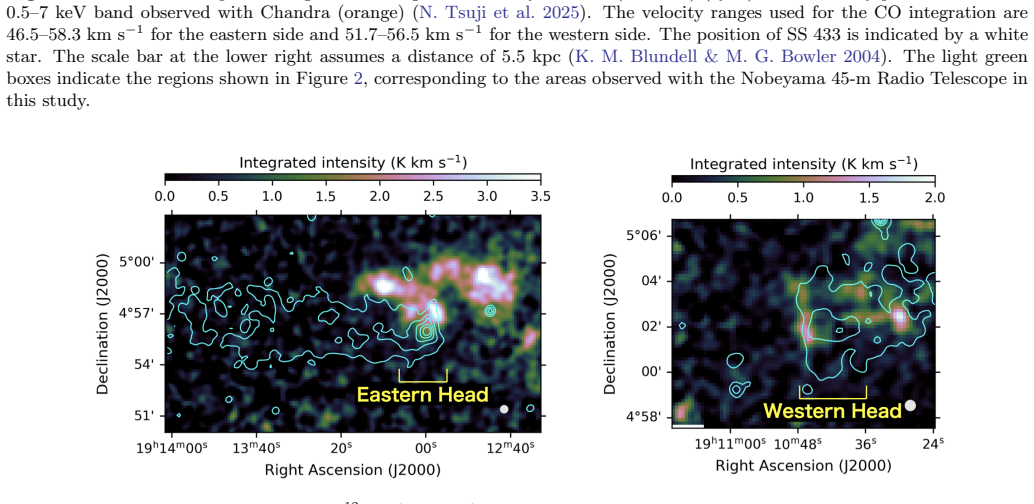
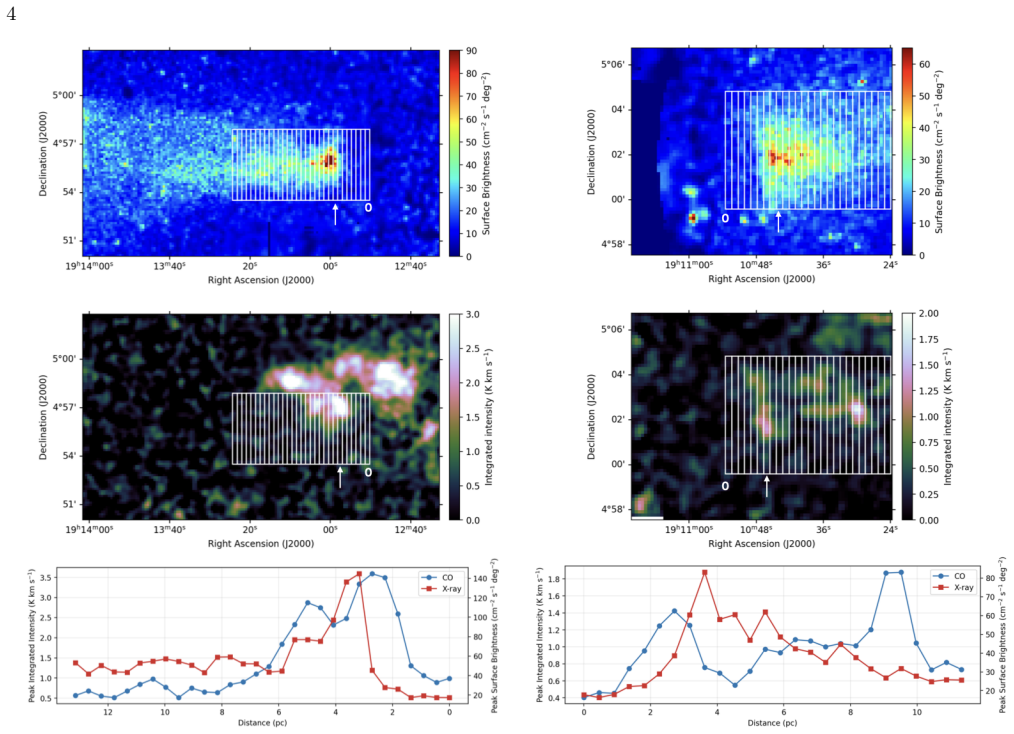
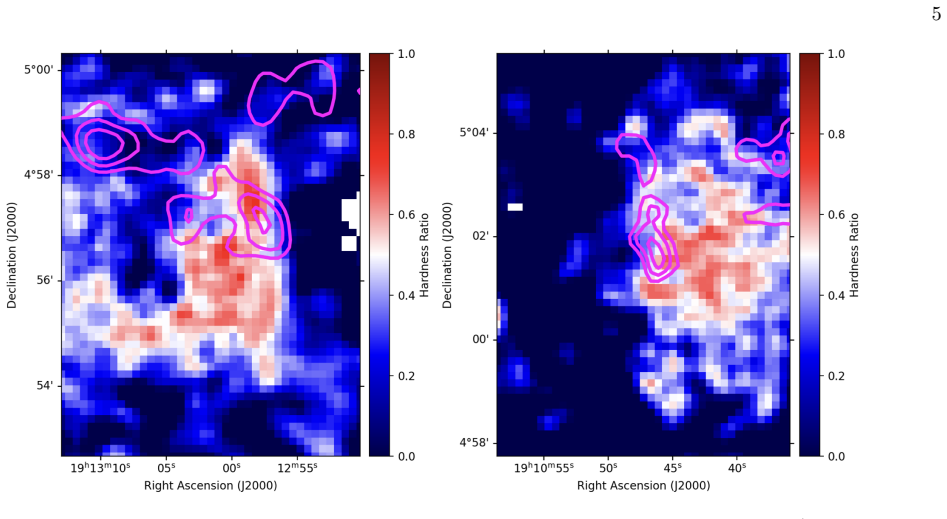
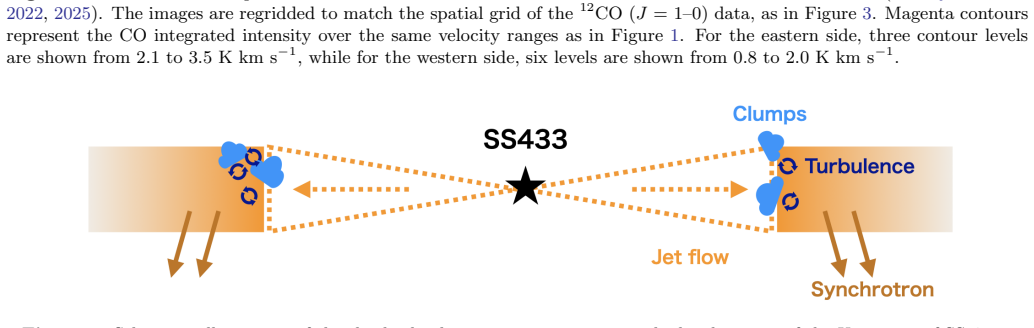
The first identification of molecular clumps directly associated with the re-brightening regions of the large-scale X-ray jets of SS 433, based on 12CO (J=1-0) observations. Multiple clumps toward the eastern and western jet heads show clear spatial correlation with the X-ray emission. The X-ray emission peaks immediately downstream of the molecular clumps, while the hardness ratio is enhanced at their surfaces. These results provide direct evidence for shock-cloud interactions between the jets and the surrounding interstellar medium. Turbulence generated at the jet-cloud interface amplifies magnetic fields, producing the observed non-thermal X-ray emission.
What carries the argument
Spatial correlation between CO molecular clumps and X-ray re-brightening regions, featuring a downstream X-ray peak and surface hardness enhancement, as the signature of physical shock interaction.
If this is right
- Jet interactions with the interstellar medium determine the X-ray properties of microquasar jets.
- Turbulence at jet-cloud boundaries amplifies magnetic fields.
- The amplified fields accelerate particles and generate the observed nonthermal X-ray emission.
- Similar shock-cloud processes operate at both eastern and western jet heads.
Where Pith is reading between the lines
- The same interaction mechanism may appear in other microquasars once comparable CO mapping is obtained.
- Detailed simulations of the turbulence layer could forecast the expected X-ray luminosity from such interfaces.
- Multi-wavelength follow-up at higher angular resolution could locate the precise sites of field amplification.
Load-bearing premise
The spatial alignments and X-ray morphology indicate genuine physical shocks at the jet-cloud interfaces rather than chance projection or unrelated processes.
What would settle it
Finding CO clumps at the jet heads but without a corresponding downstream X-ray intensity peak or hardness increase at the clump surfaces would falsify the claimed shock interaction.
Figures

read the original abstract
We report the first identification of molecular clumps directly associated with the re-brightening regions of the large-scale X-ray jets of SS 433, based on $^{12}$CO ($J$ = 1--0) observations with the Nobeyama 45-m Radio Telescope. Multiple clumps are detected toward the eastern and western jet heads, showing clear spatial correlation with the X-ray emission. The X-ray emission peaks immediately downstream of the molecular clumps, while the hardness ratio is enhanced at their surfaces, indicating that the observed structures cannot be explained by absorption effects. These results provide direct evidence for shock--cloud interactions between the jets and the surrounding interstellar medium. We suggest that turbulence generated at the jet--cloud interface amplifies magnetic fields, producing the observed non-thermal X-ray emission. Our findings highlight the importance of jet--ISM interactions in shaping the X-ray properties of microquasar jets.
Editorial analysis
A structured set of objections, weighed in public.
Referee Report
Summary. The manuscript reports the first detection of 12CO (J=1-0) molecular clumps toward the eastern and western X-ray jet heads of SS 433 using Nobeyama 45-m telescope observations. The clumps exhibit spatial correlation with X-ray re-brightening regions; X-ray emission peaks immediately downstream of the clumps while hardness ratios are enhanced at clump surfaces. The authors interpret these features as direct evidence for shock-cloud interactions, proposing that turbulence at the jet-cloud interface amplifies magnetic fields and produces the observed non-thermal X-ray emission.
Significance. If the physical association holds, the result would provide valuable new evidence on how jet-ISM interactions shape non-thermal X-ray properties in microquasars. The work is observationally novel in linking molecular gas directly to jet re-brightening sites in SS 433 and could inform models of turbulence-driven field amplification in relativistic jets.
major comments (2)
- [Abstract] Abstract: The central claim of 'direct evidence for shock-cloud interactions' depends on the spatial correlation being physical rather than coincidental. No quantitative chance-alignment probability, projection-effect test, or velocity information linking the CO clumps to the jet flow is reported, leaving the causal step under-supported.
- [Abstract] Abstract: The statement that the structures 'cannot be explained by absorption effects' rests on the downstream X-ray peak and surface hardness enhancement, yet the abstract supplies no explicit absorption modeling, hardness-ratio error analysis, or statistical significance of the correlation to substantiate this exclusion.
minor comments (1)
- [Abstract] The abstract would benefit from stating the number of detected clumps, the angular resolution of the Nobeyama data, and any quantitative measure of the CO-X-ray positional match.
Simulated Author's Rebuttal
We thank the referee for the constructive comments on our manuscript. We address each major comment point by point below.
read point-by-point responses
-
Referee: [Abstract] Abstract: The central claim of 'direct evidence for shock-cloud interactions' depends on the spatial correlation being physical rather than coincidental. No quantitative chance-alignment probability, projection-effect test, or velocity information linking the CO clumps to the jet flow is reported, leaving the causal step under-supported.
Authors: The CO clumps coincide precisely with the well-established positions of the X-ray jet heads, and the X-ray emission peaks immediately downstream of the clumps in both the eastern and western jets. This repeated morphological pattern across independent jet directions makes random alignment improbable. We did not include a formal statistical probability calculation. We will revise the manuscript to add explicit discussion of projection effects and note the absence of velocity information as a limitation while retaining the morphological evidence as support for physical association. revision: partial
-
Referee: [Abstract] Abstract: The statement that the structures 'cannot be explained by absorption effects' rests on the downstream X-ray peak and surface hardness enhancement, yet the abstract supplies no explicit absorption modeling, hardness-ratio error analysis, or statistical significance of the correlation to substantiate this exclusion.
Authors: The exclusion of absorption follows from the X-ray peak lying downstream of the clumps and the hardness ratio increasing specifically at clump surfaces; absorption by foreground molecular gas would suppress rather than shift or harden emission in this manner. The abstract is necessarily concise. We will revise the main text to include additional details on hardness-ratio uncertainties and the spatial correlation significance to better support the statement. revision: partial
Circularity Check
Purely observational result with no derivation chain or fitted predictions
full rationale
The manuscript reports new 12CO (J=1-0) observations with the Nobeyama 45-m telescope showing spatial correlations between molecular clumps and X-ray re-brightening regions in the SS 433 jets. It notes downstream X-ray peaks and surface hardness enhancements, then interprets these as evidence for shock-cloud interactions. No equations, model fits, parameter estimations, or mathematical derivations appear anywhere in the text. The central claim rests on direct observational associations rather than any reduction of a predicted quantity to fitted inputs or self-citations. No load-bearing steps match any of the enumerated circularity patterns.
Axiom & Free-Parameter Ledger
axioms (2)
- domain assumption 12CO (J=1-0) emission reliably traces dense molecular hydrogen gas in the interstellar medium
- domain assumption Spatial coincidence plus downstream X-ray peak and surface hardness enhancement indicate physical interaction rather than projection effects
Reference graph
Works this paper leans on
-
[1]
Abell, G. O., & Margon, B. 1979, Nature, 279, 701, doi: 10.1038/279701a0
-
[2]
E., van den Eijnden, J., et al
Atri, P., Motta, S. E., van den Eijnden, J., et al. 2025, A&A, 696, A223, doi: 10.1051/0004-6361/202452837
-
[3]
Blundell, K. M., & Bowler, M. G. 2004, ApJL, 616, L159, doi: 10.1086/426542
-
[4]
M., Laing, R., Lee, S., & Richards, A
Blundell, K. M., Laing, R., Lee, S., & Richards, A. 2018, ApJL, 867, L25, doi: 10.3847/2041-8213/aae890
-
[5]
Bosch-Cabot, P., Tetarenko, A. J., Rosolowsky, E., et al. 2026, ApJ, 997, 64, doi: 10.3847/1538-4357/ae20f2
-
[6]
1996, A&A, 312, 306
Brinkmann, W., Aschenbach, B., & Kawai, N. 1996, A&A, 312, 306
1996
-
[7]
2007, A&A, 463, 611, doi: 10.1051/0004-6361:20065570
Burwitz, V. 2007, A&A, 463, 611, doi: 10.1051/0004-6361:20065570
-
[8]
The Jets and and Supercritical Accretion Disk in SS433
Fabrika, S. 2004, Astrophys. Space Phys. Res., 12, 1, doi: 10.48550/arXiv.astro-ph/0603390
work page internal anchor Pith review Pith/arXiv arXiv doi:10.48550/arxiv.astro-ph/0603390 2004
-
[9]
2003, PASJ, 55, L61, doi: 10.1093/pasj/55.5.L61
Fukui, Y., Moriguchi, Y., Tamura, K., et al. 2003, PASJ, 55, L61, doi: 10.1093/pasj/55.5.L61
-
[10]
2012, ApJ, 746, 82, doi: 10.1088/0004-637X/746/1/82
Fukui, Y., Sano, H., Sato, J., et al. 2012, ApJ, 746, 82, doi: 10.1088/0004-637X/746/1/82
-
[11]
Gies, D. R., Huang, W., & McSwain, M. V. 2002, ApJL, 578, L67, doi: 10.1086/344436
-
[12]
2026, A&A, 706, A283, doi: 10.1051/0004-6361/202557124 H
Grollimund, N., Corbel, S., Fender, R., et al. 2026, A&A, 706, A283, doi: 10.1051/0004-6361/202557124 H. E. S. S. Collaboration, Aharonian, F., Ait Benkhali, F., et al. 2024, Science, 383, 402, doi: 10.1126/science.adi2048
-
[13]
Hillwig, T. C., & Gies, D. R. 2008, ApJL, 676, L37, doi: 10.1086/587140
-
[14]
2012, ApJ, 744, 71, doi: 10.1088/0004-637X/744/1/71
Inoue, T., Yamazaki, R., Inutsuka, S.-i., & Fukui, Y. 2012, ApJ, 744, 71, doi: 10.1088/0004-637X/744/1/71
-
[15]
2025, PASJ, 77, 880, doi: 10.1093/pasj/psaf059
Kayama, K., Tanaka, T., Uchida, H., et al. 2025, PASJ, 77, 880, doi: 10.1093/pasj/psaf059
-
[16]
2022, PASJ, 74, 1143, doi: 10.1093/pasj/psac060
Kayama, K., Tanaka, T., Uchida, H., et al. 2022, PASJ, 74, 1143, doi: 10.1093/pasj/psac060
-
[17]
S., Murase, K., & M´ esz´ aros, P
Kimura, S. S., Murase, K., & M´ esz´ aros, P. 2020, ApJ, 904, 188, doi: 10.3847/1538-4357/abbe00
-
[18]
Komissarov, S. S., & Falle, S. A. E. G. 1997, MNRAS, 288, 833, doi: 10.1093/mnras/288.4.833
-
[19]
2010, ApJ, 709, 1374, doi: 10.1088/0004-637X/709/2/1374
Kubota, K., Ueda, Y., Fabrika, S., et al. 2010, ApJ, 709, 1374, doi: 10.1088/0004-637X/709/2/1374
-
[20]
2011, in IAU
Kuno, N., Tosaki, T., Onodera, S., et al. 2011, in IAU
2011
-
[21]
277, Tracing the Ancestry of Galaxies, ed
Symposium, Vol. 277, Tracing the Ancestry of Galaxies, ed. C. Carignan, F. Combes, & K. C. Freeman, 67–70, doi: 10.1017/S1743921311022484
-
[22]
Kutner, M. L., & Ulich, B. L. 1981, ApJ, 250, 341, doi: 10.1086/159380 Lhaaso Collaboration, Cao, Z., Aharonian, F., et al. 2025, National Science Review, 12, nwaf496, doi: 10.1093/nsr/nwaf496 8
-
[23]
2020, ApJ, 892, 143, doi: 10.3847/1538-4357/ab7a22
Liu, Q.-C., Chen, Y., Zhou, P., Zhang, X., & Jiang, B. 2020, ApJ, 892, 143, doi: 10.3847/1538-4357/ab7a22
-
[24]
1984, ARA&A, 22, 507, doi: 10.1146/annurev.aa.22.090184.002451
Margon, B. 1984, ARA&A, 22, 507, doi: 10.1146/annurev.aa.22.090184.002451
-
[25]
Mariani, I., Motta, S. E., Atri, P., et al. 2025, A&A, 704, A239, doi: 10.1051/0004-6361/202556290 Mart´ ı, J., Bujalance-Fern´ andez, I., Luque-Escamilla, P. L., et al. 2018, A&A, 619, A40, doi: 10.1051/0004-6361/201833733
-
[26]
2002, Science, 297, 1673, doi: 10.1126/science.1073660
Migliari, S., Fender, R., & M´ endez, M. 2002, Science, 297, 1673, doi: 10.1126/science.1073660
-
[27]
Migliari, S., Fender, R. P., Blundell, K. M., M´ endez, M., & van der Klis, M. 2005, MNRAS, 358, 860, doi: 10.1111/j.1365-2966.2005.08791.x
-
[28]
2016, in Society of Photo-Optical Instrumentation Engineers (SPIE) Conference Series, Vol
Minamidani, T., Nishimura, A., Miyamoto, Y., et al. 2016, in Society of Photo-Optical Instrumentation Engineers (SPIE) Conference Series, Vol. 9914, Millimeter, Submillimeter, and Far-Infrared Detectors and Instrumentation for Astronomy VIII, ed. W. S. Holland & J. Zmuidzinas, 99141Z, doi: 10.1117/12.2232137
-
[29]
2005, Advances in Space Research, 35, 1062, doi: 10.1016/j.asr.2005.01.086
Moldowan, A., Safi-Harb, S., Fuchs, Y., & Dubner, G. 2005, Advances in Space Research, 35, 1062, doi: 10.1016/j.asr.2005.01.086
-
[30]
Motta, S. E., Atri, P., Matthews, J. H., et al. 2025, A&A, 696, A222, doi: 10.1051/0004-6361/202452838
-
[31]
2015, PASJ, 67, 117, doi: 10.1093/pasj/psv088
Nakamura, F., Ogawa, H., Yonekura, Y., et al. 2015, PASJ, 67, 117, doi: 10.1093/pasj/psv088
-
[32]
2026, arXiv e-prints, arXiv:2603.21550, doi: 10.48550/arXiv.2603.21550
Oka, T., Ariyama, R., & Kotani, T. 2026, arXiv e-prints, arXiv:2603.21550, doi: 10.48550/arXiv.2603.21550
-
[33]
Reynolds, S. P. 2008, ARA&A, 46, 89, doi: 10.1146/annurev.astro.46.060407.145237
-
[34]
1997, ApJ, 483, 868, doi: 10.1086/304274
Safi-Harb, S., & ¨Ogelman, H. 1997, ApJ, 483, 868, doi: 10.1086/304274
-
[35]
1999, ApJ, 512, 784, doi: 10.1086/306803
Safi-Harb, S., & Petre, R. 1999, ApJ, 512, 784, doi: 10.1086/306803
-
[36]
2022, ApJ, 935, 163, doi: 10.3847/1538-4357/ac7c05
Safi-Harb, S., Mac Intyre, B., Zhang, S., et al. 2022, ApJ, 935, 163, doi: 10.3847/1538-4357/ac7c05
-
[37]
2025, PASJ, 77, 1113, doi: 10.1093/pasj/psaf088
Sakai, Y., Yamada, S., Sakemi, H., et al. 2025, PASJ, 77, 1113, doi: 10.1093/pasj/psaf088
-
[38]
2023, PASJ, 75, 338, doi: 10.1093/pasj/psad001
Sakemi, H., Machida, M., Yamamoto, H., & Tachihara, K. 2023, PASJ, 75, 338, doi: 10.1093/pasj/psad001
-
[39]
2010, ApJ, 724, 59, doi: 10.1088/0004-637X/724/1/59
Sano, H., Sato, J., Horachi, H., et al. 2010, ApJ, 724, 59, doi: 10.1088/0004-637X/724/1/59
-
[40]
2020, ApJL, 904, L24, doi: 10.3847/2041-8213/abc884
Sano, H., Inoue, T., Tokuda, K., et al. 2020, ApJL, 904, L24, doi: 10.3847/2041-8213/abc884
-
[41]
2008, PASJ, 60, 445, doi: 10.1093/pasj/60.3.445
Sawada, T., Ikeda, N., Sunada, K., et al. 2008, PASJ, 60, 445, doi: 10.1093/pasj/60.3.445
-
[42]
2018, ApJ, 863, 103, doi: 10.3847/1538-4357/aad04e
Su, Y., Zhou, X., Yang, J., et al. 2018, ApJ, 863, 103, doi: 10.3847/1538-4357/aad04e
-
[43]
2020, ApJ, 889, 146, doi: 10.3847/1538-4357/ab6442
Sudoh, T., Inoue, Y., & Khangulyan, D. 2020, ApJ, 889, 146, doi: 10.3847/1538-4357/ab6442
-
[44]
2026, A&A, 707, A278, doi: 10.1051/0004-6361/202557726
Sunyaev, R., Khabibullin, I., Churazov, E., et al. 2026, A&A, 707, A278, doi: 10.1051/0004-6361/202557726
-
[45]
Miller-Jones, J. C. A., & Sivakoff, G. R. 2018, MNRAS, 475, 448, doi: 10.1093/mnras/stx3151
-
[46]
Tetarenko, A. J., Rosolowsky, E. W., Miller-Jones, J. C. A., & Sivakoff, G. R. 2020, MNRAS, 497, 3504, doi: 10.1093/mnras/staa2175
-
[47]
2025, ApJL, 993, L24, doi: 10.3847/2041-8213/ae0e73
Tsuji, N., Inoue, Y., Khangulyan, D., et al. 2025, ApJL, 993, L24, doi: 10.3847/2041-8213/ae0e73
-
[48]
A., Tanaka, T., Takahashi, T., & Maeda, Y
Uchiyama, Y., Aharonian, F. A., Tanaka, T., Takahashi, T., & Maeda, Y. 2007, Nature, 449, 576, doi: 10.1038/nature06210
-
[49]
Yamamoto, H., Ishikawa, T., & Takeuchi, T. T. 2024, PASJ, 76, L1, doi: 10.1093/pasj/psae007
-
[50]
2022, PASJ, 74, 493, doi: 10.1093/pasj/psac012
Yamamoto, H., Okamoto, R., Murata, Y., et al. 2022, PASJ, 74, 493, doi: 10.1093/pasj/psac012
-
[51]
2008, PASJ, 60, 715, doi: 10.1093/pasj/60.4.715
Yamamoto, H., Ito, S., Ishigami, S., et al. 2008, PASJ, 60, 715, doi: 10.1093/pasj/60.4.715
discussion (0)
Sign in with ORCID, Apple, or X to comment. Anyone can read and Pith papers without signing in.