REVIEW 3 major objections 4 minor 15 references
Population-Level Generative Modeling for Ranking Data
T0 review · 3 major / 4 minor · reviewed 2026-08-14 · deepseek-v4-flash
Pith's one-line read Ranking generation reduces to low-dimensional preference learning
desk verdict A novel and mostly sound pipeline for population-level ranking generation, but the headline finite-sample guarantee is missing a key transfer lemma and leans on an assumed error rate. read the letter →
The pith
A machine-rendered reading of the paper's core claim, the machinery that carries it, and where it could break.
The reading
What carries the argument
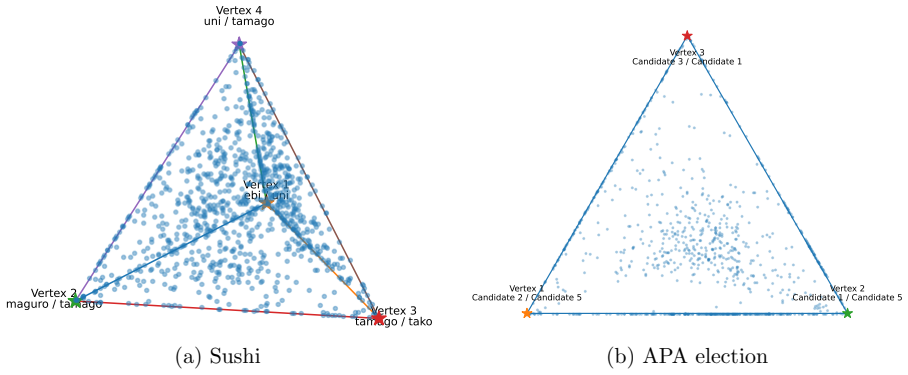
The carrying object is the factorization $Q = H\Pi$ of the $n \times m$ utility matrix into a $K$-column latent utility matrix $H$, whose columns are preference types, and an $m$-column matrix $\Pi$ whose columns are probability vectors on the $(K-1)$-simplex; each ranker's Plackett–Luce utilities are a convex combination of the $K$ preference-type utilities. Identifiability is restored by centering $H$, requiring at least one pure ranker per preference type, and affine independence of the latent utility columns. From a constrained maximum-likelihood estimate of $Q$, the paper recovers $H$ by a vertex-search procedure (the Sketched Vertex Search variant) and recovers $\Pi$ by barycentric coordinates. It then learns the population distribution of these weights with flow matching on the additive log-ratio transform $T(\pi) = (\log(\pi_1/\pi_K), \ldots, \log(\pi_{K-1}/\pi_K))$ and generates rankings by sampling weights from the fitted flow and decoding them through the Plackett–Luce model.
What would settle it
Run a synthetic experiment with a known latent utility matrix and a known Dirichlet-mixture weight distribution: fit LPSE-FM and estimate $W_1(P_\pi, \widehat{P}_{\pi,m})$ and $\sup_\ell W_{1,\tau}$ as $m$ and $L$ grow with $n$ fixed. If the empirical error does not decay like $\sqrt{((K/L + Kn/(mL))\log(mnL))} + m^{-s/(2s+K-1)}$, the theorem's rate is wrong; a plateau as $m$ grows would specifically indict the $Kn/(mL)$ term.
Extended reading notes
Core claim
The paper's central claim is Theorem 6: under the stated identifiability, balance, and stability conditions, $W_1(P_\pi, \widehat{P}_{\pi,m}) + \sup_{\ell \in [n]} W_{1,\tau}(P_R^{(\ell)}, P_{\widetilde{R}}^{(\ell)}) = O_P\left(\sqrt{\left(\frac{K}{L} + \frac{Kn}{mL}\right)\log(mnL)} + \varepsilon_{\mathrm{FM}} + N^{-1}\right)$, where $W_{1,\tau}$ is the $1$-Wasserstein distance built on the normalized Kemeny–Snell ranking distance. This is an oracle reduction: if the latent utility matrix $H$ were known, the KL divergence between generated and true ranking distributions would collapse exactly to $KL(P_\pi \| P_{\pi'})$, so the only real learning target is the population distribution of preference weights on the simplex. The theorem further states that when the Euler step size obeys $N^{-1} = O\left(\sqrt{\left(\frac{K}{L} + \frac{Kn}{mL}\right)\log(mnL)} + \varepsilon_{\mathrm{FM}}\right)$, the numerical discretization error is absorbed and the stated rate becomes the estimation term plus the flow-matching term.
Load-bearing premise
The rate in Theorem 6 assumes that flow matching trained on the true latent weights achieves an $L^2$ velocity error $\varepsilon_{\mathrm{FM}}$, and the paper defers the concrete bound for $\varepsilon_{\mathrm{FM}}$ to a supplementary section that is not included in the preprint; if that assumption fails, the advertised finite-sample guarantee is conditional on an unknown quantity.
Editorial extensions
If this is right
- Ranking generation can be performed with finite-sample guarantees rather than relying solely on black-box generative models; the error separates into a statistical estimation term and a generative flow-matching term.
- Longer observed rankings per ranker directly reduce the estimation error through the $1/L$ factor, so the length of partial rankings materially affects how accurately the ranking population can be reproduced.
- The $Kn/(mL)$ term shows that adding items without adding rankers or observed ranking length degrades the guarantee, quantifying how many rankers are needed as the item set grows.
- In the oracle case $H = H'$, the KL error between generated and true ranking distributions equals $KL(P_\pi \| P_{\pi'})$, so the pipeline is exactly as accurate as its latent distribution learner.
- The fitted latent simplex supplies an interpretable representation of preference heterogeneity: vertices correspond to pure preference types and interior points to mixed types.
Reading between the lines
- The concrete $\varepsilon_{\mathrm{FM}}$ rate is deferred to a supplementary section, but if the claimed $m^{-s/(2s+K-1)}$ rate holds, the full generation error follows a classical nonparametric smoothing rate in the latent density's smoothness; a direct numerical check would fit LPSE-FM to known Dirichlet mixtures and compare $W_{1,\tau}$ across $K$ at fixed $m$.
- Because Proposition 1's oracle reduction is learner-agnostic, the same simplex representation could be coupled with other latent distribution learners, such as normalizing flows or diffusion on the log-ratio space, without changing the estimation-error term.
- The balance condition requires the ranker weights to span all preference directions, so real populations with a rare preference type would need more rankers; a testable extension is to stratify the simplex by vertex-neighborhood density and measure where the Wasserstein error concentrates.
- A possible observable consequence is that LPSE-FM's advantage over generic ranking VAEs should grow with $n$, since the $Kn/(mL)$ estimation term and the flow-matching benefit both scale with the number of items.
Editorial analysis
A structured set of objections, weighed in public.
Referee Report
Summary. The paper proposes LPSE-FM, a generative framework for ranking data. Each ranker's Plackett-Luce utility vector is modeled as a convex combination of K latent utility vectors, so the population of rankers is represented by a distribution on the latent preference simplex. The method estimates the utility matrix by constrained maximum likelihood, recovers the latent simplex by vertex search, computes barycentric preference weights, learns the population distribution of these weights by flow matching on a log-ratio transformed simplex, and decodes generated weights into rankings through the fitted Plackett-Luce model. The theoretical section states finite-sample rates for the constrained MLE, for vertex recovery in Frobenius norm, for the Wasserstein estimation error of the learned latent distribution, and for the flow-matching error, culminating in Theorem 6, which claims a combined rate for the latent Wasserstein error and the supremum over ranking lengths of the ranking-level 1-Wasserstein error. Experiments on synthetic data, the Sushi preference dataset, and the PrefLib APA election data compare LPSE-FM with GP-VAE and GM-VAE baselines, reporting lower pairwise preference errors in most settings.
Significance. If the claimed guarantees hold, the paper makes a useful contribution by formulating population-level ranking generation and showing an oracle reduction from ranking generation to learning a (K-1)-dimensional latent distribution, with rates that clarify the roles of item count n, ranking length L, latent dimension K, and ranker count m. The manuscript has clear strengths: the identifiability conditions for the latent simplex are explicitly stated, the constrained MLE and vertex-recovery rates are concrete, the algorithm is reproducible with released code, and the experiments consistently show improved pairwise fidelity over the baselines. However, the central generative guarantee in Theorem 6 is currently not derived in the main text: no displayed argument transfers the latent Wasserstein error to ranking-level Wasserstein error when the estimated simplex is used, and the main rate depends on a flow-matching error epsilon_FM that is assumed rather than bounded in the preprint. The significance of the paper is therefore conditional on filling these two gaps.
major comments (3)
- [Section 3, Theorem 6] The claimed bound on sup_{\ell} W_{1,\tau}(P_R^{(\ell)}, P_{\tilde R}^{(\ell)}) is not established by the displayed decomposition. The text decomposes only W_1(\hat P_{\pi,m}^{(N)}, P_\pi) into estimation and flow-matching errors, and the only ranking-level statement, Proposition 1, assumes H = H'. Theorems 2 and 3 together with Condition 1 give Frobenius control (1/n)\|\hat H - H\|_F^2 = O_P(R) with R = ((K/L) + (Kn/(mL))) log(mnL), which permits max-norm or spectral error of order O_P(\sqrt{nR}). Since W_{1,\tau} between ranking distributions depends on both the estimated weights and the estimated simplex, the ranking term could dominate the advertised rate unless an additional transfer lemma is provided. The manuscript needs an explicit Lipschitz or coupling argument from the latent Wasserstein error plus a max-norm or spectral error bound for \hat H-H, with constants, before Theorem 6 follows.
- [Section 3, Assumption 2 and Remark 9] Theorem 5 and Theorem 6 state rates in terms of epsilon_FM, but epsilon_FM is assumed rather than bounded in the main text. The concrete claim in Remark 9 that the flow-matching error is O_P(m^{-s/(2s+K-1)}) is deferred to supplementary Section B, which is not included in the preprint. As written, the finite-sample guarantee is conditional on an unverified quantity. Please either prove this bound in the main body or clearly state all additional assumptions (such as smoothness of P_pi, network approximation, and optimization oracle) under which it holds, and confirm that the constants do not have hidden dependence on n or K.
- [Section 3, Theorem 4] Theorem 4 asserts W_1(\hat P_{\pi,m}^{(N)}, \tilde P_{\pi,m}^{(N)}) = O_P(\sqrt{R}) from the perturbation of the training inputs {\pi_j} to {\hat\pi_j}, but the main text gives no statement of the required stability property of the empirical flow-matching estimator under input perturbations. The proof is not in the preprint. Since Theorem 6's first term rests on this estimate, please display at least the relevant stability lemma and its assumptions in the main text, or state explicitly that it is proved in the supplementary material with a precise reference.
minor comments (4)
- [Section 4.1] The text says 'We generate complete rankings of n items' but then states 'Each ranking contains all L = 60 items' while Table 1 includes n = 120. If the n = 120 setting consists of top-60 partial rankings, this should be stated explicitly, and the notation should be consistent with the theoretical setup where L_j can be less than n.
- [Section 2.3, Remark 5] The clipping map C_tau is introduced for numerical stability, but the theoretical statements in Section 3 assume the log-ratio transform is applied to strictly positive coordinates and Assumption 3 requires finite E\|\log \pi\|^2. The effect of clipping on the Wasserstein rates is not analyzed; please clarify how the theory accommodates estimated weights that hit the boundary.
- [Section 2.2, Condition 1] Condition 1 is stated for a generic vertex recovery procedure, but the main text does not verify it for the SVS procedure actually used in Algorithm 1. A specific statement that SVS satisfies Condition 1, with the relevant constant, would make the theoretical claims about the implemented method more direct.
- [Tables 3 and 5] The empirical tables report averaged errors over five runs without standard errors or confidence intervals. Given the small differences between LPSE-FM and GM-VAE on some settings, reporting variability would help assess whether the observed improvements are stable.
Circularity Check
No substantive circularity: the finite-sample claims rest on stated assumptions and external stability results; the deferred epsilon_FM and missing ranking-transfer lemma are correctness gaps, not reductions to inputs.
full rationale
Walking the derivation chain: Proposition 1 is a data-processing/KL-contraction statement for the oracle case H=H' and does not use fitted values as predictions. Theorem 2 is a standard restricted-MLE rate. In Theorem 3, the bH-rate is exactly Condition 1 applied to the MLE bQ, and the bPi-rate follows from barycentric coordinates; Condition 1 is explicitly stated as a stability assumption with external support cited to Jin et al. (2024), so the theorem does not smuggle its conclusion in as an input. The Wasserstein estimation error in Theorem 4 is a separate Lipschitz transfer from the Frobenius rates, not a tautology. The flow-matching error in Theorem 5 inherits epsilon_FM from Assumption 2; this is an unverified oracle-input assumption rather than a circular derivation, though the preprint itself says the concrete bound is deferred to Supplementary Section B, which is not included. The sup over ell of W_{1,tau} in Theorem 6 is asserted without a displayed transfer lemma controlling bH in max/spectral norm; this is a missing proof or correctness risk, not a circularity. The only self-citation (Fan, Ke, and Shi 2026) appears in Remarks 1 and 2 as a comparison of identifiability conditions and is not load-bearing. No displayed equation equates a prediction to a fitted value, and no central claim reduces by construction to its inputs.
Assumptions & free parameters
free parameters (4)
- K (number of latent preference types) =
K=3 (synthetic), K=4 (Sushi), K=3 (APA)
- M_S (number of k-means clusters in SVS denoising) =
Unspecified
- τ (clipping threshold for log-ratio map) =
Unspecified
- N (number of Euler steps in flow-matching ODE solver) =
Unspecified
assumptions (8)
- domain assumption Rankings are generated by the Plackett-Luce model with utility vectors q_j = H π_j, where π_j lies in the K-1 simplex.
- domain assumption Identifiability conditions C1-C3, especially C2: for each preference type there exists a pure ranker with π_j = e_k.
- domain assumption Latent preference weights π_j are i.i.d. from an unknown population distribution Pπ supported on the simplex.
- domain assumption Assumption 1: the neural velocity field is Lipschitz and bounded.
- domain assumption Assumption 2: the oracle flow-matching velocity field estimated on true π_j has L2 error ε_FM.
- domain assumption Assumption 3: E||log π||^2 is finite for the latent preference distribution.
- domain assumption Balance condition (11): the Gram matrices n^{-1}H^T H and m^{-1}ΠΠ^T are well conditioned.
- standard math Condition 1: the vertex recovery procedure is stable in Frobenius norm.
Cite this review
Pith. "Pith review of Population-Level Generative Modeling for Ranking Data." pith.science (2026). https://pith.science/paper/BNWN45AM
@misc{pith2026260808422,
  author       = {Pith},
  title        = {Pith review of: Population-Level Generative Modeling for Ranking Data},
  year         = {2026},
  howpublished = {\url{https://pith.science/paper/BNWN45AM}},
  note         = {Machine review of arXiv:2608.08422}
}
read the original abstract
Ranking data arise in scientific and machine learning applications, including recommendation systems, information retrieval, voting, marketing, and AI preference ranking from human feedback. Existing statistical work has primarily focused on inference tasks such as preference estimation, rank aggregation, and ranking prediction. However, generating realistic synthetic rankings from an observed population is important for privacy-preserving data sharing, benchmark construction, simulation, and uncertainty quantification. This task is challenging because rankings are high-dimensional combinatorial objects with non-Euclidean dependence structures, while ranking populations often exhibit substantial preference heterogeneity. We propose a framework for population-level generative modeling through a latent preference simplex embedding. It estimates a low-dimensional latent preference simplex through a likelihood-based ranking model, leverages flow matching to learn the population distribution of latent preferences, and generates new rankings through the fitted probabilistic ranking model. We show that ranking generation admits an oracle reduction to latent distribution learning and derive finite-sample generative guarantees that clarify how the number of items, ranking length, and latent dimension affect accuracy. Experiments on synthetic and real datasets demonstrate improved population-level fidelity and provide a statistically interpretable representation of preference heterogeneity.
Figures

Reference graph
Works this paper leans on
-
[4]
K. Fukumizu, T. Suzuki, N. Isobe, K. Oko, and M. Koyama. Flow matching achieves almost minimax optimal convergence. InInternational Conference on Learning Rep- resentations, volume 2025, pages 27608–27640,
work page 2025
- [6]
-
[8]
S. R. Johnson, D. A. Henderson, and R. J. Boys. Revealing subgroup structure in ranked data using a bayesian wand.Journal of the American Statistical Association, 115(532): 1888–1901,
work page 1901
- [10]
- [11]
-
[12]
S. Liu, A. Zhang, G. Hu, H. Qian, and T.-s. Chua. Preference diffusion for recommen- dation. InInternational Conference on Learning Representations, volume 2025, pages 79844–79881,
work page 2025
-
[1974]
P. Tsimpos, Z. Ren, J. Zech, and Y. Marzouk. Optimal scheduling of dynamic transport. arXiv preprint arXiv:2504.14425,
-
[2008]
H. Guo, E. Xue, L. Huang, S. Wang, X. Wang, L. Wang, J. Wang, and S. Chen. Action is all you need: Dual-flow generative ranking network for recommendation.arXiv preprint arXiv:2505.16752,
Show all 15 references
-
[2015]
Z. Shi, K. Liu, Q. Long, W. J. Su, and J. Xiao. Fundamental limits of game- theoretic llm alignment: Smith consistency and preference matching.arXiv preprint arXiv:2505.20627,
-
[2018]
30 D. Park, J. Neeman, J. Zhang, S. Sanghavi, and I. Dhillon. Preference completion: Large- scale collaborative ranking from pairwise comparisons. InInternational Conference on Machine Learning, pages 1907–1916. PMLR,
1907
-
[2019]
Huang, Y
Y. Huang, Y. Chen, X. Cao, R. Yang, M. Qi, Y. Zhu, Q. Han, Y. Liu, Z. Liu, X. Yao, et al. Towards large-scale generative ranking.arXiv preprint arXiv:2505.04180,
-
[2021]
29 B. Li, A. Tamkin, N. Goodman, and J. Andreas. Eliciting human preferences with language models. InInternational Conference on Learning Representations, volume 2025, pages 80984–81013,
2025
-
[2022]
R. T. Chen and Y. Lipman. Flow matching on general geometries. InInternational Conference on Learning Representations, volume 2024, pages 47922–47945,
2024
-
[2024]
Chowdhury, Y
T. Chowdhury, Y. Zick, and J. Allan. Rankshap: Shapley value based feature attributions for learning to rank. InInternational Conference on Learning Representations, volume 2025, pages 36765–36794,
2025
-
[2025]
J. Fan, Z. T. Ke, and Z. Shi. Optimal demixing of nonparametric densities.arXiv preprint arXiv:2603.27457,
Reviewed August 14, 2026 · model on record in the stance chip above.
Discussion (0). Continue with ORCID to comment.