Anomalous Floquet Heating from Sparse Long-Range Interactions
Pith reviewed 2026-06-25 22:03 UTC · model grok-4.3
The pith
Sparse infinite-range interactions produce Floquet heating that decays only as exp(-O(sqrt(omega))) because coordination numbers vary widely across sites.
A machine-rendered reading of the paper's core claim, the machinery that carries it, and where it could break.
Core claim
In periodically driven systems whose interactions form a sparse long-range network, the heating rate scales as gamma ~ exp(-O(sqrt(omega))) rather than the conventional exp(-O(omega)). This anomalous scaling originates from the broad distribution of coordination numbers: as frequency increases, the sites that dominate heating are those with larger coordination numbers, causing the relevant local energy scale to increase with omega. For small-world networks an analytic theory matches extensive numerics, and the topology of the network is identified as a handle for controlling nonequilibrium phases.
What carries the argument
The broad distribution of coordination numbers in the interaction network, which causes the effective energy scale governing heating to grow with drive frequency.
If this is right
- Heating at high frequency is dominated by the highest-coordination sites rather than by typical sites.
- The effective local energy scale relevant for heating increases with drive frequency.
- Network topology can be used as a control parameter to stabilize nonequilibrium phases.
- Sparse long-range interactions open a new route to engineering Floquet-prethermal states in programmable quantum simulators.
Where Pith is reading between the lines
- Similar anomalous scaling may appear in other network topologies that possess a broad coordination-number distribution, not only small-world graphs.
- The mechanism could shorten or lengthen prethermal lifetimes in systems whose interactions are engineered via optical lattices or Rydberg arrays.
- Measuring the distribution of local heating rates across sites would directly test whether high-coordination sites dominate at high frequency.
Load-bearing premise
The analytic theory developed for small-world networks captures the heating dynamics accurately without post-hoc parameter adjustments that would alter the reported scaling, and the numerics sample the coordination-number distribution without bias.
What would settle it
Perform large-scale simulations or experiments on a small-world network of driven spins or atoms, extract the heating rate as a function of frequency, and check whether it follows exp(-c sqrt(omega)) with c independent of other parameters.
Figures

read the original abstract
Regular lattices of interacting particles under a periodic drive typically heat with rate $\gamma \sim e^{-\mathcal{O}(\omega)}$ which is exponentially suppressed in drive frequency $\omega$. Here, we show that sparse infinite-range interactions, which have recently become accessible in quantum simulators, can lead to anomalous heating with rate $\gamma \sim e^{-\mathcal{O}(\sqrt{\omega})}$. This anomaly originates from the broad distribution of coordination numbers across the network: as the driving frequency increases, heating becomes dominated by sites with larger coordination numbers, making the characteristic local energy scale relevant for heating grow with frequency. For small-world networks, we develop an analytic theory that thoroughly matches our large scale numerics. Finally, we discuss how network topology can serve as a control knob for engineering non-equilibrium phases of matter. Our results uncover a new mechanism for Floquet heating and suggest new routes toward stabilizing nonequilibrium phases in driven systems with programmable interaction networks.
Editorial analysis
A structured set of objections, weighed in public.
Referee Report
Summary. The manuscript claims that sparse infinite-range interactions on small-world networks produce anomalous Floquet heating with rate γ ∼ e^{-O(√ω)} (instead of the conventional e^{-O(ω)}), originating from the broad coordination-number distribution P(k) that causes heating to be dominated by high-k sites as ω increases. An analytic theory developed for small-world networks is stated to match large-scale numerics, and network topology is proposed as a control parameter for nonequilibrium phases.
Significance. If the central claim is correct, the work identifies a new, topology-controlled mechanism for Floquet heating that could be relevant for stabilizing driven phases in quantum simulators with programmable long-range interactions. The reported match between an analytic theory and numerics, together with the absence of free parameters, would constitute a strength if the derivation is shown to be independent of post-hoc choices for P(k).
major comments (2)
- [Analytic theory for small-world networks] Analytic theory section: the derivation that the effective local energy scale grows proportionally to √ω (producing the reported exponent) must be shown explicitly to follow from the tail of P(k) without inserting a functional form or cutoff chosen to reproduce the numerics; otherwise the √ω scaling reduces to a modeling assumption rather than a robust consequence of sparse long-range interactions.
- [Numerical results] Numerical results section: the sampling of the coordination-number distribution across sites must be demonstrated to be unbiased (i.e., not preferentially weighting high-k sites), as any such bias would undermine the claim that the anomaly is a generic feature of the network rather than a selection effect.
minor comments (2)
- [Abstract] The abstract could usefully state the precise small-world model (e.g., Watts-Strogatz rewiring probability) used for both theory and numerics.
- [Figures] Figure captions should explicitly note the system sizes and number of disorder realizations used to extract the heating rates.
Simulated Author's Rebuttal
We thank the referee for their positive evaluation of the work's significance and for the detailed, constructive comments. We address each major comment below and are prepared to revise the manuscript accordingly where clarification or additional demonstration is needed.
read point-by-point responses
-
Referee: [Analytic theory for small-world networks] Analytic theory section: the derivation that the effective local energy scale grows proportionally to √ω (producing the reported exponent) must be shown explicitly to follow from the tail of P(k) without inserting a functional form or cutoff chosen to reproduce the numerics; otherwise the √ω scaling reduces to a modeling assumption rather than a robust consequence of sparse long-range interactions.
Authors: The analytic theory starts from the exact degree distribution P(k) of the small-world network model with sparse infinite-range links, whose tail is exponentially decaying and fixed by the network construction parameters (no free functional form is introduced). The site-resolved heating rate scales as exp(−O(ω/k²)) because the local energy scale is proportional to k. The global rate is then obtained by integrating ∫ P(k) exp(−c ω / k²) dk. For large ω the integral is evaluated via saddle-point approximation around k* ∼ √ω, directly yielding γ ∼ exp(−O(√ω)) from the tail of P(k). No cutoff is inserted by hand; the saddle arises naturally. We will expand the manuscript with an explicit saddle-point calculation to make this derivation fully transparent. revision: yes
-
Referee: [Numerical results] Numerical results section: the sampling of the coordination-number distribution across sites must be demonstrated to be unbiased (i.e., not preferentially weighting high-k sites), as any such bias would undermine the claim that the anomaly is a generic feature of the network rather than a selection effect.
Authors: All sites are included uniformly in every network realization; the reported heating rates are averages over the full set of sites with no selection or reweighting by k. To remove any ambiguity we will add a supplementary panel in the revised manuscript that overlays the empirical histogram of sampled coordination numbers against the analytic P(k), confirming that the sampled distribution is unbiased and matches the theoretical tail. revision: yes
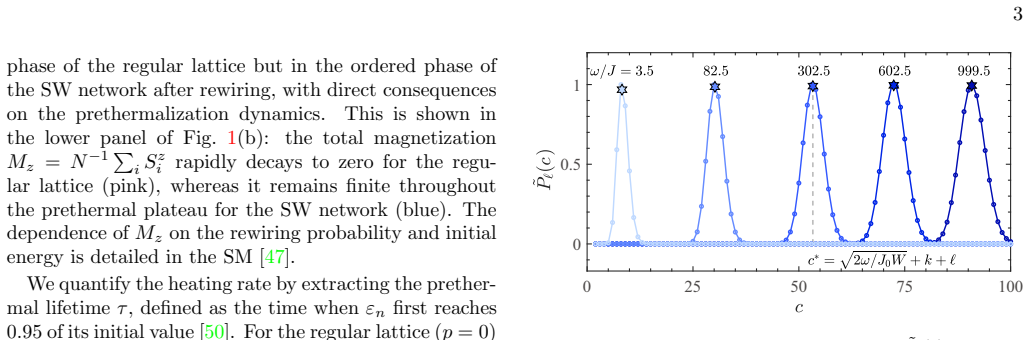
Circularity Check
No significant circularity; analytic theory for small-world networks is independently derived and matches numerics without reduction to fitted inputs
full rationale
The paper derives the anomalous √ω scaling from the broad coordination-number distribution P(k) in sparse long-range networks, developing an analytic theory for small-world networks that is stated to match large-scale numerics. No quoted steps show self-definition (e.g., a parameter fitted to data then renamed as prediction), load-bearing self-citation chains, or ansatz smuggled via prior work. The central claim rests on the network topology mechanism and is presented as a consequence of the distribution shift with ω, without evidence that the scaling is forced by construction from the inputs. This is the common honest non-finding for papers whose derivation remains self-contained against external benchmarks.
Axiom & Free-Parameter Ledger
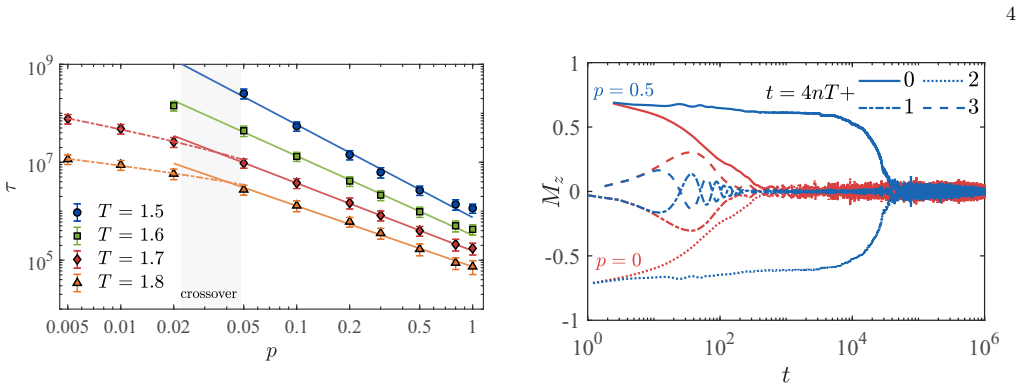
Reference graph
Works this paper leans on
-
[1]
Bukov, L
M. Bukov, L. D’Alessio, and A. Polkovnikov, Universal high-frequency behavior of periodically driven systems: From dynamical stabilization to floquet engineering, Ad- vances in Physics64, 139 (2015)
2015
-
[2]
Meinert, M
F. Meinert, M. J. Mark, K. Lauber, A. J. Daley, and H.- C. N¨ agerl, Floquet engineering of correlated tunneling in the bose-hubbard model with ultracold atoms, Phys. Rev. Lett.116, 205301 (2016)
2016
-
[3]
Eckardt, Colloquium: Atomic quantum gases in pe- riodically driven optical lattices, Reviews of Modern Physics89, 011004 (2017)
A. Eckardt, Colloquium: Atomic quantum gases in pe- riodically driven optical lattices, Reviews of Modern Physics89, 011004 (2017)
2017
-
[4]
Oka and S
T. Oka and S. Kitamura, Floquet engineering of quantum materials, Annual Review of Condensed Matter Physics 10, 387 (2019)
2019
-
[5]
Khemani, A
V. Khemani, A. Lazarides, R. Moessner, and S. L. Sondhi, Phase structure of driven quantum systems, Phys. Rev. Lett.116, 250401 (2016)
2016
-
[6]
D. V. Else, B. Bauer, and C. Nayak, Floquet time crys- tals, Phys. Rev. Lett.117, 090402 (2016)
2016
-
[7]
N. Y. Yao, A. C. Potter, I.-D. Potirniche, and A. Vish- wanath, Discrete time crystals: Rigidity, criticality, and realizations, Phys. Rev. Lett.118, 030401 (2017)
2017
-
[8]
Prosen, Time evolution of a quantum many-body sys- tem: Transition from integrability to ergodicity in the thermodynamic limit, Phys
T. Prosen, Time evolution of a quantum many-body sys- tem: Transition from integrability to ergodicity in the thermodynamic limit, Phys. Rev. Lett.80, 1808 (1998)
1998
-
[9]
D’Alessio and M
L. D’Alessio and M. Rigol, Long-time behavior of isolated periodically driven interacting lattice systems, Phys. Rev. X4, 041048 (2014)
2014
-
[10]
Lazarides, A
A. Lazarides, A. Das, and R. Moessner, Equilibrium states of generic quantum systems subject to periodic driving, Phys. Rev. E90, 012110 (2014)
2014
-
[11]
H. Kim, T. N. Ikeda, and D. A. Huse, Testing whether all eigenstates obey the eigenstate thermalization hypothe- sis, Phys. Rev. E90, 052105 (2014)
2014
-
[12]
Y. Hou, A. Pizzi, H. Jin, J. Knolle, R. Moessner, and H. Zhao, Floquet superheating, arXiv preprint arXiv:2511.12877 (2025)
arXiv 2025
-
[13]
D. A. Abanin, W. De Roeck, and F. Huveneers, Expo- nentially slow heating in periodically driven many-body systems, Phys. Rev. Lett.115, 256803 (2015)
2015
-
[15]
T. Mori, T. Kuwahara, and K. Saito, Rigorous bound on energy absorption and generic relaxation in periodically driven quantum systems, Phys. Rev. Lett.116, 120401 (2016)
2016
-
[16]
D. A. Abanin, W. De Roeck, W. W. Ho, and F. Hu- veneers, Effective hamiltonians, prethermalization, and slow energy absorption in periodically driven many-body systems, Phys. Rev. B95, 014112 (2017)
2017
-
[17]
S. Choi, J. Choi, R. Landig, G. Kucsko, H. Zhou, J. Isoya, F. Jelezko, S. Onoda, H. Sumiya, V. Khemani, C. von Keyserlingk, N. Y. Yao, E. Demler, and M. D. Lukin, Ob- servation of discrete time-crystalline order in a disordered dipolar many-body system, Nature543, 221 (2017)
2017
-
[18]
W. W. Ho, I. Protopopov, and D. A. Abanin, Bounds on energy absorption and prethermalization in quantum systems with long-range interactions, Phys. Rev. Lett. 120, 200601 (2018)
2018
-
[19]
Howell, P
O. Howell, P. Weinberg, D. Sels, A. Polkovnikov, and M. Bukov, Asymptotic prethermalization in periodically driven classical spin chains, Phys. Rev. Lett.122, 010602 (2019)
2019
-
[20]
Machado, G
F. Machado, G. D. Kahanamoku-Meyer, D. V. Else, C. Nayak, and N. Y. Yao, Exponentially slow heating in short and long-range interacting floquet systems, Phys. Rev. Res.1, 033202 (2019)
2019
-
[21]
Kiefer, F
P. Kiefer, F. Hakelberg, M. Wittemer, A. Berm´ udez, D. Porras, U. Warring, and T. Schaetz, Floquet- engineered vibrational dynamics in a two-dimensional ar- 6 ray of trapped ions, Phys. Rev. Lett.123, 213605 (2019)
2019
-
[22]
T. N. Ikeda and A. Polkovnikov, Fermi’s golden rule for heating in strongly driven floquet systems, Phys. Rev. B 104, 134308 (2021)
2021
-
[23]
P. Peng, C. Yin, X. Huang, C. Ramanathan, and P. Cap- pellaro, Floquet prethermalization in dipolar spin chains, Nature Physics17, 444 (2021)
2021
-
[24]
Pizzi, J
A. Pizzi, J. Knolle, and A. Nunnenkamp, Higher-order and fractional discrete time crystals in clean long-range interacting systems, Nature Communications12, 2341 (2021)
2021
-
[25]
M. H. Mu˜ noz Arias, K. Chinni, and P. M. Poggi, Floquet time crystals in driven spin systems with all-to-allp-body interactions, Phys. Rev. Res.4, 023018 (2022)
2022
-
[26]
Lerose, T
A. Lerose, T. Parolini, R. Fazio, D. A. Abanin, and S. Pappalardi, Theory of robust quantum many-body scars in long-range interacting systems, Phys. Rev. X15, 011020 (2025)
2025
-
[27]
Ebadi, A
S. Ebadi, A. Keesling, M. Cain, T. T. Wang, H. Levine, D. Bluvstein, G. Semeghini, A. Omran, J. G. Liu, R. Samajdar, X. Z. Luo, B. Nash, X. Gao, B. Barak, E. Farhi, S. Sachdev, N. Gemelke, L. Zhou, S. Choi, H. Pichler, S. T. Wang, M. Greiner, V. Vuleti´ c, and M. D. Lukin, Quantum optimization of maximum independent set using rydberg atom arrays, Science3...
2022
-
[28]
Bluvstein, S
D. Bluvstein, S. J. Evered, A. A. Geim, S. H. Li, H. Zhou, T. Manovitz, S. Ebadi, M. Cain, M. Kali- nowski, D. Hangleiter, J. P. Bonilla Ataides, N. Maskara, I. Cong, X. Gao, P. Sales Rodriguez, T. Karolyshyn, G. Semeghini, M. J. Gullans, M. Greiner, V. Vuleti´ c, and M. D. Lukin, Logical quantum processor based on reconfigurable atom arrays, Nature626, 58 (2024)
2024
-
[29]
Periwal, E
A. Periwal, E. S. Cooper, P. Kunkel, J. F. Wienand, E. J. Davis, and M. Schleier-Smith, Programmable in- teractions and emergent geometry in an array of atom clouds, Nature600, 630 (2021)
2021
-
[30]
B. P. Marsh, D. A. Schuller, Y. Ji, H. S. Hunt, S. Gan- guli, S. Gopalakrishnan, J. Keeling, and B. L. Lev, High- capacity associative memory in a quantum-optical spin glass, arXiv:2509.12202 (2025)
arXiv 2025
-
[31]
Grinkemeyer, E
B. Grinkemeyer, E. Guardado-Sanchez, I. Dimitrova, D. Shchepanovich, G. E. Mandopoulou, J. Borregaard, V. Vuleti´ c, and M. D. Lukin, Error-detected quantum operations with neutral atoms mediated by an optical cavity, Science387, 1301 (2025)
2025
-
[32]
J. De Santis, B. Dura-Kov´ acs, M. ¨Onc¨ u, A. Bouscal, D. Vasileiadis, and J. Zeiher, Realization of a cavity- coupled rydberg array, arXiv preprint arXiv:2602.12152 (2026)
arXiv 2026
-
[33]
Kuriyattil, P
S. Kuriyattil, P. M. Poggi, J. D. Pritchard, J. Kombe, and A. J. Daley, Entangled states from sparsely coupled spins for metrology with neutral atoms, Phys. Rev. Lett. 134, 240801 (2025)
2025
-
[34]
A. Gorlach, A. Pizzi, K. Mølmer, J. Avron, M. Segev, and I. Kaminer, Supercoherence: Harnessing long-range interactions to preserve collective coherence in disordered systems, arXiv preprint arXiv:2508.06238 (2025)
arXiv 2025
-
[35]
A. Solfanelli, A. Smerzi, P. Zoller, and N. Defenu, Robust spin-squeezing on quantum networks: the lesson from universality, arXiv preprint arXiv:2605.03032 (2026)
Pith/arXiv arXiv 2026
-
[36]
Islam, C
R. Islam, C. Senko, W. C. Campbell, S. Korenblit, J. Smith, A. Lee, E. E. Edwards, C. C. Wang, J. K. Freericks, and C. Monroe, Emergence and frustration of magnetism with variable-range interactions in a quantum simulator, Science340, 583 (2013)
2013
-
[37]
D. M. Kennes, M. Claassen, L. Xian, A. Georges, A. J. Millis, J. Hone, C. R. Dean, D. N. Basov, A. N. Pa- supathy, and A. Rubio, Moir´ e heterostructures as a condensed-matter quantum simulator, Nat. Phys.17, 155 (2021)
2021
-
[38]
Guo, Y.-K
S.-A. Guo, Y.-K. Wu, J. Ye, L. Zhang, W.-Q. Lian, R. Yao, Y. Wang, R.-Y. Yan, Y.-J. Yi, Y.-L. Xu, B.- W. Li, Y.-H. Hou, Y.-Z. Xu, W.-X. Guo, C. Zhang, B.-X. Qi, Z.-C. Zhou, L. He, and L.-M. Duan, A site- resolved two-dimensional quantum simulator with hun- dreds of trapped ions, Nature630, 613 (2024)
2024
-
[39]
D. J. Watts and S. H. Strogatz, Collective dynamics of ‘small-world’ networks, Nature393, 440 (1998)
1998
-
[40]
Rajak, R
A. Rajak, R. Citro, and E. G. Dalla Torre, Stability and pre-thermalization in chains of classical kicked rotors, J. Phys. A: Math. Theor.51, 465001 (2018)
2018
-
[41]
A. Das, S. Chakrabarty, A. Dhar, A. Kundu, D. A. Huse, R. Moessner, S. S. Ray, and S. Bhattacharjee, Light-cone spreading of perturbations and the butterfly effect in a classical spin chain, Phys. Rev. Lett.121, 024101 (2018)
2018
-
[42]
Pizzi, A
A. Pizzi, A. Nunnenkamp, and J. Knolle, Classical prethermal phases of matter, Phys. Rev. Lett.127, 140602 (2021)
2021
-
[43]
B. Ye, F. Machado, and N. Y. Yao, Floquet phases of matter via classical prethermalization, Phys. Rev. Lett. 127, 140603 (2021)
2021
-
[44]
C. Guo, H. Zhao, and Z. Cai, Emergent long-tail dy- namics in driven magnets with dynamical frustration, arXiv:2511.09401 (2025)
arXiv 2025
-
[45]
Originally derived for the one-dimensional ring [48],P(c) is valid irrespective of the dimensionality of the starting regular lattice, provided each site haskoutgoing bonds subject to rewiring and incoming rewired links are Pois- son distributed in the thermodynamic limit
-
[46]
Kuwahara, T
T. Kuwahara, T. Mori, and K. Saito, Floquet–magnus theory and generic transient dynamics in periodically driven many-body quantum systems, Annals of Physics 367, 96 (2016)
2016
-
[47]
We also compare with random reg- ular graphs, exponential-distribution networks, and a Heisenberg-type driving protocol to support the proposed mechanism
See Supplemental Material for the prethermal magne- tization plateau and the derivation of the ensemble- averaged heating rate, including the justification of the site-independent prefactor Γ0 and the finite-pand sparse- rewiring asymptotics. We also compare with random reg- ular graphs, exponential-distribution networks, and a Heisenberg-type driving pro...
-
[48]
Barrat and M
A. Barrat and M. Weigt, On the properties of small-world network models, European Physical Journal B13, 547 (2000)
2000
-
[49]
C. P. Herrero, Ising model in small-world networks, Phys. Rev. E65, 066110 (2002)
2002
-
[50]
Their average gives the data point in Fig
When extracting the lifetime, we use three different tol- erance values 0.95−0.01,0.95,0.95 + 0.01, which lead to three values of the lifetime. Their average gives the data point in Fig. 1(c), while the error bar corresponds to their standard deviation
-
[51]
Mallayya and M
K. Mallayya and M. Rigol, Heating rates in periodically driven strongly interacting quantum many-body systems, Phys. Rev. Lett.123, 240603 (2019)
2019
-
[52]
Mori, Heating rates under fast periodic driving beyond linear response, Phys
T. Mori, Heating rates under fast periodic driving beyond linear response, Phys. Rev. Lett.128, 050604 (2022). 7
2022
-
[53]
However, throughout the physically relevant fre- quency range considered in this work, the saddle-point approximation remains valid
In fact, ˜Pℓ(c) also broadens whenωincreases, so in prin- ciple, the saddle point approximation may fail in the limit ω→ ∞. However, throughout the physically relevant fre- quency range considered in this work, the saddle-point approximation remains valid
-
[54]
Milgramet al., The small world problem, Psychology today2, 60 (1967)
S. Milgramet al., The small world problem, Psychology today2, 60 (1967)
1967
-
[55]
D. V. Else, W. W. Ho, and P. T. Dumitrescu, Long- lived interacting phases of matter protected by multiple time-translation symmetries in quasiperiodically driven systems, Phys. Rev. X10, 021032 (2020)
2020
-
[56]
T. Mori, H. Zhao, F. Mintert, J. Knolle, and R. Moess- ner, Rigorous bounds on the heating rate in thue-morse quasiperiodically and randomly driven quantum many- body systems, Phys. Rev. Lett.127, 050602 (2021)
2021
-
[57]
G. He, B. Ye, R. Gong, Z. Liu, K. W. Murch, N. Y. Yao, and C. Zu, Quasi-Floquet prethermalization in a disordered dipolar spin ensemble in diamond, Physical Review Letters131, 130401 (2023)
2023
-
[58]
Pajouheshgar, A
E. Pajouheshgar, A. Bhardwaj, N. Selub, and E. Lake, Exploring the landscape of nonequilibrium memories with neural cellular automata, Phys. Rev. Lett.136, 037102 (2026)
2026
-
[59]
Anomalous Floquet Heating from Sparse Long-Range Interactions
E. Shmalo, J. H. Pixley, M. Kulkarni, S. Gopalakrish- nan, and D. A. Huse, Control transition in a temporally random classical spin chain, arXiv:2606.09297 (2026). 8 Supplementary Material for “Anomalous Floquet Heating from Sparse Long-Range Interactions” CONTENTS SM 1. Prethermal magnetization plateau 8 SM 2. Derivation of the heating rate in Small Worl...
Pith/arXiv arXiv 2026
discussion (0)
Sign in with ORCID, Apple, or X to comment. Anyone can read and Pith papers without signing in.