Robust spin-squeezing with random interaction graphs: the lesson from universality
Pith reviewed 2026-06-30 23:56 UTC · model grok-4.3
The pith
Scalable spin squeezing on arbitrary random graphs requires the system to stay below the symmetry breaking transition, with critical scaling set by the interplay of xy-ferromagnetic and percolation universality.
A machine-rendered reading of the paper's core claim, the machinery that carries it, and where it could break.
Core claim
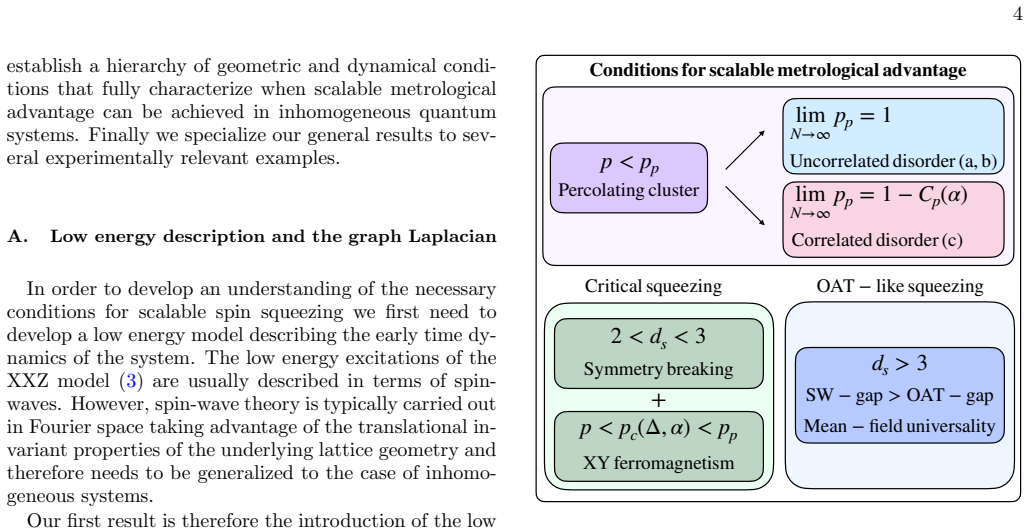
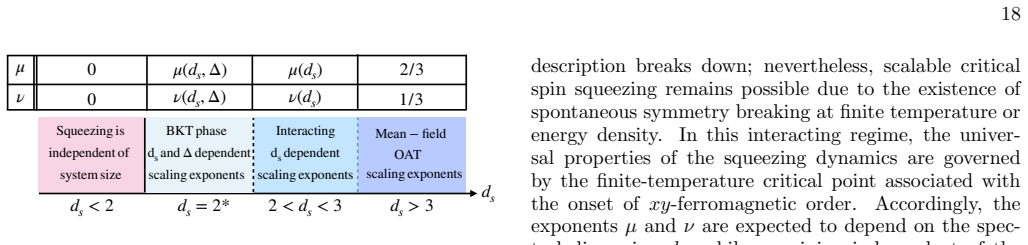
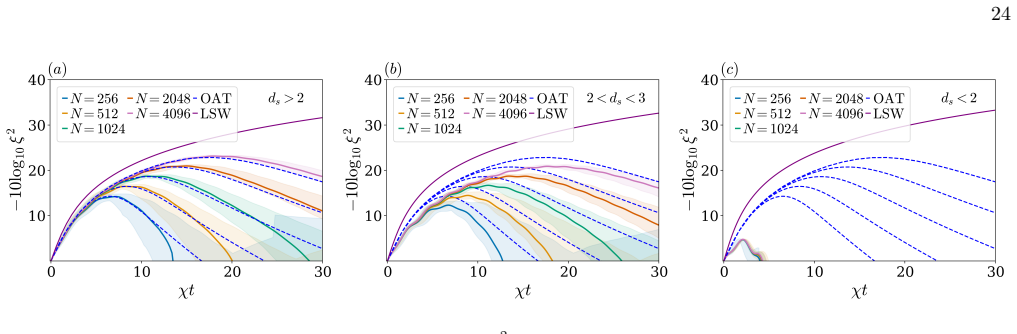
We establish the conditions under which scalable spin squeezing can be achieved in interacting spin ensembles embedded in arbitrary, inhomogeneous graph geometries. OAT-like scalable squeezing is governed solely by the universal properties of the interaction graph and is controlled by its spectral dimension. In critical squeezing the spectral dimension supplies only the necessary condition; the sufficient condition requires the model to lie below the symmetry breaking transition. In systems with random interaction graphs the scaling of the spin-squeezing critical point emerges from a nontrivial interplay between xy-ferromagnetic universality and percolation universality.
What carries the argument
The interplay between xy-ferromagnetic universality and percolation universality on random interaction graphs, which fixes the scaling of the spin-squeezing critical point.
If this is right
- OAT-like squeezing depends only on the interaction graph's universal properties via its spectral dimension.
- For critical squeezing the spectral dimension is necessary but the system must also remain below the symmetry breaking transition.
- The resulting framework yields sharp conditions for metrological gain on generic inhomogeneous structures.
- The same conditions apply across multiple experimental platforms for designing scalable quantum sensors.
Where Pith is reading between the lines
- Graph geometries in quantum simulators could be chosen to satisfy the spectral-dimension requirement for squeezing.
- Finite-size corrections in real devices may need separate verification before the universal scaling can be assumed.
- Similar graph-based universality arguments might apply to other metrological tasks such as quantum phase estimation.
Load-bearing premise
Universality classes apply directly to finite inhomogeneous random graphs without additional finite-size corrections.
What would settle it
Observation or simulation of the spin-squeezing critical-point scaling in a random-graph system that matches or deviates from the predicted xy-ferromagnetic plus percolation scaling.
Figures




read the original abstract
We establish the conditions under which scalable spin squeezing can be achieved in interacting spin ensembles embedded in arbitrary, inhomogeneous graph geometries. We identify two different forms of squeezing: OAT-like scalable squeezing is governed solely by the universal properties of the interaction graph and is controlled by its spectral dimension. In critical squeezing, on the other hand, the value of the spectral dimension only furnishes the necessary condition for scalable metrological gain, while the sufficient condition requires the model to lie below the symmetry breaking transition. Therefore, in systems with random interaction graphs, the scaling of the spin-squeezing critical point emerges from a nontrivial interplay between xy-ferromagnetic universality and percolation universality. We apply this general theoretical framework to several experimental scenarios and discuss sharp and experimentally relevant conditions for achieving robust metrological gain on generic inhomogeneous structures, giving a unifying perspective for designing scalable quantum sensors across diverse quantum simulation platforms.
Editorial analysis
A structured set of objections, weighed in public.
Referee Report
Summary. The paper claims to establish conditions for scalable spin squeezing in interacting spin ensembles on arbitrary inhomogeneous graph geometries. It distinguishes OAT-like scalable squeezing (governed solely by the interaction graph's universal properties and controlled by spectral dimension) from critical squeezing (where spectral dimension provides only a necessary condition, with the sufficient condition requiring the model to lie below the symmetry-breaking transition). The scaling of the spin-squeezing critical point is said to emerge from the interplay between xy-ferromagnetic universality and percolation universality. The framework is applied to experimental scenarios to identify conditions for robust metrological gain on generic inhomogeneous structures.
Significance. If the central claims hold, the work offers a general theoretical framework that unifies the design of scalable quantum sensors across diverse quantum simulation platforms by leveraging universality classes on random graphs. This could be significant for metrology applications where interaction graphs are inhomogeneous.
major comments (1)
- [Abstract] The central claim that the scaling of the critical point emerges from the interplay of xy-ferromagnetic and percolation universality (as stated in the abstract) rests on the direct applicability of these universality classes to finite, inhomogeneous random graphs. The manuscript does not appear to address or quantify potential finite-size corrections or rounding effects that could alter the scaling exponents or the location of the symmetry-breaking transition, which is load-bearing for the sufficient condition in critical squeezing.
Simulated Author's Rebuttal
We thank the referee for their careful reading of the manuscript and for identifying this important point regarding the applicability of universality arguments. We address the comment below.
read point-by-point responses
-
Referee: [Abstract] The central claim that the scaling of the critical point emerges from the interplay of xy-ferromagnetic and percolation universality (as stated in the abstract) rests on the direct applicability of these universality classes to finite, inhomogeneous random graphs. The manuscript does not appear to address or quantify potential finite-size corrections or rounding effects that could alter the scaling exponents or the location of the symmetry-breaking transition, which is load-bearing for the sufficient condition in critical squeezing.
Authors: We agree that finite-size corrections and rounding effects represent a valid concern for the robustness of the claimed scaling, particularly since the sufficient condition for critical squeezing depends on the location of the symmetry-breaking transition. Our derivations rely on scaling relations that become exact in the thermodynamic limit, where the XY-ferromagnetic and percolation universality classes apply directly to graphs with a prescribed spectral dimension. However, the manuscript does not provide an explicit quantification of finite-N corrections. In the revised version we will add a dedicated paragraph (and, if space permits, a short appendix) discussing the expected magnitude of these corrections for the random-graph ensembles considered, together with supporting numerical checks on finite instances. This addition will clarify the range of system sizes over which the interplay of the two universality classes remains predictive. revision: yes
Circularity Check
No significant circularity; derivation relies on external universality classes
full rationale
The provided abstract and context present the central claims as emerging from the application of established xy-ferromagnetic and percolation universality classes to the interaction graphs, without any quoted equations or steps that reduce the scaling predictions to fitted parameters, self-definitions, or load-bearing self-citations by construction. The sufficient condition (model below symmetry-breaking transition) is framed as an external theoretical requirement rather than an internal tautology. No evidence of renaming known results, smuggling ansatzes via self-citation, or calling fitted inputs predictions appears in the text. The derivation chain is therefore self-contained against external benchmarks from statistical mechanics.
Axiom & Free-Parameter Ledger
Forward citations
Cited by 2 Pith papers
-
Anomalous Floquet Heating from Sparse Long-Range Interactions
Sparse infinite-range interactions cause anomalous Floquet heating with rate γ ~ exp(-O(sqrt(ω))) originating from the broad distribution of coordination numbers.
-
Universal Spin Squeezing Dynamical Phase Transitions across Lattice Geometries, Dimensions, and Microscopic Couplings
The dynamical squeezing phase transition in bilayer XXZ spin models is universal across lattice geometries and interlayer coupling rescalings, with a new sub-linear scaling for short-range interactions.
Reference graph
Works this paper leans on
-
[1]
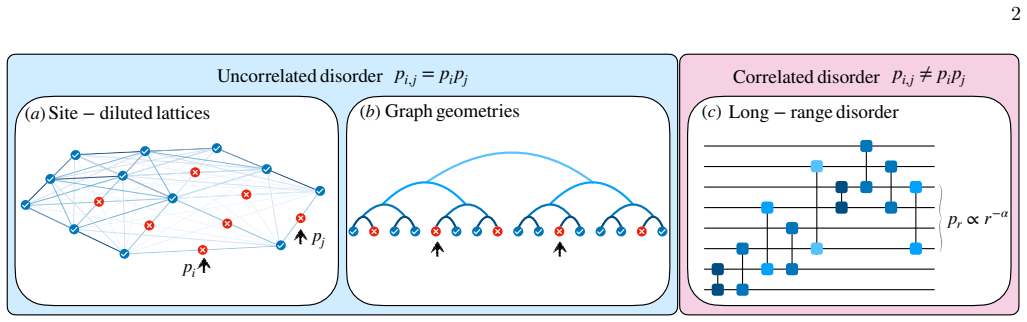
Graph geometries Going beyond diluted lattice geometries, we now con- sider how spin-squeezing dynamics is affected by more complex interaction graphs whose dimensionality, topol- ogy, and metric structure are entirely distinct from the physical embedding of the atomic array. Such graph geometries can be experimentally realized in setups of cold atoms tra...
-
[2]
Accordingly the calculation proceeds similarly to the nearest-neighbor case, allowing the thermodynamic limit of Eq
Weak long-range ( α > d ) As long as we are in the weak long-range regime α > d , the Kac scaling is finite in theN → ∞ limit. Accordingly the calculation proceeds similarly to the nearest-neighbor case, allowing the thermodynamic limit of Eq. (A3) to be taken safely, substituting the discrete momentum values kn with the continuous variable k ∈ [−π, π). L...
-
[3]
Indeed, as shown in Eq
Strong long-range ( 0 < α < d ) The situation changes dramatically in the strong long- range regime α < d . Indeed, as shown in Eq. (A2), the Kac normalization factor Nα diverges at large N ensur- ing energy extensivity. Accordingly, the thermodynamic limit of Eq. (A3) must be carefully considered. To this aim, it is convenient to write Eq. (A3) explicitl...
-
[4]
Role of an exponential cutoff We analyze the effect of introducing an exponential cutoff in the interaction profile, replacing the pure power- law couplings with Jr ∼ r−αe−κr. (A22) The Fourier transform of the couplings then reads ˜Jk(α) = NX r=1 cos(kr)e−κr rα , (A23) and the spectral gap between the zero mode and the first Fourier mode k1 = 2π/N is δλ ...
-
[5]
Equation (B4) reduces to a binary sum of cosine func- tions
The α = 0 case For α = 0, all nonzero couplings have equal strength. Equation (B4) reduces to a binary sum of cosine func- tions. The minimal gap is attained at momentum k = π, for which ˜J0 − ˜Jπ = log2(N)−1X n=0 [1 − cos(2nπ)] = 2, (B6) independently of system size. Thus, similarly to strongly long-range interacting lattices with α < d (see App. A 2), t...
-
[6]
The α > 0 case For α > 0, the sum in Eq. (B4) converges as N → ∞ and defines a classical Weierstrass function [104, 105], W (x) = ∞X n=0 λn cos(xbn), (B7) with parameters λ = 2−α, b = 2, (B8) satisfying 0 < λ < 1 and b > 1 + 3π/2. The Weierstrass function is continuous everywhere but nowhere differen- tiable, and exhibits a self-similar fractal structure....
-
[7]
(B15) Because α < 0, the dominant contributions now come from large distances n ∼ log2(N) rather than from short- range terms
The α < 0 case For α < 0, extensivity requires the introduction of a normalization factor N α, leading to the rescaled spec- trum ˜Jk(α) = log2(N)−1X n=0 N α2−αn cos (k 2n) = log2(N)−1X n=0 2α[log2(N)−n] cos (2nk) . (B15) Because α < 0, the dominant contributions now come from large distances n ∼ log2(N) rather than from short- range terms. This becomes e...
-
[8]
Giovannetti, S
V. Giovannetti, S. Lloyd, and L. Maccone, Advances in quantum metrology, Nat. Photon. 5, 222 (2011)
2011
-
[9]
C. L. Degen, F. Reinhard, and P. Cappellaro, Quantum sensing, Rev. Mod. Phys. 89, 035002 (2017)
2017
-
[10]
Pezz` e, A
L. Pezz` e, A. Smerzi, M. K. Oberthaler, R. Schmied, and P. Treutlein, Quantum metrology with nonclassical states of atomic ensembles, Rev. Mod. Phys. 90, 035005 (2018)
2018
-
[11]
Bouwmeester, J.-W
D. Bouwmeester, J.-W. Pan, M. Daniell, H. Wein- furter, and A. Zeilinger, Observation of three-photon greenberger-horne-zeilinger entanglement, Phys. Rev. Lett. 82, 1345 (1999)
1999
-
[12]
R. H. Dicke, Coherence in spontaneous radiation pro- cesses, Phys. Rev. 93, 99 (1954)
1954
-
[13]
D. J. Wineland, J. J. Bollinger, W. M. Itano, F. L. Moore, and D. J. Heinzen, Spin squeezing and reduced quantum noise in spectroscopy, Phys. Rev. A46, R6797 (1992)
1992
-
[14]
Kitagawa and M
M. Kitagawa and M. Ueda, Squeezed spin states, Phys. Rev. A 47, 5138 (1993)
1993
-
[15]
J. Ma, X. Wang, C. Sun, and F. Nori, Quantum spin squeezing, Phys. Rep. 509, 89 (2011)
2011
-
[16]
M. Kac, G. E. Uhlenbeck, and P. C. Hemmer, On the van der Waals Theory of the Vapor-Liquid Equilibrium. I. Discussion of a One-Dimensional Model, J. Math. Phys. 4, 216 (1963)
1963
-
[17]
D. J. Wineland, J. J. Bollinger, W. M. Itano, and D. J. Heinzen, Squeezed atomic states and projection noise in spectroscopy, Phys. Rev. A 50, 67 (1994)
1994
-
[18]
J. W. Britton, B. C. Sawyer, A. C. Keith, C.-C. J. Wang, J. K. Freericks, H. Uys, M. J. Biercuk, and J. J. Bollinger, Engineered two-dimensional ising inter- actions in a trapped-ion quantum simulator with hun- dreds of spins, Nature 484, 489 (2012)
2012
-
[19]
Kiesenhofer, H
D. Kiesenhofer, H. Hainzer, A. Zhdanov, P. C. Holz, M. Bock, T. Ollikainen, and C. F. Roos, Controlling two-dimensional coulomb crystals of more than 100 ions in a monolithic radio-frequency trap, PRX Quantum 4, 020317 (2023)
2023
-
[20]
S. Guo, Y. Wu, J. Ye, L. Zhang, W. Lian, R. Yao, Y. Wang, R. Yan, Y. Yi, Y. Xu, B. Li, Y. Hou, Y. Xu, W. Guo, C. Zhang, B. Qi, Z. Zhou, L. He, and L. Duan, A site-resolved two-dimensional quantum sim- ulator with hundreds of trapped ions, Nature 630, 613 (2024)
2024
-
[21]
Franke, S
J. Franke, S. R. Muleady, R. Kaubruegger, F. Kranzl, R. Blatt, A. M. Rey, M. K. Joshi, and C. F. Roos, Quantum-enhanced sensing on optical transi- 27 tions through finite-range interactions, Nature 621, 740 (2023)
2023
-
[22]
Browaeys and T
A. Browaeys and T. Lahaye, Many-body physics with individually controlled rydberg atoms, Nat. Phys. 16, 132 (2020)
2020
-
[23]
Gross and I
C. Gross and I. Bloch, Quantum simulations with ultra- cold atoms in optical lattices, Science 357, 995 (2017)
2017
-
[24]
Bornet, G
G. Bornet, G. Emperauger, C. Chen, B. Ye, M. Block, M. Bintz, J. A. Boyd, D. Barredo, T. Comparin, F. Mezzacapo, T. Roscilde, T. Lahaye, N. Y. Yao, and A. Browaeys, Scalable spin squeezing in a dipolar ryd- berg atom array, Nature 621, 728 (2023)
2023
-
[25]
W. J. Eckner, N. Darkwah Oppong, A. Cao, A. W. Young, W. R. Milner, J. M. Robinson, J. Ye, and A. M. Kaufman, Realizing spin squeezing with rydberg inter- actions in an optical clock, Nature 621, 734 (2023)
2023
-
[26]
J. A. Hines, S. V. Rajagopal, G. L. Moreau, M. D. Wahrman, N. A. Lewis, O. Markovi´ c, and M. Schleier- Smith, Spin squeezing by rydberg dressing in an array of atomic ensembles, Phys. Rev. Lett. 131, 063401 (2023)
2023
-
[27]
S. A. Moses, J. P. Covey, M. T. Miecnikowski, B. Yan, B. Gadway, J. Ye, and D. S. Jin, Creation of a low- entropy quantum gas of polar molecules in an optical lattice, Science 350, 659 (2015)
2015
-
[28]
C. M. Holland, Y. Lu, and L. W. Cheuk, On-demand entanglement of molecules in a reconfigurable optical tweezer array, Science 382, 1143 (2023)
2023
-
[29]
Bilitewski, L
T. Bilitewski, L. De Marco, J.-R. Li, K. Matsuda, W. G. Tobias, G. Valtolina, J. Ye, and A. M. Rey, Dynam- ical generation of spin squeezing in ultracold dipolar molecules, Phys. Rev. Lett. 126, 113401 (2021)
2021
-
[30]
M. W. Doherty, N. B. Manson, P. Delaney, F. Jelezko, J. Wrachtrup, and L. C. Hollenberg, The nitrogen- vacancy colour centre in diamond, Phys. Rep. 528, 1 (2013)
2013
-
[31]
R. Gong, G. He, X. Gao, P. Ju, Z. Liu, B. Ye, E. A. Hen- riksen, T. Li, and C. Zu, Coherent dynamics of strongly interacting electronic spin defects in hexagonal boron nitride, Nat. Commun. 14, 3299 (2023)
2023
-
[32]
L. B. Hughes, S. A. Meynell, W. Wu, S. Parthasarathy, L. Chen, Z. Zhang, Z. Wang, E. J. Davis, K. Mukher- jee, N. Y. Yao, and A. C. B. Jayich, Strongly interact- ing, two-dimensional, dipolar spin ensembles in (111)- oriented diamond, Phys. Rev. X 15, 021035 (2025)
2025
-
[33]
Defenu, T
N. Defenu, T. Donner, T. Macr` ı, G. Pagano, S. Ruffo, and A. Trombettoni, Long-range interacting quantum systems, Rev. Mod. Phys. 95, 035002 (2023)
2023
-
[34]
Chomaz, I
L. Chomaz, I. Ferrier-Barbut, F. Ferlaino, B. Laburthe- Tolra, B. L. Lev, and T. Pfau, Dipolar physics: a re- view of experiments with magnetic quantum gases, Rep. Prog. Phys. 86, 026401 (2022)
2022
-
[35]
Entanglement and spin-squeezing without infinite-range interactions
M. Foss-Feig, Z.-X. Gong, A. V. Gorshkov, and C. W. Clark, Entanglement and spin-squeezing with- out infinite-range interactions (2016), arXiv:1612.07805 [cond-mat.quant-gas]
work page internal anchor Pith review Pith/arXiv arXiv 2016
-
[36]
M. A. Perlin, C. Qu, and A. M. Rey, Spin squeezing with short-range spin-exchange interactions, Phys. Rev. Lett. 125, 223401 (2020)
2020
-
[37]
Comparin, F
T. Comparin, F. Mezzacapo, and T. Roscilde, Ro- bust spin squeezing from the tower of states of u(1)- symmetric spin hamiltonians, Phys. Rev. A105, 022625 (2022)
2022
-
[38]
Comparin, F
T. Comparin, F. Mezzacapo, M. Robert-de Saint- Vincent, and T. Roscilde, Scalable spin squeezing from spontaneous breaking of a continuous symmetry, Phys. Rev. Lett. 129, 113201 (2022)
2022
-
[39]
Comparin, F
T. Comparin, F. Mezzacapo, and T. Roscilde, Multi- partite entangled states in dipolar quantum simulators, Phys. Rev. Lett. 129, 150503 (2022)
2022
-
[40]
Roscilde, T
T. Roscilde, T. Comparin, and F. Mezzacapo, Entan- gling dynamics from effective rotor–spin-wave separa- tion in u(1)-symmetric quantum spin models, Phys. Rev. Lett. 131, 160403 (2023)
2023
-
[41]
Block, B
M. Block, B. Ye, B. Roberts, S. Chern, W. Wu, Z. Wang, L. Pollet, E. J. Davis, B. I. Halperin, and N. Y. Yao, Scalable spin squeezing from finite-temperature easy- plane magnetism, Nat. Phys. 20, 1575 (2024)
2024
-
[42]
A. Duha, S. E. Begg, and T. Bilitewski, Nonequilibrium critical scaling of a squeezing phase transition, Phys. Rev. Lett. 135, 150401 (2025)
2025
-
[43]
Duha and T
A. Duha and T. Bilitewski, Two-mode squeezing in floquet-engineered power-law interacting spin models, Phys. Rev. A 109, L061304 (2024)
2024
-
[44]
Y. K. Lee, M. Block, H. Lin, V. Fedoseev, P. J. D. Crow- ley, N. Y. Yao, and W. Ketterle, Observation of spin squeezing with contact interactions in one- and three- dimensional easy-plane magnets, Phys. Rev. Lett. 135, 023402 (2025)
2025
-
[45]
Douglas, V
A. Douglas, V. Kaxiras, L. Su, M. Szurek, V. Singh, O. Markovi´ c, and M. Greiner, Spin squeezing with itin- erant magnetic dipoles, Phys. Rev. X15, 041021 (2025)
2025
-
[46]
W. Wu, E. J. Davis, L. B. Hughes, B. Ye, Z. Wang, D. Kufel, T. Ono, S. A. Meynell, M. Block, C. Liu, H. Yang, A. C. Bleszynski Jayich, and N. Y. Yao, Spin squeezing in an ensemble of nitrogen–vacancy centres in diamond, Nature 646, 74 (2025)
2025
-
[47]
J. R. Maze, P. L. Stanwix, J. S. Hodges, S. Hong, J. M. Taylor, P. Cappellaro, L. Jiang, M. V. G. Dutt, E. To- gan, A. S. Zibrov, A. Yacoby, R. L. Walsworth, and M. D. Lukin, Nanoscale magnetic sensing with an in- dividual electronic spin in diamond, Nature 455, 644 (2008)
2008
-
[48]
Schirhagl, K
R. Schirhagl, K. Chang, M. Loretz, and C. L. Degen, Nitrogen-vacancy centers in diamond: Nanoscale sen- sors for physics and biology, Annu. Rev. Phys. Chem. 65, 83 (2014)
2014
-
[49]
Rovny, S
J. Rovny, S. Gopalakrishnan, A. C. B. Jayich, P. Maletinsky, E. Demler, and N. P. de Leon, Nanoscale diamond quantum sensors for many-body physics, Nat. Rev. Phys. 6, 753 (2024)
2024
-
[50]
Aslam, H
N. Aslam, H. Zhou, E. K. Urbach, M. J. Turner, R. L. Walsworth, M. D. Lukin, and H. Park, Quantum sen- sors for biomedical applications, Nat. Rev. Phys. 5, 157 (2023)
2023
-
[51]
Sanchez-Palencia and M
L. Sanchez-Palencia and M. Lewenstein, Disordered quantum gases under control, Nat. Phys. 6, 87 (2010)
2010
-
[52]
Lewenstein, A
M. Lewenstein, A. Sanpera, V. Ahufinger, B. Damski, A. Sen(De), and U. Sen, Ultracold atomic gases in op- tical lattices: mimicking condensed matter physics and beyond, Adv. Phys. 56, 243 (2007)
2007
-
[53]
J. J. Alonso and B. All´ es, Monte carlo study of the two- dimensional site-diluted dipolar ising model, Phys. Rev. B 82, 064425 (2010)
2010
-
[54]
J. C. Andresen, H. G. Katzgraber, V. Oganesyan, and M. Schechter, Existence of a thermodynamic spin-glass phase in the zero-concentration limit of anisotropic dipolar systems, Phys. Rev. X 4, 041016 (2014)
2014
-
[55]
M. P. Kwasigroch and N. R. Cooper, Synchronization 28 transition in dipole-coupled two-level systems with po- sitional disorder, Phys. Rev. A 96, 053610 (2017)
2017
-
[56]
Zhang and B
C. Zhang and B. Capogrosso-Sansone, Quantum monte carlo study of the long-range site-diluted xxz model as realized by polar molecules, Phys. Rev. A 98, 013621 (2018)
2018
-
[57]
C. M. S. Gannarelli, D. M. Silevitch, T. F. Rosenbaum, G. Aeppli, and A. J. Fisher, Contribution of spin pairs to the magnetic response in a dilute dipolar ferromagnet, Phys. Rev. B 86, 014420 (2012)
2012
-
[58]
Periwal, E
A. Periwal, E. S. Cooper, P. Kunkel, J. F. Wienand, E. J. Davis, and M. Schleier-Smith, Programmable in- teractions and emergent geometry in an array of atom clouds, Nature 600, 630 (2021)
2021
-
[59]
Bentsen, T
G. Bentsen, T. Hashizume, A. S. Buyskikh, E. J. Davis, A. J. Daley, S. S. Gubser, and M. Schleier-Smith, Tree- like interactions and fast scrambling with cold atoms, Phys. Rev. Lett. 123, 130601 (2019)
2019
-
[60]
Aharonov, A
D. Aharonov, A. Kitaev, and J. Preskill, Fault-tolerant quantum computation with long-range correlated noise, Phys. Rev. Lett. 96, 050504 (2006)
2006
-
[61]
Xu, Long-range coupling affects entanglement dy- namics, Physics 15, 2 (2022)
S. Xu, Long-range coupling affects entanglement dy- namics, Physics 15, 2 (2022)
2022
-
[62]
Sharma, X
S. Sharma, X. Turkeshi, R. Fazio, and M. Dalmonte, Measurement-induced criticality in extended and long- range unitary circuits, SciPost Phys. Core5, 023 (2022)
2022
-
[63]
Block, Y
M. Block, Y. Bao, S. Choi, E. Altman, and N. Y. Yao, Measurement-induced transition in long-range interact- ing quantum circuits, Phys. Rev. Lett. 128, 010604 (2022)
2022
-
[64]
Within this work, we use the term network in the sense commonly adopted in network theory and com- plex systems, namely, to denote a graph characterized by nontrivial topological features [136]. This terminol- ogy should not be confused with that of a quantum communication, where a quantum network represents a system of communication links supporting shar...
-
[65]
A. P. Mill´ an, G. Gori, F. Battiston, T. Enss, and N. De- fenu, Complex networks with tuneable spectral dimen- sion as a universality playground, Phys. Rev. Res. 3, 023015 (2021)
2021
-
[66]
Cassi, Phase transitions and random walks on graphs: A generalization of the mermin-wagner theo- rem to disordered lattices, fractals, and other discrete structures, Phys
D. Cassi, Phase transitions and random walks on graphs: A generalization of the mermin-wagner theo- rem to disordered lattices, fractals, and other discrete structures, Phys. Rev. Lett. 68, 3631 (1992)
1992
-
[67]
Cassi, Local vs average behavior on inhomogeneous structures: Recurrence on the average and a further extension of mermin-wagner theorem on graphs, Phys
D. Cassi, Local vs average behavior on inhomogeneous structures: Recurrence on the average and a further extension of mermin-wagner theorem on graphs, Phys. Rev. Lett. 76, 2941 (1996)
1996
-
[68]
Bruno, Absence of spontaneous magnetic order at nonzero temperature in one- and two-dimensional heisenberg and XY systems with long-range interac- tions, Phys
P. Bruno, Absence of spontaneous magnetic order at nonzero temperature in one- and two-dimensional heisenberg and XY systems with long-range interac- tions, Phys. Rev. Lett. 87, 137203 (2001)
2001
-
[69]
M. F. Maghrebi, Z.-X. Gong, and A. V. Gorshkov, Con- tinuous symmetry breaking in 1d long-range interacting quantum systems, Phys. Rev. Lett. 119, 023001 (2017)
2017
-
[70]
Giachetti, N
G. Giachetti, N. Defenu, S. Ruffo, and A. Trom- bettoni, Berezinskii-kosterlitz-thouless phase transitions with long-range couplings, Phys. Rev. Lett.127, 156801 (2021)
2021
-
[71]
Giachetti, A
G. Giachetti, A. Trombettoni, S. Ruffo, and N. De- fenu, Berezinskii-kosterlitz-thouless transitions in classi- cal and quantum long-range systems, Phys. Rev. B106, 014106 (2022)
2022
-
[72]
Glick, H
A. Glick, H. Lipkin, and N. Meshkov, Validity of many- body approximation methods for a solvable model: (iii). diagram summations, Nucl. Phys. 62, 211 (1965)
1965
-
[73]
Botet, R
R. Botet, R. Jullien, and P. Pfeuty, Size scaling for in- finitely coordinated systems, Phys. Rev. Lett. 49, 478 (1982)
1982
-
[74]
Dusuel and J
S. Dusuel and J. Vidal, Finite-size scaling exponents of the lipkin-meshkov-glick model, Phys. Rev. Lett. 93, 237204 (2004)
2004
-
[75]
Notice that spin-squeezing protocols with different scal- ing in time can be designed [137, 138] but in this case the quench crosses different transition lines [139, 140]
-
[76]
Fiedler, Algebraic connectivity of graphs, Czechoslo- vak Mathematical Journal 23, 298 (1973)
M. Fiedler, Algebraic connectivity of graphs, Czechoslo- vak Mathematical Journal 23, 298 (1973)
1973
-
[77]
A. P. Mill´ an, R. Ghorbanchian, N. Defenu, F. Battis- ton, and G. Bianconi, Local topological moves deter- mine global diffusion properties of hyperbolic higher- order networks, Phys. Rev. E 104, 054302 (2021)
2021
-
[78]
Chung, Spectral Graph Theory, CBMS Regional Con- ference Series No
F. Chung, Spectral Graph Theory, CBMS Regional Con- ference Series No. Nr. 92 (Conference Board of the Mathematical Sciences)
-
[79]
A. M. Childs and J. Goldstone, Spatial search by quan- tum walk, Phys. Rev. A 70, 022314 (2004)
2004
-
[80]
Chakraborty, L
S. Chakraborty, L. Novo, and J. Roland, Optimality of spatial search via continuous-time quantum walks, Phys. Rev. A 102, 032214 (2020)
2020
discussion (0)
Sign in with ORCID, Apple, or X to comment. Anyone can read and Pith papers without signing in.