Timing and spectral analysis of the 2025 outburst of 4U 1630-47 with textit{NICER}
Pith reviewed 2026-07-03 07:42 UTC · model grok-4.3
The pith
Transient QPOs in 4U 1630-47 trace inner disk temperature and normalization changes during the 2025 outburst rise.
A machine-rendered reading of the paper's core claim, the machinery that carries it, and where it could break.
Core claim
The transient QPOs are therefore consistent with short-timescale disk-related variability during the rising phase, whereas the millihertz-scale QRM may represent a weaker heartbeat-like variability mode appearing near the outburst peak. During the rising phase the QPO centroid frequency increased from ∼0.24 Hz to ∼3.43 Hz. Wavelet-based state separation shows that the with-QPO intervals are associated with a higher inner disk temperature and a lower diskbb normalization than the without-QPO intervals, while the photon index (Γ) shows weaker changes within the uncertainties. Near the outburst peak, the source displayed a weak QRM at ∼0.07 Hz with a fractional rms amplitude of ∼4.7%. Phase-res
What carries the argument
Wavelet-based separation of with-QPO versus without-QPO intervals, combined with diskbb-plus-power-law spectral fits that isolate correlations between QPO presence and inner-disk temperature and normalization.
Load-bearing premise
Changes in diskbb inner-disk temperature and normalization directly trace physical disk variability without significant degeneracies or unmodeled components in the chosen spectral model.
What would settle it
Refitting the same NICER spectra with an alternative model such as a Comptonization component and finding that the temperature and normalization differences between with-QPO and without-QPO intervals disappear would falsify the disk-variability link.
Figures





read the original abstract
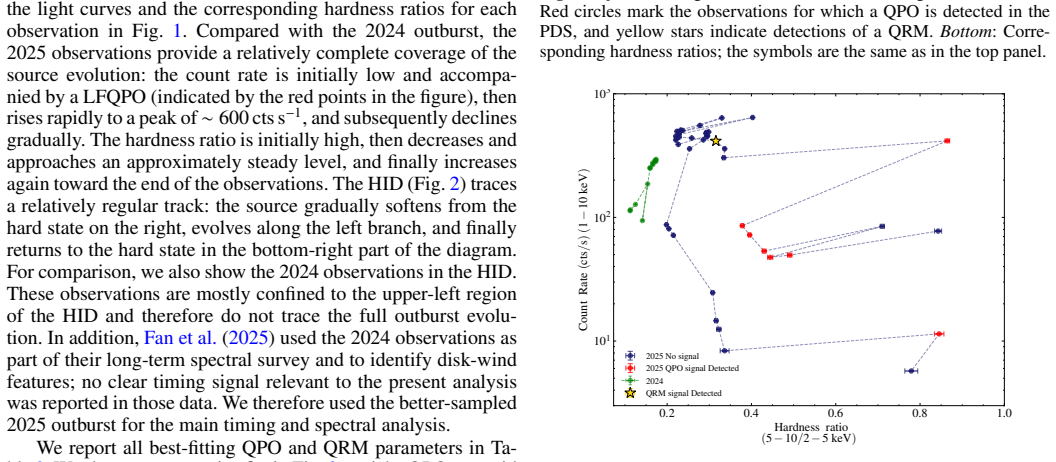
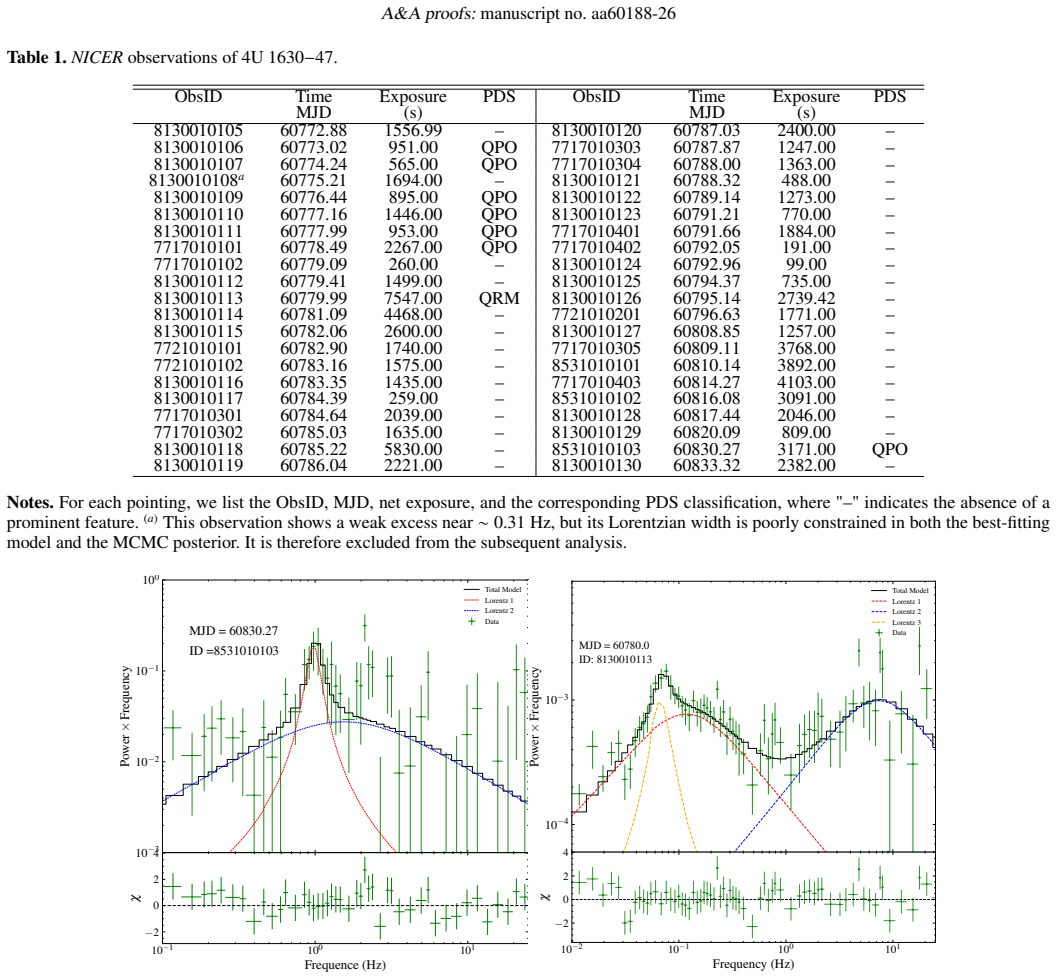
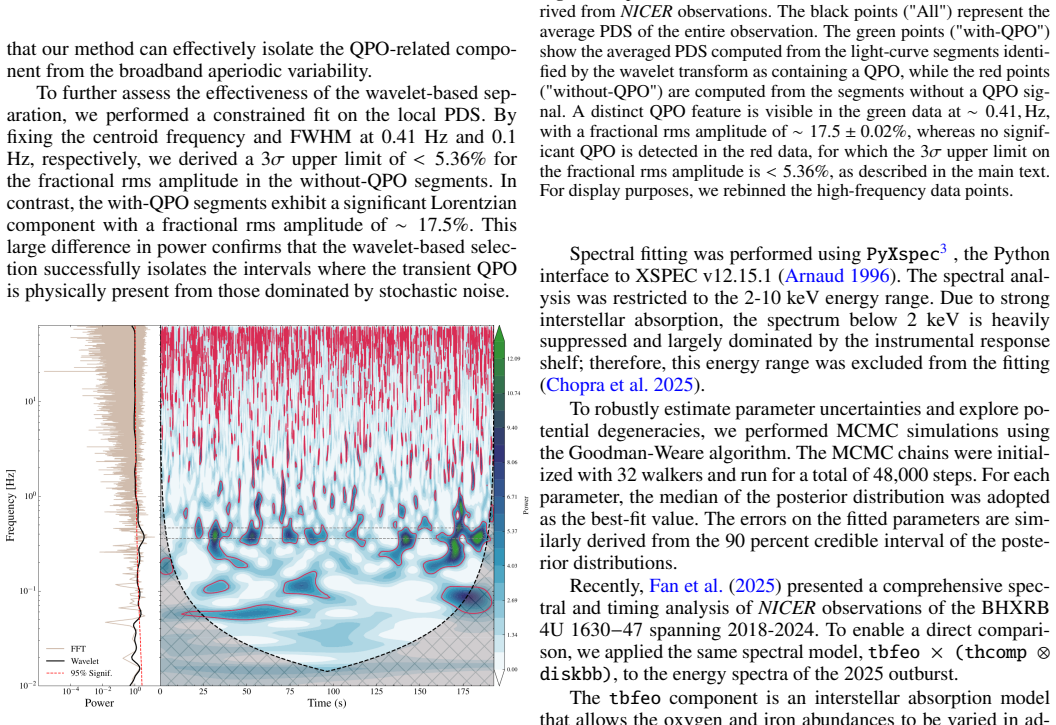
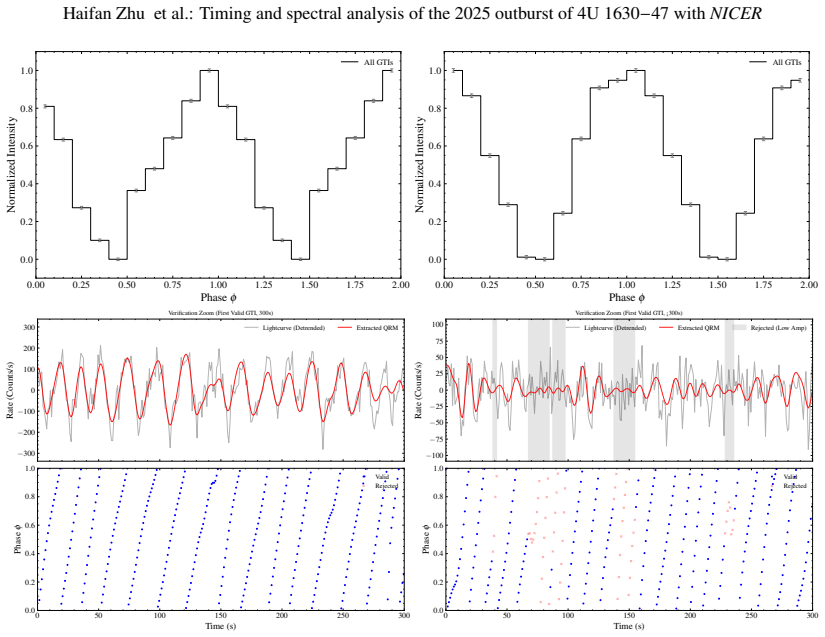
We analyzed \textit{NICER} observations of the 2025 outburst of the black hole X-ray binary 4U~1630$-$47 to investigate the spectral--timing properties of its transient low-frequency quasi-periodic oscillations (QPOs) and millihertz-scale quasi-regular modulation (QRM). During the rising phase of the outburst, the QPO centroid frequency increased from $\sim 0.24$ Hz to $\sim 3.43$ Hz. Wavelet-based state separation shows that the with-QPO intervals are associated with a higher inner disk temperature and a lower \texttt{diskbb} normalization than the without-QPO intervals, while the photon index ($\Gamma$) shows weaker changes within the uncertainties. Near the outburst peak, the source displayed a weak QRM at $\sim 0.07$ Hz with a fractional rms amplitude of $\sim 4.7\%$, lower than that of the heartbeat state observed in 2023. Phase-resolved Hilbert--Huang analysis shows that the inner disk temperature is positively correlated with the X-ray flux, the \texttt{diskbb} normalization is anticorrelated, and $\Gamma$ varies only weakly. Overall, the short-timescale spectral--timing variability is expressed most clearly through the disk-related parameters. The transient QPOs are therefore consistent with short-timescale disk-related variability during the rising phase, whereas the millihertz-scale QRM may represent a weaker heartbeat-like variability mode appearing near the outburst peak.
Editorial analysis
A structured set of objections, weighed in public.
Referee Report
Summary. The manuscript analyzes NICER observations of the 2025 outburst of black hole X-ray binary 4U 1630-47, reporting transient low-frequency QPOs with centroid frequencies rising from ~0.24 Hz to ~3.43 Hz during the outburst rise. Wavelet-based separation associates with-QPO intervals with higher diskbb inner-disk temperature and lower normalization (while photon index changes are weaker), and near peak a weak ~0.07 Hz QRM (rms ~4.7%) is identified whose phase-resolved Hilbert-Huang spectra show positive kT_in-flux correlation, anticorrelated diskbb normalization-flux, and weak Gamma variation. The authors conclude the QPOs trace short-timescale disk-related variability and the QRM represents a weaker heartbeat-like mode.
Significance. If the reported parameter correlations hold under robust modeling, the work adds to the observational evidence linking transient QPOs in BHXRBs to disk variability on short timescales and distinguishes a millihertz QRM from stronger heartbeat states seen in prior outbursts. The application of wavelet state separation and Hilbert-Huang phase resolution to NICER data is a methodological strength that could be reproducible if full data tables and statistical tests are provided.
major comments (1)
- [Abstract / spectral analysis] Abstract and spectral analysis: the central claim that QPOs trace disk-related variability and that the QRM is a weaker heartbeat mode rests on interpreting higher kT_in and lower diskbb normalization in with-QPO intervals (plus the reported flux correlations) as physical disk changes. However, the diskbb+powerlaw model is known to exhibit degeneracies in which shifts in kT_in or normalization can be compensated by adjustments to the power-law index or normalization; without tests against alternative continua (e.g., with reflection or Comptonization components) or explicit checks for parameter trade-offs, the state separations do not necessarily support the disk-origin interpretation.
minor comments (2)
- [Abstract] The abstract states conclusions about consistency with disk variability but does not report the specific statistical significance levels, error propagation methods, or pre-specification of the wavelet/Hilbert-Huang selections used to define intervals.
- [Results] Full data tables for the reported QPO frequencies, rms amplitudes, and fitted spectral parameters across intervals would be needed to allow independent verification of the correlations.
Simulated Author's Rebuttal
We thank the referee for their careful review and constructive feedback on our analysis of the 2025 outburst of 4U 1630-47. We address the single major comment below.
read point-by-point responses
-
Referee: [Abstract / spectral analysis] Abstract and spectral analysis: the central claim that QPOs trace disk-related variability and that the QRM is a weaker heartbeat mode rests on interpreting higher kT_in and lower diskbb normalization in with-QPO intervals (plus the reported flux correlations) as physical disk changes. However, the diskbb+powerlaw model is known to exhibit degeneracies in which shifts in kT_in or normalization can be compensated by adjustments to the power-law index or normalization; without tests against alternative continua (e.g., with reflection or Comptonization components) or explicit checks for parameter trade-offs, the state separations do not necessarily support the disk-origin interpretation.
Authors: We acknowledge the referee's valid point regarding known degeneracies in the diskbb+powerlaw model. Our analysis shows that photon index variations remain weak and within uncertainties across the with-QPO and without-QPO intervals, while the diskbb parameters display more pronounced and consistent differences; this differential behavior underpins our disk-related interpretation. Nevertheless, we agree that additional robustness checks would be beneficial. In the revised manuscript we have expanded the discussion section to explicitly note the model limitations, reference prior BHXRB studies using similar continua, and state that future analyses with reflection or Comptonization components could further test the conclusions. We have not performed new fits with alternative models in this revision due to the scope of the current dataset and analysis pipeline. revision: partial
Circularity Check
No circularity detected; purely observational report
full rationale
The manuscript presents timing and spectral measurements extracted from NICER light curves and spectra of the 2025 outburst. Reported quantities include observed QPO centroid frequencies (0.24–3.43 Hz), rms amplitudes, wavelet-based state separations in diskbb kT_in and normalization, and Hilbert–Huang phase-resolved correlations between kT_in, normalization, and flux. These are direct outputs of standard data-reduction and fitting procedures applied to the observations; no equation or claimed result is constructed by re-using a fitted parameter as its own prediction, no self-citation supplies a load-bearing uniqueness theorem, and no ansatz is smuggled in. The derivation chain terminates at the measured data products themselves and therefore contains no circular reduction.
Axiom & Free-Parameter Ledger
free parameters (2)
- diskbb inner-disk temperature
- diskbb normalization
axioms (1)
- domain assumption The diskbb plus power-law spectral model accurately represents the X-ray continuum without unaccounted emission components or strong parameter degeneracies.
Reference graph
Works this paper leans on
-
[1]
Alabarta, K., Altamirano, D., Méndez, M., et al. 2021, MNRAS, 507, 5507
work page 2021
-
[2]
Altamirano, D., Belloni, T., Linares, M., et al. 2011, ApJL, 742, L17
work page 2011
- [3]
-
[4]
Arnaud, K. A. 1996, ASP Conf. Ser., 101, 17
work page 1996
- [5]
-
[6]
Bellavita, C., García, F., Méndez, M., & Karpouzas, K. 2022, MNRAS, 515, 2099
work page 2022
- [7]
- [8]
-
[9]
Belloni, T., Klein-Wolt, M., Méndez, M., van der Klis, M., & van Paradijs, J. 2000, A&A, 355, 271
work page 2000
-
[10]
Belloni, T., Mendez, M., King, A., van der Klis, M., & Van Paradijs, J. 1997, ApJL, 488, L109
work page 1997
-
[11]
Benesty, J., Chen, J., Huang, Y ., & Cohen, I. 2009, in Noise reduction in speech processing (Springer), 1–4 Article number, page 11 of 13 A&A proofs:manuscript no. aa60188-26
work page 2009
-
[12]
Capitanio, F., Belloni, T., Del Santo, M., & Ubertini, P. 2009, MNRAS, 398, 1194
work page 2009
-
[13]
Capitanio, F., Campana, R., De Cesare, G., & Ferrigno, C. 2015, MNRAS, 450, 3840
work page 2015
- [14]
-
[15]
Chakrabarti, S. K. & Molteni, D. 1993, ApJ, 417, 671
work page 1993
- [16]
- [17]
-
[18]
Cheng, Z., Méndez, M., Altamirano, D., Beri, A., & Wang, Y . 2019, MNRAS, 482, 550
work page 2019
-
[19]
Chopra, A., Chakraborty, M., & Kashyap, U. 2025, J. High Energy Astrophys., 46, 100344
work page 2025
-
[20]
Czerny, B., Lachowicz, P., Dovˇciak, M., et al. 2010, A&A, 524, A26
work page 2010
- [21]
- [22]
- [23]
-
[24]
Gatuzz, E., Díaz Trigo, M., Miller-Jones, J., & Migliari, S. 2019, MNRAS, 482, 2597
work page 2019
-
[25]
C., Arzoumanian, Z., Adkins, P
Gendreau, K. C., Arzoumanian, Z., Adkins, P. W., et al. 2016, Proc. SPIE, 9905, 99051H
work page 2016
-
[26]
Huang, N. E., Shen, Z., Long, S. R., et al. 1998, Proc. R. Soc. A, 454, 903
work page 1998
-
[27]
Huang, N. E. & Wu, Z. 2008, Rev. Geophys., 46
work page 2008
- [28]
- [29]
-
[30]
Ingram, A., Done, C., & Fragile, P. C. 2009, MNRAS, 397, L101
work page 2009
-
[31]
Ingram, A. R. & Motta, S. E. 2019, New Astron. Rev., 85, 101524
work page 2019
- [32]
-
[33]
Jones, C., Forman, W., Tananbaum, H., & Turner, M. 1976, ApJ, 210, L9
work page 1976
-
[34]
Kalemci, E., Diaz Trigo, M., Oztaban, E., et al. 2025, MNRAS, 543, 3073
work page 2025
- [35]
- [36]
-
[37]
Kubota, A., Done, C., Tsurumi, K., & Mizukawa, R. 2024, MNRAS, 528, 1668
work page 2024
-
[38]
Kubota, A., Tanaka, Y ., Makishima, K., et al. 1998, PASJ, 50, 667
work page 1998
-
[39]
Kushwaha, A., Jayasurya, K. M., Agrawal, V . K., & Nandi, A. 2023, MNRAS, 524, L15
work page 2023
-
[40]
Lightman, A. P. & Eardley, D. M. 1974, ApJ, 187, L1
work page 1974
- [41]
- [42]
-
[43]
Ma, X., Tao, L., Zhang, S.-N., et al. 2021, Nature Astronomy, 5, 94
work page 2021
-
[44]
Maccarone, T. J. & Coppi, P. S. 2002, MNRAS, 336, 817
work page 2002
-
[45]
J., Uttley, P., Van Der Klis, M., Wijnands, R
Maccarone, T. J., Uttley, P., Van Der Klis, M., Wijnands, R. A., & Coppi, P. S. 2011, MNRAS, 413, 1819
work page 2011
- [46]
- [47]
-
[48]
Mastichiadis, A., Petropoulou, M., & Kylafis, N. 2022, A&A, 662, A118
work page 2022
- [49]
- [50]
-
[51]
Miyamoto, S., Kimura, K., Kitamoto, S., Dotani, T., & Ebisawa, K. 1991, ApJ, 383, 784
work page 1991
- [52]
-
[53]
Motch, C., Ricketts, M., Page, C., Ilovaisky, S., & Chevalier, C. 1983, A&A, 119, 171
work page 1983
- [54]
- [55]
- [56]
- [57]
-
[58]
Parra, M., Bianchi, S., Petrucci, P.-O., et al. 2025, A&A, 701, A292
work page 2025
- [59]
-
[60]
Remillard, R. A. & McClintock, J. E. 2006, ARA&A, 44, 49
work page 2006
-
[61]
Remillard, R. A., Morgan, E. H., McClintock, J. E., Bailyn, C. D., & Orosz, J. A. 1999, ApJ, 522, 397
work page 1999
-
[62]
Remillard, R. A., Sobczak, G. J., Muno, M. P., & McClintock, J. E. 2002, ApJ, 564, 962
work page 2002
-
[63]
Schnittman, J. D., Homan, J., & Miller, J. M. 2006, ApJ, 642, 420
work page 2006
- [64]
- [65]
- [66]
-
[67]
F., Narayan, R., McClintock, J
Steiner, J. F., Narayan, R., McClintock, J. E., & Ebisawa, K. 2009, PASP, 121, 1279
work page 2009
-
[68]
Su, Y .-H., Chou, Y ., Hu, C.-P., & Yang, T.-C. 2015, ApJ, 815, 74
work page 2015
- [69]
- [70]
- [71]
- [72]
-
[73]
Torres, M. E., Colominas, M. A., Schlotthauer, G., & Flandrin, P. 2011, Proc. IEEE ICASSP, 4144
work page 2011
-
[74]
Trudolyubov, S. P., Borozdin, K. N., & Priedhorsky, W. C. 2001, MNRAS, 322, 309
work page 2001
- [75]
-
[76]
Uttley, P. & Malzac, J. 2025, MNRAS, 536, 3284 Van der Klis, M. 1989, ARA& A, 27, 517
work page 2025
-
[77]
Verner, D. A., Ferland, G. J., Korista, K. T., & Yakovlev, D. G. 1996, ApJ, 465, 487
work page 1996
-
[78]
Vignarca, F., Migliari, S., Belloni, T., Psaltis, D., & Van Der Klis, M. 2003, A&A, 397, 729
work page 2003
- [79]
-
[80]
Weng, S.-S., Wang, T.-T., Cai, J.-P., Yuan, Q.-R., & Gu, W.-M. 2018, ApJ, 865, 19
work page 2018
discussion (0)
Sign in with ORCID, Apple, or X to comment. Anyone can read and Pith papers without signing in.