Quantum charge pumping in helical systems: A comparative study of short- and long-range hopping
Pith reviewed 2026-06-27 06:16 UTC · model grok-4.3
The pith
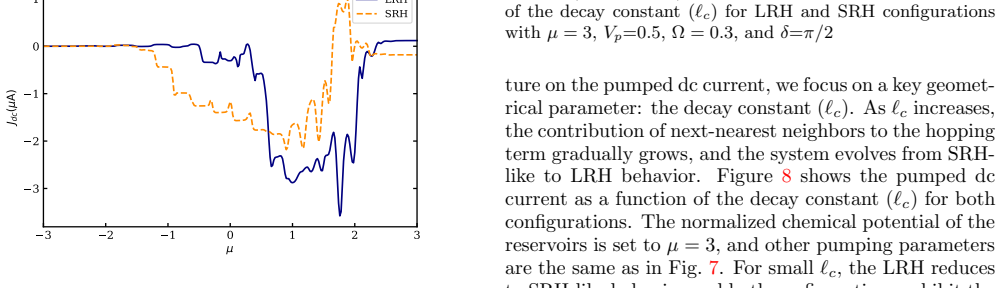
The decay exponent in helical hopping models tunes both the magnitude and sign of the pumped current
A machine-rendered reading of the paper's core claim, the machinery that carries it, and where it could break.
Core claim
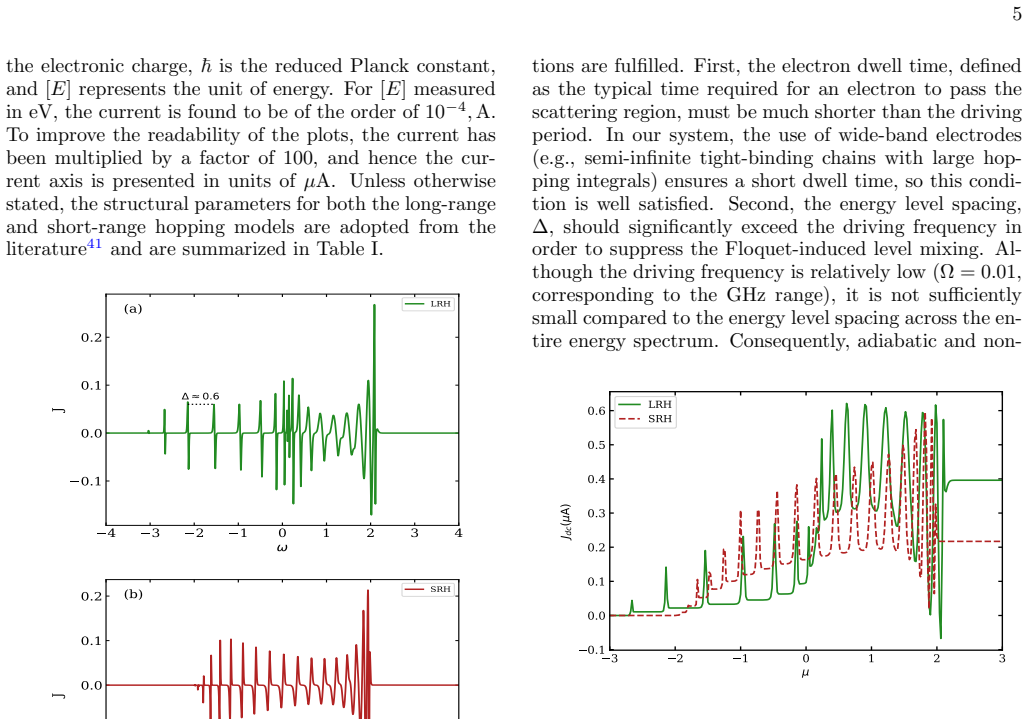
In helical systems described by a tight-binding model, the decay exponent ℓ_c that parameterizes long-range hopping acts as an effective structural parameter that can tune both the magnitude and sign of the pumped current, offering a geometric knob for controlling quantum pumping. For long-range hopping the pumped dc current exhibits pronounced plateau-like regions as a function of chemical potential when energy levels are sparsely spaced, consistent with adiabatic transport, whereas short-range hopping yields more parameter-sensitive currents without clear plateaus. The plateau stability is controlled by the drive frequency: at higher frequencies Floquet side-band mixing destroys the platea
What carries the argument
The decay exponent ℓ_c that sets the spatial decay of hopping amplitudes in the helical tight-binding Hamiltonian, thereby controlling energy level spacing and the resulting pumped dc current under time-periodic end driving.
If this is right
- Long-range hopping produces plateau-like regions in the dc pumped current versus chemical potential for sparsely spaced levels.
- Higher drive frequencies destroy the plateaus through Floquet side-band mixing and produce oscillatory currents instead.
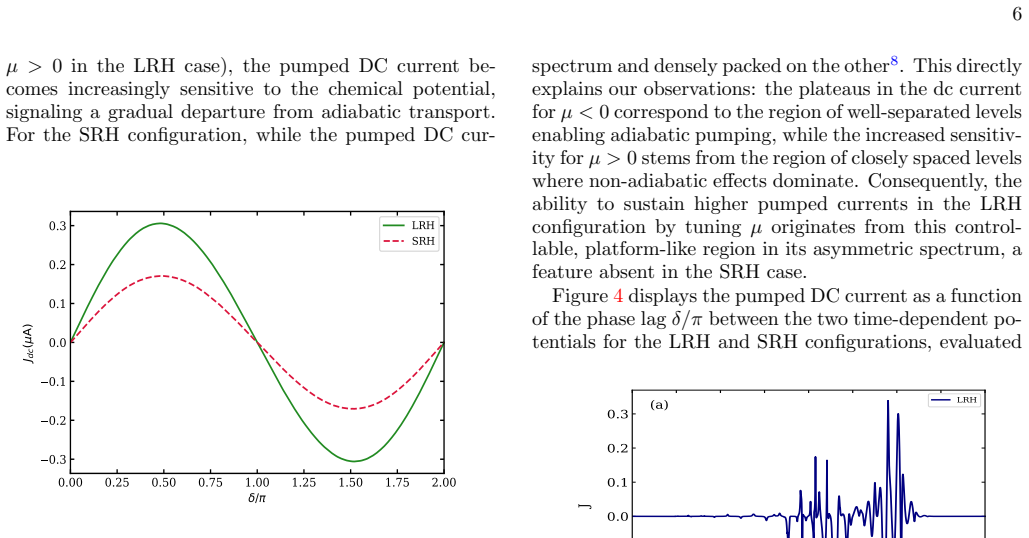
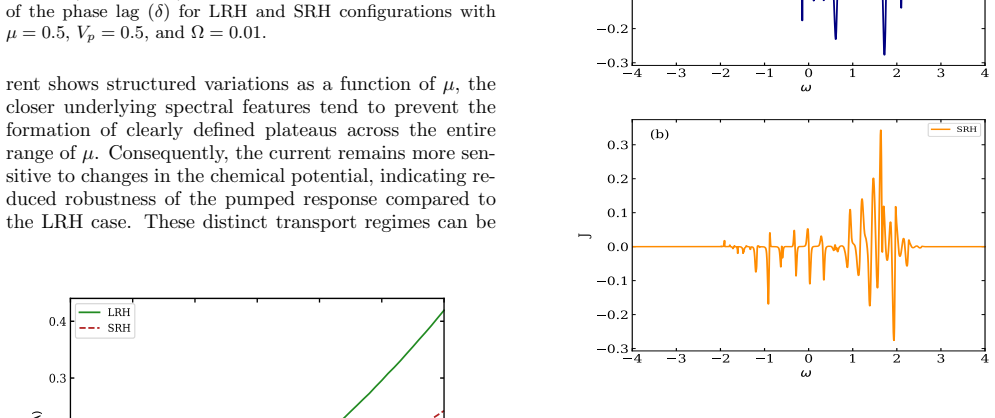
- The pumped current depends nearly sinusoidally on the phase difference between the two end potentials and vanishes at zero phase lag.
- Changing the value of the decay exponent ℓ_c can reverse the sign of the pumped current.
Where Pith is reading between the lines
- Structural parameters such as helix pitch or radius in real molecules could be used to engineer an effective decay exponent and thereby reverse pumping direction.
- The same geometric control via hopping range may apply to pumping in other chiral or quasi-one-dimensional systems mentioned in the abstract.
- The frequency dependence implies that device operation would need to stay in the low-frequency regime to maintain stable plateaus.
Load-bearing premise
The non-interacting tight-binding Hamiltonian with a single decay exponent for hopping range plus time-periodic end potentials captures the essential physics of charge pumping without electron-electron interactions or disorder.
What would settle it
A calculation or measurement in which the sign of the pumped current does not reverse when the decay exponent ℓ_c is varied across a range that changes the effective hopping from short to long while all other parameters are held fixed.
Figures



read the original abstract
Using the Keldysh non-equilibrium Green's function approach, we investigate charge pumping through a single-stranded helical structure described by a tight-binding model that includes either short-range hopping (SRH) or long-range hopping (LRH). While quantum pumping has been studied in various low-dimensional systems, the detailed behavior of the spectral current and the pumped dc current in helical geometries in the presence of higher-order electron hopping (beyond nearest neighbors) has not yet been systematically explored. Here, we focus on the interplay between helicity and extended hopping ranges, analyzing how they jointly control the energy-resolved and dc pumped currents under time-periodic end potentials. For LRH, the pumped dc current exhibits pronounced plateau-like regions as a function of chemical potential when energy levels are sparsely spaced -- consistent with adiabatic transport -- whereas SRH yields more parameter-sensitive currents without clear plateaus. The plateau stability is controlled by the drive frequency: at higher frequencies, Floquet side-band mixing destroys the plateaus, leading to oscillatory currents. The phase dependence remains nearly sinusoidal, and the current vanishes at zero phase lag, confirming the necessity of out-of-phase potentials. Crucially, in helical systems, the decay exponent $(\ell_c)$ acts as an effective structural parameter that can tune both the magnitude and sign of the pumped current, offering a geometric knob for controlling quantum pumping. Our findings not only fill a gap in the understanding of spectral and pumped currents in helical systems with extended hopping but also provide tools that can be applied to analyze similar phenomena in other chiral or quasi-one-dimensional systems.
Editorial analysis
A structured set of objections, weighed in public.
Referee Report
Summary. The manuscript employs the Keldysh NEGF formalism to compute charge pumping in a single-stranded helical tight-binding chain under time-periodic end potentials, comparing short-range hopping (SRH) against long-range hopping (LRH) parameterized by a decay exponent ℓ_c. It reports that LRH produces plateau-like features in the dc pumped current versus chemical potential when levels are sparse (consistent with adiabaticity), while SRH currents are more sensitive without clear plateaus. Plateau stability is destroyed at higher drive frequencies by Floquet side-band mixing; the phase dependence is nearly sinusoidal and vanishes at zero lag. The central observation is that ℓ_c functions as a structural knob that can tune both the magnitude and the sign of the pumped current.
Significance. If the numerical results are robust within the stated model, the identification of ℓ_c as a tunable parameter for both magnitude and sign reversal constitutes a concrete geometric control mechanism for quantum pumping in helical geometries. This is a modest but useful addition to the literature on chiral and quasi-1D pumping, and the comparative SRH/LRH analysis fills a stated gap. The work relies on standard NEGF techniques applied to a non-interacting Hamiltonian; no machine-checked proofs or parameter-free analytic derivations are claimed.
minor comments (3)
- The abstract states that 'the plateau stability is controlled by the drive frequency' and that 'at higher frequencies, Floquet side-band mixing destroys the plateaus.' A brief quantitative statement (e.g., the frequency scale relative to the level spacing or the value of ω at which plateaus disappear) would strengthen the claim without requiring new calculations.
- The model is defined with a single decay exponent ℓ_c for LRH. Clarify in the methods section whether on-site potentials or other parameters are held fixed when ℓ_c is varied, to make explicit that the reported sign changes are attributable to ℓ_c rather than to incidental parameter shifts.
- The phase-dependence result ('nearly sinusoidal' and zero at zero lag) is presented as confirmation of the necessity of out-of-phase potentials. A short remark on whether this holds for both SRH and LRH would be helpful for the comparative aspect of the study.
Simulated Author's Rebuttal
We thank the referee for their careful reading of the manuscript and for the positive overall assessment, including the recommendation for minor revision. The report correctly summarizes our Keldysh NEGF results on the role of the decay exponent ℓ_c in controlling the pumped current in helical chains. No specific major comments were enumerated in the report, so we have no point-by-point responses to provide at this stage.
Circularity Check
No circularity: numerical outputs from Keldysh NEGF on parameterized TB model
full rationale
The paper defines a tight-binding Hamiltonian with SRH or LRH (parameterized by decay exponent ℓ_c) and computes pumped currents via Keldysh NEGF under time-periodic potentials. The central claim that ℓ_c tunes magnitude and sign of the dc current is presented as a direct numerical result of this computation, not as a fit, self-definition, or reduction to prior self-citations. No equations or statements in the abstract or described chain equate the output to the input by construction; the model is non-interacting and the findings are falsifiable against external benchmarks or different interaction terms. This is the standard case of a self-contained numerical study.
Axiom & Free-Parameter Ledger
free parameters (1)
- decay exponent ℓ_c
axioms (1)
- domain assumption Keldysh non-equilibrium Green's function formalism accurately computes the pumped dc current under time-periodic driving
Reference graph
Works this paper leans on
-
[1]
Science , volume =
Electron transport in molecular wire junctions , author =. Science , volume =. 2003 , doi =
2003
-
[2]
Datta, Supriyo , title =
-
[3]
and Hanson, Ronald and Wrachtrup, J
Awschalom, David D. and Hanson, Ronald and Wrachtrup, J. Quantum technologies with optically interfaced solid-state spins , journal =. 2018 , doi =
2018
-
[4]
and Ahmadi, S
Eslami, Leila and Faizabadi, E. and Ahmadi, S. , title =. Phys. Lett. A , volume =. 2016 , doi =
2016
-
[5]
Physica E , volume =
Farshchi, Nastaran and Elahi, Seyed Mohammad and Esmaeilzadeh, Mahdi and Eslami, Leila and Darabi, Elham , title =. Physica E , volume =. 2020 , doi =
2020
-
[6]
Barriga, Edgar and Foa Torres, Luis E. F. and Cárdenas, Carlos , title =. Journal of Chemical Theory and Computation , volume =. 2024 , doi =
2024
-
[7]
Charge transport in a double-stranded DNA: Effects of helical symmetry and long-range hopping , author =. Phys. Rev. E , volume =. 2024 , month =. doi:10.1103/PhysRevE.109.014401 , url =
-
[8]
Four-channel model: An assessment of charge transfer via the backbone in B-DNA , author =. Phys. Rev. E , volume =. 2025 , month =. doi:10.1103/PhysRevE.111.024414 , url =
-
[9]
Charge transport properties of ideal and natural DNA segments, as mutation detectors , author =. Phys. Chem. Chem. Phys. , volume =. 2023 , month =. doi:10.1039/D3CP00268C , url =
-
[10]
, title =
Sarkar, Suparna and Maiti, Santanu K. , title =. Phys. Rev. B , volume =. 2019 , doi =
2019
-
[11]
Aminiranjabar, Zahra and Gultakti, Caglanaz Akin and Zhang, Amy and Oren, Ersin Emre and Hihath, Joshua , title =. Nat. Chem. , volume =. 2025 , doi =
2025
-
[12]
Chen, Xiao-Feng and Luo, Wenchen and Fang, Tie-Feng and Paltiel, Yossi and Millo, Oded and Guo, Ai-Min and Sun, Qing-Feng , title =. Phys. Rev. B , volume =. 2023 , doi =
2023
-
[13]
Guo, Ai-Min and Hu, Pei-Jia and Gao, Xiao-Hui and Fang, Tie-Feng and Sun, Qing-Feng , title =. Phys. Rev. B , volume =. 2020 , doi =
2020
-
[14]
Zhou, Ruiyi and Kanai, Yosuke , title =. J. Phys. Chem. Lett. , volume =. 2023 , doi =
2023
-
[15]
Arrachea, Liliana , title =. Phys. Rev. B , volume =
-
[16]
Nikoofard, Hossein and Esmaeilzadeh, Mahdi and Farghadan, Rouhollah and Sun, Jia-Tao , title =. Phys. Rev. B , volume =. 2022 , doi =
2022
-
[17]
and Marcus, C
Switkes, M. and Marcus, C. M. and Campman, K. and Gossard, A. C. , title =. Science , volume =. 1999 , month =
1999
-
[18]
Quantization of particle transport , author =. Phys. Rev. B , volume =. 1983 , month =. doi:10.1103/PhysRevB.27.6083 , url =
-
[19]
Adiabatic charge pumping through quantum dots in the Coulomb blockade regime , author =. Phys. Rev. B , volume =. 2009 , month =. doi:10.1103/PhysRevB.80.115311 , url =
-
[20]
Charge pumping in strongly coupled molecular quantum dots , author =. Phys. Rev. B , volume =. 2017 , month =. doi:10.1103/PhysRevB.96.195432 , url =
-
[21]
Geometric energy transport and refrigeration with driven quantum dots , author =. Phys. Rev. B , volume =. 2022 , month =. doi:10.1103/PhysRevB.106.035405 , url =
-
[22]
Floquet topological transitions in a driven one-dimensional topological insulator , author =. Phys. Rev. A , volume =. 2015 , month =. doi:10.1103/PhysRevA.92.023624 , url =
-
[23]
Tuovinen, Riku and Pavlyukh, Yaroslav , title =. Nano Letters , volume =. 2024 , month =. doi:10.1021/acs.nanolett.4c02609 , url =
-
[24]
Esmaeilzadeh and S
Fatemeh Bourbour and M. Esmaeilzadeh and S. M. Elahi and M. Eslami and others , title =. Journal of Applied Physics , volume =. 2020 , doi =
2020
-
[25]
Time-dependent Landauer-B\"uttiker approach to charge pumping in ac-driven graphene nanoribbons , author =. Phys. Rev. B , volume =. 2017 , month =. doi:10.1103/PhysRevB.96.195429 , url =
-
[26]
Floquet scattering theory of quantum pumps , author =. Phys. Rev. B , volume =. 2002 , month =. doi:10.1103/PhysRevB.66.205320 , url =
-
[27]
Exact Green's function renormalization approach to spectral properties of open quantum systems driven by harmonically time-dependent fields , author =. Phys. Rev. B , volume =. 2007 , month =. doi:10.1103/PhysRevB.75.035319 , url =
-
[28]
Conductance viewed as transmission , author =. Rev. Mod. Phys. , volume =. 1999 , month =. doi:10.1103/RevModPhys.71.S306 , url =
-
[29]
and Arrachea, L
Acciai, M. and Arrachea, L. and Splettstoesser, J. , title =. Rivista del Nuovo Cimento , volume =. 2025 , doi =
2025
-
[30]
Proceedings of the National Academy of Sciences , volume =
Ai-Min Guo and Qing-Feng Sun , title =. Proceedings of the National Academy of Sciences , volume =. 2014 , doi =
2014
-
[31]
Sarkar, Suparna and Maiti, Santanu K , title =. 2020 , month =. doi:10.1088/1361-648X/abb05f , url =
-
[32]
Quantum field-theoretical methods in transport theory of metals , author =. Rev. Mod. Phys. , volume =. 1986 , month =. doi:10.1103/RevModPhys.58.323 , url =
-
[33]
Relation between scattering-matrix and Keldysh formalisms for quantum transport driven by time-periodic fields , author =. Phys. Rev. B , volume =. 2006 , month =. doi:10.1103/PhysRevB.74.245322 , url =
-
[34]
Colloquium: The quest for high-conductance DNA , author =. Rev. Mod. Phys. , volume =. 2004 , month =. doi:10.1103/RevModPhys.76.195 , url =
-
[35]
Scattering approach to parametric pumping , author =. Phys. Rev. B , volume =. 1998 , month =. doi:10.1103/PhysRevB.58.R10135 , url =
-
[36]
Pure spin current induced by adiabatic quantum pumping in zigzag-edged graphene nanoribbons , author =. Appl. Phys. Lett. , volume =. 2014 , month =
2014
-
[37]
E Faizabadi and F Ebrahimi , title =. 2004 , month =. doi:10.1088/0953-8984/16/10/011 , url =
-
[38]
Thermal signature of a helical molecule: Beyond nearest-neighbor electron hopping , author =. Phys. Rev. B , volume =. 2024 , month =. doi:10.1103/PhysRevB.110.075419 , url =
-
[39]
Artificial Brownian motors: Controlling transport on the nanoscale , author =. Rev. Mod. Phys. , volume =. 2009 , month =. doi:10.1103/RevModPhys.81.387 , url =
-
[40]
An experimentally-achieved information-driven Brownian motor shows maximum power at the relaxation time , author =. Scientific Reports , volume =. 2018 , month =. doi:10.1038/s41598-018-30495-6 , url =
-
[41]
Floquet topological phase transitions in a periodically quenched dimer , author =. Phys. Rev. B , volume =. 2022 , month =. doi:10.1103/PhysRevB.106.224306 , url =
-
[42]
M. P. Lopez Sancho and J. M. Lopez Sancho and J. M. L. Sancho and J. Rubio , title =. 1985 , month =. doi:10.1088/0305-4608/15/4/009 , url =
-
[43]
Quantum conductance of graphene nanoribbons with edge defects , author =. Phys. Rev. B , volume =. 2008 , month =. doi:10.1103/PhysRevB.77.085408 , url =
-
[44]
Single-parameter nonadiabatic quantized charge pumping , author =. Phys. Rev. B , volume =. 2008 , month =. doi:10.1103/PhysRevB.77.153301 , url =
-
[45]
Conductance of DNA molecules: Effects of decoherence and bonding , author =. Phys. Rev. B , volume =. 2010 , month =. doi:10.1103/PhysRevB.82.125125 , url =
discussion (0)
Sign in with ORCID, Apple, or X to comment. Anyone can read and Pith papers without signing in.