Advanced PID architectures for tracking changing active constraints
Pith reviewed 2026-05-20 09:25 UTC · model grok-4.3
The pith
Advanced PID architectures control processes with changing constraints more simply than model-based methods.
A machine-rendered reading of the paper's core claim, the machinery that carries it, and where it could break.
Core claim
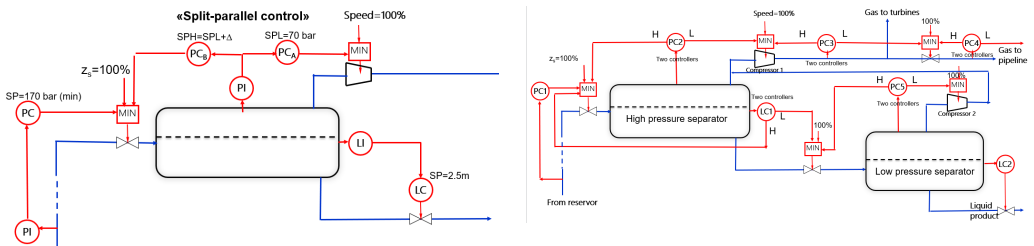
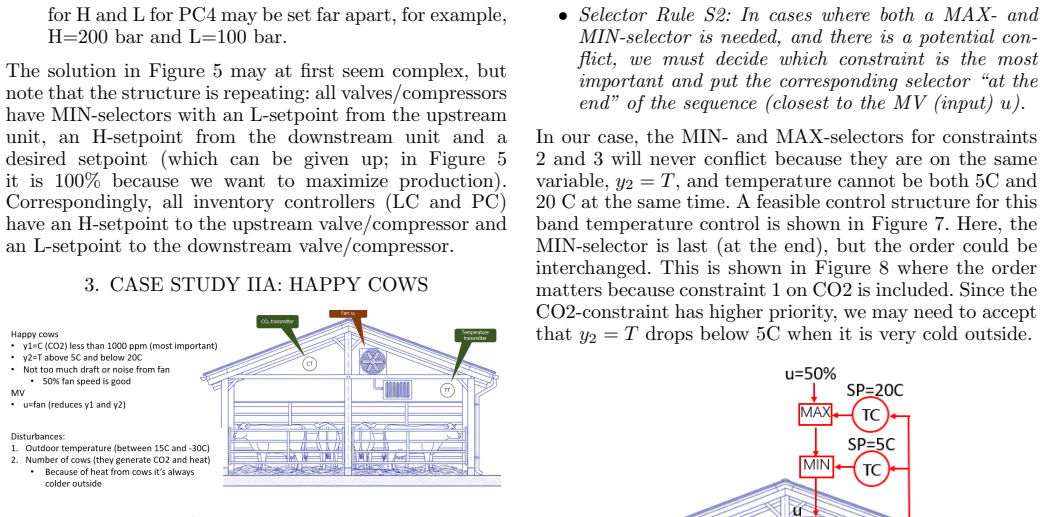
Advanced regulatory control (ARC), also known as advanced PID architectures, is a simple and robust way of controlling processes with changing and possibly conflicting constraints, where it previously was believed - at least in academia - that model-based solutions, such as MPC, were the only effective solution. This is illustrated in a gas-liquid separation process where selectors and split-parallel control achieve bidirectional inventory control with automatic movement of the throughput manipulator to the optimal position, and in a barn room control where a hierarchical switching network of PID controllers keeps CO2 levels and temperature acceptable despite conflicting constraints.
What carries the argument
Selectors and hierarchical switching networks of PID controllers that automatically adjust to the active constraints in different operating regions.
If this is right
- In the gas separation example, the system achieves bidirectional inventory control without manual intervention.
- The room climate control maintains acceptable air quality and temperature by switching between controllers as needed.
- These structures can be tuned for stability across all operating points using only basic process knowledge.
- Performance remains robust even when constraints become active or inactive dynamically.
Where Pith is reading between the lines
- Such methods could lower the barrier for implementing advanced control in smaller scale or less instrumented facilities.
- Future work might explore combining these PID architectures with minimal models for improved prediction of constraint changes.
- Applications in other areas like chemical processing or building automation could benefit from reduced complexity.
Load-bearing premise
That the selector and hierarchical PID structures can be configured and tuned to maintain stability and performance in all operating regions without needing detailed dynamic models or online optimization.
What would settle it
Demonstration in one of the case studies that the advanced PID system violates a constraint or becomes unstable in a particular operating region where a model-based approach succeeds.
Figures




read the original abstract
Advanced regulatory control (ARC), also known as advanced PID architectures, is a simple and robust way of controlling processes with changing and possibly conflicting constraints, where it previously was believed - at least in academia - that model-based solutions, such as MPC, were the only effective solution. To illustrate this, ARC is applied in two case studies. The first is a gas-liquid separation process, in which selectors and split-parallel control are combined to achieve bidirectional inventory control in which the throughput manipulator moves automatically to the most optimal position. The second case study is on keeping acceptable air quality (CO2-level) and temperature in a room (in this case, a barn for cows). The CO2 and temperature constraints can be conflicting, leading to a hierarchical switching network of PID controllers. Note: this is an extended version (with simulations) of paper at IFAC World Congress, August 2026, Korea.
Editorial analysis
A structured set of objections, weighed in public.
Referee Report
Summary. The paper claims that advanced regulatory control (ARC) architectures based on PID controllers, including selectors and hierarchical switching networks, offer a simple and robust alternative to model predictive control (MPC) for handling processes with changing and potentially conflicting active constraints. This is illustrated via two simulation-based case studies: (1) a gas-liquid separator using selectors and split-range control to achieve automatic bidirectional inventory control with the throughput manipulator shifting to optimal positions, and (2) a barn ventilation system employing a hierarchical PID network to manage conflicting CO2 and temperature constraints while maintaining air quality and comfort.
Significance. If the simulation results hold under the reported conditions, the work provides concrete evidence that standard industrial ARC techniques can address constraint-tracking problems previously assumed to require MPC, potentially lowering implementation barriers in process control. The explicit contrast with academic preferences for model-based methods and the use of reproducible case-study simulations strengthen the practical contribution, though broader validation beyond the two examples would be needed to shift consensus.
major comments (2)
- [Section 3] Section 3 (gas-liquid separator case study): the claim that the selector/split-range structure maintains stability across all operating regions without detailed dynamic models is supported only by simulation trajectories; no explicit stability analysis or gain-margin calculations are provided to confirm robustness when the active constraint switches, which is load-bearing for the central claim of superiority over MPC.
- [Section 4] Section 4 (barn ventilation case study): the hierarchical switching network is described as automatically resolving CO2/temperature conflicts, but the tuning procedure for the priority logic and anti-windup parameters is not detailed; this leaves open whether performance degrades under unmodeled disturbances, undermining the 'no detailed models required' assertion.
minor comments (3)
- The abstract and introduction should include a brief reference to the IFAC World Congress version to clarify what is new in the extended simulations.
- Figure captions for the simulation results could be expanded to explicitly label the active constraint at each time interval for easier reader verification.
- Notation for the selector logic (e.g., high/low selectors) is introduced without a dedicated table; adding one would improve clarity for readers unfamiliar with ARC.
Simulated Author's Rebuttal
We thank the referee for the constructive comments and the recommendation for minor revision. We address each major comment below and will incorporate clarifications and additional details to strengthen the presentation of the ARC methods.
read point-by-point responses
-
Referee: [Section 3] Section 3 (gas-liquid separator case study): the claim that the selector/split-range structure maintains stability across all operating regions without detailed dynamic models is supported only by simulation trajectories; no explicit stability analysis or gain-margin calculations are provided to confirm robustness when the active constraint switches, which is load-bearing for the central claim of superiority over MPC.
Authors: We agree that an explicit stability analysis would strengthen the manuscript. The case study is intended to show that standard ARC structures (selectors and split-range) can be implemented using only local PID tuning without a full dynamic model for the overall system. The provided simulations cover a range of operating conditions and constraint switches with stable closed-loop behavior. In the revision we will add a short discussion of robustness, including approximate gain margins obtained from the individual loop frequency responses at representative operating points, to better support the claim while preserving the practical, model-light focus. revision: yes
-
Referee: [Section 4] Section 4 (barn ventilation case study): the hierarchical switching network is described as automatically resolving CO2/temperature conflicts, but the tuning procedure for the priority logic and anti-windup parameters is not detailed; this leaves open whether performance degrades under unmodeled disturbances, undermining the 'no detailed models required' assertion.
Authors: We thank the referee for this observation. The individual PID loops were tuned using standard rules (e.g., direct synthesis or Ziegler-Nichols) for each controlled variable, with priority logic set according to operational requirements (CO2 constraint given precedence during high-occupancy periods) and anti-windup implemented via back-calculation. We will revise Section 4 to explicitly document the tuning steps, priority rules, and anti-windup parameters. We will also add simulation results under unmodeled disturbances to illustrate that acceptable performance is maintained, reinforcing that the approach does not rely on a detailed process model. revision: yes
Circularity Check
No significant circularity
full rationale
The paper presents ARC structures (selectors, split-range, hierarchical PID switching) as standard industrial techniques applied to two case studies, with performance shown via simulations. No load-bearing step reduces by construction to a fitted input, self-definition, or self-citation chain; the central claim rests on explicit architectural descriptions and operating-region demonstrations rather than renaming or importing uniqueness from prior author work. The derivation is self-contained against external benchmarks of process control practice.
Axiom & Free-Parameter Ledger
axioms (1)
- domain assumption PID controllers can be structured with selectors and hierarchies to achieve stable control under changing active constraints without model-based optimization.
Reference graph
Works this paper leans on
-
[1]
Shinskey, F G , isbn =
-
[2]
Cecil L. Smith. Advanced Process Control - Beyond single-loop control. 2010
work page 2010
-
[3]
Split parallel control - a little known control structure , year =
Forsman, Krister and Adlouni, Mohammed and Skogestad, Sigurd , journal =. Split parallel control - a little known control structure , year =
-
[4]
Price, R. M. and Georgakis, C. , title =. Ind. Eng. Chem. Res. , volume=32, pages =
-
[5]
A. Maarleveld and J.E. Rijnsdorp , title =. Automatica , volume=6, pages =
-
[6]
IEEE Transactions on Automatic Control , volume=63, pages =
Marco Caponigro and Roberta Ghezzi and Benedetto Piccoli and Emmanuel Trélat , title =. IEEE Transactions on Automatic Control , volume=63, pages =
-
[7]
L.F. Bernardino and S. Skogestad , title =. Journal of Process Control , volume=136, pages =
-
[8]
Computers and Chemical Engineering , volume=159, pages =
Cristina Zotică and Krister Forsman and Sigurd Skogestad , title =. Computers and Chemical Engineering , volume=159, pages =
- [9]
-
[10]
Feedforward Control: Analysis, Design, Tuning rules, and Implementation
Guzm\'an, Jos \`e Luis and Tore H \"a gglund. Feedforward Control: Analysis, Design, Tuning rules, and Implementation. 2024
work page 2024
-
[11]
Advanced control using decomposition and simple elements , journal =. 2023 , author =
work page 2023
discussion (0)
Sign in with ORCID, Apple, or X to comment. Anyone can read and Pith papers without signing in.