REVIEW 3 major objections 5 minor 1 cited by
Sliding Windows Are Not the End: Exploring Full Ranking with Long-Context Large Language Models
T0 review · 3 major / 5 minor · reviewed 2026-08-11 · deepseek-v4-flash
Pith's one-line read With complete listwise labels and an importance-aware loss, full ranking of 100 passages in a single long-context LLM pass outperforms sliding-window ranking after fine-tuning, while reducing latency by 29.3% and API cost by about half.
desk verdict Useful efficiency study of full-list vs sliding-window ranking with long-context LLMs, but the headline effectiveness claim is confounded by richer training labels for the full-ranking model. read the letter →
The pith
A machine-rendered reading of the paper's core claim, the machinery that carries it, and where it could break.
The reading
What carries the argument
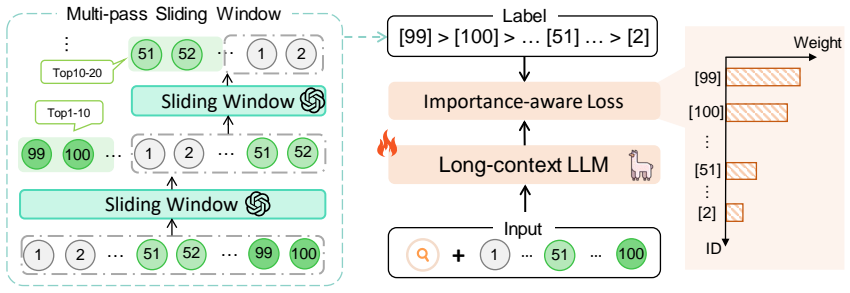
The machinery is a training recipe for listwise reranking that removes the length constraint. First, a multi-pass sliding window obtains a complete ranking: each pass reranks the remaining candidates with window size 20 and step size 10, collecting the top-10 from that pass, until all 100 passages are ordered. Second, an importance-aware language-modeling loss reweights each passage ID's tokens by their position in that label, so the few relevant top IDs are not drowned out by the many irrelevant ones. The paper also uses distillation labels from GPT-4o and GPT-4o-mini, and evaluates efficiency by comparing latency and API cost of the two inference strategies.
What would settle it
A reader could settle the claim by training a sliding-window reranker (window size 20) on the exact same multi-pass teacher labels used for RankMistral100, not on top-20 labels, while keeping the backbone, teacher, and loss identical. If that model matches or exceeds RankMistral100's NDCG@10 on TREC DL19 and DL20, the paper's attribution of the gain to full-ranking inference would be undercut.
Extended reading notes
Core claim
The discovery is that the full-ranking strategy, feeding all 100 candidate passages to a long-context LLM at once, can be made more effective than the sliding-window strategy in the supervised fine-tuning setting, despite being worse in zero-shot. The authors attribute the improvement to two training components: a multi-pass sliding-window label construction that iteratively reranks the remaining passages to produce a complete ranking of all 100 IDs, and an importance-aware loss $L_{\mathrm{ia}}$ that assigns weight $w_i = 1 + 1/\log_2(p_i+1)$ to the tokens of the passage at rank $p_i$, with a fixed weight $\alpha$ for non-passage tokens, so that high-ranked IDs contribute more to the gradient. Fine-tuned from Mistral-7B-Instruct-v0.3 and distilled from GPT-4o-mini or GPT-4o, the full-ranking model RankMistral100 outperforms the sliding-window RankMistral20 on nearly all TREC DL19/DL20 and BEIR datasets, and the advantage persists when ranking 20, 40, 60, or 80 passages, indicating generalization beyond the training length.
Load-bearing premise
The load-bearing premise is that the multi-pass sliding-window teacher labels are a correct and complete ranking of all 100 passages; the observed advantage of the full-ranking model could partly come from these richer labels rather than from the full-context inference strategy itself.
Editorial extensions
If this is right
- Fine-tuned long-context rerankers can replace the overlapping-window inference loop in production pipelines, reducing redundant passage scoring.
- API costs for listwise reranking drop by about half when the full list is ranked in one call rather than through multiple overlapping windows.
- When only the top-10 results need to be returned, the latency gap widens further, with the paper reporting roughly an 8x speed-up on the Signal dataset.
- A model trained on 100-passage lists still improves over the sliding-window baseline at N = 20, 40, 60, and 80, so deployment need not fix the candidate count at 100.
- The importance-aware loss contributes to both model variants, with ablations showing about a 0.7 NDCG@10 drop on the BEIR average when it is removed.
Reading between the lines
- Beyond the paper: because the paper never trains the sliding-window model on the same 100-passage labels, the reported gain is not yet isolated from label richness; a matched-label control would clarify which component causes the improvement.
- Beyond the paper: if the result generalizes, long-context fine-tuning could let a single reranker handle hundreds of candidates, and the position-based weighting could be applied to any generative task that emits a long ordered list.
- Beyond the paper: the appendix's repeated-ranking result, where improvement converges by 3-4 passes, suggests a two-stage full-ranking pipeline, first over 100 candidates then over the top-10 output, as a natural low-cost extension.
Editorial analysis
A structured set of objections, weighed in public.
Referee Report
Summary. The paper investigates listwise passage ranking with long-context LLMs, comparing a "full ranking" strategy that feeds all 100 BM25-retrieved passages into a single long-context call against the standard sliding-window strategy. In zero-shot settings, full ranking is found to be less effective but more efficient; after supervised fine-tuning with a newly proposed multi-pass sliding-window label construction and an importance-aware loss, the full-ranking model RankMistral100 is reported to outperform the sliding-window model RankMistral20 on nearly all TREC DL19/DL20 and BEIR datasets, while also reducing latency and API cost. The paper's central claims are the supervised fine-tuning effectiveness advantage and the efficiency advantage of full ranking, supported by the proposed label-generation and loss-weighting techniques.
Significance. If the effectiveness claim holds, the paper offers a practically valuable result: replacing repeated sliding-window inference with a single long-context call can roughly halve API cost and substantially reduce latency while maintaining or improving ranking quality after fine-tuning. The proposed complete-listwise label construction and importance-aware loss are reusable contributions for training long-context rankers, and the paper provides consistent evidence across TREC and BEIR, including an ablation of the loss and generalization experiments over different passage counts. However, the central effectiveness comparison currently changes both the inference strategy and the training-label construction at once, so the reported gains cannot yet be attributed to full ranking itself; this makes the main empirical claim not fully established as written.
major comments (3)
- [Section 4.2, Table 1] The central supervised fine-tuning comparison conflates inference strategy with label construction. RankMistral100 is trained on 100-passage multi-pass teacher labels (Section 3.1), while RankMistral20 is trained on teacher rerankings of the top-20 BM25 passages (Section 2.2 and Appendix D). The reported improvement of about 4 and 2 NDCG@10 points could therefore come from the richer full-list teacher labels rather than from the full-ranking inference strategy itself. The paper should include an ablation that fixes label construction while varying only the inference strategy, for example by training a sliding-window model on labels derived from the same multi-pass full-ranking teacher, or by training a full-ranking model on top-20 teacher labels and then evaluating both inference strategies.
- [Section 4.2, Table 6] The Top-20 versus Sample-20 experiment for RankMistral20 does not address the confound described above, because neither training-label condition is the multi-pass full ranking label used for RankMistral100. Consequently, the statement that "the full ranking model outperforms the sliding window model" in the supervised fine-tuning setting is not yet supported by a controlled comparison; this is a load-bearing issue for the abstract, introduction, and conclusion.
- [Section 4.2, "w/o Lia" rows] The ablation of the importance-aware loss is informative, but the observation that RankMistral100 still outperforms RankMistral20 when trained with the standard language modeling loss inherits the same label-construction confound. This row therefore cannot serve as independent evidence for the advantage of the full-ranking inference strategy; a controlled label-construction ablation is still required.
minor comments (5)
- [Table 1] The baseline name "RankZepyer" is a typo and should be "RankZephyr".
- [Appendix C] The text says "The results in Figure 3 show that the initial order..." but the corresponding results are presented in Table 3, not Figure 3.
- [Appendix B] The reference to "Figure A" is ambiguous; the prompt is given in Appendix A and should be cited with a proper appendix or figure number.
- [Section 3.2] The phrase "a importance-aware loss" should be "an importance-aware loss"; the same grammar issue appears in the abstract and conclusion.
- [Section 3.2 and Appendix B] The text states that α is a hyperparameter with α ≤ 1, but Appendix B fixes α = 1; please clarify whether α is tuned or simply set to 1 in all reported experiments.
Circularity Check
No significant circularity: the central empirical comparisons are measured against external human-labeled benchmarks, and the teacher labels come from GPT-4o models rather than from the proposed system.
full rationale
The paper's central effectiveness claim is an empirical comparison on TREC DL19/DL20 and BEIR against human relevance judgments, using teacher labels generated by GPT-4o-mini/GPT-4o on MS MARCO queries. No equation or parameter in the method is defined in terms of the outcome it claims to predict; the importance-aware loss (Eq. 2-3) reweights label tokens by rank position but is a hand-designed objective, and the multi-pass sliding-window label construction (Sec. 3.1) is a data-generation routine, not an inference-time prediction. The efficiency and API-cost claims follow from token-count arithmetic (Sec. 4.3, 4.5) rather than from a fitted result. The paper's own limitations section and the experimental setup do, however, contain a missing control: RankMistral100 is trained on full 100-passage multi-pass teacher labels while the sliding-window baseline RankMistral20 is trained on top-20 teacher labels (Sec. 2.2 vs Sec. 3.1), so the supervised comparison varies both inference strategy and training-label construction. This is a legitimate correctness/design risk and a missing ablation, but it is not a circularity: the gain is not forced by construction, and the zero-shot rows independently show that the full-ranking strategy alone is not better. Self-citations (Sun et al., 2023; Zhu et al., 2023; Liu et al., 2024b) are used only for standard experimental settings or related work, not as load-bearing justification. No uniqueness theorem or ansatz is imported from the authors' prior work, and no prediction reduces, by the paper's own equations, to its own inputs. Therefore no circular step is exhibited.
Assumptions & free parameters
free parameters (4)
- alpha (relational operator weight in loss) =
1
- importance weight schedule 1 + 1/log2(pi+1) =
N/A (functional form)
- window size w and step size s for label generation =
w=20, s=10
- number of training queries =
1000
assumptions (4)
- domain assumption Teacher-generated full ranking labels from GPT-4o are reliable enough to train the student model
- domain assumption NDCG@10 over BM25 top-100 is the right evaluation target
- ad hoc to paper The position-based weighting formula aligns optimization with NDCG@10
- domain assumption Long-context LLMs can actually use the full 100-passage context without positional degradation
Cite this review
Pith. "Pith review of Sliding Windows Are Not the End: Exploring Full Ranking with Long-Context Large Language Models." pith.science (2026). https://pith.science/paper/BYKXERGD
@misc{pith2026241214574,
  author       = {Pith},
  title        = {Pith review of: Sliding Windows Are Not the End: Exploring Full Ranking with Long-Context Large Language Models},
  year         = {2026},
  howpublished = {\url{https://pith.science/paper/BYKXERGD}},
  note         = {Machine review of arXiv:2412.14574}
}
read the original abstract
Large Language Models (LLMs) have shown exciting performance in listwise passage ranking. Due to the limited input length, existing methods often adopt the sliding window strategy. Such a strategy, though effective, is inefficient as it involves repetitive and serialized processing, which usually re-evaluates relevant passages multiple times. As a result, it incurs redundant API costs, which are proportional to the number of inference tokens. The development of long-context LLMs enables the full ranking of all passages within a single inference, avoiding redundant API costs. In this paper, we conduct a comprehensive study of long-context LLMs for ranking tasks in terms of efficiency and effectiveness. Surprisingly, our experiments reveal that full ranking with long-context LLMs can deliver superior performance in the supervised fine-tuning setting with a huge efficiency improvement. Furthermore, we identify two limitations of fine-tuning the full ranking model based on existing methods: (1) sliding window strategy fails to produce a full ranking list as a training label, and (2) the language modeling loss cannot emphasize top-ranked passage IDs in the label. To alleviate these issues, we propose a new complete listwise label construction approach and a novel importance-aware learning objective for full ranking. Experiments show the superior performance of our method over baselines. Our codes are available at \url{https://github.com/8421BCD/fullrank}.
Figures


Figures from the paper (3 more)


Forward citations
Cited by 1 Pith paper
-
Training Documents Reranker with Search Rubrics for Deep Research Agent
RubricRanker is a reranker trained with LLM-generated search rubrics and reinforcement learning to select high-quality document sets, outperforming baselines on deep research and RAG benchmarks.
Reference graph
Works this paper leans on
-
[1]
URL: " 'urlintro :=
ENTRY address author booktitle chapter edition editor howpublished institution journal key month note number organization pages publisher school series title type volume year eprint doi pubmed url lastchecked label extra.label sort.label short.list INTEGERS output.state before.all mid.sentence after.sentence after.block STRINGS urlintro eprinturl eprintpr...
-
[2]
write newline
" write newline "" before.all 'output.state := FUNCTION n.dashify 't := "" t empty not t #1 #1 substring "-" = t #1 #2 substring "--" = not "--" * t #2 global.max substring 't := t #1 #1 substring "-" = "-" * t #2 global.max substring 't := while if t #1 #1 substring * t #2 global.max substring 't := if while FUNCTION word.in bbl.in capitalize " " * FUNCT...
-
[3]
Yushi Bai, Xin Lv, Jiajie Zhang, Hongchang Lyu, Jiankai Tang, Zhidian Huang, Zhengxiao Du, Xiao Liu, Aohan Zeng, Lei Hou, Yuxiao Dong, Jie Tang, and Juanzi Li. 2024. Longbench: A bilingual, multitask benchmark for long context understanding. In ACL (1) , pages 3119--3137. Association for Computational Linguistics
work page 2024
-
[4]
Shouyuan Chen, Sherman Wong, Liangjian Chen, and Yuandong Tian. 2023. Extending context window of large language models via positional interpolation. CoRR, abs/2306.15595
arXiv 2023
-
[5]
Yiqun Chen, Qi Liu, Yi Zhang, Weiwei Sun, Daiting Shi, Jiaxin Mao, and Dawei Yin. 2024. Tourrank: Utilizing large language models for documents ranking with a tournament-inspired strategy. CoRR, abs/2406.11678
arXiv 2024
-
[6]
Nick Craswell, Bhaskar Mitra, Emine Yilmaz, and Daniel Campos. 2020 a . Overview of the TREC 2020 deep learning track. In TREC , volume 1266 of NIST Special Publication . National Institute of Standards and Technology (NIST)
work page 2020
- [7]
-
[8]
Jiayu Ding, Shuming Ma, Li Dong, Xingxing Zhang, Shaohan Huang, Wenhui Wang, Nanning Zheng, and Furu Wei. 2023. Longnet: Scaling transformers to 1, 000, 000, 000 tokens. CoRR, abs/2307.02486
arXiv 2023
Show all 33 references
-
[9]
Bartoldson, Bhavya Kailkhura, Avi Schwarzschild, Aniruddha Saha, Micah Goldblum, Jonas Geiping, and Tom Goldstein
Neel Jain, Ping - yeh Chiang, Yuxin Wen, John Kirchenbauer, Hong - Min Chu, Gowthami Somepalli, Brian R. Bartoldson, Bhavya Kailkhura, Avi Schwarzschild, Aniruddha Saha, Micah Goldblum, Jonas Geiping, and Tom Goldstein. 2024. Neftune: Noisy embeddings improve instruction finet...
2024
-
[10]
Albert Q. Jiang, Alexandre Sablayrolles, Arthur Mensch, Chris Bamford, Devendra Singh Chaplot, Diego de Las Casas, Florian Bressand, Gianna Lengyel, Guillaume Lample, Lucile Saulnier, L \' e lio Renard Lavaud, Marie - Anne Lachaux, Pierre Stock, Teven Le Scao, Thibaut Lavril, ...
2023 arXiv
-
[11]
u ksekg \
Percy Liang, Rishi Bommasani, Tony Lee, Dimitris Tsipras, Dilara Soylu, Michihiro Yasunaga, Yian Zhang, Deepak Narayanan, Yuhuai Wu, Ananya Kumar, Benjamin Newman, Binhang Yuan, Bobby Yan, Ce Zhang, Christian Cosgrove, Christopher D. Manning, Christopher R \' e , Diana Acosta ...
-
[12]
Qi Liu, Bo Wang, Nan Wang, and Jiaxin Mao. 2024 a . Leveraging passage embeddings for efficient listwise reranking with large language models. CoRR, abs/2406.14848
2024 arXiv
-
[13]
Wenhan Liu, Yutao Zhu, and Zhicheng Dou. 2024 b . Demorank: Selecting effective demonstrations for large language models in ranking task. CoRR, abs/2406.16332
2024 arXiv
-
[14]
Jian Luo, Xuanang Chen, Ben He, and Le Sun. 2024. Prp-graph: Pairwise ranking prompting to llms with graph aggregation for effective text re-ranking. In ACL (1) , pages 5766--5776. Association for Computational Linguistics
2024
-
[15]
Amirkeivan Mohtashami and Martin Jaggi. 2023. Landmark attention: Random-access infinite context length for transformers. CoRR, abs/2305.16300
2023 arXiv
-
[16]
Tri Nguyen, Mir Rosenberg, Xia Song, Jianfeng Gao, Saurabh Tiwary, Rangan Majumder, and Li Deng. 2016. https://ceur-ws.org/Vol-1773/CoCoNIPS\_2016\_paper9.pdf MS MARCO: A human generated machine reading comprehension dataset . In Proceedings of the Workshop on Cognitive Comput...
2016
-
[17]
Rodrigo Frassetto Nogueira and Kyunghyun Cho. 2019. http://arxiv.org/abs/1901.04085 Passage re-ranking with BERT . CoRR, abs/1901.04085
2019 arXiv
-
[18]
Rodrigo Frassetto Nogueira, Zhiying Jiang, Ronak Pradeep, and Jimmy Lin. 2020. https://doi.org/10.18653/v1/2020.findings-emnlp.63 Document ranking with a pretrained sequence-to-sequence model . In Findings of the Association for Computational Linguistics: EMNLP 2020, Online Ev...
2020 doi
- [19]
-
[20]
Ronak Pradeep, Sahel Sharifymoghaddam, and Jimmy Lin. 2023 b . Rankzephyr: Effective and robust zero-shot listwise reranking is a breeze! CoRR, abs/2312.02724
2023 arXiv
- [21]
-
[22]
Alec Radford, Jeffrey Wu, Rewon Child, David Luan, Dario Amodei, Ilya Sutskever, et al. 2019. Language models are unsupervised multitask learners. OpenAI blog, 1(8):9
2019
-
[23]
Nir Ratner, Yoav Levine, Yonatan Belinkov, Ori Ram, Inbal Magar, Omri Abend, Ehud Karpas, Amnon Shashua, Kevin Leyton - Brown, and Yoav Shoham. 2023. Parallel context windows for large language models. In ACL (1) , pages 6383--6402. Association for Computational Linguistics
2023
-
[24]
Arafat Sultan, Deevya Swain, Avirup Sil, and Heng Ji
Revanth Gangi Reddy, JaeHyeok Doo, Yifei Xu, Md. Arafat Sultan, Deevya Swain, Avirup Sil, and Heng Ji. 2024. FIRST: faster improved listwise reranking with single token decoding. CoRR, abs/2406.15657
2024 arXiv
-
[25]
Devendra Singh Sachan, Mike Lewis, Mandar Joshi, Armen Aghajanyan, Wen - tau Yih, Joelle Pineau, and Luke Zettlemoyer. 2022. https://doi.org/10.18653/v1/2022.emnlp-main.249 Improving passage retrieval with zero-shot question generation . In Proceedings of the 2022 Conference o...
2022 doi
-
[26]
Weiwei Sun, Lingyong Yan, Xinyu Ma, Shuaiqiang Wang, Pengjie Ren, Zhumin Chen, Dawei Yin, and Zhaochun Ren. 2023. https://aclanthology.org/2023.emnlp-main.923 Is chatgpt good at search? investigating large language models as re-ranking agents . In Proceedings of the 2023 Confe...
2023
-
[27]
Nandan Thakur, Nils Reimers, Andreas R \" u ckl \' e , Abhishek Srivastava, and Iryna Gurevych. 2021. BEIR: A heterogeneous benchmark for zero-shot evaluation of information retrieval models. In NeurIPS Datasets and Benchmarks
2021
-
[28]
Hugo Touvron, Louis Martin, Kevin Stone, Peter Albert, Amjad Almahairi, Yasmine Babaei, Nikolay Bashlykov, Soumya Batra, Prajjwal Bhargava, Shruti Bhosale, Dan Bikel, Lukas Blecher, Cristian Canton - Ferrer, Moya Chen, Guillem Cucurull, David Esiobu, Jude Fernandes, Jeremy Fu,...
2023 arXiv
-
[29]
Peng Xu, Wei Ping, Xianchao Wu, Lawrence McAfee, Chen Zhu, Zihan Liu, Sandeep Subramanian, Evelina Bakhturina, Mohammad Shoeybi, and Bryan Catanzaro. 2024. Retrieval meets long context large language models. In ICLR . OpenReview.net
2024
-
[30]
An Yang, Baosong Yang, Binyuan Hui, Bo Zheng, Bowen Yu, Chang Zhou, Chengpeng Li, Chengyuan Li, Dayiheng Liu, Fei Huang, Guanting Dong, Haoran Wei, Huan Lin, Jialong Tang, Jialin Wang, Jian Yang, Jianhong Tu, Jianwei Zhang, Jianxin Ma, Jianxin Yang, Jin Xu, Jingren Zhou, Jinze...
2024 arXiv
-
[31]
Peitian Zhang, Zheng Liu, Shitao Xiao, Ninglu Shao, Qiwei Ye, and Zhicheng Dou. 2024. Soaring from 4k to 400k: Extending llm's context with activation beacon. CoRR, abs/2401.03462
2024 arXiv
-
[32]
Yutao Zhu, Huaying Yuan, Shuting Wang, Jiongnan Liu, Wenhan Liu, Chenlong Deng, Zhicheng Dou, and Ji - Rong Wen. 2023. https://doi.org/10.48550/arXiv.2308.07107 Large language models for information retrieval: A survey . CoRR, abs/2308.07107
2023 doi
- [33]
Reviewed August 11, 2026 · model on record in the stance chip above.
Discussion (0). Continue with ORCID to comment.