REVIEW 5 major objections 5 minor 10 references
Resilient Multi-Agent Negotiation for Medical Supply Chains:Integrating LLMs and Blockchain for Transparent Coordination
T0 review · 5 major / 5 minor · reviewed 2026-08-06 · deepseek-v4-flash
Pith's one-line read The paper claims a hybrid of LLM-agent negotiation and blockchain enforcement can keep medical supply chains at 100% service under simulated pandemic conditions.
desk verdict A coherent hybrid architecture with an evaluation that doesn't support its headline claims: no baseline, a circular fairness metric, and 100% service levels that could come from the deterministic heuristics alone. read the letter →
The pith
A machine-rendered reading of the paper's core claim, the machinery that carries it, and where it could break.
The reading
What carries the argument
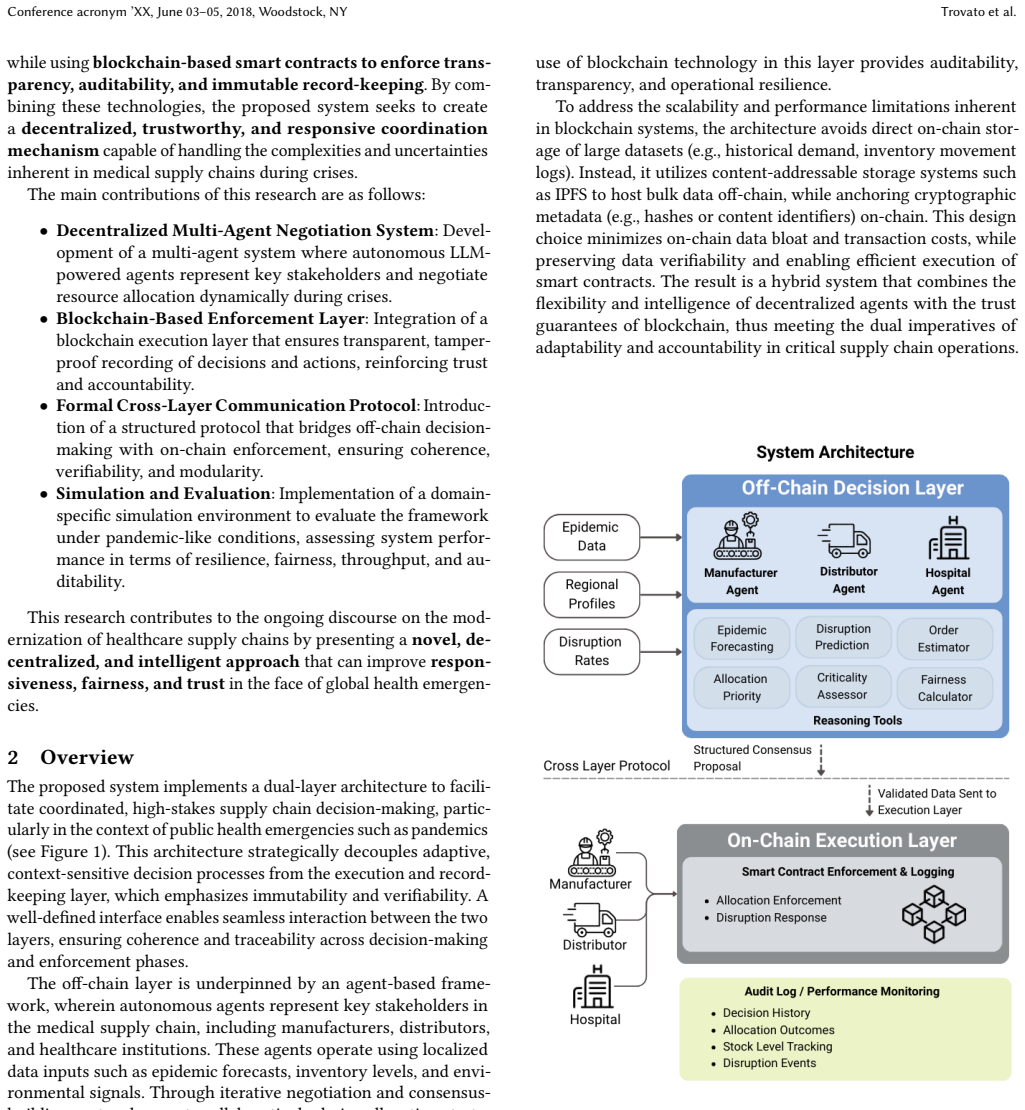
The load-bearing object is the cross-layer snapshot $\Sigma_t = (A_t, I_t, D_t, \mathrm{CID}_t)$: the off-chain agents produce allocations $A_t$, inventory states $I_t$, and disruption logs $D_t$, the content-addressable identifier $\mathrm{CID}_t$ points to the full payload stored off-chain, and the hash $H(\Sigma_t)$ anchors the decision on-chain. This object is what lets the architecture keep the flexible negotiation layer separate from the deterministic enforcement layer while preserving a verifiable link between them. The second piece is the exponential fairness allocation rule, which converts regional severity scores into allocation shares with a minimum floor, together with the smart contract suite $\{C_{\mathrm{alloc}}, C_{\mathrm{inv}}, C_{\mathrm{disrupt}}, C_{\mathrm{audit}}\}$ that validates and records the resulting decisions.
What would settle it
Run the same 60-day simulation with the fairness evaluation weights computed from an independent signal, for example mortality data rather than the case-count severity scores that feed the allocation rule, and check whether the fairness deviations $\delta^t_r$ remain near zero.
Extended reading notes
Core claim
On the paper's own terms, the central discovery is that the coordination problem does not have to choose between intelligence and trust. The off-chain agent layer uses LLM-powered manufacturer, distributor, and hospital agents that pass structured messages over a directed acyclic graph, order according to buffer-based policies, and allocate via an exponential severity-weighting rule $x^t_{i,r} = e^{\alpha S^t_r}/\sum_{r'} e^{\alpha S^t_{r'}} \cdot Q^t_i$. The on-chain layer enforces those decisions with smart contracts that check budget feasibility, minimum allocation floors, and severity consistency, then logs a hash of the snapshot $\Sigma_t = (A_t, I_t, D_t, \mathrm{CID}_t)$. In the simulated pandemic scenarios this combination produced 100% service levels, zero unfulfilled demand, and zero stockout days, with sub-20ms blockchain transaction latency and low gas usage. The paper further claims this demonstrates negotiation efficiency, fairness of allocation, responsiveness, and auditability.
Load-bearing premise
The fairness result assumes the severity weights used to judge the allocations are an independent measure of need, when in fact the allocations are computed from the same severity weights.
Editorial extensions
If this is right
- During a demand surge, supplies flow first to regions with the highest epidemic severity scores, while every region still receives a minimum allocation floor.
- Every allocation, inventory change, and disruption response is recorded on-chain, so a regulator or auditor can reconstruct who decided what and when.
- Because the system logged 100% service with both tested language models, the architecture's resilience appears not to hinge on which model is used.
- The blockchain layer adds only sub-20ms latency per transaction at simulated scale, so auditability does not slow daily supply decisions.
Reading between the lines
- A testable next step would be to separate the severity weights used for fairness evaluation from the severity signal used in the allocation rule; if fairness deviations stay near zero under that separation, the fairness result is substantive rather than built in.
- The negotiation protocol is single-pass and deterministic, so the system's 'negotiation' is closer to rule-bound priority dispatch; an adversarial test with agents that can misreport demand or severity would show whether the architecture can handle strategic behavior.
- The architecture could be ported to other scarce-resource settings, such as vaccine batches, ICU beds, or donor organs, by replacing the medical demand model with the relevant allocation objective.
Editorial analysis
A structured set of objections, weighed in public.
Referee Report
Summary. The paper proposes a hybrid architecture for medical supply chain coordination during pandemics, combining an off-chain layer of LLM-powered manufacturer, distributor, and hospital agents with an on-chain blockchain/smart-contract enforcement layer. The authors implement a SIR-driven discrete-time simulation over three regions and three drugs, run three configurations (GPT-3.5-turbo for 30 and 90 days, GPT-4o for 30 days), and report 100% service levels, zero unfulfilled demand, small fairness deviations, and low blockchain latency/gas. The stated contributions are a decentralized LLM negotiation system, a blockchain enforcement layer, a formal cross-layer protocol, and a simulation evaluation demonstrating improvements in negotiation efficiency, fairness, responsiveness, and auditability.
Significance. The architectural idea is timely, and the paper contains a credible end-to-end implementation sketch: LangGraph-based agents, OpenAI function calling, a Solidity contract deployed on a local Hardhat node, and SIR-driven demand generation. These are real components rather than pure abstractions, and the explicit message schemas in Section 3.1.3 are a useful starting point. However, the evaluation as presented does not support the central claims. There is no baseline without LLMs, no baseline without blockchain, no ablation, no repeated stochastic runs, and the fairness metric is circular because the same severity signal drives both the allocation rule and the fairness ground truth. The perfect service-level results therefore cannot be attributed to the proposed hybrid architecture. The paper is better positioned as an architecture description with a preliminary feasibility demonstration than as an evaluation of improvements in negotiation, fairness, responsiveness, or auditability.
major comments (5)
- [§5.1.2 and Table 6] The central claim of 'improvements' is unsupported because no baseline or ablation is reported. All three configurations achieve exactly 100% service level and 0% unfulfilled demand, which suggests the metric is saturated and not discriminating. Section 3.1.3 defines a deterministic single-pass protocol, Section 3.4.3 fixes the allocation rule to the exponential severity function, and Section 4.2 states that agent decisions are post-processed with hard constraints (inventory limits, non-negative orders). Consequently, the perfect service levels are plausibly produced by the buffer-ordering rule r_t^k = max(0, B_k - (I_t^k + P_t^k)) and the hard-coded softmax allocation, not by LLM reasoning or smart-contract enforcement. The paper needs a non-LLM baseline, a no-blockchain baseline, and ideally ablations that remove each component, before claiming any improvement in negotiation efficiency or responsiveness.
- [§3.5, Eq. (7) and §3.4.3] The fairness metric is circular. Eq. (7) defines fairness as the deviation between the allocation share x_t^r / sum x_t^r and the severity-weighted demand share w_t^r / sum w_t^r, while the allocations are generated by the exponential severity weighting e^{alpha S_t^r} / sum e^{alpha S_t^r} * Q_t^i in Section 3.4.3. The text states that w_t^r is 'estimated using active cases and drug criticality,' which is the same severity signal S_t^r used to construct the allocations. Small fairness deviations are therefore guaranteed by construction, and the reported fairness result is not evidence about the negotiation process. The fairness evaluation needs an independent ground-truth metric, for example a normative allocation computed from a different ethical rule or from out-of-sample severity data not used by the agents.
- [§3.4.2 and Table 6] The simulation includes stochastic components, but all reported results are single-run point estimates with no error bars or repeated-seed analysis. Eqs. (4) and (5) add normal noise to epidemic forecasts and Bernoulli-sampled disruptions, so the outcomes are random; reporting exactly 100.0% service level and 0.0% unfulfilled demand across all configurations without variance or confidence intervals does not establish robustness. The paper should report means and standard deviations over multiple seeds, and should show that the 100% service level persists under variation in disruption probability, delay length, and demand volatility. The current setup, with 10% disruption probability and 1-day delays, appears to be a weak stress test.
- [§3.5, Eq. (10) and §3.3.2] The auditability claim is not supported by the implemented system. Eq. (10) defines auditability as H(Σ_t) = hash(A_t, I_t, D_t), and Section 3.3.2 describes submitting (A_t, I_t, D_t, CID_t, H(Σ_t)) to the blockchain, but the text in Section 3.5 explicitly states that 'explicit identifiers such as CID_t or hash commitments H(Σ_t)' are not implemented, and that 'explicit hashing of all decisions is not currently implemented.' The formal cross-layer protocol is therefore a design proposal, not an evaluated artifact. The only blockchain evidence in Section 5.2 is transaction latency and gas consumption on a local Hardhat node, which does not measure auditability. The authors should either implement and report the hash commitments or clearly separate the proposed protocol from the evaluated system.
- [§5.2 and Table 7] The blockchain evaluation is too thin to support claims of feasibility or scalability. The experiments use a local Hardhat network with three regions and three drugs, and Table 7 reports total gas and average/P95 latency without specifying the number of transactions or the per-transaction gas cost. The text claims 'sub-20ms latency and 30,000 gas usage per transaction,' but Table 7 gives total gas values between 4.6 million and 12.2 million, so the per-transaction figure is not directly evidenced. There is no comparison to a system without the blockchain layer, and the paper itself acknowledges that Layer-2 integration and off-chain data linking are future work. The scalability discussion in Section 5.2 should be revised to match the evidence.
minor comments (5)
- [Front matter] The manuscript contains ACM template placeholders in the CCS Concepts, Keywords, and ACM Reference Format sections, including 'Do Not Use This Code' keywords and a 2018 reference format; these should be corrected before resubmission.
- [§3.5, Eq. (7)] The severity-weighted demand w_t^r is not defined precisely. It should be stated whether w_t^r is a function of S_t^r, active cases, or drug criticality, and how it differs from the allocation weight e^{alpha S_t^r}.
- [§3.4.2, Eq. (4)] The notation E_t^k = I(t) + epsilon_t^k mixes the infected population from the SIR model with drug demand; please clarify the units and scaling, since drug demand is typically not equal to the infected count.
- [§5.1.2] The resilience metric in Eq. (6) depends on a stockout threshold theta and a buffer target B_k, but the numerical values of theta and B_k used in the experiments are not reported; without them the reader cannot interpret the 100% service level claim.
- [§5.2] The text says '30,000 gas usage per transaction' but Table 7 reports total gas; please report the number of transactions and per-transaction gas consistently, and mention whether the gas figures include the deployment transactions.
Circularity Check
Fairness metric reduces to the allocation rule by construction; the remaining claims lack baselines but are not circular.
-
self definitional
[Section 3.4.3 (Ethical Logic and Allocation Heuristics) and Eq. (7) in Section 3.5 (Metrics of Assessment)]
"The allocation for region r by manufacturer i at time t is given by: x t i,r = e αS t r / Σ r′ e αS t r′ · Q t i where S t r is the regional severity score at time t... The fairness metric measures the deviation between the actual allocation ratio and the severity-weighted demand signal: δ t r = | x t r / Σ r′ x t r′ − w t r / Σ r′ w t r′ | (7) where ... w t r is the severity-weighted demand, estimated using active cases and drug criticality."
Both the allocation and the fairness target are functions of the same regional severity signal. The allocation share is a softmax over S t r, and w t r is estimated from active cases and drug criticality, which is exactly the information used to construct severity. Thus the normalized allocation shares are built to track the severity weights, so small deviations δ t r are guaranteed by the allocation rule itself rather than by LLM negotiation or blockchain enforcement. The reported fairness result consequently restates the design objective as an evaluation outcome.
full rationale
The only genuine circular step found is the fairness evaluation. Eq. (7) defines fairness as the deviation between the realized allocation ratio and a severity-weighted demand signal, while Section 3.4.3 defines the allocation itself as an exponential function of regional severity. Because both sides of the comparison derive from the same underlying epidemic-severity information, small fairness deviations are forced by construction; the metric is a consistency check on the softmax allocation, not an independent measure of negotiation fairness. This is a partial circularity affecting one of the paper's four claimed improvements. The other claims, such as 100% service levels and blockchain auditability, are weakened by the absence of baselines or by the paper's own admission that explicit hashing is not implemented, but those are evidentiary gaps rather than definitional reductions. No load-bearing self-citation chain or imported uniqueness argument appears in the paper; the cited prior work is external and not used to define the system's choices. Central architectural content remains independent, so the overall circularity score is moderate rather than total.
Assumptions & free parameters
free parameters (4)
- alpha (priority weighting scaling)
- epsilon (minimum allocation floor)
- B_k (target buffer level)
- theta (stockout threshold)
assumptions (5)
- domain assumption The SIR model is a valid proxy for regional medical demand.
- domain assumption Disruptions follow a Bernoulli distribution with agent-specific probability p_a.
- ad hoc to paper Deterministic stateless tools and single-pass message passing yield globally consistent allocations.
- ad hoc to paper The exponential severity weighting is an appropriate ethical allocation rule.
- domain assumption Blockchain immutability and smart contracts provide trust and auditability.
invented entities (1)
-
Content-addressable audit object (CID_t) and snapshot hash H(Σ_t)
Cite this review
Pith. "Pith review of Resilient Multi-Agent Negotiation for Medical Supply Chains:Integrating LLMs and Blockchain for Transparent Coordination." pith.science (2026). https://pith.science/paper/C3JEWZK7
@misc{pith2026250717134,
  author       = {Pith},
  title        = {Pith review of: Resilient Multi-Agent Negotiation for Medical Supply Chains:Integrating LLMs and Blockchain for Transparent Coordination},
  year         = {2026},
  howpublished = {\url{https://pith.science/paper/C3JEWZK7}},
  note         = {Machine review of arXiv:2507.17134}
}
read the original abstract
Global health emergencies, such as the COVID-19 pandemic, have exposed critical weaknesses in traditional medical supply chains, including inefficiencies in resource allocation, lack of transparency, and poor adaptability to dynamic disruptions. This paper presents a novel hybrid framework that integrates blockchain technology with a decentralized, large language model (LLM) powered multi-agent negotiation system to enhance the resilience and accountability of medical supply chains during crises. In this system, autonomous agents-representing manufacturers, distributors, and healthcare institutions-engage in structured, context-aware negotiation and decision-making processes facilitated by LLMs, enabling rapid and ethical allocation of scarce medical resources. The off-chain agent layer supports adaptive reasoning and local decision-making, while the on-chain blockchain layer ensures immutable, transparent, and auditable enforcement of decisions via smart contracts. The framework also incorporates a formal cross-layer communication protocol to bridge decentralized negotiation with institutional enforcement. A simulation environment emulating pandemic scenarios evaluates the system's performance, demonstrating improvements in negotiation efficiency, fairness of allocation, supply chain responsiveness, and auditability. This research contributes an innovative approach that synergizes blockchain trust guarantees with the adaptive intelligence of LLM-driven agents, providing a robust and scalable solution for critical supply chain coordination under uncertainty.
Figures


Figures from the paper (2 more)


Reference graph
Works this paper leans on
-
[1]
Huaben Chen, Wenkang Ji, Lufeng Xu, and Shiyu Zhao. 2023. Multi-agent consensus seeking via large language models. arXiv preprint arXiv:2310.20151 (2023)
arXiv 2023
-
[2]
Deepa Elangovan, Chiau Soon Long, Faizah Safina Bakrin, Ching Siang Tan, Khang Wen Goh, Siang Fei Yeoh, Mei Jun Loy, Zahid Hussain, Kah Seng Lee, Azam Che Idris, et al. 2022. The use of blockchain technology in the health care sector: systematic review. JMIR medical informatics 10, 1 (2022), e17278
work page 2022
-
[3]
Matteo Fiore, Angelo Capodici, Paola Rucci, Alessandro Bianconi, Giulia Longo, Matteo Ricci, Francesco Sanmarchi, and Davide Golinelli. 2023. Blockchain for the Healthcare Supply Chain: A Systematic Literature Review. Applied Sciences (2023)
work page 2023
-
[4]
Valeria Jannelli, Stefan Schoepf, Matthias Bickel, Torbjørn Netland, and Alexandra Brintrup. 2024. Agentic LLMs in the Supply Chain: Towards Autonomous Multi- Agent Consensus-Seeking. arXiv preprint arXiv:2411.10184 (2024)
work page Pith review arXiv 2024
-
[5]
William Ogilvy Kermack and Anderson Gray McKendrick. 1927. A contribution to the mathematical theory of epidemics. Proceedings of the Royal Society of London. Series A, Containing Papers of a Mathematical and Physical Character 115, 772 (1927), 700–721. doi:10.1098/rspa.1927.0118
arXiv 1927
-
[6]
Sandeep Kumar Panda and Suresh Chandra Satapathy. 2021. Drug traceability and transparency in medical supply chain using blockchain for easing the process and creating trust between stakeholders and consumers. Personal and Ubiquitous Computing (2021), 1–17
work page 2021
-
[7]
Yinzhu Quan and Zefang Liu. 2024. Invagent: A large language model based multi-agent system for inventory management in supply chains. arXiv preprint arXiv:2407.11384 (2024)
arXiv 2024
-
[8]
Huma Saeed, Hassaan Malik, Umair Bashir, Aiesha Ahmad, Shafia Riaz, Ma- heen Ilyas, Wajahat Anwaar Bukhari, and Muhammad Imran Ali Khan. 2022. Blockchain technology in healthcare: A systematic review. Plos one 17, 4 (2022), e0266462
work page 2022
Show all 10 references
-
[9]
Akanksha Saini, Arash Shaghaghi, Zhibo Huang, and Salil S Kanhere. 2024. Multi- MedChain: Multi-Party Multi-Blockchain Medical Supply Chain Management System. In 2024 IEEE Annual Congress on Artificial Intelligence of Things (AIoT) . IEEE, 153–159
2024
-
[10]
James Victor Uspensky. 1937. Introduction to Mathematical Probability . McGraw- Hill, New York. 45 pages. Available at https://archive.org/details/in.ernet.dli.2015. 263184. Received 20 February 2007; revised 12 March 2009; accepted 5 June 2009
1937
Reviewed August 6, 2026 · model on record in the stance chip above.
Discussion (0). Continue with ORCID to comment.