Closing the UV Gap: Rest-frame EUV science from high-redshift QSOs as a legacy-defining capability
Pith reviewed 2026-06-29 10:39 UTC · model grok-4.3
The pith
Expanding HST ultraviolet orbit allocations for z=1-2 quasars would capture their rest-frame extreme-ultraviolet spectra before the window closes.
A machine-rendered reading of the paper's core claim, the machinery that carries it, and where it could break.
Core claim
Rest-frame extreme-ultraviolet absorption and continuum spectroscopy of intermediate-redshift quasars at z=1-2, achieved by shifting those photons into the HST/COS far-ultraviolet bandpass, would deliver a step-change in warm-hot CGM/IGM science and produce the first systematic empirical EUV SED census of QSOs, serving as the foundational low-redshift anchor for future ultraviolet facilities.
What carries the argument
The redshift shift that moves rest-frame EUV photons (1-4 Ryd) from z=1-2 quasars into the HST far-UV bandpass for absorption and continuum spectroscopy.
If this is right
- Improved empirical constraints on warm-hot gas in the circumgalactic and intergalactic media through rest-frame EUV absorption lines.
- The first systematic census of quasar extreme-ultraviolet spectral energy distributions.
- A low-redshift reference dataset that anchors science planning for future ultraviolet observatories.
- Preservation of scientific return from HST before further sensitivity loss occurs.
Where Pith is reading between the lines
- The resulting spectra could be cross-checked against simulations of quasar-driven gas heating to test feedback prescriptions.
- An EUV census might identify systematic differences in quasar output that affect ionization balance calculations in the intergalactic medium.
- These observations could help rank targets for later facilities by providing current-epoch brightness and spectral shape measurements.
Load-bearing premise
Declining COS detector sensitivity combined with new quasar discoveries creates a narrowing perishable window that requires immediate expansion of HST allocations.
What would settle it
A demonstration that COS sensitivity remains stable through the 2030s or that no additional UV-bright z>1 quasars are found would remove the stated urgency for expanded orbits.
Figures

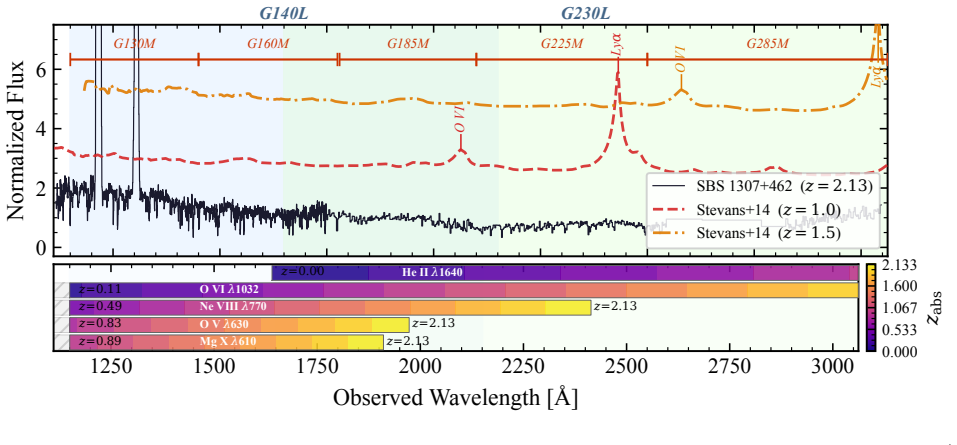
read the original abstract
The Hubble Space Telescope is the only high-resolution ultraviolet spectroscopic facility that will exist until the Habitable Worlds Observatory (HWO) achieves first light in the mid-2040s. We describe a coherent class of science, coupling rest-frame extreme-ultraviolet (EUV; 1--4 Ryd, 228--912 {\AA}) absorption and continuum spectroscopy of intermediate-redshift quasars at $z = 1-2$, shifting the rest-frame EUV photons into the HST/COS far-UV bandpass. This science on quasars and gas in the IGM and CGM is doubly perishable. The COS detector sensitivity is declining, just as new quasars are found (Milliquas, UVQS, and soon Rubin, Roman, and Euclid). Thus, the window to reach UV-bright quasars at $z>1$ QSOs narrows with every deferred orbit. Expanding HST UV orbit allocations in the 2030s would deliver a step-change in warm-hot CGM/IGM science and produce the first systematic, empirical EUV SED census of QSOs. These datasets will serve as the foundational low-redshift anchor for HWO science. This recommendation makes the scientific and strategic case for an expansion of the HST/COS spectroscopic data base on intermediate redshift AGN in their rest-frame EUV.
Editorial analysis
A structured set of objections, weighed in public.
Referee Report
Summary. The manuscript argues that HST/COS is the sole high-resolution UV facility until HWO in the mid-2040s, and that rest-frame EUV (1-4 Ryd) absorption and continuum spectroscopy of z=1-2 quasars (shifted into the COS FUV bandpass) represents a doubly perishable science opportunity. Declining COS detector sensitivity coincides with new UV-bright QSO discoveries from Milliquas, UVQS, Rubin, Roman, and Euclid, narrowing the window for high-S/N observations of warm-hot CGM/IGM gas and the first systematic empirical EUV SED census of QSOs; these data would anchor low-redshift science for HWO. The paper therefore recommends expanded HST UV orbit allocations in the 2030s.
Significance. If the quantitative premises on sensitivity decline and target availability are substantiated, the resulting legacy dataset would provide a foundational empirical anchor for EUV science with HWO and enable new constraints on warm-hot baryons in the IGM/CGM at intermediate redshifts, addressing a recognized gap between current HST capabilities and future missions.
major comments (2)
- [Abstract / Introduction] Abstract and introduction: the central claim that the observational window is narrowing due to COS sensitivity decline is load-bearing for the urgency recommendation, yet no numerical values are supplied for the rate of effective-area loss (e.g., percent per year), no references to COS monitoring reports or sensitivity curves are cited, and no projected impact on S/N for z>1 targets is quantified.
- [Abstract / Science case] Abstract and science-case sections: the argument that new QSO discoveries from Milliquas/UVQS/Rubin/Roman/Euclid will create a perishable opportunity requires estimates of annual yield of UV-bright (FUV flux sufficient for high-S/N EUV spectroscopy) z=1-2 targets and of how many such targets would be lost under a 5- or 10-year delay; none of these quantities or supporting calculations appear in the manuscript.
Simulated Author's Rebuttal
We thank the referee for the constructive feedback, which highlights opportunities to strengthen the quantitative foundation of our arguments. We will revise the manuscript to incorporate the requested details on sensitivity decline and target yields.
read point-by-point responses
-
Referee: [Abstract / Introduction] Abstract and introduction: the central claim that the observational window is narrowing due to COS sensitivity decline is load-bearing for the urgency recommendation, yet no numerical values are supplied for the rate of effective-area loss (e.g., percent per year), no references to COS monitoring reports or sensitivity curves are cited, and no projected impact on S/N for z>1 targets is quantified.
Authors: We agree that explicit quantification would strengthen the case. In revision we will cite COS team monitoring reports and sensitivity curves, supply the effective-area loss rate (percent per year), and add projected S/N calculations for representative z=1-2 targets under current and future sensitivity. revision: yes
-
Referee: [Abstract / Science case] Abstract and science-case sections: the argument that new QSO discoveries from Milliquas/UVQS/Rubin/Roman/Euclid will create a perishable opportunity requires estimates of annual yield of UV-bright (FUV flux sufficient for high-S/N EUV spectroscopy) z=1-2 targets and of how many such targets would be lost under a 5- or 10-year delay; none of these quantities or supporting calculations appear in the manuscript.
Authors: We concur that numerical estimates of annual UV-bright target yields and the effect of delays would make the perishable opportunity more rigorous. The revised manuscript will include these estimates, derived from the cited catalogs and survey projections, together with calculations of targets rendered inaccessible by a 5- or 10-year postponement. revision: yes
Circularity Check
No circularity: forward-looking recommendation without derivations or self-referential logic
full rationale
The manuscript is a policy-oriented recommendation for HST orbit allocations. It contains no equations, no fitted parameters, no predictions derived from data, and no derivation chain. All load-bearing claims rest on external references to instrument performance, survey catalogs (Milliquas, UVQS, Rubin, etc.), and future observatory timelines rather than reducing to self-citation or input-by-construction. The absence of any mathematical or statistical structure precludes the enumerated circularity patterns.
Axiom & Free-Parameter Ledger
Reference graph
Works this paper leans on
-
[1]
National Academies of Sciences & Medicine, E.Pathways to Discovery in Astronomy and Astrophysics for the 2020s(2021)
2021
-
[2]
InCanadian Long Range Plan for Astronomy and Astrophysics White Papers, vol
Cote, P.et al.CASTOR: A Flagship Canadian Space Telescope. InCanadian Long Range Plan for Astronomy and Astrophysics White Papers, vol. 2020, 18 (2019)
2020
-
[3]
Kulkarni, S. R.et al.Science with the Ultraviolet Explorer (UVEX).arXiv e-prints arXiv:2111.15608 (2021).2111.15608
-
[4]
Tilton, E. M., Stevans, M. L., Shull, J. M. & Danforth, C. W. HST-COS Observations of AGNs. III. Spectral Constraints in the Lyman Continuum from Composite COS/G140L Data.The As- trophysical Journal817, 56 (2016).1512.02635
work page internal anchor Pith review Pith/arXiv arXiv 2016
-
[5]
Shull, J. M., Stevans, M. & Danforth, C. W. HST-COS Observations of AGNs. I. Ultraviolet Composite Spectra of the Ionizing Continuum and Emission Lines.The Astrophysical Journal 752, 162 (2012).1204.3908
work page internal anchor Pith review Pith/arXiv arXiv 2012
-
[6]
Stevans, M. L., Shull, J. M., Danforth, C. W. & Tilton, E. M. HST-COS Observations of AGNs. II. Extended Survey of Ultraviolet Composite Spectra from 159 Active Galactic Nuclei.The Astrophysical Journal794, 75 (2014).1408.5900
work page internal anchor Pith review Pith/arXiv arXiv 2014
-
[7]
M., France, K., Danforth, C
Shull, J. M., France, K., Danforth, C. W., Smith, B. & Tumlinson, J. HST/COS Observations of the Quasar HE 2347-4342: Probing the Epoch of He II Patchy Reionization at Redshifts z = 2.4-2.9.The Astrophysical Journal722, 1312–1324 (2010)
2010
-
[8]
Early and Extended Helium Reionization Over More Than 600 Million Years of Cosmic Time
Worseck, G., Prochaska, J. X., Hennawi, J. F. & McQuinn, M. Early and Extended Helium Reionization over More Than 600 Million Years of Cosmic Time.The Astrophysical Journal 825, 144 (2016).1405.7405
work page internal anchor Pith review Pith/arXiv arXiv 2016
-
[9]
Worseck, G., Davies, F. B., Hennawi, J. F. & Prochaska, J. X. The Evolution of the He II-ionizing Background at Redshifts2.3< z <3.8Inferred from a Statistical Sample of 24 HST/COS He II LyαAbsorption Spectra.The Astrophysical Journal875, 111 (2019).1808.05247
work page internal anchor Pith review Pith/arXiv arXiv 2019
-
[10]
& Madau, P
Haardt, F. & Madau, P. Radiative Transfer in a Clumpy Universe. IV . New Synthesis Models of the Cosmic UV/X-Ray Background.The Astrophysical Journal746, 125 (2012)
2012
-
[11]
New synthesis models of consistent extragalactic background light over cosmic time
Khaire, V . & Srianand, R. New synthesis models of consistent extragalactic background light over cosmic time.Monthly Notices of the Royal Astronomical Society484, 4174–4199 (2019). 1801.09693
work page internal anchor Pith review Pith/arXiv arXiv 2019
-
[12]
Puchwein, E., Haardt, F., Haehnelt, M. G. & Madau, P. Consistent modelling of the meta- galactic UV background and the thermal/ionization history of the intergalactic medium.Monthly Notices of the Royal Astronomical Society485, 47–68 (2019).1801.04931
work page internal anchor Pith review Pith/arXiv arXiv 2019
-
[13]
Faucher-Gigu `ere, C.-A. A cosmic UV/X-ray background model update.Monthly Notices of the Royal Astronomical Society493, 1614–1632 (2020).1903.08657
- [14]
-
[15]
R.et al.The UV-bright Quasar Survey (UVQS): DR1.AJ152, 25 (2016).1602
Monroe, T. R.et al.The UV-bright Quasar Survey (UVQS): DR1.AJ152, 25 (2016).1602. 06255
2016
- [16]
-
[17]
Ivezi ´c, ˇZ.et al.LSST: From Science Drivers to Reference Design and Anticipated Data Prod- ucts.The Astrophysical Journal873, 111 (2019).0805.2366
work page internal anchor Pith review Pith/arXiv arXiv 2019
- [18]
-
[19]
Spergel, D.et al.Wide-Field InfraRed Survey Telescope-AFTA 2015 Report.arXiv e-prints arXiv:1503.03757 (2015).1503.03757
work page internal anchor Pith review Pith/arXiv arXiv 2015
-
[20]
Detection of Ne VIII in the Low-Redshift Warm-Hot IGM
Savage, B. D., Lehner, N., Wakker, B. P., Sembach, K. R. & Tripp, T. M. Detection of Ne VIII in the Low-Redshift Warm-Hot Intergalactic Medium.The Astrophysical Journal626, 776–794 (2005).astro-ph/0503051
work page internal anchor Pith review Pith/arXiv arXiv 2005
-
[21]
Danforth, C. W. & Shull, J. M. The Low-z Intergalactic Medium. I. O VI Baryon Census.The Astrophysical Journal624, 555–560 (2005).astro-ph/0501054
work page internal anchor Pith review Pith/arXiv arXiv 2005
-
[22]
Savage, B. D., Lehner, N. & Narayanan, A. COS Observations of Metal Line and Broad Lyman- αAbsorption in the Multi-phase O VI and Ne VIII System at z = 0.20701 toward HE 0226-4110. The Astrophysical Journal743, 180 (2011).1111.1697
work page internal anchor Pith review Pith/arXiv arXiv 2011
-
[23]
Mulchaey, J. S. & Chen, H.-W. The Galactic Environment of the Ne VIII Absorber Toward HE0226 - 4110.The Astrophysical Journal Letters698, L46–L50 (2009).0905.1327
work page internal anchor Pith review Pith/arXiv arXiv 2009
-
[24]
Tumlinson, J.et al.The Large, Oxygen-Rich Halos of Star-Forming Galaxies Are a Major Reservoir of Galactic Metals.Science334, 948 (2011).1111.3980
work page internal anchor Pith review Pith/arXiv arXiv 2011
-
[25]
The COS-Dwarfs Survey: The Carbon Reservoir Around sub-L* Galaxies
Bordoloi, R.et al.The COS-Dwarfs Survey: The Carbon Reservoir around Sub-L* Galaxies. The Astrophysical Journal796, 136 (2014).1406.0509
work page internal anchor Pith review Pith/arXiv arXiv 2014
-
[26]
A., Barthel, P
Verner, D. A., Barthel, P. D. & Tytler, D. Atomic data for absorption lines from the ground level at wavelengths greater than 228A.A&AS108, 287–340 (1994)
1994
-
[27]
Y ., Heckman, T
Bordoloi, R., Wagner, A. Y ., Heckman, T. M. & Norman, C. A. The Formation and Physical Origin of Highly Ionized Cooling Gas.The Astrophysical Journal848, 122 (2017).1605. 07187
2017
-
[28]
Shull, J. M., Bordoloi, R. & Danforth, C. Quasar Spectral Energy Distributions in the Rest-frame Extreme Ultraviolet: Hubble-COS Spectra of Two Ultraluminous Quasars.The Astrophysical Journal991, 103 (2025).2508.10097
-
[29]
The Hidden Mass and Large Spatial Extent of a Poststarburst Galaxy Outflow
Tripp, T. M.et al.The Hidden Mass and Large Spatial Extent of a Post-Starburst Galaxy Out- flow.Science334, 952 (2011).1111.3982
work page internal anchor Pith review Pith/arXiv arXiv 2011
-
[30]
Meiring, J. D.et al.QSO Absorption Systems Detected in Ne VIII: High-metallicity Clouds with a Large Effective Cross Section.The Astrophysical Journal767, 49 (2013).1201.0939. 7
work page internal anchor Pith review Pith/arXiv arXiv 2013
-
[31]
Hussain, T.et al.HST/COS detection of a Ne VIII absorber towards PG 1407+265: an un- ambiguous tracer of collisionally ionized hot gas?Monthly Notices of the Royal Astronomical Society446, 2444–2455 (2015).1410.7804
work page internal anchor Pith review Pith/arXiv arXiv 2015
-
[32]
Burchett, J. N.et al.The COS Absorption Survey of Baryon Harbors (CASBaH): Warm-Hot Circumgalactic Gas Reservoirs Traced by Ne VIII Absorption.The Astrophysical Journal Let- ters877, L20 (2019).1810.06560
work page internal anchor Pith review Pith/arXiv arXiv 2019
- [33]
-
[34]
The Rest-Frame Extreme Ultraviolet Spectral Properties of QSOs
Telfer, R. C., Zheng, W., Kriss, G. A. & Davidsen, A. F. The Rest-Frame Extreme-Ultraviolet Spectral Properties of Quasi-stellar Objects.The Astrophysical Journal565, 773–785 (2002). astro-ph/0109531
work page internal anchor Pith review Pith/arXiv arXiv 2002
-
[35]
Lusso, E.et al.The first ultraviolet quasar-stacked spectrum at z≃2.4 from WFC3.Monthly Notices of the Royal Astronomical Society449, 4204–4220 (2015).1503.02075
work page internal anchor Pith review Pith/arXiv arXiv 2015
-
[36]
Jiang, Y .-F., Blaes, O., Kaul, I. & Zhang, L. Radiation and Magnetic Pressure Support in Accre- tion Disks Around Supermassive Black Holes and the Physical Origin of the Extreme-ultraviolet to Soft X-Ray Spectrum.The Astrophysical Journal988, 43 (2025).2505.09671
-
[37]
The Effects of Disc Winds on the Spectrum and Black Hole Growth Rate of Active Galactic Nuclei
Slone, O. & Netzer, H. The effects of disc winds on the spectrum and black hole growth rate of active galactic nuclei.Monthly Notices of the Royal Astronomical Society426, 656–664 (2012). 1207.7074
work page internal anchor Pith review Pith/arXiv arXiv 2012
-
[38]
Line driven winds and the UV turnover in AGN accretion discs
Laor, A. & Davis, S. W. Line-driven winds and the UV turnover in AGN accretion discs. Monthly Notices of the Royal Astronomical Society438, 3024–3038 (2014).1312.3556
work page internal anchor Pith review Pith/arXiv arXiv 2014
-
[39]
The tight relation between X-ray and ultraviolet luminosity of quasars
Lusso, E. & Risaliti, G. The Tight Relation between X-Ray and Ultraviolet Luminosity of Quasars.The Astrophysical Journal819, 154 (2016).1602.01090. 8
work page internal anchor Pith review Pith/arXiv arXiv 2016
discussion (0)
Sign in with ORCID, Apple, or X to comment. Anyone can read and Pith papers without signing in.