Transient Gas-Dynamics Filamentation of High-PowerFemtosecond Laser Pulse in Compressed Argon
Pith reviewed 2026-05-19 20:12 UTC · model grok-4.3
The pith
Pressure shock drops in compressed argon trigger early multiple filamentation and broaden femtosecond laser spectra by up to 80 nm in proportion to initial pressure.
A machine-rendered reading of the paper's core claim, the machinery that carries it, and where it could break.
Core claim
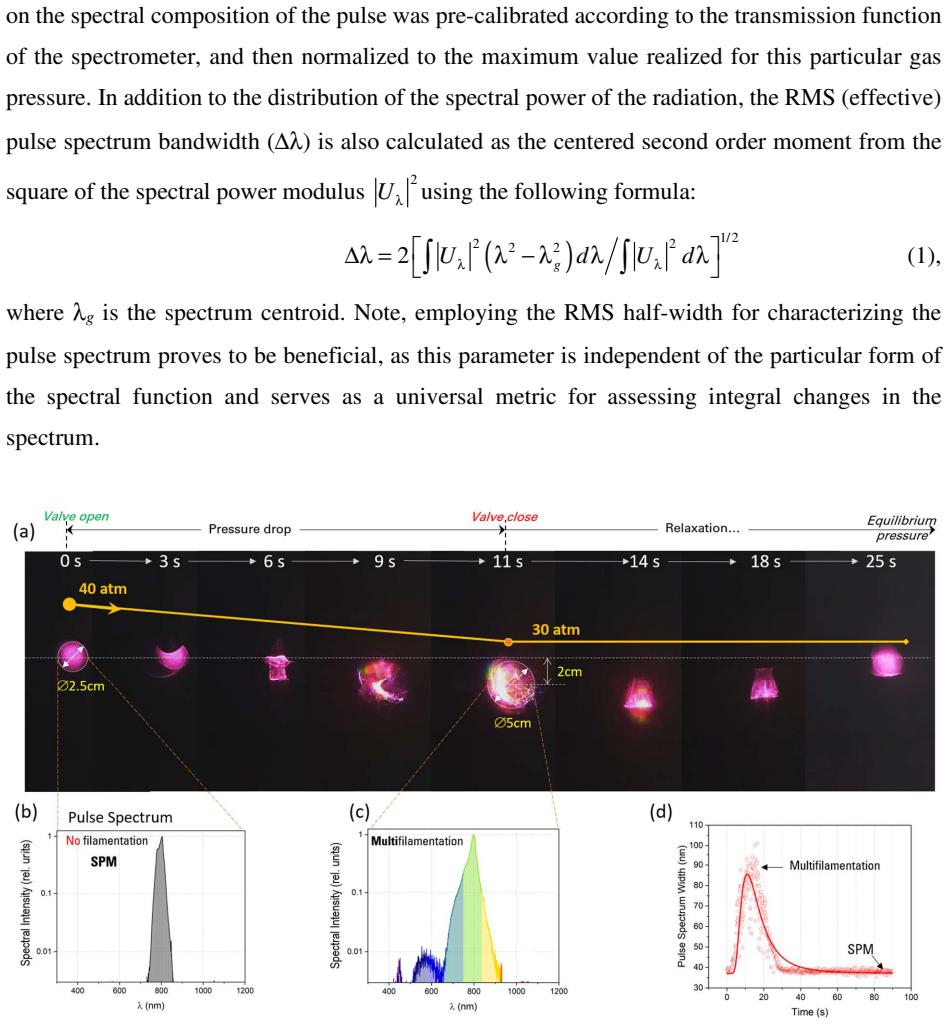
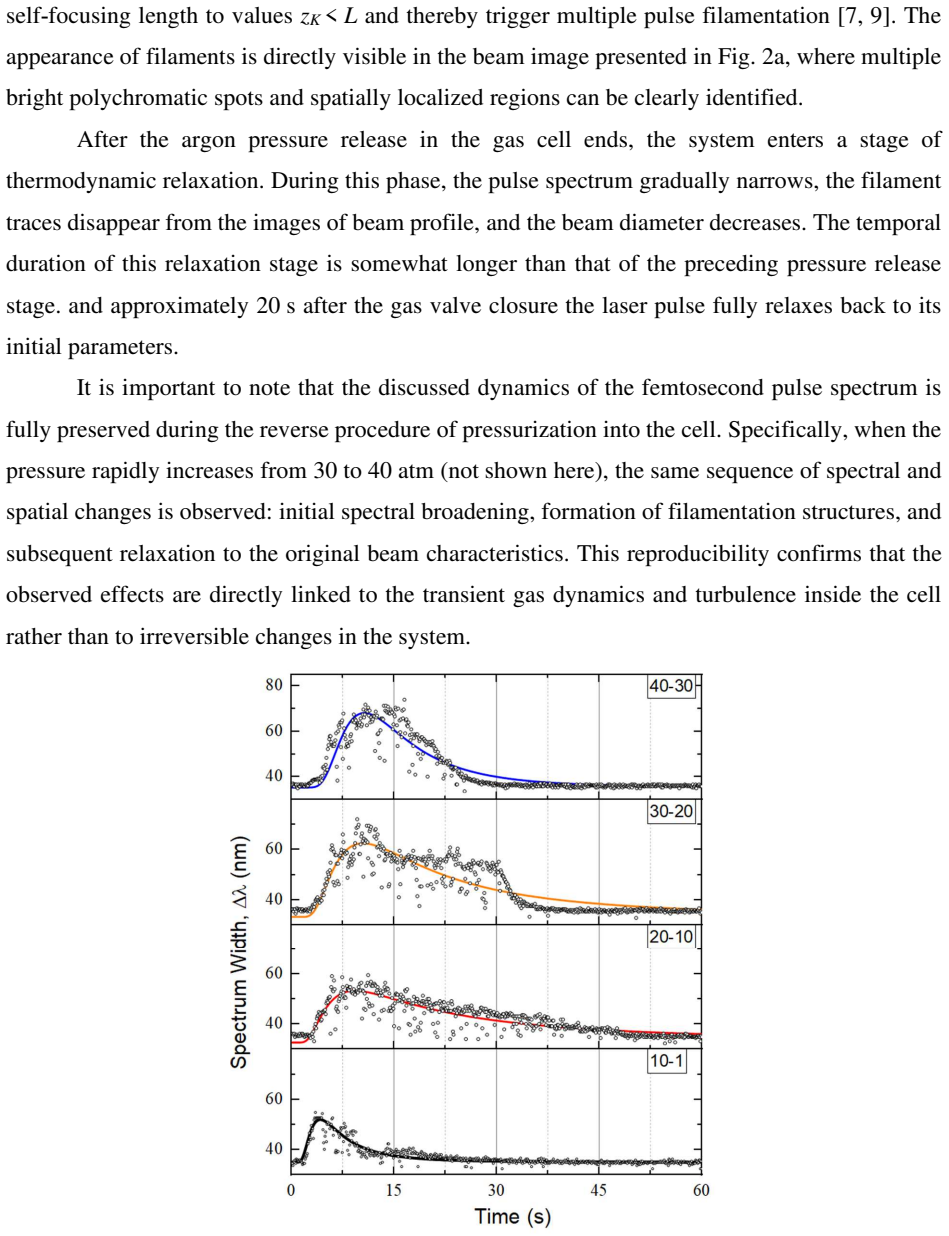
Under pressure shock-drop conditions in argon at up to 40 atm, the resulting jet flows and vortex gas turbulence trigger the early onset of multiple filamentation of the femtosecond pulse and produce large-scale spectrum broadening throughout the entire duration of the pressure drop, with the broadening magnitude reaching 80 nm and scaling proportionally with the initial gas pressure.
What carries the argument
Jet flows and vortex gas turbulence induced by the pressure shock-drop, which accelerate the start of multiple filamentation and drive the observed spectral broadening.
If this is right
- Supercontinuum spectra from filamentation can be controlled by imposing shock pressure release and rise conditions in gas cells.
- The method offers a route to tune spectral width by adjusting initial gas pressure.
- Turbulence dynamics near the outlet valve directly modify pulse propagation characteristics.
- The approach extends to pressure rise conditions as well as drops.
Where Pith is reading between the lines
- Similar turbulence-driven effects could appear in other compressed gases or at different laser wavelengths if the shock conditions are replicated.
- The technique might combine with existing filamentation setups to produce tunable broadband sources without changing pulse energy.
- Testing the scaling of broadening with pressure in a sealed cell versus an open flow could isolate the role of vortex relaxation times.
Load-bearing premise
The early onset of multiple filamentation and spectrum broadening result directly from the jet flows and vortex turbulence created by the pressure shock-drop rather than from changes in gas density or ionization alone.
What would settle it
Measuring the same spectrum broadening and filamentation timing in static high-pressure argon without a shock-drop, or finding no turbulence effects in the CFD simulations, would show that the pressure dynamics are not the controlling factor.
Figures



read the original abstract
We have experimentally investigated the spectral characteristics and spatial structure of femtosecond pulses from a titanium:sapphire laser during filamentation in an optical cell filled with argon at pressures up to 40 atm under pressure shock-drop conditions. This leads to the development of strong jet flows and vortex gas turbulence, which in turn triggers the early onset of multiple filamentation of the optical pulse and largescale broadening of its spectrum throughout the entire duration of the pressure drop. The magnitude of this spectrum broadening can reach 80 nm and is proportional to the initial gas pressure. Using computational fluid dynamics simulations, we studied the dynamics of the emergence, development, and relaxation of stimulated turbulence in compressed gas in the region of the cell outlet valve and assessed the effect it exerts on the propagating femtosecond pulse. The revealed regularities may serve as the basis for developing an effective method of controlling the spectrum of supercontinuum radiation via filamentation of highpower ultrashort laser pulses in gas cells under shock pressure release and rise conditions.
Editorial analysis
A structured set of objections, weighed in public.
Referee Report
Summary. The paper experimentally investigates the spectral characteristics and spatial structure of femtosecond titanium:sapphire laser pulses during filamentation in an optical cell filled with argon at pressures up to 40 atm under pressure shock-drop conditions. This setup induces strong jet flows and vortex gas turbulence, triggering early onset of multiple filamentation and large-scale spectral broadening (up to 80 nm) throughout the pressure drop, with the broadening magnitude reported as proportional to initial gas pressure. CFD simulations examine the emergence, development, and relaxation of the stimulated turbulence and its effect on the propagating pulse. The authors suggest these regularities may enable control of supercontinuum spectrum via shock pressure release and rise conditions.
Significance. If the reported spectral broadening, its proportionality to pressure, and the causal attribution to turbulence hold after addressing evidentiary gaps, the work could offer a new experimental handle for controlling supercontinuum generation in high-pressure gas cells, with relevance to nonlinear optics applications. The use of CFD to model flow dynamics provides a useful complement to the experiment.
major comments (2)
- [Abstract] Abstract: the central claim that spectral broadening reaches 80 nm and is proportional to initial gas pressure provides no quantitative data, error bars, measurement protocols, or fitting details, leaving the primary experimental result without visible supporting evidence or controls.
- [Discussion of mechanism] Discussion of mechanism: the attribution of early multiple filamentation and broadening specifically to jet flows and vortex turbulence is not isolated from concurrent bulk changes in average gas density (which scale n2 and ionization probability). No control condition (uniform density ramp without induced turbulence) or in-situ local density fluctuation measurements are described.
minor comments (1)
- [Abstract] The abstract refers to 'throughout the entire duration of the pressure drop' without specifying the relevant time scale or how it was determined from the data.
Simulated Author's Rebuttal
We thank the referee for the careful reading and constructive comments on our manuscript. We address each major comment below with specific responses and indicate planned revisions to the next version of the paper.
read point-by-point responses
-
Referee: [Abstract] Abstract: the central claim that spectral broadening reaches 80 nm and is proportional to initial gas pressure provides no quantitative data, error bars, measurement protocols, or fitting details, leaving the primary experimental result without visible supporting evidence or controls.
Authors: The abstract is intentionally concise and summarizes the key findings without embedding full quantitative details, error bars, or protocols, which is standard practice. The main text and figures provide the supporting evidence: spectral measurements were performed with a calibrated spectrometer (resolution specified in Methods), broadening values up to 80 nm are shown in time-resolved spectra with standard deviation error bars from repeated shots, and proportionality to initial pressure is demonstrated via linear regression on data from 10–40 atm with R² values reported. We will revise the abstract to include a brief parenthetical reference to the quantitative support in the main text and figures. revision: yes
-
Referee: [Discussion of mechanism] Discussion of mechanism: the attribution of early multiple filamentation and broadening specifically to jet flows and vortex turbulence is not isolated from concurrent bulk changes in average gas density (which scale n2 and ionization probability). No control condition (uniform density ramp without induced turbulence) or in-situ local density fluctuation measurements are described.
Authors: We agree that average density changes during the pressure drop affect both n2 and ionization thresholds, and these are included in our CFD model. However, the shock-drop protocol specifically generates localized jet flows and vortex structures whose spatiotemporal evolution, as simulated, correlates directly with the observed early filamentation onset and the duration of spectral broadening—features absent in steady-pressure filamentation at the same average density. The CFD results quantify the additional local density fluctuations from turbulence that seed multiple filaments. While an ideal uniform-ramp control experiment would strengthen isolation, the dynamic pressure-drop data combined with the simulations already distinguish the turbulence contribution through timing and spatial structure. We will expand the discussion to explicitly compare the turbulence-induced fluctuations against the mean-density effect and acknowledge the absence of a separate control run. revision: partial
- Absence of a dedicated uniform-density-ramp control experiment and in-situ local density fluctuation diagnostics, which would require additional hardware and runs not performed in the current study.
Circularity Check
No significant circularity in experimental observations and CFD simulations
full rationale
The paper reports direct experimental measurements of spectral broadening (up to 80 nm, proportional to initial pressure) during filamentation under pressure shock-drop conditions in argon, together with separate CFD simulations of jet flows and turbulence. No derivation chain, fitted parameters renamed as predictions, self-definitional equations, or load-bearing self-citations appear in the described work. Claims rest on observed data and independent fluid-dynamics modeling rather than any reduction of outputs to inputs by construction.
Axiom & Free-Parameter Ledger
Lean theorems connected to this paper
-
IndisputableMonolith/Cost/FunctionalEquation.leanwashburn_uniqueness_aczel unclear?
unclearRelation between the paper passage and the cited Recognition theorem.
The magnitude of this spectrum broadening can reach 80 nm and is proportional to the initial gas pressure... CFD simulations... Reynolds-averaged Navier-Stokes (RANS) equations... k-ε model
-
IndisputableMonolith/Foundation/DimensionForcing.leanalexander_duality_circle_linking unclear?
unclearRelation between the paper passage and the cited Recognition theorem.
n2(p) = β n2(p0)... Marburger formula... self-focusing distance zK
What do these tags mean?
- matches
- The paper's claim is directly supported by a theorem in the formal canon.
- supports
- The theorem supports part of the paper's argument, but the paper may add assumptions or extra steps.
- extends
- The paper goes beyond the formal theorem; the theorem is a base layer rather than the whole result.
- uses
- The paper appears to rely on the theorem as machinery.
- contradicts
- The paper's claim conflicts with a theorem or certificate in the canon.
- unclear
- Pith found a possible connection, but the passage is too broad, indirect, or ambiguous to say the theorem truly supports the claim.
Reference graph
Works this paper leans on
-
[1]
Self-focusing: Past and Present. Fundamentals and P rospects (eds., Y.R. Shen, R.W. Boyd, and S.G. Lukishova, Springer-Verlag New York, 2009): https://doi.org/10.1007/978-0-387- 34727-1
-
[2]
Femtosecond filamentat ion in transparent media,
A. Couairon, A. Myzyrowicz, “Femtosecond filamentat ion in transparent media,” Phys. Reports 441, 47-189 (2007): https://doi.org/10.1016/j.physrep.2006.12.005
-
[3]
From self-focusing l ight beams to femtosecond laser pulse filamentation,
S.V. Chekalin, V.P. Kandidov, "From self-focusing l ight beams to femtosecond laser pulse filamentation," Phys. Usp. 56, 123–140 (2013): https://doi.org/10.3367/UFNe.0183.201302b.0133
-
[4]
Recent developments in femtosecond filamentation,
A. Houard, Y. Liu and A. Mysyrowicz, “Recent developments in femtosecond filamentation,” J. Phys.: Conf. Ser. 497 012001 (2014). https://doi.org/10.1088/1742-6596/497/1/012001
-
[5]
Physics and applications of atmospheric nonlinear optics and filamentation,
J. Kasparian, J.-P. Wolf, “Physics and applications of atmospheric nonlinear optics and filamentation,” Opt. Express 16, 466-493 (2008). https://doi.org/10.1364/OE.16.000466
-
[6]
V.P. Kandidov, O.G. Kosareva, M.P. Tamarov, A. Brod eur, S.L. Chin, "Nucleation and random movement of filaments in the propagation of high-power laser radiation in a turbulent atmosphere", Quantum Electron. 29 (10), 911 (1999): https://doi.org/10.1070/QE1999v029n10ABEH001602
-
[7]
Filamentation of femtosecond laser pulses in turbulent air,
S. L. Chin, A. Talebpour, J. Yang, S. Petit, V. P. Kandidov, O. G. Kosareva, and M. P Tamarov, “Filamentation of femtosecond laser pulses in turbulent air,” Appl. Phys. B 74, 67– 76 (2002): https://doi.org/10.1007/s003400100738
-
[8]
S.A. Shlyonov, V.Yu. Fedorov, V.P. Kandidov, “Filam entation of phase-modulated femtosecond laser pulse on kilometer-long paths in the turbulent atmosphere,” Atmospheric and oceanic optics 20, 275 (2007)
work page 2007
-
[9]
Femtosecond filamentation in turbulent air,
A. Houard, M. Franco, B. Prade, A. Durécu, L. Lombar d, P. Bourdon, O. Vasseur, B. Fleury, C. Robert, V. Michau, A. Couairon, and A. Mysyrowic z, “Femtosecond filamentation in turbulent air,” Phys. Rev. A78, 033804 (2008): https://doi.org/10.1103/PhysRevA.78.033804
-
[10]
Spatial evolution of laser filaments in turbulent air,
T. Zeng, S, Zhu, S, Zhou, Y. He, “Spatial evolution of laser filaments in turbulent air,” Opt. Commun. 412, 161 (2018): https://doi.org/10.1016/j.optcom.2017.12.013
-
[11]
Enhancement of multi- filament generation and filament-induced fluorescen ce by turbulence,
J. Liu, Z. Zhang, B. Shang, C. Chu, L. Sun, N. Zhang, L. Lin, W. Liu, “Enhancement of multi- filament generation and filament-induced fluorescen ce by turbulence,” Opt. Commun. 517, 128290 (2022): https://doi.org/10.1016/j.optcom.2022.128290
-
[12]
Femtosecond laser filamentation in simulated atmospheric turbulence [Invited],
J. Guo, L. Sun, Y. Wang, J. Xue, Z. Zhang, H. Liu, S. Tao, W. Qian, P. Qi, L. Lin, and W. Liu, “Femtosecond laser filamentation in simulated atmospheric turbulence [Invited],” Chinese Optics Letters 21(11), 110004 (2023). http://dx.doi.org/10.3788/COL202321.110004
-
[13]
Propagation of ultra-short, intense laser pulses i n air,
J. R. Penano, P. Sprangle, B. Hazafi, A. Ting, D. F . Gordon, and C. A. Kapetanakos, “Propagation of ultra-short, intense laser pulses i n air,” Phys. Plasmas 11, 2865 (2004). https://doi.org/10.1063/1.1648020
-
[14]
Laser filaments generated and transmitted in highly turbulent air,
R. Ackermann, G. Méjean, J. Kasparian, J. Yu, E. Sa lmon, J.-P. Wolf, “Laser filaments generated and transmitted in highly turbulent air,” Opt. Lett. 31, 86 (2006): https://doi.org/10.1364/OL.31.000086
-
[15]
Propagation of laser filaments through an extended turbulent region,
R. Salame, N. Lascoux, E. Salmon, R. Ackermann, and J. Kasparian, “Propagation of laser filaments through an extended turbulent region,” Ap pl. Phys. Lett. 91, 171106 (2007): https://doi.org/10.1063/1.2799163
-
[16]
Remote sensing of the atmosphere using ultrashort laser pulses,
P. Rairoux, H. Schillinger, S. Niedermeier, M. Rodr iguez, F. Ronneberger, R. Sauerbrey, B. Stein, D. Waite, C. Wedekind, H. Wille, L. Wöste, C . Ziener, “Remote sensing of the atmosphere using ultrashort laser pulses,” App. Phy s. B 71, 573-580 (2000). https://doi.org/10.1007/s003400000375
-
[17]
Femtosecond pulse propagation in argon: A pressure dependence study,
M. Mlejnek, E.M. Wright, J.V. Moloney, “Femtosecond pulse propagation in argon: A pressure dependence study,” Phys. Rev. E 48, 4903 ( 1998). https://doi.org/10.1103/PhysRevE.58.4903 18
-
[18]
Influence of pressure on spectral broadening of femtosecond laser pulses in air,
H. Zhang, Y. Zhang, S. Lin, Y. Zhang, A. Chen, Y. J iang, S. Li, and M. Jin, “Influence of pressure on spectral broadening of femtosecond laser pulses in air,” Phys. Plasmas 28, 043302 (2021); https://doi.org/10.1063/5.0042998
-
[19]
Energy transmittance of focused femtosecond pulses at different air pressures,
S. Li, M. Yu, X. Cai, H. Zhang, M. Jin, J. Wu, “Energy transmittance of focused femtosecond pulses at different air pressures,” Optoelectron. L ett. 19, 605–613 (2023). https://doi.org/10.1007/s11801-023-3037-6
-
[20]
Supercontinuum saturation of femtosecond laser filament in pressurized gases,
Y.E. Geints, A.D. Bulygin, V.O. Kompanets, S.V. Chek alin, “Supercontinuum saturation of femtosecond laser filament in pressurized gases,” O pt. Lett. 49, 6033 6036 (2024). https://doi.org/10.1364/OL.539885
-
[21]
Peculiarities of supercontinuum generation in high-pressure He, N 2, Ar, and CO 2 gases,
Y.E. Geints, V.O. Kompanets, A.V. Kireev, S.V. Chek alin, “Peculiarities of supercontinuum generation in high-pressure He, N 2, Ar, and CO 2 gases,” Optics & Laser Technology 191, 113370 (2025). https://doi.org/10.1016/j.optlastec.2025.113370
-
[22]
A.G. Gaydon, and I.R. Hurle, The Shock Tube in High Temperature Chemical Physics, (Chapman and Hall, London, 1963)
work page 1963
-
[23]
Self-focusing distance of very high power laser pulses,
G. Fibich, S. Eisenmann, B. Ilan, Y. Erlich, M. Fraenkel, Z. Henis, A.L. Gaeta, and A. Zigler, "Self-focusing distance of very high power laser pulses," Opt. Express 13, 5897-5903 (2005): https://doi.org/10.1364/OPEX.13.005897
-
[24]
Y.E. Geints, “Pressure scaling of femtosecond laser filamentation in air: Prospects for long- range atmospheric propagation,” Opt. Commun. 573, 1 3007 (2024). https://doi.org/10.1016/j.optcom.2024.131007
-
[25]
M. N. Polyanskiy. Refractiveindex.info database of optical constants. Sci. Data 11, 94 (2024): https://doi.org/10.1038/s41597-023-02898-2
-
[26]
Y. Hu, J. Nie, K. Sun, L. Wang, “Filamentation of f emtosecond laser pulse influenced by the air turbulence at various propagation distances,” O pt. Commun. 383, 281-286 (2017). http://dx.doi.org/10.1016/j.optcom.2016.08.019
-
[27]
Applied gasdynamics (4th revised edition)
G. N. Abramovich, “Applied gasdynamics (4th revised edition)” (Moscow Izdatel Nauka, 1976)
work page 1976
-
[28]
Wilcox, Turbulence Modeling for CFD, 3d ed
D.C. Wilcox, Turbulence Modeling for CFD, 3d ed. (D CW Industries, 2006)
work page 2006
-
[29]
A Universal Formulation of Two-equation Models for Adaptive Computation of Turbulent Flows,
L. Ignat, D. Pelletier, and F. Ilinca, “A Universal Formulation of Two-equation Models for Adaptive Computation of Turbulent Flows,” Comput. M ethods Appl. Mech. Eng. 189, 1119– 1139 (2000). https://doi.org/10.1016/S0045-7825(99)00370-9
-
[30]
F. Moukalled, L. Mangani, M. Darwish, The finite vo lume method in computational fluid dynamics: an advanced introduction with OpenFOAM® a nd Matlab®. 1st ed., V. 113 (Fluid mechanics and its applications). Springer, 2015. https://doi.org/10.1007/978-3-319-16874-6
discussion (0)
Sign in with ORCID, Apple, or X to comment. Anyone can read and Pith papers without signing in.