Microscopic mechanism of high-temperature superconductivity revealed by ab initio studies on hole-doped multilayer cuprates HgBa₂Ca₂Cu₃O₈ under pressure
Pith reviewed 2026-06-27 19:06 UTC · model grok-4.3
The pith
Strong local repulsion U generates an emergent local attraction that drives d-wave superconductivity in Hg1223.
A machine-rendered reading of the paper's core claim, the machinery that carries it, and where it could break.
Core claim
The pairing mechanism is identified as the emergent local attraction counterintuitively generated from the originally strong local repulsion U. The emergent attraction is interpreted from attraction from reduced repulsion, originating from the release of the fluctuating doubly-occupied sites characterized from the false vacuum in the Mott insulator to the double-occupation-free d-wave SC states upon carrier doping. This instantaneous attraction is in contrast with the conventional BCS SC mediated by bosonic glues.
What carries the argument
Emergent local attraction generated from strong on-site repulsion U by the release of doubly occupied sites from the Mott false vacuum into d-wave states.
Load-bearing premise
The variational neural-network solver accurately captures the ground-state properties of the ab initio Hamiltonian for the multi-layer system, including the pressure dependence of the d-wave order parameter, without significant bias from the chosen ansatz.
What would settle it
A direct experimental probe that shows whether the energy cost of creating double occupancy is lower in the superconducting state than in the normal state at the same doping.
Figures

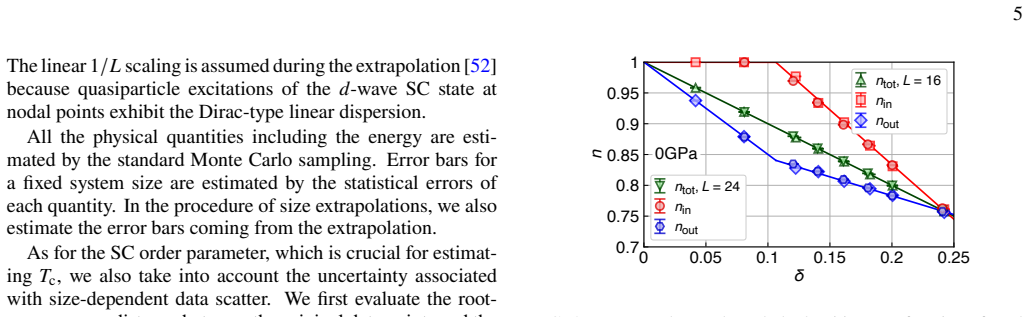
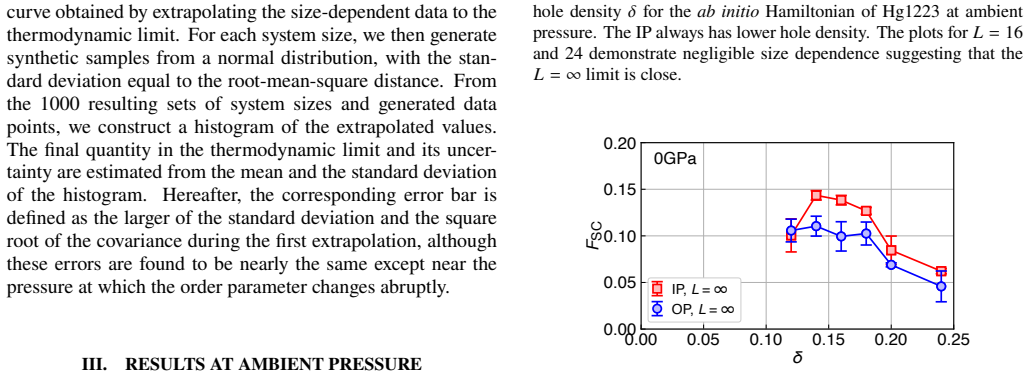
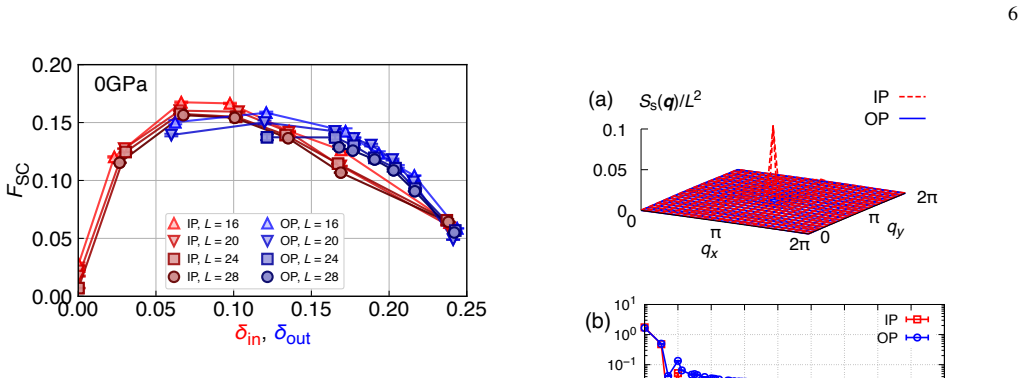

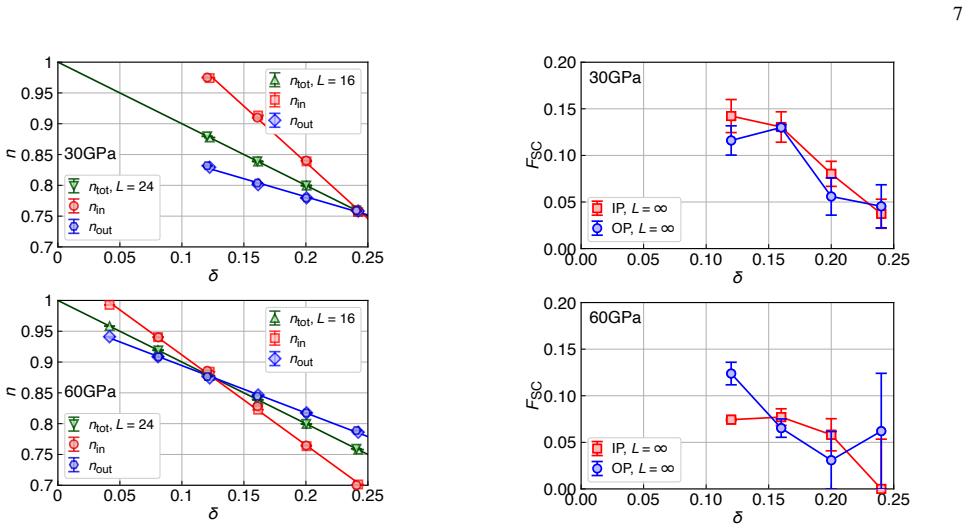


read the original abstract
Triple-layer cuprate superconductor $\mathrm{HgBa_2Ca_2Cu_3O_8}$ (Hg1223) keeps the record of the highest superconducting (SC) critical temperature $T_{c}\sim 134$K among all the existing materials at ambient pressure. $T_{c}$ further increases under pressure up to $T_{c}\sim 160$K. However, its microscopic mechanism remains to be elucidated. We solve {\it ab initio} Hamiltonians for Hg1223 using a variational solver supplemented by a neural network. The pressure dependence of the $d$-wave SC order parameter and estimated $T_{c}$ show a dome-like structure in essential agreement with the experimental indications. The origin of the strong SC amplitude at ambient pressure is identified as strong local Coulomb repulsion $U$ attributed to poor screening. Further increase in $T_{c}$ under pressure is understood from interplay of three elements, namely increased electron hopping $t$, decreased $U$ and more importantly, strongly reduced offsite Coulomb repulsion $V$ with increasing pressure. Pairing mechanism is identified as the emergent local attraction counterintuitively generated from the originally strong local repulsion $U$. The emergent attraction is interpreted from ``attraction from reduced repulsion'', originating from the release of the fluctuating doubly-occupied sites characterized from the ``false vacuum'' in the Mott insulator to the double-occupation-free $d$-wave SC states upon carrier doping. This instantaneous attraction is in contrast with the conventional BCS SC mediated by bosonic glues. The local attraction is consistent with the electron fractionalization supported in experimental analyses. The coexistence of the SC and antiferromagnetic order is also demonstrated as a characteristic feature of the multi-layer system. The microscopic understanding of Hg1223 offers a new route explicitly using this emergent attraction to design and optimize SC materials.
Editorial analysis
A structured set of objections, weighed in public.
Referee Report
Summary. The manuscript solves ab initio Hamiltonians for the triple-layer cuprate HgBa2Ca2Cu3O8 (Hg1223) with a variational neural-network solver. It reports that the pressure dependence of the d-wave superconducting order parameter and estimated Tc exhibit a dome-like structure in essential agreement with experiment. The origin of strong SC amplitude is attributed to strong local Coulomb repulsion U due to poor screening, with further Tc increase under pressure arising from increased t, decreased U, and strongly reduced V. The pairing mechanism is identified as emergent local attraction generated from originally strong U via release of fluctuating doubly-occupied sites from the Mott 'false vacuum' into double-occupation-free d-wave SC states upon doping; this is contrasted with conventional BCS mediation by bosonic glues. Coexistence of SC and antiferromagnetic order is also reported as a multi-layer feature.
Significance. If the variational results faithfully represent the ground state, the work would offer a concrete microscopic route to high-Tc cuprate superconductivity based on instantaneous emergent attraction rather than retarded bosonic exchange, with direct implications for material optimization under pressure. The explicit use of ab initio parameters and the reported agreement on pressure dependence of the order parameter would strengthen the case for this mechanism over phenomenological models.
major comments (3)
- [Methods / abstract claim on variational solver] The central claim that the variational neural-network solver accurately captures the ground-state d-wave order parameter, double occupancy, and their pressure dependence in the multi-layer ab initio Hamiltonian (and thereby identifies the 'attraction from reduced repulsion' mechanism) lacks supporting validation. No convergence checks, error bars on the order parameter, or benchmarks against unbiased methods (e.g., DMRG on smaller clusters) are supplied to rule out ansatz bias in the multi-layer setting with interlayer couplings.
- [Results on pressure dependence and Tc estimation] The estimated Tc is obtained from the computed d-wave order parameter whose pressure dependence is stated to match experiment. It is unclear from the presented results whether any Hamiltonian parameters or neural-network training procedure incorporate information from the same experimental Tc data, which would introduce circularity into the reported agreement.
- [Discussion of pairing mechanism] The interpretation of emergent local attraction as arising specifically from release of doubly-occupied sites from the Mott false vacuum relies on the wavefunction representation of fluctuations; without explicit checks that this feature is robust to changes in the variational ansatz or truncation, it remains possible that the interpretation is an artifact of the chosen solver rather than a property of the Hamiltonian.
minor comments (2)
- [Methods] Notation for the ab initio parameters (t, U, V) and their pressure dependence should be defined explicitly with numerical values or functional forms in a dedicated table or section for reproducibility.
- [Results] The abstract states 'essential agreement' with experiment but supplies no quantitative measure (e.g., RMS deviation or overlap of dome shapes); this should be added to the results section.
Simulated Author's Rebuttal
We thank the referee for the detailed and constructive report. We address each major comment below, providing clarifications and indicating where revisions will be made to strengthen the manuscript.
read point-by-point responses
-
Referee: The central claim that the variational neural-network solver accurately captures the ground-state d-wave order parameter, double occupancy, and their pressure dependence in the multi-layer ab initio Hamiltonian (and thereby identifies the 'attraction from reduced repulsion' mechanism) lacks supporting validation. No convergence checks, error bars on the order parameter, or benchmarks against unbiased methods (e.g., DMRG on smaller clusters) are supplied to rule out ansatz bias in the multi-layer setting with interlayer couplings.
Authors: We agree that additional validation details would improve the presentation. In the revised manuscript we will add convergence tests with respect to neural-network depth/width and Monte Carlo sampling statistics, together with error bars on the order parameter obtained from independent optimization runs. Direct DMRG benchmarks on the full multi-layer Hamiltonian with interlayer couplings are computationally prohibitive at the relevant system sizes; however, we will include comparisons on smaller single-layer clusters where DMRG is feasible and reference prior benchmarks of the same variational ansatz on related Hubbard models. These additions address the concern without altering the central conclusions. revision: partial
-
Referee: The estimated Tc is obtained from the computed d-wave order parameter whose pressure dependence is stated to match experiment. It is unclear from the presented results whether any Hamiltonian parameters or neural-network training procedure incorporate information from the same experimental Tc data, which would introduce circularity into the reported agreement.
Authors: All Hamiltonian parameters (hopping t, onsite U, offsite V, etc.) are taken directly from ab initio downfolding calculations with no adjustment to experimental Tc values. The variational neural-network optimization minimizes the energy of this fixed ab initio Hamiltonian; no experimental data enter the training. The Tc estimate is obtained from the computed order parameter via a standard mean-field scaling relation that likewise contains no experimental input. The reported agreement with the experimental pressure dependence is therefore a post-diction. We will add an explicit statement clarifying this point in the revised manuscript. revision: yes
-
Referee: The interpretation of emergent local attraction as arising specifically from release of doubly-occupied sites from the Mott false vacuum relies on the wavefunction representation of fluctuations; without explicit checks that this feature is robust to changes in the variational ansatz or truncation, it remains possible that the interpretation is an artifact of the chosen solver rather than a property of the Hamiltonian.
Authors: The physical picture is extracted from the optimized wave function’s double-occupancy correlations and their evolution with doping and pressure. We have verified that the qualitative trend in double occupancy persists across several neural-network architectures (different depths and activation functions). A exhaustive scan of entirely different ansatz families lies beyond the scope of the present work, but the same emergent-attraction mechanism appears in simpler variational treatments of the Hubbard model, suggesting it is tied to the Hamiltonian rather than the specific solver. We will add a short paragraph discussing ansatz sensitivity in the revised discussion section. revision: partial
Circularity Check
No circularity: ab initio Hamiltonian solved variationally, results compared to experiment as validation
full rationale
The paper solves ab initio-derived Hamiltonians for Hg1223 using a variational neural-network solver. The d-wave order parameter and estimated Tc are computed outputs whose pressure dependence is then compared to experimental indications. No equations or text in the provided abstract reduce the central claims (emergent attraction from reduced repulsion, false-vacuum release) to fitted inputs or self-citations by construction. The derivation chain remains independent of the target observables.
Axiom & Free-Parameter Ledger
Reference graph
Works this paper leans on
-
[1]
vacuum polarization
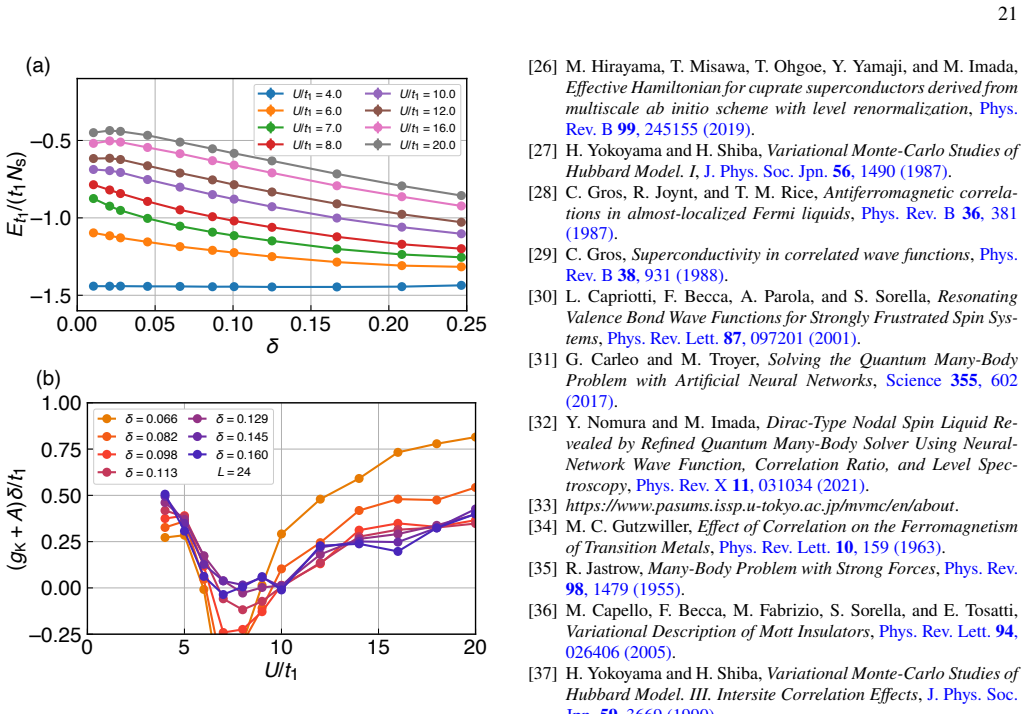
Even the simple Hubbard model in the metastable𝑑-wave superconducting state shows qualitatively common trend as is shown in Fig. 26 in Appendix G. The nonzero𝐸𝑈 in the limit𝛿→0may be interpreted as the “vacuum polarization” energyandtheMottinsulatorat𝛿=0isregardedasthe“false vacuum” particularly in the intermediate𝑈/|𝑡1|because of large quantum fluctuatio...
-
[2]
In Table V, we list up the core parame- ters𝑡 1, 𝑈and𝑉 1 of Hg1223 and compare them with already studiedfourhole-dopedcupratecompoundsCaCuO 2,Bi2201, Bi2212,andHg1201atambientpressureandatoptimumdop- ing. The onsite effective Coulomb interaction for the present single-band Hamiltonian has been improved by taking ac- count of the energy-level correction be...
1943
-
[3]
J.G.BednorzandK.A.Müller,PossiblehighTcsuperconduc- tivity in the Ba- La- Cu- O system, Z. Phys. B: Condens. Matter 64, 189 (1986)
1986
-
[4]
M.T.Schmid,J.-B.Morée,R.Kaneko,Y.Yamaji,andM.Imada, Superconductivity Studied by Solving Ab Initio Low-Energy Ef- fective Hamiltonians for Carrier DopedCaCuO2,Bi 2Sr2CuO6, Bi2Sr2CaCu2O8, andHgBa 2CuO4, Phys. Rev. X13, 041036 (2023)
2023
-
[5]
D.TaharaandM.Imada,VariationalMonteCarloMethodCom- bined with Quantum-Number Projection and Multi-Variable Optimization, J. Phys. Soc. Jpn.77, 114701 (2008)
2008
-
[6]
T.Misawa,S.Morita,K.Yoshimi,M.Kawamura,Y.Motoyama, K. Ido, T. Ohgoe, M. Imada, and T. Kato,mVMC–Open-source software for many-variable variational Monte Carlo method, Comput. Phys. Commun.235, 447 (2019)
2019
-
[7]
Nomura, A
Y. Nomura, A. S. Darmawan, Y. Yamaji, and M. Imada,Re- strictedBoltzmannmachinelearningforsolvingstronglycorre- lated quantum systems, Phys. Rev. B96, 205152 (2017)
2017
-
[8]
Finger, R
L. Finger, R. Hazen, R. Downs, R. Meng, and C. Chu,Crys- tal chemistry of HgBa2CaCu2O8+𝛿 and HgBa2Ca2Cu3O8+𝛿 single-crystal x-ray diffraction results, Physica C226, 216 (1994)
1994
-
[9]
R. T. Downs and M. Hall-Wallace,The American Mineralogist Crystal Structure Database, Am. Mineral.88, 247 (2003)
2003
-
[10]
Gražulis, D
S. Gražulis, D. Chateigner, R. T. Downs, A. F. T. Yokochi, M.Quirós,L.Lutterotti,E.Manakova,J.Butkus,P.Moeck,and A. Le Bail,Crystallography Open Database – an open-access collection of crystal structures, J. Appl. Crystallogr.42, 726 (2009)
2009
-
[11]
Vaitkus, A
A. Vaitkus, A. Merkys, T. Sander, M. Quirós, P. A. Thiessen, E. E. Bolton, and S. Gražulis,A workflow for deriving chem- ical entities from crystallographic data and its application to the Crystallography Open Database, J. Cheminform.15, 123 (2023)
2023
-
[12]
Momma and F
K. Momma and F. Izumi,VESTA3 for three-dimensional visu- alization of crystal, volumetric and morphology data, J. Appl. Crystallogr.44, 1272 (2011)
2011
-
[13]
S.Putilin,E.Antipov,O.Chmaissemt,andM.Mareziot,Super- conductivityat94KinHgBa2Cu04+𝛿,Nature362,226(1993)
1993
-
[14]
Schilling, M
A. Schilling, M. Cantoni, J. Guo, and H. R. Ott,Superconduc- tivity above 130 K in the Hg-Ba-Ca-Cu-O system, Nature363, 56 (1993)
1993
-
[15]
L.Gao,Y.Y.Xue,F.Chen,Q.Xiong,R.L.Meng,D.Ramirez, C. W. Chu, J. H. Eggert, and H. K. Mao,Superconductivity up to 164 K inHgBa2Cam−1CumO2m+2+𝛿 (m=1, 2, and 3) under quasihydrostatic pressures, Phys. Rev. B50, 4260 (1994)
1994
-
[16]
P. Dai, B. C. Chakoumakos, G. F. Sun, K. Wong, Y. Xin, and D. F. Lu,Synthesis and neutron powder diffraction study of the superconductorHgBa 2Ca2Cu3O8+𝛿 byTlsubstitution,Physica C243, 201 (1995)
1995
-
[17]
Yamamoto, N
A. Yamamoto, N. Takeshita, C. Terakura, and Y. Tokura,High pressure effects revisited for the cuprate superconductor family withhighestcriticaltemperature,Nat.Commun.6,8990(2015)
2015
-
[18]
H.Mukuda,S.Shimizu,A.Iyo,andY.Kitaoka,High-TcSuper- conductivity and Antiferromagnetism in Multilayered Copper Oxides –A New Paradigm of Superconducting Mechanism–, J. Phys. Soc. Jpn.81, 011008 (2012)
2012
-
[19]
Kurokawa, S
K. Kurokawa, S. Isono, Y. Kohama, S. Kunisada, S. Sakai, R. Sekine, M. Okubo, M. D. Watson, T. K. Kim, C. Cacho, S.Shin,T.Tohyama,K.Tokiwa,andT.Kondo,Unveilingphase diagram of the lightly doped high-Tc cuprate superconductors with disorder removed, Nat. Commun.14, 4064 (2023)
2023
-
[20]
Bardeen, L
J. Bardeen, L. N. Cooper, and J. R. Schrieffer,Theory of Super- conductivity, Phys. Rev.108, 1175 (1957)
1957
-
[21]
Morée, Y
J.-B. Morée, Y. Yamaji, and M. Imada,Dome structure in pres- sure dependence of superconducting transition temperature for HgBa2Ca2Cu3O8: Studies by ab initio low-energy effective Hamiltonian, Phys. Rev. Res.6, 023163 (2024). 21 0.00 0.05 0.10 0.15 0.20 0.25 δ –1.5 –1.0 –0.5Et1/(t1Ns) (a) U/t1 = 4.0 U/t1 = 6.0 U/t1 = 7.0 U/t1 = 8.0 U/t1 = 10.0 U/t1 = 12.0...
2024
-
[22]
Morée, M
J.-B. Morée, M. Hirayama, M. T. Schmid, Y. Yamaji, and M. Imada,Ab initio low-energy effective Hamiltonians for the high-temperature superconducting cupratesBi 2Sr2CuO6, Bi2Sr2CaCu2O8,HgBa 2CuO4,andCaCuO 2,Phys.Rev.B106, 235150 (2022)
2022
-
[23]
Aryasetiawan, J
F. Aryasetiawan, J. M. Tomczak, T. Miyake, and R. Sakuma, Downfolded Self-Energy of Many-Electron Systems, Phys. Rev. Lett.102, 176402 (2009)
2009
-
[24]
Hirayama, T
M. Hirayama, T. Miyake, and M. Imada,Derivation of static low-energyeffectivemodelsbyanabinitiodownfoldingmethod without double counting of Coulomb correlations: Application to SrVO3, FeSe, and FeTe, Phys. Rev. B87, 195144 (2013)
2013
-
[25]
Hirayama, T
M. Hirayama, T. Miyake, M. Imada, and S. Biermann,Low- energy effective Hamiltonians for correlated electron systems beyond density functional theory, Phys. Rev. B96, 075102 (2017)
2017
-
[26]
Aryasetiawan, M
F. Aryasetiawan, M. Imada, A. Georges, G. Kotliar, S. Bier- mann, and A. I. Lichtenstein,Frequency-dependent local inter- actions and low-energy effective models from electronic struc- ture calculations, Phys. Rev. B70, 195104 (2004)
2004
-
[27]
Imada and T
M. Imada and T. Miyake,Electronic Structure Calculation by First Principles for Strongly Correlated Electron Systems, J. Phys. Soc. Jpn.79, 112001 (2010)
2010
-
[28]
Hirayama, T
M. Hirayama, T. Misawa, T. Ohgoe, Y. Yamaji, and M. Imada, EffectiveHamiltonianforcupratesuperconductorsderivedfrom multiscale ab initio scheme with level renormalization, Phys. Rev. B99, 245155 (2019)
2019
-
[29]
H.YokoyamaandH.Shiba,VariationalMonte-CarloStudiesof Hubbard Model. I, J. Phys. Soc. Jpn.56, 1490 (1987)
1987
-
[30]
C. Gros, R. Joynt, and T. M. Rice,Antiferromagnetic correla- tions in almost-localized Fermi liquids, Phys. Rev. B36, 381 (1987)
1987
-
[31]
Gros,Superconductivity in correlated wave functions, Phys
C. Gros,Superconductivity in correlated wave functions, Phys. Rev. B38, 931 (1988)
1988
-
[32]
Capriotti, F
L. Capriotti, F. Becca, A. Parola, and S. Sorella,Resonating ValenceBondWaveFunctionsforStronglyFrustratedSpinSys- tems, Phys. Rev. Lett.87, 097201 (2001)
2001
-
[33]
Carleo and M
G. Carleo and M. Troyer,Solving the Quantum Many-Body Problem with Artificial Neural Networks, Science355, 602 (2017)
2017
-
[34]
Nomura and M
Y. Nomura and M. Imada,Dirac-Type Nodal Spin Liquid Re- vealed by Refined Quantum Many-Body Solver Using Neural- Network Wave Function, Correlation Ratio, and Level Spec- troscopy, Phys. Rev. X11, 031034 (2021). [33]https://www.pasums.issp.u-tokyo.ac.jp/mvmc/en/about
2021
-
[35]
M. C. Gutzwiller,Effect of Correlation on the Ferromagnetism of Transition Metals, Phys. Rev. Lett.10, 159 (1963)
1963
-
[36]
98, 1479 (1955)
R.Jastrow,Many-BodyProblemwithStrongForces,Phys.Rev. 98, 1479 (1955)
1955
-
[37]
Capello, F
M. Capello, F. Becca, M. Fabrizio, S. Sorella, and E. Tosatti, Variational Description of Mott Insulators, Phys. Rev. Lett.94, 026406 (2005)
2005
-
[38]
H.YokoyamaandH.Shiba,VariationalMonte-CarloStudiesof Hubbard Model. III. Intersite Correlation Effects, J. Phys. Soc. Jpn.59, 3669 (1990)
1990
-
[39]
Bouchaud, A
J. Bouchaud, A. Georges, and C. Lhuillier,Pair wave functions for strongly correlated fermions and their determinantal repre- sentation, J. Phys. (Paris)49, 553 (1988)
1988
-
[40]
Bajdich, L
M. Bajdich, L. Mitas, L. K. Wagner, and K. E. Schmidt,Pfaf- fianpairingandbackflowwavefunctionsforelectronicstructure quantumMonteCarlomethods,Phys.Rev.B77,115112(2008)
2008
-
[41]
S.Sorella,GeneralizedLanczosalgorithmforvariationalquan- tum Monte Carlo, Phys. Rev. B64, 024512 (2001)
2001
-
[42]
Heeb and T
E. Heeb and T. Rice,Systematic improvement of variational Monte Carlo using Lanczos iterations, Z. Phys. B: Condens. Matter90, 73 (1993)
1993
-
[43]
T.MisawaandM.Imada,Originofhigh-𝑇 𝑐 superconductivityin doped Hubbard models and their extensions: Roles of uniform charge fluctuations, Phys. Rev. B90, 115137 (2014)
2014
-
[44]
K. Ido, K. Yoshimi, T. Misawa, and M. Imada,Unconventional dual 1D–2D quantum spin liquid revealed by ab initio studies on organic solids family, npj Quantum Mater.7, 48 (2022)
2022
-
[45]
Imada and T
M. Imada and T. Kashima,Path-Integral Renormalization GroupMethodforNumericalStudyofStronglyCorrelatedElec- tron Systems, J. Phys. Soc. Jpn.69, 2723 (2000)
2000
-
[46]
Kashima and M
T. Kashima and M. Imada,Path-Integral Renormalization GroupMethodforNumericalStudyonGroundStatesofStrongly CorrelatedElectronSystems,J.Phys.Soc.Jpn.70,2287(2001)
2001
-
[47]
D. Wu, R. Rossi, F. Vicentini, N. Astrakhantsev, F. Becca, X. Cao, J. Carrasquilla, F. Ferrari, A. Georges, M. Hibat-Allah, M. Imada, A. M. Läuchli, G. Mazzola, A. Mezzacapo, A. Mil- lis, J. R. Moreno, T. Neupert, Y. Nomura, J. Nys, O. Parcollet, R.Pohle,I.Romero,M.Schmid,J.M.Silvester,S.Sorella,L.F. Tocchio, L. Wang, S. R. White, A. Wietek, Q. Yang, Y. Y...
2024
-
[48]
Tranquada, B
J. Tranquada, B. Sternlieb, J. Axe, Y. Nakamura, and S.-i. 22 Uchida,Evidence for stripe correlations of spins and holes in copper oxide superconductors, Nature375, 561 (1995)
1995
-
[49]
J. M. Tranquada, J. D. Axe, N. Ichikawa, A. R. Moodenbaugh, Y. Nakamura, and S. Uchida,Coexistence of, and Competi- tion between, Superconductivity and Charge-Stripe Order in La1.6−x Nd0.4SrxCuO4, Phys. Rev. Lett.78, 338 (1997)
1997
-
[50]
Iqbal, F
Y. Iqbal, F. Becca, S. Sorella, and D. Poilblanc,Gapless spin- liquidphaseinthekagomespin- 1 2 Heisenbergantiferromagnet, Phys. Rev. B87, 060405 (2013)
2013
-
[51]
H.-H.Zhao,K.Ido,S.Morita,andM.Imada,VariationalMonte Carlo method for fermionic models combined with tensor net- worksandapplicationstothehole-dopedtwo-dimensionalHub- bard model, Phys. Rev. B96, 085103 (2017)
2017
-
[52]
K. Ido, T. Ohgoe, and M. Imada,Competition among various charge-inhomogeneousstatesand𝑑-wavesuperconductingstate in Hubbard models on square lattices, Phys. Rev. B97, 045138 (2018)
2018
-
[53]
Ohgoe, M
T. Ohgoe, M. Hirayama, T. Misawa, K. Ido, Y. Yamaji, and M. Imada,Ab initio study of superconductivity and inhomo- geneity in a Hg-based cuprate superconductor, Phys. Rev. B 101, 045124 (2020)
2020
-
[54]
Fukuoka, A
A. Fukuoka, A. Tokiwa-Yamamoto, M. Itoh, R. Usami, S.Adachi,andK.Tanabe,DependenceofT candtransportprop- erties on the Cu valence inHgBa2Can−1CunO2(n+1)+𝛿 (n=2,3) superconductors, Phys. Rev. B55, 6612 (1997)
1997
-
[55]
Kotegawa, Y
H. Kotegawa, Y. Tokunaga, K. Ishida, G.-q. Zheng, Y. Kitaoka, H.Kito,A.Iyo,K.Tokiwa,T.Watanabe,andH.Ihara,Unusual magnetic and superconducting characteristics in multilayered high-𝑇𝑐 cuprates: 63CuNMR study, Phys. Rev. B64, 064515 (2001)
2001
-
[56]
Devereaux, M
S.-i.Ideta,S.Adachi,T.Noji,S.Yamaguchi,N.Sasaki,S.Ishida, S.-i.Uchida,T.Fujii,T.Watanabe,W.O.Wang,B.Moritz,T.P. Devereaux, M. Arita, C.-Y. Mou, T. Yoshida, K. Tanaka, T.- K. Lee, and A. Fujimori,Proximity-induced nodal metal in an extremelyunderdopedCuO2planeintriple-layercuprates,Nat. Commun.16, 9470 (2025)
2025
-
[57]
Nakamura, Y
K. Nakamura, Y. Yoshimoto, and M. Imada,Ab ini- tio two-dimensional multiband low-energy models of EtMe3Sb[Pd(dmit)2]2 and𝜅-(BEDT-TTF) 2Cu(NCS)2 withcom- parisonstosingle-bandmodels,Phys.Rev.B86,205117(2012)
2012
-
[58]
D. T. Jover, R. J. Wijngaarden, H. Wilhelm, R. Griessen, S. M. Loureiro, J.-J. Capponi, A. Schilling, and H. R. Ott,Pres- sure dependence of the superconducting critical temperature ofHgBa 2Ca2Cu3O8+y andHgBa 2Ca3Cu4O10+y up to 30 GPa, Phys. Rev. B54, 4265 (1996)
1996
-
[59]
J. W. Alldredge, J. Lee, K. Mcelroy, M. Wang, K. Fujita, Y. Kohsaka, C. Taylor, H. Eisaki, S. Uchida, P. J. Hirschfeld, and J. C. Davis,Evolution of the electronic excitation spec- trum with strongly diminishing hole density in superconducting Bi2Sr2CaCu2O8+𝛿, Nat. Phys.4, 319 (2008)
2008
-
[60]
Sakai, M
S. Sakai, M. Civelli, and M. Imada,Direct connection between Mott insulators and𝑑-wave high-temperature superconductors revealedbycontinuousevolutionofself-energypoles,Phys.Rev. B98, 195109 (2018)
2018
-
[61]
Y.Ohta,T.Tohyama,andS.Maekawa,Apexoxygenandcritical temperatureincopperoxidesuperconductors: Universalcorre- lation with the stability of local singlets, Phys. Rev. B43, 2968 (1991)
1991
-
[62]
M. R. Koblischka, S. Roth, A. Koblischka-Veneva, T. Karwoth, A. Wiederhold, X. L. Zeng, S. Fasoulas, and M. Murakami, RelationbetweenCrystalStructureandTransitionTemperature of Superconducting Metals and Alloys, Metals10, 158 (2020)
2020
-
[63]
Al-Ruqaishi and C
Z. Al-Ruqaishi and C. R. Ooi,Multi-variable empirical equa- tionforcriticaltemperatureofcupratesuperconductors,Result. Phys.81, 108576 (2026)
2026
-
[64]
Attfield, A
J. Attfield, A. Kharlanov, and J. McAllister,Cation effects in doped La2CuO4 superconductors, Nature394, 157 (1998)
1998
-
[65]
Hobou, S
H. Hobou, S. Ishida, K. Fujita, M. Ishikado, K. M. Kojima, H. Eisaki, and S. Uchida,Enhancement of the superconducting critical temperature in Bi2Sr2CaCu2O8+𝛿 by controlling disor- der outside CuO2 planes, Phys. Rev. B79, 064507 (2009)
2009
-
[66]
Nilsson, K
F. Nilsson, K. Karlsson, and F. Aryasetiawan,Dynamically screenedCoulombinteractionintheparentcompoundsofhole- dopedcuprates: Trendsandexceptions,Phys.Rev.B99,075135 (2019)
2019
-
[67]
Kitatani, L
M. Kitatani, L. Si, P. Worm, J. M. Tomczak, R. Arita, and K. Held,Optimizing Superconductivity: From Cuprates via Nickelates to Palladates, Phys. Rev. Lett.130, 166002 (2023)
2023
-
[68]
Morée and R
J.-B. Morée and R. Arita,Universal chemical formula depen- dence of ab initio low-energy effective Hamiltonian in single- layercarrier-dopedcupratesuperconductors: Studyusingahi- erarchical dependence extraction algorithm, Phys. Rev. B110, 014502 (2024)
2024
-
[69]
Y. J. Uemura, L. P. Le, G. M. Luke, B. J. Sternlieb, W. D. Wu, J. H. Brewer, T. M. Riseman, C. L. Seaman, M. B. Maple, M. Ishikawa, D. G. Hinks, J. D. Jorgensen, G. Saito, and H. Yamochi,Basic similarities among cuprate, bismuthate, organic, Chevrel-phase, and heavy-fermion superconductors shown by penetration-depth measurements, Phys. Rev. Lett.66, 2665 (1991)
1991
-
[70]
Prokof’ev, O
N. Prokof’ev, O. Ruebenacker, and B. Svistunov,Critical Point of a Weakly Interacting Two-Dimensional Bose Gas, Phys. Rev. Lett.87, 270402 (2001)
2001
-
[71]
X.Luo,H.Chen,Y.Li,Q.Gao,C.Yin,H.yan,T.Miao,H.Luo, Y. Shu, Y. Chen, C. Lin, S. Zhang, Z. Wang, F. Zhang, F. Yang, Q. Peng, G. Liu, L. Zhao, Z. Xu, T. Xiang, and X. J. Zhou, Electronic origin of high superconducting critical temperature in trilayer cuprates, Nat. Phys.19, 1841 (2023)
2023
-
[72]
Liu and M
X. Liu and M. Jiang,Enhanced superconductivity via layer differentiationinthetrilayerHubbardmodel,Phys.Rev.B112, L201103 (2025)
2025
-
[73]
B.Bacq-Labreuil, B.Lacasse, A.-M.S.Tremblay,D.Sénéchal, andK.Haule,TowardanAbInitioTheoryofHigh-Temperature Superconductors: AStudyofMultilayerCuprates,Phys.Rev.X 15, 021071 (2025)
2025
-
[74]
Commun.16, 1845 (2025)
Z.-H.Cui,J.Yang,J.Tölle,H.-Z.Ye,S.Yuan,H.Zhai,G.Park, R.Kim,X.Zhang,L.Lin,T.C.Berkelbach,andG.K.-L.Chan, Ab initio quantum many-body description of superconducting trends in the cuprates, Nat. Commun.16, 1845 (2025)
2025
-
[75]
Imada and T
M. Imada and T. J. Suzuki,Excitons and Dark Fermions as Origins of Mott Gap, Pseudogap and Superconductivity in Cuprate Superconductors – General Concept and Basic For- malism Based on Gap Physics, J. Phys. Soc. Jpn.88, 024701 (2019)
2019
-
[76]
Sakai, M
S. Sakai, M. Civelli, and M. Imada,Hidden Fermionic Excita- tionBoostingHigh-TemperatureSuperconductivityinCuprates, Phys. Rev. Lett.116, 057003 (2016)
2016
-
[77]
Sakai, S
S. Sakai, S. Blanc, M. Civelli, Y. Gallais, M. Cazayous, M.-A. Méasson,J.S.Wen,Z.J.Xu,G.D.Gu,G.Sangiovanni,Y.Mo- tome, K. Held, A. Sacuto, A. Georges, and M. Imada,Raman- ScatteringMeasurementsandTheoryoftheEnergy-Momentum Spectrum for UnderdopedBi2Sr2CaCuO8+𝛿 Superconductors: Evidence of an𝑠-Wave Structure for the Pseudogap, Phys. Rev. Lett.111, 107001 (2013)
2013
-
[78]
Imada,Charge Order and Superconductivity as Competing BrothersinCuprateHigh-TcSuperconductors,J.Phys.Soc.Jpn
M. Imada,Charge Order and Superconductivity as Competing BrothersinCuprateHigh-TcSuperconductors,J.Phys.Soc.Jpn. 90, 111009 (2021)
2021
-
[79]
Yamaji, T
Y. Yamaji, T. Yoshida, A. Fujimori, and M. Imada,Hidden 23 self-energiesasoriginofcupratesuperconductivityrevealedby machine learning, Phys. Rev. Res.3, 043099 (2021)
2021
-
[80]
Singh, H
A. Singh, H. Y. Huang, J. D. Xie, J. Okamoto, C. T. Chen, T. Watanabe, A. Fujimori, M. Imada, and D. J. Huang,Uncon- ventional exciton evolution from the pseudogap to supercon- ducting phases in cuprates, Nat. Commun.13, 7906 (2022)
2022
discussion (0)
Sign in with ORCID, Apple, or X to comment. Anyone can read and Pith papers without signing in.