Learning light scattering from operator parameter spaces to Galerkin-consistent solution spaces
Pith reviewed 2026-06-27 06:02 UTC · model grok-4.3
The pith
FEMONet maps physical parameters of wave problems to finite-element coefficients that obey the variational weak form of the vector wave equations.
A machine-rendered reading of the paper's core claim, the machinery that carries it, and where it could break.
Core claim
FEMONet is the first Galerkin-consistent operator-learning framework for complex-valued optical scattering; it learns from an operator parameter space directly to a solution space of finite-element expansion coefficients by enforcing the variational weak form of the governing vector wave equations, absorbing spatial derivatives into pre-assembled stiffness matrices and load vectors, and thereby preserving compatible trial and test spaces during training.
What carries the argument
The Galerkin-consistent formulation that predicts finite-element expansion coefficients (rather than unconstrained field values) while absorbing spatial derivatives into assembled stiffness matrices and load vectors.
If this is right
- Classical finite-element solvers can be extended from single instances to families of parameterized scattering problems.
- Training becomes more efficient because the physics loss no longer requires coordinate derivatives of the network output.
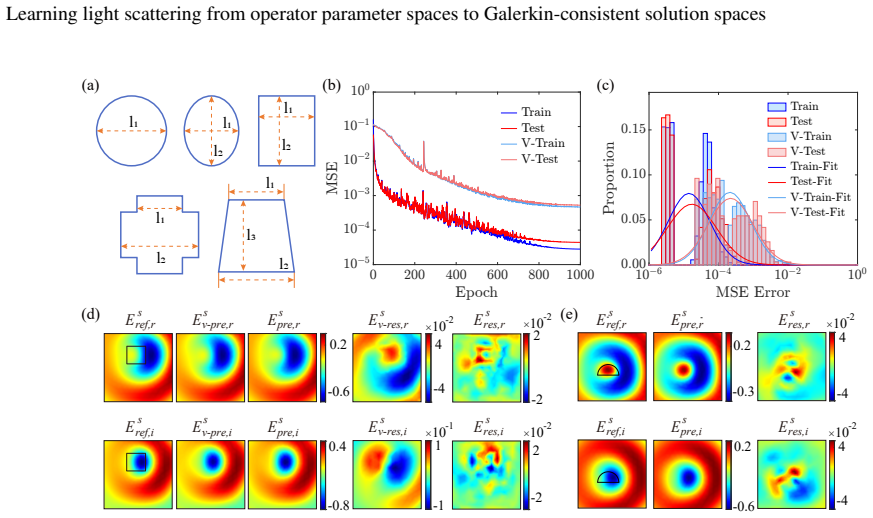
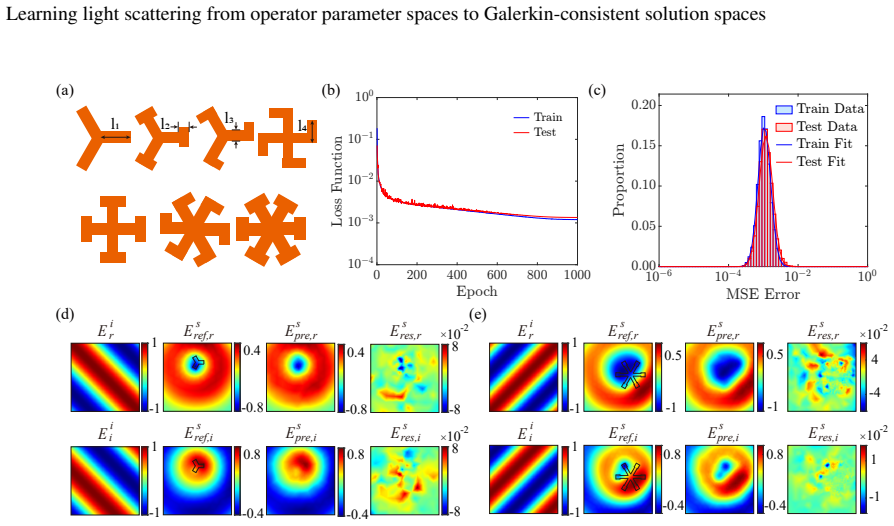
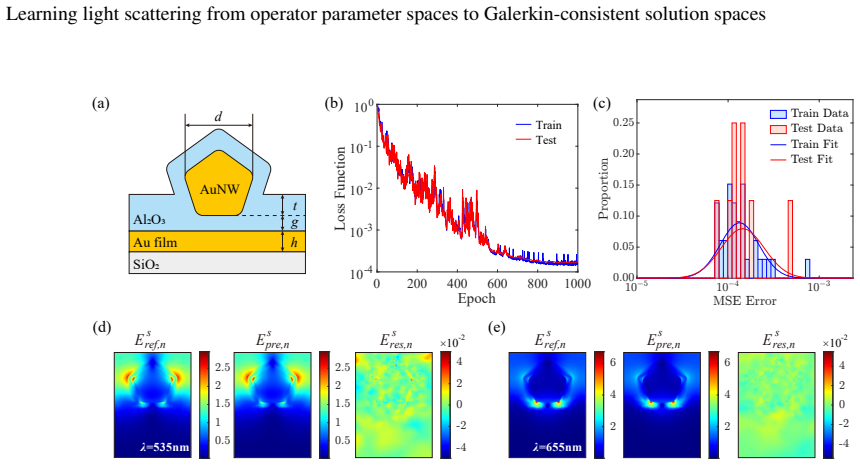
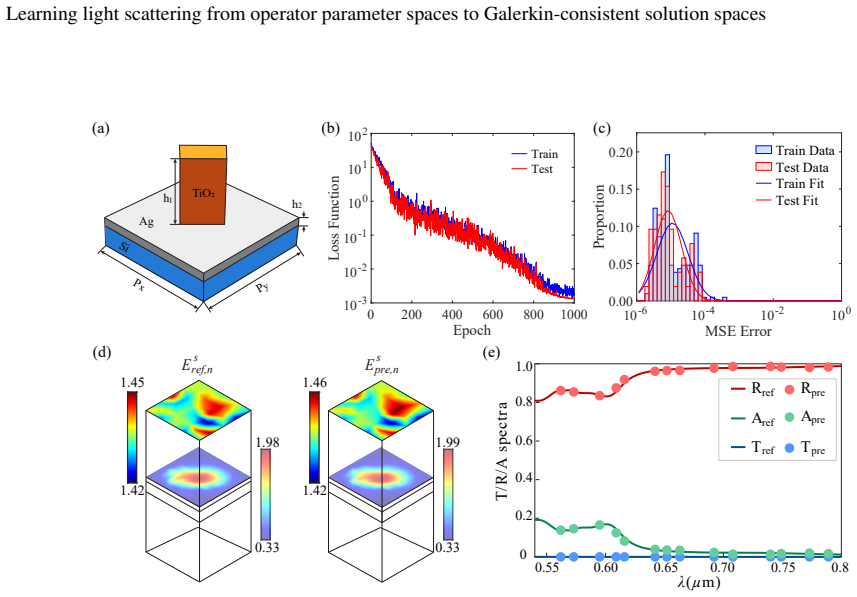
- The same framework achieves high accuracy on dielectric, metallic, arrayed, plasmonic, and fully three-dimensional nanophotonic structures.
- Generalization holds across the range of structures without retraining for each new geometry or material.
- The approach supplies a stable, physics-respecting forward model suitable for downstream inverse design tasks.
Where Pith is reading between the lines
- The same finite-element-constrained operator idea could be applied to other linear wave equations such as acoustic or elastic scattering without changing the core architecture.
- Because the stiffness matrices are assembled once, the method may combine naturally with existing finite-element libraries to produce hybrid simulation pipelines.
- If the operator parameter space is expanded to include fabrication tolerances, the model could directly output statistics over ensembles of manufactured devices.
- The separation between parameter space and solution space suggests a route to transfer learning: pre-train on simple dielectrics and fine-tune on plasmonic cases with far fewer samples.
Load-bearing premise
Predicting finite-element expansion coefficients instead of raw field values will automatically keep the learned solutions inside compatible trial and test spaces and produce stable training across all structure types.
What would settle it
A test case on a plasmonic or three-dimensional metallic scatterer in which the FEMONet coefficients produce a residual in the weak-form loss that grows with network depth or exceeds the residual obtained from a standard finite-element solver on the same mesh.
Figures



read the original abstract
Efficient and generalizable full-wave simulation is essential for nanophotonic analysis and inverse design, yet existing methods face a tradeoff between the high computational cost of numerical solvers and the limited generalizability of neural operator models for complex optical scattering. Here, we introduce FEMONet, a finite-element-constrained operator-learning framework that learns light scattering from an operator parameter space to a Galerkin-consistent solution space. The operator parameter space encodes the physical entities defining a wave-equation problem, while the variational weak form links this space to the coordinate and physical solution spaces. Integrated with operator-learning networks, FEMONet extends classical solvers from isolated problem instances to parameterized scattering operators. To our knowledge, FEMONet represents the first Galerkin-consistent operator-learning framework for complex-valued optical scattering, grounded in the variational weak form of the governing vector wave equations. Finite-element discretization absorbs spatial derivatives into assembled stiffness matrices and load vectors, removing coordinate-based derivatives of the neural-network output from the physics loss and improving training efficiency. By predicting finite-element expansion coefficients rather than unconstrained field values, the Galerkin-consistent formulation preserves compatible trial and test spaces, achieving high accuracy, stable training, and generalization across dielectric, metallic, arrayed, plasmonic, and three-dimensional nanophotonic structures.
Editorial analysis
A structured set of objections, weighed in public.
Referee Report
Summary. The manuscript introduces FEMONet, a finite-element-constrained operator-learning framework that maps an operator parameter space (encoding physical entities in wave-equation problems) to a Galerkin-consistent solution space of finite-element expansion coefficients for complex-valued optical scattering. It grounds the approach in the variational weak form of the governing vector wave equations, absorbs spatial derivatives into pre-assembled stiffness matrices and load vectors, and claims this yields high accuracy, stable training, and generalization across dielectric, metallic, arrayed, plasmonic, and 3D nanophotonic structures while being the first such Galerkin-consistent operator-learning method.
Significance. If the central claims hold with supporting evidence, the work could meaningfully advance parameterized full-wave nanophotonic simulation by bridging classical FEM variational solvers with neural operators, reducing the cost of repeated solves for families of scattering problems. The emphasis on preserving compatible trial/test spaces via coefficient prediction rather than pointwise fields is a potentially useful architectural choice, though its practical impact remains to be quantified.
major comments (2)
- [Abstract] Abstract: The claim that 'by predicting finite-element expansion coefficients rather than unconstrained field values, the Galerkin-consistent formulation preserves compatible trial and test spaces' is load-bearing for the central contribution. This preservation requires (i) the network output to lie exactly in the span of the chosen FE basis for every parameter instance and (ii) the physics loss to be formed exclusively from pre-assembled stiffness/load operators without additional coordinate derivatives or penalty terms. The abstract supplies no indication that either condition is enforced by architecture or loss design.
- [Abstract] Abstract: The assertions of 'high accuracy, stable training, and generalization across dielectric, metallic, arrayed, plasmonic, and three-dimensional nanophotonic structures' constitute the primary performance claims, yet the abstract (and the provided text) contains no quantitative error metrics, baselines, ablation studies, or cross-regime results. Without such evidence the soundness of the Galerkin-consistency advantage cannot be evaluated.
Simulated Author's Rebuttal
We thank the referee for the constructive comments. We address each major comment below and will revise the abstract to improve clarity on the Galerkin-consistent formulation and to include key quantitative highlights from the results.
read point-by-point responses
-
Referee: [Abstract] Abstract: The claim that 'by predicting finite-element expansion coefficients rather than unconstrained field values, the Galerkin-consistent formulation preserves compatible trial and test spaces' is load-bearing for the central contribution. This preservation requires (i) the network output to lie exactly in the span of the chosen FE basis for every parameter instance and (ii) the physics loss to be formed exclusively from pre-assembled stiffness/load operators without additional coordinate derivatives or penalty terms. The abstract supplies no indication that either condition is enforced by architecture or loss design.
Authors: We agree the abstract should more explicitly connect the design choices to enforcement of the conditions. The manuscript specifies that the network outputs finite-element expansion coefficients (ensuring outputs lie exactly in the chosen basis for every parameter instance) and that the physics loss is assembled exclusively from pre-computed stiffness matrices and load vectors (removing coordinate derivatives and penalty terms). We will revise the abstract to state these enforcement mechanisms directly. revision: yes
-
Referee: [Abstract] Abstract: The assertions of 'high accuracy, stable training, and generalization across dielectric, metallic, arrayed, plasmonic, and three-dimensional nanophotonic structures' constitute the primary performance claims, yet the abstract (and the provided text) contains no quantitative error metrics, baselines, ablation studies, or cross-regime results. Without such evidence the soundness of the Galerkin-consistency advantage cannot be evaluated.
Authors: Quantitative error metrics, baselines, ablation studies, and cross-regime results appear in the results section of the manuscript. To strengthen the abstract we will add concise representative metrics (e.g., relative L2 errors on test sets) and explicit mention of generalization across the listed structure classes while preserving abstract length. revision: yes
Circularity Check
No circularity: derivation rests on standard variational FEM without reduction to inputs
full rationale
The paper defines FEMONet by choosing to output finite-element expansion coefficients and to form the physics loss exclusively from pre-assembled stiffness/load operators. This choice directly inherits the Galerkin structure from the classical weak form; it does not derive any new result that is then fed back as a fitted parameter or self-defined quantity. No self-citation chain is load-bearing for the central claim, and the abstract provides no equations that equate a prediction to its own training target by construction. The framework is therefore self-contained against external benchmarks.
Axiom & Free-Parameter Ledger
axioms (1)
- domain assumption The variational weak form of the governing vector wave equations links the operator parameter space to the coordinate and physical solution spaces.
Reference graph
Works this paper leans on
-
[1]
John Wiley & Sons, 2015
Jian-Ming Jin.The finite element method in electromagnetics. John Wiley & Sons, 2015
2015
-
[2]
Finite-difference time-domain methods.Nature Reviews Methods Primers, 3(1):75, 2023
FL Teixeira, C Sarris, Y Zhang, D-Y Na, J-P Berenger, Y Su, M Okoniewski, WC Chew, V Backman, and Jamesina J Simpson. Finite-difference time-domain methods.Nature Reviews Methods Primers, 3(1):75, 2023
2023
-
[3]
Artech House, 2009
Giuseppe Pelosi, Roberto Coccioli, and Stefano Selleri.Quick finite elements for electromagnetic waves. Artech House, 2009
2009
-
[4]
Wiley-IEEE Press, 1993
Roger F Harrington.Field computation by moment methods. Wiley-IEEE Press, 1993
1993
-
[5]
Springer, 2007
Stefan A Maier et al.Plasmonics: fundamentals and applications, volume 1. Springer, 2007
2007
-
[6]
Modes and mode volumes of leaky optical cavities and plasmonic nanoresonators.ACS Photonics, 1(1):2–10, 2014
Philip Trøst Kristensen and Stephen Hughes. Modes and mode volumes of leaky optical cavities and plasmonic nanoresonators.ACS Photonics, 1(1):2–10, 2014
2014
-
[7]
Theory of the spontaneous optical emission of nanosize photonic and plasmon resonators.Physical Review Letters, 2013
P Lalanne. Theory of the spontaneous optical emission of nanosize photonic and plasmon resonators.Physical Review Letters, 2013
2013
-
[8]
Light propagation with phase discontinuities: generalized laws of reflection and refraction.science, 334(6054):333–337, 2011
Nanfang Yu, Patrice Genevet, Mikhail A Kats, Francesco Aieta, Jean-Philippe Tetienne, Federico Capasso, and Zeno Gaburro. Light propagation with phase discontinuities: generalized laws of reflection and refraction.science, 334(6054):333–337, 2011
2011
-
[9]
Inverse design in nanophotonics.Nature photonics, 12(11):659–670, 2018
Sean Molesky, Zin Lin, Alexander Y Piggott, Weiliang Jin, Jelena Vuckovi´c, and Alejandro W Rodriguez. Inverse design in nanophotonics.Nature photonics, 12(11):659–670, 2018
2018
-
[10]
Deep neural networks for the evaluation and design of photonic devices.Nature Reviews Materials, 6(8):679–700, 2021
Jiaqi Jiang, Mingkun Chen, and Jonathan A Fan. Deep neural networks for the evaluation and design of photonic devices.Nature Reviews Materials, 6(8):679–700, 2021
2021
-
[11]
Maziar Raissi, Paris Perdikaris, and George E Karniadakis. Physics-informed neural networks: A deep learning framework for solving forward and inverse problems involving nonlinear partial differential equations.Journal of Computational physics, 378:686–707, 2019
2019
-
[12]
Physics-informed neural networks for inverse problems in nano-optics and metamaterials.Optics express, 28(8):11618–11633, 2020
Yuyao Chen, Lu Lu, George Em Karniadakis, and Luca Dal Negro. Physics-informed neural networks for inverse problems in nano-optics and metamaterials.Optics express, 28(8):11618–11633, 2020
2020
-
[13]
Maxwellnet: Physics-driven deep neural network training based on maxwell’s equations.Apl Photonics, 7(1), 2022
Joowon Lim and Demetri Psaltis. Maxwellnet: Physics-driven deep neural network training based on maxwell’s equations.Apl Photonics, 7(1), 2022
2022
-
[14]
arXiv preprint arXiv:1912.00873 , year=
Ehsan Kharazmi, Zhongqiang Zhang, and George Em Karniadakis. Variational physics-informed neural networks for solving partial differential equations.arXiv preprint arXiv:1912.00873, 2019
-
[15]
hp-vpinns: Variational physics-informed neural networks with domain decomposition.Computer Methods in Applied Mechanics and Engineering, 374:113547, 2021
Ehsan Kharazmi, Zhongqiang Zhang, and George Em Karniadakis. hp-vpinns: Variational physics-informed neural networks with domain decomposition.Computer Methods in Applied Mechanics and Engineering, 374:113547, 2021
2021
-
[16]
Learning nonlinear operators via deeponet based on the universal approximation theorem of operators.Nature machine intelligence, 3(3):218–229, 2021
Lu Lu, Pengzhan Jin, Guofei Pang, Zhongqiang Zhang, and George Em Karniadakis. Learning nonlinear operators via deeponet based on the universal approximation theorem of operators.Nature machine intelligence, 3(3):218–229, 2021
2021
-
[17]
Learning the solution operator of parametric partial differential equations with physics-informed deeponets.Science advances, 7(40):eabi8605, 2021
Sifan Wang, Hanwen Wang, and Paris Perdikaris. Learning the solution operator of parametric partial differential equations with physics-informed deeponets.Science advances, 7(40):eabi8605, 2021
2021
-
[18]
Fourier Neural Operator for Parametric Partial Differential Equations
Zongyi Li, Nikola Kovachki, Kamyar Azizzadenesheli, Burigede Liu, Kaushik Bhattacharya, Andrew Stuart, and Anima Anandkumar. Fourier neural operator for parametric partial differential equations.arXiv preprint arXiv:2010.08895, 2020
work page internal anchor Pith review Pith/arXiv arXiv 2010
-
[19]
Understanding and mitigating gradient flow pathologies in physics-informed neural networks.SIAM Journal on Scientific Computing, 43(5):A3055–A3081, 2021
Sifan Wang, Yujun Teng, and Paris Perdikaris. Understanding and mitigating gradient flow pathologies in physics-informed neural networks.SIAM Journal on Scientific Computing, 43(5):A3055–A3081, 2021
2021
-
[20]
When and why pinns fail to train: A neural tangent kernel perspective.Journal of Computational Physics, 449:110768, 2022
Sifan Wang, Xinling Yu, and Paris Perdikaris. When and why pinns fail to train: A neural tangent kernel perspective.Journal of Computational Physics, 449:110768, 2022
2022
-
[21]
Deep learning for the design of photonic structures.Nature photonics, 15(2):77–90, 2021
Wei Ma, Zhaocheng Liu, Zhaxylyk A Kudyshev, Alexandra Boltasseva, Wenshan Cai, and Yongmin Liu. Deep learning for the design of photonic structures.Nature photonics, 15(2):77–90, 2021
2021
-
[22]
Deep learning in nano-photonics: inverse design and beyond.Photonics research, 9(5):B182–B200, 2021
Peter R Wiecha, Arnaud Arbouet, Christian Girard, and Otto L Muskens. Deep learning in nano-photonics: inverse design and beyond.Photonics research, 9(5):B182–B200, 2021
2021
-
[23]
Neural operator: Learning maps between function spaces with applications to pdes.Journal of Machine Learning Research, 24(89):1–97, 2023
Nikola Kovachki, Zongyi Li, Burigede Liu, Kamyar Azizzadenesheli, Kaushik Bhattacharya, Andrew Stuart, and Anima Anandkumar. Neural operator: Learning maps between function spaces with applications to pdes.Journal of Machine Learning Research, 24(89):1–97, 2023. 25 Learning light scattering from operator parameter spaces to Galerkin-consistent solution spaces
2023
-
[24]
Machine prediction of topological transitions in photonic crystals.Physical Review Applied, 14(4):044032, 2020
Bei Wu, Kun Ding, Che Ting Chan, and Yuntian Chen. Machine prediction of topological transitions in photonic crystals.Physical Review Applied, 14(4):044032, 2020
2020
-
[25]
Springer, 2004
Alexandre Ern and Jean-Luc Guermond.Theory and practice of finite elements, volume 159. Springer, 2004
2004
-
[26]
Springer, 2013
Daniele Boffi, Franco Brezzi, Michel Fortin, et al.Mixed finite element methods and applications, volume 44. Springer, 2013
2013
-
[27]
The inf–sup condition and its evaluation for mixed finite element methods.Computers & structures, 79(2):243–252, 2001
Klaus-Jürgen Bathe. The inf–sup condition and its evaluation for mixed finite element methods.Computers & structures, 79(2):243–252, 2001
2001
-
[28]
Robust variational physics-informed neural networks.Computer Methods in Applied Mechanics and Engineering, 425:116904, 2024
Sergio Rojas, Paweł Maczuga, Judit Muñoz-Matute, David Pardo, and Maciej Paszy ´nski. Robust variational physics-informed neural networks.Computer Methods in Applied Mechanics and Engineering, 425:116904, 2024
2024
-
[29]
Temperature-dependent dark-field scattering of single plasmonic nanocavity.Nanophotonics, 9(10):3347–3356, 2020
Wei Jiang, Huatian Hu, Qian Deng, Shunping Zhang, and Hongxing Xu. Temperature-dependent dark-field scattering of single plasmonic nanocavity.Nanophotonics, 9(10):3347–3356, 2020
2020
-
[30]
Surface plasmon polariton–enhanced upconversion luminescence for biosensing applications.Nanophotonics, 13(21):3995–4006, 2024
Duc Le, Marjut Kreivi, Sanna Aikio, Noora Heinilehto, Teemu Sipola, Jarno Petäjä, Tian-Long Guo, Matthieu Roussey, and Jussi Hiltunen. Surface plasmon polariton–enhanced upconversion luminescence for biosensing applications.Nanophotonics, 13(21):3995–4006, 2024
2024
-
[31]
Visible light focusing flat lenses based on hybrid dielectric-metal metasurface reflector-arrays.Scientific reports, 7(1):45044, 2017
Qingbin Fan, Pengcheng Huo, Daopeng Wang, Yuzhang Liang, Feng Yan, and Ting Xu. Visible light focusing flat lenses based on hybrid dielectric-metal metasurface reflector-arrays.Scientific reports, 7(1):45044, 2017
2017
-
[32]
A high-efficient hybrid physics-informed neural networks based on convolutional neural network
Zhiwei Fang. A high-efficient hybrid physics-informed neural networks based on convolutional neural network. IEEE Transactions on Neural Networks and Learning Systems, 33(10):5514–5526, 2021
2021
-
[33]
An algorithm for the machine calculation of complex fourier series
James W Cooley and John W Tukey. An algorithm for the machine calculation of complex fourier series. Mathematics of computation, 19(90):297–301, 1965
1965
-
[34]
Fourier features let networks learn high frequency functions in low dimensional domains.Advances in neural information processing systems, 33:7537–7547, 2020
Matthew Tancik, Pratul Srinivasan, Ben Mildenhall, Sara Fridovich-Keil, Nithin Raghavan, Utkarsh Singhal, Ravi Ramamoorthi, Jonathan Barron, and Ren Ng. Fourier features let networks learn high frequency functions in low dimensional domains.Advances in neural information processing systems, 33:7537–7547, 2020
2020
-
[35]
Gradient-based learning applied to document recognition.Proceedings of the IEEE, 86(11):2278–2324, 1998
Yann LeCun, Léon Bottou, Yoshua Bengio, and Patrick Haffner. Gradient-based learning applied to document recognition.Proceedings of the IEEE, 86(11):2278–2324, 1998
1998
-
[36]
Deep residual learning for image recognition
Kaiming He, Xiangyu Zhang, Shaoqing Ren, and Jian Sun. Deep residual learning for image recognition. In Proceedings of the IEEE conference on computer vision and pattern recognition, pages 770–778, 2016
2016
-
[37]
Learning spatiotemporal features with 3d convolutional networks
Du Tran, Lubomir Bourdev, Rob Fergus, Lorenzo Torresani, and Manohar Paluri. Learning spatiotemporal features with 3d convolutional networks. InProceedings of the IEEE international conference on computer vision, pages 4489–4497, 2015
2015
-
[38]
Language modeling with gated convolutional networks
Yann N Dauphin, Angela Fan, Michael Auli, and David Grangier. Language modeling with gated convolutional networks. InInternational conference on machine learning, pages 933–941. PMLR, 2017
2017
-
[39]
Pay attention to mlps.Advances in neural information processing systems, 34:9204–9215, 2021
Hanxiao Liu, Zihang Dai, David So, and Quoc V Le. Pay attention to mlps.Advances in neural information processing systems, 34:9204–9215, 2021
2021
-
[40]
Femonet: Robust and universal operator learning for optical scattering problem via mionet
Lida Liu. Femonet: Robust and universal operator learning for optical scattering problem via mionet. https://github.com/HUST-CPO/FEMONet-Robust-and-universal-Operator-learning-for-optical-scattering- problem-via-MIONet, 2026
2026
-
[41]
The deep ritz method: A deep learning-based numerical algorithm for solving variational problems
Yu B EW. The deep ritz method: A deep learning-based numerical algorithm for solving variational problems. Commun Math Stat, 6(1):1–12, 2018
2018
-
[42]
Shahed Rezaei, Reza Najian Asl, Shirko Faroughi, Mahdi Asgharzadeh, Ali Harandi, Rasoul Najafi Koopas, Gottfried Laschet, Stefanie Reese, and Markus Apel. A finite operator learning technique for mapping the elastic properties of microstructures to their mechanical deformations.International Journal for Numerical Methods in Engineering, 126(1):e7637, 2025
2025
-
[43]
Scattering activities bounded by reciprocity and parity conservation.Physical Review Research, 2(1):013277, 2020
Weijin Chen, Qingdong Yang, Yuntian Chen, and Wei Liu. Scattering activities bounded by reciprocity and parity conservation.Physical Review Research, 2(1):013277, 2020
2020
-
[44]
Arbitrary polarization-independent backscattering or reflection by rotationally symmetric reciprocal structures.Physical Review B, 103(4):045422, 2021
Weijin Chen, Qingdong Yang, Yuntian Chen, and Wei Liu. Arbitrary polarization-independent backscattering or reflection by rotationally symmetric reciprocal structures.Physical Review B, 103(4):045422, 2021. 26
2021
discussion (0)
Sign in with ORCID, Apple, or X to comment. Anyone can read and Pith papers without signing in.