REVIEW 3 major objections 5 minor 61 references
Occlusion-Aware Temporally Consistent Amodal Completion for 3D Human-Object Interaction Reconstruction
T0 review · 3 major / 5 minor · reviewed 2026-08-06 · deepseek-v4-flash
Pith's one-line read This paper claims that temporally consistent amodal completion, driven by optical-flow-warped neighboring latents and template-free occlusion masks, lets monocular video of human–object interaction be reconstructed and animated in 3D.
desk verdict Temporal amodal completion is a plausible incremental contribution, but the 3D reconstruction claim rests on oracle masks and poses, so the paper oversells its end-to-end result. read the letter →
The pith
A machine-rendered reading of the paper's core claim, the machinery that carries it, and where it could break.
The reading
What carries the argument
The load-bearing mechanism is the pair of temporal modules: Bidirectional Temporal Feature Warping, which uses an off-the-shelf optical-flow network to align latent features from frames $t-n$ through $t+n$ (with $n = 7$) into frame $t$'s coordinate space, and Temporal Fusion Attention, which treats the current frame's latent as the query and the warped neighbors as keys and values in scaled dot-product attention. The machinery converts a per-frame inpainting problem into one where the diffusion model is told, in latent space, what the neighboring frames saw behind the occluder. The template-free occlusion identification supports this by supplying the mask $M_{\mathrm{occlusion}} = (M_{\mathrm{visible}} \cup \mathrm{ConcaveHull}(\pi(\mathcal{C}))) \cap M_{\mathrm{occluder}}$, where $\mathcal{C}$ is the 2D projection of the inferred 3D point cloud.
What would settle it
A reader could take a BEHAVE sequence with known ground-truth meshes and compare the predicted occlusion mask to the true occluded region computed from the meshes; if the mask IoU is low for interactions with nonconvex objects or novel poses, the temporal inpainting can only fix what the mask reveals. The end-to-end claim would also be tested by replacing the provided 6-DoF object poses used in object 3DGS training with the pipeline's own predictions.
Extended reading notes
Core claim
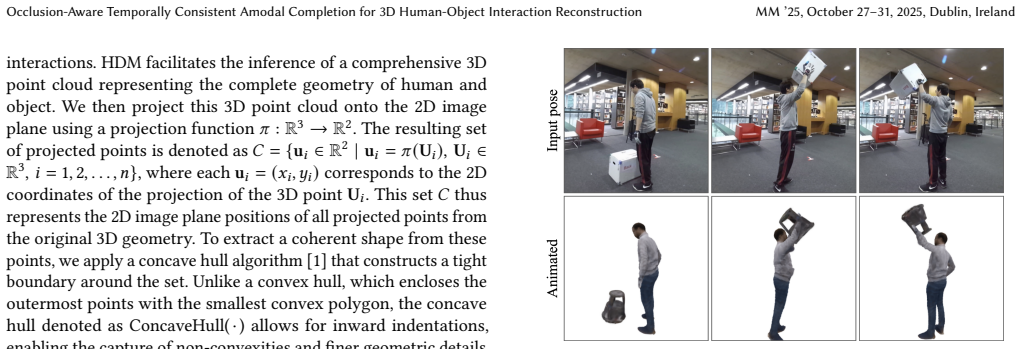
The paper argues that the missing piece in occlusion-heavy human-object reconstruction is temporal context, not better single-frame inpainting. Its pipeline encodes each frame with a diffusion VAE, warps the encoded features of up to fourteen neighboring frames into the current frame using optical flow, and lets the current latent attend over those warped neighbors so the inpainting model sees what the occluder hid. Occlusion masks come from projecting a template-free 3D point cloud of the interaction onto the image, forming a concave hull, and intersecting that union of visible and projected masks with the occluder's SAM2 mask. With these inputs, a Stable Diffusion inpainting pass fills the occluded regions, and the temporally coherent output frames supervise 3DGS object and human models. The authors report consistent superiority on IoU and CLIP for completion, lower warping error for temporal consistency, and higher masked PSNR, SSIM, and LPIPS for reconstruction.
Load-bearing premise
The whole pipeline rests on the assumption that a 3D model of the interaction, estimated from still images, projects onto the video frames in a way that pinpoints exactly which pixels are occluded; the paper itself allows that this estimate can be wrong for parts it has never seen.
Editorial extensions
If this is right
- If correct, monocular RGB video is a sufficient input for photo-realistic, animatable HOI reconstruction, removing the need for multi-view rigs or full visibility.
- Temporally consistent inpainting raises the appearance-supervision quality for 3DGS enough that masked PSNR, SSIM, and LPIPS improve over no-completion and frame-wise inpainting baselines.
- Larger temporal windows ($n=7$) improve both completion and consistency, implying that aggregating many frames pays off when motion is complex.
- Template-free mask identification outperforms fixed human-mask masking, so occlusion localization should be derived from 3D projection rather than predefined templates.
- The method's gains on both BEHAVE and InterCap suggest the pipeline transfers across datasets, human subjects, and object categories.
Reading between the lines
- The paper's 'first approach' claim is about the full pipeline, but the paper's own supplementary section C.3 says object 3DGS training uses provided masks aligned with 6-DoF poses rather than predicted masks; a fully automatic monocular pipeline therefore remains to be demonstrated.
- The temporal fusion mechanism is not HOI-specific: it could be lifted to any video inpainting or novel-view task where occlusion masks are available, so its value could be isolated in a controlled synthetic benchmark.
- The 15–70% occlusion filter means the method was not tested on near-total occlusion, where the geometry estimate and the diffusion prior would both be stressed.
- A testable extension is to replace the static-image HDM projection with a video-level segmentation or tracking of the occludee, which might reduce mask errors that the ablation table's human-mask baseline already hints at.
Editorial analysis
A structured set of objections, weighed in public.
Referee Report
Summary. The paper proposes a pipeline for temporally consistent amodal completion of occluded human-object interactions in monocular video. It combines bidirectional optical-flow warping and cross-frame attention over VAE latents, a template-free occlusion mask obtained by projecting HDM 3D point clouds and intersecting them with SAM2 occluder masks, and Stable Diffusion inpainting conditioned on the fused latent. The completed frames are then used to train 3D Gaussian Splatting models (GaussianAvatar for humans and a GS-Pose-style object model) for animatable reconstruction. Experiments on BEHAVE and InterCap report amodal completion IoU/CLIP, temporal-consistency metrics, and 3D reconstruction PSNR/SSIM/LPIPS. The central claims are consistent superiority over existing baselines and the first animatable, photo-realistic 3D HOI reconstruction from monocular video.
Significance. If the full pipeline worked end-to-end, it would be a valuable zero-shot alternative to trained video inpainting for HOI: the amodal-completion stage is training-free and built from off-the-shelf optical flow, segmentation, HDM, and Stable Diffusion, and the application to 3D Gaussian Splatting is timely. The paper is transparent about several limitations and includes ablations for the temporal and masking components. However, the evidence is not yet fully aligned with the strongest claims: the quantitative advantage over Stable Diffusion inpainting is marginal on BEHAVE, and the 3D object reconstruction uses oracle masks and poses, so the end-to-end monocular reconstruction claim is not established by the reported experiments.
major comments (3)
- [Section 3.6, Supplementary C.3, Table 2] The 3D reconstruction experiment does not validate the full pipeline end-to-end. Supplementary C.3 states that for object reconstruction 'we use the provided object masks aligned with 6-DoF object poses instead of our predicted masks for object reconstruction.' This bypasses the proposed template-free occlusion identification of Section 3.4 and prevents Eq. (12) from being supervised by the pipeline's own masks. Table 2 therefore supports only the weaker claim that a 3DGS model trained with oracle object masks and poses can render textures from amodally completed frames. Because the first-contribution bullet in Section 1 is precisely the end-to-end monocular HOI reconstruction claim, this is load-bearing. I request either an additional experiment in which object 3DGS training uses the predicted masks (or otherwise propagates predicted mask errors), or a substantive revision of the claimed contribution to state that object masks and 6-DoF poses are assumed available.
- [Section 4.3, Table 1, Section 4.1] The phrase 'consistently superior performance' overstates the results in Table 1. On BEHAVE, the IoU gain over SD Inpainting is 61.75% versus 60.81% and the CLIP score is essentially tied (27.64 versus 27.63); on InterCap the CLIP gain is modest (27.65 versus 27.23). LaMa has a higher TC score on both datasets than the proposed method, although it performs worse on IoU. In addition, the evaluation is restricted to frames with occlusion ratios between 15% and 70%, and several objects are excluded for various reasons. No error bars, per-sequence breakdowns, or significance tests are reported. I ask the authors to temper the wording and to provide per-sequence statistics or significance tests so the reader can judge whether the advantage is consistent or driven by a subset of the data.
- [Section 3.4, Section 5, Table 4] The template-free occlusion identification claim is not yet robustly supported. The method depends on HDM's inferred 3D geometry, and Section 5 concedes that HDM 'may not always accurately infer the geometry of unseen parts.' Table 4 compares the proposed mask only against a predefined human-mask baseline; it does not quantify the accuracy of the HDM-based projected mask or the sensitivity of the amodal completion result to mask errors. Reporting mask IoU/recall against held-out occluded ground truth, or a sensitivity analysis that perturbs the proposed occlusion mask, would directly test the load-bearing assumption that the concave-hull projection of HDM point clouds localizes occluded pixels accurately enough for amodal completion.
minor comments (5)
- [Eq. (1), Section 3.1] The notation F_{s→e} is not defined; please clarify the meaning of s and e or replace it with standard denoising time-step notation.
- [Section 3.3] Please clarify whether the Temporal Fusion Attention mechanism contains any learned parameters. The equations describe a fixed scaled dot-product attention over pretrained VAE latents; if no parameters are learned, the text should say so explicitly.
- [Section 4.2, Supplementary D] For reproducibility, the exact text prompts used for inpainting and for the CLIP score should be listed for each object category; the paper only refers to 'a corresponding text prompt P.'
- [Supplementary D, 3D reconstruction] The sentence 'Since our method reconstructs only the object or the human the background' is missing a word; it should read '...the human, excluding the background.'
- [References [27], Section 3.6] The text cites 'GS-Pose' but the reference title is 'GS2Pose: Two-stage 6D Object Pose Estimation Guided by Gaussian Splatting.' Please make the naming consistent.
Circularity Check
No circular derivation: core amodal completion is externally validated against held-out ground truth; the 3D reconstruction claim is weakened by oracle object masks and poses, but this is an attribution gap rather than a circular step.
full rationale
The derivation chain is not circular. The amodal completion and temporal consistency claims are self-contained: BTF warping uses external SEA-RAFT optical flow (Eqs. 3-4), Temporal Fusion Attention is ordinary cross-attention (Eqs. 5-6), occlusion masks are formed by projecting external HDM point clouds and intersecting with SAM2 masks (Eqs. 7-9), and inpainting uses Stable Diffusion (Eq. 11). All are evaluated against held-out ground-truth masks and frames on BEHAVE/InterCap (Table 1); no fitted parameter is renamed as a prediction (n=7 and lambda=0.2 are fixed hyperparameters chosen by ablation). HDM, SAM2, SEA-RAFT, and Stable Diffusion are external tools, and the cited self-works (e.g., [5]) are not load-bearing. The only material gap is Supplementary C.3: 'we use the provided object masks aligend with 6-DoF object poses instead of our predicted masks for object reconstruction.' Therefore Table 2's 'Ours' validates an oracle-conditioned 3DGS trained on inpainted textures rather than the complete proposed pipeline, and the Section 1 claim of 'the first approach to reconstruct photo-realistic and animatable 3D human-object interactions from monocular videos' is stronger than what is demonstrated. Section 5's admission that HDM 'may not always accurately infer the geometry of unseen parts' is a robustness caveat, not a circular step. This is an evaluation/attribution overclaim, not a circularity: the 3D reconstruction metrics are independent of the predicted masks and do not reduce by construction to the method's own inputs.
Assumptions & free parameters
free parameters (5)
- Temporal support window n =
7
- Diffusion guidance scale =
6.0
- Photometric loss balance lambda =
0.2
- Occlusion ratio inclusion range =
15%-70%
- Evaluation crop margin scale =
1.2
assumptions (6)
- domain assumption Optical flow between frames can be bilinearly scaled and used to warp VAE latent features into alignment in latent space.
- domain assumption HDM reconstructs accurate full 3D geometry of human and object from monocular RGB for mask generation.
- domain assumption Stable Diffusion inpainting, given the mask and temporally fused latent, produces semantically and geometrically plausible occluded appearance.
- domain assumption Each input video contains exactly one human and one object.
- domain assumption Provided BEHAVE object masks and 6-DoF object and camera poses are accurate enough to supervise 3DGS training.
- domain assumption SAM2 segmentation of inpainted frames yields valid amodal masks for IoU evaluation.
Cite this review
Pith. "Pith review of Occlusion-Aware Temporally Consistent Amodal Completion for 3D Human-Object Interaction Reconstruction." pith.science (2026). https://pith.science/paper/CA26DKWX
@misc{pith2026250708137,
  author       = {Pith},
  title        = {Pith review of: Occlusion-Aware Temporally Consistent Amodal Completion for 3D Human-Object Interaction Reconstruction},
  year         = {2026},
  howpublished = {\url{https://pith.science/paper/CA26DKWX}},
  note         = {Machine review of arXiv:2507.08137}
}
read the original abstract
We introduce a novel framework for reconstructing dynamic human-object interactions from monocular video that overcomes challenges associated with occlusions and temporal inconsistencies. Traditional 3D reconstruction methods typically assume static objects or full visibility of dynamic subjects, leading to degraded performance when these assumptions are violated-particularly in scenarios where mutual occlusions occur. To address this, our framework leverages amodal completion to infer the complete structure of partially obscured regions. Unlike conventional approaches that operate on individual frames, our method integrates temporal context, enforcing coherence across video sequences to incrementally refine and stabilize reconstructions. This template-free strategy adapts to varying conditions without relying on predefined models, significantly enhancing the recovery of intricate details in dynamic scenes. We validate our approach using 3D Gaussian Splatting on challenging monocular videos, demonstrating superior precision in handling occlusions and maintaining temporal stability compared to existing techniques.
Figures


Figures from the paper (6 more)


Reference graph
Works this paper leans on
-
[1]
K. Bellock. [n. d.]. alphashape. https://github.com/bellockk/alphashape. GitHub repository, accessed 2025-04-11
work page 2025
-
[2]
Bharat Lal Bhatnagar, Xianghui Xie, Ilya A Petrov, Cristian Sminchisescu, Chris- tian Theobalt, and Gerard Pons-Moll. 2022. Behave: Dataset and method for tracking human object interactions. InProceedings of the IEEE/CVF Conference on Computer Vision and Pattern Recognition. 15935–15946
work page 2022
-
[3]
A. Chen, B. Smith, and C. Lee. 2023. Amodal 3D Shape from Partial Views. In Proceedings of the IEEE/CVF International Conference on Computer Vision (ICCV). 4567–4576
work page 2023
-
[4]
Seunggeun Chi, Hyung-gun Chi, Hengbo Ma, Nakul Agarwal, Faizan Siddiqui, Karthik Ramani, and Kwonjoon Lee. 2024. M2d2m: Multi-motion generation from text with discrete diffusion models. InEuropean conference on computer vision. Springer, 18–36
work page 2024
-
[5]
Seunggeun Chi, Enna Sachdeva, Pin-Hao Huang, and Kwonjoon Lee. 2025. Contact-Aware Amodal Completion for Human-Object Interaction via Multi- Regional Inpainting. arXiv:2508.00427 [cs.CV] https://arxiv.org/abs/2508.00427
arXiv 2025
-
[6]
Yuren Cong, Mengmeng Xu, Christian Simon, Shoufa Chen, Jiawei Ren, Yanping Xie, Juan-Manuel Perez-Rua, Bodo Rosenhahn, Tao Xiang, and Sen He. 2023. Flatten: optical flow-guided attention for consistent text-to-video editing.arXiv preprint arXiv:2310.05922(2023)
arXiv 2023
-
[7]
Patrick Esser, Johnathan Chiu, Parmida Atighehchian, Jonathan Granskog, and Anastasis Germanidis. 2023. Structure and content-guided video synthesis with diffusion models. InProceedings of the IEEE/CVF international conference on com- puter vision. 7346–7356
work page 2023
-
[8]
Yang Fu, Sifei Liu, Amey Kulkarni, Jan Kautz, Alexei A. Efros, and Xiaolong Wang. 2024. COLMAP-Free 3D Gaussian Splatting. InProceedings of the IEEE/CVF Conference on Computer Vision and Pattern Recognition (CVPR). 20796–20805
work page 2024
Show all 61 references
-
[9]
Michal Geyer, Omer Bar-Tal, Shai Bagon, and Tali Dekel. 2023. Tokenflow: Consis- tent diffusion features for consistent video editing.arXiv preprint arXiv:2307.10373 (2023)
2023 arXiv
-
[10]
Liangxiao Hu, Hongwen Zhang, Yuxiang Zhang, Boyao Zhou, Boning Liu, Sheng- ping Zhang, and Liqiang Nie. 2024. Gaussianavatar: Towards realistic human avatar modeling from a single video via animatable 3d gaussians. InProceedings of the IEEE/CVF conference on computer vision an...
2024
-
[11]
Yinghao Huang, Omid Taheri, Michael J Black, and Dimitrios Tzionas. 2022. InterCap: Joint markerless 3D tracking of humans and objects in interaction. In DAGM German Conference on Pattern Recognition. Springer, 281–299
2022
-
[12]
Yinghao Huang, Omid Taheri, Michael J Black, and Dimitrios Tzionas. 2024. InterCap: Joint Markerless 3D Tracking of Humans and Objects in Interaction from Multi-view RGB-D Images.International Journal of Computer Vision(2024), 1–16
2024
-
[13]
Ajay Jain, Matthew Tancik, and Pieter Abbeel. 2021. Putting nerf on a diet: Semantically consistent few-shot view synthesis. InProceedings of the IEEE/CVF International Conference on Computer Vision. 5885–5894
2021
-
[14]
Jisoo Jeong, Jamie Menjay Lin, Fatih Porikli, and Nojun Kwak. 2022. Imposing consistency for optical flow estimation. InProceedings of the IEEE/CVF conference on Computer Vision and Pattern Recognition. 3181–3191
2022
-
[15]
Wei Jiang, Kwang Moo Yi, Golnoosh Samei, Oncel Tuzel, and Anurag Ranjan
-
[16]
Bernhard Kerbl, Georgios Kopanas, Thomas Leimkühler, and George Drettakis
-
[17]
M. Kim, J. Park, and K. Lee. 2023. Monocular Differentiable Rendering for Self-Supervised 3D Amodal Masks. InProceedings of the IEEE/CVF International Conference on Computer Vision (ICCV). 789–798
2023
-
[18]
Diederik P Kingma, Max Welling, et al. 2013. Auto-encoding variational bayes
2013
-
[19]
Muhammed Kocabas, Jen-Hao Rick Chang, James Gabriel, Oncel Tuzel, and Anurag Ranjan. 2024. Hugs: Human gaussian splats. InProceedings of the IEEE/CVF conference on computer vision and pattern recognition. 505–515
2024
-
[20]
Wei-Sheng Lai, Jia-Bin Huang, Oliver Wang, Eli Shechtman, Ersin Yumer, and Ming-Hsuan Yang. 2018. Learning blind video temporal consistency. InProceed- ings of the European conference on computer vision (ECCV). 170–185
2018
-
[21]
Dong In Lee, Hyeongcheol Park, Jiyoung Seo, Eunbyung Park, Hyunje Park, Ha Dam Baek, Sangheon Shin, Sangmin Kim, and Sangpil Kim. 2025. Editsplat: Multi-view fusion and attention-guided optimization for view-consistent 3d scene editing with 3d gaussian splatting. InProceedings...
2025
-
[22]
Inhee Lee, Byungjun Kim, and Hanbyul Joo. 2024. Guess the unseen: Dynamic 3d scene reconstruction from partial 2d glimpses. InProceedings of the IEEE/CVF conference on computer vision and pattern recognition. 1062–1071
2024
-
[23]
P. Li, Q. Zhang, and R. Others. 2022. Compositional Models for Amodal Layout Completion. InProceedings of the IEEE/CVF Conference on Computer Vision and Pattern Recognition (CVPR). 2345–2354
2022
-
[24]
Jiaqi Lin, Zhihao Li, Xiao Tang, Jianzhuang Liu, Shiyong Liu, Jiayue Liu, Yangdi Lu, Xiaofei Wu, Songcen Xu, Youliang Yan, et al. 2024. Vastgaussian: Vast 3d gaussians for large scene reconstruction. InProceedings of the IEEE/CVF Conference on Computer Vision and Pattern Recog...
2024
-
[25]
Haoyu Lu, Guoxing Yang, Nanyi Fei, Yuqi Huo, Zhiwu Lu, Ping Luo, and Mingyu Ding. 2023. Vdt: General-purpose video diffusion transformers via mask modeling. arXiv preprint arXiv:2305.13311(2023)
2023 arXiv
-
[26]
Tao Lu, Mulin Yu, Linning Xu, Yuanbo Xiangli, Limin Wang, Dahua Lin, and Bo Dai. 2024. Scaffold-gs: Structured 3d gaussians for view-adaptive rendering. In Proceedings of the IEEE/CVF Conference on Computer Vision and Pattern Recognition. 20654–20664
2024
-
[27]
Jilan Mei, Junbo Li, and Cai Meng. 2024. GS2Pose: Tow-stage 6D Object Pose Estimation Guided by Gaussian Splatting.arXiv preprint arXiv:2411.03807(2024)
2024 arXiv
-
[28]
Ben Mildenhall, Pratul P Srinivasan, Matthew Tancik, Jonathan T Barron, Ravi Ramamoorthi, and Ren Ng. 2021. Nerf: Representing scenes as neural radiance fields for view synthesis.Commun. ACM65, 1 (2021), 99–106
2021
-
[29]
Michal Nazarczuk, Thomas Tanay, Sibi Catley-Chandar, Richard Shaw, Radu Timofte, and Eduardo Pérez-Pellitero. 2024. AIM 2024 sparse neural rendering challenge: Dataset and benchmark.arXiv preprint arXiv:2409.15041(2024)
2024 arXiv
-
[30]
Nguyen, T
H. Nguyen, T. Davis, and X. Xu. 2022. Learning Disentangled Shape-Texture for Amodal Completion. InAdvances in Neural Information Processing Systems (NeurIPS). 1–12
2022
-
[31]
Ege Ozguroglu, Ruoshi Liu, Dídac Surís, Dian Chen, Achal Dave, Pavel Tokmakov, and Carl Vondrick. 2024. pix2gestalt: Amodal segmentation by synthesizing wholes. In2024 IEEE/CVF Conference on Computer Vision and Pattern Recognition (CVPR). IEEE Computer Society, 3931–3940
2024
-
[32]
Ben Poole, Ajay Jain, Jonathan T Barron, and Ben Mildenhall. 2022. Dreamfusion: Text-to-3d using 2d diffusion.arXiv preprint arXiv:2209.14988(2022)
2022 arXiv
-
[33]
Alec Radford, Jong Wook Kim, Chris Hallacy, Aditya Ramesh, Gabriel Goh, Sandhini Agarwal, Girish Sastry, Amanda Askell, Pamela Mishkin, Jack Clark, et al. 2021. Learning transferable visual models from natural language supervision. InInternational conference on machine learnin...
2021
-
[34]
Nikhila Ravi, Valentin Gabeur, Yuan-Ting Hu, Ronghang Hu, Chaitanya Ryali, Tengyu Ma, Haitham Khedr, Roman Rädle, Chloe Rolland, Laura Gustafson, Eric Mintun, Junting Pan, Kalyan Vasudev Alwala, Nicolas Carion, Chao-Yuan Wu, Ross Girshick, Piotr Dollár, and Christoph Feichtenh...
2024 arXiv
-
[35]
Robin Rombach, Andreas Blattmann, Dominik Lorenz, Patrick Esser, and Björn Ommer. 2022. High-resolution image synthesis with latent diffusion models. In Proceedings of the IEEE/CVF conference on computer vision and pattern recognition. 10684–10695
2022
-
[36]
Chitwan Saharia, William Chan, Saurabh Saxena, Lala Li, Jay Whang, Emily L Denton, Kamyar Ghasemipour, Raphael Gontijo Lopes, Burcu Karagol Ayan, Tim Salimans, et al. 2022. Photorealistic text-to-image diffusion models with deep language understanding.Advances in neural inform...
2022
-
[37]
Johannes L Schonberger and Jan-Michael Frahm. 2016. Structure-from-motion revisited. InProceedings of the IEEE conference on computer vision and pattern recognition. 4104–4113. MM ’25, October 27–31, 2025, Dublin, Ireland Hyungjun Doh et al
2016
-
[38]
Jingyu Shi, Rahul Jain, Seunggeun Chi, Hyungjun Doh, Hyung-gun Chi, Alexan- der J Quinn, and Karthik Ramani. 2025. CARING-AI: Towards Authoring Context- aware Augmented Reality INstruction through Generative Artificial Intelligence. InProceedings of the 2025 CHI Conference on ...
2025
-
[39]
Adam Sun, Tiange Xiang, Scott Delp, Fei-Fei Li, and Ehsan Adeli. 2024. Occfusion: Rendering occluded humans with generative diffusion priors.Advances in Neural Information Processing Systems37 (2024), 92184–92209
2024
-
[40]
Cheng Sun, Min Sun, and Hwann-Tzong Chen. 2022. Direct voxel grid optimiza- tion: Super-fast convergence for radiance fields reconstruction. InProceedings of the IEEE/CVF conference on computer vision and pattern recognition. 5459–5469
2022
-
[41]
Roman Suvorov, Elizaveta Logacheva, Anton Mashikhin, Anastasia Remizova, Arsenii Ashukha, Aleksei Silvestrov, Naejin Kong, Harshith Goka, Kiwoong Park, and Victor Lempitsky. 2022. Resolution-robust large mask inpainting with fourier convolutions. InProceedings of the IEEE/CVF ...
2022
-
[42]
Teed and J
Z. Teed and J. Deng. 2020. RAFT: Recurrent All-Pairs Field Transforms for Optical Flow. InEuropean Conference on Computer Vision (ECCV). 402–419
2020
-
[43]
Yihan Wang, Lahav Lipson, and Jia Deng. 2024. Sea-raft: Simple, efficient, accurate raft for optical flow. InEuropean Conference on Computer Vision. Springer, 36–54
2024
-
[44]
Zhou Wang, Alan C Bovik, Hamid R Sheikh, and Eero P Simoncelli. 2004. Image quality assessment: from error visibility to structural similarity.IEEE transactions on image processing13, 4 (2004), 600–612
2004
-
[45]
J. Wu, Z. Yang, and H. Kim. 2022. Self-Supervised Amodal Reconstruction from Single Images. InEuropean Conference on Computer Vision (ECCV). 341–356
2022
-
[46]
Qianyang Wu, Ye Shi, Xiaoshui Huang, Jingyi Yu, Lan Xu, and Jingya Wang. 2024. Thor: Text to human-object interaction diffusion via relation intervention.arXiv preprint arXiv:2403.11208(2024)
2024 arXiv
-
[47]
Xianghui Xie, Bharat Lal Bhatnagar, Jan Eric Lenssen, and Gerard Pons-Moll
-
[48]
Katherine Xu, Lingzhi Zhang, and Jianbo Shi. 2024. Amodal completion via progressive mixed context diffusion. InProceedings of the IEEE/CVF Conference on Computer Vision and Pattern Recognition. 9099–9109
2024
-
[49]
Chen Yang, Sikuang Li, Jiemin Fang, Ruofan Liang, Lingxi Xie, Xiaopeng Zhang, Wei Shen, and Qi Tian. 2024. GaussianObject: High-Quality 3D Object Reconstruc- tion from Four Views with Gaussian Splatting.ACM Transactions on Graphics (TOG)43, 6 (2024), 1–13
2024
-
[50]
Shuai Yang, Yifan Zhou, Ziwei Liu, and Chen Change Loy. 2023. Rerender a video: Zero-shot text-guided video-to-video translation. InSIGGRAPH Asia 2023 Conference Papers. 1–11
2023
-
[51]
Richard Zhang, Phillip Isola, Alexei A Efros, Eli Shechtman, and Oliver Wang
-
[52]
Zhixing Zhang, Bichen Wu, Xiaoyan Wang, Yaqiao Luo, Luxin Zhang, Yinan Zhao, Peter Vajda, Dimitris Metaxas, and Licheng Yu. 2024. Avid: Any-length video inpainting with diffusion model. InProceedings of the IEEE/CVF Conference on Computer Vision and Pattern Recognition. 7162–7172
2024
-
[53]
Shangchen Zhou, Chongyi Li, Kelvin CK Chan, and Chen Change Loy. 2023. Propainter: Improving propagation and transformer for video inpainting. In Proceedings of the IEEE/CVF international conference on computer vision. 10477– 10486
2023
-
[54]
Shangchen Zhou, Peiqing Yang, Jianyi Wang, Yihang Luo, and Chen Change Loy
-
[55]
X. Zhou, Y. Li, Z. Wang, and T. Others. 2023. Amodal Instance Segmentation with Transformers. InProceedings of the IEEE/CVF Conference on Computer Vision and Pattern Recognition (CVPR). 1234–1243
2023
-
[56]
keyboard
Zehao Zhu, Zhiwen Fan, Yifan Jiang, and Zhangyang Wang. 2024. Fsgs: Real- time few-shot view synthesis using gaussian splatting. InEuropean conference on computer vision. Springer, 145–163. Occlusion-Aware Temporally Consistent Amodal Completion for 3D Human-Object Interaction...
2024
-
[59]
InProceedings of the IEEE/CVF Conference on Computer Vision and Pattern Recognition
Upscale-a-video: Temporal-consistent diffusion model for real-world video super-resolution. InProceedings of the IEEE/CVF Conference on Computer Vision and Pattern Recognition. 2535–2545
-
[2018]
InProceedings of the IEEE conference on computer vision and pattern recognition
The unreasonable effectiveness of deep features as a perceptual metric. InProceedings of the IEEE conference on computer vision and pattern recognition. 586–595
-
[2022]
InEuropean Conference on Computer Vision
Neuman: Neural human radiance field from a single video. InEuropean Conference on Computer Vision. Springer, 402–418
-
[2023]
https://repo-sam.inria.fr/fungraph/3d- gaussian-splatting/
3D Gaussian Splatting for Real-Time Radiance Field Rendering.ACM Transactions on Graphics42, 4 (July 2023). https://repo-sam.inria.fr/fungraph/3d- gaussian-splatting/
2023
-
[2024]
InIEEE Conference on Computer Vision and Pattern Recognition (CVPR)
Template Free Reconstruction of Human-object Interaction with Proce- dural Interaction Generation. InIEEE Conference on Computer Vision and Pattern Recognition (CVPR)
Reviewed August 6, 2026 · model on record in the stance chip above.
Discussion (0). Continue with ORCID to comment.