Assessing Finite Element Choice in Structural Topology Optimization and A Posteriori Error Estimation
Pith reviewed 2026-05-20 03:06 UTC · model grok-4.3
The pith
The choice of finite element type influences both the optimized compliance and the accuracy in SIMP structural topology optimization.
A machine-rendered reading of the paper's core claim, the machinery that carries it, and where it could break.
Core claim
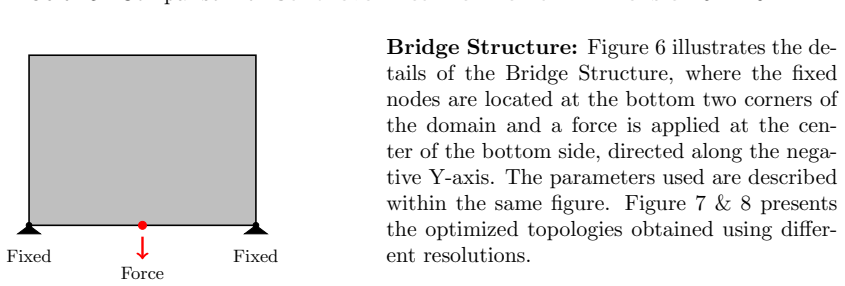
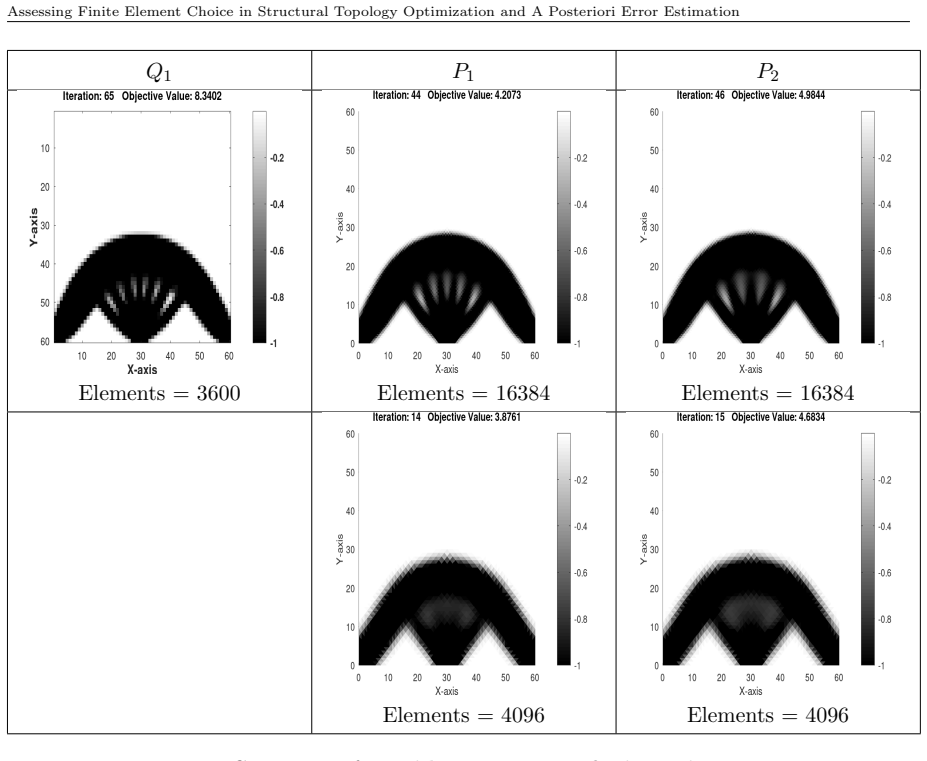
Numerical experiments on a cantilever beam, a bridge structure, and a beveled beam demonstrate that P1, P2, and Q1 finite elements produce different optimized compliance values and different levels of accuracy in the finite element solutions when used within the SIMP topology optimization framework, with accuracy assessed by an a posteriori error estimator.
What carries the argument
The SIMP topology optimization loop run with three different finite-element discretizations (linear triangles, quadratic triangles, bilinear quadrilaterals) together with an a posteriori error estimator that quantifies solution accuracy for each choice.
If this is right
- The final compliance achieved by the optimizer depends on which element type is chosen.
- The estimated accuracy of the finite-element solution inside the optimization loop also varies with element type.
- Element selection therefore affects both the quantity that is being minimized and the trustworthiness of the solution used to compute it.
Where Pith is reading between the lines
- If the accuracy advantage of one element family persists across a wider set of load cases, adaptive choice of element type during optimization becomes a practical next step.
- The observed sensitivity suggests that verification of an optimized design should include at least two different element types rather than relying on a single discretization.
- Extending the same comparison to three-dimensional problems or to objectives other than compliance would test whether the reported influence of element type is general.
Load-bearing premise
The a posteriori error estimator provides a consistent and reliable indicator of finite-element solution accuracy that can be compared fairly across P1, P2, and Q1 element types inside the SIMP loop.
What would settle it
Re-running the same benchmark optimizations and obtaining essentially identical compliance values and error estimates for all three element types would show that element choice does not produce the reported differences.
Figures





read the original abstract
This study investigates the impact of finite element selection on structural topology optimization using the SIMP (Solid Isotropic Material with Penalization) method. Specifically, it compares linear (P1) and quadratic (P2) triangular elements with the conventional bi-linear quadrilateral (Q1) elements. Numerical experiments performed on benchmark problems including a cantilever beam, a bridge structure, and a beveled beam reveal notable differences in both the final optimized objective value (compliance) and the accuracy of the finite element solutions. The accuracy is evaluated using an a posteriori error estimator, highlighting the influence of element type on solution quality and optimization performance.
Editorial analysis
A structured set of objections, weighed in public.
Referee Report
Summary. The manuscript investigates the impact of finite element type selection (P1 and P2 triangular elements versus conventional Q1 quadrilateral elements) on structural topology optimization via the SIMP method. Numerical experiments on benchmark problems (cantilever beam, bridge structure, beveled beam) are reported to show notable differences in the final optimized compliance values and in the accuracy of the finite-element solutions, with accuracy assessed using an a posteriori error estimator.
Significance. If the observed differences in compliance and accuracy prove robust and the error estimator is demonstrated to be a reliable, unbiased comparator across element families within the SIMP loop, the results could offer practical guidance on discretization choices that improve optimization outcomes and solution quality in topology optimization. The work relies on standard SIMP formulations and existing estimators from the literature without introducing new parameters or self-referential quantities.
major comments (2)
- [Abstract and §4] Abstract and §4 (Numerical Experiments): The headline claim of 'notable differences' in both compliance and solution accuracy is presented without quantitative values, mesh convergence data, degrees-of-freedom counts, or explicit description of how the a posteriori error estimator was applied and normalized for each element type (P1, P2, Q1). This leaves the magnitude and attribution of the reported differences weakly supported.
- [§3.2] §3.2 (A Posteriori Error Estimation): The central comparison of solution accuracy across P1/P2 triangular and Q1 quadrilateral elements rests on the assumption that the chosen residual-based or recovery estimator yields comparable effectivity indices near unity for all three families on the same benchmark geometries inside the optimization loop. No verification is provided that interpolation operators, jump-term scaling, and effectivity constants remain consistent; without this, accuracy differences could be estimator artifacts rather than true discretization effects.
minor comments (2)
- [Abstract] The abstract would be strengthened by including at least one concrete quantitative example (e.g., compliance values or error estimator magnitudes) rather than the qualitative phrase 'notable differences'.
- [§3.2] Notation for the error estimator (e.g., residual terms, recovery operators) should be introduced with explicit formulas and references to the specific literature implementations used for triangles versus quadrilaterals.
Simulated Author's Rebuttal
We thank the referee for the detailed and constructive report. We address the two major comments point by point below and have revised the manuscript to strengthen the quantitative support and verification of the error estimator.
read point-by-point responses
-
Referee: [Abstract and §4] Abstract and §4 (Numerical Experiments): The headline claim of 'notable differences' in both compliance and solution accuracy is presented without quantitative values, mesh convergence data, degrees-of-freedom counts, or explicit description of how the a posteriori error estimator was applied and normalized for each element type (P1, P2, Q1). This leaves the magnitude and attribution of the reported differences weakly supported.
Authors: We agree that the presentation of results in the abstract and Section 4 would be strengthened by explicit quantitative data. In the revised manuscript we have added a table in Section 4 that lists the final compliance values, degrees of freedom, and mesh sizes for P1, P2, and Q1 discretizations on each benchmark problem. We have also included a short mesh-convergence study and a paragraph that describes the precise application and normalization of the a posteriori estimator for each element family. revision: yes
-
Referee: [§3.2] §3.2 (A Posteriori Error Estimation): The central comparison of solution accuracy across P1/P2 triangular and Q1 quadrilateral elements rests on the assumption that the chosen residual-based or recovery estimator yields comparable effectivity indices near unity for all three families on the same benchmark geometries inside the optimization loop. No verification is provided that interpolation operators, jump-term scaling, and effectivity constants remain consistent; without this, accuracy differences could be estimator artifacts rather than true discretization effects.
Authors: We acknowledge the importance of demonstrating that the estimator behaves comparably across element families. The estimator follows standard residual-based formulations from the literature, with element-specific interpolation operators and jump-term scaling already implemented in our code. In the revised §3.2 we have added a verification subsection that reports effectivity indices computed on the same benchmark geometries (outside the optimization loop) for P1, P2, and Q1 elements; the indices remain close to unity and consistent across families. The scaling constants and interpolation details are now stated explicitly. revision: yes
Circularity Check
No circularity: standard SIMP + literature estimators applied to benchmarks
full rationale
The paper applies the established SIMP formulation and invokes existing a posteriori error estimators from the literature to compare P1/P2/Q1 elements on standard benchmark problems. No equation or result is shown to be defined in terms of itself, no fitted parameter is relabeled as a prediction, and no load-bearing premise reduces to a self-citation chain. The reported differences in compliance and estimated accuracy are empirical outcomes of the numerical experiments rather than tautological re-expressions of the inputs.
Axiom & Free-Parameter Ledger
axioms (2)
- domain assumption The SIMP method with penalization produces meaningful optimized designs when combined with finite-element analysis.
- domain assumption A posteriori error estimators developed for linear elasticity remain reliable when applied inside an iterative density-based optimization loop.
Reference graph
Works this paper leans on
-
[1]
A. G. M. Michell. Lviii. the limits of economy of material in frame-structures.The London, Edinburgh, and Dublin Philosophical Magazine and Journal of Science, 8(47):589–597, 1904
work page 1904
-
[2]
G. I. N. Rozvany. Grillages of maximum strength and maximum stiffness.International Journal of Mechanical Sciences, 14(10):651–666, 1972
work page 1972
-
[3]
G. I. N. Rozvany. Optimal load transmission by flexure. volume 1, pages 253–263, 1972
work page 1972
-
[4]
W. Prager and G. I. N. Rozvany. Optimization of structural geometry. In A. R. Bednarek and L. Cesari, editors,Dynamical Systems, pages 265–293. Academic Press, New York, 1977
work page 1977
-
[5]
Martin P. Bendsøe and Noboru Kikuchi. Generating optimal topologies in structural design using a homog- enization method.Computer Methods in Applied Mechanics and Engineering, 71(2):197–224, 1988
work page 1988
-
[6]
Optimal shape design as a material distribution problem.Structural optimization, 1:193– 202, 1989
Martin P Bendsøe. Optimal shape design as a material distribution problem.Structural optimization, 1:193– 202, 1989
work page 1989
-
[7]
Martin P Bendsøe. Topology optimization. InEncyclopedia of Optimization, pages 2636–2638. Springer, 2001
work page 2001
-
[8]
Some aspects of the genesis of structures.Structural optimization, 5(1):64–69, 1992
HP Mlejnek. Some aspects of the genesis of structures.Structural optimization, 5(1):64–69, 1992
work page 1992
-
[9]
Yi Min Xie and Grant P Steven. A simple evolutionary procedure for structural optimization.Computers & structures, 49(5):885–896, 1993
work page 1993
-
[10]
Y Mike Xie, Grant P Steven, YM Xie, and GP Steven.Basic evolutionary structural optimization. Springer, 1997
work page 1997
-
[11]
Recent developments in evolutionary structural optimization (eso) for con- tinuum structures
Yi Min Xie and Xiaodong Huang. Recent developments in evolutionary structural optimization (eso) for con- tinuum structures. InIOP Conference Series: Materials Science and Engineering, volume 10, page 012196. IOP Publishing, 2010
work page 2010
-
[12]
Zicheng Zhuang, Yi Min Xie, Qing Li, and Shiwei Zhou. A 172-line matlab code for structural topology optimization in the body-fitted mesh.Structural and Multidisciplinary Optimization, 66(1):11, 2023
work page 2023
-
[13]
Osvaldo M Querin, Grant P Steven, and Yi Min Xie. Evolutionary structural optimisation (eso) using a bidirectional algorithm.Engineering computations, 15(8):1031–1048, 1998
work page 1998
- [14]
-
[15]
A level-set method for shape optimization
Gr´ egoire Allaire, Fran¸ cois Jouve, and Anca-Maria Toader. A level-set method for shape optimization. Comptes rendus. Math´ ematique, 334(12):1125–1130, 2002
work page 2002
-
[16]
Michael Yu Wang, Xiaoming Wang, and Dongming Guo. A level set method for structural topology opti- mization.Computer methods in applied mechanics and engineering, 192(1-2):227–246, 2003
work page 2003
-
[17]
Gr´ egoire Allaire, Fran¸ cois Jouve, and Anca-Maria Toader. Structural optimization using sensitivity analysis and a level-set method.Journal of computational physics, 194(1):363–393, 2004
work page 2004
-
[18]
M. Zhou and G. I. N. Rozvany. The coc algorithm, part ii: Topological, geometrical and generalized shape optimization.Computer Methods in Applied Mechanics and Engineering, 89(1):309–336, 1991
work page 1991
-
[19]
Ole Sigmund. A 99 line topology optimization code written in matlab.Structural and multidisciplinary optimization, 21:120–127, 2001
work page 2001
-
[20]
Martin P. Bendsøe. Optimal shape design as a material distribution problem.Structural Optimization, 1(4):193–202, 1989
work page 1989
-
[21]
YM Xie and GP Steven. Evolutionary structural optimization for dynamic problems.Computers & Struc- tures, 58(6):1067–1073, 1996. 14 Jyotiranjan et al
work page 1996
-
[22]
Bidirectional evolutionary method for stiffness optimization.AIAA journal, 37(11):1483–1488, 1999
Xiao Ying Yang, Yi Min Xie, Grant P Steven, and Osvaldo M Querin. Bidirectional evolutionary method for stiffness optimization.AIAA journal, 37(11):1483–1488, 1999
work page 1999
-
[23]
X. F. Sun, Jie Yang, Y. M. Xie, Xiaodong Huang, and Z. H. Zuo. Topology optimization of composite structure using bi-directional evolutionary structural optimization method.Procedia Engineering, 14:2980– 2985, 2011
work page 2011
-
[24]
JH Zhu, WH Zhang, and KP Qiu. Bi-directional evolutionary topology optimization using element replace- able method.Computational Mechanics, 40:97–109, 2007
work page 2007
-
[25]
Xiaodong Huang and Yi Min Xie. Bi-directional evolutionary topology optimization of continuum structures with one or multiple materials.Computational Mechanics, 43:393–401, 2009
work page 2009
-
[26]
Stanley Osher and James A Sethian. Fronts propagating with curvature-dependent speed: Algorithms based on hamilton-jacobi formulations.Journal of computational physics, 79(1):12–49, 1988
work page 1988
-
[27]
Mark Ainsworth and J Tinsley Oden. A posteriori error estimation in finite element analysis.Computer methods in applied mechanics and engineering, 142(1-2):1–88, 1997
work page 1997
-
[28]
I Babuvˇ ska and Werner C Rheinboldt. Error estimates for adaptive finite element computations.SIAM Journal on Numerical Analysis, 15(4):736–754, 1978
work page 1978
-
[29]
Olgierd C Zienkiewicz and Jian Z Zhu. A simple error estimator and adaptive procedure for practical engineerng analysis.International journal for numerical methods in engineering, 24(2):337–357, 1987
work page 1987
-
[30]
R¨ udiger Verf¨ urth. A review of a posteriori error estimation techniques for elasticity problems.Computer Methods in Applied Mechanics and Engineering, 176(1-4):419–440, 1999
work page 1999
-
[31]
Alexandre Ern and Jean-Luc Guermond.Theory and practice of finite elements, volume 159. Springer, 2004
work page 2004
-
[32]
Claes Johnson.Numerical solution of partial differential equations by the finite element method. Courier Corporation, 2009
work page 2009
-
[33]
Philippe G Ciarlet.Mathematical elasticity: volume II: theory of plates. Elsevier, 1997
work page 1997
-
[34]
Finite element discretizations for linear elasticity
Emma Cinatl. Finite element discretizations for linear elasticity. Master’s thesis, Clemson University, 2018
work page 2018
-
[35]
Bendsøe and Ole Sigmund.Topology Optimization: Theory, Methods, and Applications
Martin P. Bendsøe and Ole Sigmund.Topology Optimization: Theory, Methods, and Applications. Springer, Berlin, Heidelberg, 2001
work page 2001
-
[36]
OpenAI. Chatgpt: Language model. Accessed: 2023-10-01, 2023. Department of Mathematics, SRM University AP, Andhra Pradesh 522240, India Email address:jyotiranjan n@srmap.edu.in Department of Mathematics, SRM University AP, Andhra Pradesh 522240, India Email address:shafeequdheen p@srmap.edu.in Department of Mathematics, SRM University AP, Andhra Pradesh 5...
work page 2023
discussion (0)
Sign in with ORCID, Apple, or X to comment. Anyone can read and Pith papers without signing in.