Positron Emission Tomography with quantum-entangled Compton events: first imaging results at clinically relevant activities
Pith reviewed 2026-06-25 19:01 UTC · model grok-4.3
The pith
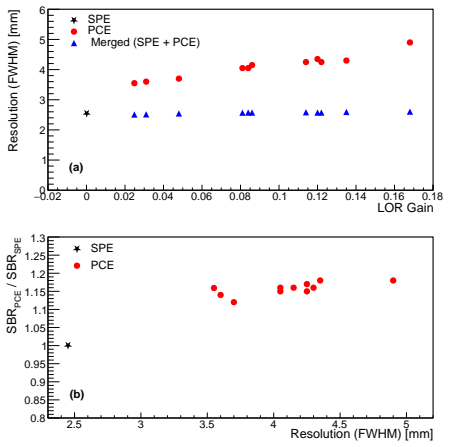
Polarization correlations of annihilation photons can increase PET sensitivity by up to 10% at clinical activities.
A machine-rendered reading of the paper's core claim, the machinery that carries it, and where it could break.
Core claim
A PET demonstrator with single-layer scintillator polarimeters recorded the first images of 68Ge line sources and a 68Ga-filled NEMA NU-4 phantom at clinically relevant activities by selecting Compton events whose polarization correlation matches the expected entanglement of annihilation quanta. These polarization-correlated events delivered up to 20% better average signal-to-random background ratio than single-pixel events, with spatial resolutions between 3.6 mm and 4.9 mm depending on selection cuts. The measured contrast, signal-to-noise, and resolution values support the estimate that combining the two event classes can raise overall sensitivity by as much as 10% without compromising im
What carries the argument
Single-layer scintillator polarimeters that identify polarization-correlated Compton pairs of annihilation photons by their scattering angles.
If this is right
- Polarization-correlated Compton events can be added to standard single-pixel events in the same reconstruction without separate hardware.
- The higher signal-to-random ratio permits either lower injected activity or shorter scan times at fixed image quality.
- Data-selection criteria that trade spatial resolution for background rejection remain compatible with clinical activity levels up to hundreds of MBq.
- The approach preserves the ability to form high-quality images of standard phantoms at activities used in patient studies.
Where Pith is reading between the lines
- Existing PET systems could gain sensitivity by adding polarization-sensitive readout to one or more detector layers rather than replacing entire rings.
- The method might allow reduced patient dose while maintaining diagnostic contrast, provided the resolution trade-off is balanced by reconstruction algorithms.
- Further refinement of the angular cuts used to select correlated events could narrow the gap between 2.5 mm and 3.6 mm resolution without losing the background-rejection benefit.
Load-bearing premise
The 20% signal-to-random improvement measured on selected polarization events will produce a net 10% sensitivity gain in a full tomographic reconstruction without introducing new biases or artifacts.
What would settle it
A complete tomographic reconstruction of the NEMA phantom using the combined event selection that yields less than a 5% net sensitivity gain or shows visible artifacts or degraded contrast-to-noise ratio.
Figures




read the original abstract
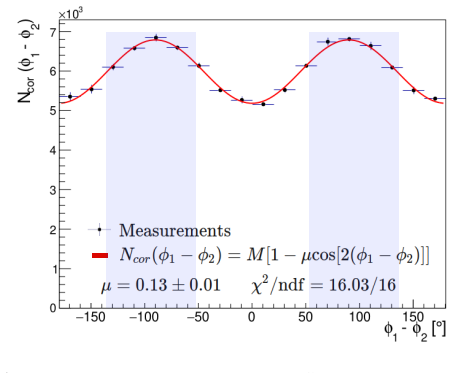
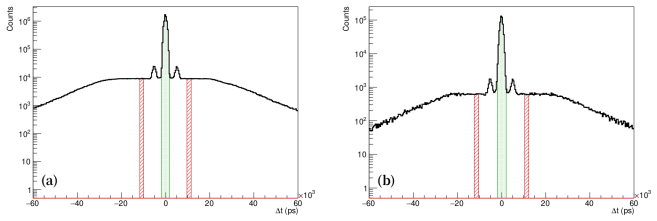
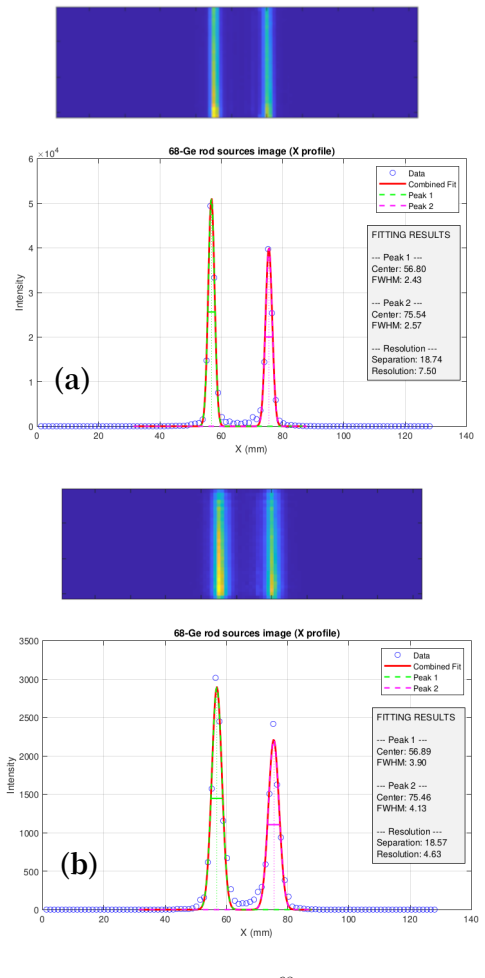
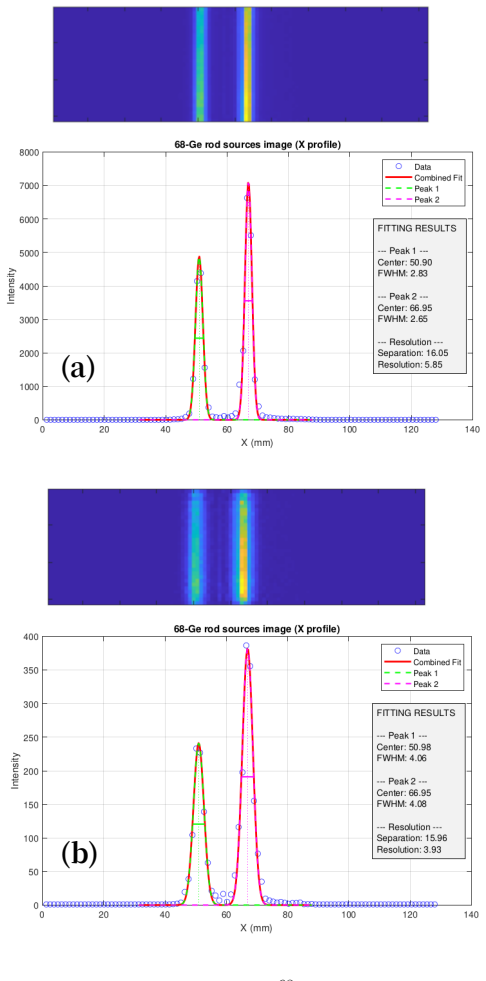
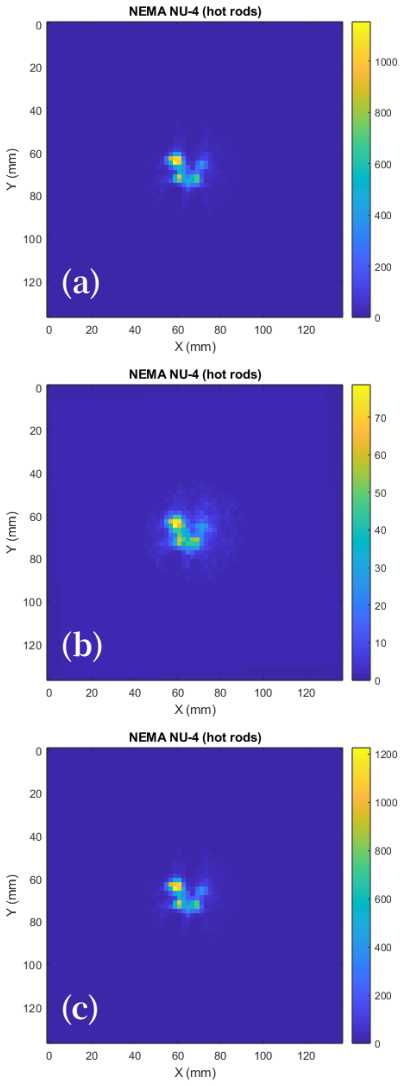
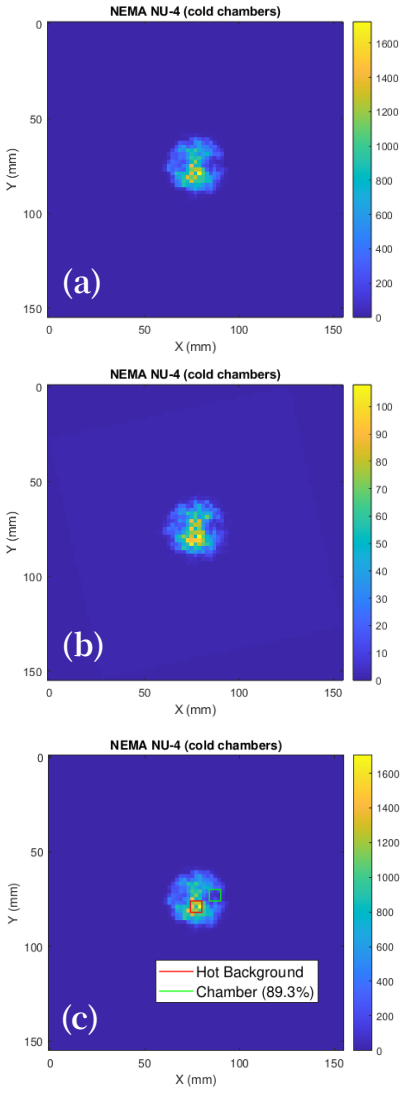
In Positron Emission Tomography, a potential, yet unutilized enhancement, may come from exploiting the quantum entanglement of the annihilation quanta, inscribed in the correlation of their polarizations. To investigate this, we built a PET demonstrator capable of measuring polarization correlations of annihilation quanta by their Compton scattering, based on single-layer scintillator polarimeters. We present a detailed study of the imaging of two $^{68}$Ge line sources, 45 MBq each, to extract the spatial resolution and assess image quality. The results show that a spatial resolution of 2.5$\pm$0.1 mm is obtained using single-pixel events, while resolutions obtained with polarization-correlated Compton events range from 3.6$\pm$0.3 mm to 4.9$\pm$0.3 mm, depending on data selection criteria. We also found that the polarization-correlated Compton events exhibit up to 20% higher average signal to random background ratio compared to the single-pixel events. We also present the first imaging of the NEMA NU-4 phantom filled with a $^{68}$Ga solution of 378 MBq initial activity, successfully combining polarization-correlated events with conventional single-pixel event selection. Based on the extracted spatial resolution, signal-to-background, signal-to-noise, contrast, and contrast-to-noise ratio, we estimate that up to 10% sensitivity increase may be attained by exploiting the polarization-correlated events, while preserving a high image quality.
Editorial analysis
A structured set of objections, weighed in public.
Referee Report
Summary. The paper reports the construction of a PET demonstrator using single-layer scintillator polarimeters to measure polarization correlations of annihilation quanta via Compton scattering. It presents imaging results for two 68Ge line sources (45 MBq each) yielding 2.5±0.1 mm resolution with single-pixel events and 3.6-4.9 mm with polarization-correlated Compton events (depending on selection criteria), a 20% higher average signal-to-random background ratio for the correlated events, and the first NEMA NU-4 phantom imaging with 68Ga (378 MBq initial activity) by combining both event types. From extracted metrics on resolution, S/RB, SNR, contrast and CNR, the authors estimate up to 10% sensitivity increase while preserving image quality.
Significance. If the net sensitivity gain holds after full reconstruction, this would constitute a concrete experimental step toward exploiting quantum entanglement in PET, potentially improving sensitivity at clinically relevant activities without new hardware. The work is strengthened by direct measurements at high activities, successful phantom imaging that combines event classes, and concrete numerical outcomes on resolution and background ratios rather than purely theoretical predictions.
major comments (2)
- [Abstract] Abstract: the headline estimate of 'up to 10% sensitivity increase' is presented as derived from the 20% S/RB improvement, resolution values, and phantom metrics, yet no explicit scaling calculation, event-fraction weighting, or side-by-side tomographic reconstruction (with vs. without the selected polarization-correlated events) is shown to confirm a net positive gain once the resolution degradation (3.6-4.9 mm vs 2.5 mm) and selection thresholds are folded in.
- [Results (NEMA phantom)] Results section on NEMA phantom: the reconstruction algorithm is not described, nor is any error propagation or uncertainty quantification supplied for the sensitivity estimate or the contrast-to-noise ratios, leaving the quantitative claim that image quality is 'preserved' without a verifiable basis.
minor comments (2)
- [Results (line sources)] The dependence of resolution on post-hoc data selection criteria is noted but the exact thresholds and their impact on event yield should be tabulated for reproducibility.
- Clarify whether the reported resolutions are FWHM or other metric and how they were extracted from the line-source profiles.
Simulated Author's Rebuttal
We thank the referee for the constructive comments and for recognizing the significance of our experimental demonstration. We address each major comment below and will revise the manuscript accordingly.
read point-by-point responses
-
Referee: [Abstract] Abstract: the headline estimate of 'up to 10% sensitivity increase' is presented as derived from the 20% S/RB improvement, resolution values, and phantom metrics, yet no explicit scaling calculation, event-fraction weighting, or side-by-side tomographic reconstruction (with vs. without the selected polarization-correlated events) is shown to confirm a net positive gain once the resolution degradation (3.6-4.9 mm vs 2.5 mm) and selection thresholds are folded in.
Authors: We agree that the sensitivity estimate would benefit from an explicit derivation. In the revised manuscript we will add a dedicated paragraph (or supplementary note) that details the scaling procedure, including the weighting by the fraction of polarization-correlated events, the measured 20 % S/RB gain, the resolution values, and the trade-off with the 3.6–4.9 mm versus 2.5 mm resolutions, so that the net-gain claim is fully traceable. revision: yes
-
Referee: [Results (NEMA phantom)] Results section on NEMA phantom: the reconstruction algorithm is not described, nor is any error propagation or uncertainty quantification supplied for the sensitivity estimate or the contrast-to-noise ratios, leaving the quantitative claim that image quality is 'preserved' without a verifiable basis.
Authors: We accept that the reconstruction method and uncertainty analysis require fuller documentation. The revised manuscript will include a concise description of the reconstruction algorithm used for the NEMA phantom data together with error propagation and uncertainty estimates on the sensitivity gain, CNR, and related metrics, thereby providing a verifiable basis for the statement that image quality is preserved. revision: yes
Circularity Check
No circularity: all reported values are direct experimental measurements with no derivation chain reducing to inputs by construction.
full rationale
The paper reports measured spatial resolutions (2.5 mm for single-pixel events, 3.6-4.9 mm for polarization-correlated events), a 20% higher signal-to-random background ratio, and image quality metrics (SNR, contrast, CNR) extracted from line source and NEMA phantom data. The 10% sensitivity estimate is presented as a qualitative extrapolation from these independent experimental quantities rather than any equation, fit, or self-citation that would make the output equivalent to the input by construction. No self-definitional steps, fitted parameters renamed as predictions, or load-bearing self-citations appear in the derivation of the central claims.
Axiom & Free-Parameter Ledger
free parameters (1)
- polarization correlation selection thresholds
Reference graph
Works this paper leans on
-
[1]
Agostinelli S.et al.Geant4—a simulation toolkit.Nuclear Instruments and Methods in Physics Research Section A: Accelerators, Spectrometers, Detectors and Associated Equipmen, 506(3):250–303, 2003
2003
-
[2]
Bohm and Y
D. Bohm and Y. Aharonov. Discussion of experimental proof for the para- dox of Einstein, Rosen, and Podolsky.Phys. Rev., 108:1070–1076, Nov 1957. 16
1957
-
[3]
Di Francesco, R
A. Di Francesco, R. Bugalho, L. Oliveira, L. Pacher, A. Rivetti, M. Rolo, J. C. Silva, R. Silva, and J. Varela. TOFPET2: A high-performance ASIC for time and amplitude measurements of SiPM signals in time-of-flight ap- plications.Journal of Instrumentation, 11:C03042, 2016
2016
-
[4]
P. Dirac. The quantum theory of the electron.Proc. R. Soc. Lond. A, 117:610–624, 1928
1928
-
[5]
A deep neural network for positioning and inter-crystal scatter identification in multiplexed pet detectors: a simulation study.Physics in Medicine and Biology, 69, 08 2024
Francisco Enriquez-Mier-y Terán, Luping Zhou, Steve Meikle, and Andre Kyme. A deep neural network for positioning and inter-crystal scatter identification in multiplexed pet detectors: a simulation study.Physics in Medicine and Biology, 69, 08 2024
2024
-
[6]
Hudson and R.S
H.M. Hudson and R.S. Larkin. Accelerated image reconstruction using ordered subsets of projection data.IEEE Transactions on Medical Imaging, 13(4):601–609, 1994
1994
-
[7]
L. R. Kasday, J.D. Ullman, and C. S. Wu. Angular correlation of compton- scattered annihilation photons and hidden variables.Il Nuovo Cimento B, 25:633–661, 1975
1975
-
[8]
Kim D.et al.Background reduction in PET by double compton scattering of quantum entangled annihilation photon.Journal of Instrumentation, 18:P07007, 2023
2023
-
[9]
Kolthammer, Kuan-Hao Su, Aarati Grover, Manoj Narayanan, David W
Jeffrey A. Kolthammer, Kuan-Hao Su, Aarati Grover, Manoj Narayanan, David W. Jordan, and Raymond F. Muzic. Performance evaluation of the ingenuity tf pet/ct scanner with a focus on high count-rate conditions. Physics in Medicine and Biology, 59(14):3843–3859, Jul 2014
2014
-
[10]
Kožuljević A. M.et al.Investigation of the spatial resolution of PET imag- ing system measuring polarization-correlated Compton events.Nuclear In- struments and Methods in Physics Research Section A: Accelerators, Spec- trometers, Detectors and Associated Equipment, 1068:169795, 2024
2024
-
[11]
Kožuljević A.M.et al.Study of multi-pixel scintillator detector configura- tions for measuring polarized gamma radiation.Condensed Matter, 6:43, 2021
2021
-
[12]
Nuclear Instruments and Methods in Physics Research Section A: Acceler- ators, Spectrometers, Detectors and Associated Equipment, 648:S208–S210, 2011
Kuncic Z.et al.Polarization enhanced X-ray imaging for biomedicine. Nuclear Instruments and Methods in Physics Research Section A: Acceler- ators, Spectrometers, Detectors and Associated Equipment, 648:S208–S210, 2011
2011
-
[13]
Langhoff
H. Langhoff. Die linearpolarisation der vernichtungsstrahlung von positro- nen.Zeitschrift für Physik, 160:186–193, 1960
1960
-
[14]
Makek M.et al.Single-layer Compton detectors for measurement of polar- ization correlations of annihilation quanta.Nuclear Instruments and Meth- ods in Physics Research Section A: Accelerators, Spectrometers, Detectors and Associated Equipment, 958:162835, 2020
2020
-
[15]
McNamara A.et al.Towards optimal imaging with PET: An in silico feasibility study.Physics in Medicine and Biology, 59:7587–7600, 2014. 17
2014
-
[16]
Quantitative PET in the 2020s: a roadmap.Physics in Medicine and Biology, 63:06RM01, 2021
Steven Meikle et al. Quantitative PET in the 2020s: a roadmap.Physics in Medicine and Biology, 63:06RM01, 2021
2021
-
[17]
Moskal, D
P. Moskal, D. Kumar, S. Sharma, E. Y. Beyene, N. Chug, A. Coussat, C. Curceanu, E. Czerwinski, M. Das, K. Dulski, M. Gorgol, B. Jasin- ska, K. Kacprzak, T. Kaplanoglu, L. Kaplon, K. Klimaszewski, T. Kozik, E. Lisowski, F. Lisowski, W. Mryka, S. Niedzwiecki, S. Parzych, E. P. del Rio, L. Raczynski, M. Radler, R. Y. Shopa, M. Skurzok, E. L. Stepien, P. Tant...
2024
-
[18]
Einstein, S
Tinsu Pan, Stephen A. Einstein, S. Cheenu Kappadath, Kelley S. Grogg, Claudia Lois Gomez, Adam M. Alessio, William C. Hunter, Georges El Fakhri, Paul E. Kinahan, and Osama R. Mawlawi. Performance eval- uation of the 5-ring ge discovery mi pet/ct system using the national electrical manufacturers association nu 2-2012 standard.Medical Physics, 46(7):3025–3...
2012
-
[19]
Parashari S.et al.Optimisation of detector modules for measuring gamma- ray polarization in Positron Emission Tomography.Nuclear Instruments and Methods in Physics Research Section A: Accelerators, Spectrometers, Detectors and Associated Equipment, 1040:167186, 2022
2022
-
[20]
Resolving inter-crystal scatter in a light-sharing depth-encoding pet detec- tor.Physics in Medicine and Biology, 69(3):035024, feb 2024
Eric Petersen, Andy LaBella, Yixin Li, Zipai Wang, and Amir H Goldan. Resolving inter-crystal scatter in a light-sharing depth-encoding pet detec- tor.Physics in Medicine and Biology, 69(3):035024, feb 2024
2024
-
[21]
M. H. L. Pryce and J. C. Ward. Angular correlation effects with annihila- tion radiation.Nature, 160:4065, 1947
1947
-
[22]
Gallowitsch, Peter Lind, Thomas Beyer, and Geraldine Minear
Ivo Rausch, Jacobo Cal-González, Daniela Dapra, Hans J. Gallowitsch, Peter Lind, Thomas Beyer, and Geraldine Minear. Performance evaluation of the biograph mct flow pet/ct system according to the nema nu2-2012 standard.EJNMMI Physics, 2(1):26, Dec 2015
2012
-
[23]
Romanchek, G
G. Romanchek, G. Shoop, K. Gholami, E. Enlow, and S. Abbaszadeh. Quantum Entanglement Filtering: A PET feasibility study in imaging dual-positron and prompt gamma emission via Monte Carlo simulation. IEEE Transactions on Radiation and Plasma Medical Sciences, 8(8):916– 925, November 2024. PMID: 39507126
2024
-
[24]
Physics and technology of time-of-flight PET detectors
Dennis R Schaart. Physics and technology of time-of-flight PET detectors. Physics in Medicine and Biology, 66:09TR01, 2021
2021
-
[25]
Snyder, Simon Pasternack, and J
Hartland S. Snyder, Simon Pasternack, and J. Hornbostel. Angular cor- relation of scattered annihilation radiation.Phys. Rev., 73:440–448, Mar 1948
1948
-
[26]
Giulia Terragni, Vanessa Nadig, Elena Tribbia, Stefano di Gangi, Eka- terini Toumparidou, Thomas Meyer, Johann Marton, Volkmar Schulz, Ste- fan Gundacker, Marco Pizzichemi, and Etiennette Auffray. Exploring the 18 performance of a doi-capable tof-pet module using different sipms, cus- tomized and commercial readout electronics.Physics in Medicine and Bi- ...
2025
-
[27]
Toghyani M.et al.Polarisation-based coincidence event discrimination: An in silico study towards a feasible scheme for Compton-PET.Physics in Medicine and Biology, 61:5803–5817, 2016
2016
-
[28]
Watts D.P.et al.Photon quantum entanglement in the MeV regime and its application in PET imaging.Nature Communications, 12:2646, 2021
2021
-
[29]
Physics in Medicine and Biology, 66:065010, 2021
WettenhoviV.et al.OMEGA—open-sourceemissiontomographysoftware. Physics in Medicine and Biology, 66:065010, 2021
2021
-
[30]
C. S. Wu and I. Shaknov. The angular correlation of scattered annihilation radiation.Phys. Rev., 77:136–136, Jan 1950
1950
-
[31]
In that case, the 2 We thank D
A. Zatcepin, M. Pizzichemi, A. Polesel, et al. Improving depth-of- interaction resolution in pixellated PET detectors using neural networks. Physics in Medicine and Biology, 65(17):175017, aug 2020. Published 2020 Aug 27. Acknowledgements We are grateful to Mr. Marijan Žuvić of the University Hospital Centre Zagreb for the preparation of the radioactive s...
discussion (0)
Sign in with ORCID, Apple, or X to comment. Anyone can read and Pith papers without signing in.