Conditional Tropical Cyclogenesis Rates via Rare-Event Sampling in a Neural Weather Emulator
Pith reviewed 2026-07-01 00:50 UTC · model grok-4.3
The pith
Forward flux sampling with a neural emulator estimates tropical cyclogenesis rates across three orders of magnitude from 98 initial conditions.
A machine-rendered reading of the paper's core claim, the machinery that carries it, and where it could break.
Core claim
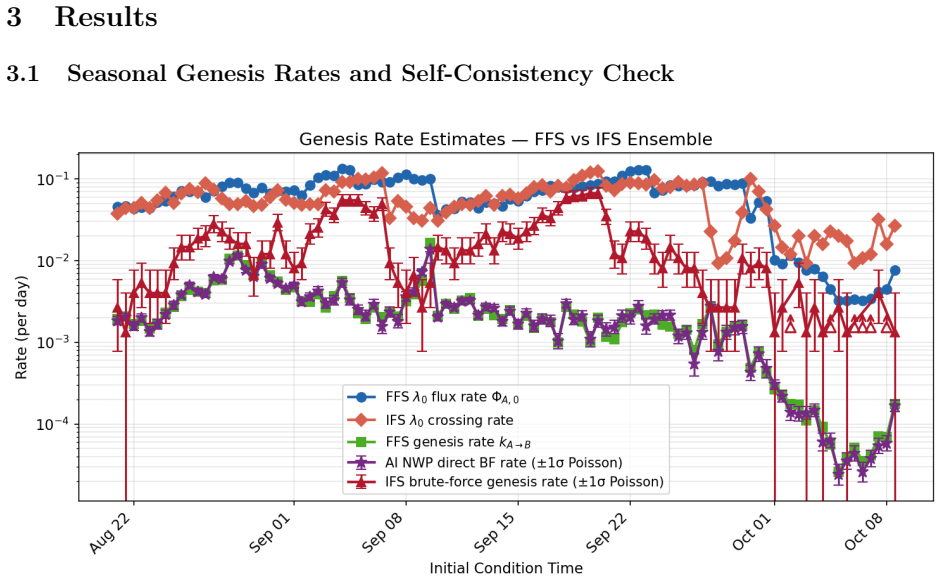
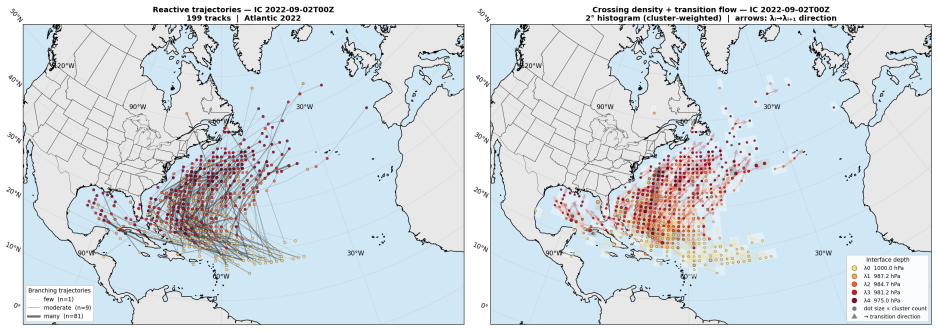
Forward Flux Sampling decomposes the rare disturbance-to-mature-cyclone path into a flux through an initial interface pressure and a product of conditional crossing probabilities across four intermediate interface pressures. Applied to the 1-degree SDL-WXFormer neural emulator on 98 Atlantic basin initial conditions spanning 21 August to 8 October 2022, the method resolves conditional genesis rates spanning nearly three orders of magnitude while reproducing a seasonal cycle qualitatively consistent with observations. Self-consistency checks against independent direct-sampling rates give a mean ratio of 1.03 with standard deviation 0.15, and computational enhancement factors range from 3X to
What carries the argument
Forward Flux Sampling, which decomposes rare intensification paths into an initial flux and successive conditional crossing probabilities across four pressure interfaces.
If this is right
- Genesis rates span nearly three orders of magnitude across the sampled initial conditions.
- The computed rates capture a seasonal cycle qualitatively consistent with observations.
- Self-consistency checks against direct sampling produce a mean ratio of 1.03 plus or minus 0.15.
- Computational speedups range from 3X in active environments to 140X in suppressed ones.
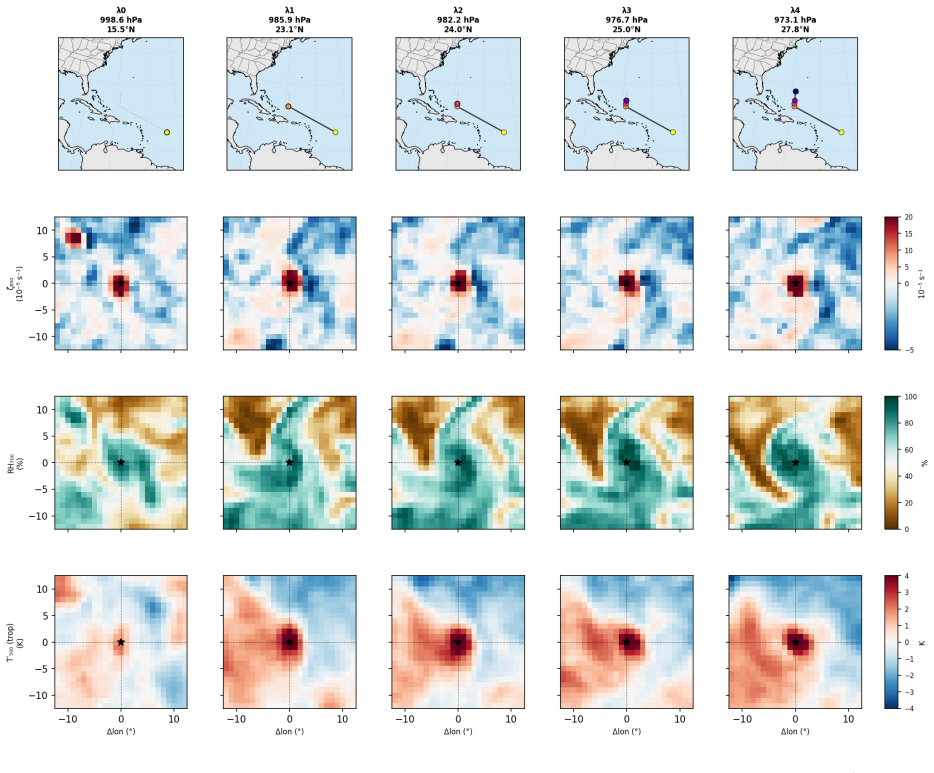
- Case studies identify different rate-limiting steps in different environments, such as initial organization for Earl and final intensification for Ian.
Where Pith is reading between the lines
- The same sampling framework could be applied to other rare atmospheric transitions once suitable emulators exist.
- Seasonal or subseasonal forecast systems might incorporate these conditional rates to improve probabilistic guidance.
- Finer-resolution emulators would allow the method to diagnose physical mechanisms at scales closer to observed storm structure.
Load-bearing premise
The neural emulator must reproduce atmospheric dynamics and variability for rare intensification trajectories without introducing systematic bias in the crossing probabilities.
What would settle it
Running the same 98 initial conditions through a high-resolution physics-based model with direct sampling and finding large systematic differences from the FFS rates would indicate bias in the emulator.
Figures






read the original abstract
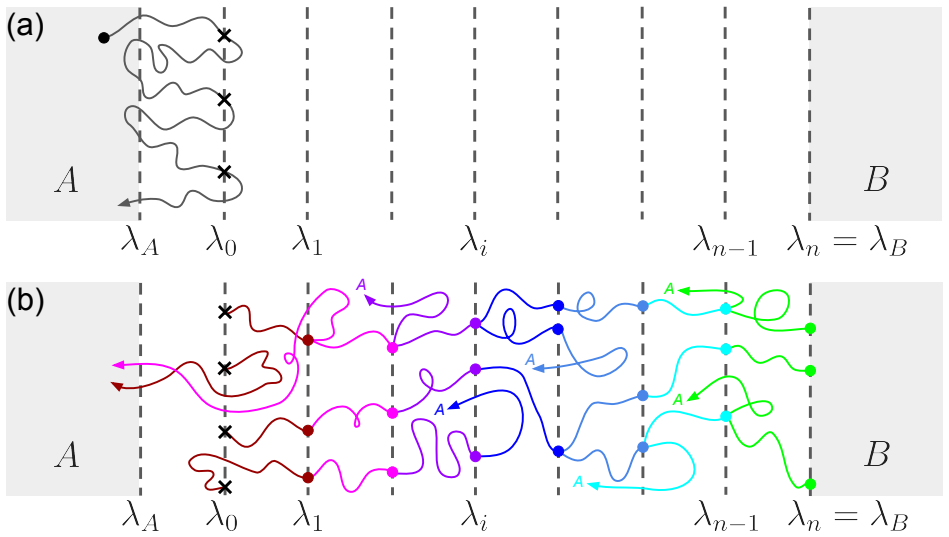
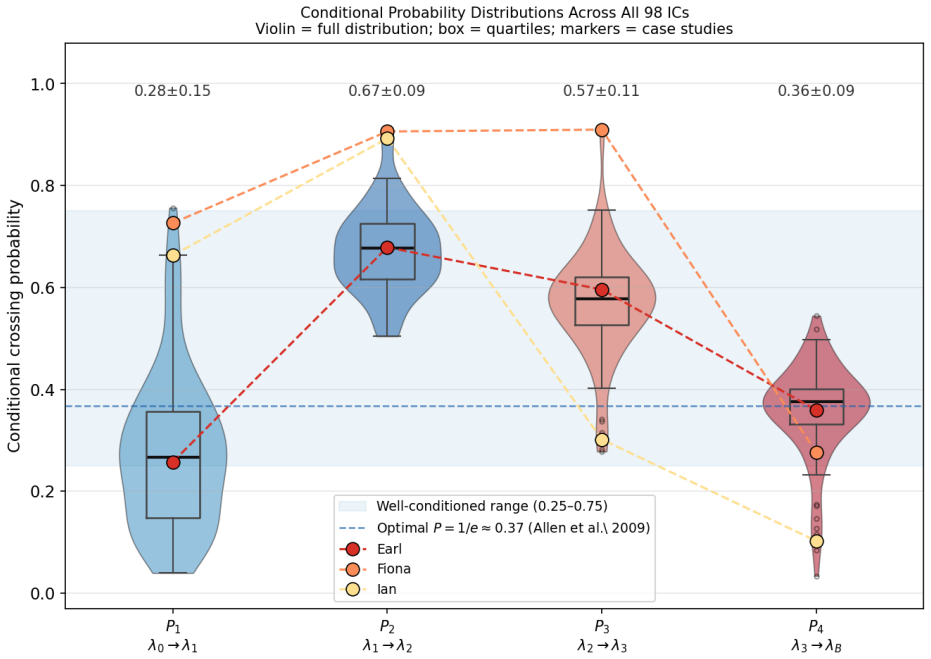
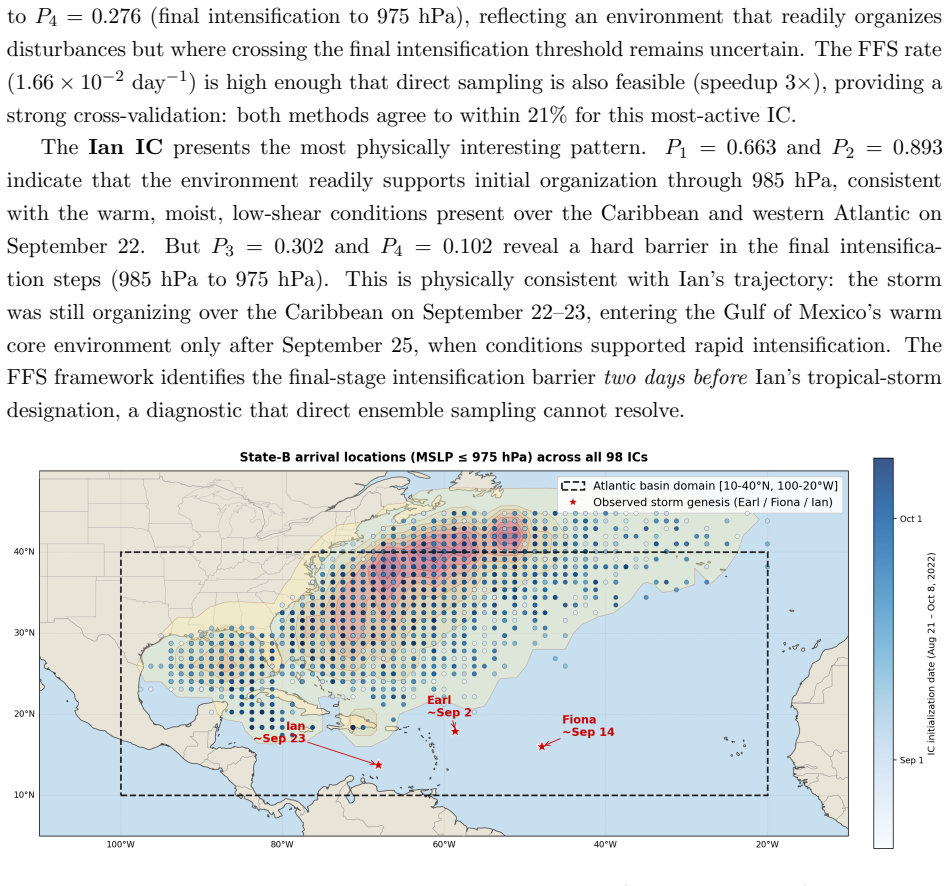
We couple Forward Flux Sampling (FFS), a non-equilibrium rare-event technique from statistical mechanics, to a neural weather emulator (SDL-WXFormer, 1{\deg} grid spacing) to estimate conditional tropical cyclogenesis rates, or how often a tropical cyclone achieves a hurricane-level central pressure, without modifying model dynamics. Tropical cyclogenesis rates vary by orders of magnitude across regimes, yet direct ensemble sampling cannot resolve this variability at operationally feasible ensemble sizes. FFS decomposes the rare disturbance to mature cyclone intensification path into a flux through an initial interface pressure and a product of conditional crossing probabilities across four intermediate interface pressures. We use the 1{\deg} emulator because FFS requires O(10^4) model trajectories per initial condition, and because the model's calibrated stochastic layers provide the necessary exploratory spread. Applied to 98 Atlantic basin initial conditions spanning 21 August - 8 October 2022, FFS resolves genesis rates spanning nearly three orders of magnitude, capturing a seasonal cycle qualitatively consistent with observations. A self-consistency check comparing FFS rates to independent direct-sampling rates yields a mean ratio of 1.03 +/- 0.15 across all initial conditions. Computational enhancement factors range from 3X (most active environment) to 140X (most suppressed), with a geometric mean of 14X. Three case studies illustrate the physical diagnostics the method provides: the rate-limiting step is initial tropical organization for the Earl environment, uniformly high crossing probabilities for the Fiona precursor environment, and a compound barrier at the final intensification stages for the Ian environment. More efficient emulators would enable application of FFS to finer resolutions.
Editorial analysis
A structured set of objections, weighed in public.
Referee Report
Summary. The manuscript couples Forward Flux Sampling (FFS) to the 1° SDL-WXFormer neural weather emulator to compute conditional tropical cyclogenesis rates for 98 Atlantic initial conditions (21 Aug–8 Oct 2022). FFS decomposes the intensification path into an initial flux and products of conditional crossing probabilities across four pressure interfaces. Reported results include genesis rates spanning nearly three orders of magnitude, qualitative seasonal-cycle agreement with observations, a self-consistency ratio of 1.03 ± 0.15 versus direct sampling, computational speedups of 3–140× (geometric mean 14×), and case-study diagnostics identifying rate-limiting steps for the Earl, Fiona, and Ian environments.
Significance. If the emulator’s stochastic layers reproduce the variability required for rare intensification trajectories, the work supplies an efficient, non-intrusive method for resolving order-of-magnitude variability in genesis rates that direct ensembles cannot access. The internal self-consistency check and the physical diagnostics extracted from the case studies constitute clear methodological strengths. The approach is extensible to other rare atmospheric events provided emulator fidelity for those trajectories can be established.
major comments (1)
- [Abstract] Abstract (final two paragraphs) and the self-consistency paragraph: the reported three-order-of-magnitude rate variability and qualitative seasonal agreement rest on the assumption that the 1° emulator’s crossing probabilities match real atmospheric statistics. The only quantitative validation supplied is the internal ratio 1.03 ± 0.15 against direct sampling within the same emulator; no comparison of the 98 computed rates to observed 2022 genesis outcomes, reanalysis, or higher-resolution models is presented, leaving the central claim load-bearing on an untested fidelity assumption explicitly flagged by the authors’ own remark on the need for finer-resolution emulators.
Simulated Author's Rebuttal
We thank the referee for the constructive review and for recognizing the methodological strengths of the FFS-emulator coupling. We address the single major comment below.
read point-by-point responses
-
Referee: [Abstract] Abstract (final two paragraphs) and the self-consistency paragraph: the reported three-order-of-magnitude rate variability and qualitative seasonal agreement rest on the assumption that the 1° emulator’s crossing probabilities match real atmospheric statistics. The only quantitative validation supplied is the internal ratio 1.03 ± 0.15 against direct sampling within the same emulator; no comparison of the 98 computed rates to observed 2022 genesis outcomes, reanalysis, or higher-resolution models is presented, leaving the central claim load-bearing on an untested fidelity assumption explicitly flagged by the authors’ own remark on the need for finer-resolution emulators.
Authors: We agree that the only quantitative validation is the internal self-consistency ratio and that no direct comparison of the 98 rates to 2022 observations, reanalysis, or higher-resolution models is provided. The manuscript is a methodological demonstration that the reported rates and variability are those generated by the 1° SDL-WXFormer; the qualitative seasonal-cycle statement is based on the overall pattern of higher rates during more active periods within the emulator. We will revise the abstract (final two paragraphs) and the self-consistency section to state explicitly that the results characterize the emulator’s statistics, that external fidelity remains to be established with finer-resolution models (as already noted in the text), and that the central claims concern the method’s performance rather than direct reproduction of observed genesis outcomes. This revision will be incorporated in the next version. revision: yes
Circularity Check
No significant circularity; rates obtained from direct sampling on emulator
full rationale
The derivation computes conditional genesis rates by applying FFS to O(10^4) trajectories generated by the SDL-WXFormer emulator and validates the method via an independent direct-sampling comparison (mean ratio 1.03 +/- 0.15). This internal check confirms numerical consistency of the rare-event algorithm inside the fixed emulator but does not reduce the reported rates to a fitted parameter, self-definition, or self-citation chain. No equations or steps in the abstract equate the output to its inputs by construction, and the emulator itself is treated as an external black-box model whose dynamics are not redefined within the paper.
Axiom & Free-Parameter Ledger
axioms (2)
- domain assumption The neural weather emulator accurately captures the dynamics and stochastic variability needed for rare-event intensification paths.
- standard math Forward Flux Sampling correctly factors the rare-event probability into an initial flux and a product of conditional crossing probabilities across interfaces.
Reference graph
Works this paper leans on
-
[1]
Allen, R. J. and Warren, P. B. and ten Wolde, P. R. , title =. Physical Review Letters , volume =. 2005 , doi =
2005
-
[2]
Simulating rare events in equilibrium or nonequilibrium stochastic systems
Allen, Rosalind J and Frenkel, Daan and ten Wolde, Pieter Rein. Simulating rare events in equilibrium or nonequilibrium stochastic systems. J. Chem. Phys. doi:10.1063/1.2140273
-
[3]
Allen, R. J. and Valeriani, C. and ten Wolde, P. R. , title =. J. Phys.: Condens. Matter , volume =. 2009 , doi =
2009
-
[4]
and Allen, R
Valeriani, C. and Allen, R. J. and Morelli, M. J. and Frenkel, D. and ten Wolde, P. R. , title =. J. Chem. Phys. , volume =. 2007 , doi =
2007
-
[5]
Schreck, J. S. and Ouldridge, T. E. and Romano, F. and. Nucleic Acids Res. , volume =. 2015 , doi =
2015
-
[6]
Bolhuis, P. G. and Chandler, D. and Dellago, C. and Geissler, P. L. , title =. Annu. Rev. Phys. Chem. , volume =. 2002 , doi =
2002
-
[7]
and Parrinello, M
Laio, A. and Parrinello, M. , title =. Proc. Natl. Acad. Sci. , volume =
-
[8]
Khoo, Yuehaw and Lu, Jianfeng and Ying, Lexing. Solving for high-dimensional committor functions using artificial neural networks. Res. Math. Sci. doi:10.1007/s40687-018-0160-2
-
[9]
Adaptive multilevel splitting for rare event analysis , journal =
C. Adaptive multilevel splitting for rare event analysis , journal =. 2007 , doi =
2007
-
[10]
and Wouters, J
Ragone, F. and Wouters, J. and Bouchet, F. , title =. Proc. Natl. Acad. Sci. , volume =. 2018 , doi =
2018
-
[11]
Webber, R. J. and Plotkin, D. A. and O'Neill, M. E. and Abbot, D. S. and Weare, J. , title =. Chaos , volume =. 2019 , doi =
2019
-
[12]
Bringing statistics to storylines: Rare event sampling for sudden, transient extreme events
Finkel, Justin and O'Gorman, Paul A. Bringing statistics to storylines: Rare event sampling for sudden, transient extreme events. J. Adv. Model. Earth Syst. doi:10.1029/2024ms004264
-
[13]
Plotkin, D. A. and Webber, R. J. and O'Neill, M. E. and Weare, J. and Abbot, D. S. , title =. J. Adv. Model. Earth Syst. , volume =. 2019 , doi =
2019
-
[14]
A large deviation theory-based analysis of heat waves and cold spells in a simplified model of the general circulation of the atmosphere , journal =
G. A large deviation theory-based analysis of heat waves and cold spells in a simplified model of the general circulation of the atmosphere , journal =. 2019 , doi =
2019
-
[15]
, title =
Touchette, H. , title =. Phys. Rep. , volume =. 2009 , doi =
2009
-
[16]
Learning skillful medium-range global weather forecasting
Lam, Remi and Sanchez-Gonzalez, Alvaro and Willson, Matthew and Wirnsberger, Peter and Fortunato, Meire and Alet, Ferran and Ravuri, Suman and Ewalds, Timo and Eaton-Rosen, Zach and Hu, Weihua and Merose, Alexander and Hoyer, Stephan and Holland, George and Vinyals, Oriol and Stott, Jacklynn and Pritzel, Alexander and Mohamed, Shakir and Battaglia, Peter....
-
[17]
Bi, Kaifeng and Xie, Lingxi and Zhang, Hengheng and Chen, Xin and Gu, Xiaotao and Tian, Qi. Accurate medium-range global weather forecasting with 3D neural networks. Nature. doi:10.1038/s41586-023-06185-3
-
[18]
Pathak, Jaideep and Subramanian, Shashank and Harrington, Peter and Raja, Sanjeev and Chattopadhyay, Ashesh and Mardani, Morteza and Kurth, Thorsten and Hall, David and Li, Zongyi and Azizzadenesheli, Kamyar and Hassanzadeh, Pedram and Kashinath, Karthik and Anandkumar, Animashree. FourCastNet : A Global Data-driven High-resolution Weather Model using Ada...
work page internal anchor Pith review Pith/arXiv arXiv
- [19]
-
[20]
and Coauthors , title =
Buizza, R. and Coauthors , title =. Bull. Amer. Meteor. Soc. , volume =
-
[21]
2023 , journal =
ECMWF , title =. 2023 , journal =
2023
-
[22]
and Bell, B
Hersbach, H. and Bell, B. and Berrisford, P. and Hirahara, S. and Hor. The. Quart. J. Roy. Meteor. Soc. , volume =. 2020 , doi =
2020
-
[23]
Frank, N. L. , title =. Mon. Wea. Rev. , volume =. 1970 , doi =
1970
-
[24]
Gray, W. M. , title =. Mon. Wea. Rev. , volume =. 1968 , doi =
1968
-
[25]
Landsea, C. W. , title =. Climatic Change , volume =. 1998 , doi =
1998
-
[26]
Halperin, D. J. and Fuelberg, H. E. and Hart, R. E. and Cossuth, J. H. and Sura, P. and Pasch, R. J. , title =. Wea. Forecasting , volume =. 2013 , doi =
2013
-
[27]
Hart, R. E. , title =. Mon. Wea. Rev. , volume =. 2003 , doi =
2003
-
[28]
Titley, D. W. and Elsberry, R. L. , title =. Mon. Wea. Rev. , volume =. 2000 , doi =
2000
-
[29]
Knaff, J. A. and Zehr, R. M. , title =. Wea. Forecasting , volume =. 2007 , doi =
2007
-
[30]
Lorenz, E. N. , title =. Tellus , volume =. 1969 , doi =
1969
-
[31]
and Marinescu, P
Heikenfeld, M. and Marinescu, P. J. and Christensen, M. and Watson-Parris, D. and Senf, F. and van den Heever, S. C. and Stier, P. , TITLE =. Geoscientific Model Development , VOLUME =. 2019 , NUMBER =
2019
-
[32]
and Emanuel, K
Bister, M. and Emanuel, K. A. , title =. Meteor.\ Atmos.\ Phys. , volume =. 1998 , doi =
1998
-
[33]
Camargo, S. J. and Emanuel, K. A. and Sobel, A. H. , title =. J.\ Climate , volume =. 2007 , doi =
2007
-
[34]
WeatherBench 2: A benchmark for the next generation of data‐driven global weather models
Rasp, Stephan and Hoyer, Stephan and Merose, Alexander and Langmore, Ian and Battaglia, Peter and Russell, Tyler and Sanchez-Gonzalez, Alvaro and Yang, Vivian and Carver, Rob and Agrawal, Shreya and Chantry, Matthew and Ben Bouallegue, Zied and Dueben, Peter and Bromberg, Carla and Sisk, Jared and Barrington, Luke and Bell, Aaron and Sha, Fei. WeatherBenc...
-
[35]
and Haji-Akbari, A
Hussain, S. and Haji-Akbari, A. , title =. J.\ Chem.\ Phys. , volume =. 2020 , doi =
2020
-
[36]
Lancelin, A. and Wikner, A. and Dubus, L. and. arXiv preprint arXiv:2510.27066 , year =. 2510.27066 , archivePrefix =
-
[37]
Mu, B. and Chen, Y. and Yuan, S. and Qin, B. and Guo, H. , title =. arXiv preprint arXiv:2512.12545 , year =. 2512.12545 , archivePrefix =
-
[38]
and Gerber, E
Finkel, J. and Gerber, E. P. and Abbot, D. S. and Weare, J. , title =. AGU Adv. , volume =. 2023 , doi =
2023
-
[39]
and Fischer, E
Zhang, Z. and Fischer, E. and Zscheischler, J. and Engelke, S. , title =. Sci.\ Adv. , year =
-
[40]
Towards accurate extreme event likelihoods from diffusion model climate emulators
Manshausen, P. and Brenowitz, N. and Berner, J. and Kashinath, K. and Pritchard, M. , title =. arXiv preprint arXiv:2605.03802 , year =. 2605.03802 , archivePrefix =
work page internal anchor Pith review Pith/arXiv arXiv
discussion (0)
Sign in with ORCID, Apple, or X to comment. Anyone can read and Pith papers without signing in.