Dust Formation in Common Envelope Binary Interactions -- III. Lightcurves
Pith reviewed 2026-06-26 04:29 UTC · model grok-4.3
The pith
Simulations of common envelope binary interactions produce light curves with a hot peak, dust-induced decline, and cool plateau.
A machine-rendered reading of the paper's core claim, the machinery that carries it, and where it could break.
Core claim
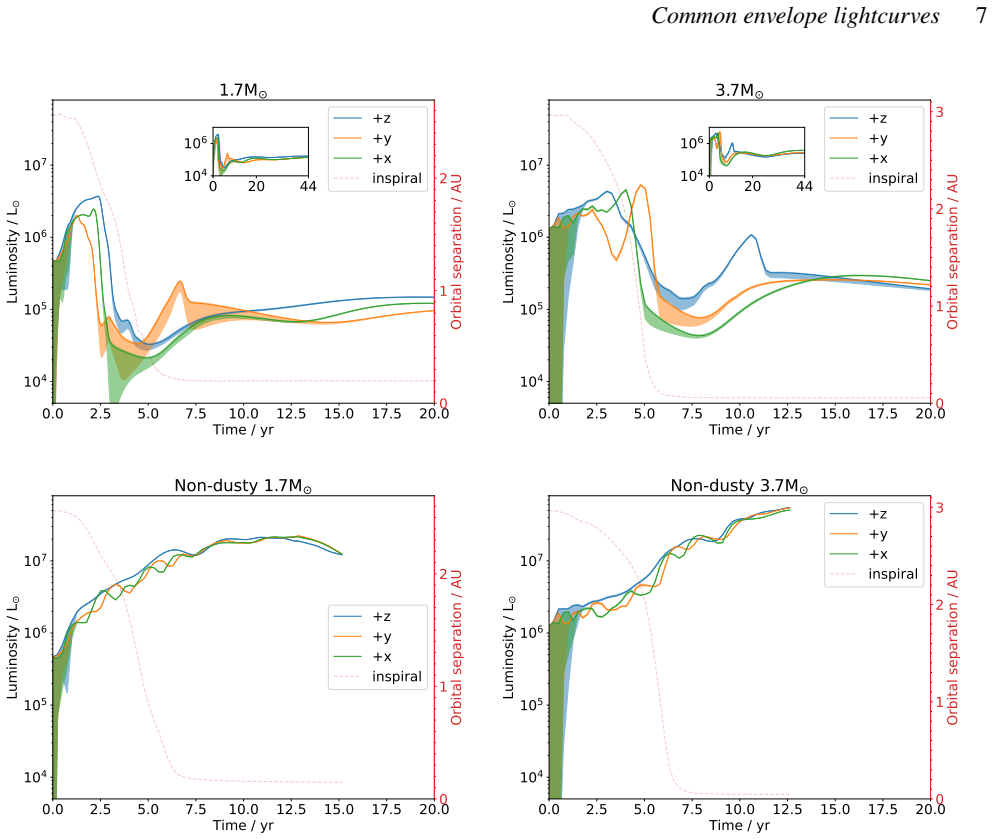
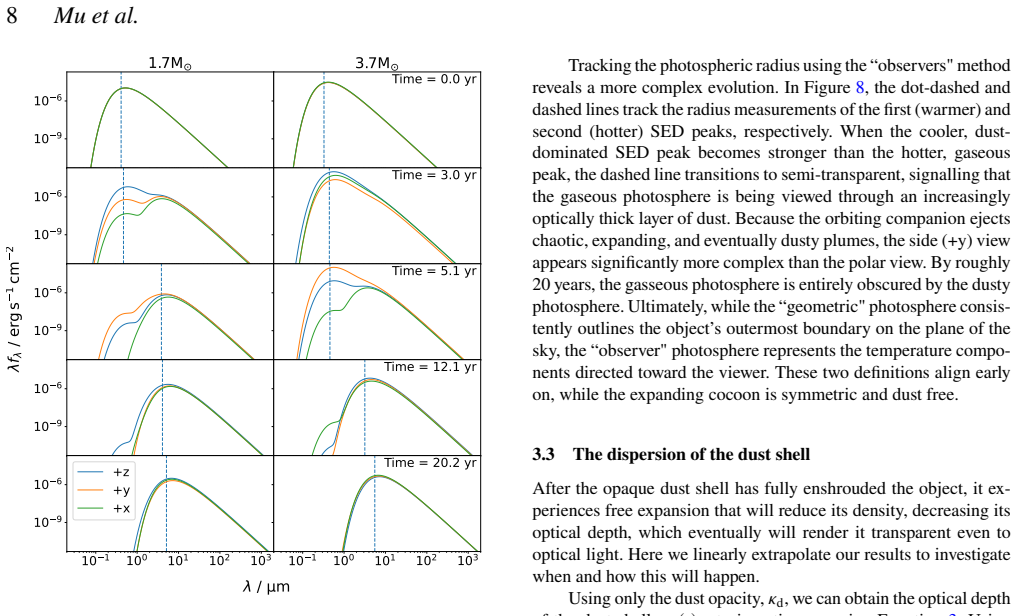
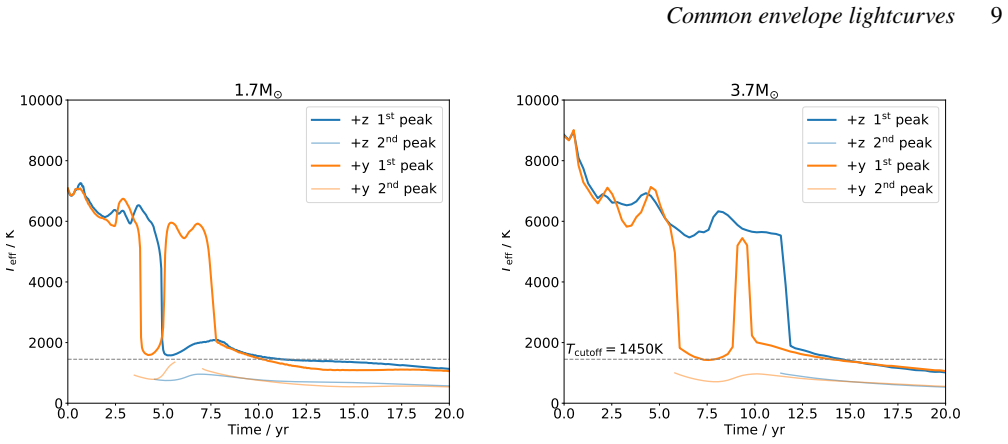
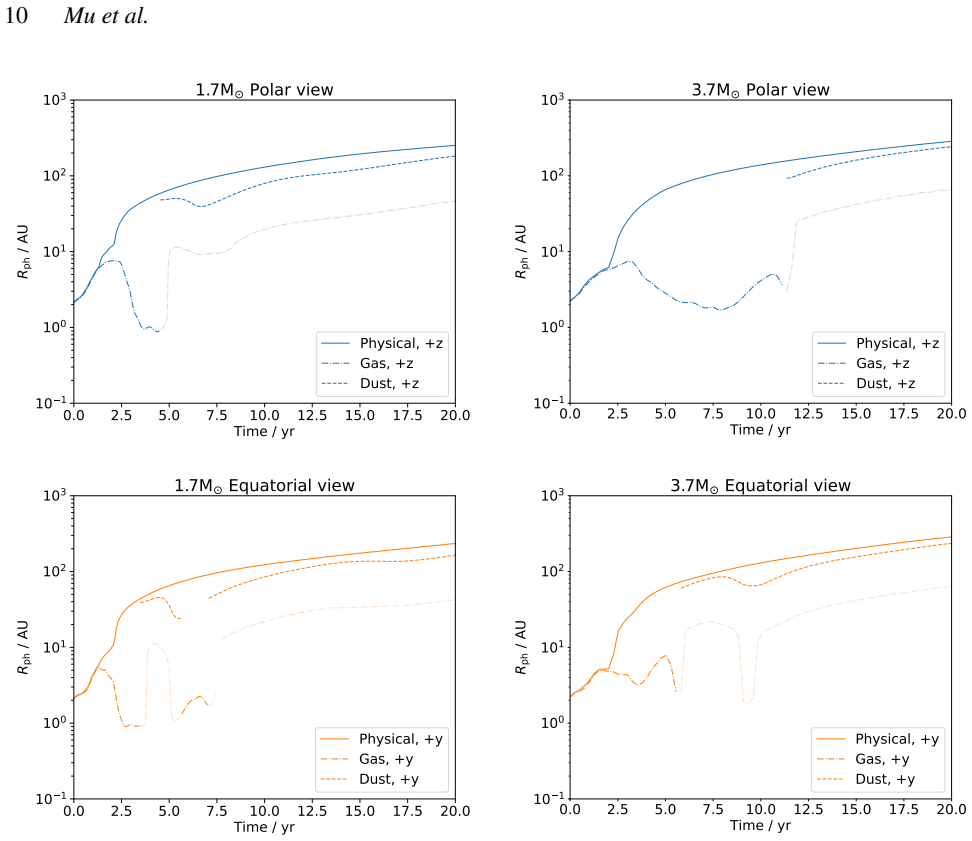
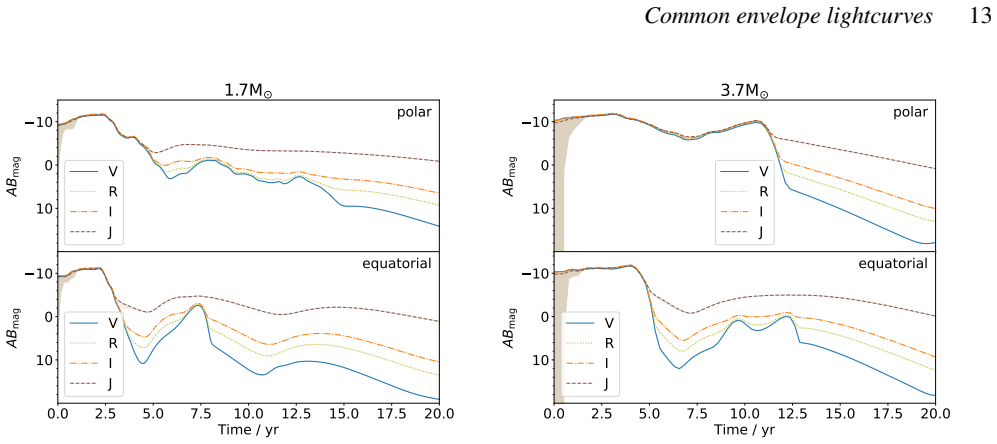
Post-processing light-curve calculations for 3D simulations of common envelope binary interactions, including dust nucleation, reveal a bright hot peak lasting 3-5 years due to photospheric expansion before and during inspiral. Dust forms 1-3 years after the interaction begins, causing a sharp decline in bolometric luminosity followed by partial recovery and a plateau at an effective temperature of approximately 400 K. The dust photosphere grows to about 250 au, and is predicted to become optically thin at visible wavelengths between 100 and 200 years later, revealing an inner warmer photosphere.
What carries the argument
Post-processed light curves from 3D hydrodynamic simulations with dust nucleation
If this is right
- Additional peaks appear at different times and for different viewing angles due to the asymmetry of the interaction.
- The dust photosphere reaches a size of approximately 250 au by the end of the 44-year simulations.
- Between 100 and 200 years after the interaction, the dust is expected to become optically thin at visible wavelengths, revealing an inner warmer photosphere.
- The simulated light curves provide a match to observed events such as OGLE-2002-BLG-360 and AT 2025abao.
Where Pith is reading between the lines
- The asymmetry of the common envelope interaction implies that observed light curves of luminous red novae depend strongly on the observer's viewing angle.
- These results suggest that dust formation is a key process shaping the later evolution of common envelope transients.
- Extending the simulations beyond adiabatic conditions could reveal how cooling affects the long-term light curve plateau.
Load-bearing premise
The hydrodynamic simulations assume adiabatic conditions over 44 years and have limited surface resolution in the initial phases.
What would settle it
An observed luminous red nova that shows no sharp luminosity decline 1-3 years after outburst onset or lacks a subsequent cool plateau at around 400 K would challenge the dust formation sequence in the models.
Figures



read the original abstract
Luminous red novae are transient events thought to arise from common envelope binary interactions. In this paper, we perform post-processing light-curve calculations for two, 3D hydrodynamic simulations of common envelope events. These simulations model interactions between 1.7 $M_\odot$ and 3.7 $M_\odot$ asymptotic giant branch stars and a 0.6 $M_\odot$ compact companion, including dust nucleation. In both our simulations, which are carried out for 44 years under adiabatic conditions, we observe a bright, hot peak lasting $3-5$ years, primarily due to the expansion of the photosphere before and during inspiral. Additional peaks can be seen appearing at different times and for different viewing angles, due to the asymmetry of the interaction. Dust forms about $1-3$ years after the beginning of the simulated interaction and shortly afterwards we witness a sharp decline in the bolometric luminosity, followed by a partial recovery and a plateau with an effective temperature of $\sim$400 K. The dust photosphere reaches a size of $\sim$250 au by the end of the simulations, but we predict that between 100 and 200 years, the dust will become optically thin at visible wavelengths, revealing an inner, warmer photosphere. The lightcurves obtained have two, well-quantified, but large uncertainties: insufficient surface resolution primarily affecting the first 1-2 years of the simulated lightcurves and the adiabatic assumption that affects primarily the later years. We finally contextualise our simulations within a group of observed luminous red nova transients, drawing particular attention to the outburst of OGLE-2002-BLG-360 and AT 2025abao, which are the closest match to our simulation.
Editorial analysis
A structured set of objections, weighed in public.
Referee Report
Summary. The paper performs post-processing light-curve calculations on two 44-year adiabatic 3D hydrodynamic simulations of common-envelope interactions (1.7 and 3.7 M⊙ AGB primaries with a 0.6 M⊙ companion, including dust nucleation). It reports a bright hot peak of 3–5 years driven by photospheric expansion before/during inspiral, dust formation at 1–3 years followed by a sharp bolometric decline, partial recovery, and a ~400 K plateau; the dust photosphere reaches ~250 au, with a prediction that it becomes optically thin at visible wavelengths between 100–200 years. Results are compared to observed luminous red novae, especially OGLE-2002-BLG-360 and AT 2025abao. The abstract explicitly flags two large uncertainties: insufficient surface resolution (primarily first 1–2 years) and the adiabatic assumption (primarily later years).
Significance. If the reported timelines and shapes prove robust, the work supplies the first multi-year, dust-inclusive light-curve predictions from 3D CE hydrodynamics and offers a concrete link between simulated photospheric expansion/dust nucleation and specific observed transients. The long integration time and inclusion of viewing-angle asymmetry are strengths.
major comments (2)
- [Abstract] Abstract: The central quantitative claims (3–5 yr bright hot peak, dust nucleation at 1–3 yr, subsequent sharp decline and ~400 K plateau, dust photosphere size ~250 au) are extracted from temperature and density fields whose evolution is controlled by the two explicitly flagged uncertainties whose time domains coincide exactly with the reported features. No resolution study or non-adiabatic run is described that would demonstrate that the quoted numbers survive changes in surface resolution or the inclusion of radiative losses.
- [Abstract] Abstract and § (light-curve post-processing description): Because the light curves are obtained by post-processing existing adiabatic hydro runs rather than by self-consistent radiation-hydrodynamics, any deviation from adiabaticity at late times directly alters the density–temperature trajectory that sets both the photospheric radius used for the early peak and the conditions for dust nucleation; the manuscript provides no independent check that the reported decline/plateau timing is insensitive to this assumption.
minor comments (2)
- [Abstract] The abstract states the two uncertainties are “well-quantified” but does not supply the actual quantification (e.g., convergence tests or estimated temperature errors); adding a short paragraph or table with those numbers would strengthen the presentation.
- Figure captions and text should explicitly label which viewing angles correspond to the additional peaks mentioned, to allow readers to assess the claimed asymmetry effects.
Simulated Author's Rebuttal
We thank the referee for their careful reading of the manuscript and for acknowledging the potential significance of the first multi-year, dust-inclusive light-curve predictions from 3D common-envelope hydrodynamics. We address the two major comments below. Both comments correctly identify limitations that the manuscript already flags explicitly in the abstract; our responses explain why the reported results are still presented as baseline predictions from the available simulations.
read point-by-point responses
-
Referee: [Abstract] Abstract: The central quantitative claims (3–5 yr bright hot peak, dust nucleation at 1–3 yr, subsequent sharp decline and ~400 K plateau, dust photosphere size ~250 au) are extracted from temperature and density fields whose evolution is controlled by the two explicitly flagged uncertainties whose time domains coincide exactly with the reported features. No resolution study or non-adiabatic run is described that would demonstrate that the quoted numbers survive changes in surface resolution or the inclusion of radiative losses.
Authors: We agree that the reported timelines fall within the time domains affected by the two uncertainties already highlighted in the abstract. The quantitative values are therefore presented strictly as outcomes of the existing adiabatic simulations rather than as robust predictions independent of those assumptions. A dedicated resolution study or non-adiabatic hydrodynamic run lies outside the scope of this post-processing paper, which uses two previously published 44-year simulations. The manuscript therefore does not claim that the precise numbers (3–5 yr, 1–3 yr, ~250 au) would remain unchanged under different numerical or physical assumptions; instead it supplies the first concrete light-curve shapes and viewing-angle asymmetries obtainable from current 3D CE models that include dust nucleation. revision: no
-
Referee: [Abstract] Abstract and § (light-curve post-processing description): Because the light curves are obtained by post-processing existing adiabatic hydro runs rather than by self-consistent radiation-hydrodynamics, any deviation from adiabaticity at late times directly alters the density–temperature trajectory that sets both the photospheric radius used for the early peak and the conditions for dust nucleation; the manuscript provides no independent check that the reported decline/plateau timing is insensitive to this assumption.
Authors: We concur that the adiabatic assumption is a major limitation for the post-inspiral evolution and that the post-processing method cannot supply an independent verification of the decline/plateau timing. The early (3–5 yr) hot peak is driven by the dynamical photospheric expansion captured in the hydrodynamical runs before significant radiative losses are expected, while the later dust-related features are acknowledged to be sensitive to the adiabatic approximation. The paper therefore frames the ~400 K plateau and 100–200 yr optical thinning as illustrative outcomes under the stated assumptions, not as predictions guaranteed to survive the inclusion of radiative cooling. No additional check is possible without new radiation-hydrodynamic simulations. revision: no
Circularity Check
No significant circularity; results from post-processing of independent hydro simulations
full rationale
The paper computes lightcurves via post-processing of two pre-existing 3D adiabatic hydrodynamic simulations that already include dust nucleation. The reported timelines (3-5 yr hot peak, 1-3 yr dust formation, subsequent decline and ~400 K plateau) and sizes (~250 au dust photosphere) are direct numerical outputs from those simulations, not quantities defined by or fitted within the lightcurve post-processor itself. The manuscript flags resolution and adiabatic limitations but does not rename fitted parameters as predictions or reduce any central claim to a self-citation chain. No self-definitional, fitted-input, or ansatz-smuggling steps appear in the derivation chain.
Axiom & Free-Parameter Ledger
axioms (1)
- domain assumption Adiabatic conditions throughout the 44-year hydrodynamic evolution
Reference graph
Works this paper leans on
-
[1]
SPLASH: An interactive visualisation tool for Smoothed Particle Hydrodynamics simulations
splash: An Interactive Visualisation Tool for Smoothed Particle Hydrodynamics Simulations. , keywords =. doi:10.1071/AS07022 , archivePrefix =. 0709.0832 , primaryClass =
work page internal anchor Pith review Pith/arXiv arXiv doi:10.1071/as07022
-
[2]
Eddington Envelopes: The Fate of Stars on Parabolic Orbits Tidally Disrupted by Supermassive Black Holes. , keywords =. doi:10.3847/2041-8213/ad6862 , archivePrefix =. 2404.09381 , primaryClass =
-
[3]
Forbidden hugs in pandemic times. IV. Panchromatic evolution of three luminous red novae. , keywords =. doi:10.1051/0004-6361/202244684 , archivePrefix =. 2208.02782 , primaryClass =
-
[4]
SN 1997bs in M66: Another Extragalactic Eta Carinae Analog?
SN 1997bs in M66: Another Extragalactic Eta Carinae Analog?. , keywords =. doi:10.1086/317727 , archivePrefix =. astro-ph/0009027 , primaryClass =
work page internal anchor Pith review Pith/arXiv arXiv doi:10.1086/317727
-
[5]
The luminous red nova AT 2018bwo in NGC 45 and its binary yellow supergiant progenitor. , keywords =. doi:10.1051/0004-6361/202140525 , archivePrefix =. 2102.05662 , primaryClass =
-
[6]
Forbidden hugs in pandemic times. III. Observations of the luminous red nova AT 2021biy in the nearby galaxy NGC 4631. , keywords =. doi:10.1051/0004-6361/202244393 , archivePrefix =. 2207.00734 , primaryClass =
-
[7]
Simulating a stellar contact binary merger - I. Stellar models. , keywords =. doi:10.1093/mnras/stab2140 , archivePrefix =. 2107.11480 , primaryClass =
-
[8]
doi:10.5281/zenodo.14712174 , version =
Fouesneau, Morgan , title =. doi:10.5281/zenodo.14712174 , url =
-
[9]
2002, Earth Moon and Planets, 90, 1,
UBVRI passbands. , keywords =. doi:10.1086/132749 , adsurl =
-
[10]
From 3D hydrodynamic simulations of common-envelope interaction to gravitational-wave mergers. , keywords =. doi:10.1051/0004-6361/202142731 , archivePrefix =. 2111.12112 , primaryClass =
-
[11]
Simulating a Stellar Binary Merger. II. Obtaining a Light Curve. , keywords =. doi:10.3847/1538-4357/ada6b8 , archivePrefix =. 2412.06583 , primaryClass =
-
[12]
3D simulations of AGB stellar winds. II. Ray-tracer implementation and impact of radiation on the outflow morphology. , keywords =. doi:10.1051/0004-6361/202346282 , archivePrefix =. 2304.09786 , primaryClass =
-
[13]
The obstructive role of radiation transport in envelope ejection
Common envelopes in massive stars: III. The obstructive role of radiation transport in envelope ejection. , keywords =. doi:10.1051/0004-6361/202554782 , archivePrefix =. 2503.20506 , primaryClass =
-
[14]
Shock-powered light curves of luminous red novae as signatures of pre-dynamical mass-loss in stellar mergers. , keywords =. doi:10.1093/mnras/stx1768 , archivePrefix =. 1705.03895 , primaryClass =
work page internal anchor Pith review Pith/arXiv arXiv doi:10.1093/mnras/stx1768
-
[15]
Bridging the Gap between Luminous Red Novae and Common Envelope Evolution: The Role of Recombination Energy and Radiation Force. , keywords =. doi:10.3847/2041-8213/ad2a47 , archivePrefix =. 2402.05686 , primaryClass =
-
[16]
Hot Springs and Dust Reservoirs: JWST Reveals the Dusty, Molecular Aftermath of Extragalactic Stellar Mergers. , keywords =. doi:10.3847/1538-4357/ae38bf , archivePrefix =. 2508.03932 , primaryClass =
-
[17]
Lessons from the Onset of a Common Envelope Episode: the Remarkable M31 2015 Luminous Red Nova Outburst. , keywords =. doi:10.3847/1538-4357/835/2/282 , archivePrefix =. 1605.01493 , primaryClass =
work page internal anchor Pith review Pith/arXiv arXiv doi:10.3847/1538-4357/835/2/282 2015
-
[18]
Luminous red novae: Stellar mergers or giant eruptions?. , keywords =. doi:10.1051/0004-6361/201935999 , archivePrefix =. 1906.00812 , primaryClass =
-
[19]
Living Reviews in Computational Astrophysics , keywords =
Simulations of common-envelope evolution in binary stellar systems: physical models and numerical techniques. Living Reviews in Computational Astrophysics , keywords =. doi:10.1007/s41115-023-00017-x , archivePrefix =. 2212.07308 , primaryClass =
-
[20]
Dust formation in common envelope binary interaction - I: 3D simulations using the Bowen approximation. , keywords =. doi:10.1093/mnras/stad3748 , archivePrefix =. 2306.16609 , primaryClass =
-
[21]
Low-Temperature Opacities. , keywords =. doi:10.1086/428642 , archivePrefix =. astro-ph/0502045 , primaryClass =
work page internal anchor Pith review Pith/arXiv arXiv doi:10.1086/428642
-
[22]
Andrew Harris and Terrence S. Tricco , title =. 2023 , publisher =. doi:10.21105/joss.05263 , url =
-
[23]
The Limiting Effects of Dust in Brown Dwarf Model Atmospheres
The Limiting Effects of Dust in Brown Dwarf Model Atmospheres. , keywords =. doi:10.1086/321547 , archivePrefix =. astro-ph/0104256 , primaryClass =
work page internal anchor Pith review Pith/arXiv arXiv doi:10.1086/321547
-
[24]
3D models of the circumstellar environments of evolved stars: Formation of multiple spiral structures. , keywords =. doi:10.1093/mnras/stac749 , archivePrefix =. 2203.08318 , primaryClass =
-
[25]
A 3D Radiation Hydrodynamic AGB Binary Model. , keywords =. doi:10.3847/1538-4357/ab7b6e , archivePrefix =. 1910.08027 , primaryClass =
-
[26]
Mass Transfer and Disc Formation in AGB Binary Systems
Mass transfer and disc formation in AGB binary systems. , keywords =. doi:10.1093/mnras/stx680 , archivePrefix =. 1702.06160 , primaryClass =
work page internal anchor Pith review Pith/arXiv arXiv doi:10.1093/mnras/stx680
-
[27]
The central stars of NGC 2346, He 2-36 and NGC 3132
A-type central stars of planetary nebulae - II. The central stars of NGC 2346, He 2-36 and NGC 3132. , year = 1978, month = dec, volume = 185, pages =
1978
-
[28]
doi:10.1093/mnras/stv701 , Eprint =
Likely detection of water-rich asteroid debris in a metal-polluted white dwarf. , archivePrefix = "arXiv", eprint =. doi:10.1093/mnras/stv701 , adsurl =
-
[29]
, archivePrefix = "arXiv", eprint =
The frequency and infrared brightness of circumstellar discs at white dwarfs. , archivePrefix = "arXiv", eprint =. doi:10.1093/mnras/stv282 , adsurl =
-
[30]
, archivePrefix = "arXiv", eprint =
Detectable close-in planets around white dwarfs through late unpacking. , archivePrefix = "arXiv", eprint =. doi:10.1093/mnras/stu2475 , adsurl =
-
[31]
, archivePrefix = "arXiv", eprint =
Evidence for an Anhydrous Carbonaceous Extrasolar Minor Planet. , archivePrefix = "arXiv", eprint =. doi:10.1088/0004-637X/799/1/109 , adsurl =
-
[32]
, archivePrefix = "arXiv", eprint =
Hydrogen delivery onto white dwarfs from remnant exo-Oort cloud comets. , archivePrefix = "arXiv", eprint =. doi:10.1093/mnras/stu2026 , adsurl =
-
[33]
Tidal disruption of an extremely eccentric asteroid
Formation of planetary debris discs around white dwarfs - I. Tidal disruption of an extremely eccentric asteroid. , archivePrefix = "arXiv", eprint =. doi:10.1093/mnras/stu1871 , adsurl =
-
[34]
, archivePrefix = "arXiv", eprint =
Variable emission from a gaseous disc around a metal-polluted white dwarf. , archivePrefix = "arXiv", eprint =. doi:10.1093/mnras/stu1876 , adsurl =
-
[35]
, archivePrefix = "arXiv", eprint =
Comparison of Atmospheric Parameters Determined from Spectroscopy and Photometry for DA White Dwarfs in the Sloan Digital Sky Survey. , archivePrefix = "arXiv", eprint =. doi:10.1088/0004-637X/796/2/128 , adsurl =
-
[36]
, archivePrefix = "arXiv", eprint =
Non-LTE spectral models for the gaseous debris-disk component of Ton 345. , archivePrefix = "arXiv", eprint =. doi:10.1051/0004-6361/201423690 , adsurl =
-
[37]
, archivePrefix = "arXiv", eprint =
The Drop during Less than 300 Days of a Dusty White Dwarf's Infrared Luminosity. , archivePrefix = "arXiv", eprint =. doi:10.1088/2041-8205/792/2/L39 , adsurl =
-
[38]
, archivePrefix = "arXiv", eprint =
Accelerated post-AGB evolution, initial-final mass relations, and the star-formation history of the Galactic bulge. , archivePrefix = "arXiv", eprint =. doi:10.1051/0004-6361/201118391 , adsurl =
-
[39]
, archivePrefix = "arXiv", eprint =
The frequency of planetary debris around young white dwarfs. , archivePrefix = "arXiv", eprint =. doi:10.1051/0004-6361/201423691 , adsurl =
-
[40]
, archivePrefix = "arXiv", eprint =
Evidence for an external origin of heavy elements in hot DA white dwarfs. , archivePrefix = "arXiv", eprint =. doi:10.1093/mnras/stu216 , adsurl =
-
[41]
Annual Review of Earth and Planetary Sciences , year = 2014, month = may, volume = 42, pages =
Extrasolar Cosmochemistry. Annual Review of Earth and Planetary Sciences , year = 2014, month = may, volume = 42, pages =. doi:10.1146/annurev-earth-060313-054740 , adsurl =
-
[42]
, archivePrefix = "arXiv", eprint =
Dusty WDs in the WISE All Sky Survey SDSS. , archivePrefix = "arXiv", eprint =. doi:10.1088/0004-637X/786/2/77 , adsurl =
-
[43]
The X-shooter Spectral Library (XSL). I. DR1: Near-ultraviolet through optical spectra from the first year of the survey. , archivePrefix = "arXiv", eprint =. doi:10.1051/0004-6361/201322505 , adsurl =
-
[44]
, archivePrefix = "arXiv", eprint =
Elemental Compositions of Two Extrasolar Rocky Planetesimals. , archivePrefix = "arXiv", eprint =. doi:10.1088/0004-637X/783/2/79 , adsurl =
-
[45]
, archivePrefix = "arXiv", eprint =
Radiative levitation of silicon in the atmospheres of two Hyades DA white dwarfs. , archivePrefix = "arXiv", eprint =. doi:10.1093/mnrasl/slt149 , adsurl =
-
[46]
Science , archivePrefix = "arXiv", eprint =
Evidence for Water in the Rocky Debris of a Disrupted Extrasolar Minor Planet. Science , archivePrefix = "arXiv", eprint =. doi:10.1126/science.1239447 , adsurl =
-
[47]
, archivePrefix = "arXiv", eprint =
Two Beyond-primitive Extrasolar Planetesimals. , archivePrefix = "arXiv", eprint =. doi:10.1088/0004-637X/766/2/132 , adsurl =
-
[48]
Proceedings of the National Academy of Science , year = 2012, month = nov, volume = 109, pages =
Carbon and other light element contents in the Earth's core based on first-principles molecular dynamics. Proceedings of the National Academy of Science , year = 2012, month = nov, volume = 109, pages =. doi:10.1073/pnas.1203826109 , adsurl =
-
[49]
The chemical diversity of exo-terrestrial planetary debris around white dwarfs. , archivePrefix = "arXiv", eprint =. doi:10.1111/j.1365-2966.2012.21201.x , adsurl =
-
[50]
, archivePrefix = "arXiv", eprint =
Gaseous Material Orbiting the Polluted, Dusty White Dwarf HE 1349-2305. , archivePrefix = "arXiv", eprint =. doi:10.1088/2041-8205/751/1/L4 , adsurl =
-
[51]
Double core evolution. I. A 16 M sun star with a 1 M sun neutron-star companion. , keywords =. 1978. doi:10.1086/156142 , adsurl =
-
[52]
, archivePrefix = "arXiv", eprint =
Detection of Keplerian dynamics in a disk around the post-AGB star AC Herculis. , archivePrefix = "arXiv", eprint =. doi:10.1051/0004-6361/201525742 , adsurl =
-
[53]
The effect of a wider initial separation on common envelope binary interaction simulations
The effect of a wider initial separation on common envelope binary interaction simulations. , keywords =. doi:10.1093/mnras/stw2377 , archivePrefix =. 1603.01953 , primaryClass =
work page internal anchor Pith review Pith/arXiv arXiv doi:10.1093/mnras/stw2377
-
[54]
Formation pathway for lonely stripped-envelope supernova progenitors: implications for Cassiopeia A. , keywords =. doi:10.1093/mnras/staa2898 , archivePrefix =. 2008.05076 , primaryClass =
-
[55]
E pur si muove: Galilean-invariant cosmological hydrodynamical simulations on a moving mesh. , keywords =. doi:10.1111/j.1365-2966.2009.15715.x , archivePrefix =. 0901.4107 , primaryClass =
-
[56]
Journal of Computational Physics , year = 2013, month = mar, volume =
Efficient parallelization for AMR MHD multiphysics calculations; implementation in AstroBEAR. Journal of Computational Physics , year = 2013, month = mar, volume =. doi:10.1016/j.jcp.2012.10.004 , adsurl =
-
[57]
Properties of the post in-spiral common envelope ejecta II: dust formation. , keywords =. doi:10.1093/mnras/staa2169 , archivePrefix =. 2003.06151 , primaryClass =
-
[58]
Dynamical and thermal evolution
Properties of the post-inspiral common envelope ejecta - I. Dynamical and thermal evolution. , keywords =. 2019. doi:10.1093/mnras/stz2312 , archivePrefix =. 1907.03980 , primaryClass =
-
[59]
Density Conversion between 1D and 3D Stellar Models with ^ 1D MESA2HYDRO ^ 3D. , keywords =. 2019. doi:10.3847/1538-4357/ab3405 , archivePrefix =. 1907.09062 , primaryClass =
-
[60]
Speaking with one voice: simulations and observations discuss the common envelope parameter. , keywords =. 2019. doi:10.1093/mnras/stz2756 , archivePrefix =. 1902.02039 , primaryClass =
-
[61]
Extending Common Envelope Simulations from Roche Lobe Overflow to the Nebular Phase
Extending common envelope simulations from Roche lobe overflow to the nebular phase. , keywords =. doi:10.1093/mnras/sty3485 , archivePrefix =. 1809.02297 , primaryClass =
work page internal anchor Pith review Pith/arXiv arXiv doi:10.1093/mnras/sty3485
-
[62]
Monthly Notices of the Royal Astronomical Society , volume=
The impact of recombination energy on simulations of the common-envelope binary interaction , author=. Monthly Notices of the Royal Astronomical Society , volume=. 2020 , publisher=
2020
-
[63]
Smoothed Particle Hydrodynamics and Magnetohydrodynamics
Smoothed particle hydrodynamics and magnetohydrodynamics. Journal of Computational Physics , keywords =. doi:10.1016/j.jcp.2010.12.011 , archivePrefix =. 1012.1885 , primaryClass =
work page internal anchor Pith review Pith/arXiv arXiv doi:10.1016/j.jcp.2010.12.011 2010
-
[64]
Phantom: A smoothed particle hydrodynamics and magnetohydrodynamics code for astrophysics
Phantom: A Smoothed Particle Hydrodynamics and Magnetohydrodynamics Code for Astrophysics. , keywords =. 2018. doi:10.1017/pasa.2018.25 , archivePrefix =. 1702.03930 , primaryClass =
work page internal anchor Pith review Pith/arXiv arXiv doi:10.1017/pasa.2018.25 2018
-
[65]
Super asymptotic giant branch stars. I - Evolution code comparison. , keywords =. 2010. doi:10.1111/j.1365-2966.2009.15772.x , adsurl =
-
[66]
Evolution of massive AGB stars. III. the thermally pulsing super-AGB phase. , keywords =. 2010. doi:10.1051/0004-6361/200913556 , adsurl =
-
[67]
, archivePrefix = "arXiv", eprint =
A mid-IR interferometric survey with MIDI/VLTI: resolving the second-generation protoplanetary disks around post-AGB binaries. , archivePrefix = "arXiv", eprint =. doi:10.1051/0004-6361/201629161 , adsurl =
-
[68]
arXiv e-prints , archivePrefix = "arXiv", eprint =
Gas Flows Within Cavities of Circumbinary Discs in Eccentric Binary Protostellar Systems. arXiv e-prints , archivePrefix = "arXiv", eprint =
-
[69]
, archivePrefix = "arXiv", eprint =
The planets around NN Serpentis: still there. , archivePrefix = "arXiv", eprint =. doi:10.1093/mnras/stt1903 , adsurl =
-
[70]
, archivePrefix = "arXiv", eprint =
A Spitzer Space Telescope Study of the Debris Disks around Four SDSS White Dwarfs. , archivePrefix = "arXiv", eprint =. doi:10.1088/0004-637X/750/1/86 , adsurl =
-
[71]
, archivePrefix = "arXiv", eprint =
Two Extrasolar Asteroids with Low Volatile-element Mass Fractions. , archivePrefix = "arXiv", eprint =. doi:10.1088/0004-637X/750/1/69 , adsurl =
-
[72]
A trio of metal-rich dust and gas discs found orbiting candidate white dwarfs with K-band excess. , archivePrefix = "arXiv", eprint =. doi:10.1111/j.1365-2966.2012.20421.x , adsurl =
-
[73]
, archivePrefix = "arXiv", eprint =
Constraints on the Lifetimes of Disks Resulting from Tidally Destroyed Rocky Planetary Bodies. , archivePrefix = "arXiv", eprint =. doi:10.1088/0004-637X/749/2/154 , adsurl =
-
[74]
, archivePrefix = "arXiv", eprint =
Detailed Compositional Analysis of the Heavily Polluted DBZ White Dwarf SDSS J073842.56+183509.06: A Window on Planet Formation?. , archivePrefix = "arXiv", eprint =. doi:10.1088/0004-637X/749/1/6 , adsurl =
-
[75]
, archivePrefix = "arXiv", eprint =
The Link between Planetary Systems, Dusty White Dwarfs, and Metal-polluted White Dwarfs. , archivePrefix = "arXiv", eprint =. doi:10.1088/0004-637X/747/2/148 , adsurl =
-
[76]
, archivePrefix = "arXiv", eprint =
The Cosmic Origins Spectrograph. , archivePrefix = "arXiv", eprint =. doi:10.1088/0004-637X/744/1/60 , adsurl =
-
[77]
, archivePrefix = "arXiv", eprint =
Water Fractions in Extrasolar Planetesimals. , archivePrefix = "arXiv", eprint =. doi:10.1088/0004-6256/143/1/6 , adsurl =
-
[78]
, archivePrefix = "arXiv", eprint =
X-shooter, the new wide band intermediate resolution spectrograph at the ESO Very Large Telescope. , archivePrefix = "arXiv", eprint =. doi:10.1051/0004-6361/201117752 , adsurl =
-
[79]
, archivePrefix = "arXiv", eprint =
Rocky Extrasolar Planetary Compositions Derived from Externally Polluted White Dwarfs. , archivePrefix = "arXiv", eprint =. doi:10.1088/0004-637X/741/1/64 , adsurl =
-
[80]
Monthly Notices of the Royal Astronomical Society , author =
DA white dwarfs in Sloan Digital Sky Survey Data Release 7 and a search for infrared excess emission. , archivePrefix = "arXiv", eprint =. doi:10.1111/j.1365-2966.2011.19337.x , adsurl =
discussion (0)
Sign in with ORCID, Apple, or X to comment. Anyone can read and Pith papers without signing in.