Extreme Mass Ratio Inspirals in Light of Quasi-periodic Eruptions: Milli-Hertz Gravitational Wave Background
Pith reviewed 2026-06-29 03:48 UTC · model grok-4.3
The pith
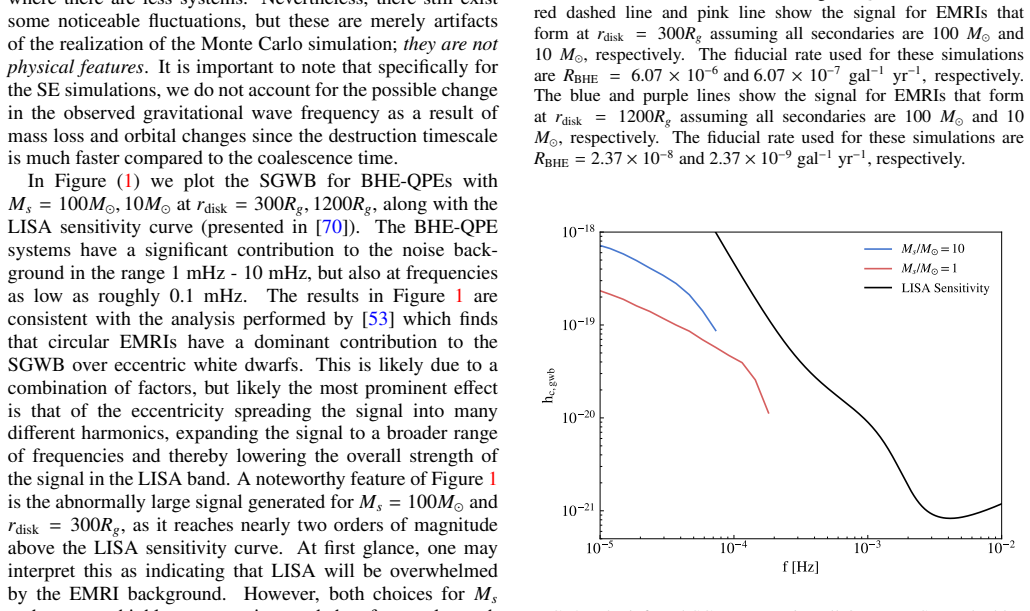
Black hole EMRIs traced by QPEs can exceed LISA sensitivity for the milliHertz SGWB while stellar EMRIs remain below it.
A machine-rendered reading of the paper's core claim, the machinery that carries it, and where it could break.
Core claim
Using rates inferred from QPE detections under the disk-collision model, black hole EMRIs contribute to the SGWB in the 1-10 mHz band at levels ranging from just below to roughly two orders of magnitude above the LISA sensitivity curve, depending on the secondary mass and formation radius, whereas stellar EMRIs contribute only to sub-milliHertz frequencies and remain below the LISA curve.
What carries the argument
The disk-collision model linking QPE flares to twice-per-orbit collisions of circular EMRIs with a TDE-formed disk, used to infer fiducial EMRI formation rates of 2.88e-6 (stellar) and 6.07e-6 (black hole) per galaxy per year.
If this is right
- Black hole EMRIs alone can produce a detectable or dominant milliHertz SGWB for LISA.
- Stellar EMRIs do not contribute to the 1-10 mHz band resolvable by LISA.
- The SGWB strength from black hole EMRIs scales with secondary mass and the radius at which the EMRI forms.
- Current QPE detections set the black hole EMRI rate at roughly 6 times 10 to the minus 6 per galaxy per year.
Where Pith is reading between the lines
- LISA observations of the milliHertz background could test whether QPEs trace the dominant EMRI channel.
- More QPE detections would narrow the predicted range and reduce systematic uncertainty in the LISA forecast.
- The separation between stellar and black hole contributions opens a path to use combined X-ray and gravitational-wave data to identify the secondary type.
Load-bearing premise
The disk-collision model is the correct explanation for all observed QPEs and that these QPEs directly trace the full population of circular EMRIs without large selection biases or dominant alternative channels.
What would settle it
A direct measurement of the SGWB amplitude in the 1-10 mHz band that falls outside the range predicted from the QPE-inferred black hole EMRI rates, or the detection of QPEs that do not occur twice per orbit or lack an associated TDE disk.
Figures

read the original abstract
Quasi-periodic eruptions (QPEs) are repeated X-ray bursts originating in galactic nuclei. Of the many proposed models, the favored model is the disk-collision model in which a stellar mass orbiter collides with a disk formed from a tidal disruption event, generating flares twice per orbit. In this model QPEs are tracers of circular extreme mass ratio inspirals (EMRIs) and can be used to infer the EMRI formation rate and estimate their contribution to the stochastic gravitational wave background (SGWB) in the Laser Interferometer Space Antenna (LISA) band. Whether the secondary is a stellar-mass black hole or a main sequence star is still debated and leads to different results for the EMRI rate and SGWB. We obtain fiducial rates -- subject to systematic uncertainties -- of $R_{\rm SE} = 2.88\times10^{-6}$ per galaxy per year for stellar EMRIs and $R_{\rm BHE} = 6.07\times10^{-6}$ per galaxy per year for black hole EMRIs, then estimate their contribution to the SGWB. We find that only black hole EMRIs contribute to the 1 - 10 milliHertz band resolvable by LISA, and depending on the secondary mass and formation radius can contribute from just below the LISA sensitivity curve to roughly two orders of magnitude above it. Stellar EMRIs, being tidally disrupted before reaching the 1 - 10 milliHertz band, only contribute to sub-milliHertz frequencies and remain below the LISA sensitivity curve.
Editorial analysis
A structured set of objections, weighed in public.
Referee Report
Summary. The manuscript uses the disk-collision model to interpret observed QPEs as tracers of circular EMRIs, deriving fiducial formation rates R_SE = 2.88×10^{-6} and R_BHE = 6.07×10^{-6} per galaxy per year. It then computes the resulting SGWB in the LISA band, concluding that only black-hole EMRIs reach the 1-10 mHz range (potentially exceeding LISA sensitivity depending on secondary mass and formation radius) while stellar EMRIs are tidally disrupted earlier and contribute only below 1 mHz at amplitudes below the LISA curve.
Significance. If the rates and disruption assumptions hold, the work supplies concrete, falsifiable numerical predictions linking electromagnetic QPE detections to the milli-Hz SGWB amplitude, which is directly relevant for LISA data analysis and EMRI population studies. The explicit separation of stellar versus black-hole secondary contributions and the parameter-dependent amplitude range constitute a clear, testable output.
major comments (2)
- [Rate derivation section] Rate derivation section (preceding the SGWB calculation): the fiducial values R_SE and R_BHE are stated without explicit steps, data-selection criteria, number of QPE sources used, or error propagation from observed flare properties to formation rates. Because the subsequent SGWB amplitude is obtained by direct insertion of these rates into the model equations, the lack of a traceable derivation renders the 1-10 mHz claims load-bearing on unverified normalizations.
- [SGWB contribution section] Section computing the frequency-dependent SGWB (the paragraph containing the 1-10 mHz statement): the assertion that stellar EMRIs are tidally disrupted before entering the LISA band rests on the specific secondary-mass and formation-radius assumptions adopted for the disk-collision scenario. No quantitative assessment of selection biases in current QPE detections (inclination, host-galaxy type, or secondary mass) or exclusion of alternative QPE mechanisms is supplied, so the claimed separation between SE and BHE contributions is not protected against order-of-magnitude shifts in the input rates.
minor comments (2)
- The abstract flags 'systematic uncertainties' but the main text should include an explicit error budget or sensitivity analysis showing how the SGWB amplitude changes when R_SE and R_BHE are varied within plausible ranges.
- Notation for the two rates (R_SE, R_BHE) is introduced without a dedicated table summarizing the observational inputs and model parameters used to obtain the numerical values.
Simulated Author's Rebuttal
We thank the referee for the constructive feedback on our manuscript. The comments highlight important areas for improving transparency in the rate derivation and clarifying the model assumptions and biases in the SGWB section. We address each major comment below and indicate planned revisions.
read point-by-point responses
-
Referee: [Rate derivation section] Rate derivation section (preceding the SGWB calculation): the fiducial values R_SE and R_BHE are stated without explicit steps, data-selection criteria, number of QPE sources used, or error propagation from observed flare properties to formation rates. Because the subsequent SGWB amplitude is obtained by direct insertion of these rates into the model equations, the lack of a traceable derivation renders the 1-10 mHz claims load-bearing on unverified normalizations.
Authors: We agree that the rate derivation requires greater traceability. The fiducial rates are obtained by scaling the observed QPE occurrence with the TDE fraction and QPE-phase lifetime under the disk-collision model, but the manuscript does not provide the explicit steps, source list, or error propagation. We will add a dedicated subsection detailing the five known QPE sources, selection criteria based on X-ray periodicity, and propagation of uncertainties from flare properties, while retaining the note on systematic uncertainties already present in the abstract. revision: yes
-
Referee: [SGWB contribution section] Section computing the frequency-dependent SGWB (the paragraph containing the 1-10 mHz statement): the assertion that stellar EMRIs are tidally disrupted before entering the LISA band rests on the specific secondary-mass and formation-radius assumptions adopted for the disk-collision scenario. No quantitative assessment of selection biases in current QPE detections (inclination, host-galaxy type, or secondary mass) or exclusion of alternative QPE mechanisms is supplied, so the claimed separation between SE and BHE contributions is not protected against order-of-magnitude shifts in the input rates.
Authors: The separation between stellar and black-hole EMRIs follows from the tidal radii under the disk-collision model assumptions for secondary mass and formation radius, which are stated in the text. We will expand the relevant paragraph to include a quantitative estimate of selection biases (e.g., inclination and host-galaxy preferences in current detections that could shift rates by up to an order of magnitude) and will explicitly state that the analysis is conditional on the disk-collision model, with alternative mechanisms discussed only in the introduction. This provides the requested protection against misinterpretation while remaining within the paper's scope. revision: partial
Circularity Check
No significant circularity; rates inferred from observations then used for separate SGWB estimate
full rationale
The paper infers fiducial EMRI rates R_SE and R_BHE from QPE detections under the disk-collision model, then computes the resulting SGWB amplitude in the LISA band. The central distinction (stellar EMRIs tidally disrupted before 1-10 mHz while BH EMRIs reach that band) follows from orbital dynamics and tidal radius calculations, independent of the numerical rate values. No self-definitional steps, no fitted parameter renamed as a prediction of the same quantity, and no load-bearing self-citations appear in the provided abstract or derivation outline. The SGWB result is a downstream calculation from empirical inputs rather than a quantity forced by construction to equal those inputs.
Axiom & Free-Parameter Ledger
free parameters (1)
- R_SE and R_BHE
axioms (1)
- domain assumption QPEs are produced by stellar-mass objects on circular orbits colliding with a TDE-formed disk twice per orbit.
Reference graph
Works this paper leans on
-
[1]
Rx j1301.9+2747: A highly variable seyfert galaxy with ex- tremely soft x-ray emission,
Luming Sun, Xinwen Shu, and Tinggui Wang, “Rx j1301.9+2747: A highly variable seyfert galaxy with ex- tremely soft x-ray emission,” The Astrophysical Journal768, 167 (2013)
2013
-
[2]
X-ray quasi-periodic erup- tions from two previously quiescent galaxies,
R. Arcodia, A. Merloni, K. Nandra, J. Buchner, M. Sal- vato, D. Pasham, R. Remillard, J. Comparat, G. Lamer, G. Ponti, A. Malyali, J. Wolf, Z. Arzoumanian, D. Bogens- berger, D. A. H. Buckley, K. Gendreau, M. Gromadzki, E. Kara, M. Krumpe, C. Markwardt, M. E. Ramos-Ceja, A. Rau, M. Schramm, and A. Schwope, “X-ray quasi-periodic erup- tions from two previo...
2021
-
[3]
The complex time and energy evolution of quasi- periodic eruptions in ero-qpe1,
R. Arcodia, G. Miniutti, G. Ponti, J. Buchner, M. Giustini, A. Merloni, K. Nandra, F. Vincentelli, E. Kara, M. Salvato, and D. Pasham, “The complex time and energy evolution of quasi- periodic eruptions in ero-qpe1,” Astronomy & Astrophysics 662, A49 (2022)
2022
-
[4]
The more the merrier: Srg/erosita discovers two further galaxies showing x-ray quasi-periodic eruptions,
R. Arcodia, Z. Liu, A. Merloni, A. Malyali, A. Rau, J. Chakraborty, A. Goodwin, D. Buckley, J. Brink, M. Gro- madzki, Z. Arzoumanian, J. Buchner, E. Kara, K. Nandra, G. Ponti, M. Salvato, G. Anderson, P. Baldini, I. Grotova, M. Krumpe, C. Maitra, J. C. A. Miller-Jones, and M. E. Ramos- Ceja, “The more the merrier: Srg/erosita discovers two further galaxie...
2024
-
[5]
Possible x- ray quasi-periodic eruptions in a tidal disruption event candi- date,
Joheen Chakraborty, Erin Kara, Megan Masterson, Margherita Giustini, Giovanni Miniutti, and Richard Saxton, “Possible x- ray quasi-periodic eruptions in a tidal disruption event candi- date,” The Astrophysical Journal Letters921, L40 (2021)
2021
-
[6]
Monthly quasi- periodic eruptions from repeated stellar disruption by a massive black hole,
P. A. Evans, C. J. Nixon, S. Campana, P. Charalampopou- los, D. A. Perley, A. A. Breeveld, K. L. Page, S. R. Oates, R. A. J. Eyles-Ferris, D. B. Malesani, L. Izzo, M. R. Goad, P. T. O’Brien, J. P. Osborne, and B. Sbarufatti, “Monthly quasi- periodic eruptions from repeated stellar disruption by a massive black hole,” Nature Astronomy7, 1368–1375 (2023)
2023
-
[7]
X-ray quasi-periodic eruptions from the galactic nu- cleus of rx j1301.9+2747,
Margherita Giustini, Giovanni Miniutti, and Richard D. Sax- ton, “X-ray quasi-periodic eruptions from the galactic nu- cleus of rx j1301.9+2747,” Astronomy & Astrophysics636, L2 (2020)
2020
-
[8]
X-ray eruptions every 22 days from the nucleus of a nearby galaxy,
Muryel Guolo, Dheeraj R. Pasham, Michal Zaja ˇcek, Eric R. Coughlin, Suvi Gezari, Petra Sukov´a, Thomas Wevers, V ojtˇech Witzany, Francesco Tombesi, Sjoert van Velzen, Kate D. Alexander, Yuhan Yao, Riccardo Arcodia, Vladim ´ır Karas, James C. A. Miller-Jones, Ronald Remillard, Keith Gendreau, and Elizabeth C. Ferrara, “X-ray eruptions every 22 days from ...
2024
-
[9]
Discovery of extreme quasi-periodic eruptions in a newly accreting massive black hole,
Lorena Hern ´andez-Garc´ıa, Joheen Chakraborty, Paula S´anchez- S´aez, Claudio Ricci, Jorge Cuadra, Barry McKernan, K. E. Saavik Ford, Patricia Ar ´evalo, Arne Rau, Riccardo Ar- codia, Erin Kara, Zhu Liu, Andrea Merloni, Gabriele Bruni, Adelle Goodwin, Zaven Arzoumanian, Roberto J. Assef, Pietro Baldini, Amelia Bayo, Franz E. Bauer, Santiago Bernal, Murra...
2025
-
[10]
Nine-hour x-ray quasi-periodic eruptions from a low-mass black hole galactic nucleus,
G. Miniutti, R. D. Saxton, M. Giustini, K. D. Alexander, R. P. Fender, I. Heywood, I. Monageng, M. Coriat, A. K. Tzioumis, A. M. Read, C. Knigge, P. Gandhi, M. L. Pretorius, and B. Ag´ıs-Gonz´alez, “Nine-hour x-ray quasi-periodic eruptions from a low-mass black hole galactic nucleus,” Nature573, 381– 384 (2019)
2019
-
[11]
Repeating tidal dis- ruptions in gsn 069: Long-term evolution and constraints on quasi-periodic eruptions’ models,
G. Miniutti, M. Giustini, R. Arcodia, R. D. Saxton, A. M. Read, S. Bianchi, and K. D. Alexander, “Repeating tidal dis- ruptions in gsn 069: Long-term evolution and constraints on quasi-periodic eruptions’ models,” Astronomy & Astrophysics 670, A93 (2023)
2023
-
[12]
Alive and kick- ing: A new qpe phase in gsn 069 revealing a quiescent lumi- nosity threshold for qpes,
G. Miniutti, M. Giustini, R. Arcodia, R. D. Saxton, J. Chakraborty, A. M. Read, and E. Kara, “Alive and kick- ing: A new qpe phase in gsn 069 revealing a quiescent lumi- nosity threshold for qpes,” Astronomy & Astrophysics674, L1 (2023)
2023
-
[13]
Quasi-periodic x-ray eruptions years after a nearby tidal dis- ruption event,
M. Nicholl, D. R. Pasham, A. Mummery, M. Guolo, K. Gen- dreau, G. C. Dewangan, E. C. Ferrara, R. Remillard, C. Bon- nerot, J. Chakraborty, A. Hajela, V . S. Dhillon, A. F. Gillan, J. Greenwood, M. E. Huber, A. Janiuk, G. Salvesen, S. van Velzen, A. Aamer, K. D. Alexander, C. R. Angus, Z. Arzou- manian, K. Auchettl, E. Berger, T. de Boer, Y . Cendes, K. C....
2024
-
[14]
Tormund’s return: Hints of quasi- periodic eruption features from a recent optical tidal disruption event,
E. Quintin, N. A. Webb, S. Guillot, G. Miniutti, E. S. Kam- moun, M. Giustini, R. Arcodia, G. Soucail, N. Clerc, R. Am- ato, and C. B. Markwardt, “Tormund’s return: Hints of quasi- periodic eruption features from a recent optical tidal disruption event,” Astronomy & Astrophysics675, A152 (2023)
2023
-
[15]
Host galaxy properties of quasi-periodically erupting x- ray sources,
T. Wevers, D. R. Pasham, P. Jalan, S. Rakshit, and R. Arco- dia, “Host galaxy properties of quasi-periodically erupting x- ray sources,” Astronomy & Astrophysics659, L2 (2022)
2022
-
[16]
Discovery of crested quasi-periodic eruptions following the most luminous srg/erosita tidal disruption event,
P. Baldini, A. Rau, A. Merloni, B. Trakhtenbrot, R. Arco- dia, M. Giustini, G. Miniutti, S. J. Brennan, M. Freyberg, P. S´anchez-S´aez, I. Grotova, Z. Liu, T. Lian, and K. Nandra, “Discovery of crested quasi-periodic eruptions following the most luminous srg/erosita tidal disruption event,” Astronomy & Astrophysics706, L15 (2026)
2026
-
[17]
A torus remnant revealed by the infrared echo of tidal disruption event at 2019qiz: Implications for the missing energy and quasiperiodic eruption formation,
Mingxin Wu, Ning Jiang, Jiazheng Zhu, Di Luo, Liming Dou, and Tinggui Wang, “A torus remnant revealed by the infrared echo of tidal disruption event at 2019qiz: Implications for the missing energy and quasiperiodic eruption formation,” The As- trophysical Journal Letters988, L77 (2025)
2025
-
[18]
Joheen Chakraborty, Erin Kara, Riccardo Arcodia, Johannes Buchner, Margherita Giustini, Lorena Hern ´andez-Garc´ıa, Itai Linial, Megan Masterson, Giovanni Miniutti, Andrew Mum- mery, Christos Panagiotou, Erwan Quintin, and Paula S´anchez- S´aez, “Discovery of quasi-periodic eruptions in the tidal disrup- tion event and extreme coronal line emitter at2022u...
arXiv 2025
-
[19]
X-ray quasi- periodic eruptions and tidal disruption events prefer similar host galaxies,
T. Wevers, K. D. French, A. I. Zabludoff, T. C. Fischer, K. Row- lands, M. Guolo, B. Dalla Barba, R. Arcodia, M. Berton, F. Bian, I. Linial, G. Miniutti, and D. R. Pasham, “X-ray quasi- periodic eruptions and tidal disruption events prefer similar host galaxies,” The Astrophysical Journal Letters970, L23 (2024)
2024
-
[20]
Extended emission-line region in a poststarburst galaxy hosting tidal disruption event at2019qiz and quasiperiodic erup- tions,
Yifei Xiong, Ning Jiang, Zhen Pan, Lei Hao, and Zhenzhen Li, “Extended emission-line region in a poststarburst galaxy hosting tidal disruption event at2019qiz and quasiperiodic erup- tions,” The Astrophysical Journal989, 49 (2025)
2025
-
[21]
Embers of active galactic nuclei: Tidal disruption events and quasiperiodic eruptions,
Ning Jiang and Zhen Pan, “Embers of active galactic nuclei: Tidal disruption events and quasiperiodic eruptions,” The As- trophysical Journal Letters983, L18 (2025)
2025
-
[22]
Mingxin Wu, Ning Jiang, Jiazheng Zhu, Di Luo, Liming Dou, and Tinggui Wang, “A Torus Remnant Revealed by the Infrared Echo of Tidal Disruption Event AT 2019qiz: Implications for the Missing Energy and Quasiperiodic Eruption Formation,” Astrophys. J. Lett.988, L77 (2025), arXiv:2507.13251 [astro- ph.HE]
arXiv 2025
-
[23]
Gsn 069 – a tidal disruption near miss,
Andrew King, “Gsn 069 – a tidal disruption near miss,” Monthly Notices of the Royal Astronomical Society: Letters 493, L120–L123 (2020)
2020
-
[24]
Quasi-periodic eruptions from galaxy nuclei,
Andrew King, “Quasi-periodic eruptions from galaxy nuclei,” Monthly Notices of the Royal Astronomical Society515, 4344–4349 (2022)
2022
-
[25]
A model for the possible connection between a tidal disruption event and quasi-periodic eruption in gsn 069,
Mengye Wang, Jinjing Yin, Yiqiu Ma, and Qingwen Wu, “A model for the possible connection between a tidal disruption event and quasi-periodic eruption in gsn 069,” The Astrophysi- cal Journal933, 225 (2022)
2022
-
[26]
A disk instability model for the quasi-periodic eruptions of gsn 069,
Xin Pan, Shuang-Liang Li, Xinwu Cao, Giovanni Miniutti, and Minfeng Gu, “A disk instability model for the quasi-periodic eruptions of gsn 069,” The Astrophysical Journal Letters928, L18 (2022)
2022
-
[27]
Modified models of radiation pressure instability applied to 10, 105, and 107 m⊙ accreting black holes,
Marzena ´Sniegowska, Mikołaj Grzedzielski, Bo ˙zena Czerny, and Agnieszka Janiuk, “Modified models of radiation pressure instability applied to 10, 105, and 107 m⊙ accreting black holes,” Astronomy & Astrophysics672, A19 (2023)
2023
-
[28]
Emri+tde=qpe: Periodic x-ray flares from star–disk collisions in galactic nuclei,
Itai Linial and Brian D. Metzger, “Emri+tde=qpe: Periodic x-ray flares from star–disk collisions in galactic nuclei,” The Astrophysical Journal957, 34 (2023)
2023
-
[29]
Quasi- periodic eruptions from impacts between the secondary and a rigidly precessing accretion disc in an extreme mass-ratio in- spiral system,
Alessia Franchini, Matteo Bonetti, Alessandro Lupi, Giovanni Miniutti, Elisa Bortolas, Margherita Giustini, Massimo Dotti, Alberto Sesana, Riccardo Arcodia, and Taeho Ryu, “Quasi- periodic eruptions from impacts between the secondary and a rigidly precessing accretion disc in an extreme mass-ratio in- spiral system,” Astronomy & Astrophysics675, A100 (2023)
2023
-
[30]
X-ray quasi-periodic eruptions driven by star–disk collisions: Application to gsn069 and probing the spin of massive black holes,
Jingtao Xian, Fupeng Zhang, Liming Dou, Jiasheng He, and Xinwen Shu, “X-ray quasi-periodic eruptions driven by star–disk collisions: Application to gsn069 and probing the spin of massive black holes,” The Astrophysical Journal Letters921, L32 (2021)
2021
-
[31]
Quasi-periodic flares from star-accretion-disc collisions,
Lixin (Jane) Dai, Steven V . Fuerst, and Roger Bland- ford, “Quasi-periodic flares from star-accretion-disc collisions,” Monthly Notices of the Royal Astronomical Society402, 1614–1624 (2010)
2010
-
[32]
Probing orbits of stellar mass objects deep in galactic nuclei with quasiperiodic eruptions,
Cong Zhou, Lei Huang, Kangrou Guo, Ya-Ping Li, and Zhen Pan, “Probing orbits of stellar mass objects deep in galactic nuclei with quasiperiodic eruptions,” Physical Review D109 (2024), 10.1103/physrevd.109.103031
-
[33]
Cong Zhou, Binyu Zhong, Yuhe Zeng, Lei Huang, and Zhen Pan, “Probing orbits of stellar mass objects deep in galactic nu- clei with quasiperiodic eruptions. ii. population analysis,” Phys- ical Review D110(2024), 10.1103/physrevd.110.083019
-
[34]
Kun Liu, Shang-Fei Liu, Zhen Pan, Hongping Deng, Rongfeng Shen, and Cong Yu, “Quasi-periodic eruptions from stellar- 8 mass black holes impacting accretion disks in galactic nuclei,” (2026), arXiv:2603.00226 [astro-ph.HE]
arXiv 2026
-
[35]
Shunquan Huang, Xiaoshan Huang, Zhaohuan Zhu, and Rebecca G. Martin, “Resolving oblique star-disk collisions in quasi-periodic eruptions: Numerical requirements and the importance of geometry,” (2026), arXiv:2604.00953 [astro- ph.HE]
Pith/arXiv arXiv 2026
-
[36]
Secular Evolution of Quasiperiodic Eruptions,
Cong Zhou, Yuhe Zeng, and Zhen Pan, “Secular Evolution of Quasiperiodic Eruptions,” Astrophys. J.985, 242 (2025), arXiv:2411.18046 [astro-ph.HE]
arXiv 2025
-
[37]
Testing emri models for quasi-periodic eruptions with 3.5 yr of monitoring ero-qpe1,
Joheen Chakraborty, Riccardo Arcodia, Erin Kara, Giovanni Miniutti, Margherita Giustini, Alexandra J. Tetarenko, Lauren Rhodes, Alessia Franchini, Matteo Bonetti, Kevin B. Burdge, Adelle J. Goodwin, Thomas J. Maccarone, Andrea Merloni, Gabriele Ponti, Ronald A. Remillard, and Richard D. Sax- ton, “Testing emri models for quasi-periodic eruptions with 3.5 ...
2024
-
[38]
Dynamical measurement of supermassive black hole masses: Qpe timing method,
Cong Zhou, Zhen Pan, Ning Jiang, and Wen Zhao, “Dynamical measurement of supermassive black hole masses: Qpe timing method,” Monthly No- tices of the Royal Astronomical Society543, 1816– 1832 (2025), https://academic.oup.com/mnras/article- pdf/543/2/1816/64303418/staf1580.pdf
2025
-
[39]
Joheen Chakraborty, Lisa V . Drummond, Matteo Bonetti, Alessia Franchini, Shubham Kejriwal, Giovanni Miniutti, Ric- cardo Arcodia, Scott A. Hughes, Francisco Duque, Erin Kara, Alberto Sesana, Margherita Giustini, Amedeo Motta, and Kevin Burdge, “Prospects for emri/mbh parameter estimation using quasi-periodic eruption timings: short-timescale analy- sis,”...
arXiv 2025
-
[40]
Quasi-periodic eruptions as a probe of accretion disc in tidal disruption events,
Tomoya Suzuguchi and Tatsuya Matsumoto, “Quasi-periodic eruptions as a probe of accretion disc in tidal disruption events,” Monthly Notices of the Royal Astronomical Society 545, staf2243 (2026), https://academic.oup.com/mnras/article- pdf/545/4/staf2243/66002192/staf2243.pdf
2026
-
[41]
Evolution of quasi- periodic eruptions in the post-tde accretion disk perturbed by an orbiting star,
Martin Mondek, Michal Zaja ˇcek, Henry Best, Taj Jankovi ˇc, Vladim´ır Karas, and Petr Kurf ¨urst, “Evolution of quasi- periodic eruptions in the post-tde accretion disk perturbed by an orbiting star,” (2026), arXiv:2603.28380 [astro-ph.HE]
Pith/arXiv arXiv 2026
-
[42]
Properties of the gsn 069 accretion disk from a joint x-ray and uv spectral analysis: Stress-testing quasi-periodic eruption models,
M. Guolo, A. Mummery, T. Wevers, M. Nicholl, S. Gezari, A. Ingram, and D. R. Pasham, “Properties of the gsn 069 accretion disk from a joint x-ray and uv spectral analysis: Stress-testing quasi-periodic eruption models,” The Astrophys- ical Journal985, 146 (2025)
2025
-
[43]
A time-dependent solution for gsn 069 disk evolution and the nature of long-lived tidal disruption events,
M. Guolo, A. Mummery, A. Ingram, M. Nicholl, S. Gezari, and E. Nathan, “A time-dependent solution for gsn 069 disk evolution and the nature of long-lived tidal disruption events,” The Astrophysical Journal992, 114 (2025)
2025
-
[44]
Cosmic hide and seek: The volumetric rate of x-ray quasi-periodic eruptions,
R. Arcodia, A. Merloni, J. Buchner, P. Baldini, G. Ponti, A. Rau, Z. Liu, K. Nandra, and M. Salvato, “Cosmic hide and seek: The volumetric rate of x-ray quasi-periodic eruptions,” Astronomy & Astrophysics684, L14 (2024)
2024
-
[45]
Two-body relaxation in the emri-tde disk model for quasi periodic eruptions,
Chiara Maria Allievi, Luca Broggi, Alberto Sesana, and Mat- teo Bonetti, “Two-body relaxation in the emri-tde disk model for quasi periodic eruptions,” (2026), arXiv:2603.02302 [astro- ph.HE]
arXiv 2026
-
[46]
Laser interferometer space antenna,
Pau Amaro-Seoane, Heather Audley, Stanislav Babak, John Baker, Enrico Barausse, Peter Bender, Emanuele Berti, Pierre Binetruy, Michael Born, Daniele Bortoluzzi, Jordan Camp, Chiara Caprini, Vitor Cardoso, Monica Colpi, John Conklin, Neil Cornish, Curt Cutler, Karsten Danzmann, Rita Dolesi, Luigi Ferraioli, Valerio Ferroni, Ewan Fitzsimons, Jonathan Gair, ...
Pith/arXiv arXiv 2017
-
[47]
The tianqin project: Current progress on science and technology,
Jianwei Mei, Yan-Zheng Bai, Jiahui Bao, Enrico Barausse, Lin Cai, Enrico Canuto, Bin Cao, Wei-Ming Chen, Yu Chen, Yan-Wei Ding, Hui-Zong Duan, Huimin Fan, Wen-Fan Feng, Honglin Fu, Qing Gao, TianQuan Gao, Yungui Gong, Xingyu Gou, Chao-Zheng Gu, De-Feng Gu, Zi-Qi He, Martin Hendry, Wei Hong, Xin-Chun Hu, Yi-Ming Hu, Yuexin Hu, Shun-Jia Huang, Xiang-Qing Hu...
-
[48]
Sensitivity functions for space-borne gravitational wave detectors,
Xiao-Yu Lu, Yu-Jie Tan, and Cheng-Gang Shao, “Sensitivity functions for space-borne gravitational wave detectors,” Physi- cal Review D100(2019), 10.1103/physrevd.100.044042
-
[49]
Fundamentals of the orbit and response for tianqin,
Xin-Chun Hu, Xiao-Hong Li, Yan Wang, Wen-Fan Feng, Ming- Yue Zhou, Yi-Ming Hu, Shou-Cun Hu, Jian-Wei Mei, and Cheng-Gang Shao, “Fundamentals of the orbit and response for tianqin,” Classical and Quantum Gravity35, 095008 (2018)
2018
-
[50]
Tianqin: a space-borne gravitational wave detector,
Jun Luo, Li-Sheng Chen, Hui-Zong Duan, Yun-Gui Gong, Shoucun Hu, Jianghui Ji, Qi Liu, Jianwei Mei, Vadim Mi- lyukov, Mikhail Sazhin, Cheng-Gang Shao, Viktor T Toth, Hai- Bo Tu, Yamin Wang, Yan Wang, Hsien-Chi Yeh, Ming-Sheng Zhan, Yonghe Zhang, Vladimir Zharov, and Ze-Bing Zhou, “Tianqin: a space-borne gravitational wave detector,” Classical and Quantum G...
2016
-
[51]
The taiji program in space for gravitational wave physics and the nature of gravity,
Wen-Rui Hu and Yue-Liang Wu, “The taiji program in space for gravitational wave physics and the nature of gravity,” National Science Review4, 685–686 (2017)
2017
-
[52]
The taiji program: A concise overview,
Ziren Luo, Yan Wang, Yueliang Wu, Wenrui Hu, and Gang Jin, “The taiji program: A concise overview,” Progress of Theoretical and Experimental Physics2021(2020), 9 10.1093/ptep/ptaa083
-
[53]
Milli- hertz gravitational-wave background produced by quasiperiodic eruptions,
Xian Chen, Yu Qiu, Shuo Li, and F. K. Liu, “Milli- hertz gravitational-wave background produced by quasiperiodic eruptions,” The Astrophysical Journal930, 122 (2022)
2022
-
[54]
Multi-band emission from star-disk collision and implications for quasi- periodic eruptions,
Xiaoshan Huang, Itai Linial, and Yan-Fei Jiang, “Multi-band emission from star-disk collision and implications for quasi- periodic eruptions,” (2025), arXiv:2506.11231 [astro-ph.HE]
arXiv 2025
-
[55]
Radiation-hydrodynamics of star-disc collisions for quasi-periodic eruptions,
Taj Jankovi ˇc, Cl ´ement Bonnerot, Sergey Karpov, and Alek- sej Jurca, “Radiation-hydrodynamics of star-disc collisions for quasi-periodic eruptions,” (2026), arXiv:2602.02656 [astro- ph.HE]
Pith/arXiv arXiv 2026
-
[56]
Radiation transport simulations of quasiperiodic eruptions from star–disk collisions,
Indrek Vurm, Itai Linial, and Brian D. Metzger, “Radiation transport simulations of quasiperiodic eruptions from star–disk collisions,” The Astrophysical Journal983, 40 (2025)
2025
-
[57]
Sierra A. Dodd, Xiaoshan Huang, Shane W. Davis, and Enrico Ramirez-Ruiz, “Perturbing agn accretion disks with stars and moderately massive black holes: Implications for changing-look agn and quasi-periodic eruptions,” (2025), arXiv:2506.19900 [astro-ph.HE]
arXiv 2025
-
[58]
Black hole-accretion disk collision in general relativity: Axisymmetric simulations,
Alan Tsz-Lok Lam, Masaru Shibata, Kyohei Kawaguchi, and Joaquin Pelle, “Black hole-accretion disk collision in general relativity: Axisymmetric simulations,” (2025), arXiv:2504.17016 [astro-ph.HE]
arXiv 2025
-
[59]
The disk accretion of a tidally disrupted star onto a massive black hole,
John K. Cannizzo, Hyung Mok Lee, and Jeremy Goodman, “The disk accretion of a tidally disrupted star onto a massive black hole,” The Astrophysical Journal351, 38 (1990)
1990
-
[60]
Tidal disruption of stars by black holes of 106–108 solar masses in nearby galaxies,
Martin J. Rees, “Tidal disruption of stars by black holes of 106–108 solar masses in nearby galaxies,” Nature333, 523–528 (1988)
1988
-
[61]
Flares from the tidal disruption of stars by massive black holes,
Andrew Ulmer, “Flares from the tidal disruption of stars by massive black holes,” The Astrophysical Journal514, 180–187 (1999)
1999
-
[62]
Optical flares from the tidal disruption of stars by massive black holes: Optical signa- tures of tidally disrupted stars,
Linda E. Strubbe and Eliot Quataert, “Optical flares from the tidal disruption of stars by massive black holes: Optical signa- tures of tidally disrupted stars,” Monthly Notices of the Royal Astronomical Society400, 2070–2084 (2009)
2070
-
[63]
The evolution of viscous discs and the origin of the nebular variables,
D. Lynden-Bell and J. E. Pringle, “The evolution of viscous discs and the origin of the nebular variables,” Monthly Notices of the Royal Astronomical Society168, 603–637 (1974)
1974
-
[64]
Tidal disruption event demographics with the zwicky transient facility: V olumetric rates, luminosity function, and implications for the local black hole mass function,
Yuhan Yao, Vikram Ravi, Suvi Gezari, Sjoert van Velzen, Wen- bin Lu, Steve Schulze, Jean J. Somalwar, S. R. Kulkarni, Er- ica Hammerstein, Matt Nicholl, Matthew J. Graham, Daniel A. Perley, S. Bradley Cenko, Robert Stein, Angelo Ricarte, Ur- mila Chadayammuri, Eliot Quataert, Eric C. Bellm, Joshua S. Bloom, Richard Dekany, Andrew J. Drake, Steven L. Groom...
2023
-
[65]
Science opportunities of wet extreme mass-ratio inspi- rals,
Zhenwei Lyu, Zhen Pan, Junjie Mao, Ning Jiang, and Huan Yang, “Science opportunities of wet extreme mass-ratio inspi- rals,” Physical Review D113(2026), 10.1103/337c-g6x1
-
[66]
Gravitational radiation and the motion of two point masses,
P. C. Peters, “Gravitational radiation and the motion of two point masses,” Physical Review136, B1224–B1232 (1964)
1964
-
[67]
Evidence for the preferential disruption of moderately massive stars by supermassive black holes,
Brenna Mockler, Angela A. Twum, Katie Auchettl, Sierra Dodd, K. D. French, Jamie A. P. Law-Smith, and Enrico Ramirez-Ruiz, “Evidence for the preferential disruption of moderately massive stars by supermassive black holes,” The Astrophysical Journal924, 70 (2022)
2022
-
[68]
Gravitational wave back- ground from extreme mass ratio inspirals,
Matteo Bonetti and Alberto Sesana, “Gravitational wave back- ground from extreme mass ratio inspirals,” Physical Review D 102(2020), 10.1103/physrevd.102.103023
-
[69]
Exploring the local black hole mass function below 10¡sup¿6¡/sup¿ solar masses,
Elena Gallo and Alberto Sesana, “Exploring the local black hole mass function below 10¡sup¿6¡/sup¿ solar masses,” The Astrophysical Journal Letters883, L18 (2019)
2019
-
[70]
The construc- tion and use of lisa sensitivity curves,
Travis Robson, Neil J Cornish, and Chang Liu, “The construc- tion and use of lisa sensitivity curves,” Classical and Quantum Gravity36, 105011 (2019)
2019
-
[71]
Wet extreme mass ratio inspirals may be more common for spaceborne gravita- tional wave detection,
Zhen Pan, Zhenwei Lyu, and Huan Yang, “Wet extreme mass ratio inspirals may be more common for spaceborne gravita- tional wave detection,” Phys. Rev. D104, 063007 (2021)
2021
-
[72]
Formation rate of extreme mass ra- tio inspirals in active galactic nuclei,
Zhen Pan and Huan Yang, “Formation rate of extreme mass ra- tio inspirals in active galactic nuclei,” Phys. Rev. D103, 103018 (2021)
2021
-
[73]
Probing Formation Channels of Extreme Mass-Ratio Inspirals,
Houyi Sun, Ya-Ping Li, Zhen Pan, and Huan Yang, “Probing Formation Channels of Extreme Mass-Ratio Inspirals,” (2025), arXiv:2509.00469 [gr-qc]
arXiv 2025
-
[74]
Relativistic treatment of extreme mass ratio inspirals crossing accretion disks,
Yuhe Zeng and Zhen Pan, “Relativistic treatment of extreme mass ratio inspirals crossing accretion disks,” Phys. Rev. D113, 123002 (2026), arXiv:2601.11925 [astro-ph.HE]
Pith/arXiv arXiv 2026
discussion (0)
Sign in with ORCID, Apple, or X to comment. Anyone can read and Pith papers without signing in.