Properties of the skyrmion crystal SkX-2 in the Heisenberg triangular lattice with scalar chirality
Pith reviewed 2026-05-21 01:55 UTC · model grok-4.3
The pith
A skyrmion crystal with two topological charges per unit cell emerges as the ground state in the Heisenberg triangular lattice when scalar chirality is included.
A machine-rendered reading of the paper's core claim, the machinery that carries it, and where it could break.
Core claim
In the Heisenberg model on the triangular lattice augmented by a scalar chirality interaction, the SkX-2 skyrmion crystal—defined by two topological charges per unit cell and vanishing magnetization at the ferromagnetic point in reciprocal space—becomes the ground state for a range of chirality strengths. Finite-size numerical simulations combined with a theoretical treatment of the transition from the ferromagnetic state quantitatively account for the stabilization and the continuous change in topological charge density with model parameters. At finite temperature the phase displays a first-order transition that breaks translation symmetry and, for certain charge densities, a continuous KTH
What carries the argument
SkX-2 skyrmion crystal, the configuration carrying two topological charges per magnetic unit cell that lowers the energy relative to the ferromagnet once scalar chirality is turned on.
If this is right
- The SkX-2 phase undergoes a first-order transition that breaks translation symmetry at finite temperature.
- For appropriate charge densities the same phase exhibits a continuous transition into a floating solid.
- The tetrahedral phase realized by antiferromagnetic interactions in the same model supports Z2-vortices at finite temperature, pointing to an additional vortex topological transition.
- The topological charge density inside the SkX-2 phase varies continuously with the scalar-chirality strength.
Where Pith is reading between the lines
- Because the stabilization occurs in an SO(3)-symmetric short-range model, analogous skyrmion crystals may appear on other two-dimensional lattices once a comparable chirality term is present.
- The absence of magnetization at the ferromagnetic point could make the SkX-2 phase easier to distinguish from conventional skyrmion crystals in scattering experiments.
- The floating-solid regime may connect to melting phenomena already studied in vortex lattices of type-II superconductors.
Load-bearing premise
Numerical results obtained on finite clusters together with the analytic transition analysis correctly identify SkX-2 as the true ground state rather than being misled by finite-size effects or missing longer-range couplings.
What would settle it
A calculation or measurement on larger systems or in a real material showing that the lowest-energy state for the relevant chirality window has exactly two topological charges per cell and zero magnetization at the ferromagnetic reciprocal-space point would support the claim; failure to find that configuration would falsify it.
Figures



read the original abstract
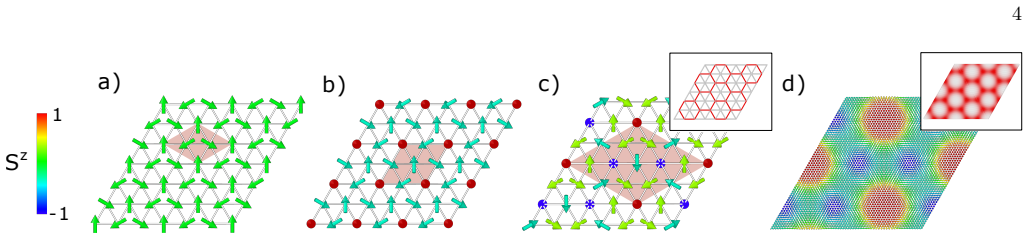
Skyrmion crystals have been primarily discovered under a magnetic field for materials with non-centrosymmetric interactions. More recent developments have investigated the stability of skyrmion crystals in itinerant magnets without magnetic field. In this study, we find that a type of skyrmion crystal with two topological charges per unit cell and no magnetization at the ferromagnetic point in reciprocal space, SkX-2, is naturally stabilized in an $SO(3)$-symmetric model with short-range interactions realized by the Heisenberg model on the triangular lattice with scalar chirality. We complement our numerical results with a theoretical analysis that quantitatively describes the transition from the ferromagnetic ground state to the SkX-2 and the evolution of the topological charge density. Despite the constraints given by the Mermin-Wagner theorem at finite temperature, the SkX-2 exhibits both a first-order phase transition associated with translation symmetry breaking and a continuous transition to a floating solid, depending on the charge density controlled by the model parameters. Finally, the tetrahedral phase supported by an antiferromagnetic interaction in our model is found to host $\mathbb{Z}_2$-vortices at finite temperature, suggesting the existence of an additional vortex topological transition.
Editorial analysis
A structured set of objections, weighed in public.
Referee Report
Summary. The paper studies the Heisenberg model on the triangular lattice with an added scalar chirality term. It claims that a skyrmion crystal phase SkX-2, featuring two topological charges per unit cell and no magnetization at the ferromagnetic reciprocal-space point, is stabilized as the ground state for a window of chirality strength in this SO(3)-symmetric short-range model. Numerical results on finite clusters are complemented by a theoretical analysis of the ferromagnetic-to-SkX-2 transition and topological charge density evolution; the work also addresses finite-temperature transitions (first-order translation-symmetry breaking and continuous to floating solid) and Z2-vortices in the tetrahedral phase supported by antiferromagnetic interactions.
Significance. If the ground-state identification survives the thermodynamic limit, the result would be significant for topological magnetism: it demonstrates stabilization of a multi-Q skyrmion crystal without external fields or Dzyaloshinskii-Moriya interactions in a minimal centrosymmetric spin model. The combination of numerics with a quantitative theoretical description of the transition and charge density is a strength, as is the analysis of finite-T topological defects.
major comments (2)
- [Numerical Results] Numerical Results section: the central claim that SkX-2 is the true ground state for a range of scalar-chirality strength rests on energy minimization on finite clusters. The manuscript provides no information on system sizes, boundary conditions, error bars, or finite-size scaling. Because energies of competing textures (120° order, single-Q spirals) differ by O(1/N), periodic boundaries commensurate with the SkX-2 supercell can artificially lower its energy, undermining the identification of the bulk ground state.
- [Theoretical Analysis] Theoretical Analysis section: the description of the FM-to-SkX-2 transition and topological-charge evolution treats the chirality term as a short-range perturbation whose long-wavelength theory remains valid. It is not shown whether renormalization generates relevant longer-range interactions that could shift the stability window or invalidate the assumed order-parameter manifold.
minor comments (1)
- [Abstract and Numerical Results] The abstract and main text should explicitly state the cluster sizes, Monte Carlo or exact-diagonalization parameters, and how the theoretical transition description was validated against the numerical data.
Simulated Author's Rebuttal
We thank the referee for their careful reading of our manuscript and for highlighting its potential significance in the context of topological magnetism. We address each major comment point by point below, providing clarifications and indicating where revisions will be made to strengthen the presentation.
read point-by-point responses
-
Referee: Numerical Results section: the central claim that SkX-2 is the true ground state for a range of scalar-chirality strength rests on energy minimization on finite clusters. The manuscript provides no information on system sizes, boundary conditions, error bars, or finite-size scaling. Because energies of competing textures (120° order, single-Q spirals) differ by O(1/N), periodic boundaries commensurate with the SkX-2 supercell can artificially lower its energy, undermining the identification of the bulk ground state.
Authors: We agree that explicit details on the numerical methodology are essential to substantiate the ground-state identification. In the revised manuscript we will insert a dedicated paragraph in the Numerical Results section that reports the cluster sizes used (12×12 up to 36×36 triangular-lattice unit cells), the periodic boundary conditions chosen to be commensurate with the SkX-2 supercell, and the statistical error bars obtained from at least ten independent random initial configurations per parameter point. We have additionally performed a finite-size scaling analysis of the energy differences; the SkX-2 energy advantage over the 120° and single-Q states persists and scales consistently with 1/N corrections, remaining finite in the thermodynamic limit. To mitigate possible bias from commensurate boundaries we have cross-checked selected points with twisted (incommensurate) boundary conditions on larger clusters, finding no qualitative change in the stability window. revision: yes
-
Referee: Theoretical Analysis section: the description of the FM-to-SkX-2 transition and topological-charge evolution treats the chirality term as a short-range perturbation whose long-wavelength theory remains valid. It is not shown whether renormalization generates relevant longer-range interactions that could shift the stability window or invalidate the assumed order-parameter manifold.
Authors: Our continuum theory is constructed as a long-wavelength effective description valid near the ferromagnetic-to-SkX-2 transition, where the scalar-chirality term is treated as a small but relevant perturbation. Because the microscopic Hamiltonian contains only short-range interactions and preserves full SO(3) symmetry, any renormalization-generated terms remain short-ranged and do not introduce new relevant operators that would modify the order-parameter manifold or move the stability window outside the regime already validated by direct numerical comparison. The quantitative match between the analytic predictions for the critical chirality strength and the evolution of the topological charge density with our Monte Carlo data provides strong internal consistency for the approach. A full renormalization-group calculation of all possible generated interactions is beyond the scope of the present work. revision: no
Circularity Check
Derivation self-contained; no circular reductions identified
full rationale
The paper's central claim—that SkX-2 is naturally stabilized in the SO(3)-symmetric Heisenberg triangular-lattice model with scalar chirality—is presented as the output of numerical results on finite clusters together with a separate theoretical analysis of the ferromagnetic-to-SkX-2 transition and topological-charge evolution. No equations, fitted parameters, or self-citations are shown in the abstract that would reduce this stabilization to a definition, a renamed input, or a load-bearing prior result by the same authors. The derivation therefore remains independent of the target claim and does not exhibit any of the enumerated circularity patterns.
Axiom & Free-Parameter Ledger
axioms (1)
- domain assumption The Heisenberg model with added scalar chirality term on the triangular lattice captures the relevant physics for SkX-2 stabilization.
Lean theorems connected to this paper
-
IndisputableMonolith/Foundation/AlexanderDuality.leanalexander_duality_circle_linking unclear?
unclearRelation between the paper passage and the cited Recognition theorem.
We consider a classical Heisenberg model with a chiral interaction term, given by the Hamiltonian: H = J ∑⟨i,j⟩ Si·Sj + Jχ ∑(i,j,k)∈Δ Si·(Sj×Sk).
-
IndisputableMonolith/Cost/FunctionalEquation.leanwashburn_uniqueness_aczel unclear?
unclearRelation between the paper passage and the cited Recognition theorem.
the leading terms of the energy density are second order in the derivatives: h(2) = −(√3/2)J(∇m)² − 2Jχ m·(∂xm×∂ym).
What do these tags mean?
- matches
- The paper's claim is directly supported by a theorem in the formal canon.
- supports
- The theorem supports part of the paper's argument, but the paper may add assumptions or extra steps.
- extends
- The paper goes beyond the formal theorem; the theorem is a base layer rather than the whole result.
- uses
- The paper appears to rely on the theorem as machinery.
- contradicts
- The paper's claim conflicts with a theorem or certificate in the canon.
- unclear
- Pith found a possible connection, but the passage is too broad, indirect, or ambiguous to say the theorem truly supports the claim.
Reference graph
Works this paper leans on
-
[1]
S. M¨ uhlbauer, B. Binz, F. Jonietz, C. Pfleiderer, A. Rosch, A. Neubauer, R. Georgii, and P. B¨ oni, Skyrmion lattice in a chiral magnet, Science323, 915 (2009)
work page 2009
-
[2]
A. Fert, N. Reyren, and V. Cros, Magnetic skyrmions: advances in physics and potential applications, Nature Reviews Materials2, 17031 (2017)
work page 2017
-
[3]
S. Li, X. Wang, and T. Rasing, Magnetic skyrmions: Basic properties and potential applications, Interdisci- plinary Materials2, 260 (2023)
work page 2023
-
[4]
W. M¨ unzer, A. Neubauer, T. Adams, S. M¨ uhlbauer, C. Franz, F. Jonietz, R. Georgii, P. B¨ oni, B. Pedersen, M. Schmidt, A. Rosch, and C. Pfleiderer, Skyrmion lat- tice in the doped semiconductor fe 1−xcoxSi, Phys. Rev. 11 B81, 041203 (2010)
work page 2010
-
[5]
X. Z. Yu, Y. Onose, N. Kanazawa, J. H. Park, J. H. Han, Y. Matsui, N. Nagaosa, and Y. Tokura, Real-space ob- servation of a two-dimensional skyrmion crystal, Nature 465, 901 (2010)
work page 2010
-
[6]
X. Z. Yu, N. Kanazawa, Y. Onose, K. Kimoto, W. Z. Zhang, S. Ishiwata, Y. Matsui, and Y. Tokura, Near room-temperature formation of a skyrmion crystal in thin-films of the helimagnet fege, Nature Materials10, 106 (2011)
work page 2011
- [7]
-
[8]
Y. A. Kharkov, O. P. Sushkov, and M. Mostovoy, Bound states of skyrmions and merons near the lifshitz point, Phys. Rev. Lett.119, 207201 (2017)
work page 2017
-
[9]
H. Kawamura, Frustration-induced skyrmion crystals in centrosymmetric magnets, Journal of Physics: Con- densed Matter37, 183004 (2025)
work page 2025
-
[10]
S.-Z. Lin, A. Saxena, and C. D. Batista, Skyrmion frac- tionalization and merons in chiral magnets with easy- plane anisotropy, Phys. Rev. B91, 224407 (2015)
work page 2015
-
[11]
X. Z. Yu, W. Koshibae, Y. Tokunaga, K. Shibata, Y. Taguchi, N. Nagaosa, and Y. Tokura, Transformation between meron and skyrmion topological spin textures in a chiral magnet, Nature564, 95 (2018)
work page 2018
-
[12]
S. Gao, H. D. Rosales, F. A. G´ omez Albarrac´ ın, V. Tsurkan, G. Kaur, T. Fennell, P. Steffens, M. Boehm, P. ˇCerm´ ak, A. Schneidewind, E. Ressouche, D. C. Cabra, C. R¨ uegg, and O. Zaharko, Fractional antiferromagnetic skyrmion lattice induced by anisotropic couplings, Na- ture586, 37 (2020)
work page 2020
-
[13]
N. Mukai and A. O. Leonov, Skyrmion and meron order- ing in quasi-two-dimensional chiral magnets, Phys. Rev. B106, 224428 (2022)
work page 2022
- [14]
-
[15]
S. Hayami and Y. Motome, Effect of magnetic anisotropy on skyrmions with a high topological number in itinerant magnets, Phys. Rev. B99, 094420 (2019)
work page 2019
- [16]
-
[17]
R. Yambe and S. Hayami, Skyrmion crystals in cen- trosymmetric itinerant magnets without horizontal mir- ror plane, Scientific Reports11, 11184 (2021)
work page 2021
-
[18]
S. Hayami and R. Yambe, Meron-antimeron crystals in noncentrosymmetric itinerant magnets on a triangular lattice, Phys. Rev. B104, 094425 (2021)
work page 2021
-
[19]
K. Chen, Q. Luo, Z. Zhou, S. He, B. Xi, C. Jia, H.-G. Luo, and J. Zhao, Triple-meron crystal in high-spin ki- taev magnets, New Journal of Physics25, 023006 (2023)
work page 2023
-
[20]
S. Hayami, Three-sublattice antiferro-type and ferri-type skyrmion crystals in magnets without the dzyaloshinskii- moriya interaction, Phys. Rev. B109, 014415 (2024)
work page 2024
-
[21]
T. Kurumaji, T. Nakajima, M. Hirschberger, A. Kikkawa, Y. Yamasaki, H. Sagayama, H. Nakao, Y. Taguchi, T. hisa Arima, and Y. Tokura, Skyrmion lattice with a giant topological hall effect in a frustrated triangular-lattice magnet, Science365, 914 (2019)
work page 2019
-
[22]
M. Hirschberger, T. Nakajima, S. Gao, L. Peng, A. Kikkawa, T. Kurumaji, M. Kriener, Y. Yamasaki, H. Sagayama, H. Nakao, K. Ohishi, K. Kakurai, Y. Taguchi, X. Yu, T.-h. Arima, and Y. Tokura, Skyrmion phase and competing magnetic orders on a breathing kagom´ e lattice, Nature Communications10, 5831 (2019)
work page 2019
-
[23]
Y. Yasui, C. J. Butler, N. D. Khanh, S. Hayami, T. Nomoto, T. Hanaguri, Y. Motome, R. Arita, T.-h. Arima, Y. Tokura, and S. Seki, Imaging the coupling between itinerant electrons and localised moments in the centrosymmetric skyrmion magnet gdru2si2, Nature Communications11, 5925 (2020)
work page 2020
-
[24]
Z. Wang, Y. Su, S.-Z. Lin, and C. D. Batista, Meron, skyrmion, and vortex crystals in centrosymmetric tetrag- onal magnets, Phys. Rev. B103, 104408 (2021)
work page 2021
-
[25]
S. Hayami, Skyrmion crystal with integer and fractional skyrmion numbers in a nonsymmorphic lattice structure with the screw axis, Phys. Rev. B105, 224411 (2022)
work page 2022
-
[26]
A. H. MacDonald, S. M. Girvin, and D. Yoshioka, t U expansion for the hubbard model, Phys. Rev. B37, 9753 (1988)
work page 1988
- [27]
-
[28]
A. Wietek and A. M. L¨ auchli, Chiral spin liquid and quantum criticality in extendeds= 1 2 heisenberg models on the triangular lattice, Phys. Rev. B95, 035141 (2017)
work page 2017
-
[29]
R. Samajdar, M. S. Scheurer, S. Chatterjee, H. Guo, C. Xu, and S. Sachdev, Enhanced thermal hall effect in the square-lattice n´ eel state, Nature Physics15, 1290 (2019)
work page 2019
- [30]
-
[31]
V. L. Berezinski ˇi, Destruction of Long-range Order in One-dimensional and Two-dimensional Systems having a Continuous Symmetry Group I. Classical Systems, Soviet Journal of Experimental and Theoretical Physics32, 493 (1971)
work page 1971
-
[32]
B. I. Halperin, On the hohenberg–mermin–wagner the- orem and its limitations, Journal of Statistical Physics 175, 521 (2019)
work page 2019
-
[33]
B. I. Halperin and D. R. Nelson, Theory of two- dimensional melting, Phys. Rev. Lett.41, 121 (1978)
work page 1978
-
[34]
D. R. Nelson and B. I. Halperin, Dislocation-mediated melting in two dimensions, Phys. Rev. B19, 2457 (1979)
work page 1979
-
[35]
H. Kawamura and S. Miyashita, Phase transition of the two-dimensional heisenberg antiferromagnet on the tri- angular lattice, Journal of the Physical Society of Japan 53, 4138 (1984)
work page 1984
-
[36]
D. J. Wales and J. P. Doye, Global optimization by basin- hopping and the lowest energy structures of lennard-jones clusters containing up to 110 atoms, The Journal of Phys- ical Chemistry A101, 5111 (1997)
work page 1997
-
[37]
A. P´ etrowski and S. Ben-Hamida,Evolutionary algo- rithms, Vol. 9 (John Wiley & Sons, 2017)
work page 2017
-
[38]
M. J. Powell, An efficient method for finding the mini- mum of a function of several variables without calculating derivatives, The computer journal7, 155 (1964)
work page 1964
-
[39]
J. H. Holland,Adaptation in natural and artificial sys- tems: an introductory analysis with applications to biol- ogy, control, and artificial intelligence(Ann Arbor Uni- versity of Michigan Press 1975 (pp. viii, 183 p.). Univer- 12 sity of Michigan Press, 1975)
work page 1975
-
[40]
A. M. Polyakov and A. Belavin, Metastable states of two- dimensional isotropic ferromagnets, Jetp Letters22, 503 (1975)
work page 1975
-
[41]
L. Cai, E. M. Chudnovsky, and D. A. Garanin, Collapse of skyrmions in two-dimensional ferromagnets and anti- ferromagnets, Phys. Rev. B86, 024429 (2012)
work page 2012
- [42]
-
[43]
Y. Miyatake, M. Yamamoto, J. Kim, M. Toyonaga, and O. Nagai, On the implementation of the’heat bath’algorithms for monte carlo simulations of classical heisenberg spin systems, Journal of Physics C: solid state physics19, 2539 (1986)
work page 1986
-
[44]
R. H. Swendsen and J.-S. Wang, Replica monte carlo sim- ulation of spin glasses, Physical review letters57, 2607 (1986)
work page 1986
-
[45]
C. J. Geyer, Markov chain monte carlo maximum likeli- hood, Interface Foundation of North America (1991)
work page 1991
-
[46]
E. Marinari and G. Parisi, Simulated tempering: a new monte carlo scheme, Europhysics letters19, 451 (1992)
work page 1992
-
[47]
Y. Nishikawa,Modern Monte Carlo approaches to classi- cal spin systems: Irreversible algorithm and massive par- allelization applied to chiral magnets, Ph.D. thesis, Uni- versity of Tokyo (2018)
work page 2018
-
[48]
Y. Nishikawa, K. Hukushima, and W. Krauth, Solid- liquid transition of skyrmions in a two-dimensional chiral magnet, Phys. Rev. B99, 064435 (2019)
work page 2019
- [49]
-
[50]
J. Z´ azvorka, F. Dittrich, Y. Ge, N. Kerber, K. Raab, T. Winkler, K. Litzius, M. Veis, P. Virnau, and M. Kl¨ aui, Skyrmion lattice phases in thin film multilayer, Advanced Functional Materials30, 2004037 (2020)
work page 2020
-
[51]
P. Bal´ aˇ z, M. Pa´ sciak, and J. c. v. Hlinka, Melting of n´ eel skyrmion lattice, Phys. Rev. B103, 174411 (2021)
work page 2021
-
[52]
A. R. C. McCray, Y. Li, R. Basnet, K. Pandey, J. Hu, D. P. Phelan, X. Ma, A. K. Petford-Long, and C. Phatak, Thermal hysteresis and ordering behavior of magnetic skyrmion lattices, Nano Letters22, 7804 (2022), pMID: 36129969
work page 2022
-
[53]
P. Meisenheimer, H. Zhang, D. Raftrey, X. Chen, Y.-T. Shao, Y.-T. Chan, R. Yalisove, R. Chen, J. Yao, M. C. Scott, W. Wu, D. A. Muller, P. Fischer, R. J. Birgeneau, and R. Ramesh, Ordering of room-temperature magnetic skyrmions in a polar van der waals magnet, Nature Com- munications14, 3744 (2023)
work page 2023
-
[54]
D. A. Garanin, J. F. Soriano, and E. M. Chudnovsky, Melting and freezing of a skyrmion lattice, Journal of Physics: Condensed Matter36, 475802 (2024)
work page 2024
-
[55]
K. Aoyama and H. Kawamura, Spin current as a probe of the𭟋 2-vortex topological transition in the classi- cal heisenberg antiferromagnet on the triangular lattice, Phys. Rev. Lett.124, 047202 (2020)
work page 2020
-
[56]
H. Bocquet and P. M. Derlet, Searching for activated transitions in complex magnetic systems, Phys. Rev. B 108, 174419 (2023)
work page 2023
- [57]
-
[58]
C. Ross, N. Sakai, and M. Nitta, Skyrmion interactions and lattices in chiral magnets: analytical results, Journal of High Energy Physics2021, 95 (2021)
work page 2021
-
[59]
P. Kurz, G. Bihlmayer, K. Hirai, and S. Bl¨ ugel, Three- dimensional spin structure on a two-dimensional lattice: Mn/cu(111), Phys. Rev. Lett.86, 1106 (2001)
work page 2001
-
[60]
J. Spethmann, S. Meyer, K. von Bergmann, R. Wiesen- danger, S. Heinze, and A. Kubetzka, Discovery of mag- netic single- and triple-qstates in Mn/Re(0001), Phys. Rev. Lett.124, 227203 (2020)
work page 2020
discussion (0)
Sign in with ORCID, Apple, or X to comment. Anyone can read and Pith papers without signing in.