Edge-on HI-bearing ultra diffuse galaxy candidates in the 40% ALFALFA catalog
Pith reviewed 2026-05-24 16:43 UTC · model grok-4.3
The pith
Correcting central surface brightness for face-on view reveals 11 edge-on HUDS candidates in the 40% ALFALFA catalog.
A machine-rendered reading of the paper's core claim, the machinery that carries it, and where it could break.
Core claim
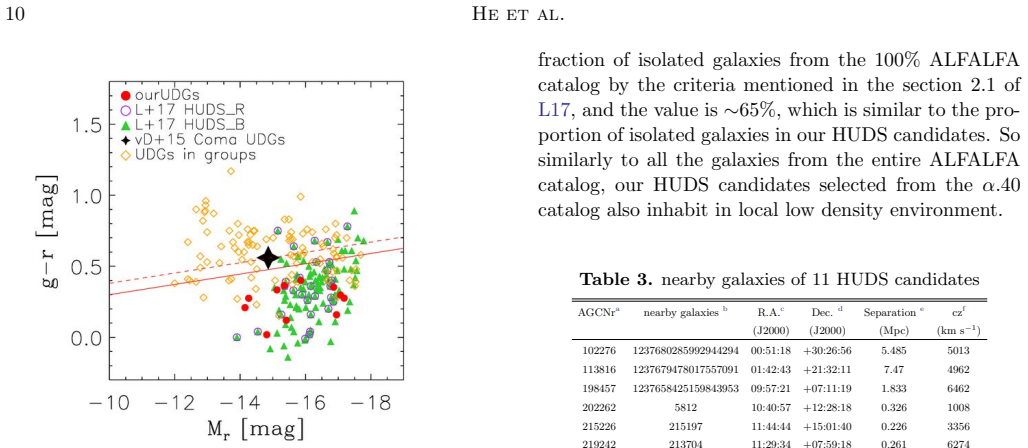
After correcting the observed central surface brightness to a face-on perspective, we discover 11 edge-on HUDS candidates. All these newly discovered HUDS candidates are blue and HI-bearing, similar to other HUDS in 70% ALFALFA catalog, and different from UDGs in clusters.
What carries the argument
Inclination correction of observed central surface brightness assuming exponential surface brightness profiles to recover face-on values for edge-on HI sources.
If this is right
- The edge-on selection plus correction provides an efficient route to find ultra-diffuse galaxies inside HI catalogs.
- The 11 candidates lie in low-density environments.
- Their blue colors and HI content match previously reported field HUDS.
- The candidates differ in color and gas content from UDGs found in clusters.
Where Pith is reading between the lines
- The same selection could be run on the full ALFALFA catalog or other HI surveys to increase the sample size.
- Targeted imaging or spectroscopy could confirm distances and verify the face-on surface brightness values.
- The shared traits with other field HUDS point toward formation channels distinct from those in dense environments.
Load-bearing premise
Ultra-diffuse galaxies follow exponential surface brightness profiles so edge-on viewing reliably boosts their apparent central surface brightness enough for selection.
What would settle it
Measuring Sérsic indices for the 11 candidates and finding values far from 1, or obtaining direct face-on photometry showing central surface brightness too bright to qualify as ultra-diffuse.
Figures


read the original abstract
Ultra-diffuse galaxies (UDGs) are objects which have very extended morphology and faint central surface brightness. Most UDGs are discovered in galaxy clusters and groups, but also some are found in low density environments. The diffuse morphology and faint surface brightness make them difficult to distinguish from the sky background. Several previous works have suggested that at least some UDGs are consistent with exponential surface brightness profiles (S\'{e}rsic n ~ 1). The surface brightness of exponential disks is enhanced in edge-on systems, so searching for edge-on systems may be an efficient way to select UDGs. In this paper, we focus on searching for edge-on HI-bearing ultra-diffuse sources (HUDS) from the 40% ALFALFA catalog, based on SDSS g- and r-band images. After correcting the observed central surface brightness to a face-on perspective, we discover 11 edge-on HUDS candidates. All these newly discovered HUDS candidates are blue and HI-bearing, similar to other HUDS in 70% ALFALFA catalog, and different from UDGs in clusters.
Editorial analysis
A structured set of objections, weighed in public.
Referee Report
Summary. The paper searches the 40% ALFALFA catalog for edge-on HI-bearing ultra-diffuse galaxy (HUDS) candidates using SDSS g- and r-band imaging. It applies a face-on correction to the observed central surface brightness under the assumption of exponential (Sérsic n~1) profiles drawn from prior work, identifies 11 new candidates, and reports that they are blue and HI-rich, resembling other field HUDS but unlike cluster UDGs.
Significance. If the deprojection is valid, the result demonstrates an efficient observational route to recover low-surface-brightness field galaxies that are otherwise missed, thereby enlarging the known HUDS population outside clusters and reinforcing environmental differences in UDG properties.
major comments (1)
- [Abstract and selection procedure] Abstract and selection procedure: The face-on central surface-brightness correction that defines the 11 HUDS candidates rests on the assumption that these objects follow Sérsic n~1 profiles. The manuscript supplies no Sérsic-index measurement or profile fit for the candidates themselves; if n>1 the inclination boost is weaker, the corrected face-on value is brighter than assumed, and the UDG classification threshold may not be satisfied.
minor comments (1)
- [Abstract] The abstract states the count of 11 candidates but does not report the total number of edge-on sources examined or the precise numerical threshold applied after correction; adding these quantities would clarify the selection efficiency.
Simulated Author's Rebuttal
We thank the referee for their thoughtful review and constructive comments on our manuscript. We address the major comment below in a point-by-point manner.
read point-by-point responses
-
Referee: The face-on central surface-brightness correction that defines the 11 HUDS candidates rests on the assumption that these objects follow Sérsic n~1 profiles. The manuscript supplies no Sérsic-index measurement or profile fit for the candidates themselves; if n>1 the inclination boost is weaker, the corrected face-on value is brighter than assumed, and the UDG classification threshold may not be satisfied.
Authors: We acknowledge the validity of this point. The assumption of Sérsic n ≈ 1 is explicitly based on prior literature cited in the manuscript, which has found that many UDGs and HUDS are consistent with exponential profiles. No individual Sérsic fits were performed on these 11 candidates, as the selection focused on identifying edge-on systems via the inclination correction under this literature-supported assumption. We agree this constitutes an important caveat for the classification. In revision, we will expand the methods and discussion sections to state the assumption more explicitly, note its implications if n > 1 (i.e., brighter face-on surface brightness and possible non-UDG status), and strengthen the literature references. This will be a textual clarification rather than new measurements. revision: partial
Circularity Check
No circularity: pure observational catalog search using external prior assumption
full rationale
The paper conducts an observational search in the ALFALFA catalog, applying a standard face-on correction for edge-on exponential disks drawn from prior literature (not self-citation). No equations derive a result from fitted inputs, no self-definitional loops, no predictions that reduce to the selection criteria by construction, and no load-bearing self-citation chain. The Sérsic n~1 assumption is cited from external previous works as a selection criterion; failure to verify it on the new candidates is a potential correctness issue, not circularity. The derivation chain is self-contained against external benchmarks.
Axiom & Free-Parameter Ledger
axioms (1)
- domain assumption At least some UDGs are consistent with exponential surface brightness profiles (Sérsic n ~ 1)
Lean theorems connected to this paper
-
IndisputableMonolith/Cost/FunctionalEquation.leanwashburn_uniqueness_aczel unclear?
unclearRelation between the paper passage and the cited Recognition theorem.
Several previous works have suggested that at least some UDGs are consistent with exponential surface brightness profiles (Sérsic n ~ 1). ... μ0,face = μ0,edge − 2.5×lg(hs/rs).
-
IndisputableMonolith/Foundation/AlexanderDuality.leanalexander_duality_circle_linking unclear?
unclearRelation between the paper passage and the cited Recognition theorem.
we use the n = 1 in this work either. Using the exponential profile model by GALFIT
What do these tags mean?
- matches
- The paper's claim is directly supported by a theorem in the formal canon.
- supports
- The theorem supports part of the paper's argument, but the paper may add assumptions or extra steps.
- extends
- The paper goes beyond the formal theorem; the theorem is a base layer rather than the whole result.
- uses
- The paper appears to rely on the theorem as machinery.
- contradicts
- The paper's claim conflicts with a theorem or certificate in the canon.
- unclear
- Pith found a possible connection, but the passage is too broad, indirect, or ambiguous to say the theorem truly supports the claim.
Reference graph
Works this paper leans on
-
[1]
Abazajian, K. N., Adelman-McCarthy, J. K., Ag¨ ueros, M. A., et al. 2009, ApJS, 182, 543
work page 2009
- [2]
-
[3]
Baushev, A. N. 2018, NewA, 60, 69
work page 2018
-
[4]
Beasley, M. A., Romanowsky, A. J., Pota, V., et al. 2016, ApJL, 819, L20
work page 2016
- [5]
- [6]
-
[7]
Bell, E. F., McIntosh, D. H., Katz, N., & Weinberg, M. D. 2003, ApJS, 149, 289
work page 2003
-
[8]
Bellazzini, M., Belokurov, V., Magrini, L., et al. 2017, MNRAS, 467, 3751
work page 2017
-
[9]
Bennet, P., Sand, D. J., Zaritsky, D., et al. 2018, ApJL, 866, L11
work page 2018
- [10]
-
[11]
1978, PhD thesis, PhD Thesis, Groningen Univ., (1978)
Bosma, A. 1978, PhD thesis, PhD Thesis, Groningen Univ., (1978)
work page 1978
- [12]
- [13]
- [14]
-
[15]
Carleton, T., Errani, R., Cooper, M., et al. 2019, MNRAS, 485, 382
work page 2019
-
[16]
K., Kereˇ s, D., Wetzel, A., et al
Chan, T. K., Kereˇ s, D., Wetzel, A., et al. 2018, MNRAS, 478, 906
work page 2018
- [17]
- [18]
-
[19]
Devour, B. M., & Bell, E. F. 2016, MNRAS, 459, 2054 Di Cintio, A., Brook, C. B., Dutton, A. A., et al. 2017, MNRAS, 466, L1
work page 2016
- [20]
-
[21]
Giovanelli, R., Haynes, M. P., Salzer, J. J., et al. 1995, AJ, 110, 1059
work page 1995
- [22]
- [23]
-
[24]
Haynes, M. P., Giovanelli, R., Martin, A. M., et al. 2011, AJ, 142, 170
work page 2011
-
[25]
Haynes, M. P., Giovanelli, R., Kent, B. R., et al. 2018, ApJ, 861, 49
work page 2018
- [26]
-
[27]
Hernandez, X., Park, C., Cervantes-Sodi, B., & Choi, Y.-Y. 2007, MNRAS, 375, 163
work page 2007
-
[28]
Elmegreen, B. G. 2016, AJ, 152, 177
work page 2016
-
[29]
Huang, S., Haynes, M. P., Giovanelli, R., et al. 2012, AJ, 143, 133
work page 2012
- [30]
- [31]
-
[32]
G., Papastergis, E., Pandya, V., et al
Jones, M. G., Papastergis, E., Pandya, V., et al. 2018, A&A, 614, A21
work page 2018
-
[33]
Kadowaki, J., Zaritsky, D., & Donnerstein, R. L. 2017, ApJL, 838, L21
work page 2017
-
[34]
Moustakas, L. A. 2011, ApJ, 726, 98
work page 2011
-
[35]
Koda, J., Yagi, M., Yamanoi, H., & Komiyama, Y. 2015, ApJL, 807, L2
work page 2015
- [36]
-
[37]
Lee, M. G., Kang, J., Lee, J. H., & Jang, I. S. 2017, ApJ, 844, 157
work page 2017
-
[38]
Leisman, L., Haynes, M. P., Janowiecki, S., et al. 2017, ApJ, 842, 133
work page 2017
-
[39]
Lim, S., Peng, E. W., Cˆ ot´ e, P., et al. 2018, ApJ, 862, 82
work page 2018
-
[40]
Liu, F. S., Xia, X. Y., Mao, S., Wu, H., & Deng, Z. G. 2008, MNRAS, 385, 23
work page 2008
-
[41]
Maller, A. H., Berlind, A. A., Blanton, M. R., & Hogg, D. W. 2009, ApJ, 691, 394 edge-on HUDS 13 Mart´ ınez-Delgado, D., L¨ asker, R., Sharina, M., et al. 2016, AJ, 151, 96
work page 2009
-
[42]
L., Giovanelli, R., & Haynes, M
Masters, K. L., Giovanelli, R., & Haynes, M. P. 2003, AJ, 126, 158
work page 2003
-
[43]
L., Nichol, R., Bamford, S., et al
Masters, K. L., Nichol, R., Bamford, S., et al. 2010, MNRAS, 404, 792
work page 2010
- [44]
- [45]
-
[46]
Merritt, A., van Dokkum, P., Danieli, S., et al. 2016, ApJ, 833, 168
work page 2016
-
[47]
Mihos, J. C., Durrell, P. R., Ferrarese, L., et al. 2015, ApJL, 809, L21 Moffat, J. W., & Toth, V. T. 2019, MNRAS, 482, L1
work page 2015
- [48]
-
[49]
Moster, B. P., Somerville, R. S., Maulbetsch, C., et al. 2010, ApJ, 710, 903 Mu˜ noz, R. P., Eigenthaler, P., Puzia, T. H., et al. 2015, ApJL, 813, L15 M¨ uller, O., Jerjen, H., & Binggeli, B. 2018, A&A, 615, A105
work page 2010
- [50]
- [51]
-
[52]
Osterbrock, D. E. 1989, Astrophysics of gaseous nebulae and active galactic nuclei (Sausalito, California: University Science Books)
work page 1989
-
[53]
Papastergis, E., Adams, E. A. K., & Romanowsky, A. J. 2017, A&A, 601, L10
work page 2017
- [54]
-
[55]
Roediger, J. C., & Courteau, S. 2015, MNRAS, 452, 3209 Rom´ an, J., & Trujillo, I. 2017a, MNRAS, 468, 703 —. 2017b, MNRAS, 468, 4039
work page 2015
- [56]
-
[57]
V., Mieske, S., & Zeilinger, W
Saulder, C., van Kampen, E., Chilingarian, I. V., Mieske, S., & Zeilinger, W. W. 2016, A&A, 596, A14 Schlafly, E. F., & Finkbeiner, D. P. 2011, ApJ, 737, 103
work page 2016
-
[58]
Schlegel, D. J., Finkbeiner, D. P., & Davis, M. 1998, ApJ, 500, 525
work page 1998
- [59]
-
[60]
Somerville, R. S., Popping, G., & Trager, S. C. 2015, MNRAS, 453, 4337
work page 2015
- [61]
-
[62]
Taylor, E. N., Hopkins, A. M., Baldry, I. K., et al. 2011, MNRAS, 418, 1587
work page 2011
- [63]
-
[64]
2017, ApJ, 836, 191 van den Bosch, F
Trujillo, I., Roman, J., Filho, M., & S´ anchez Almeida, J. 2017, ApJ, 836, 191 van den Bosch, F. C., Aquino, D., Yang, X., et al. 2008, MNRAS, 387, 79 van der Burg, R. F. J., Hoekstra, H., Muzzin, A., et al. 2015, A&A, 577, A19 van der Burg, R. F. J., Muzzin, A., & Hoekstra, H. 2016, A&A, 590, A20 van der Burg, R. F. J., Hoekstra, H., Muzzin, A., et al. ...
work page 2017
-
[65]
Venhola, A., Peletier, R., Laurikainen, E., et al. 2017, A&A, 608, A142
work page 2017
-
[66]
Wasserman, A., Romanowsky, A. J., Brodie, J., et al. 2018, ApJL, 863, L15
work page 2018
-
[67]
Wild, V., Charlot, S., Brinchmann, J., et al. 2011, MNRAS, 417, 1760
work page 2011
- [68]
-
[69]
Yagi, M., Koda, J., Komiyama, Y., & Yamanoi, H. 2016, ApJS, 225, 11
work page 2016
-
[70]
G., Adelman, J., Anderson, Jr., J
York, D. G., Adelman, J., Anderson, Jr., J. E., et al. 2000, AJ, 120, 1579
work page 2000
- [71]
- [72]
- [73]
- [74]
- [75]
discussion (0)
Sign in with ORCID, Apple, or X to comment. Anyone can read and Pith papers without signing in.