Identification and Inference for Structural Accelerated Failure Time Models via Instrument Interactions
Pith reviewed 2026-06-29 10:57 UTC · model grok-4.3
The pith
Instrument interactions identify causal effects in structural accelerated failure time models even without valid instruments.
A machine-rendered reading of the paper's core claim, the machinery that carries it, and where it could break.
Core claim
By exploiting interactions among instrumental variables, structural accelerated failure time models are identified for causal inference on right-censored time-to-event data without requiring classical instrumental variable validity assumptions, as long as the interaction-based identification condition holds. Identification and inference are achieved through a Neyman-orthogonal observed-data moment function constructed via augmented inverse probability censoring weighting, estimated by generalized empirical likelihood under many-weak-moment asymptotics, with accompanying diagnostics for identification strength and overidentifying restrictions.
What carries the argument
The interaction-based identification condition, which forms moment conditions from products of instrumental variables, together with the resulting Neyman-orthogonal censoring-adjusted moment function.
If this is right
- Valid causal inference is obtained for both valid and invalid instruments whenever the interaction condition is satisfied.
- The estimator remains consistent and asymptotically normal under many weak moment asymptotics.
- Double robustness permits valid inference when nuisance functions are estimated flexibly.
- Diagnostic tools can detect weak identification or violations of overidentifying restrictions.
Where Pith is reading between the lines
- Similar interaction conditions might be derived for other parametric survival models beyond the accelerated failure time specification.
- In large observational cohorts the method reduces the need to verify classical validity for every individual instrument.
- The double-robust moment construction could be adapted to other forms of censoring or missingness.
Load-bearing premise
The interaction-based identification condition holds, enabling identification without classical instrumental variable validity.
What would settle it
A simulation or empirical example in which the interaction condition is violated produces biased estimates from the proposed procedure while the same procedure remains unbiased when the condition holds.
Figures
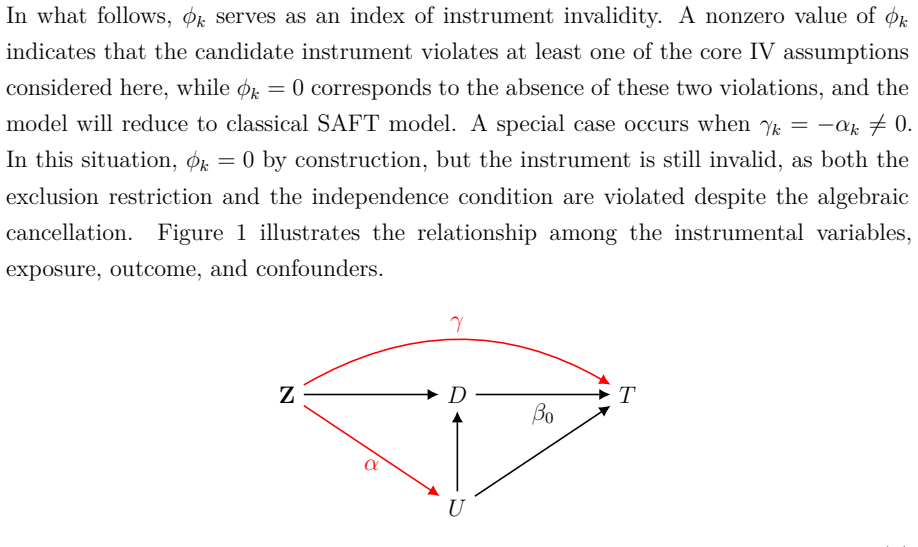
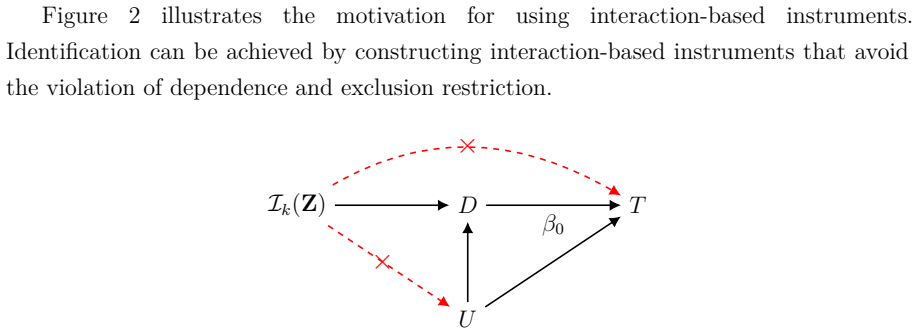
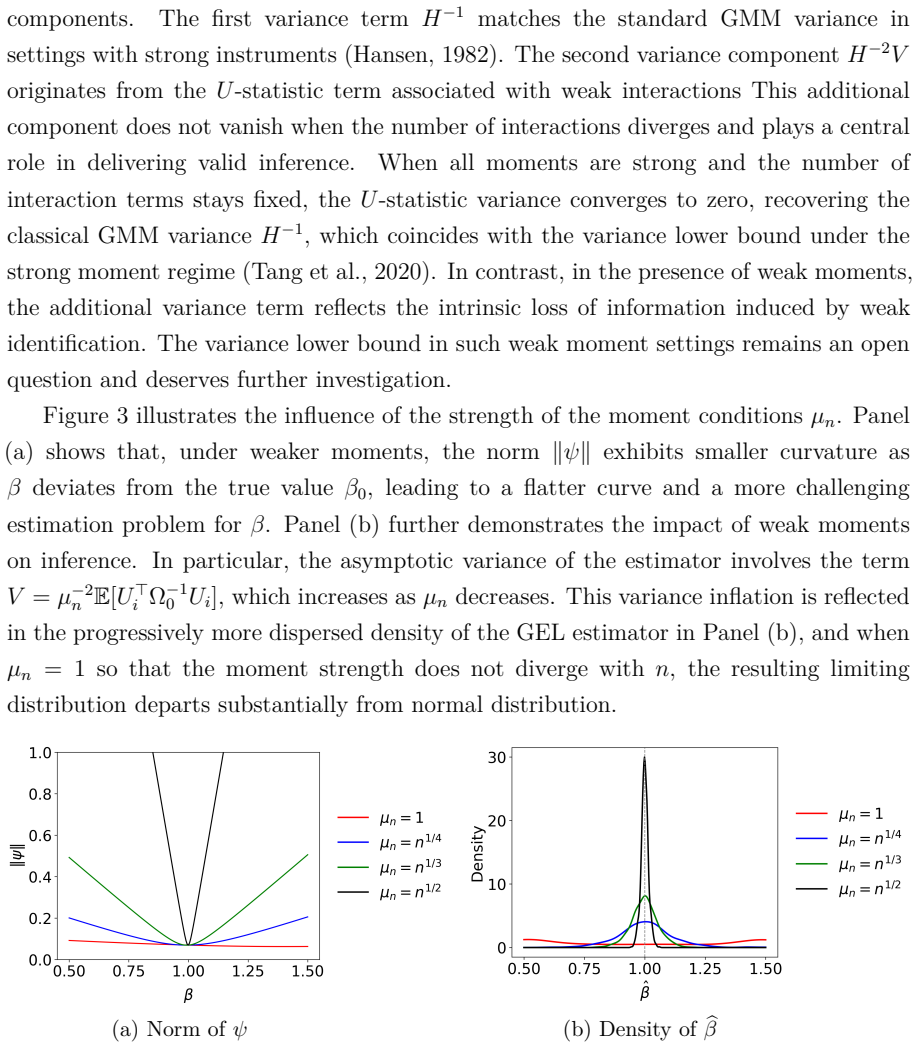
read the original abstract
We study causal inference for time-to-event outcomes under right censoring in the presence of unmeasured confounding. Focusing on structural accelerated failure time models, we develop an identification and inference framework that exploits interactions among instrumental variables. The proposed approach does not rely on classical instrumental variable validity and yields valid causal inference under both valid and invalid instruments, provided that the interaction-based identification condition holds. To accommodate right censoring, we construct a censoring-adjusted observed data moment function using an augmented inverse probability censoring weighting approach. The resulting moment function is Neyman orthogonal with respect to nuisance functions and enjoys a double robustness property, enabling valid inference under flexible nuisance estimation. Estimation and inference are conducted using generalized empirical likelihood, which is well suited to settings with many potentially weak interaction-based moment conditions. We establish consistency, and asymptotic normality under many weak moment asymptotics, and develop diagnostic tools to assess interaction-based identification strength and overidentifying restrictions. Simulation studies demonstrate favorable finite sample performance across a range of censoring rates and instrument configurations. An application to UK Biobank data illustrates the practical relevance of the proposed method for causal survival analysis in large-scale observational studies.
Editorial analysis
A structured set of objections, weighed in public.
Referee Report
Summary. The manuscript develops an identification and inference framework for structural accelerated failure time models with right-censored time-to-event outcomes under unmeasured confounding. It exploits interactions among instrumental variables to achieve identification and valid causal inference without requiring classical IV validity, conditional on an interaction-based identification condition. The approach constructs a censoring-adjusted observed-data moment function via augmented inverse probability censoring weighting (AIPCW) that is Neyman orthogonal and doubly robust, performs estimation and inference via generalized empirical likelihood (GEL) suited to many potentially weak moments, establishes consistency and asymptotic normality under many-weak asymptotics, and supplies diagnostics for identification strength and overidentifying restrictions. Finite-sample performance is illustrated in simulations and an application to UK Biobank data.
Significance. If the derivations hold, the work offers a practically relevant extension of causal survival methods to settings with possibly invalid instruments, provided the interaction condition is satisfied and diagnosed. The AIPCW construction for double robustness, the GEL estimator under many-weak asymptotics, and the explicit diagnostics are standard but well-chosen technical devices that strengthen the contribution for large-scale observational studies.
minor comments (3)
- [Abstract] Abstract: the phrasing 'We establish consistency, and asymptotic normality under many weak moment asymptotics' contains an extraneous comma and should read 'consistency and asymptotic normality'.
- The manuscript would benefit from a dedicated subsection (likely in the identification or assumptions section) that explicitly states the interaction-based identification condition as a numbered assumption or theorem, separate from the classical IV validity discussion, to make the conditional nature of the results immediately visible to readers.
- [Simulations] Simulation section: the reported configurations of censoring rates and instrument strengths should include a table or figure panel that directly contrasts performance under the interaction condition holding versus failing, to illustrate the diagnostic tools' practical value.
Simulated Author's Rebuttal
We thank the referee for their careful reading and positive evaluation of the manuscript. The referee's summary accurately reflects the paper's contributions, and we are pleased that the work is viewed as offering a relevant extension for causal survival analysis with possibly invalid instruments. We note that the recommendation is for minor revision, but no specific major comments are provided in the report.
Circularity Check
No significant circularity
full rationale
The identification and inference framework is explicitly conditioned on an external interaction-based identification assumption that is flagged as a prerequisite rather than derived internally. The AIPCW construction for the observed-data moment function, Neyman orthogonality, double robustness, and GEL estimation under many-weak asymptotics are presented as standard technical tools applied to the structural AFT model; none of these steps reduce the target causal parameter to a fitted quantity or self-referential definition by the paper's own equations. No load-bearing self-citations, uniqueness theorems imported from the authors' prior work, or ansatz smuggling are visible in the abstract or described derivation chain. The central claim therefore remains self-contained against the stated identifying condition and external benchmarks.
Axiom & Free-Parameter Ledger
Reference graph
Works this paper leans on
-
[1]
Angrist, J. D. and Krueger, A. B. (2001). Instrumental variables and the search for identification: From supply and demand to natural experiments. Journal of Economic Perspectives, 15(4):69–85. Bang, H. and Robins, J. M. (2005). Doubly robust estimation in missing data and causal inference models. Biometrics, 61(4):962–973. Bickel, P. J., Klaassen, C. A.,...
2001
-
[2]
Bowden, J., Davey Smith, G., Haycock, P
Springer. Bowden, J., Davey Smith, G., Haycock, P. C., and Burgess, S. (2016). Consistent estimation in mendelian randomization with some invalid instruments using a weighted median estimator. Genetic Epidemiology, 40(4):304–314. Bowden, J., Smith, G. D., and Burgess, S. (2015). Mendelian randomization with invalid instruments: effect estimation and bias ...
2016
-
[3]
Cai, T., Huang, J., and Tian, L. (2009). Regularized estimation for the accelerated failure time model. Biometrics, 65(2):394–404. Chernozhukov, V., Chetverikov, D., Demirer, M., Duflo, E., Hansen, C., Newey, W., and Robins, J. (2018). Double/debiased machine learning for treatment and structural parameters. The Econometrics Journal , 21(1):C1–C68. Cox, D...
2009
-
[4]
A., Cole, S
Hernán, M. A., Cole, S. R., Margolick, J., Cohen, M., and Robins, J. M. (2005). Structural accelerated failure time models for survival analysis in studies with time- varying treatments. Pharmacoepidemiology and Drug Safety , 14(7):477–491. Hoerl, A. E. and Kennard, R. W. (1970). Ridge regression: biased estimation for nonorthogonal problems. Technometric...
2005
-
[5]
28 Robins, J. M. and Rotnitzky, A. (1992). Recovery of information and adjustment for dependent censoring using surrogate markers. In AIDS Epidemiology: Methodological Issues, pages 297–331. Springer. Robins, J. M., Rotnitzky, A., and Zhao, L. P. (1994). Estimation of regression coefficients when some regressors are not always observed. Journal of the Amer...
1992
-
[6]
White, H. (1980). A heteroskedasticity-consistent covariance matrix estimator and a direct test for heteroskedasticity. Econometrica, 48(4):817–838. Ye, T., Liu, Z., Sun, B., and Tchetgen Tchetgen, E. (2024). GENIUS-MA WII: for robust Mendelian randomization with many weak invalid instruments. Journal of the Royal Statistical Society Series B: Statistical...
-
[7]
There exists a positive constant c such that 1/c ≤ λmin(Ω(β,η0))<λmax(Ω(β,η0)) ≤ c for all β∈ B, and λmaxE(ψ ′ (η0; O)ψ ′ (η0; O)⊤ ) ≤ c
Condition 4 (Bounded eigenvalue). There exists a positive constant c such that 1/c ≤ λmin(Ω(β,η0))<λmax(Ω(β,η0)) ≤ c for all β∈ B, and λmaxE(ψ ′ (η0; O)ψ ′ (η0; O)⊤ ) ≤ c. 39 Condition 3 (i) and Condition 4 impose basic regularity conditions ensuring that the key observable quantities and matrices remain well behaved. In particular, they require bounded e...
2009
-
[8]
This completes the proof of Lemma S5
+Op (√ m/n ) = Op (√ m/n ) . This completes the proof of Lemma S5. Lemma S6. Under Conditions 1-4, (i). ¯Ω (β0, ˆη) − Ω 0 =op(1/ √m); (ii). n− 1 ∑n i=1ψ(β0, ˆη; Oi)ψ′( ˆη; Oi)⊤ − E { ψ(β0, η0; O)ψ′(η0; O)⊤ } =op(1/ √m); (iii). n− 1 ∑n i=1ψ′( ˆη; Oi)ψ′( ˆη; Oi)⊤ − E { ψ′(η0; O)ψ′(η0; O)⊤ } =op(1/ √m); (iv). supβ∈B ¯Ω(β,ˆη) − Ω (β,η0...
2016
-
[9]
Lemma S8
¯ψ(β0, η0)∥+ ∥¯Ω(β0, ˆη)− 1( ¯ψ(β0, η0) − ¯ψ(β0, ˆη))∥+op(µn/ √n) =op(1/ √m)Op(µn/ √n) +Op(1)op(1/ √n) +op(µn/ √n) =op(µn/ √n), The uniform bound follows by the same argument with βin place of β0, which gives supβ∈B ∥λ(β,ˆη) − λ(β,η0)∥=op(µn/ √n). Lemma S8. Let ˜Q(β,η) = Eψ(β,η)⊤ Ω(β,η)− 1Eψ(β,η)/ 2 +m/ (2n). Under Conditions 1–5, sup β∈B ⏐⏐⏐ ˜Q(β,η0) − ˆ...
2024
-
[10]
(S14) Define ˆUi =ψ′( ˆη; Oi) −ψ∗ − 1 n n∑ j=1 { ψ(β0, ˆη; Oj)ψ′( ˆη; Oj)⊤ } ¯Ω(β0, ˆη)− 1ψ(β0, ˆη; Oi). Combining (S14), Lemma S7, we obtain ∂ˆQ(β,ˆη) ∂β ⏐⏐⏐⏐⏐ β=β0 = 1 n n∑ i=1 ρ′(λ(β0, ˆη)⊤ψ(β0, ˆη; Oi))λ(β0, ˆη)⊤ψ′( ˆη; Oi) + 1 n n∑ i=1 ρ′ ( λ(β0, ˆη)⊤ψ(β0, ˆη; Oi) ) ψ(β0, ˆη; Oi)⊤∂λ(β0, ˆη) ∂β = 1 n n∑ i=1 {−1 − λ(β0, ˆη)⊤ψ(β0, ˆη; Oi) +r}{−¯ψ(β0, ˆη...
2009
-
[11]
Combining the bounds for D1 to D4, we obtain sup β∈B ⏐⏐⏐⏐ ∂2 ˆQ(β,ˆη) ∂β2 − ∂2 ˆQ(β,η0) ∂β2 ⏐⏐⏐⏐ =op(µ2 n/n )
For D4, we have sup β∈B |D4( ˆη) −D4(η0)| ≤ sup β∈B ⏐⏐⏐⏐ ∂λ(β,ˆη)⊤ ∂β {ψ′( ˆη) −ψ′(η0)} ⏐⏐⏐⏐ + sup β∈B ⏐⏐⏐⏐ {∂λ(β,ˆη)⊤ ∂β − ∂λ(β,η0)⊤ ∂β } ψ′(η0) ⏐⏐⏐⏐ = op(µ2 n/n ). Combining the bounds for D1 to D4, we obtain sup β∈B ⏐⏐⏐⏐ ∂2 ˆQ(β,ˆη) ∂β2 − ∂2 ˆQ(β,η0) ∂β2 ⏐⏐⏐⏐ =op(µ2 n/n ). 54 Lemma 13 in Newey and Windmeijer (2009) implies sup β∈B n µ2 n ⏐⏐⏐⏐ ∂2 ˆQ(β,η...
2009
discussion (0)
Sign in with ORCID, Apple, or X to comment. Anyone can read and Pith papers without signing in.