Mapping the star formation peak with LIGO A# and Next-Generation detectors
Pith reviewed 2026-06-28 05:06 UTC · model grok-4.3
The pith
LIGO A# can constrain the binary black hole merger rate peak to within 0.1 in redshift after one year of data.
A machine-rendered reading of the paper's core claim, the machinery that carries it, and where it could break.
Core claim
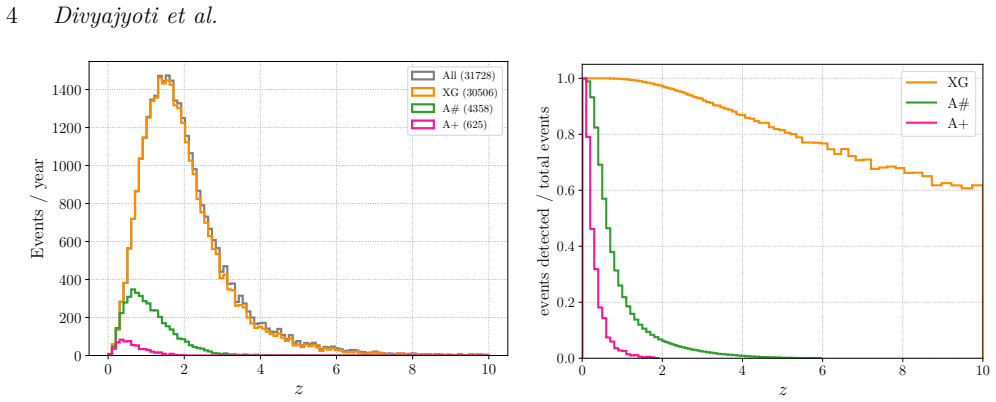
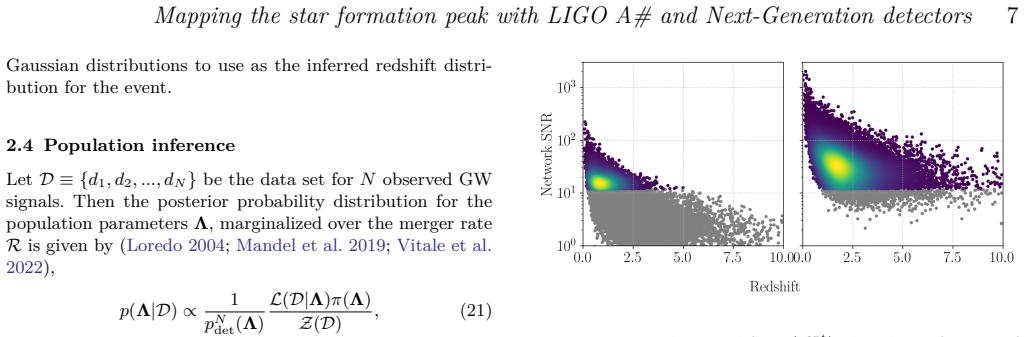
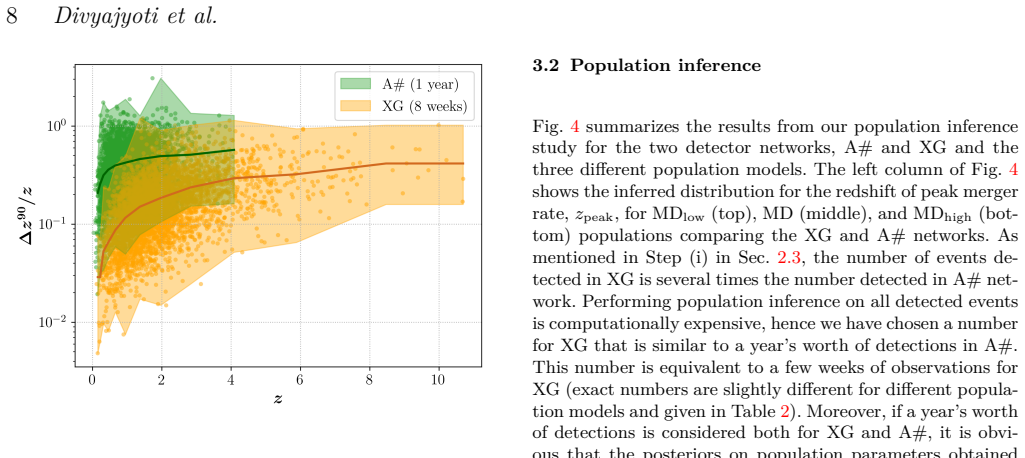
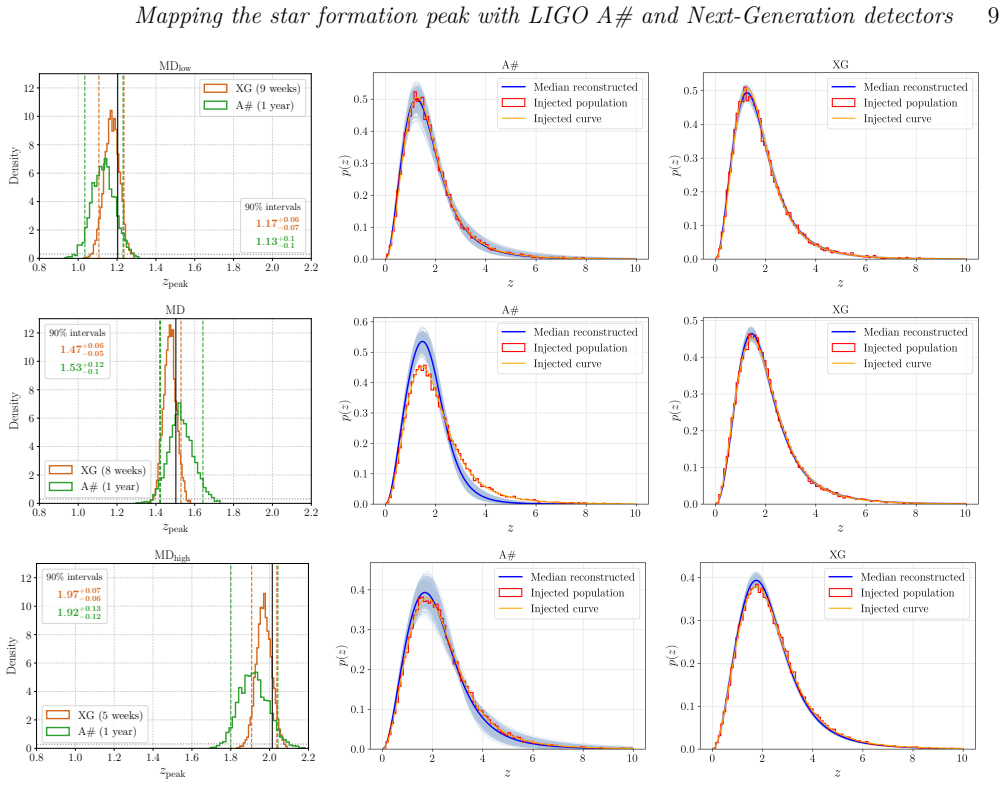
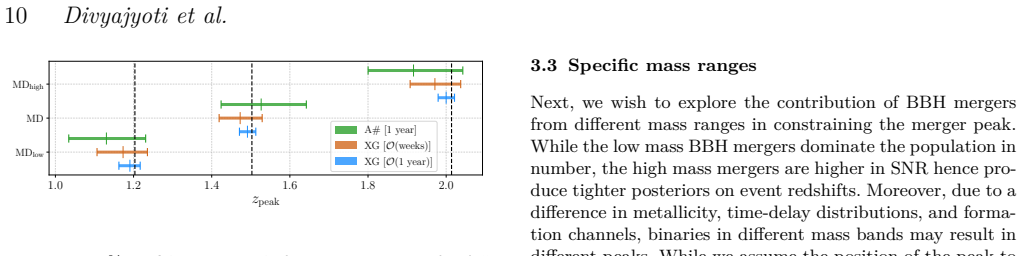
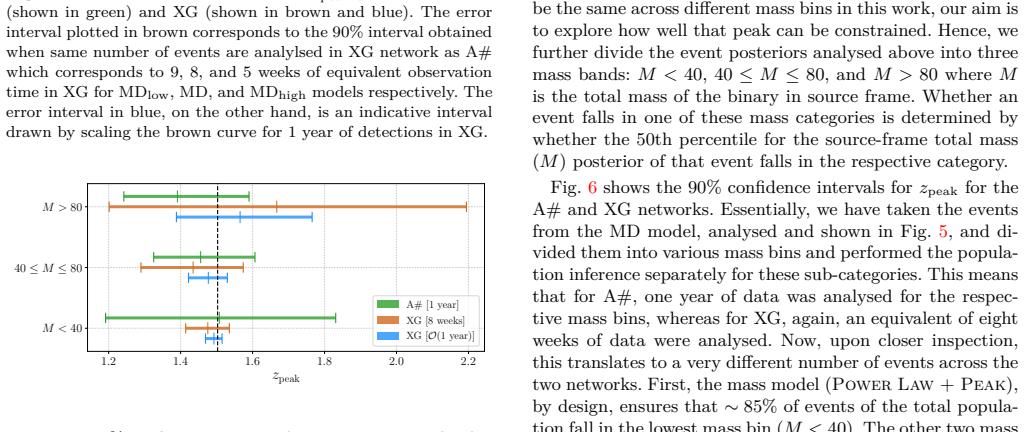
Using simulated binary black hole signals drawn from three star-formation population models plus an inverse time-delay model, a LIGO A# network constrains the merger-rate peak at z_peak=1.5 to a precision of ±0.1 after one year of observation; a Cosmic Explorer plus Einstein Telescope network measures the full redshift distribution to ±0.02.
What carries the argument
The inverse time-delay model that converts star-formation histories into observable merger-rate distributions, applied to the detected redshifts of binary black holes.
If this is right
- Electromagnetic and gravitational-wave measurements of star formation history can be cross-checked without shared systematics.
- The redshift distribution of mergers becomes a direct observable for testing galaxy evolution models at high redshift.
- Next-generation detectors turn the merger-rate peak into a high-precision cosmological probe rather than a marginal constraint.
Where Pith is reading between the lines
- The same analysis framework could be extended to other compact-object populations to test whether all channels share the same star-formation peak.
- If the measured peak shifts with detector sensitivity, it would indicate selection effects that current simulations under-estimate.
- Combining the gravitational-wave peak measurement with electromagnetic data at low redshift could tighten the overall normalization of the star-formation rate density.
Load-bearing premise
The three population models together with the inverse time-delay prescription accurately capture how star formation maps onto the observable merger rate.
What would settle it
Real LIGO A# data that recover a peak width larger than ±0.1 or a location inconsistent with the input z=1.5 population would show the claimed precision does not hold.
Figures
read the original abstract
Measuring the redshift evolution of star formation rate density is crucial in understanding the origin and evolution of galaxies and large scale structure in the universe. It is currently measured with electromagnetic probes, however, these probes often track luminosity, which is then converted to star formation rate (SFR) depending on various factors such as initial mass function, dust extinction, etc. Gravitational waves provide an independent method to constrain SFR at high redshifts by tracking the redshift evolution obtained from analysis of binary black hole mergers. In this study we explore three population models for star-formation combined with an \textit{inverse} time-delay model and demonstrate that it is possible to obtain bounds on the peak of redshift distribution with a network of upgraded LIGO detectors (such as LIGO-A#). For a year of observation, using simulated signals with a merger rate peak at $z_\text{peak}=1.5$, a network of LIGO detectors at A# sensitivity is able to constrain the peak of merger rate with a precision of $\pm 0.1$. Further, we obtain the results with a next-generation network (of Cosmic Explorer and Einstein Telescope) and conclude that the redshift distribution will be extremely well measured, with a precision of $\pm 0.02$, with future detectors.
Editorial analysis
A structured set of objections, weighed in public.
Referee Report
Summary. The manuscript claims that simulated binary black hole merger signals drawn from three star-formation population models combined with an inverse time-delay prescription allow a LIGO A# network to recover the peak redshift z_peak of the merger-rate distribution to a precision of ±0.1 after one year of observation (injected at z_peak=1.5). It further claims that a next-generation network (Cosmic Explorer + Einstein Telescope) achieves a precision of ±0.02 on the redshift distribution.
Significance. If the quoted precisions prove robust, the work would demonstrate that gravitational-wave observations can serve as an independent probe of the star-formation-rate peak at high redshift, complementing electromagnetic methods. The forward-simulation-and-recovery approach supplies a concrete, falsifiable estimate of achievable precision and is a methodological strength.
major comments (2)
- [population models and simulation setup] Population models and simulation setup (as referenced in the abstract): the quoted precisions (±0.1 for A# and ±0.02 for CE+ET) are obtained exclusively by injecting and recovering signals from the three chosen population models plus the inverse time-delay prescription. The manuscript does not marginalize over alternative delay-time distributions, metallicity evolutions, or redshift-dependent selection functions; if the true mapping from SFR to observable merger rate differs in functional form, the recovered posterior on z_peak will be biased or its width mis-estimated. This modeling assumption is load-bearing for the central claim.
- [abstract and methods] Abstract and methods description: the simulation setup provides no indication that the inference includes a complete end-to-end treatment of detector selection effects, noise realizations, or a full error budget beyond the stated models. Without these details it is not possible to verify whether the reported precisions remain valid under realistic systematics.
minor comments (1)
- The phrase 'inverse time-delay model' is introduced without a clear definition or comparison to the standard forward time-delay distribution used in the literature; a brief explanatory paragraph would improve accessibility.
Simulated Author's Rebuttal
We thank the referee for their careful reading, positive assessment of the work's significance, and constructive comments. We respond point-by-point to the major comments below.
read point-by-point responses
-
Referee: [population models and simulation setup] Population models and simulation setup (as referenced in the abstract): the quoted precisions (±0.1 for A# and ±0.02 for CE+ET) are obtained exclusively by injecting and recovering signals from the three chosen population models plus the inverse time-delay prescription. The manuscript does not marginalize over alternative delay-time distributions, metallicity evolutions, or redshift-dependent selection functions; if the true mapping from SFR to observable merger rate differs in functional form, the recovered posterior on z_peak will be biased or its width mis-estimated. This modeling assumption is load-bearing for the central claim.
Authors: We agree that the reported precisions are obtained under the specific assumptions of the three population models combined with the inverse time-delay prescription, without marginalization over alternative delay-time distributions, metallicity evolutions, or other functional forms. The three models were chosen to span a representative range of star-formation scenarios, but this does not constitute a full exploration of modeling uncertainties. We will revise the manuscript to state this limitation explicitly in the abstract and methods, and add a discussion paragraph on possible biases to the recovered z_peak if the true mapping differs. revision: partial
-
Referee: [abstract and methods] Abstract and methods description: the simulation setup provides no indication that the inference includes a complete end-to-end treatment of detector selection effects, noise realizations, or a full error budget beyond the stated models. Without these details it is not possible to verify whether the reported precisions remain valid under realistic systematics.
Authors: The methods section outlines the injection of simulated binary black hole signals drawn from the population models into the detector network, with recovery that accounts for selection effects through the network sensitivity. However, we acknowledge that the description of noise realizations and the complete error budget could be expanded for clarity. We will revise the methods section to provide additional details on the noise modeling, selection function implementation, and error budget assumptions. revision: yes
Circularity Check
No significant circularity; simulation-based recovery is self-contained
full rationale
The paper conducts a forward simulation study: signals are drawn from three specified population models plus an inverse time-delay prescription with an injected z_peak=1.5, then recovered via Bayesian inference on detector networks. The quoted precisions (±0.1 for A#; ±0.02 for CE+ET) are the resulting posterior widths under those explicit modeling choices, not quantities forced to equal the inputs by algebraic identity, parameter renaming, or self-citation. No load-bearing step reduces the central claim to a tautology or prior author result; the derivation remains independent of the target constraints once the population models and selection effects are stated.
Axiom & Free-Parameter Ledger
free parameters (1)
- z_peak
axioms (1)
- domain assumption Binary black hole merger rate traces star formation rate density after an inverse time delay
Reference graph
Works this paper leans on
-
[1]
doi:10.1016/0375-9601(93)90758-R , journal =
-
[2]
Extracting distribution parameters from multiple uncertain observations with selection biases
Mandel, Ilya and Farr, Will M. and Gair, Jonathan R. Extracting distribution parameters from multiple uncertain observations with selection biases. Mon. Not. Roy. Astron. Soc. 2019. doi:10.1093/mnras/stz896. arXiv:1809.02063
work page internal anchor Pith review Pith/arXiv arXiv doi:10.1093/mnras/stz896 2019
-
[3]
Handbook of Gravitational Wave Astronomy , year = 2022, editor =
Inferring the Properties of a Population of Compact Binaries in Presence of Selection Effects. Handbook of Gravitational Wave Astronomy , year = 2022, editor =. doi:10.1007/978-981-15-4702-7_45-1 , adsurl =
-
[4]
Meddelanden fran Lunds Astronomiska Observatorium Serie I , year = 1922, month = mar, volume =
On some relations in stellar statistics. Meddelanden fran Lunds Astronomiska Observatorium Serie I , year = 1922, month = mar, volume =
1922
-
[5]
Meddelanden fran Lunds Astronomiska Observatorium Serie I , year = 1925, month = feb, volume =
A contribution to the problem of determining the distribution in space of the stars. Meddelanden fran Lunds Astronomiska Observatorium Serie I , year = 1925, month = feb, volume =
1925
-
[6]
Accuracy Requirements for Empirically-Measured Selection Functions
Farr, Will M. Accuracy Requirements for Empirically-Measured Selection Functions. Research Notes of the AAS. 2019. doi:10.3847/2515-5172/ab1d5f. arXiv:1904.10879
work page internal anchor Pith review Pith/arXiv arXiv doi:10.3847/2515-5172/ab1d5f 2019
-
[7]
Precision Requirements for Monte Carlo Sums within Hierarchical Bayesian Inference. arXiv e-prints , keywords =. doi:10.48550/arXiv.2204.00461 , archivePrefix =. 2204.00461 , primaryClass =
-
[8]
Talbot, Colm and Golomb, Jacob. Growing pains: understanding the impact of likelihood uncertainty on hierarchical Bayesian inference for gravitational-wave astronomy. Mon. Not. Roy. Astron. Soc. 2023. doi:10.1093/mnras/stad2968. arXiv:2304.06138
-
[9]
2025a, Journal of Open Source Software, 10, 7753, doi: 10.21105/joss.07753
Talbot, Colm and Farah, Amanda and Galaudage, Shanika and Golomb, Jacob and Tong, Hui. GWPopulation: Hardware agnostic population inference for compact binaries and beyond. J. Open Source Softw. 2025. doi:10.21105/joss.07753. arXiv:2409.14143
-
[10]
2014, ARA&A, 52, 415, doi: 10.1146/annurev-astro-081811-125615
Madau, Piero and Dickinson, Mark. Cosmic Star Formation History. Ann. Rev. Astron. Astrophys. 2014. doi:10.1146/annurev-astro-081811-125615. arXiv:1403.0007
work page internal anchor Pith review Pith/arXiv arXiv doi:10.1146/annurev-astro-081811-125615 2014
-
[11]
Double Compact Objects I: The Significance Of The Common Envelope On Merger Rates
Dominik, Michal and Belczynski, Krzysztof and Fryer, Christopher and Holz, Daniel and Berti, Emanuele and Bulik, Tomasz and Mandel, Ilya and O'Shaughnessy, Richard. Double Compact Objects I: The Significance of the Common Envelope on Merger Rates. Astrophys. J. 2012. doi:10.1088/0004-637X/759/1/52. arXiv:1202.4901
work page internal anchor Pith review Pith/arXiv arXiv doi:10.1088/0004-637x/759/1/52 2012
-
[12]
P \'e rez-Gonz \'a lez, Pablo G. and others. The Rise of the Galactic Empire: Ultraviolet Luminosity Functions at z 17 and z 25 Estimated with the MIDIS+NGDEEP Ultra-deep JWST/NIRCam Data Set. Astrophys. J. 2025. doi:10.3847/1538-4357/adf8c9. arXiv:2503.15594
-
[13]
Botticella, M. T. and Smartt, S. J. and Kennicutt, Jr., R. C. and Cappellaro, E. and Sereno, M. and Lee, J. C. A comparison between star formation rate diagnostics and rate of core collapse supernovae within 11 Mpc. Astron. Astrophys. 2012. doi:10.1051/0004-6361/201117343. arXiv:1111.1692
work page internal anchor Pith review Pith/arXiv arXiv doi:10.1051/0004-6361/201117343 2012
-
[14]
Gravitationally bound gas determines star formation in the Galaxy. , keywords =. doi:10.1051/0004-6361/202453608 , archivePrefix =. 2505.07763 , primaryClass =
-
[15]
The blazar sequence: A new perspective.Mon
Dave, Romeel. The galaxy stellar mass-star formation rate relation: Evidence for an evolving stellar initial mass function?. Mon. Not. Roy. Astron. Soc. 2008. doi:10.1111/j.1365-2966.2008.12866.x. arXiv:0710.0381
-
[16]
The Prevalence of Bursty Star Formation in Low-mass Galaxies at z = 1─7 from H -to-UV Diagnostics. , keywords =. doi:10.3847/1538-4357/ae102f , archivePrefix =. 2510.05388 , primaryClass =
-
[17]
The JWST EXCELS survey: A spectroscopic investigation of the ionizing properties of star-forming galaxies at 1<z<8. , keywords =. doi:10.1093/mnras/staf1995 , archivePrefix =. 2509.26591 , primaryClass =
-
[18]
Galactic longitudes 330 to 345
Dave, Romeel and Finlator, Kristian and Oppenheimer, Benjamin D. An Analytic Model for the Evolution of the Stellar, Gas, and Metal Content of Galaxies. Mon. Not. Roy. Astron. Soc. 2012. doi:10.1111/j.1365-2966.2011.20148.x. arXiv:1108.0426
-
[19]
Finkelstein, Steven L. and others. The Evolution of the Galaxy Rest-frame Ultraviolet Luminosity Function Over the First two Billion Years. Astrophys. J. 2015. doi:10.1088/0004-637X/810/1/71. arXiv:1410.5439
work page internal anchor Pith review Pith/arXiv arXiv doi:10.1088/0004-637x/810/1/71 2015
-
[20]
The first GLIMPSE of the faint galaxy population at Cosmic Dawn with JWST: The evolution of the ultraviolet luminosity function across z 9 - 15. , keywords =. doi:10.1093/mnras/staf2267 , archivePrefix =. 2509.24881 , primaryClass =
-
[21]
arXiv e-prints , keywords =
Constraining Cosmological and Astrophysical Parameters with the Cosmic Star Formation History. arXiv e-prints , keywords =
-
[22]
Moster, Benjamin P. and Naab, Thorsten and White, Simon D. M. Galactic star formation and accretion histories from matching galaxies to dark matter haloes. Mon. Not. Roy. Astron. Soc. 2013. doi:10.1093/mnras/sts261. arXiv:1205.5807
work page internal anchor Pith review Pith/arXiv arXiv doi:10.1093/mnras/sts261 2013
-
[23]
Double Compact Objects II: Cosmological Merger Rates
Dominik, Michal and Belczynski, Krzysztof and Fryer, Christopher and Holz, Daniel E. and Berti, Emanuele and Bulik, Tomasz and Mandel, Ilya and O'Shaughnessy, Richard. Double Compact Objects II: Cosmological Merger Rates. Astrophys. J. 2013. doi:10.1088/0004-637X/779/1/72. arXiv:1308.1546
work page internal anchor Pith review Pith/arXiv arXiv doi:10.1088/0004-637x/779/1/72 2013
-
[24]
Vitale, Salvatore and Farr, Will M. and Ng, Ken and Rodriguez, Carl L. Measuring the star formation rate with gravitational waves from binary black holes. Astrophys. J. Lett. 2019. doi:10.3847/2041-8213/ab50c0. arXiv:1808.00901
-
[25]
gwforge: a user-friendly package to generate gravitational-wave mock data
Chandra, Koustav. gwforge: a user-friendly package to generate gravitational-wave mock data. Class. Quant. Grav. 2025. doi:10.1088/1361-6382/ad9b68. arXiv:2407.21109
-
[26]
A Mock Data Challenge for the Einstein Gravitational-Wave Telescope
Regimbau, Tania and others. A Mock Data Challenge for the Einstein Gravitational-Wave Telescope. Phys. Rev. D. 2012. doi:10.1103/PhysRevD.86.122001. arXiv:1201.3563
work page internal anchor Pith review Pith/arXiv arXiv doi:10.1103/physrevd.86.122001 2012
-
[27]
0.5-1.5 m height, 30-60 cm spread
Wilson, Edwin B. Probable Inference, the Law of Succession, and Statistical Inference. J. Am. Statist. Assoc. 1927. doi:10.1080/01621459.1927.10502953
-
[28]
The Average Star Formation Histories of Galaxies in Dark Matter Halos from z=0-8
Behroozi, Peter S. and Wechsler, Risa H. and Conroy, Charlie. The Average Star Formation Histories of Galaxies in Dark Matter Halos from z= 0-8. Astrophys. J. 2013. doi:10.1088/0004-637X/770/1/57. arXiv:1207.6105
work page internal anchor Pith review Pith/arXiv arXiv doi:10.1088/0004-637x/770/1/57 2013
-
[29]
Ensuring Consistency between Noise and Detection in Hierarchical Bayesian Inference
Essick, Reed and Fishbach, Maya. Ensuring Consistency between Noise and Detection in Hierarchical Bayesian Inference. Astrophys. J. 2024. doi:10.3847/1538-4357/ad1604. arXiv:2310.02017
-
[30]
Romero-Shaw, I. M. and others. Bayesian inference for compact binary coalescences with bilby: validation and application to the first LIGO Virgo gravitational-wave transient catalogue. Mon. Not. Roy. Astron. Soc. 2020. doi:10.1093/mnras/staa2850. arXiv:2006.00714
work page internal anchor Pith review Pith/arXiv arXiv doi:10.1093/mnras/staa2850 2020
-
[31]
PESummary , year =
Hoy, Charlie. PESummary , year =
-
[32]
Probing the peak of star formation with the stochastic background of binary black hole mergers
Bers, Nico and Biscoveanu, Sylvia. Probing the Peak of Star Formation with the Stochastic Background of Binary Black Hole Mergers. Astrophys. J. 2026. doi:10.3847/1538-4357/ae2319. arXiv:2506.21868
work page internal anchor Pith review Pith/arXiv arXiv doi:10.3847/1538-4357/ae2319 2026
-
[33]
The cosmic merger rate of stellar black hole binaries from the Illustris simulation
Mapelli, Michela and Giacobbo, Nicola and Ripamonti, Emanuele and Spera, Mario. The cosmic merger rate of stellar black hole binaries from the Illustris simulation. Mon. Not. Roy. Astron. Soc. 2017. doi:10.1093/mnras/stx2123. arXiv:1708.05722
work page internal anchor Pith review Pith/arXiv arXiv doi:10.1093/mnras/stx2123 2017
-
[34]
Santoliquido, Filippo and Mapelli, Michela and Giacobbo, Nicola and Bouffanais, Yann and Artale, M. Celeste. The cosmic merger rate density of compact objects: impact of star formation, metallicity, initial mass function and binary evolution. Mon. Not. Roy. Astron. Soc. 2021. doi:10.1093/mnras/stab280. arXiv:2009.03911
-
[35]
2025, A&A, 698, A144, doi: 10.1051/0004-6361/202452757
Sgalletta, Cecilia and Mapelli, Michela and Boco, Lumen and Santoliquido, Filippo and Artale, M. Celeste and Iorio, Giuliano and Lapi, Andrea and Spera, Mario. The more accurately the metal-dependent star formation rate is modeled, the larger the predicted excess of binary black hole mergers. Astron. Astrophys. 2025. doi:10.1051/0004-6361/202452757. arXiv...
-
[36]
Does the Black Hole Merger Rate Evolve with Redshift?
Fishbach, Maya and Holz, Daniel E. and Farr, Will M. Does the Black Hole Merger Rate Evolve with Redshift?. Astrophys. J. Lett. 2018. doi:10.3847/2041-8213/aad800. arXiv:1805.10270
work page internal anchor Pith review Pith/arXiv arXiv doi:10.3847/2041-8213/aad800 2018
-
[37]
and Vijaykumar, Aditya and Ajith, Parameswaran
Singh, Mukesh Kumar and Kapadia, Shasvath J. and Vijaykumar, Aditya and Ajith, Parameswaran. Impact of Higher Harmonics of Gravitational Radiation on the Population Inference of Binary Black Holes. Astrophys. J. 2024. doi:10.3847/1538-4357/ad499b. arXiv:2312.07376
-
[38]
Semianalytic sensitivity estimates for catalogs of gravitational-wave transients
Essick, Reed. Semianalytic sensitivity estimates for catalogs of gravitational-wave transients. Phys. Rev. D. 2023. doi:10.1103/PhysRevD.108.043011. arXiv:2307.02765
-
[39]
Accounting for Source Uncertainties in Analyses of Astronomical Survey Data
Loredo, Thomas J. Accounting for source uncertainties in analyses of astronomical survey data. AIP Conf. Proc. 2004. doi:10.1063/1.1835214. arXiv:astro-ph/0409387
work page internal anchor Pith review Pith/arXiv arXiv doi:10.1063/1.1835214 2004
-
[40]
Dupletsa, Ulyana and Harms, Jan and Banerjee, Biswajit and Branchesi, Marica and Goncharov, Boris and Maselli, Andrea and Oliveira, Ana Carolina Silva and Ronchini, Samuele and Tissino, Jacopo. gwfish: A simulation software to evaluate parameter-estimation capabilities of gravitational-wave detector networks. Astron. Comput. 2023. doi:10.1016/j.ascom.2022...
-
[41]
Ajith, P. and Bose, Sukanta. Estimating the parameters of non-spinning binary black holes using ground-based gravitational-wave detectors: Statistical errors. Phys. Rev. D. 2009. doi:10.1103/PhysRevD.79.084032. arXiv:0901.4936
work page internal anchor Pith review Pith/arXiv arXiv doi:10.1103/physrevd.79.084032 2009
-
[42]
Vallisneri, Michele. Use and abuse of the Fisher information matrix in the assessment of gravitational-wave parameter-estimation prospects. Phys. Rev. D. 2008. doi:10.1103/PhysRevD.77.042001. arXiv:gr-qc/0703086
work page internal anchor Pith review Pith/arXiv arXiv doi:10.1103/physrevd.77.042001 2008
-
[43]
doi:10.1088/0264-9381/12/4/009 , journal =
-
[44]
doi:10.1109/MCSE.2007.55 , journal =
-
[45]
Phys. Rev. , number =. doi:10.1103/PhysRevD.94.064035 , eprint =
-
[46]
Observation of Gravitational Waves from a Binary Black Hole Merger
doi:10.1103/PhysRevLett.116.061102 , eid =. arXiv , author =:1602.03837 , journal =
work page internal anchor Pith review Pith/arXiv arXiv doi:10.1103/physrevlett.116.061102
-
[47]
Phys. Rev. Lett. , number =. doi:10.1103/PhysRevLett.116.241103 , eprint =
-
[48]
Class. Quant. Grav. , number =. doi:10.1088/1361-6382/aa6854 , eprint =
-
[49]
Phys. Rev. D , note =. doi:10.1103/PhysRevD.93.112004 , eprint =
-
[50]
doi:10.1038/nature24471 , eprint =
Nature , number =. doi:10.1038/nature24471 , eprint =
-
[51]
Astrophys. J. Lett. , number =. doi:10.3847/2041-8213/ab960f , eprint =
-
[52]
Astrophys. J. Lett. , number =. doi:10.3847/2041-8213/aba493 , eprint =
-
[53]
Phys. Rev. Lett. , number =. doi:10.1103/PhysRevLett.125.101102 , eprint =
-
[54]
arXiv , author =:2010.14550 , month =
arXiv 2010
-
[55]
Acernese, F. , collaboration =. J. Phys. Conf. Ser. , number =. doi:10.1088/1742-6596/610/1/012014 , editor =
-
[56]
General relativistic celestial mechanics of binary systems
Damour, Thibault and Deruelle, Nathalie , journal =. General relativistic celestial mechanics of binary systems. 1985 , zbl =
1985
-
[57]
Phenomenological template family for black-hole coalescence waveforms
doi:10.1088/0264-9381/24/19/S31 , editor =. arXiv , author =:0704.3764 , journal =
work page internal anchor Pith review Pith/arXiv arXiv doi:10.1088/0264-9381/24/19/s31
-
[58]
Phys. Rev. Lett. , pages =. doi:10.1103/PhysRevLett.106.241101 , eprint =
-
[59]
doi:10.1088/0264-9381/29/12/124001 , editor =. arXiv , author =:1201.5319 , journal =
work page internal anchor Pith review Pith/arXiv arXiv doi:10.1088/0264-9381/29/12/124001
-
[60]
Progress of Theoretical and Experimental Physics , volume =
PTEP , month =. doi:10.1093/ptep/ptaa125 , eprint =
-
[61]
Phys. Rev. D , number =. doi:10.1103/PhysRevD.105.L121503 , eprint =
-
[62]
Phys. Rev. D , number =. doi:10.1103/PhysRevD.105.104031 , eprint =
-
[63]
Phys. Rev. D , number =. doi:10.1103/PhysRevD.108.084037 , eprint =
-
[64]
Phys. Rev. D , number =. doi:10.1103/PhysRevD.109.044022 , eprint =
-
[65]
gwastro/pycbc: PyCBC release v1.16.11 , url =
Alex Nitz and others , doi =. gwastro/pycbc: PyCBC release v1.16.11 , url =
-
[66]
Phys. Rev. D , number =. doi:10.1103/PhysRevD.102.062003 , eprint =
-
[67]
The LVK Collaboration , howpublished =
-
[68]
A\# Strain Sensitivity , url =
-
[69]
A+/O5 strain curve projections , url =
-
[70]
Cosmic Explorer Strain Sensitivity , url =
-
[71]
ET sensitivity curves used for CoBA Science Study , url =
-
[72]
Soni, S. and others. LIGO Detector Characterization in the first half of the fourth Observing run. Class. Quant. Grav. 2025. doi:10.1088/1361-6382/adc4b6. arXiv:2409.02831
-
[73]
Capote, E. and others. Advanced LIGO detector performance in the fourth observing run. Phys. Rev. D. 2025. doi:10.1103/PhysRevD.111.062002. arXiv:2411.14607
-
[74]
Phys. Rev. D , pages =. doi:10.1103/PhysRevD.85.122006 , eprint =
-
[75]
arXiv , author =:1702.00786 , journal =
-
[76]
Gen. Rel. Grav. , number =. doi:10.1007/s10714-019-2546-x , eprint =
-
[77]
Astrophys. J. , number =. doi:10.3847/1538-4357/aa6f5e , eprint =
-
[78]
Phys. Rev. Lett. , number =. doi:10.1103/PhysRevLett.134.011401 , eprint =
-
[79]
arXiv , author =:2509.04637 , month =
-
[80]
and Cutler, Curt and Sussman, Gerald J
Apostolatos, Theocharis A. and Cutler, Curt and Sussman, Gerald J. and Thorne, Kip S. , doi =. Phys. Rev. D , pages =
discussion (0)
Sign in with ORCID, Apple, or X to comment. Anyone can read and Pith papers without signing in.