REVIEW 4 major objections 6 minor 47 references
BRAIN: Bayesian Reasoning via Active Inference for Agentic and Embodied Intelligence in Mobile Networks
T0 review · 4 major / 6 minor · reviewed 2026-08-02 · deepseek-v4-flash
Pith's one-line read A Bayesian free-energy agent controls mobile network slices more adaptably than deep RL.
desk verdict A credible first application of active inference to O-RAN slicing with a real testbed, but the headline 28.3% robustness gain exists only in the abstract and the evaluation never actually demonstrates it. read the letter →
The pith
A machine-rendered reading of the paper's core claim, the machinery that carries it, and where it could break.
The reading
What carries the argument
The generative model is the central object: a joint distribution over hidden slice states, observations, and actions, with a transition model B, an observation model A, and a preference distribution over outcomes. The variational free energy F_t and expected free energy G(a) carry the argument: minimizing F_t performs perception (Bayesian belief updating), and minimizing G(a) selects actions by trading extrinsic preference-alignment against epistemic information gain. Named in the paper, the 'expected free energy (EFE) decomposition' is what makes decisions auditable.
What would settle it
Build a scenario where two different hidden conditions (e.g., high traffic demand vs. poor channel quality) produce identical KPM reports over several control intervals. If BRAIN's posterior belief and chosen action cannot distinguish them and QoS degrades, the sufficient-statistic premise fails. Concretely: induce an interference event while holding reported metrics constant, and observe whether the agent's allocation diverges from an oracle that sees the true state.
Extended reading notes
Core claim
BRAIN is an active-inference agent implemented as an O-RAN xApp. At each control interval it receives O-RAN KPM reports (throughput, buffer occupancy, transport-block count), performs a Bayesian update of its posterior belief over hidden slice-demand states, then selects the physical-resource-block allocation and scheduler whose one-step expected free energy is smallest. The expected free energy is decomposed into an extrinsic term, the KL divergence between predicted outcomes and a hand-specified preference distribution encoding slice QoS targets, and an epistemic term, the expected information gain about hidden state. On a GPU-accelerated O-RAN testbed with eMBB, URLLC, and mMTC slices, BR
Load-bearing premise
The whole inference loop presupposes that the O-RAN KPM reports (throughput, buffer occupancy, transport-block count) are a sufficient statistic of the true network condition, so that no unobserved factor such as channel quality or interference can silently mislead the state estimate.
Editorial extensions
If this is right
- Near-real-time RIC controllers can host agents that keep heterogeneous slice QoS targets under changing traffic without episodic retraining, reducing operational cost.
- Network AI decisions become auditable: operators can inspect posterior beliefs over slice demand states and the extrinsic/epistemic terms behind each action.
- Exploration–exploitation emerges from the inference objective itself, so agents do not need crafted reward signals or explicit exploration schedules.
- If the approach generalizes, the same active-inference loop can be applied to other O-RAN control tasks, such as power control, handover, or energy saving.
Reading between the lines
- The hand-coded generative model is domain-specific; scaling to city-wide networks would likely require learning the A and B matrices from data, a hard inference problem the paper does not address.
- The 28.3% robustness figure compares against one non-stationary event on one testbed; a broader distribution of shifts is needed to know whether the advantage is structural or scenario-specific.
- Because active inference subsumes reward-based control through preference distributions, a testable extension is to derive the preference model directly from operator service-level agreements and verify the agent follows them under multi-cell interference.
- The sufficient-statistic assumption about KPM reports could be probed by feeding the agent augmented state (e.g., channel quality indicator) and checking whether beliefs and actions change materially.
Editorial analysis
A structured set of objections, weighed in public.
Referee Report
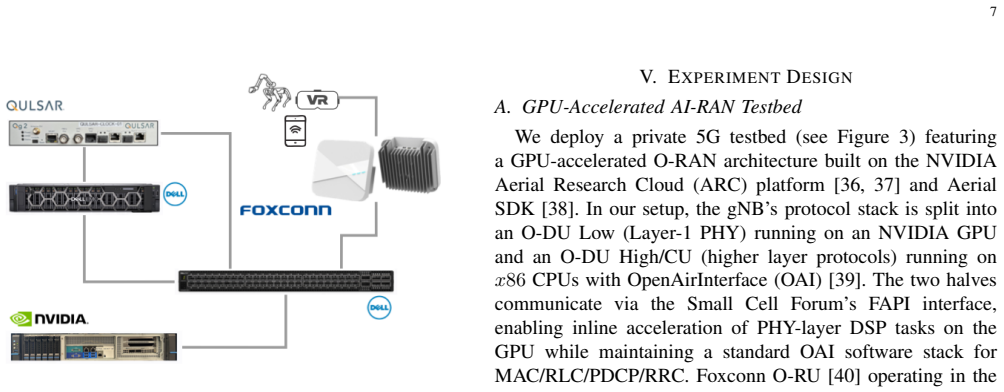
Summary. The paper introduces BRAIN, an active-inference agent for O-RAN network slicing that maintains a hand-coded deep generative model of the RAN, performs variational Bayesian belief updating over latent slice-demand states, and selects resource-allocation actions by minimizing expected free energy. The authors claim that BRAIN outperforms tuned heuristic and DRL baselines (DQN, A2C, REINFORCE, PPO, SAC) in a GPU-accelerated testbed, achieving higher QoS satisfaction, faster adaptation to sudden traffic shifts (up to 28.3% higher robustness), and real-time interpretability via posterior beliefs and EFE decomposition. The paper presents the framework, implementation details, and qualitative results in Figures 4–8, but quantitative evidence for the headline claims is missing.
Significance. If fully substantiated, this would be a meaningful contribution: it is one of the first demonstrations of active inference for closed-loop RAN control on a real O-RAN/AI-RAN testbed, with a plausible case for intrinsic explainability and non-stationarity robustness. The deployment as an xApp and the comparison against a wide set of DRL baselines are both valuable. However, the current evidence is insufficient to support the central empirical claims: the abstract's 28.3% robustness figure is not reproduced in Section VI, no confidence intervals or per-seed statistics are reported despite promises in Section V-C, and the 'explainability' is largely a restatement of the agent's internal computation. The paper's strengths are its real-world testbed and the principled formulation; its weaknesses are the missing quantitative evaluation and the unvalidated generative-model assumptions.
major comments (4)
- [§VI, Fig. 8, Abstract] The headline claim of 'up to 28.3% higher robustness' appears only in the Abstract and is never derived in the evaluation. Section V-C states that 5 independent runs and 95% confidence intervals are reported, but Figures 4, 7, and 8 show single curves with no error bands, and no table provides means, variances, or per-seed values. Without a quantitative comparison, the central 'superior adaptability' conclusion is unsupported; the observed differences could lie within run-to-run variance. Please report the actual robustness numbers, the QoS-satisfaction values before/after the shift, and appropriate statistical tests.
- [§IV-D, §IV-C, Algorithm 1] The explainability claim is introspective and circular in the sense that the quantities used to explain decisions (posterior beliefs Q(s_t) and EFE components) are exactly the quantities used to select actions in Eq. (8) and Algorithm 1. This is not a causal explanation validated independently: it merely restates the agent's decision rule. To substantiate 'human-interpretable' and 'causal' explanations, the paper should validate against ground-truth causes (e.g., injected traffic-demand changes), compare against an independent explainer, or show an ablation where the explanation actually predicts the action's effect. Otherwise, it is just a visualization of the algorithm's internal variables.
- [§III-A, §IV-A, §V-C] The correctness of the agent hinges on two assumptions that are not tested: (i) the O-RAN KPM reports are a sufficient statistic of the network's condition (stated in §III-A), and (ii) the hand-coded generative model—transition matrix B, observation matrix A, and preference distribution P_pref—accurately represents the real RAN environment. No learning of A or B from data is described, and the paper mentions sensitivity analyses in §V-C but does not report them in Section VI. If the generative model is misspecified (e.g., hidden states do not capture channel quality or mobility), the EFE-based action selection can be systematically wrong. Please provide a sensitivity study or a description of how A, B, and P_pref were calibrated and validated.
- [§V-C, Fig. 8] The non-stationarity experiment is not fully specified. It is unclear whether the DRL baselines were allowed to continue online learning after the shift (which the paper's own 'catastrophic forgetting' argument suggests they would need to do), or whether they were frozen. The comparison is only meaningful if the baselines are treated fairly: if they are kept in training mode, the drop/recovery in Fig. 8 may reflect their ability to adapt; if frozen, it reflects only their initial policy. The paper should state the exact training status of each baseline during the stress test and report the recovery time and post-shift QoS satisfaction quantitatively.
minor comments (6)
- [§VI, Fig. 7] The CDF plots show qualitative curves but no legend for line styles; color alone is used, which will not be accessible in grayscale. Consider adding markers or different line styles.
- [§IV-B, Eq. (10)] The KL divergence in Eq. (10) has a sum from t=0 to infinity over observations, which is notationally incorrect for a single-step divergence. It should be a sum over observation outcomes o, not over time.
- [§III-A] Typo: 'massive machine-yype communications' should be 'massive machine-type communications'.
- [§II, References] Reference [44] is listed as 'Deep Reinforcement Learning with Double Q-learning' but is cited for A2C. The A2C baseline is missing an explicit reference (e.g., the asynchronous advantage actor-critic paper).
- [§V-C] Typo: 'Tranining' should be 'Training'. Also, the sentence 'We compare both convergence speed in terms of training iterations and actual wall-clock time' is incomplete—the actual wall-clock comparison is not reported in Section VI.
- [§I, Fig. 1] The preliminary experiment on catastrophic forgetting is described qualitatively; if it is based on an actual run, the setup (environment, DRL algorithm, hyperparameters) should be specified, or it should be clearly labeled as an illustrative sketch.
Circularity Check
No significant circularity: the BRAIN derivation is self-contained; only minor motivational self-citations appear, and the headline robustness figure is a missing-support concern rather than a circular step.
full rationale
The core derivation (Algorithm 1, Eqs. 3-11) is not circular: BRAIN selects actions by minimizing G(a_t) = KL_pref - I_gain computed from an explicitly specified generative model, and the performance comparison against DRL baselines is externally measured on a GPU-accelerated testbed, so the empirical claims are not fitted inputs renamed as predictions. The only self-citations ([16] Maier; [23] Basaran & Dressler) are motivational or related-work and are not load-bearing for the derivation. The claimed 'introspective explainability' uses the same quantities (Q(s_t), G components) that determine the action; this is algorithmic transparency rather than a circular derivation, because it does not claim an independent prediction from those quantities. The 'up to 28.3% higher robustness' figure appears only in the abstract and is not substantiated by quantitative tables, confidence intervals, or per-seed results in Section VI; that is a missing-support/correctness concern, not a circularity, and does not raise the circularity score.
Assumptions & free parameters
free parameters (5)
- Reward weights α, β, γ =
not reported
- Precision γ for action posterior =
not reported
- Preference distribution P_pref(o) =
not reported
- Generative model matrices A and B =
not reported
- Planning horizon H =
one-step horizon (H=1)
assumptions (4)
- domain assumption KPM reports are a sufficient statistic of the network's condition
- ad hoc to paper The hand-coded generative model P(s,o,a) adequately captures RAN dynamics
- domain assumption Variational free-energy minimization is an appropriate objective for network control
- domain assumption The single-cell testbed with two UEs is representative of 6G non-stationary environments
invented entities (2)
-
Latent traffic-demand states (Low/Medium/High) per slice
-
'Check' (information-gathering) actions
Cite this review
Pith. "Pith review of BRAIN: Bayesian Reasoning via Active Inference for Agentic and Embodied Intelligence in Mobile Networks." pith.science (2026). https://pith.science/paper/CSD3M2RQ
@misc{pith2026260214033,
  author       = {Pith},
  title        = {Pith review of: BRAIN: Bayesian Reasoning via Active Inference for Agentic and Embodied Intelligence in Mobile Networks},
  year         = {2026},
  howpublished = {\url{https://pith.science/paper/CSD3M2RQ}},
  note         = {Machine review of arXiv:2602.14033}
}
read the original abstract
Future sixth-generation (6G) mobile networks will demand artificial intelligence (AI) agents that are not only autonomous and efficient, but also capable of real-time adaptation in dynamic environments and transparent in their decisionmaking. However, prevailing agentic AI approaches in networking, exhibit significant shortcomings in this regard. Conventional deep reinforcement learning (DRL)-based agents lack explainability and often suffer from brittle adaptation, including catastrophic forgetting of past knowledge under non-stationary conditions. In this paper, we propose an alternative solution for these challenges: Bayesian reasoning via Active Inference (BRAIN) agent. BRAIN harnesses a deep generative model of the network environment and minimizes variational free energy to unify perception and action in a single closed-loop paradigm. We implement BRAIN as O-RAN eXtended application (xApp) on GPU-accelerated testbed and demonstrate its advantages over standard DRL baselines. In our experiments, BRAIN exhibits (i) robust causal reasoning for dynamic radio resource allocation, maintaining slice-specific quality of service (QoS) targets (throughput, latency, reliability) under varying traffic loads, (ii) superior adaptability with up to 28.3% higher robustness to sudden traffic shifts versus benchmarks (achieved without any retraining), and (iii) real-time interpretability of its decisions through human-interpretable belief state diagnostics.
Figures


Figures from the paper (5 more)


Reference graph
Works this paper leans on
-
[1]
Embodied Intelligence: A Synergy of Morphology, Action, Perception and Learning,
H. Liu, D. Guo, and A. Cangelosi, “Embodied Intelligence: A Synergy of Morphology, Action, Perception and Learning,”ACM Computing Surveys, vol. 57, no. 7, pp. 1–36, Mar. 2025
2025
-
[2]
Artificial General Intelligence (AGI)-Native Wireless Systems: A Journey Beyond 6G,
W. Saad, O. Hashash, C. K. Thomas, C. Chaccour, M. Debbah, N. Mandayam, and Z. Han, “Artificial General Intelligence (AGI)-Native Wireless Systems: A Journey Beyond 6G,”Proceedings of the IEEE, vol. 113, no. 9, pp. 849–887, Sep. 2025
2025
-
[3]
Empowering the 6G Cellular Architecture with Open RAN,
M. Polese, M. Dohler, F. Dressler, M. Erol-Kantarci, R. Jana, R. Knopp, and T. Melodia, “Empowering the 6G Cellular Architecture with Open RAN,”IEEE Journal on Selected Areas in Communications, vol. 42, no. 2, pp. 245–262, Feb. 2024
2024
-
[4]
Channel Nonstationarity and Consistency for Beyond 5G and 6G: A Survey,
X. Cheng, Z. Huang, and L. Bai, “Channel Nonstationarity and Consistency for Beyond 5G and 6G: A Survey,”IEEE Communications Surveys & Tutorials, vol. 24, no. 3, pp. 1634–1669, 2022
2022
-
[5]
A Vision of 6G Wireless Systems: Applications, Trends, Technologies, and Open Research Problems,
W. Saad, M. Bennis, and M. Chen, “A Vision of 6G Wireless Systems: Applications, Trends, Technologies, and Open Research Problems,” IEEE Network, vol. 34, no. 3, pp. 134–142, May 2020
2020
-
[6]
Convolutional Networks for Images, Speech, and Time Series,
Y . LeCun and Y . Bengio, “Convolutional Networks for Images, Speech, and Time Series,” inHandbook of Brain Theory and Neural Networks, M. A. Arbib, Ed., MIT Press, 2003, pp. 255–258
2003
-
[7]
D. Bank, N. Koenigstein, and R. Giryes, “Autoencoders,” arXiv, cs.NI 2003.05991, Apr. 2021
arXiv 2003
-
[8]
Causal Reasoning: Charting a Revolutionary Course for Next- Generation AI-Native Wireless Networks,
C. K. Thomas, C. Chaccour, W. Saad, M. Debbah, and C. S. Hong, “Causal Reasoning: Charting a Revolutionary Course for Next- Generation AI-Native Wireless Networks,”IEEE Vehicular Technology Magazine, vol. 19, no. 1, pp. 16–31, Mar. 2024
2024
Show all 47 references
-
[9]
R. S. Sutton and A. G. Barto,Reinforcement Learning: An Introduc- tion. Cambridge, MA: MIT Press, 1998, p. 322
1998
-
[10]
An Intro- duction to Deep Reinforcement Learning,
F.-L. Vincent, H. Peter, I. Riashat, G. B. Marc, and P. Joelle, “An Intro- duction to Deep Reinforcement Learning,”Foundations and Trends® in Machine Learning, vol. 11, no. 3–4, pp. 219–354, Dec. 2018
2018
-
[11]
OnSlicing: Online End-to-End Network Slicing with Reinforcement Learning,
Q. Liu, N. Choi, and T. Han, “OnSlicing: Online End-to-End Network Slicing with Reinforcement Learning,” in17th ACM International Conference on Emerging Networking Experiments and Technologies (CoNEXT 2021), Virtual Conference: ACM, Dec. 2021, pp. 141–153
2021
-
[12]
ORANSlice: An Open Source 5G Network Slicing Platform for O-RAN,
H. Cheng, S. D’Oro, R. Gangula, S. Velumani, D. Villa, L. Bonati, M. Polese, T. Melodia, G. Arrobo, and C. Maciocco, “ORANSlice: An Open Source 5G Network Slicing Platform for O-RAN,” in30th ACM International Conference on Mobile Computing and Networking (MobiCom 2024), Washin...
2024
-
[13]
Explainable Deep Reinforcement Learning: State of the Art and Challenges,
G. A. V ouros, “Explainable Deep Reinforcement Learning: State of the Art and Challenges,”ACM Computing Surveys, vol. 55, no. 5, pp. 1–39, Dec. 2022
2022
-
[14]
Generalization- Enhanced DRL-Based Resource Allocation in Wireless Communica- tion Networks With Dynamic User Loads,
X. Yang, Y . Shi, J. Liu, Z. Xie, M. Sheng, and J. Li, “Generalization- Enhanced DRL-Based Resource Allocation in Wireless Communica- tion Networks With Dynamic User Loads,”IEEE Wireless Communi- cations Letters, vol. 14, no. 12, pp. 3902–3906, Dec. 2025
2025
-
[15]
AI Embodiment Through 6G: Shaping the Future of AGI,
L. Bariah and M. Debbah, “AI Embodiment Through 6G: Shaping the Future of AGI,”IEEE Wireless Communications, vol. 31, no. 5, pp. 174–181, Oct. 2024
2024
-
[16]
From artificial intelligence to active inference: the key to true AI and the 6G world brain [Invited],
M. Maier, “From artificial intelligence to active inference: the key to true AI and the 6G world brain [Invited],”Journal of Optical Communications and Networking, vol. 18, no. 1, A28–A43, Jan. 2026
2026
-
[17]
Active inference and learning,
K. J. Friston, T. FitzGerald, F. Rigoli, P. Schwartenbeck, J. ODoherty, and G. Pezzulo, “Active inference and learning,”Neuroscience & Biobehavioral Reviews, vol. 68, pp. 862–879, Sep. 2016
2016
-
[18]
Explainable Artificial Intelligence (XAI): What we know and what is left to attain Trustworthy Artificial Intelligence,
S. Ali, T. Abuhmed, S. El-Sappagh, K. Muhammad, J. M. Alonso- Moral, R. Confalonieri, R. Guidotti, J. Del Ser, N. D ´ıaz-Rodr´ıguez, and F. Herrera, “Explainable Artificial Intelligence (XAI): What we know and what is left to attain Trustworthy Artificial Intelligence,” Elsevi...
2023
-
[19]
Explainable Artificial Intelligence (XAI) 2.0: A manifesto of open challenges and interdisciplinary research directions,
L. Longo, M. Brcic, F. Cabitza, J. Choi, R. Confalonieri, J. D. Ser, R. Guidotti, Y . Hayashi, F. Herrera, A. Holzinger, R. Jiang, H. Khosravi, F. Lecue, G. Malgieri, A. P ´aez, W. Samek, J. Schneider, T. Speith, and S. Stumpf, “Explainable Artificial Intelligence (XAI) 2.0: A...
2024
-
[20]
Explainable Artificial Intelligence for 6G: Improving Trust between Human and Machine,
W. Guo, “Explainable Artificial Intelligence for 6G: Improving Trust between Human and Machine,”IEEE Communications Magazine, vol. 58, no. 6, pp. 39–45, Jun. 2020
2020
-
[21]
A Unified Approach to Interpreting Model Predictions,
S. M. Lundberg and S.-I. Lee, “A Unified Approach to Interpreting Model Predictions,” in31st International Conference on Neural In- formation Processing Systems (NIPS 2017), Long Beach, CA: Curran Associates Inc., Dec. 2017, pp. 4768–4777
2017
-
[22]
“Why Should I Trust You?
M. T. Ribeiro, S. Singh, and C. Guestrin, ““Why Should I Trust You?”: Explaining the Predictions of Any Classifier,” in22nd ACM SIGKDD International Conference on Knowledge Discovery and Data Mining, San Francisco, CA: ACM, Aug. 2016, pp. 1135 –1144
2016
-
[23]
XAInomaly: Explainable, Interpretable and Trustworthy AI for xURLLC in 6G Open-RAN,
O. T. Basaran and F. Dressler, “XAInomaly: Explainable, Interpretable and Trustworthy AI for xURLLC in 6G Open-RAN,” in3rd Inter- national Conference on 6G Networking (6GNet 2024), Paris, France: IEEE, Oct. 2024, pp. 93–101
2024
-
[24]
EXPLORA: AI/ML EXPLainability for the Open RAN,
C. Fiandrino, L. Bonati, S. D’Oro, M. Polese, T. Melodia, and J. Widmer, “EXPLORA: AI/ML EXPLainability for the Open RAN,” Proceedings of the ACM on Networking, vol. 1, pp. 1–26, Nov. 2023
2023
-
[25]
Towards Explainable AI for Channel Estimation in Wireless Communications,
A. K. Gizzini, Y . Medjahdi, A. J. Ghandour, and L. Clavier, “Towards Explainable AI for Channel Estimation in Wireless Communications,” IEEE Transactions on Vehicular Technology, vol. 73, no. 5, pp. 7389– 7394, May 2024
2024
-
[26]
ChronoProf: Profiling Time Series Forecasters and Classifiers in Mobile Networks with Explainable AI,
P. F. P ´erez, I. Bravo, A. Kamath, C. Fiandrino, and J. Widmer, “ChronoProf: Profiling Time Series Forecasters and Classifiers in Mobile Networks with Explainable AI,” in26th IEEE International Symposium on a World of Wireless, Mobile and Multimedia Networks (WoWMoM 2025), Fo...
2025
-
[27]
AIChronoLens: Advancing Explainability for Time Series AI Forecasting in Mobile Networks,
C. Fiandrino, E. P. G ´omez, P. F. P ´erez, H. Mohammadalizadeh, M. Fiore, and J. Widmer, “AIChronoLens: Advancing Explainability for Time Series AI Forecasting in Mobile Networks,” in43rd IEEE International Conference on Computer Communications (INFOCOM 2024), Vancouver, Cana...
2024
-
[28]
SYMBXRL: Symbolic Explainable Deep Reinforcement Learning for Mobile Networks,
A. Duttagupta, M. Jabbari, C. Fiandrino, M. Fiore, and J. Widmer, “SYMBXRL: Symbolic Explainable Deep Reinforcement Learning for Mobile Networks,” in44th IEEE International Conference on Com- puter Communications (INFOCOM 2025), London, United Kingdom: IEEE, May 2025, pp. 1–10
2025
-
[29]
Active inference on discrete state-spaces: A synthesis,
L. Da Costa, T. Parr, N. Sajid, S. Veselic, V . Neacsu, and K. J. Friston, “Active inference on discrete state-spaces: A synthesis,”Journal of Mathematical Psychology, vol. 99, p. 102 447, Dec. 2020
2020
-
[30]
Reinforce- ment Learning through Active Inference,
A. Tschantz, B. Millidge, A. K. Seth, and C. L. Buckley, “Reinforce- ment Learning through Active Inference,” arXiv, cs.LG, Feb. 2020
2020
-
[31]
An Empirical Study of Active Inference on a Humanoid Robot,
G. Oliver, P. Lanillos, and G. Cheng, “An Empirical Study of Active Inference on a Humanoid Robot,”IEEE Transactions on Cognitive and Developmental Systems, vol. 14, no. 2, pp. 462–471, Jun. 2022
2022
-
[32]
Real-World Robot Control Based on Contrastive Deep Active Inference With Demonstrations,
K. Fujii, T. Isomura, and S. Murata, “Real-World Robot Control Based on Contrastive Deep Active Inference With Demonstrations,”IEEE Access, vol. 12, pp. 172 343–172 357, 2024
2024
-
[33]
Designing explainable arti- ficial intelligence with active inference: A framework for transparent introspection and decision-making,
M. Albarracin, I. Hip ´olito, S. E. Tremblay, J. G. Fox, G. Ren ´e, K. J. Friston, and M. J. D. Ramstead, “Designing explainable arti- ficial intelligence with active inference: A framework for transparent introspection and decision-making,” arXiv, cs.AI, Jun. 2023
2023
-
[34]
T. Parr, G. Pezzulo, and K. J. Friston,Active Inference: The Free Energy Principle in Mind, Brain, and Behavior. The MIT Press, 2022
2022
-
[35]
The free-energy principle: a unified brain theory?
K. J. Friston, “The free-energy principle: a unified brain theory?” Nature Reviews Neuroscience, vol. 11, no. 2, pp. 127–138, Jan. 2010
2010
-
[36]
Aerial: A GPU Hyperconverged Platform for 5G,
A. Kelkar and C. Dick, “Aerial: A GPU Hyperconverged Platform for 5G,” inACM SIGCOMM 2021, Demo Session, Virtual Conference: ACM, Aug. 2021, pp. 79–81
2021
-
[37]
NVIDIA Aerial GPU Hosted AI-on-5G,
A. Kelkar and C. Dick, “NVIDIA Aerial GPU Hosted AI-on-5G,” in 4th IEEE 5G World Forum (5GWF 2021), Montr ´eal, Canada: IEEE, Oct. 2021, pp. 64–69
2021
-
[38]
NVIDIA Aerial SDK
NVIDIA. “NVIDIA Aerial SDK. ”[Online]. Available: https : / / developer.nvidia.com/aerial-sdk (accessed: 15.01.2026)
2026
-
[39]
OpenAirInterface: Democratizing innovation in the 5G Era,
F. Kaltenberger, A. P. Silva, A. Gosain, L. Wang, and T.-T. Nguyen, “OpenAirInterface: Democratizing innovation in the 5G Era,”Elsevier Computer Networks, vol. 176, p. 107 284, Jul. 2020
2020
-
[40]
Foxconn RPQN
Foxconn. “Foxconn RPQN. ”[Online]. Available: https://fcc.report/ FCC-ID/2AQ68RPQN7801/5573870.pdf (accessed: 15.01.2026)
2026
-
[41]
OSC Near Realtime RIC
O-RAN SC. “OSC Near Realtime RIC. ”[Online]. Available: https: //wiki.o-ran-sc.org/display/RICP/2022-05-24+Release+E (accessed: 15.01.2026)
2022
-
[42]
ColO- RAN: Developing Machine Learning-Based xApps for Open RAN Closed-Loop Control on Programmable Experimental Platforms,
M. Polese, L. Bonati, S. D’Oro, S. Basagni, and T. Melodia, “ColO- RAN: Developing Machine Learning-Based xApps for Open RAN Closed-Loop Control on Programmable Experimental Platforms,” IEEE Transactions on Mobile Computing, vol. 22, no. 10, pp. 5787– 5800, Oct. 2023
2023
-
[43]
Playing Atari with Deep Reinforcement Learning,
V . Mnih, K. Kavukcuoglu, D. Silver, A. Graves, I. Antonoglou, D. Wierstra, and M. Riedmiller, “Playing Atari with Deep Reinforcement Learning,” arXiv, cs.LG 1312.5602, Dec. 2013
2013 arXiv
-
[44]
Deep Reinforcement Learning with Double Q-learning,
H. van Hasselt, A. Guez, and D. Silver, “Deep Reinforcement Learning with Double Q-learning,” in30th AAAI Conference on Artificial Intelligence (AAAI 2016), Phoenix, AZ: AAAI Press, Feb. 2016, pp. 2094–2100. 13
2016
-
[45]
Simple statistical gradient-following algorithms for connectionist reinforcement learning,
R. J. Williams, “Simple statistical gradient-following algorithms for connectionist reinforcement learning,”Machine Learning, vol. 8, no. 3–4, pp. 229–256, May 1992
1992
-
[46]
Proximal Policy Optimization Algorithms,
J. Schulman, R. Wolski, P. Dhariwal, A. Radford, and O. Klimov, “Proximal Policy Optimization Algorithms,” arXiv, cs.LG, Jul. 2017, pp. 1–12
2017
-
[47]
Soft Actor-Critic: Off-Policy Maximum Entropy Deep Reinforcement Learning with a Stochastic Actor,
T. Haarnoja, A. Zhou, P. Abbeel, and S. Levine, “Soft Actor-Critic: Off-Policy Maximum Entropy Deep Reinforcement Learning with a Stochastic Actor,” arXiv, cs.LG 1801.01290, Aug. 2018. Osman Tugay Basaranis a 6G/AI Research Scien- tist at Prof. Dr.-Ing. Falko Dressler’s Teleco...
2018 arXiv
Reviewed August 2, 2026 · model on record in the stance chip above.
Discussion (0). Continue with ORCID to comment.