REVIEW 5 major objections 5 minor 39 references
Epidemiology-informed Network for Robust Rumor Detection
T0 review · 5 major / 5 minor · reviewed 2026-08-12 · deepseek-v4-flash
Pith's one-line read This paper claims that an epidemiology-inspired state encoder, supervised by LLM-generated stance pseudo-labels, makes graph-based rumor detectors more accurate and more robust across shallow and deep propagation trees.
desk verdict Solid, reproducible applied-ML paper with modest gains; the epidemiology framing and LLM-supervision contribution are both less clean than claimed, but the work deserves proper refereeing. read the letter →
The pith
A machine-rendered reading of the paper's core claim, the machinery that carries it, and where it could break.
The reading
What carries the argument
The eUSD model is a three-compartment environmental transmission system: $dU/dt = -\alpha U e - \beta U e$, $dS/dt = \alpha U e$, $dD/dt = \beta U e$, with environment influence $e$ set to 1. It is discretized by a forward difference quotient into recurrent updates of three learnable state embeddings (Unknown, Support, Denial) over the tree's depth steps. State labels are produced by an LLM that classifies each reply's stance toward its parent, combined by XOR along the path to derive the reply's state relative to the root. A KL-divergence loss matches the encoder's softmax-normalized state distributions to the LLM-derived distributions at every depth and is added to the rumor-classification cross-entropy loss with weight $\lambda$; this auxiliary loss is what steers the data-driven GNN toward epidemiology-informed dynamics.
What would settle it
Train EIN on the same three datasets with random or flipped LLM stance labels while keeping the encoder and KL loss; if accuracy does not drop, the stance-supervision mechanism is not carrying the gain. Separately, human-annotate a random sample of reply posts and compare Gemma 2-9B's labels to the human labels; near-chance agreement on ambiguous replies would undercut the claimed mechanism.
Extended reading notes
Core claim
The central discovery is that the eUSD (environmental Unknown–Support–Denial) transmission model, discretized into learnable state embeddings, supplies a robust prior for rumor-spread dynamics that data-driven GNNs lack. When the encoder's predicted state distributions are trained to match LLM-generated state labels via a KL-divergence auxiliary loss, the resulting tree-level representation consistently improves accuracy, AUC, and F1 for both BiGCN and ResGCN across DRWeibo, Weibo, and Pheme, with the gains most visible where the baselines degrade: depth-1 trees and trees deeper than five levels.
Load-bearing premise
The auxiliary loss assumes the LLM's stance labels are accurate enough to supervise the state encoder; the paper never validates Gemma 2-9B's labels against human annotations, and if they are systematically wrong on sarcastic or ambiguous replies, that error gets baked into the learned state dynamics.
Editorial extensions
If this is right
- EIN is a plug-in: adding it to BiGCN and ResGCN improves all three metrics on all three datasets in the paper's reported results.
- The LLM is used only during training, so the deployed detector has no extra inference-time cost over its graph backbone.
- The robustness results cover depth-1 trees (few interactions) and depth>5 trees (noisy cascades), the early-detection and high-controversy cases that matter in practice.
- The eUSD formulation outperforms the classic USD model in the paper's ablation, indicating that root-post-driven (environmental) influence fits rumor propagation better than population-driven influence.
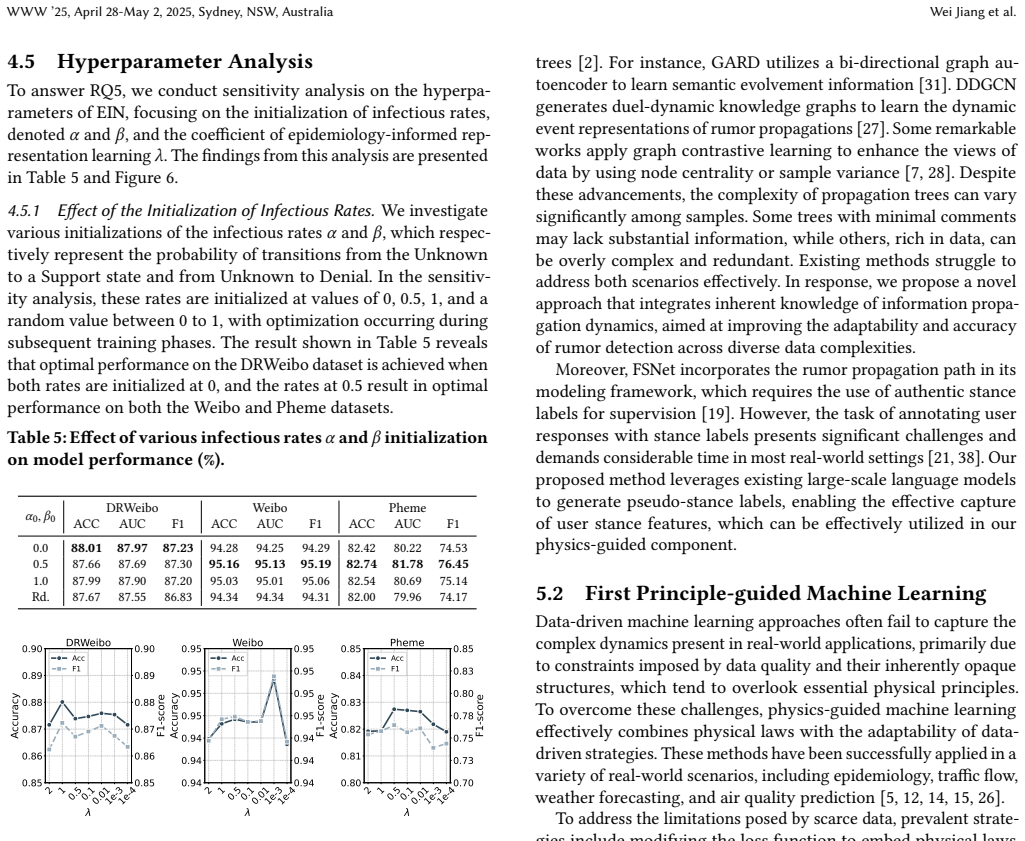
- The sensitivity analysis shows the method needs per-dataset tuning of the transition-rate initialization and the auxiliary-loss weight $\lambda$ to reach its best numbers.
Reading between the lines
- The paper never measures how accurate Gemma 2-9B's stance labels are against human annotations; if those pseudo-labels are biased on sarcastic or ambiguous replies, the KL loss would imprint that bias into the learned dynamics.
- The 'EIN w/o ERL' ablation removes the encoder and the loss together, so it cannot isolate the contribution of the LLM pseudo-labels; a variant that keeps the encoder but randomizes the KL targets would settle it.
- Because the encoder is a small recurrent state machine, the same plug-in pattern could transfer to other tree-structured social tasks, such as early fake-news alerting or stance detection on low-depth threads.
- The depth-robustness finding suggests a general recipe: injecting a principle-based prior into a GNN can compensate for both data sparsity and noisy structure, which may extend beyond rumor detection to other graph classification problems.
Signed reviews
Editorial analysis
A structured set of objections, weighed in public.
Referee Report
Summary. The paper proposes an Epidemiology-informed Network (EIN), a plug-in module for graph-based rumor detectors that augments the data-driven tree embedding with a state embedding produced by an 'environmental Unknown-Support-Denial' (eUSD) encoder. To train this encoder without human stance annotations, the authors use Gemma 2-9B to generate pairwise stance labels between a post and its parent, derive node-level state labels via an XOR rule, and add a KL-divergence loss L_p between the predicted and pseudo-label state distributions. Experiments on DRWeibo, Weibo, and Pheme report accuracy, AUC, and F1 improvements over ten baselines, including variants built on BiGCN and ResGCN backbones, plus a depth-stratified analysis intended to show robustness across shallow and deep propagation trees. The code is released.
Significance. If the central claim holds, the work offers a simple, backbone-agnostic way to improve robustness in rumor detection without inference-time LLM calls, and it proposes an interesting use of LLM pseudo-labels for stance supervision. The manuscript ships code, covers three datasets, and evaluates with multiple baselines, which are real strengths. However, the claimed mechanism is not empirically isolated from the LLM supervision, the gains on Pheme overlap within standard deviations, and the robustness analysis lacks error bars and significance tests. The 'epidemiology-informed' framing is also stronger than what the equations justify, since all key parameters are learned and no test verifies the learned dynamics against the eUSD model. These issues leave the central attribution of the gains under-evidenced, but they are addressable in revision.
major comments (5)
- [Section 3.3, Eq. (8)] The definition of the target distribution is time-inconsistent. The text defines p_{u,t} = |C_u|/(n-1) with n the number of nodes in the tree, which does not depend on t. If the intent is to use depth-specific counts at stage t, the construction is not provided; if the target is indeed the stationary global distribution, the time-indexed notation and the comparison with time-indexed encoder outputs \hat{p}_{u,t} are misleading. Either way, the objective as written does not clearly enforce the claimed temporal dynamics, and this is load-bearing for the representation learning module.
- [Section 4.4, Figure 5] The ablation 'EIN w/o ERL' removes the epidemiology-informed representation learning component, but the description does not clarify whether the epidemiology-informed encoder itself remains in the network. As reported, the ablation conflates two effects: the added encoder capacity and the information carried by the LLM-generated pseudo-labels. The paper does not provide a control that keeps the encoder and removes only the auxiliary loss, nor a control with random or constant stance labels, nor an evaluation of the agreement between Gemma's stance labels and human annotations. Without these, the improvement attributed to 'epidemiology-informed representation learning' could be due to the pseudo-labels encoding a rumor prior or to plain regularization.
- [Tables 2 and 3] Several headline gains are within one standard deviation of the baseline. On Pheme in Table 2, EIN's ACC 82.74±0.77 vs BiGCN 82.00±1.28, AUC 81.78±1.30 vs 79.76±3.38, and F1 76.45±1.66 vs 73.84±4.64 all overlap; in Table 3, EIN+ResGCN improves ResGCN on Pheme by only 0.46 ACC, 0.19 AUC, and 0.24 F1. The abstract's claim that EIN 'outperforms state-of-the-art methods' and the Section 4.2 claim that it 'consistently enhances' both backbones are not supported without paired significance tests or confidence intervals.
- [Section 4.3, Figure 4] The robustness claim is based on bars without error bars or statistical tests, and the depth-stratified evaluation is severely imbalanced: Table 4 shows only 4.65% of DRWeibo test samples have depth>5 and only 10.08% of Weibo test samples have depth=1. The visible differences in those sparse bins are not interpretable as evidence of robustness. The paper should report the number of test samples per bin, add significance tests or confidence intervals, and restrict the claim to bins with sufficient support.
- [Sections 2.2 and 3.1] The eUSD model is described as first-principles domain knowledge, but the implemented encoder is a learned linear residual network: Eq. (3) is U_{t+1} = (1-α-β) U_t with learnable α and β, and Eq. (4) comprises learned linear maps W_s, W_d, and W_u. No experiment checks whether the learned states actually follow eUSD dynamics, and no comparison is made against a same-capacity MLP with no epidemiology structure beyond the EIN w/o ERL variant. The 'epidemiology-informed' attribution is therefore not demonstrated; the eUSD form is a hypothesis, not a constraint.
minor comments (5)
- [Figures 1 and 4 and Table 4] The depth categories are labeled '5+' in the figures and 'depth≥5' in Table 4; the text also uses 'depth≥5' and 'depth ≥ 5' on the same page. Please standardize the notation.
- [Section 4.2] The model name 'LeRuD' is spelled 'LeRUD' in the second paragraph of Section 4.2; use one consistent name throughout.
- [Eq. (2)] The definition b_u = W_{u0} - αW_{u0} - βW_{u0} = (1-α-β)W_{u0} can flip sign when α + β > 1, which is inconsistent with the 'number of nodes in a tree' interpretation of the initial Unknown state. Please clarify or constrain the initialization.
- [Algorithm 1] The XOR rule for propagating state labels assumes a two-valued stance and logical transitivity across the tree. This assumption should be stated explicitly and ideally checked on a small human-annotated sample, especially since the LLM prompt itself is only asked for binary labels.
- [Figure 5] The ablation results are presented without standard deviations, so it is impossible to tell whether the differences between EIN, EIN-reg, and EIN w/o ERL are meaningful; please add error bars or a numerical table.
Circularity Check
No significant circularity: EIN's gains are held-out empirical results, and the epidemiology-informed loss trains rather than defines the state encoder.
full rationale
The derivation chain is self-contained: the eUSD model in Eq. (1) is an adopted epidemiological modeling assumption, Eqs. (3)-(4) implement it as a discretized, learnable-parameter encoder, and Eq. (8) defines a KL-divergence training loss that pushes the encoder's predicted state distributions toward LLM-generated pseudo-labels; no equation sets the final rumor prediction equal to the fitted transition rates or to the pseudo-labels by construction. The accuracy and depth-robustness claims (Tables 2-4, Figure 4) are measured on held-out test samples against external baselines, so the central result is not forced by the training objective. The only self-citation, [15], is used in Sections 3.1 and 5.2 as a general pointer to prior physics-guided ML work and is not load-bearing for the rumor-detection derivation. The unmeasured accuracy of the LLM stance labels and the fact that the 'EIN w/o ERL' ablation removes the whole module are experimental-identification concerns, not circularity, so no circular step is exhibited.
Assumptions & free parameters
free parameters (3)
- Infectious rates alpha, beta =
Initialized 0.0 (DRWeibo), 0.5 (Weibo, Pheme); optimized during training
- Epidemiology-informed representation learning coefficient lambda =
1.0 (DRWeibo), 0.001 (Weibo), 0.5 (Pheme)
- Learnable weights W_u, W_s, W_d, W_x, W_l, b_u, b_s, b_d
assumptions (4)
- domain assumption The eUSD continuous model (Eq. 1) with e=1 is a valid description of rumor propagation in a tree.
- domain assumption The discrete forward Euler updates in Eqs. (3)-(4) faithfully encode the eUSD dynamics.
- domain assumption LLM-generated stance labels are accurate enough to supervise state learning.
- domain assumption Tree depth T serves as the discretized epidemiological time t.
Cite this review
Pith. "Pith review of Epidemiology-informed Network for Robust Rumor Detection." pith.science (2026). https://pith.science/paper/CSMXNXOQ
@misc{pith2026241112949,
  author       = {Pith},
  title        = {Pith review of: Epidemiology-informed Network for Robust Rumor Detection},
  year         = {2026},
  howpublished = {\url{https://pith.science/paper/CSMXNXOQ}},
  note         = {Machine review of arXiv:2411.12949}
}
read the original abstract
The rapid spread of rumors on social media has posed significant challenges to maintaining public trust and information integrity. Since an information cascade process is essentially a propagation tree, recent rumor detection models leverage graph neural networks to additionally capture information propagation patterns, thus outperforming text-only solutions. Given the variations in topics and social impact of the root node, different source information naturally has distinct outreach capabilities, resulting in different heights of propagation trees. This variation, however, impedes the data-driven design of existing graph-based rumor detectors. Given a shallow propagation tree with limited interactions, it is unlikely for graph-based approaches to capture sufficient cascading patterns, questioning their ability to handle less popular news or early detection needs. In contrast, a deep propagation tree is prone to noisy user responses, and this can in turn obfuscate the predictions. In this paper, we propose a novel Epidemiology-informed Network (EIN) that integrates epidemiological knowledge to enhance performance by overcoming data-driven methods sensitivity to data quality. Meanwhile, to adapt epidemiology theory to rumor detection, it is expected that each users stance toward the source information will be annotated. To bypass the costly and time-consuming human labeling process, we take advantage of large language models to generate stance labels, facilitating optimization objectives for learning epidemiology-informed representations. Our experimental results demonstrate that the proposed EIN not only outperforms state-of-the-art methods on real-world datasets but also exhibits enhanced robustness across varying tree depths.
Figures


Figures from the paper (4 more)



Reference graph
Works this paper leans on
-
[1]
Muhammad Zubair Asghar, Ammara Habib, Anam Habib, Adil Khan, Rehman Ali, and Asad Khattak. 2021. Exploring deep neural networks for rumor detection. Journal of Ambient Intelligence and Humanized Computing 12 (2021), 4315–4333
work page 2021
-
[2]
Tian Bian, Xi Xiao, Tingyang Xu, Peilin Zhao, Wenbing Huang, Yu Rong, and Junzhou Huang. 2020. Rumor detection on social media with bi-directional graph convolutional networks. In Proceedings of the AAAI conference on artificial intelligence, Vol. 34. 549–556
work page 2020
-
[3]
Roman Bresson, Giannis Nikolentzos, George Panagopoulos, Michail Chatzianas- tasis, Jun Pang, and Michalis Vazirgiannis. 2024. Kagnns: Kolmogorov-arnold networks meet graph learning. arXiv preprint arXiv:2406.18380 (2024)
arXiv 2024
-
[4]
Y Chang and MCM de Jong. 2023. A novel method to jointly estimate transmission rate and decay rate parameters in environmental transmission models. Epidemics 42, 100672
work page 2023
-
[5]
Shengyu Chen, Nasrin Kalanat, Yiqun Xie, Sheng Li, Jacob A Zwart, Jeffrey M Sadler, Alison P Appling, Samantha K Oliver, Jordan S Read, and Xiaowei Jia. 2023. Physics-guided machine learning from simulated data with different physical parameters. Knowledge and Information Systems 65, 8 (2023), 3223–3250
work page 2023
-
[6]
Jun-Jun Cheng, Yun Liu, Bo Shen, and Wei-Guo Yuan. 2013. An epidemic model of rumor diffusion in online social networks. The European Physical Journal B 86, 1 (2013), 29
work page 2013
-
[7]
Chaoqun Cui and Caiyan Jia. 2024. Propagation Tree Is Not Deep: Adaptive Graph Contrastive Learning Approach for Rumor Detection. In Proceedings of the AAAI Conference on Artificial Intelligence , Vol. 38. 73–81
work page 2024
-
[8]
Joydip Dhar, Ankur Jain, and Vijay K. Gupta. 2016. A mathematical model of news propagation on online social network and a control strategy for rumor spreading. Social Network Analysis and Mining 6 (2016), 1–9
work page 2016
Show all 39 references
-
[9]
Yutong Feng, Qiongyan Wang, Yutong Xia, Junlin Huang, Siru Zhong, Kun Wang, Shifen Cheng, and Yuxuan Liang. 2024. Spatio-Temporal Field Neural Networks for Air Quality Inference. arXiv preprint arXiv:2403.02354 (2024)
2024 arXiv
-
[10]
Han Guo, Juan Cao, Yazi Zhang, Junbo Guo, and Jintao Li. 2018. Rumor detec- tion with hierarchical social attention network. In Proceedings of the 27th ACM international conference on information and knowledge management . 943–951
2018
-
[11]
Erhu He, Yiqun Xie, Licheng Liu, Weiye Chen, Zhenong Jin, and Xiaowei Jia. 2023. Physics guided neural networks for time-aware fairness: an application in crop yield prediction. In Proceedings of the AAAI Conference on Artificial Intelligence , Vol. 37. 14223–14231
2023
-
[12]
Kethmi Hirushini Hettige, Jiahao Ji, Shili Xiang, Cheng Long, Gao Cong, and Jingyuan Wang. 2024. AirPhyNet: Harnessing Physics-Guided Neural Networks for Air Quality Prediction. arXiv preprint arXiv:2402.03784 (2024)
2024 arXiv
-
[13]
S Mo Jang, Tieming Geng, Jo-Yun Queenie Li, Ruofan Xia, Chin-Tser Huang, Hwalbin Kim, and Jijun Tang. 2018. A computational approach for examining the roots and spreading patterns of fake news: Evolution tree analysis. Computers in Human Behavior 84 (2018), 103–113
2018
-
[14]
Xiaowei Jia, Jacob Zwart, Jeffrey Sadler, Alison Appling, Samantha Oliver, Steven Markstrom, Jared Willard, Shaoming Xu, Michael Steinbach, Jordan Read, et al
-
[15]
Wei Jiang, Tong Chen, Guanhua Ye, Wentao Zhang, Lizhen Cui, Zi Huang, and Hongzhi Yin. 2024. Physics-guided Active Sample Reweighting for Urban Flow Prediction. arXiv preprint arXiv:2407.13605 (2024)
2024 arXiv
-
[16]
Ling Min Serena Khoo, Hai Leong Chieu, Zhong Qian, and Jing Jiang. 2020. Interpretable rumor detection in microblogs by attending to user interactions. In Proceedings of the AAAI conference on artificial intelligence , Vol. 34. 8783–8790
2020
-
[17]
Thomas N Kipf and Max Welling. 2016. Semi-supervised classification with graph convolutional networks. arXiv preprint arXiv:1609.02907 (2016)
2016 arXiv
-
[18]
Sejeong Kwon, Meeyoung Cha, Kyomin Jung, Wei Chen, and Yajun Wang. 2013. Prominent features of rumor propagation in online social media. In 2013 IEEE 13th international conference on data mining . IEEE, 1103–1108
2013
-
[19]
Jun Li, Yi Bin, Yunshan Ma, Yang Yang, Zi Huang, and Tat-Seng Chua. 2024. Filter- based Stance Network for Rumor Verification. ACM Transactions on Information Systems 42, 4 (2024), 1–28
2024
-
[20]
Qiang Liu, Xiang Tao, Junfei Wu, Shu Wu, and Liang Wang. 2024. Can Large Language Models Detect Rumors on Social Media?arXiv preprint arXiv:2402.03916 (2024)
2024 arXiv
-
[21]
Jing Ma, Wei Gao, Prasenjit Mitra, Sejeong Kwon, Bernard J Jansen, Kam-Fai Wong, and Meeyoung Cha. 2016. Detecting rumors from microblogs with recur- rent neural networks. (2016)
2016
-
[22]
Jing Ma, Wei Gao, and Kam-Fai Wong. 2018. Rumor detection on twitter with tree- structured recursive neural networks. Association for Computational Linguistics
2018
-
[23]
Quoc Viet Hung Nguyen, Chi Thang Duong, Thanh Tam Nguyen, Matthias Wei- dlich, Karl Aberer, Hongzhi Yin, and Xiaofang Zhou. 2017. Argument discovery via crowdsourcing. The VLDB Journal 26 (2017), 511–535
2017
-
[24]
Thanh Tam Nguyen, Chi Thang Duong, Matthias Weidlich, Hongzhi Yin, and Quoc Viet Hung Nguyen. 2017. Retaining data from streams of social platforms with minimal regret. In Twenty-sixth International Joint Conference on Artificial Intelligence
2017
-
[25]
Thanh Cong Phan, Thanh Tam Nguyen, Matthias Weidlich, Hongzhi Yin, Jun Jo, and Quoc Viet Hung Nguyen. 2022. exrumourlens: Auditable rumour detection with multi-view explanations. In 2022 IEEE 38th International Conference on Data Engineering (ICDE). IEEE, 3174–3177
2022
-
[26]
Alexander Rodríguez, Jiaming Cui, Naren Ramakrishnan, Bijaya Adhikari, and B Aditya Prakash. 2023. Einns: Epidemiologically-informed neural networks. In Proceedings of the AAAI Conference on Artificial Intelligence, Vol. 37. 14453–14460
2023
-
[27]
Mengzhu Sun, Xi Zhang, Jiaqi Zheng, and Guixiang Ma. 2022. Ddgcn: Dual dynamic graph convolutional networks for rumor detection on social media. In Proceedings of the AAAI conference on artificial intelligence , Vol. 36. 4611–4619
2022
-
[28]
Tiening Sun, Zhong Qian, Sujun Dong, Peifeng Li, and Qiaoming Zhu. 2022. Rumor detection on social media with graph adversarial contrastive learning. In Proceedings of the ACM Web Conference 2022 . 2789–2797
2022
-
[29]
Xiangguo Sun, Hong Cheng, Bo Liu, Jia Li, Hongyang Chen, Guandong Xu, and Hongzhi Yin. 2023. Self-supervised hypergraph representation learning for sociological analysis. IEEE Transactions on Knowledge and Data Engineering 35, 11 (2023), 11860–11871
2023
-
[30]
Nguyen Thanh Tam, Matthias Weidlich, Bolong Zheng, Hongzhi Yin, Nguyen Quoc Viet Hung, and Bela Stantic. 2019. From anomaly detection to rumour detec- tion using data streams of social platforms. Proceedings of the VLDB Endowment 12, 9 (2019), 1016–1029
2019
-
[31]
Xiang Tao, Liang Wang, Qiang Liu, Shu Wu, and Liang Wang. 2024. Semantic Evolvement Enhanced Graph Autoencoder for Rumor Detection. In Proceedings of the ACM on Web Conference 2024 . 4150–4159
2024
-
[32]
Gemma Team, Morgane Riviere, Shreya Pathak, Pier Giuseppe Sessa, Cassidy Hardin, Surya Bhupatiraju, Léonard Hussenot, Thomas Mesnard, Bobak Shahriari, Alexandre Ramé, et al. 2024. Gemma 2: Improving open language models at a practical size. arXiv preprint arXiv:2408.00118 (2024)
2024 arXiv
-
[33]
Amir Pouran Ben Veyseh, My T Thai, Thien Huu Nguyen, and Dejing Dou. 2019. Rumor detection in social networks via deep contextual modeling. In Proceedings of the 2019 IEEE/ACM international conference on advances in social networks analysis and mining. 113–120
2019
-
[34]
Rong-Hua Wang, Zhen Jin, Quan-Xing Liu, Johan van de Koppel, and David Alonso. 2012. A simple stochastic model with environmental transmission ex- plains multi-year periodicity in outbreaks of avian flu. PLoS One 7, 2 (2012), e28873
2012
-
[35]
Keyulu Xu, Weihua Hu, Jure Leskovec, and Stefanie Jegelka. 2018. How powerful are graph neural networks? arXiv preprint arXiv:1810.00826 (2018)
2018 arXiv
-
[36]
Yuning You, Tianlong Chen, Yongduo Sui, Ting Chen, Zhangyang Wang, and Yang Shen. 2020. Graph contrastive learning with augmentations. Advances in neural information processing systems 33 (2020), 5812–5823
2020
-
[37]
Laijun Zhao, Hongxin Cui, Xiaoyan Qiu, Xiaoli Wang, and Jiajia Wang. 2013. SIR rumor spreading model in the new media age. Physica A: Statistical Mechanics and its Applications 392, 4 (2013), 995–1003
2013
-
[38]
Arkaitz Zubiaga, Maria Liakata, and Rob Procter. 2017. Exploiting context for ru- mour detection in social media. In Social Informatics: 9th International Conference, SocInfo 2017, Oxford, UK, September 13-15, 2017, Proceedings, Part I 9 . Springer, 109–123. WWW ’25, April 28-...
2017
-
[2021]
In Proceedings of the 2021 SIAM International Conference on Data Mining (SDM)
Physics-guided recurrent graph model for predicting flow and temperature in river networks. In Proceedings of the 2021 SIAM International Conference on Data Mining (SDM). SIAM, 612–620
2021
Reviewed August 12, 2026 · model on record in the stance chip above.
Discussion (0). Continue with ORCID to comment.