REVIEW 4 major objections 5 minor 65 references
The paper claims that extinction for RR Lyrae stars in the Gaia bands can be derived from compact period-amplitude(-metallicity) relations, with new PACZ relations for RRab stars and the first PAC relations for RRc stars, reproducing intrin
Reviewed by Pith at T0; open to challenge. T0 means a machine referee read the full paper against a public rubric. the ladder, T0–T4 →
T0 review · deepseek-v4-flash
2026-08-02 04:49 UTC pith:CULLXMFP
load-bearing objection Useful first RRc reddening relation in Gaia bands, but the training labels inherit the zero point of the very extinction estimates they aim to improve—worth refereeing with a demand for an independent zero-point check. the 4 major comments →
Improving reddening estimates for RR Lyrae stars in the Gaia bands: a machine learning approach to the PAC(Z) relation
The pith
A machine-rendered reading of the paper's core claim, the machinery that carries it, and where it could break.
Core claim
On the paper's own terms, the central discovery is that the intrinsic Gaia colors of RR Lyrae stars are predictable from a small set of pulsation parameters, and that the same functional form works separately for both pulsation modes. The recalibrated PACZ relations for RRab and the new PAC relations for RRc reproduce (G−G_RP)_0 and (G_BP−G_RP)_0 with residual scatters of about 0.03–0.04 mag, and their derived A_G values are consistent across field stars, globular clusters, dwarf spheroidal galaxies, and the Magellanic Clouds. The paper further claims that the (G_BP−G_RP)-based relations are more stable than the (G−G_RP)-based ones, especially at low reddening, because the wider wavelength b
What carries the argument
The central object is the period-amplitude-color (PAC) relation, extended to period-amplitude-color-metallicity (PACZ) when metallicity is included. It is a linear regression that predicts intrinsic color from log period, a peak-to-peak amplitude, and, for RRab stars, metallicity. The carrying mechanism is sequential feature selection (SFS) with bootstrap-resampled coefficients, which chooses the predictors from a pool of periods, amplitudes, and Fourier parameters and guards against overfitting in the small reference sample. The selected relations are then used to compute color excesses and, via fixed total-to-selective extinction ratios, G-band absorption.
Load-bearing premise
The training labels—the intrinsic colors used to fit the relations—are computed from literature absorption values, so a systematic zero-point error in those absorptions would be absorbed into the fitted coefficients and bias every derived A_G.
What would settle it
Take a sample of RR Lyrae stars in a low-reddening dwarf galaxy and in an LMC field with known geometry, measure their reddening independently via Balmer decrements or near-infrared color–color diagrams, and compare with the A_G from the (G_BP−G_RP) relation; a systematic offset beyond the quoted 0.12–0.18 mag uncertainties would falsify the zero point.
If this is right
- A homogeneous reddening scale now exists for both RRab and RRc stars in Gaia passbands, so extinction corrections no longer need passband transformations from V/I calibrations.
- The (G_BP−G_RP)-based PAC(Z) relations can be applied to roughly 140,000 RR Lyrae stars in Gaia DR3, with A_G uncertainties of about 0.12–0.18 mag.
- All-sky A_G maps built from the new relations trace the disc, bulge, halo, and Magellanic Clouds consistently.
- Using the new relations reduces the scatter in the G-band absolute magnitude–metallicity relation for field RR Lyrae stars compared to DR3 absorptions.
- RRc stars, previously without any PAC calibration, now have an extinction estimator of their own.
Where Pith is reading between the lines
- If the calibration's zero point holds, the same feature-selection approach could be retrained on Gaia DR4 photometry to sharpen the coefficients, since DR4 will have better light-curve sampling.
- The finding that RRc stars need only period and amplitude suggests a physical simplification: first-overtone pulsators may have more homogeneous envelope properties, which could be tested against pulsation models.
- Because the relations are empirical, they will inherit any systematic error in the reference reddening values; an independent check against reddening from Balmer decrements or near-infrared colors would settle the zero point.
Editorial analysis
A structured set of objections, weighed in public.
Referee Report
Summary. The paper recalibrates period-amplitude-color (PAC) and period-amplitude-color-metallicity (PACZ) relations for RR Lyrae stars in the Gaia bands, and extends them for the first time to first-overtone (RRc) stars. Using an all-sky reference sample from Muhie et al. (2021), the authors compute training intrinsic colors by subtracting extinction values derived from M21 A_V through fixed Huang et al. (2021) ratios. Sequential feature selection with linear regression and bootstrap resampling identifies logP, amplitude, and [Fe/H] as predictors for RRab stars, and logP plus amplitude for RRc stars. The fitted relations are applied to the full Gaia DR3 RR Lyrae sample to produce A_G maps and mean color excesses for globular clusters and dwarf galaxies, with comparisons to DR3 values, SF11 maps, and the LMC/SMC. The paper reports residual scatters of 0.027-0.044 mag and A_G uncertainties of roughly 0.12-0.18 mag, concluding that the new relations improve on the DR3 implementation.
Significance. If the training labels are trustworthy, the paper delivers a useful and homogeneous extinction tool in the exact Gaia photometric system, applicable to over 140,000 RR Lyrae stars and covering both RRab and RRc pulsators. The SFS methodology recovers the physically expected PACZ form for RRab stars, the uncertainty propagation is carefully implemented, and the quality cuts (C*<=0.1, epoch and period-matching cuts) are sensible. The extension to RRc stars is a genuine gap in the literature. However, the scientific value depends on the external accuracy of the M21 A_V labels, since the internal RMS measures consistency with those labels rather than absolute accuracy; the external checks are too loose to certify the claimed improvement.
major comments (4)
- [Section 2 and Eq. (1)-(2); Table 3] The training targets are not independent of the relation being rebuilt. Intrinsic colors (G-GRP)_0 and (GBP-GRP)_0 are obtained by subtracting A_G, A_GBP, A_GRP from observed Gaia colors, where these absorptions come from M21 A_V converted with fixed Huang et al. ratios. For stars at |b|<=40 deg, M21 A_V itself is derived from E(V-Ks)/E(V-W1) period-metallicity-color calibrations via Dambis et al. (2013)/Yuan et al. (2013) - i.e., the same class of empirical period-color relation that this paper recalibrates. A zero-point or extinction-law error in M21 A_V is therefore absorbed by the fitted coefficients and intercept, and the reported RMS (0.027-0.044) measures scatter around that possibly biased prior. The authors should quantify this sensitivity, e.g. by adding a constant offset to A_V and re-fitting, or by restricting the training set to high-latitude stars whose A_V comes from the D
- [Section 3.2 and Appendix A (Figs A.2/A.4, Table 3)] The stated residual RMS values are in-sample residuals from models fitted on the full M21 sample after SFS feature selection. The 5-fold cross-validation is used only to choose the feature set, not to produce an unbiased estimate of the final model's predictive error. For RRc stars, with only 38 training objects, in-sample RMS is particularly optimistic. The paper should report cross-validated or hold-out residuals (and their uncertainty) for the final relations; if out-of-sample RMS is substantially larger, the central claim of 'residual scatter ~0.03-0.04 mag' would need to be revised.
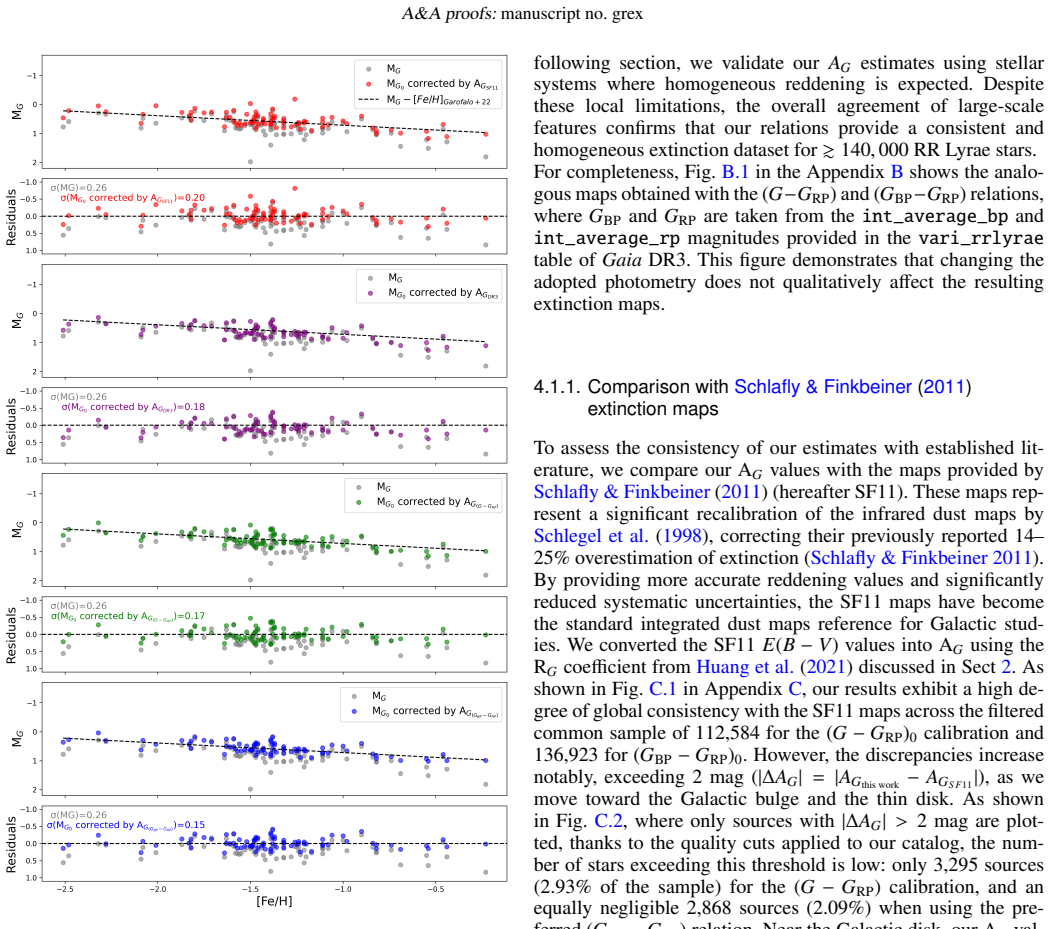
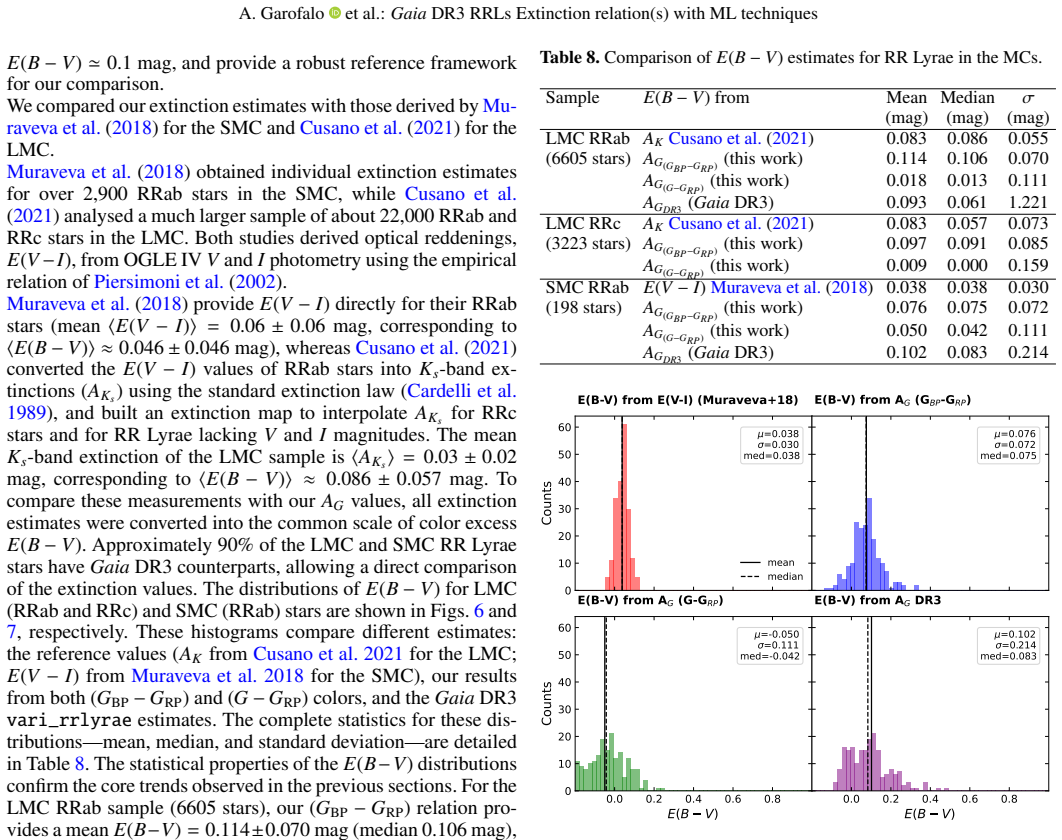
- [Section 4.2-4.3 and Tables 6-8] The external validations are too insensitive to rule out a training-label zero-point bias. The dSph and low-reddening GC checks operate in a regime where a 0.1 mag A_G offset is comparable to or larger than the entire expected signal. The LMC/SMC comparisons show residuals that are consistent with a small offset: LMC RRab E(B-V) is 0.114+/-0.070 versus 0.083+/-0.055 from Cusano et al., and SMC RRab is 0.076+/-0.072 versus 0.038+/-0.030 from Muraveva et al. The MG-[Fe/H] test in Section 4.1.2 uses the scatter of residuals, which is largely insensitive to a constant A_G offset. These checks establish broad consistency but do not certify the claimed improvement beyond DR3 or exclude a systematic error inherited from M21 A_V. A quantitative comparison against an independent, absolute extinction tracer with comparable per-star precision (e.g., IR-based maps at higher reddening, or a zero-poin
- [Section 4.1 and Fig. 4] The agreement between the two color calibrations is presented as evidence of stability, but the RRab comparison shows a median offset of about -0.12 mag between A_G from (GBP-GRP) and A_G from (G-GRP), which is not negligible compared to the claimed A_G uncertainties of 0.13-0.18 mag. The paper should discuss whether this offset reflects differential extinction-law assumptions, a calibration inconsistency, or photometric systematics, and whether it propagates into the final recommended (GBP-GRP)-based values.
minor comments (5)
- [Abstract and Section 1] The phrase 'first time' for RRc PAC relations should be checked carefully against earlier work (e.g., Piersimoni et al. or Dambis et al. may contain implicit RRc color relations); if none exists, a one-sentence literature confirmation would strengthen the novelty claim.
- [Figure 1 caption] The caption refers to 'M21 final reference samples' but the samples are a subset of Muhie et al. (2021); clarify that M21 is the label used for the selected subsample, not the original catalog.
- [Section 4.1] When comparing A_G values from the two relations, the text says 'excellent agreement' but the median offset and sigma are worth reporting in the text, not only the figure; consider adding the numerical values for both RRab and RRc.
- [Section 2] Typo in the introduction: 'they are widely used to tracers' should be 'as tracers'. Also, the notation R_G, R_GBP, R_GRP should be defined explicitly as A_lambda / E(B-V) in a single place, since the conversion in Eq. (1)-(2) relies on this.
- [Reproducibility] No code, configuration files, or exact SFS implementation details (e.g., random seed, cross-validation splits, bootstrap procedure) are provided. Given the machine-learning component, a statement about code availability or a reproducible appendix would be valuable.
Circularity Check
Partial circularity: low-latitude training labels are built from the same period–metallicity–color relations the paper then 'derives'; external checks give independent support.
specific steps
-
fitted input called prediction
[Sect. 2 (training-label construction) with Sect. 3.2 / Table 3 (PACZ fits)]
"For stars located at low Galactic latitudes (|b| ≤ 40◦), where the 3D map becomes unreliable due to the clumpy dust distribution, A_V values were instead derived from color excesses E(V−W1) or E(V−Ks), calibrated through period–metallicity–color relations and converted using the extinction coefficients of Yuan et al. (2013). ... The intrinsic colors (G−GRP)0 and (GBP−GRP)0 were then obtained by correcting the int_average ... magnitudes ... for the corresponding absorptions ... Table 3: (G−GRP)0 = −0.068(±0.008)×AmpG+0.393(±0.034)×logP+0.030(±0.004)×[Fe/H]+0.548(±0.011)."
For the |b|≤40° part of the M21 training sample, the regression targets are not observed intrinsic colors but observed colors minus absorption corrections whose A_V values were themselves derived from period–metallicity–color relations. The fitted expressions then include logP and [Fe/H] as predictors, exactly the variables entering those period–color calibrations. Least-squares fitting to targets that already contain that PAC dependence forces the new Gaia-band PACZ relation to re-encode the earlier calibration, transformed by fixed Huang et al. ratios, rather than to independently 'predict' intrinsic colors. The stated ~0.03–0.04 mag residuals are scatter of the training labels about the fitted line, not an independent confirmation. The circularity is partial because stars at |b|>40° use
full rationale
The central derivation chain is: observed Gaia colors − A_V-based absorptions → training intrinsic colors → SFS linear regression in logP, amplitude, and [Fe/H] → all-sky E and A_G values. The load-bearing potential circularity is in the training labels: for low-latitude stars, A_V is obtained from period–metallicity–color relations of exactly the type the paper claims to derive, so the fitted PACZ relation partly re-expresses its own input calibration. However, this is not a complete by-construction identity: high-latitude training stars use the Drimmel 3D dust map, the SFS procedure is a standard regression rather than a renaming, and the external validations against GCs, dSphs, and the Magellanic Clouds are independent of the M21 training set and show broad consistency (with some offsets, e.g., SMC 0.076 vs 0.038 mag). Self-citations to Garofalo et al. (2022) and Muraveva et al. (2025) are used for validation or metallicity assignment rather than to establish the core calibration, so they are not load-bearing circularity. Overall, the main claim has independent empirical content, but the low-|b| training-label construction imports the same period–color dependence being recalibrated, warranting a score of 4 rather than 0.
Axiom & Free-Parameter Ledger
free parameters (7)
- RRab PAC(Z) coefficients for (G-GRP)0 =
AmpG: -0.068, logP: +0.393, [Fe/H]: +0.030, intercept: +0.548
- RRab PAC(Z) coefficients for (GBP-GRP)0 =
AmpGBP: -0.087, logP: +0.820, [Fe/H]: +0.051, intercept: +0.874
- RRc PAC coefficients for (G-GRP)0 =
Two variants: AmpGBP -0.139/logP +0.365/intercept +0.518; AmpG -0.164/logP +0.383/intercept +0.526
- RRc PAC coefficients for (GBP-GRP)0 =
AmpG: -0.295, logP: +0.808, intercept: +0.896
- SFS feature count =
3 for RRab; 2 for RRc
- Quality cuts: num_clean_epochs_g >= 40 and |Delta P| <= 0.001 d =
40 epochs; 0.001 d
- Corrected flux-excess threshold C* <= 0.1 =
0.1
axioms (6)
- domain assumption The M21 AV values used to construct training intrinsic colors are accurate.
- domain assumption A single extinction law with R_V=3.1 and the Huang et al. total-to-selective ratios applies to all sources.
- domain assumption The intrinsic color relations are linear in the SFS-selected features.
- domain assumption Gaia DR3 intensity-averaged magnitudes and pulsation parameters are unbiased for the selected stars, and C* identifies blending.
- domain assumption Published cluster/dwarf-galaxy memberships and literature E(B-V) values used for validation are reliable.
- domain assumption Metallicity scale transformations between Crestani et al. and Zinn & West scales are accurate.
read the original abstract
RR Lyrae stars are essential tracers of old stellar populations and distance indicators across the Milky Way and nearby galaxies. However, their use as standard candles is limited by uncertainties in extinction, especially in the Gaia bands. In Gaia DR3, absorption values (AG) for fundamental-mode RR Lyrae (RRab) were based on an empirical period-amplitude-color (PAC) relation calibrated on a small sample and on passband transformations. We aim to recalibrate extinction relations for RRab stars and establish, for the first time, analogous relations for first-overtone RR Lyrae (RRc) stars in the Gaia passbands. We used Gaia DR3 photometry and pulsation properties of an all-sky reference sample. Intrinsic colors (G - GRP)0 and (GBP - GRP)0 were derived through sequential feature selection combined with linear regression and bootstrap resampling, ensuring robust estimates of color excess and AG. We recalibrated PACZ relations for RRab stars and derived, for the first time, PAC relations for RRc stars in the Gaia bands. The new relations reproduce intrinsic colors with residual scatters of ~0.03-0.04 mag and provide AG estimates across both pulsation types. Tests on RR Lyrae stars in Galactic globular clusters and dwarf galaxies show consistent AG values, with the PAC(Z) relations based on (GBP - GRP) being more stable than those using (G - GRP). The new relations provide reliable extinction estimates for both RRab and RRc stars, improving on the DR3 implementation and offering a valuable tool for Galactic studies in view of Gaia DR4.
Figures



Reference graph
Works this paper leans on
-
[1]
1966, in Stellar Evolution, ed.\ R
Baker, N. 1966, in Stellar Evolution, ed.\ R. F. Stein,& A. G. W. Cameron (Plenum, New York) 333
1966
-
[2]
1988, A&A, 200, 58
Balluch, M. 1988, A&A, 200, 58
1988
-
[3]
Cox, J. P. 1980, Theory of Stellar Pulsation (Princeton University Press, Princeton) 165
1980
-
[4]
N.,& Stewart, J
Cox, A. N.,& Stewart, J. N. 1969, Academia Nauk, Scientific Information 15, 1
1969
-
[5]
1980, Prog
Mizuno H. 1980, Prog. Theor. Phys., 64, 544
1980
-
[6]
Tscharnuter W. M. 1987, A&A, 188, 55
1987
-
[7]
1992, in ASP Conf
Terlevich, R. 1992, in ASP Conf. Ser. 31, Relationships between Active Galactic Nuclei and Starburst Galaxies, ed. A. V. Filippenko, 13
1992
-
[8]
Yorke, H. W. 1980a, A&A, 86, 286
-
[9]
F., Tytler, D
Zheng, W., Davidsen, A. F., Tytler, D. & Kriss, G. A. 1997, preprint
1997
-
[10]
Cambridge Astrophysics Series , keywords =
RR Lyrae stars. Cambridge Astrophysics Series , keywords =
-
[11]
The Carnegie-Chicago Hubble Program. I. An Independent Approach to the Extragalactic Distance Scale Using Only Population II Distance Indicators. , keywords =. doi:10.3847/0004-637X/832/2/210 , archivePrefix =. 1604.01788 , primaryClass =
-
[12]
Summary of the content and survey properties
Gaia Data Release 3. Summary of the content and survey properties. , keywords =. doi:10.1051/0004-6361/202243940 , archivePrefix =. 2208.00211 , primaryClass =
-
[13]
Specific processing and validation of all-sky RR Lyrae and Cepheid stars: The RR Lyrae sample
Gaia Data Release 3. Specific processing and validation of all-sky RR Lyrae and Cepheid stars: The RR Lyrae sample. , keywords =. doi:10.1051/0004-6361/202243964 , archivePrefix =. 2206.06278 , primaryClass =
-
[14]
Specific characterisation and validation of all-sky Cepheids and RR Lyrae stars
Gaia Data Release 2. Specific characterisation and validation of all-sky Cepheids and RR Lyrae stars. , keywords =. doi:10.1051/0004-6361/201833374 , archivePrefix =. 1805.02079 , primaryClass =
-
[15]
BVI Time-Series Data of the Galactic Globular Cluster NGC 3201. I. RR Lyrae Stars. , keywords =. doi:10.1086/341821 , archivePrefix =. astro-ph/0205219 , primaryClass =
-
[16]
Astronomical Data Analysis Software and Systems XIV , year = 2005, editor =
TOPCAT & STIL: Starlink Table/VOTable Processing Software. Astronomical Data Analysis Software and Systems XIV , year = 2005, editor =
2005
-
[17]
Kinematics and multiband period-luminosity-metallicity relation of RR Lyrae stars via statistical parallax. , keywords =. doi:10.1093/mnras/stab219 , archivePrefix =. 2101.03899 , primaryClass =
-
[18]
On the Use of Field RR Lyrae as Galactic Probes. II. A New S Calibration to Estimate Their Metallicity. , keywords =. doi:10.3847/1538-4357/abd183 , archivePrefix =. 2012.02284 , primaryClass =
arXiv 2012
-
[19]
Metallicities from high-resolution spectra of 49 RR Lyrae variables. , keywords =. doi:10.1093/mnras/stab857 , archivePrefix =. 2103.11012 , primaryClass =
-
[20]
The globular cluster system of the Galaxy. III. Measurements of radial velocity and metallicity for 60 clusters and a compilation of metallicities for 121 clusters. , keywords =. doi:10.1086/190947 , adsurl =
-
[21]
The VizieR database of astronomical catalogues. , keywords =. doi:10.1051/aas:2000169 , archivePrefix =. astro-ph/0002122 , primaryClass =
-
[22]
The CDS reference database for astronomical objects
The SIMBAD astronomical database. The CDS reference database for astronomical objects. , keywords =. doi:10.1051/aas:2000332 , archivePrefix =. astro-ph/0002110 , primaryClass =
-
[23]
Horizontal branch stars: the interplay between observations and theory, and insights into the formation of the Galaxy. , keywords =. doi:10.1007/s10509-009-9987-8 , archivePrefix =. astro-ph/0507464 , primaryClass =
-
[24]
The RR Lyrae Period-Luminosity Relation. I. Theoretical Calibration. , keywords =. doi:10.1086/422916 , archivePrefix =. astro-ph/0406067 , primaryClass =
-
[25]
A pulsational approach to near-infrared and visual magnitudes of RR Lyr stars. , keywords =. doi:10.1046/j.1365-8711.2003.06878.x , archivePrefix =. astro-ph/0306142 , primaryClass =
arXiv 2003
-
[26]
Distance to the Large Magellanic Cloud: The RR Lyrae Stars. , keywords =. doi:10.1086/367773 , adsurl =
-
[27]
Metallicity of RR Lyrae stars from the Gaia Data Release 3 catalogue computed with Machine Learning algorithms. , keywords =. doi:10.1093/mnras/stae2679 , archivePrefix =. 2407.05815 , primaryClass =
-
[28]
Reddening and Extinction toward the Galactic Bulge from OGLE-III: The Inner Milky Way's R _ V -0.5ex 2.5 Extinction Curve. , keywords =. doi:10.1088/0004-637X/769/2/88 , archivePrefix =. 1208.1263 , primaryClass =
-
[29]
New LZ and PW(Z) relations of RR Lyrae stars calibrated with Gaia EDR3 parallaxes. , keywords =. doi:10.1093/mnras/stac735 , archivePrefix =. 2203.07435 , primaryClass =
-
[30]
Milky Way Tomography with the SkyMapper Southern Survey. II. Photometric Recalibration of SMSS DR2. , keywords =. doi:10.3847/1538-4357/abca37 , archivePrefix =. 2011.07172 , primaryClass =
Pith/arXiv arXiv 2011
-
[31]
Leveraging Deep Learning for Time-Series Extrinsic Regression in Predicting the Photometric Metallicity of Fundamental-Mode RR Lyrae Stars. Sensors , keywords =. doi:10.3390/s24165203 , archivePrefix =. 2410.17906 , primaryClass =
-
[32]
Unified deep learning approach for estimating the metallicities of RR Lyrae stars using light curves from Gaia Data Release 3. , keywords =. doi:10.1051/0004-6361/202555681 , adsurl =
-
[33]
and Elisseeff, A
Guyon, I. and Elisseeff, A. , title =. Journal of Machine Learning Research , year =
-
[34]
and John, G
Kohavi, R. and John, G. H. , title =. Artificial Intelligence , year =
-
[35]
The RR Lyrae Stars: New Perspectives. , keywords =. doi:10.1088/0004-6256/147/2/31 , adsurl =
-
[36]
A Catalog of Parameters for Globular Clusters in the Milky Way. , keywords =. doi:10.1086/118116 , adsurl =
-
[37]
The VMC Survey - XLII. Near-infrared period-luminosity relations for RR Lyrae stars and the structure of the Large Magellanic Cloud. , keywords =. doi:10.1093/mnras/stab901 , archivePrefix =. 2103.15492 , primaryClass =
-
[38]
Structure of the Small Magellanic Cloud from RR Lyrae stars
The VMC survey - XXVI. Structure of the Small Magellanic Cloud from RR Lyrae stars. , keywords =. doi:10.1093/mnras/stx2514 , archivePrefix =. 1709.09064 , primaryClass =
-
[39]
The Relationship between Infrared, Optical, and Ultraviolet Extinction. , keywords =. doi:10.1086/167900 , adsurl =
-
[40]
A three-dimensional Galactic extinction model. , keywords =. doi:10.1051/0004-6361:20031070 , archivePrefix =. astro-ph/0307273 , primaryClass =
-
[41]
RR Lyrae variables: visual and infrared luminosities, intrinsic colours and kinematics. , keywords =. doi:10.1093/mnras/stt1514 , archivePrefix =. 1308.4727 , primaryClass =
-
[42]
Empirical extinction coefficients for the GALEX, SDSS, 2MASS and WISE passbands. , keywords =. doi:10.1093/mnras/stt039 , archivePrefix =. 1301.1427 , primaryClass =
-
[43]
Distance, reddening and three dimensional structure of the SMC - I: Using RRab stars. arXiv e-prints , keywords =. doi:10.48550/arXiv.1707.03130 , archivePrefix =. 1707.03130 , primaryClass =
-
[44]
OGLE-ing the Magellanic System: Optical Reddening Maps of the Large and Small Magellanic Clouds from Red Clump Stars. , keywords =. doi:10.3847/1538-4365/abcb81 , archivePrefix =. 2006.02448 , primaryClass =
Pith/arXiv arXiv 2006
-
[45]
New Optical Reddening Maps of the Large and Small Magellanic Clouds. , keywords =. doi:10.1088/0004-6256/141/5/158 , archivePrefix =. 1104.2325 , primaryClass =
-
[46]
Reddening map and recent star formation in the Magellanic Clouds based on OGLE IV Cepheids. , keywords =. doi:10.1051/0004-6361/201834574 , archivePrefix =. 1906.04481 , primaryClass =
Pith/arXiv arXiv 1906
-
[47]
Proper identification of RR Lyrae stars brighter than 12.5 mag. , keywords =. doi:10.1051/0004-6361:20053230 , archivePrefix =. astro-ph/0507602 , primaryClass =
-
[48]
Astronomy Reports , year = 2017, month = jan, volume =
General catalogue of variable stars: Version GCVS 5.1. Astronomy Reports , year = 2017, month = jan, volume =. doi:10.1134/S1063772917010085 , adsurl =
-
[49]
Variable Stars in the Ultra-faint Dwarf Spheroidal Galaxy Ursa Major I. , keywords =. doi:10.1088/0004-637X/767/1/62 , archivePrefix =. 1302.3230 , primaryClass =
-
[50]
Measuring Reddening with Sloan Digital Sky Survey Stellar Spectra and Recalibrating SFD. , keywords =. doi:10.1088/0004-637X/737/2/103 , archivePrefix =. 1012.4804 , primaryClass =
-
[51]
Give to Ursa Minor what is Ursa Minor's: An updated census of the RR Lyrae population in the Ursa Minor dwarf galaxy based on Gaia DR3. , keywords =. doi:10.1051/0004-6361/202452619 , archivePrefix =. 2410.12433 , primaryClass =
-
[52]
The Carina Project IX: On Hydrogen and Helium Burning Variables. , keywords =. doi:10.1088/0004-637X/814/1/71 , archivePrefix =. 1509.02687 , primaryClass =
-
[53]
Dwarf Cepheids in the Carina Dwarf Spheroidal Galaxy. , keywords =. doi:10.1086/300330 , archivePrefix =. astro-ph/9807233 , primaryClass =
-
[54]
The Carina Project. I. Bright Variable Stars. , keywords =. doi:10.1086/374943 , archivePrefix =. astro-ph/0302418 , primaryClass =
-
[55]
Pulsating Variable Stars in the Coma Berenices Dwarf Spheroidal Galaxy. , keywords =. doi:10.1088/0004-637X/695/1/L83 , archivePrefix =. 0902.4230 , primaryClass =
-
[56]
A DECam view of the diffuse dwarf galaxy Crater II - Variable stars. , keywords =. doi:10.1093/mnras/stz3393 , archivePrefix =. 1912.00081 , primaryClass =
Pith/arXiv arXiv 1912
-
[57]
Deep CCD Photometry of the Sextans Dwarf Spheroidal Galaxy. , keywords =. doi:10.1086/115734 , adsurl =
-
[58]
Stellar Archaeology in the Galactic Halo with the Ultra-faint Dwarfs. VI. Ursa Major II. , keywords =. doi:10.1088/0004-637X/752/1/42 , archivePrefix =. 1203.5321 , primaryClass =
-
[59]
The Observed Properties of Dwarf Galaxies in and around the Local Group. , keywords =. doi:10.1088/0004-6256/144/1/4 , archivePrefix =. 1204.1562 , primaryClass =
-
[60]
Gaia RR Lyrae Stars in Nearby Ultra-faint Dwarf Satellite Galaxies. , keywords =. doi:10.3847/1538-4365/ab67c0 , archivePrefix =. 2001.01107 , primaryClass =
Pith/arXiv arXiv 2001
-
[61]
The RR Lyrae Distance to the Draco Dwarf Spheroidal Galaxy. , keywords =. doi:10.1086/381073 , archivePrefix =. astro-ph/0310477 , primaryClass =
-
[62]
The Araucaria Project: the Distance to the Sculptor Dwarf Spheroidal Galaxy from Infrared Photometry of RR Lyrae Stars. , keywords =. doi:10.1088/0004-6256/135/6/1993 , archivePrefix =. 0804.0347 , primaryClass =
Pith/arXiv arXiv 1993
-
[63]
Maps of Dust Infrared Emission for Use in Estimation of Reddening and Cosmic Microwave Background Radiation Foregrounds. , keywords =. doi:10.1086/305772 , archivePrefix =. astro-ph/9710327 , primaryClass =
-
[64]
Photometric content and validation
Gaia Early Data Release 3. Photometric content and validation. , keywords =. doi:10.1051/0004-6361/202039587 , archivePrefix =. 2012.01916 , primaryClass =
Pith/arXiv arXiv 2012
-
[65]
Peremennye Zvezdy , year = 2025, month = jan, volume =
Mid-infrared Period - luminosity Relations of RR Lyrae Variables via Color-transformed Data. Peremennye Zvezdy , year = 2025, month = jan, volume =. doi:10.24412/2221-0474-2025-45-7-31 , adsurl =
discussion (0)
Sign in with ORCID, Apple, or X to comment. Anyone can read and Pith papers without signing in.