Creating and Driving a Twist Soliton on a Magnetic Skyrmion Tube
Pith reviewed 2026-06-26 15:50 UTC · model grok-4.3
The pith
A twist soliton forms on a skyrmion tube via thermal quench and moves nonlinearly under current, with speed set by its chirality.
A machine-rendered reading of the paper's core claim, the machinery that carries it, and where it could break.
Core claim
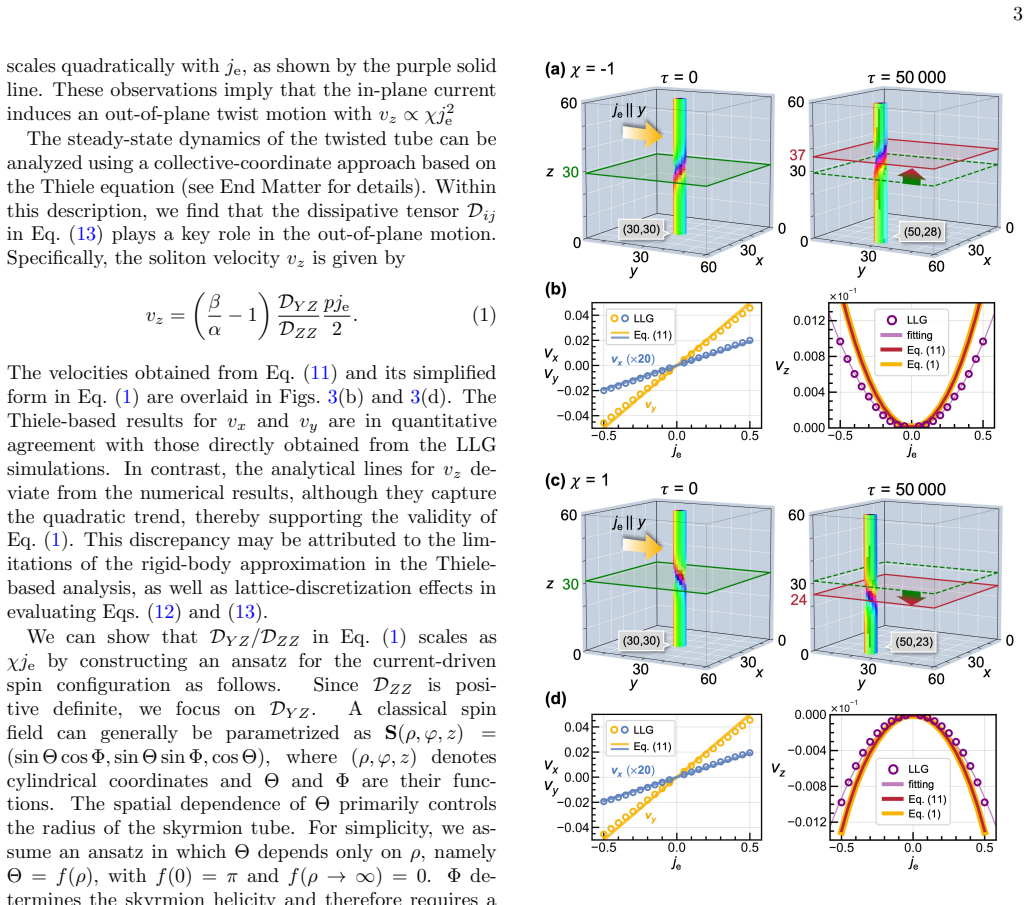
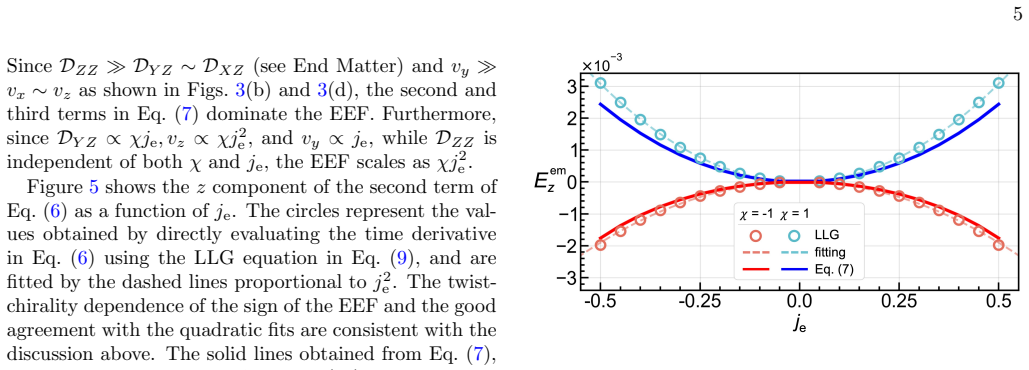
A twist soliton is a localized twist texture on a skyrmion tube that forms through thermal quench dynamics. Its current-driven motion is nonlinear and depends on twist chirality; the velocity increases substantially under a perpendicular magnetic-field component. The associated emergent electric field produces a Hall signal that identifies both the soliton and the sign of its chirality.
What carries the argument
The twist soliton, a localized texture carrying a twist along the skyrmion tube whose chirality controls current response and emergent fields.
If this is right
- Twist chirality sets both the direction and magnitude of current-driven motion.
- A perpendicular magnetic field can be used to tune soliton speed upward.
- Hall measurements can read out the presence and chirality sign of the soliton.
- The twist degree of freedom becomes a necessary ingredient for describing skyrmion-tube dynamics.
- Three-dimensional spin textures can be exploited for spintronic functionality.
Where Pith is reading between the lines
- The thermal-quench nucleation route may work for other three-dimensional topological textures such as hopfions.
- Chirality could serve as an extra information bit in a device that stores both position and twist sense.
- The same collective-coordinate approach might predict analogous solitons in non-magnetic analogs such as optical or fluid vortices.
Load-bearing premise
The micromagnetic model and collective-coordinate description continue to hold for the twist soliton without major deformation or pinning from material disorder.
What would settle it
Observation that a perpendicular magnetic field does not increase the velocity of a current-driven twist soliton, or that the Hall voltage shows no dependence on the sign of the twist chirality.
Figures


read the original abstract
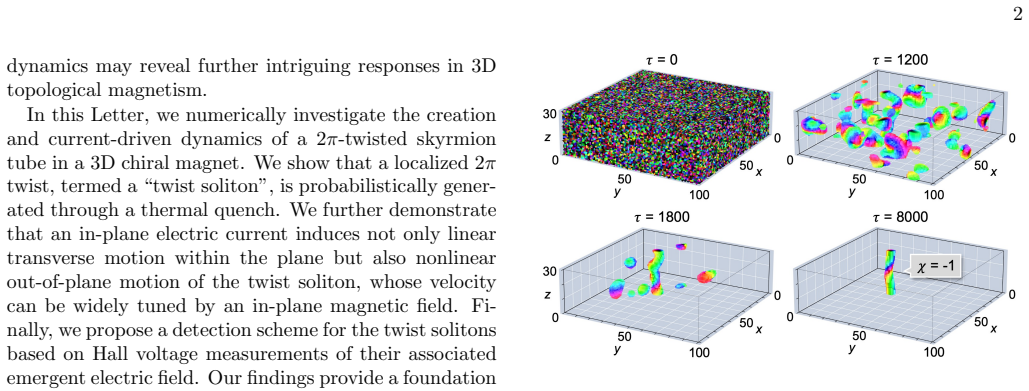
A magnetic skyrmion tube is a three-dimensional topological soliton formed by stacking two-dimensional skyrmions along the out-of-plane direction. Recent real-space observations of skyrmion tubes have stimulated growing interest in their dynamics and emergent properties. Here, we go beyond simple skyrmion stacking and investigate how a ``twist" introduced along the tube direction affects the dynamics and emergent responses of skyrmion tubes. We find that such a twist can be created as a localized texture, termed a twist soliton, through thermal quench dynamics. By complementarily combining large-scale numerical simulations with analytical calculations based on collective coordinates, we clarify its current-driven nonlinear motions that depend on its twist chirality. Remarkably, its velocity can be substantially enhanced by a magnetic-field component perpendicular to the tube. Furthermore, the associated emergent electric field enables identification of the twist soliton, including the sign of its chirality, through Hall measurements. Our results reveal the twist degree of freedom as an essential ingredient of skyrmion-tube physics and pave the way for the development of spintronic devices exploiting the three-dimensional nature of spin textures.
Editorial analysis
A structured set of objections, weighed in public.
Referee Report
Summary. The manuscript studies twist solitons on magnetic skyrmion tubes in a 3D micromagnetic model. It reports that a localized twist texture (twist soliton) can be nucleated via thermal quench, and that its current-driven dynamics are nonlinear and chirality-dependent. A transverse magnetic-field component is shown to enhance velocity, while the emergent electric field permits Hall detection of both the soliton and its chirality sign. The central results rest on complementary large-scale micromagnetic simulations and a collective-coordinate reduction.
Significance. If the central claims survive scrutiny, the work establishes the twist degree of freedom as an additional control knob for 3D skyrmion-tube dynamics and emergent electromagnetism, with direct implications for spintronic device concepts that exploit three-dimensional topology. The dual numerical-analytical approach is a positive feature, as is the explicit link between chirality and measurable Hall response.
major comments (2)
- [§4] §4 (collective-coordinate derivation): the reduced equations of motion are obtained under the explicit assumption that the twist-soliton profile remains rigid (internal degrees of freedom frozen) at the drive currents employed. No quantitative check is provided that the twist amplitude or core radius stays constant when the current exceeds the threshold for nonlinear motion; if appreciable deformation occurs, both the predicted velocity enhancement by the transverse field and the chirality-dependent Hall signature lose their analytic foundation.
- [§5.1, Fig. 4] §5.1 and Fig. 4: the micromagnetic simulations that underpin the velocity-vs-current curves and the Hall-voltage data are performed in a defect-free geometry. The manuscript does not report any test with weak random anisotropy or pinning sites; because the collective-coordinate prediction relies on free propagation of the soliton, even modest disorder could pin or scatter the texture and thereby invalidate the claimed chirality-dependent transport signatures.
minor comments (2)
- [Eq. (12)] The definition of the emergent electric field (Eq. (12)) should be accompanied by a brief statement of the gauge choice and the integration path used to obtain the Hall voltage.
- [Fig. 2] Figure 2 caption: the color scale for the twist angle is not stated; readers cannot judge the magnitude of the reported twist soliton without it.
Simulated Author's Rebuttal
We thank the referee for the careful reading of our manuscript and the positive assessment of its significance. We address each major comment below with clarifications and indicate where revisions will be made.
read point-by-point responses
-
Referee: [§4] §4 (collective-coordinate derivation): the reduced equations of motion are obtained under the explicit assumption that the twist-soliton profile remains rigid (internal degrees of freedom frozen) at the drive currents employed. No quantitative check is provided that the twist amplitude or core radius stays constant when the current exceeds the threshold for nonlinear motion; if appreciable deformation occurs, both the predicted velocity enhancement by the transverse field and the chirality-dependent Hall signature lose their analytic foundation.
Authors: We agree that a quantitative check of the rigid-profile assumption is required to underpin the collective-coordinate predictions. In the revised manuscript we will add a supplementary analysis that monitors the twist amplitude and core radius versus current in the nonlinear regime, confirming that deformations remain small for the currents and parameters employed. This will directly address the concern and preserve the analytic foundation of the velocity and Hall results. revision: yes
-
Referee: [§5.1, Fig. 4] §5.1 and Fig. 4: the micromagnetic simulations that underpin the velocity-vs-current curves and the Hall-voltage data are performed in a defect-free geometry. The manuscript does not report any test with weak random anisotropy or pinning sites; because the collective-coordinate prediction relies on free propagation of the soliton, even modest disorder could pin or scatter the texture and thereby invalidate the claimed chirality-dependent transport signatures.
Authors: The referee correctly identifies that the reported simulations are performed in a clean geometry. To demonstrate robustness, we will perform additional micromagnetic runs that incorporate weak random anisotropy and a low density of pinning sites. The outcomes will be presented in the revised manuscript, showing that the chirality-dependent velocity enhancement and Hall signatures persist for moderate disorder strengths consistent with the collective-coordinate picture. revision: yes
Circularity Check
No significant circularity; derivation self-contained via simulations and standard collective coordinates
full rationale
The paper supports its claims on twist soliton creation and current-driven dynamics through large-scale numerical simulations combined with analytical calculations based on collective coordinates. These are standard methods in the field of skyrmion dynamics, applied independently here without any quoted reduction of predictions to fitted parameters, self-definitional loops, or load-bearing self-citations. No equations or steps in the abstract or described approach equate outputs to inputs by construction, and the complementary use of numerics and analytics provides external verification rather than circular reinforcement.
Axiom & Free-Parameter Ledger
free parameters (1)
- micromagnetic parameters (exchange, DMI, anisotropy)
axioms (2)
- domain assumption Micromagnetic continuum approximation holds for the skyrmion tube and twist soliton
- domain assumption Thermal quench dynamics can nucleate a stable localized twist without destroying the tube topology
invented entities (1)
-
twist soliton
no independent evidence
Reference graph
Works this paper leans on
-
[1]
P. P. Freitas and L. Berger, Observation ofs−dexchange force between domain walls and electric current in very thin permalloy films, J. Appl. Phys.57, 1266 (1985)
1985
-
[2]
Slonczewski, Current-driven excitation of magnetic multilayers, J
J. Slonczewski, Current-driven excitation of magnetic multilayers, J. Magn. Magn. Mater.159, L1 (1996)
1996
-
[3]
Berger, Emission of spin waves by a magnetic mul- tilayer traversed by a current, Phys
L. Berger, Emission of spin waves by a magnetic mul- tilayer traversed by a current, Phys. Rev. B54, 9353 (1996)
1996
-
[4]
Yamaguchi, T
A. Yamaguchi, T. Ono, S. Nasu, K. Miyake, K. Mibu, and T. Shinjo, Real-Space Observation of Current-Driven Do- main Wall Motion in Submicron Magnetic Wires, Phys. Rev. Lett.92, 077205 (2004)
2004
-
[5]
Kl¨ aui, P.-O
M. Kl¨ aui, P.-O. Jubert, R. Allenspach, A. Bischof, J. A. C. Bland, G. Faini, U. R¨ udiger, C. A. F. Vaz, L. Vila, and C. Vouille, Direct Observation of Domain- Wall Configurations Transformed by Spin Currents, Phys. Rev. Lett.95, 026601 (2005)
2005
-
[6]
S. E. Barnes, J. Ieda, and S. Maekawa, Magnetic memory and current amplification devices using moving domain walls, Appl. Phys. Lett.89, 122507 (2006)
2006
-
[7]
S. E. Barnes and S. Maekawa, Generalization of Fara- day’s Law to Include Nonconservative Spin Forces, Phys. Rev. Lett.98, 246601 (2007)
2007
-
[8]
R. A. Duine, Spin pumping by a field-driven domain wall, Phys. Rev. B77, 014409 (2008)
2008
-
[9]
Tserkovnyak and M
Y. Tserkovnyak and M. Mecklenburg, Electron transport driven by nonequilibrium magnetic textures, Phys. Rev. B77, 134407 (2008)
2008
-
[10]
S. S. P. Parkin, M. Hayashi, and L. Thomas, Mag- netic Domain-Wall Racetrack Memory, Science320, 190 (2008)
2008
-
[11]
S. A. Yang, G. S. D. Beach, C. Knutson, D. Xiao, Q. Niu, 6 M. Tsoi, and J. L. Erskine, Universal Electromotive Force Induced by Domain Wall Motion, Phys. Rev. Lett.102, 067201 (2009)
2009
-
[12]
Shibata and H
J. Shibata and H. Kohno, Spin and charge transport in- duced by gauge fields in a ferromagnet, Phys. Rev. B84, 184408 (2011)
2011
-
[13]
Jonietz, S
F. Jonietz, S. M¨ uhlbauer, C. Pfleiderer, A. Neubauer, W. M¨ unzer, A. Bauer, T. Adams, R. Georgii, P. B¨ oni, R. A. Duine, K. Everschor, M. Garst, and A. Rosch, Spin Transfer Torques in MnSi at Ultralow Current Densities, Science330, 1648 (2010)
2010
-
[14]
J. Zang, M. Mostovoy, J. H. Han, and N. Nagaosa, Dy- namics of Skyrmion Crystals in Metallic Thin Films, Phys. Rev. Lett.107, 136804 (2011)
2011
-
[15]
Schulz, R
T. Schulz, R. Ritz, A. Bauer, M. Halder, M. Wagner, C. Franz, C. Pfleiderer, K. Everschor, M. Garst, and A. Rosch, Emergent electrodynamics of skyrmions in a chiral magnet, Nat. Phys.8, 301 (2012)
2012
-
[16]
A. Fert, V. Cros, and J. Sampaio, Skyrmions on the track, Nat. Nanotechnol.8, 152 (2013)
2013
-
[17]
Iwasaki, M
J. Iwasaki, M. Mochizuki, and N. Nagaosa, Universal current-velocity relation of skyrmion motion in chiral magnets, Nat. Commun.4, 1463 (2013)
2013
-
[18]
Iwasaki, M
J. Iwasaki, M. Mochizuki, and N. Nagaosa, Current- induced skyrmion dynamics in constricted geometries, Nat. Nanotechnol.8, 742 (2013)
2013
-
[19]
Nagaosa and Y
N. Nagaosa and Y. Tokura, Topological properties and dynamics of magnetic skyrmions, Nat. Nanotechnol.8, 899 (2013)
2013
-
[20]
Koshibae, Y
W. Koshibae, Y. Kaneko, J. Iwasaki, M. Kawasaki, Y. Tokura, and N. Nagaosa, Memory functions of mag- netic skyrmions, Jpn. J. Appl. Phys.54, 053001 (2015)
2015
-
[21]
Jiang, X
W. Jiang, X. Zhang, G. Yu, W. Zhang, X. Wang, M. Ben- jamin Jungfleisch, J. Pearson, X. Cheng, O. Heinonen, K. L. Wang, Y. Zhou, A. Hoffmann, and S. te Velthuis, Direct observation of the skyrmion Hall effect, Nat. Phys. 13, 162 (2017)
2017
-
[22]
H. S. Park, X. Yu, S. Aizawa, T. Tanigaki, T. Akashi, Y. Takahashi, T. Matsuda, N. Kanazawa, Y. Onose, D. Shindo, A. Tonomura, and Y. Tokura, Observation of the magnetic flux and three-dimensional structure of skyrmion lattices by electron holography, Nat. Nanotech- nol.9, 337 (2014)
2014
-
[23]
Donnelly, M
C. Donnelly, M. Guizar-Sicairos, V. Scagnoli, S. Gliga, M. Holler, J. Raabe, and L. J. Heyderman, Three- dimensional magnetization structures revealed with x-ray vector nanotomography, Nature547, 328 (2017)
2017
-
[24]
S. Seki, M. Suzuki, M. Ishibashi, R. Takagi, N. D. Khanh, Y. Shiota, K. Shibata, W. Koshibae, Y. Tokura, and T. Ono, Direct visualization of the three-dimensional shape of skyrmion strings in a noncentrosymmetric mag- net, Nat. Mater.21, 181 (2022)
2022
-
[25]
D. Wolf, S. Schneider, U. K. R¨ oßler, A. Kov´ acs, M. Schmidt, R. E. Dunin-Borkowski, B. B¨ uchner, B. Rellinghaus, and A. Lubk, Unveiling the three- dimensional magnetic texture of skyrmion tubes, Nat. Nanotechnol.17, 250 (2022)
2022
-
[26]
X. Yu, K. V. Iakoubovskii, F. S. Yasin, L. Peng, K. Naka- jima, S. Schneider, K. Karube, T. Arima, Y. Taguchi, and Y. Tokura, Real-Space Observations of Three- Dimensional Antiskyrmions and Skyrmion Strings, Nano Lett.22, 9358 (2022)
2022
-
[27]
M. E. Henderson, B. Heacock, M. Bleuel, D. G. Cory, C. Heikes, M. G. Huber, J. Krzywon, O. Nahman- Levesqu´ e, G. M. Luke, M. Pula, D. Sarenac, K. Zher- nenkov, and D. A. Pushin, Three-dimensional neutron far-field tomography of a bulk skyrmion lattice, Nat. Phys.19, 1617 (2023)
2023
-
[28]
Zheng, N
F. Zheng, N. S. Kiselev, F. N. Rybakov, L. Yang, W. Shi, S. Bl¨ ugel, and R. E. Dunin-Borkowski, Hopfion rings in a cubic chiral magnet, Nature623, 718 (2023)
2023
-
[29]
X. Yu, N. Nakanishi, Y.-L. Chiew, Y. Liu, K. Naka- jima, N. Kanazawa, K. Karube, Y. Taguchi, N. Nagaosa, and Y. Tokura, 3D skyrmion strings and their melting dynamics revealed via scalar-field electron tomography, Commun. Mater.5, 80 (2024)
2024
-
[30]
Milde, D
P. Milde, D. K¨ ohler, J. Seidel, L. M. Eng, A. Bauer, A. Chacon, J. Kindervater, S. M¨ uhlbauer, C. Pfleiderer, S. Buhrandt, C. Sch¨ utte, and A. Rosch, Unwinding of a Skyrmion Lattice by Magnetic Monopoles, Science340, 1076 (2013)
2013
-
[31]
M. T. Birch, D. Cort´ es-Ortu˜ no, L. A. Turnbull, M. N. Wilson, F. Groß, N. Tr¨ ager, A. Laurenson, N. Bukin, S. H. Moody, M. Weigand, G. Sch¨ utz, H. Popescu, R. Fan, P. Steadman, J. A. T. Verezhak, G. Balakrish- nan, J. C. Loudon, A. C. Twitchett-Harrison, O. Hov- orka, H. Fangohr, F. Y. Ogrin, J. Gr¨ afe, and P. D. Hat- ton, Real-space imaging of conf...
2020
-
[32]
Zheng, F
F. Zheng, F. N. Rybakov, A. B. Borisov, D. Song, S. Wang, Z.-A. Li, H. Du, N. S. Kiselev, J. Caron, A. Kov´ acs, M. Tian, Y. Zhang, S. Bl¨ ugel, and R. E. Dunin-Borkowski, Experimental observation of chiral magnetic bobbers in B20-type FeGe, Nat. Nanotechnol. 13, 451 (2018)
2018
-
[33]
A. O. Leonov and K. Inoue, Homogeneous and hetero- geneous nucleation of skyrmions in thin layers of cubic helimagnets, Phys. Rev. B98, 054404 (2018)
2018
-
[34]
Sutcliffe, Hopfions in chiral magnets, J
P. Sutcliffe, Hopfions in chiral magnets, J. Phys. A: Math. Theor.51, 375401 (2018)
2018
-
[35]
Yokouchi, S
T. Yokouchi, S. Hoshino, N. Kanazawa, A. Kikkawa, D. Morikawa, K. Shibata, T. Arima, Y. Taguchi, F. Ka- gawa, N. Nagaosa, and Y. Tokura, Current-induced dy- namics of skyrmion strings, Sci. Adv.4, eaat1115 (2018)
2018
-
[36]
Lin, J.-X
S.-Z. Lin, J.-X. Zhu, and A. Saxena, Kelvin modes of a skyrmion line in chiral magnets and the associated magnon transport, Phys. Rev. B99, 140408(R) (2019)
2019
-
[37]
S. Seki, M. Garst, J. Waizner, R. Takagi, N. D. Khanh, Y. Okamura, K. Kondou, F. Kagawa, Y. Otani, and Y. Tokura, Propagation dynamics of spin excitations along skyrmion strings, Nat. Commun.11, 256 (2020)
2020
-
[38]
X. Xing, Y. Zhou, and H. Braun, Magnetic Skyrmion Tubes as Nonplanar Magnonic Waveguides, Phys. Rev. Appl.13, 034051 (2020)
2020
-
[39]
Okumura, V
S. Okumura, V. P. Kravchuk, and M. Garst, Instability of Magnetic Skyrmion Strings Induced by Longitudinal Spin Currents, Phys. Rev. Lett.131, 066702 (2023)
2023
-
[40]
V. P. Kravchuk, Nonlinear dynamics of skyrmion strings, Phys. Rev. B108, 144412 (2023)
2023
-
[41]
Hasimoto, A soliton on a vortex filament, J
H. Hasimoto, A soliton on a vortex filament, J. Fluid Mech.51, 477 (1972)
1972
-
[42]
V. P. Kravchuk, U. K. R¨ ossler, J. van den Brink, and M. Garst, Solitary wave excitations of skyrmion strings in chiral magnets, Phys. Rev. B102, 220408(R) (2020)
2020
-
[43]
Tokura and N
Y. Tokura and N. Kanazawa, Magnetic Skyrmion Mate- rials, Chem. Rev.121, 2857 (2021)
2021
-
[44]
S. A. Meynell, M. N. Wilson, H. Fritzsche, A. N. Bog- danov, and T. L. Monchesky, Surface twist instabilities 7 and skyrmion states in chiral ferromagnets, Phys. Rev. B90, 014406 (2014)
2014
-
[45]
Kawaguchi, Y
Y. Kawaguchi, Y. Tanaka, and N. Nagaosa, Skyrmionic magnetization configurations at chiral magnet/ferromagnet heterostructures, Phys. Rev. B93, 064416 (2016)
2016
-
[46]
A. O. Leonov, Y. Togawa, T. L. Monchesky, A. N. Bogdanov, J. Kishine, Y. Kousaka, M. Miyagawa, T. Koyama, J. Akimitsu, T. Koyama, K. Harada, S. Mori, D. McGrouther, R. Lamb, M. Krajnak, S. McVi- tie, R. L. Stamps, and K. Inoue, Chiral Surface Twists and Skyrmion Stability in Nanolayers of Cubic Helimag- nets, Phys. Rev. Lett.117, 087202 (2016)
2016
-
[47]
Brearton, D
R. Brearton, D. M. Burn, A. A. Haghighirad, G. van der Laan, and T. Hesjedal, Three-dimensional structure of magnetic skyrmions, Phys. Rev. B106, 214404 (2022)
2022
-
[48]
L. Kong, J. Tang, Y. Wu, W. Wang, J. Jiang, Y. Wang, J. Li, Y. Xiong, S. Wang, M. Tian, and H. Du, Diverse helicities of dipolar skyrmions, Phys. Rev. B109, 014401 (2024)
2024
-
[49]
Yokota, Twisted Skyrmion Strings in a Layered Heisenberg Model with Dipole–Dipole Interactions, J
T. Yokota, Twisted Skyrmion Strings in a Layered Heisenberg Model with Dipole–Dipole Interactions, J. Phys. Soc. Jpn.90, 104701 (2021)
2021
-
[50]
C. Saji, E. Saavedra, V. L. Carvalho-Santos, A. S. Nunez, and R. E. Troncoso, Statics and dynamics of twisted skyrmion tubes in frustrated magnets, Phys. Rev. B112, 134414 (2025)
2025
-
[51]
T. W. B. Kibble, Topology of cosmic domains and strings, J. Phys. A9, 1387 (1976)
1976
-
[52]
W. H. Zurek, Cosmological experiments in superfluid he- lium?, Nature317, 505 (1985)
1985
-
[53]
Lin and S
S.-Z. Lin and S. Hayami, Ginzburg-landau theory for skyrmions in inversion-symmetric magnets with compet- ing interactions, Phys. Rev. B93, 064430 (2016)
2016
-
[54]
V. M. Kuchkin, N. S. Kiselev, A. Haller, i. c. v. Liˇ sˇ c´ ak, A. Michels, and T. L. Schmidt, Stability and nucleation of dipole strings in uniaxial chiral magnets, Phys. Rev. B111, 174410 (2025)
2025
-
[55]
Togawa, T
Y. Togawa, T. Koyama, K. Takayanagi, S. Mori, Y. Kousaka, J. Akimitsu, S. Nishihara, K. Inoue, A. S. Ovchinnikov, and J. Kishine, Chiral Magnetic Soliton Lattice on a Chiral Helimagnet, Phys. Rev. Lett.108, 107202 (2012)
2012
-
[56]
Kasai, K
S. Kasai, K. Shimizu, S. Okumura, Y. Kato, and Y. Mo- tome, Three-dimensional topological superstructure of magnetic hopfions threaded by meron strings in easy- plane magnets, Phys. Rev. B112, 184424 (2025)
2025
-
[57]
Consequently, the skyrmion Hall angle, determined by the ratio of the ve- locities along thexandydirections, exhibits only a weak dependence on the twist chiralityχ
Note that, due to the periodic boundary conditions, the skyrmion tubes circulate 16 times in the positiveydi- rection within the simulation time range, while no cir- culation occurs along thexdirection. Consequently, the skyrmion Hall angle, determined by the ratio of the ve- locities along thexandydirections, exhibits only a weak dependence on the twist ...
-
[58]
Masell, D
J. Masell, D. R. Rodrigues, B. F. McKeever, and K. Everschor-Sitte, Spin-transfer torque driven motion, deformation, and instabilities of magnetic skyrmions at high currents, Phys. Rev. B101, 214428 (2020)
2020
-
[59]
Yamane and J
Y. Yamane and J. Ieda, Skyrmion-generated spinmotive forces in inversion broken ferromagnets, J. Magn. Magn. Mater.491, 165550 (2019)
2019
-
[60]
Yokouchi, F
T. Yokouchi, F. Kagawa, M. Hirschberger, Y. Otani, N. Nagaosa, and Y. Tokura, Emergent electromagnetic induction in a helical-spin magnet, Nature586, 232 (2020)
2020
-
[61]
Fujita and M
H. Fujita and M. Sato, Ultrafast generation of skyrmionic defects with vortex beams: Printing laser profiles on mag- nets, Phys. Rev. B95, 054421 (2017)
2017
-
[62]
Knapman, T
R. Knapman, T. Tausendpfund, S. A. D´ ıaz, and K. Everschor-Sitte, Spacetime magnetic hopfions from in- ternal excitations and braiding of skyrmions, Commun. Phys.7, 151 (2024)
2024
-
[63]
Shimizu, S
K. Shimizu, S. Okumura, Y. Kato, and Y. Motome, Soli- ton penetration from edges in a monoaxial chiral magnet, Phys. Rev. B111, 024411 (2025)
2025
- [64]
-
[65]
S. C. Shaju, M. Azhar, and K. Everschor-Sitte, Hopfions in screw chiral magnets, APL Mater.14, 051111 (2026)
2026
-
[66]
Priest and T
E. Priest and T. Forbes, The magnetic nature of solar flares, Astron. Astrophys. Rev.10, 313 (2002)
2002
-
[67]
Bogolubsky, Three-dimensional topological solitons in the lattice model of a magnet with competing interac- tions, Phys
I. Bogolubsky, Three-dimensional topological solitons in the lattice model of a magnet with competing interac- tions, Phys. Lett. A126, 511 (1988)
1988
-
[68]
Y. Liu, W. Hou, X. Han, and J. Zang, Three-Dimensional Dynamics of a Magnetic Hopfion Driven by Spin Transfer Torque, Phys. Rev. Lett.124, 127204 (2020)
2020
-
[69]
F. N. Rybakov, N. S. Kiselev, A. B. Borisov, L. D¨ oring, C. Melcher, and S. Bl¨ ugel, Magnetic hopfions in solids, APL Mater.10, 111113 (2022)
2022
-
[70]
G. H. Derrick, Comments on Nonlinear Wave Equations as Models for Elementary Particles, Journal of Mathe- matical Physics5, 1252 (1964)
1964
-
[71]
Zhang and Z
S. Zhang and Z. Li, Roles of Nonequilibrium Conduction Electrons on the Magnetization Dynamics of Ferromag- nets, Phys. Rev. Lett.93, 127204 (2004)
2004
-
[72]
Oogane, T
M. Oogane, T. Wakitani, S. Yakata, R. Yilgin, Y. Ando, A. Sakuma, and T. Miyazaki, Magnetic Damping in Fer- romagnetic Thin Films, Jpn. J. Appl. Phys.45, 3889 (2006)
2006
-
[73]
M¨ uhlbauer, B
S. M¨ uhlbauer, B. Binz, F. Jonietz, C. Pfleiderer, A. Rosch, A. Neubauer, R. Georgii, and P. B¨ oni, Skyrmion Lattice in a Chiral Magnet, Science323, 915 (2009)
2009
-
[74]
X. Z. Yu, N. Kanazawa, Y. Onose, K. Kimoto, W. Z. Zhang, S. Ishiwata, Y. Matsui, and Y. Tokura, Near room-temperature formation of a skyrmion crystal in thin-films of the helimagnet FeGe, Nat. Mater.10, 106 (2011)
2011
-
[75]
Masell and K
J. Masell and K. Everschor-Sitte, Current-Induced Dy- namics of Chiral Magnetic Structures: Creation, Motion, and Applications (2021) pp. 147–181. 8 End Matter Model and Method—We introduce the model Hamil- tonian and numerical methods used in this study. We consider a 3D chiral magnet with competing spin inter- actions on a simple cubic lattice. The Hami...
2021
-
[76]
(9) using the fourth- order Runge-Kutta method with time step ∆τ= 0.1
We numerically integrate Eq. (9) using the fourth- order Runge-Kutta method with time step ∆τ= 0.1. Throughout this work, we setp= 0.2,α= 0.04, and β= 0.02, which are typical values for ferromagnetic met- als [71, 72]. Formation rate of skyrmion tubes—We present statis- tics of the topological structures created in 500 indepen- dent quench dynamics simula...
discussion (0)
Sign in with ORCID, Apple, or X to comment. Anyone can read and Pith papers without signing in.