Evaluating System-Level Fidelity with Peaked Random Circuits
Pith reviewed 2026-06-29 21:59 UTC · model grok-4.3
The pith
Peaked Random Circuits benchmark NISQ fidelity by measuring success at identifying a deterministic peak across qubit counts and depths.
A machine-rendered reading of the paper's core claim, the machinery that carries it, and where it could break.
Core claim
Running a matrix of Peaked Random Circuits with varying qubit counts and circuit depths quantifies a quantum system's ability to identify the deterministic peak despite cumulative noise, gate errors, and connectivity constraints, yielding a high-precision fidelity metric comparable to Quantum Volume but with greater sensitivity to interference effects.
What carries the argument
Peaked Random Circuits (PRCs), which produce one reliably detectable peaked output state amid noise while remaining classically hard to simulate; the benchmark deploys matrices of PRCs at stepped qubit counts and depths to measure how well peak identification survives hardware imperfections.
If this is right
- PRCs can be applied across superconducting and trapped-ion architectures to produce cross-platform reliability scores.
- The benchmark detects interference effects with greater sensitivity than Quantum Volume on the tested hardware.
- Matrices of PRCs with stepped qubit counts and depths supply a concrete procedure for quantifying cumulative effects of noise and connectivity limits.
- The approach creates a framework for assessing computational reliability of NISQ systems that remains feasible on current devices.
Where Pith is reading between the lines
- The same matrix protocol could be run on additional qubit numbers to map how fidelity degrades with scale on a given platform.
- Differences in PRC scores between architectures might point to which error sources most limit peak detection in each technology.
- If the greater interference sensitivity proves consistent, PRC benchmarks could complement Quantum Volume in hardware selection for algorithms sensitive to coherent errors.
Load-bearing premise
That success rates in recovering the peaked output across a range of circuit sizes and depths accurately reflect overall system fidelity under real noise and error conditions.
What would settle it
If PRC-derived fidelity scores on the same devices fail to track independent error-rate measurements or Quantum Volume scores in a consistent way, the claim that PRC matrices provide a comparable high-precision metric would not hold.
Figures

read the original abstract
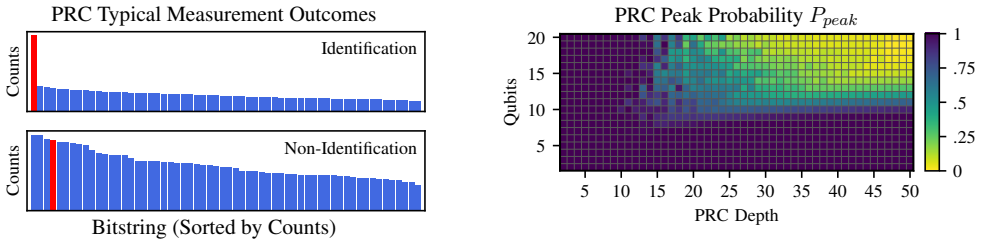
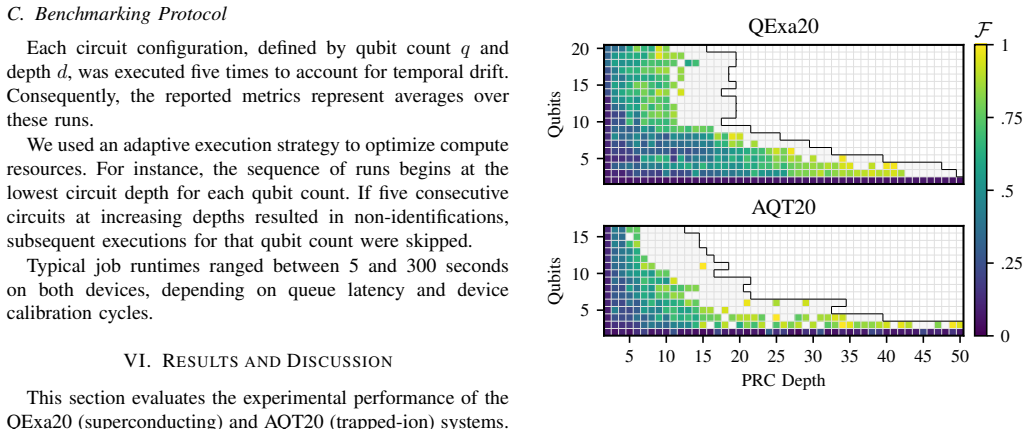
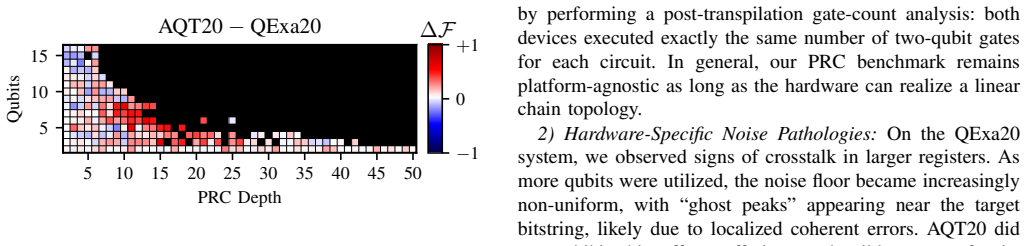
Quantum computing is transitioning from experimental prototypes to commercially available turnkey systems, making architecture-agnostic performance metrics essential for cross-platform comparison. Peaked Random Circuits (PRCs) have recently been proposed as a viable path to demonstrate quantum advantage on NISQ devices: a quantum processor can reliably detect a single, peaked output state amid background noise, yet the circuits' characteristics render classical simulation infeasible. In this paper, we repurpose PRCs as a system-level fidelity benchmark. By successively running a matrix of PRCs with varying qubit counts and circuit depths, we quantify a system's ability to identify the deterministic peak despite cumulative noise, gate errors, and connectivity constraints. We apply the benchmark on IQM's superconducting and AQT's trapped-ion architectures. Our results show that PRCs provide a high-precision metric comparable to Quantum Volume while exhibiting greater sensitivity to interference effects. Consequently, PRCs enable a robust framework for assessing the computational reliability of NISQ hardware across platforms.
Editorial analysis
A structured set of objections, weighed in public.
Referee Report
Summary. The manuscript proposes repurposing Peaked Random Circuits (PRCs) as an architecture-agnostic system-level fidelity benchmark for NISQ devices. It runs matrices of PRCs with varying qubit counts and depths on IQM superconducting and AQT trapped-ion hardware, claims the resulting success probabilities quantify a system's ability to identify the deterministic peak amid noise and errors, and concludes that PRCs yield a high-precision metric comparable to Quantum Volume but with greater sensitivity to interference effects.
Significance. If the central claim holds and the ideal peak can be obtained without circularity, the work would supply a new cross-platform benchmark with potential advantages in sensitivity. The manuscript does not, however, supply machine-checked proofs, reproducible code, or parameter-free derivations that would strengthen the assessment.
major comments (1)
- [Abstract] Abstract: The claim that PRC characteristics 'render classical simulation infeasible' directly conflicts with the requirement to compare measured success probabilities against a known 'deterministic peak' probability in order to compute fidelity. No section of the manuscript resolves this by providing a non-simulation method for identifying the peak at the qubit counts and depths used in the matrix, nor does it restrict the benchmark to simulable sizes while preserving the 'system-level' and 'quantum advantage' framing.
minor comments (1)
- [Abstract] The abstract asserts results on sensitivity and comparability but supplies no methods details, data, error bars, or analysis steps; these must be added for the central claim to be evaluable.
Simulated Author's Rebuttal
We thank the referee for the careful review and for identifying the tension in our abstract. We agree that the current wording creates an unresolved conflict between the claim of classical intractability and the need for a known peak probability, and that the manuscript does not currently supply an explicit non-simulation method or size restriction. We address this point below and will revise accordingly.
read point-by-point responses
-
Referee: [Abstract] Abstract: The claim that PRC characteristics 'render classical simulation infeasible' directly conflicts with the requirement to compare measured success probabilities against a known 'deterministic peak' probability in order to compute fidelity. No section of the manuscript resolves this by providing a non-simulation method for identifying the peak at the qubit counts and depths used in the matrix, nor does it restrict the benchmark to simulable sizes while preserving the 'system-level' and 'quantum advantage' framing.
Authors: We accept the criticism as valid. The abstract's phrasing is imprecise and does not resolve the logical tension. In the PRC construction used in the work, the target peak output state is chosen explicitly during circuit generation, so its identity is known a priori; the measured success probability is simply the probability of observing that specific state. However, obtaining the precise ideal probability value for normalization does rely on classical simulation for the depths and widths reported. No section currently explains this distinction or restricts the benchmark to simulable regimes. We will (1) revise the abstract to remove or qualify the 'infeasible' claim, (2) add a dedicated methods subsection describing how the peak state is identified by construction, and (3) explicitly limit the current benchmark results to simulable sizes while noting that the same protocol could be applied at larger scales where only the peak state (not the full distribution) needs to be targeted. These changes will be made in the revised manuscript. revision: yes
Circularity Check
No significant circularity; benchmark repurposing is empirical and self-contained
full rationale
The paper's core step is to run a matrix of PRCs on hardware at varying qubit counts and depths, then report measured success probabilities against the known ideal peak as a fidelity score. This is a direct empirical procedure with no equations shown that reduce the output to a fitted parameter or self-referential definition. The abstract's intractability claim applies to the regime where PRCs demonstrate advantage, while the benchmark application is presented as feasible on the tested systems; no derivation chain equates the fidelity metric to its own inputs by construction. No self-citation load-bearing steps, uniqueness theorems, or ansatzes are invoked in the provided text. The result remains an independent cross-platform comparison.
Axiom & Free-Parameter Ledger
Reference graph
Works this paper leans on
-
[1]
Building logical qubits in a superconducting quantum computing system,
J. M. Gambetta, J. M. Chow, and M. Steffen, “Building logical qubits in a superconducting quantum computing system,”npj quantum information, vol. 3, no. 1, p. 2, 2017. [Online]. Available: https://doi.org/10.1038/s41534-016-0004-0
-
[2]
Applied Physics Reviews6(2), 021314 (2019) https://doi.org/10.1063/1.5088164
C. D. Bruzewicz, J. Chiaverini, R. McConnell, and J. M. Sage, “Trapped-ion quantum computing: Progress and challenges,”Applied physics reviews, vol. 6, no. 2, 2019. [Online]. Available: https: //doi.org/10.1063/1.5088164
-
[3]
Quantum computing with neutral atoms,
L. Henriet, L. Beguin, A. Signoles, T. Lahaye, A. Browaeyset al., “Quantum computing with neutral atoms,”Quantum, vol. 4, p. 327,
-
[4]
Quantum computing with neutral atoms,
[Online]. Available: https://doi.org/10.22331/q-2020-09-21-327
-
[5]
D. E. Browne and T. Rudolph, “Resource-efficient linear optical quantum computation,”Physical Review Letters, vol. 95, no. 1, p. 010501, 2005. [Online]. Available: https://doi.org/10.1103/PhysRevLett. 95.010501
-
[6]
On verifiable quantum advantage with peaked circuit sampling,
S. Aaronson and Y . Zhang, “On verifiable quantum advantage with peaked circuit sampling,”arXiv preprint arXiv:2404.14493, 2024. [Online]. Available: https://doi.org/10.48550/arXiv.2404.14493
-
[7]
Complexity and hardness of random peaked circuits,
Y . Zhang, “Complexity and hardness of random peaked circuits,” arXiv preprint arXiv:2510.00132, 2025. [Online]. Available: https: //doi.org/10.48550/arXiv.2510.00132
-
[8]
Quantum volume in practice: What users can expect from NISQ devices,
E. Pelofske, A. B ¨artschi, and S. Eidenbenz, “Quantum volume in practice: What users can expect from NISQ devices,”IEEE Transactions on Quantum Engineering, vol. 3, pp. 1–19, 2022. [Online]. Available: https://doi.org/10.1109/TQE.2022.3184764
-
[9]
H. Heimonen, A. Auer, V . Bergholm, I. de Vega, and M. M ¨ott¨onen, “Quantum computing at IQM,” inImpact of Scientific Computing on Science and Society. Springer, 2023, pp. 373–393. [Online]. Available: https://doi.org/10.1007/978-3-031-29082-4 22
-
[10]
Compact ion-trap quantum computing demonstrator,
I. Pogorelov, T. Feldker, C. D. Marciniak, L. Postler, G. Jacob et al., “Compact ion-trap quantum computing demonstrator,”PRX quantum, vol. 2, no. 2, p. 020343, 2021. [Online]. Available: https://doi.org/10.1103/PRXQuantum.2.020343
-
[11]
Qasmbench: A low- level quantum benchmark suite for NISQ evaluation and simulation,
A. Li, S. Stein, S. Krishnamoorthy, and J. Ang, “Qasmbench: A low- level quantum benchmark suite for NISQ evaluation and simulation,” ACM Transactions on Quantum Computing, vol. 4, no. 2, pp. 1–26,
-
[12]
ACM Transactions on Quantum Computing4(2) (2023) https://doi.org/10.1145/3550488
[Online]. Available: https://doi.org/10.1145/3550488
-
[13]
Benchmarking quantum computers,
T. Proctor, K. Young, A. D. Baczewski, and R. Blume-Kohout, “Benchmarking quantum computers,”Nature Reviews Physics, vol. 7, no. 2, pp. 105–118, 2025. [Online]. Available: https://doi.org/10.1038/ s42254-024-00796-z
2025
-
[14]
Systematic benchmarking of quantum computers: Status and recommendations,
J. M. Lorenz, T. Monz, J. Eisert, D. Reitzner, F. Schopfer et al., “Systematic benchmarking of quantum computers: Status and recommendations,”arXiv preprint arXiv:2503.04905, 2025. [Online]. Available: https://doi.org/10.48550/arXiv.2503.04905
-
[15]
Validating quantum computers using randomized model circuits,
A. W. Cross, L. S. Bishop, S. Sheldon, P. D. Nation, and J. M. Gambetta, “Validating quantum computers using randomized model circuits,”Physical Review A, vol. 100, no. 3, p. 032328, 2019. [Online]. Available: https://doi.org/10.1103/PhysRevA.100.032328
-
[16]
A. Wack, H. Paik, A. Javadi-Abhari, P. Jurcevic, I. Faroet al., “Quality, speed, and scale: Three key attributes to measure the performance of near-term quantum computers,”arXiv preprint arXiv:2110.14108, vol. 2110, 2021. [Online]. Available: https://doi.org/10.48550/arXiv.2110. 14108
-
[17]
M. Amico, H. Zhang, P. Jurcevic, L. S. Bishop, P. Nationet al., “Defining best practices for quantum benchmarks,” in2023 IEEE International Conference on Quantum Computing and Engineering (QCE), vol. 1. IEEE, 2023, pp. 692–702. [Online]. Available: https://doi.org/10.1109/QCE57702.2023.00084
-
[18]
Benchmarking fault-tolerant quantum computing hardware via QLOPS,
L. Kong, F. Zhang, and J. Chen, “Benchmarking fault-tolerant quantum computing hardware via QLOPS,”ACM Transactions on Quantum Computing, 2025. [Online]. Available: https://doi.org/10.1145/3797968
-
[19]
Scalable and robust randomized benchmarking of quantum processes,
E. Magesan, J. M. Gambetta, and J. Emerson, “Scalable and robust randomized benchmarking of quantum processes,”Physical Review Letters, vol. 106, no. 18, May 2011. [Online]. Available: http://dx.doi.org/10.1103/PhysRevLett.106.180504
-
[20]
Hands-on introduction to randomized benchmarking,
A. Silva and E. Greplova, “Hands-on introduction to randomized benchmarking,”SciPost Physics Lecture Notes, Jul. 2025. [Online]. Available: http://dx.doi.org/10.21468/SciPostPhysLectNotes.97
-
[21]
Scalable randomized benchmarking of quantum computers using mirror circuits,
T. Proctor, S. Seritan, K. Rudinger, E. Nielsen, R. Blume-Kohout, and K. Young, “Scalable randomized benchmarking of quantum computers using mirror circuits,”Physical Review Letters, vol. 129, no. 15, Oct
-
[22]
Available: http://dx.doi.org/10.1103/PhysRevLett.129
[Online]. Available: http://dx.doi.org/10.1103/PhysRevLett.129. 150502
-
[23]
Application- oriented performance benchmarks for quantum computing,
T. Lubinski, S. Johri, P. Varosy, J. Coleman, L. Zhaoet al., “Application- oriented performance benchmarks for quantum computing,”IEEE Transactions on Quantum Engineering, vol. 4, pp. 1–32, 2023. [Online]. Available: https://doi.org/10.1109/TQE.2023.3253761
-
[24]
Quark: A framework for quantum computing application benchmarking,
J. R. Fin ˇzgar, P. Ross, L. H¨olscher, J. Klepsch, and A. Luckow, “Quark: A framework for quantum computing application benchmarking,” in 2022 IEEE International Conference on Quantum Computing and En- gineering (QCE), 2022, pp. 226–237
2022
-
[25]
A method for constructing quasi-random peaked quantum circuits,
O. G. Udalov, “A method for constructing quasi-random peaked quantum circuits,”arXiv preprint arXiv:2508.07491, 2025. [Online]. Available: https://doi.org/10.48550/arXiv.2508.07491
-
[26]
Heuristic quantum advantage with peaked circuits,
H. Gharibyan, M. Z. Mullath, N. E. Sherman, V . P. Su, H. Tepanyan, and Y . Zhang, “Heuristic quantum advantage with peaked circuits,”
-
[27]
Available: https://doi.org/10.48550/arXiv.2510.25838
[Online]. Available: https://doi.org/10.48550/arXiv.2510.25838
-
[28]
A. Javadi-Abhari, M. Treinish, K. Krsulich, C. J. Wood, J. Lishmanet al., “Quantum computing with qiskit,” arXiv preprint arXiv:2405.08810, 2024. [Online]. Available: https://doi.org/10.48550/arXiv.2405.08810
work page internal anchor Pith review Pith/arXiv arXiv doi:10.48550/arxiv.2405.08810 2024
-
[29]
L. Burgholzer, J. Echavarria, P. Hopf, Y . Stade, D. Rovara et al., “The munich quantum software stack: Connecting end users, integrating diverse quantum technologies, accelerating HPC,” arXiv preprint arXiv:2509.02674, 2025. [Online]. Available: https: //doi.org/10.48550/arXiv.2509.02674
discussion (0)
Sign in with ORCID, Apple, or X to comment. Anyone can read and Pith papers without signing in.