Gravitational Light Deflection with SKA-VLBI and Its Application to Precision Tests of General Relativity
Pith reviewed 2026-06-25 20:41 UTC · model grok-4.3
The pith
SKA-VLBI can track extragalactic sources to measure solar light deflection and reach gamma accuracy of 10^{-7} in general relativity tests.
A machine-rendered reading of the paper's core claim, the machinery that carries it, and where it could break.
Core claim
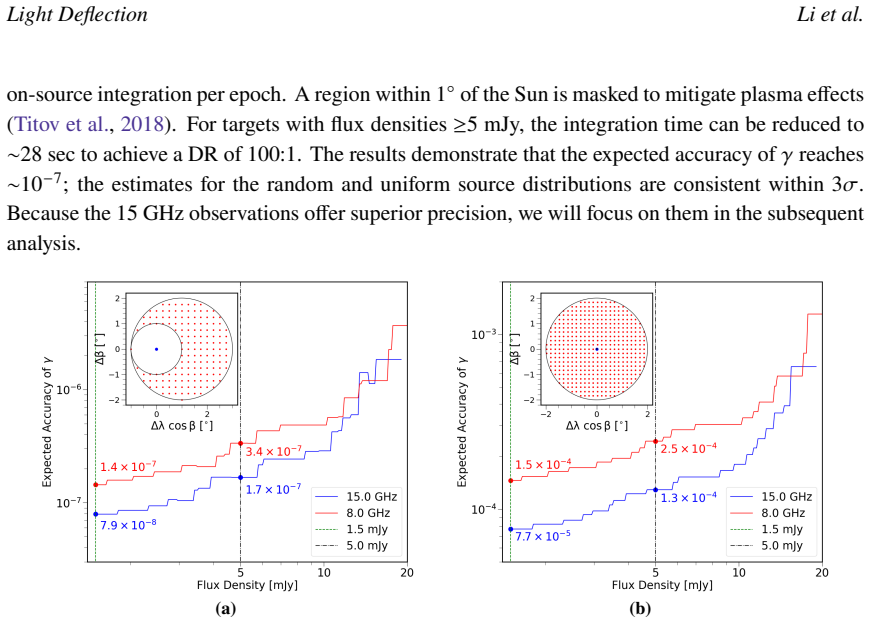
Single-epoch SKA-VLBI at 15 GHz reaches ~2 μas astrometric precision and detects ~36 sources per square degree at ~1.5 mJy, enabling 10-epoch tracking that improves gamma accuracy to ~10^{-7} with the Sun as lens and to ~10^{-4} with Jupiter while determining Jupiter's J_{2,J} to ~10^{-3} from the quadrupolar deflection term.
What carries the argument
The ~2 μas single-epoch astrometric precision of SKA-VLBI, achieved through 300-second integrations at 15 GHz, which supports in-beam source detection and multi-epoch positional tracking near the Sun or Jupiter.
If this is right
- The measurements would provide the first observational access to the quadrupolar light deflection term induced by a planet.
- Gamma constraints at 10^{-7} would allow discrimination among higher-order parameterized post-Newtonian formalisms.
- The same data would set a practical foundation for routine sub-microarcsecond radio astrometry.
- Jupiter oblateness determined from light deflection would offer an independent check on interior structure models.
Where Pith is reading between the lines
- Repeated observations of the same fields could also yield proper-motion catalogs at microarcsecond level for the detected sources.
- The Jupiter measurements might be extended to Saturn or other gas giants once similar sensitivity is demonstrated.
- If the quoted source density holds, the method could be applied to additional solar-system bodies for cross-checks on the same gamma value.
Load-bearing premise
The calculations assume single-epoch SKA-VLBI observations will actually deliver ~2 μas astrometric precision together with detection of ~36 sources per square degree at 1.5 mJy flux density.
What would settle it
An on-sky test showing SKA-VLBI single-epoch precision no better than 5 μas or fewer than 10 detectable sources per square degree at 1.5 mJy would remove the projected gains in gamma and J2 accuracy.
Figures
read the original abstract
Experimental test of general relativity remains an ongoing endeavour. Radio astrometry provides a vital tool for precisely measuring the light deflection caused by the Sun, testing general relativity, and discriminating between gravitational theories. The best accuracy for the post-Newtonian relativistic parameter, $\gamma$, achieved with very long baseline interferometry is $9 \times 10^{-5}$. With 300-sec integration, SKA-VLBI can achieve a sensitivity of $\sim$15 $\mu$Jy at 15 GHz over a bandwidth of 0.256 GHz. This enables detection of $\sim$36 extragalactic radio sources per square degree with flux densities of $\sim$1.5 mJy, and potentially detecting in-beam radio sources. Single-epoch SKA-VLBI observations may achieve an astrometric precision of $\sim$2 $\mu$as. Utilising the Sun as a gravitational lens, 10-epoch positional tracking of extragalactic sources could improve $\gamma$ accuracy to $\sim$10$^{-7}$. Even with Jupiter as a lens, SKA-VLBI can measure $\gamma$ to $\sim$10$^{-4}$. Critically, it may conduct the first measurement of quadrupolar deflection of light caused by Jupiter, determining the physical oblateness of Jupiter, $J_{\mathrm{2, J}}$, to within $\sim${}$10^{-3}$. These advances are expected to rigorously test and improve gravitational theories or high-order parameterized post-Newtonian formalisms, while laying the foundations for (sub)$\mu$as astrometry.
Editorial analysis
A structured set of objections, weighed in public.
Referee Report
Summary. The manuscript forecasts that SKA-VLBI observations at 15 GHz can achieve single-epoch astrometric precision of ~2 μas, enabling 10-epoch tracking of extragalactic sources to measure the PPN parameter γ to ~10^{-7} using solar deflection and to ~10^{-4} using Jupiter, while also providing the first detection of Jupiter's quadrupolar light deflection and constraining its oblateness J_{2,J} to ~10^{-3}. These projections rest on a quoted sensitivity of ~15 μJy in 300 s and a source density of ~36 sources/deg² at 1.5 mJy.
Significance. If the claimed single-epoch precision and source counts are validated, the work would advance radio astrometric tests of GR by two orders of magnitude in γ and introduce a new observable (quadrupolar deflection) for solar-system bodies, with direct relevance to high-order PPN formalisms.
major comments (1)
- [Abstract] Abstract (sensitivity and source-count paragraphs): The single-epoch astrometric precision of ~2 μas is stated without an explicit error-propagation analysis that combines thermal noise with residual tropospheric/ionospheric delays, source-structure effects, and baseline-calibration uncertainties. Because this 2 μas figure is multiplied directly into the 10-epoch Sun-lens and Jupiter-lens forecasts for γ and J_{2,J}, the absence of the budget renders the headline improvements unverifiable; an effective floor of 5–10 μas would nullify the claimed gains.
minor comments (1)
- [Abstract] Abstract: the expression “∼${}$10^{-3}$” contains a LaTeX formatting artifact that should be corrected to ∼10^{-3}.
Simulated Author's Rebuttal
We thank the referee for the thorough review and the constructive comment on the abstract. We address the point raised below and agree that additional detail will strengthen the presentation of our forecasts.
read point-by-point responses
-
Referee: [Abstract] Abstract (sensitivity and source-count paragraphs): The single-epoch astrometric precision of ~2 μas is stated without an explicit error-propagation analysis that combines thermal noise with residual tropospheric/ionospheric delays, source-structure effects, and baseline-calibration uncertainties. Because this 2 μas figure is multiplied directly into the 10-epoch Sun-lens and Jupiter-lens forecasts for γ and J_{2,J}, the absence of the budget renders the headline improvements unverifiable; an effective floor of 5–10 μas would nullify the claimed gains.
Authors: We agree that the abstract would benefit from a concise statement on how the ~2 μas single-epoch precision is obtained. The value is derived from the quoted thermal-noise sensitivity of ~15 μJy (300 s integration at 15 GHz) under the assumption that standard VLBI calibration procedures reduce residual tropospheric, ionospheric, source-structure, and baseline errors to a level comparable to or below the thermal contribution for the selected compact sources. However, to make this transparent and to allow readers to assess the robustness of the subsequent γ and J_{2,J} projections, we will revise the manuscript by (i) adding a short paragraph in the methods section that outlines the dominant error terms and their estimated magnitudes after calibration, and (ii) inserting a one-sentence qualifier in the abstract that the 2 μas figure represents the thermal-noise-limited precision after mitigation of systematics. These additions will not alter the headline numbers but will render the error budget explicit. revision: yes
Circularity Check
No significant circularity; forecasts use external specs and standard GR formulas
full rationale
The paper's derivation chain consists of stating SKA-VLBI sensitivity (~15 μJy at 15 GHz), deriving source density (~36 sources/deg² at 1.5 mJy) and single-epoch precision (~2 μas), then applying standard post-Newtonian light deflection formulas to project γ and J_{2,J} improvements. No step reduces the target quantities (γ accuracy, J2) back to the inputs by construction, via fitted parameters renamed as predictions, or through load-bearing self-citations. The claims are independent projections against external benchmarks rather than self-referential definitions or ansatzes.
Axiom & Free-Parameter Ledger
axioms (1)
- standard math Parameterized post-Newtonian formalism correctly describes light deflection by solar-system bodies
Reference graph
Works this paper leans on
-
[1]
doi: 10.3847/1538-3881/ad4030. 9 Light Deflection Li et al. G. S. Bisnovatyi-Kogan and O. Y. Tsupko.Universe, 3(3):57, July
-
[2]
doi: 10.1093/mnras/ staa3023. E. Fomalont, S. Kopeikin, G. Lanyi, and J. Benson.Astrophys. J., 699(2):1395–1402, July
-
[3]
doi: 10.1088/0004-637X/699/2/1395. E. B. Fomalont and S. Kopeikin.Proceedings of the International Astronomical Union, 3(S248): 383386,
-
[5]
doi: 10.1017/S1743921308019613. E. B. Fomalont and S. M. Kopeikin.Astrophys. J., 598(1):704–711, Nov
-
[6]
2009, MNRAS, 394, 1825, doi:10.1111/j
doi: 10.1111/j. 1365-2966.2009.15387.x. S. M. Kopeikin and V. V. Makarov.Phys. Rev. D, 75(6):062002, Mar
work page doi:10.1111/j 2009
-
[7]
doi: 10.1016/j.physleta.2007.03.036. Y. Li et al.Astrophys. J., 938(1):58, Oct. 2022a. doi: 10.3847/1538-4357/ac8df8. Y. Li et al.Astrophys. J., 925(1):47, Jan. 2022b. doi: 10.3847/1538-4357/ac3821. Y. Li et al.Res. Astron. Astrophys., 24(7):072001, July
-
[8]
doi: 10.1088/1674-4527/ad420c. S. E. Motta et al.Astron. Astrophys., 696:A222, Apr
-
[9]
doi: 10.1051/0004-6361/202452838. Z. Paragi et al. InAdvancing Astrophysics with the Square Kilometre Array (AASKA14), page 143, Apr
-
[10]
doi: 10.22323/1.215.0143. M. J. Rioja and R. Dodson.Astron. Astrophys. Rev., 28(1):6, Sept
-
[11]
D.S.RobertsonandW.E.Carter.Nature,310(5978):572–574,Aug.1984
doi: 10.1007/ s00159-020-00126-z. D.S.RobertsonandW.E.Carter.Nature,310(5978):572–574,Aug.1984. doi: 10.1038/310572a0. K. C. Sahu et al.Astrophys. J., 983(2):104, Apr
-
[12]
doi: 10.3847/1538-4357/adbe6e. O. Titov et al.Astron. Astrophys., 618:A8, Oct
-
[13]
doi: 10.1051/0004-6361/201833459. C. M. Will.Astrophys. J., 590(2):683–690, June
-
[14]
doi: 10.1086/375164. C. M. Will.Living Rev. Relativ., 17(1):4, Dec
-
[15]
doi: 10.12942/lrr-2014-4. C. M. Will.Class. Quantum Gravity, 32(12):124001, June
-
[16]
doi: 10.1088/0264-9381/32/12/ 124001. Y. Xu et al. InAdvancing Astrophysics with the SKA – II (AASKAII)
discussion (0)
Sign in with ORCID, Apple, or X to comment. Anyone can read and Pith papers without signing in.