A flow-matching generative model for event-by-event jet-induced hydro response in high-energy heavy-ion collisions
Pith reviewed 2026-05-19 22:20 UTC · model grok-4.3
The pith
Flow-matching model generates final hadron spectra from initial gamma and jet information alone
A machine-rendered reading of the paper's core claim, the machinery that carries it, and where it could break.
Core claim
With only the initial spatial and momentum information of the γ and jets, the network is shown to conditionally generate the marginal final-state hadron spectra from the jet-induced hydro response that agree well with the training data. This generative model achieves a computational acceleration of approximately six orders of magnitude compared to the full CoLBT-hydro simulations, while faithfully preserving the statistical properties of the front and diffusion wake of the Mach-cone-like hydro response and their contributions to the hadron spectra.
What carries the argument
Flow-matching generative model conditioned on initial gamma and jet spatial and momentum data to output final hadron spectra from the jet-induced hydro response
If this is right
- The model makes large-scale event-by-event studies of jet-induced medium responses computationally practical.
- It maintains the separate contributions of the front wake and diffusion wake to the final hadron spectra.
- Statistical properties of the Mach-cone-like hydro structure are reproduced without running concurrent hard-parton and medium evolution.
- The approach can support more extensive physics investigations that were previously limited by simulation cost.
Where Pith is reading between the lines
- The same conditioning approach could be tested on other hard probes or different beam energies to check how broadly the initial information suffices.
- Faster generation of hydro responses could allow higher-statistics comparisons between theory and experimental hadron data.
- The speedup opens the possibility of embedding the model inside larger Monte Carlo frameworks for event generation.
Load-bearing premise
The initial spatial and momentum information of the gamma and jets alone is sufficient for the model to learn the full conditional distribution of final hadron spectra produced by the complete jet-medium evolution.
What would settle it
If generated spectra on an independent test set of gamma-jet events deviate from full CoLBT-hydro results in the angular or transverse-momentum distributions of hadrons associated with the diffusion wake, the central claim would be falsified.
Figures




read the original abstract
In high-energy heavy-ion collisions, propagation of the energy deposited into the medium by energetic partons that traverse the quark-gluon plasma (QGP) leads to Mach-cone-like jet-induced medium response. Full simulations of such jet-induced medium responses require a complete model such as the coupled Linear Boltzmann Transport and hydrodynamic (CoLBT-hydro) model that can carry out the concurrent evolution of both hard partons and the medium. Such full simulations on parallelized computers, however, are very resource-intensive and alternative simulation methods will be useful for more extensive physics investigations. In this study, we train a Flow Matching generative model with $\gamma$-jet events in 0-10$\%$ Pb+Pb collisions at $\sqrt{s_{\rm{NN}}}$ = 5.02 TeV from the CoLBT-hydro model to estimate the final-state hadron spectra $d^3N/dp_Td\eta d\phi$ from jet-induced hydro response. With only the initial spatial and momentum information of the $\gamma$ and jets, the network is shown to conditionally generate the marginal final-state hadron spectra from the jet-induced hydro response that agree well with the training data. This generative model achieves a computational acceleration of approximately six orders of magnitude compared to the full CoLBT-hydro simulations, while faithfully preserving the statistical properties of the front and diffusion wake of the Mach-cone-like hydro response and their contributions to the hadron spectra.
Editorial analysis
A structured set of objections, weighed in public.
Referee Report
Summary. The manuscript presents a flow-matching generative model trained on γ-jet events from the CoLBT-hydro simulation in 0-10% Pb+Pb collisions at √s_NN = 5.02 TeV. Using only the initial spatial and momentum information of the γ and jets as input, the model is claimed to conditionally generate the marginal final-state hadron spectra d³N/dp_T dη dφ from the jet-induced hydro response. These generated spectra are stated to agree well with the training data, achieve a computational speedup of approximately six orders of magnitude relative to full CoLBT-hydro runs, and preserve the statistical properties of the front and diffusion wake of the Mach-cone-like hydro response.
Significance. If the central claims hold after addressing verification gaps, the work would offer a practical acceleration for simulating jet-induced medium responses in heavy-ion collisions. This could enable larger-scale event-by-event studies of Mach-cone features and their contributions to hadron spectra that are currently constrained by the high computational cost of coupled transport-hydrodynamic models like CoLBT-hydro.
major comments (3)
- [Abstract] Abstract: the assertion of generating 'event-by-event' jet-induced hydro responses is undermined because the input features contain only initial γ/jet kinematics and no information on the specific medium realization or local density fluctuations along the jet path; each training pair arises from one particular CoLBT-hydro medium evolution, so the network can at best reproduce the marginal distribution averaged over medium fluctuations rather than the conditional distribution for a fixed medium.
- [Abstract] Abstract and results: the statement that generated spectra 'agree well' with training data lacks any quantitative support such as χ² values, Kolmogorov-Smirnov distances, error bars on spectra comparisons, or details on training/validation splits and generalization tests to held-out events; this leaves the strength of the agreement and the six-order speedup claim unverified.
- [Method] Method and results: the weakest assumption—that initial γ/jet phase-space information alone suffices to learn the full conditional distribution of final-state hadron spectra from concurrent hard-parton and medium evolution—is not tested; a direct check against CoLBT-hydro events sharing the same jet but differing in medium geometry would be required to substantiate the event-by-event character asserted in the title.
minor comments (2)
- [Abstract] Abstract: the differential spectra notation d^3N/dp_Tdηdφ would benefit from explicit parentheses or spacing (e.g., d³N / dp_T dη dφ) for clarity.
- [Method] Consider adding a brief discussion of how the flow-matching architecture handles the high-dimensional output space of the hadron spectra to aid reproducibility.
Simulated Author's Rebuttal
We thank the referee for the detailed and constructive report. The comments highlight important clarifications needed regarding the scope of the generative model. We address each major comment below with proposed revisions that strengthen the manuscript without altering its core claims.
read point-by-point responses
-
Referee: [Abstract] Abstract: the assertion of generating 'event-by-event' jet-induced hydro responses is undermined because the input features contain only initial γ/jet kinematics and no information on the specific medium realization or local density fluctuations along the jet path; each training pair arises from one particular CoLBT-hydro medium evolution, so the network can at best reproduce the marginal distribution averaged over medium fluctuations rather than the conditional distribution for a fixed medium.
Authors: We agree with this assessment. The abstract already specifies generation of the 'marginal final-state hadron spectra', and the model is trained to sample from the distribution of responses averaged over the medium fluctuations present in the CoLBT-hydro training events. The 'event-by-event' language in the title is meant to convey that individual spectra are generated (as opposed to mean-field averages), but we recognize this can be misleading. In the revision we will change the title to 'A flow-matching generative model for marginal jet-induced hydro response in high-energy heavy-ion collisions' and add explicit wording in the abstract and Section 2 clarifying that the outputs represent samples from the marginal distribution conditioned only on jet kinematics. revision: yes
-
Referee: [Abstract] Abstract and results: the statement that generated spectra 'agree well' with training data lacks any quantitative support such as χ² values, Kolmogorov-Smirnov distances, error bars on spectra comparisons, or details on training/validation splits and generalization tests to held-out events; this leaves the strength of the agreement and the six-order speedup claim unverified.
Authors: We accept this criticism. The revised manuscript will include χ² per degree of freedom for all spectral comparisons shown in the figures, Kolmogorov-Smirnov distances and associated p-values between generated and training distributions, statistical error bars on the plotted spectra, a clear description of the training/validation/test split (70/15/15), and explicit results demonstrating performance on held-out events. We will also report wall-clock timings with hardware details to substantiate the speedup factor. revision: yes
-
Referee: [Method] Method and results: the weakest assumption—that initial γ/jet phase-space information alone suffices to learn the full conditional distribution of final-state hadron spectra from concurrent hard-parton and medium evolution—is not tested; a direct check against CoLBT-hydro events sharing the same jet but differing in medium geometry would be required to substantiate the event-by-event character asserted in the title.
Authors: This observation is correct: the current training set does not contain paired simulations with identical jet kinematics but different medium realizations, so we have not performed the suggested direct test. Generating such paired data would require substantial additional CoLBT-hydro runs that lie outside the scope of the present work. We will add a dedicated paragraph in the Discussion section acknowledging this limitation and stating that the model reproduces the statistically averaged response over typical medium fluctuations rather than medium-specific conditional distributions. This scope is still sufficient for the intended use case of accelerating large-scale ensemble studies of Mach-cone features. revision: partial
Circularity Check
No circularity: surrogate model trained on external simulation data
full rationale
The paper trains a flow-matching generative model on event samples produced by the independent CoLBT-hydro simulation. The network takes only initial γ/jet kinematics as conditioning input and is evaluated by direct statistical comparison to held-out CoLBT-hydro hadron spectra; the reported agreement and six-order-of-magnitude speedup are therefore external benchmarks rather than quantities defined in terms of the model itself. No self-citations, uniqueness theorems, or ansätze are invoked to justify the architecture or loss; the central claim does not reduce to a fitted parameter renamed as a prediction or to any self-referential equation. The derivation chain is therefore self-contained against the external hydrodynamic data.
Axiom & Free-Parameter Ledger
free parameters (1)
- Flow-matching neural network parameters
axioms (2)
- domain assumption The CoLBT-hydro model provides an accurate representation of jet-induced medium response in the QGP.
- domain assumption Initial spatial and momentum information of the gamma and jets is sufficient to determine the conditional distribution of final hadron spectra from the hydro response.
Lean theorems connected to this paper
-
IndisputableMonolith/Foundation/RealityFromDistinction.leanreality_from_one_distinction unclear?
unclearRelation between the paper passage and the cited Recognition theorem.
With only the initial spatial and momentum information of the γ and jets, the network is shown to conditionally generate the marginal final-state hadron spectra
-
IndisputableMonolith/Cost/FunctionalEquation.leanwashburn_uniqueness_aczel unclear?
unclearRelation between the paper passage and the cited Recognition theorem.
Flow Matching generative model... ODE dx/dt = u_θ(x,t)
What do these tags mean?
- matches
- The paper's claim is directly supported by a theorem in the formal canon.
- supports
- The theorem supports part of the paper's argument, but the paper may add assumptions or extra steps.
- extends
- The paper goes beyond the formal theorem; the theorem is a base layer rather than the whole result.
- uses
- The paper appears to rely on the theorem as machinery.
- contradicts
- The paper's claim conflicts with a theorem or certificate in the canon.
- unclear
- Pith found a possible connection, but the passage is too broad, indirect, or ambiguous to say the theorem truly supports the claim.
Reference graph
Works this paper leans on
-
[1]
The azimuthal angle of the hadron is restricted to|ϕ h −ϕ γ|< π/2
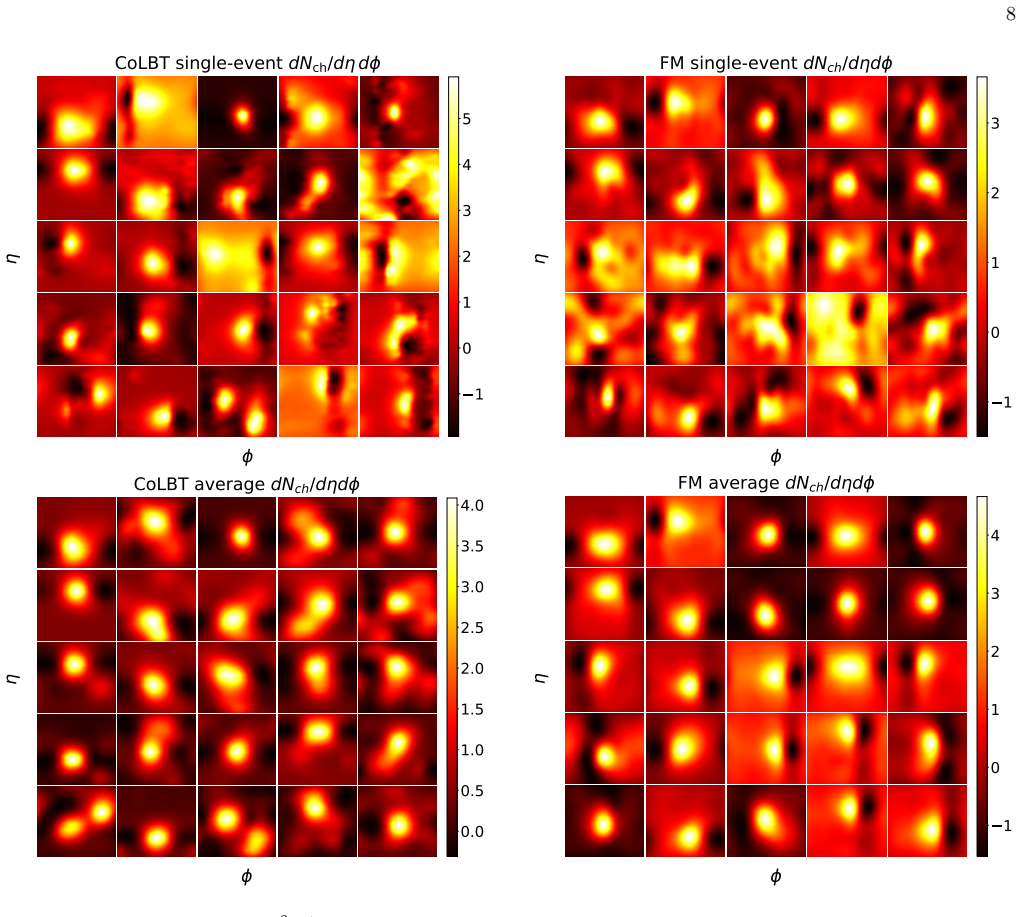
from both CoLBT-hydro (solid) and the Flow Match- ing model (dot-dashed). The azimuthal angle of the hadron is restricted to|ϕ h −ϕ γ|< π/2. The shaded bands are statistical errors. As we have discussed earlier, both the front and the diffusion wake follow the jet in rapidity while the az- 3 2 1 0 1 2 3 h 2.0 1.5 1.0 0.5 0.0 0.5 1.0 1.5 2.0 dNch/d h( jet ...
-
[2]
Energy loss in perturbative QCD
R. Baier, D. Schiff, and B. G. Zakharov, Ann. Rev. Nucl. Part. Sci.50, 37 (2000), arXiv:hep-ph/0002198
work page internal anchor Pith review Pith/arXiv arXiv 2000
-
[3]
Jet Quenching and Radiative Energy Loss in Dense Nuclear Matter
M. Gyulassy, I. Vitev, X.-N. Wang, and B.-W. Zhang, , 123 (2004), arXiv:nucl-th/0302077
work page internal anchor Pith review Pith/arXiv arXiv 2004
-
[4]
Gluon Radiation and Parton Energy Loss
A. Kovner and U. A. Wiedemann, , 192 (2003), arXiv:hep-ph/0304151
work page internal anchor Pith review Pith/arXiv arXiv 2003
-
[5]
Introductory lectures on jet quenching in heavy ion collisions
J. Casalderrey-Solana and C. A. Salgado, Acta Phys. Polon. B38, 3731 (2007), arXiv:0712.3443 [hep-ph]
work page internal anchor Pith review Pith/arXiv arXiv 2007
-
[6]
U. A. Wiedemann, , 521 (2010), arXiv:0908.2306 [hep- ph]
work page internal anchor Pith review Pith/arXiv arXiv 2010
-
[7]
J. P. Blaizot and Y. Mehtar-Tani, Int. J. Mod. Phys. E 24, 1530012 (2015), arXiv:1503.05958 [hep-ph]
work page internal anchor Pith review Pith/arXiv arXiv 2015
-
[8]
Jet quenching in high-energy heavy-ion collisions
G.-Y. Qin and X.-N. Wang, Int. J. Mod. Phys. E24, 1530014 (2015), arXiv:1511.00790 [hep-ph]
work page internal anchor Pith review Pith/arXiv arXiv 2015
-
[9]
S. Cao and X.-N. Wang, Rept. Prog. Phys.84, 024301 (2021), arXiv:2002.04028 [hep-ph]
- [10]
- [11]
-
[12]
K. Adcoxet al.(PHENIX), Phys. Rev. Lett.88, 022301 (2002), arXiv:nucl-ex/0109003
work page internal anchor Pith review Pith/arXiv arXiv 2002
-
[13]
Centrality dependence of high pT hadron suppression in Au+Au collisions at sqrt(sNN)=130 GeV
C. Adleret al.(STAR), Phys. Rev. Lett.89, 202301 (2002), arXiv:nucl-ex/0206011
work page internal anchor Pith review Pith/arXiv arXiv 2002
-
[14]
New Forms of QCD Matter Discovered at RHIC
M. Gyulassy and L. McLerran, Nucl. Phys. A750, 30 (2005), arXiv:nucl-th/0405013
work page internal anchor Pith review Pith/arXiv arXiv 2005
- [15]
-
[16]
G. Aadet al.(ATLAS), Phys. Rev. Lett.105, 252303 (2010), arXiv:1011.6182 [hep-ex]. 15
work page internal anchor Pith review Pith/arXiv arXiv 2010
-
[17]
K. Aamodtet al.(ALICE), Phys. Lett. B696, 30 (2011), arXiv:1012.1004 [nucl-ex]
work page internal anchor Pith review Pith/arXiv arXiv 2011
-
[18]
S. Chatrchyanet al.(CMS), Phys. Rev. C84, 024906 (2011), arXiv:1102.1957 [nucl-ex]
work page internal anchor Pith review Pith/arXiv arXiv 2011
-
[19]
The theory and phenomenology of perturbative QCD based jet quenching
A. Majumder and M. Van Leeuwen, Prog. Part. Nucl. Phys.66, 41 (2011), arXiv:1002.2206 [hep-ph]
work page internal anchor Pith review Pith/arXiv arXiv 2011
-
[20]
First Results from Pb+Pb collisions at the LHC
B. Muller, J. Schukraft, and B. Wyslouch, Ann. Rev. Nucl. Part. Sci.62, 361 (2012), arXiv:1202.3233 [hep- ex]
work page internal anchor Pith review Pith/arXiv arXiv 2012
-
[21]
Bayesian extraction of jet energy loss distributions in heavy-ion collisions
Y. He, L.-G. Pang, and X.-N. Wang, Phys. Rev. Lett. 122, 252302 (2019), arXiv:1808.05310 [hep-ph]
work page internal anchor Pith review Pith/arXiv arXiv 2019
- [22]
-
[23]
F. Arleo and G. Falmagne, Phys. Rev. D109, L051503 (2024), arXiv:2212.01324 [hep-ph]
-
[24]
Conical Flow induced by Quenched QCD Jets
J. Casalderrey-Solana, E. V. Shuryak, and D. Teaney, J. Phys. Conf. Ser.27, 22 (2005), arXiv:hep-ph/0411315
work page internal anchor Pith review Pith/arXiv arXiv 2005
-
[25]
H. Stoecker, Nucl. Phys. A750, 121 (2005), arXiv:nucl- th/0406018
-
[26]
J. Ruppert and B. Muller, Phys. Lett. B618, 123 (2005), arXiv:hep-ph/0503158
work page internal anchor Pith review Pith/arXiv arXiv 2005
-
[27]
S. S. Gubser, S. S. Pufu, and A. Yarom, Phys. Rev. Lett.100, 012301 (2008), arXiv:0706.4307 [hep-th]
work page internal anchor Pith review Pith/arXiv arXiv 2008
-
[28]
G. Y. Qin, A. Majumder, H. Song, and U. Heinz, Phys. Rev. Lett.103, 152303 (2009), arXiv:0903.2255 [nucl- th]
work page internal anchor Pith review Pith/arXiv arXiv 2009
-
[29]
H. Li, F. Liu, G.-l. Ma, X.-N. Wang, and Y. Zhu, Phys. Rev. Lett.106, 012301 (2011), arXiv:1006.2893 [nucl- th]
work page internal anchor Pith review Pith/arXiv arXiv 2011
- [30]
- [31]
- [32]
-
[33]
Z. Yang, T. Luo, W. Chen, L. Pang, and X.-N. Wang, PoSHardProbes2023, 124 (2024)
work page 2024
-
[34]
Z. Yang, T. Luo, Y. He, C. A. Salgado, and X.-N. Wang, EPJ Web Conf.296, 11013 (2024)
work page 2024
-
[35]
V. Chekhovskyet al.(CMS), Phys. Lett. B874, 140120 (2026), arXiv:2507.09307 [nucl-ex]
- [36]
- [37]
-
[38]
M. Aaboudet al.(ATLAS), Phys. Lett. B790, 108 (2019), arXiv:1805.05635 [nucl-ex]
work page internal anchor Pith review Pith/arXiv arXiv 2019
-
[39]
Sirimannaet al.(JETSCAPE), Phys
C. Sirimannaet al.(JETSCAPE), Phys. Rev. C111, 064911 (2025), arXiv:2412.19738 [hep-ph]
-
[40]
A. Kumaret al.(JETSCAPE), Phys. Rev. C107, 034911 (2023), arXiv:2204.01163 [hep-ph]
- [41]
-
[42]
S. Acharyaet al.(ALICE), Phys. Rev. C101, 034911 (2020), arXiv:1909.09718 [nucl-ex]
-
[43]
Y. Mehtar-Tani, D. Pablos, and K. Tywoniuk, Phys. Rev. Lett.127, 252301 (2021), arXiv:2101.01742 [hep- ph]
-
[44]
D. Pablos, Phys. Rev. Lett.124, 052301 (2020), arXiv:1907.12301 [hep-ph]
-
[45]
Senguptaet al.(JETSCAPE), (2025), arXiv:2501.16482 [hep-ph]
A. Senguptaet al.(JETSCAPE), (2025), arXiv:2501.16482 [hep-ph]
-
[46]
Full jet in quark-gluon plasma with hydrodynamic medium response
Y. Tachibana, N.-B. Chang, and G.-Y. Qin, Phys. Rev. C95, 044909 (2017), arXiv:1701.07951 [nucl-th]
work page internal anchor Pith review Pith/arXiv arXiv 2017
-
[47]
T. Luo, S. Cao, Y. He, and X.-N. Wang, Phys. Lett. B 782, 707 (2018), arXiv:1803.06785 [hep-ph]
work page internal anchor Pith review Pith/arXiv arXiv 2018
- [48]
-
[49]
A. M. Sirunyanet al.(CMS), Phys. Rev. Lett.122, 152001 (2019), arXiv:1809.08602 [hep-ex]
work page internal anchor Pith review Pith/arXiv arXiv 2019
-
[50]
Medium Modification of \gamma-jets in High-energy Heavy-ion Collisions
X.-N. Wang and Y. Zhu, Phys. Rev. Lett.111, 062301 (2013), arXiv:1302.5874 [hep-ph]
work page internal anchor Pith review Pith/arXiv arXiv 2013
-
[51]
W. Chen, S. Cao, T. Luo, L.-G. Pang, and X.-N. Wang, Phys. Lett. B777, 86 (2018), arXiv:1704.03648 [nucl- th]
work page internal anchor Pith review Pith/arXiv arXiv 2018
- [52]
-
[53]
G. Aadet al.(ATLAS), Phys. Rev. Lett.126, 072301 (2021), arXiv:2008.09811 [nucl-ex]
-
[54]
Jet fragmentation functions in proton-proton collisions using soft-collinear effective theory
Y.-T. Chien, Z.-B. Kang, F. Ringer, I. Vitev, and H. Xing, JHEP05, 125 (2016), arXiv:1512.06851 [hep- ph]
work page internal anchor Pith review Pith/arXiv arXiv 2016
-
[55]
M. Aaboudet al.(ATLAS), Phys. Rev. C98, 024908 (2018), arXiv:1805.05424 [nucl-ex]
work page internal anchor Pith review Pith/arXiv arXiv 2018
-
[56]
X.-f. Guo and X.-N. Wang, Phys. Rev. Lett.85, 3591 (2000), arXiv:hep-ph/0005044
work page internal anchor Pith review Pith/arXiv arXiv 2000
-
[57]
Heavy Quark Energy Loss in Nuclear Medium
B.-W. Zhang, E. Wang, and X.-N. Wang, Phys. Rev. Lett.93, 072301 (2004), arXiv:nucl-th/0309040
work page internal anchor Pith review Pith/arXiv arXiv 2004
-
[58]
Hard collinear gluon radiation and multiple scattering in a medium
A. Majumder, Phys. Rev. D85, 014023 (2012), arXiv:0912.2987 [nucl-th]
work page internal anchor Pith review Pith/arXiv arXiv 2012
- [59]
- [60]
- [61]
-
[62]
Y. He, T. Luo, X.-N. Wang, and Y. Zhu, Phys. Rev. C91, 054908 (2015), [Erratum: Phys.Rev.C 97, 019902 (2018)], arXiv:1503.03313 [nucl-th]
work page internal anchor Pith review Pith/arXiv arXiv 2015
-
[63]
L. Pang, Q. Wang, and X.-N. Wang, Phys. Rev. C86, 024911 (2012), arXiv:1205.5019 [nucl-th]
work page internal anchor Pith review Pith/arXiv arXiv 2012
-
[64]
L. Pang, Q. Wang, and X.-N. Wang, Nucl. Phys. A 904-905, 811c (2013), arXiv:1211.1570 [nucl-th]
work page internal anchor Pith review Pith/arXiv arXiv 2013
-
[65]
L.-G. Pang, H. Petersen, and X.-N. Wang, Phys. Rev. C97, 064918 (2018), arXiv:1802.04449 [nucl-th]
work page internal anchor Pith review Pith/arXiv arXiv 2018
-
[66]
Longitudinal fluctuations and decorrelations of anisotropic flows at the LHC and RHIC energies
X.-Y. Wu, L.-G. Pang, G.-Y. Qin, and X.-N. Wang, Phys. Rev. C98, 024913 (2018), arXiv:1805.03762 [nucl- th]
work page internal anchor Pith review Pith/arXiv arXiv 2018
-
[67]
X.-Y. Wu, L.-G. Pang, G.-Y. Qin, and X.-N. Wang, Nucl. Phys. A982, 327 (2019), arXiv:1807.04995 [nucl- th]
work page internal anchor Pith review Pith/arXiv arXiv 2019
- [68]
-
[69]
Z. Yang and X.-N. Wang, Phys. Rev. Lett.135, 072302 (2025), arXiv:2501.03419 [hep-ph]
-
[70]
Z. Yang and X.-N. Wang, Phys. Rev. C113, L031901 (2026), arXiv:2508.04194 [hep-ph]
-
[71]
Z. Yang and X.-N. Wang, Research8, 0941 (2025), arXiv:2509.23780 [hep-ph]. 16
-
[72]
G. Aadet al.(ATLAS), Phys. Rev. C111, 044909 (2025), arXiv:2408.08599 [nucl-ex]
-
[73]
Hayrapetyanet al.(CMS), (2026), arXiv:2602.19431 [nucl-ex]
A. Hayrapetyanet al.(CMS), (2026), arXiv:2602.19431 [nucl-ex]
-
[74]
D. P. Kingma and M. Welling, (2013), arXiv:1312.6114 [stat.ML]
work page internal anchor Pith review Pith/arXiv arXiv 2013
-
[75]
Tutorial on variational autoencoders,
C. Doersch, (2016), arXiv:1606.05908 [stat.ML]
-
[76]
I. J. Goodfellow, J. Pouget-Abadie, M. Mirza, B. Xu, D. Warde-Farley, S. Ozair, A. Courville, and Y. Bengio, (2014), arXiv:1406.2661 [stat.ML]
work page internal anchor Pith review Pith/arXiv arXiv 2014
-
[77]
A. Vaswani, N. Shazeer, N. Parmar, J. Uszkoreit, L. Jones, A. N. Gomez, L. Kaiser, and I. Polosukhin, in31st International Conference on Neural Information Processing Systems(2017) arXiv:1706.03762 [cs.CL]
work page internal anchor Pith review Pith/arXiv arXiv 2017
-
[78]
L. Dinh, D. Krueger, and Y. Bengio (2014) arXiv:1410.8516 [cs.LG]
work page internal anchor Pith review Pith/arXiv arXiv 2014
-
[79]
Flow Matching for Generative Modeling
Y. Lipman, R. T. Q. Chen, H. Ben-Hamu, M. Nickel, and M. Le, (2023), arXiv:2210.02747 [cs.LG]
work page internal anchor Pith review Pith/arXiv arXiv 2023
-
[80]
Deep Unsupervised Learning using Nonequilibrium Thermodynamics
J. Sohl-Dickstein, E. A. Weiss, N. Maheswaranathan, and S. Ganguli, (2015), arXiv:1503.03585 [cs.LG]
work page internal anchor Pith review Pith/arXiv arXiv 2015
discussion (0)
Sign in with ORCID, Apple, or X to comment. Anyone can read and Pith papers without signing in.