REVIEW 4 major objections 6 minor 61 references
Towards the efficacy of federated prediction for epidemics on networks
T0 review · 4 major / 6 minor · reviewed 2026-08-11 · deepseek-v4-flash
Pith's one-line read The paper claims that federated learning can deliver effective node-level epidemic forecasts on partitioned networks, with a spatio-temporal graph attention model (STGAT) preferred for fluctuating epidemic dynamics, LSTM sufficient for…
desk verdict Useful empirical sweep of federated epidemic prediction, but the STGAT-versus-LSTM comparison is confounded by model capacity and the evidence base lacks error bars; worth serious review with requested revisions. read the letter →
The pith
A machine-rendered reading of the paper's core claim, the machinery that carries it, and where it could break.
The reading
What carries the argument
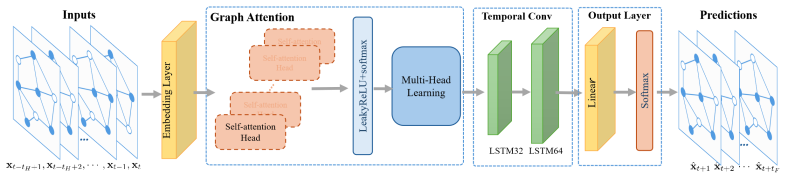
The central mechanism is a federated training loop in which each client owns a subnetwork induced by a partition of the full network, trains locally on its own node-state trajectories, and shares only model parameters with a central server that aggregates them via FedAvg or FedProx. The local predictors are two architectures: a pure temporal LSTM and the proposed Spatio-Temporal Graph Attention Network (STGAT), which combines an embedding layer, a multi-head graph attention layer for spatial dependencies, two LSTM layers for temporal dependencies, and a softmax classifier. The paper's novel evaluation tool is "efficacy energy," defined as the average of the mean client metric over an increasing number of clients, which measures system robustness under uncertain client configurations rather than at one fixed setting. Simulations use the Gillespie algorithm on a practical airline network, and graph partitions include even node-index splitting, spectral clustering, and Kernighan-Lin partitioning.
What would settle it
Run the same federated pipeline on the same airline network and epidemic parameters, but partition nodes by geographic region or by a cut that removes the busiest inter-region routes, holding everything else fixed. If STGAT no longer outperforms LSTM, or if FedProx's advantage shrinks, then the reported results are an artifact of the chosen partition rather than a general property of federated epidemic prediction.
Extended reading notes
Core claim
On a 600-node OpenFlights airline network with epidemic trajectories generated by a Gillespie simulator, the paper claims that federated learning provides effective node-level epidemic prediction across seven compartmental models. In centralized baselines, LSTM performs better for SIS, SIR, SEIR, and SIR VS, while STGAT performs better for non-Markovian SIS, SIS with time-varying rates, and SIRS. In federated settings, FedProx consistently outperforms FedAvg, and its advantage grows with the number of clients, which the authors attribute to the proximal term stabilizing local updates under data heterogeneity. The paper also shows that graph partition strategy matters: spectral clustering helps when clients are few, Kernighan-Lin partitioning stays strong across client counts, and even index-based splits work reasonably. Performance degrades as the effective infection rate rises and as missing infectious reports increase, with the authors framing this as a tension between information richness and intrinsic stochasticity.
Load-bearing premise
The central premise is that cutting the network into per-client subnetworks and discarding cross-client edges preserves enough spatial structure for the graph-based model to remain meaningful; if transmission across the cut edges dominates, the paper's STGAT results may not transfer to real deployments.
Editorial extensions
If this is right
- A central server can train node-level epidemic predictors across partitioned subnetworks without centralizing raw health data, enabling inter-region collaboration under privacy constraints.
- FedProx should be preferred over FedAvg as the default aggregation method for federated epidemic prediction, because it degrades more gracefully as the number of clients increases.
- For epidemic processes with fluctuating or periodic dynamics, the graph-aware STGAT model earns its added complexity, while for simpler outbreak patterns a temporal LSTM is sufficient.
- Partition strategy is a first-order design choice: Kernighan-Lin partitioning balances feature consistency and volume uniformity across clients, while spectral clustering helps only when client counts are small.
- Missing or noisy infectious reports degrade federated prediction performance, so deployments need data-quality safeguards such as noise-resilient aggregation or imputation.
Reading between the lines
- If the partition sensitivity seen in the paper is real, then real deployments where authorities hold only their own region's data may lose STGAT's advantage unless cross-client boundary information is shared through some privacy-preserving mechanism.
- The efficacy energy metric is a reusable statistic for comparing any federated system under uncertain client participation, not just epidemic prediction, since it averages performance across client counts instead of relying on one configuration.
- A direct testable extension would be to add synthetic cross-client transmission, such as shared boundary nodes or shared edge statistics, to measure how much of STGAT's gain comes from within-client topology versus global network structure.
- The framework's logic could extend to other collective dynamics on networks, such as traffic congestion, cascading failures, or information spread, but the paper's static-network assumption leaves dynamic contact networks as an open challenge.
Signed reviews
Editorial analysis
A structured set of objections, weighed in public.
Referee Report
Summary. The paper proposes a federated learning framework for node-level epidemic prediction on networks, where the network is partitioned among clients that keep local data private and a central server aggregates model updates using FedAvg or FedProx. Two predictors are compared: a pure temporal LSTM and a spatio-temporal graph attention network (STGAT). The evaluation on a 600-node OpenFlights airline network covers seven epidemic models (SIS, SIR, SEIR, SIRS, SIR-VS, non-Markovian SIS, SIS with time-varying rates), varying numbers of clients, three graph partitioning schemes, different effective infection rates, and missing reporting. A summary statistic called 'efficacy energy' is introduced to aggregate performance across client counts. The central claims are that no single model dominates across all scenarios, FedProx generally outperforms FedAvg, and STGAT is preferable for fluctuating dynamics while LSTM suffices for simpler patterns.
Significance. If the results hold, the paper is a useful contribution to privacy-preserving epidemic forecasting: it formulates a realistic cross-silo setting, applies existing FL algorithms to a new domain, and proposes a compact metric (efficacy energy) for comparing FL configurations under variable client counts. The study explicitly acknowledges that STGAT does not universally beat LSTM, which is a more nuanced conclusion than typical 'graph-based model wins' narratives. The paper also ships source code on GitHub, which is helpful for reproducibility. However, the current experimental support is thin: a single stochastic realization, no error bars, absent epidemic parameter values, and a model comparison that confounds architecture capacity with graph usage all limit the reliability of the qualitative takeaways.
major comments (4)
- [4.1.2–4.1.3] The conclusion that STGAT is superior for fluctuating dynamics (nmSIS, SIStv, SIRS) is not supported by the comparisons as run: the LSTM baseline is a single 64-unit LSTM layer, whereas STGAT adds an 8-head graph attention layer followed by two LSTM layers with 32 and 64 hidden units. The models therefore differ in parameter count and temporal depth, not only in graph usage. Without a capacity-matched LSTM or an ablation on the GAT block, the observed gains cannot be attributed to the graph-based attention mechanism, which is the load-bearing interpretation in Section 4.1.3 and Section 6.
- [4.2.1] The evaluation partitions the network by node index and trains each client on its induced subgraph, discarding all cross-client edges. When transmission across partition boundaries is significant, the local subgraph omits the very spatial interactions needed to predict boundary nodes, so the reported federated performance may be an artifact of the partition rather than a property of the FL framework. The paper should report the fraction of cut edges for each M and ideally include a condition in which the server shares topology (adjacency) with clients while keeping node states private, to separate privacy-preserving aggregation from the loss of global structural information.
- [4.2.2, Eq. (20)] Equation (20) defines the efficacy energy as η = 1/(M0-2) Σ_{K=2}^{M0} \bar{α}[M], but the summation index K does not appear in the summand, and the denominator M0-2 does not match the M0-1 terms in the sum (from 2 to M0). This makes the metric not well-defined as written; it should be \bar{α}[K] (or \bar{α}[M]) with denominator M0-1. Since the paper's comparative conclusions are drawn from this aggregated quantity, this must be corrected.
- [4.1.1–4.1.2, Table 1] No values are reported for any of the epidemic parameters listed in Table 1 (β, δ, ω, v1, v2, a, b, c, and the Weibull parameters for non-Markovian SIS), and the figures of prevalence (Figure 4) are not sufficient to determine them. In addition, the experiments use a single Gillespie realization per configuration with no error bars or multiple seeds. As a result, the claims that FedProx 'consistently outperforms' FedAvg and that STGAT outperforms LSTM in specific regimes are not supported by any measure of statistical significance or reproducibility.
minor comments (6)
- [Figure 1 caption] The caption contains a typo: 'the greed for the recovered' should be 'the green for the recovered'.
- [Section 4.1.2] The text says 'they are used to forecast traffic speed in the next tF = 10 time steps'; this is a copy-paste error from a traffic-forecasting paper and should read 'forecast epidemic node states'.
- [Algorithm 1] The phrase 'if Early Stop condition satisfried' should be 'satisfied'.
- [Figure 11] The caption and axis labels use 'missing radio' instead of 'missing ratio'.
- [Section 5.2] The phrase 'allowing local users to access high-equality services' should be 'high-quality services'.
- [Section 3.1] Definition 2 allows 'disjoint or overlapping subnetworks', but the experiments only implement disjoint partitions; the paper should clarify that overlapping regions are out of scope for the numerical study.
Circularity Check
No significant circularity: the federated-learning comparisons and the efficacy-energy ranking are empirical measurements, not derivations that reduce to their own inputs.
full rationale
The paper's central claims—that FedProx outperforms FedAvg and that STGAT and LSTM have complementary strengths—are supported by measured performance on simulated epidemic data. The efficacy energy defined in Eq. (20) is a descriptive aggregation, namely the mean over client counts of the measured average metric ᾱ[M], and the statement that FedProx achieves higher energy is an empirical observation about the measured performance curves, not a result forced by the definition. No parameter is fitted to a target and then renamed as a prediction. The self-citations in the paper are not load-bearing: reference [24] is used for the Gillespie-style simulation approach, reference [6] is background on SIS control, and reference [61] appears only as a suggested future direction. No uniqueness theorem from the authors' prior work is invoked to forbid alternatives, and the STGAT architecture is presented as a designed model with external GAT/LSTM ancestry rather than as an ansatz justified solely by self-citation. The concern that the LSTM/STGAT comparison is confounded by model capacity is a correctness and experimental-design issue, not a circularity issue, because the comparison does not reduce by construction to its inputs. Overall, the derivation chain is self-contained with respect to the empirical evaluations, so no circular step is identified.
Assumptions & free parameters
free parameters (3)
- efficacy energy upper client count M0 =
16 or 25 (by scenario)
- epidemic simulation parameters (beta, delta, omega, v1, v2, a, b, c) =
not reported
- FedProx proximal term mu =
0.01
assumptions (5)
- domain assumption Gillespie event-driven simulation accurately realizes the stated Markovian and non-Markovian epidemic processes
- domain assumption Node-level classification accuracy meaningfully measures prediction quality, despite most nodes being static at any time step
- ad hoc to paper The dynamic (pre-extinction) phase is the regime of interest; phases near extinction are excluded from evaluation
- domain assumption The OpenFlights airport network with 600 highest-degree airports and 22,352 links is a representative contact structure for epidemic spread
- ad hoc to paper Each client's local graph is the induced subgraph of the partition, with cross-client edges removed, and this preserves the spatial signal needed by STGAT
Cite this review
Pith. "Pith review of Towards the efficacy of federated prediction for epidemics on networks." pith.science (2026). https://pith.science/paper/CXVNP6TG
@misc{pith2026241202161,
  author       = {Pith},
  title        = {Pith review of: Towards the efficacy of federated prediction for epidemics on networks},
  year         = {2026},
  howpublished = {\url{https://pith.science/paper/CXVNP6TG}},
  note         = {Machine review of arXiv:2412.02161}
}
read the original abstract
Epidemic prediction is of practical significance in public health, enabling early intervention, resource allocation, and strategic planning. However, privacy concerns often hinder the sharing of health data among institutions, limiting the development of accurate prediction models. In this paper, we develop a general privacy-preserving framework for node-level epidemic prediction on networks based on federated learning (FL). We frame the spatio-temporal spread of epidemics across multiple data-isolated subnetworks, where each node state represents the aggregate epidemic severity within a community. Then, both the pure temporal LSTM model and the spatio-temporal model i.e., Spatio-Temporal Graph Attention Network (STGAT) are proposed to address the federated epidemic prediction. Extensive experiments are conducted on various epidemic processes using a practical airline network, offering a comprehensive assessment of FL efficacy under diverse scenarios. By introducing the efficacy energy metric to measure system robustness under various client configurations, we systematically explore key factors influencing FL performance, including client numbers, aggregation strategies, graph partitioning, missing infectious reports. Numerical results manifest that STGAT excels in capturing spatio-temporal dependencies in dynamic processes whereas LSTM performs well in simpler pattern. Moreover, our findings highlight the importance of balancing feature consistency and volume uniformity among clients, as well as the prediction dilemma between information richness and intrinsic stochasticity of dynamic processes. This study offers practical insights into the efficacy of FL scenario in epidemic management, demonstrates the potential of FL to address broader collective dynamics.
Figures


Figures from the paper (8 more)


Reference graph
Works this paper leans on
-
[1]
D. Bernoulli, “Essai d’une nouvelle analyse de la mortalit´ e caus´ ee par la petite v´ erole, et des avantages de l’inoculation pour la pr´ evenir,”Histoire de l’Acad., Roy. Sci.(Paris) avec Mem , pp. 1–45, 1760
-
[2]
Epidemic processes in complex networks,
R. Pastor Satorras, C. Castellano, P. Van Mieghem, and A. Vespignani, “Epidemic processes in complex networks,” Reviews of Modern Physics , vol. 87, no. 3, p. 925, 2015
work page 2015
-
[3]
Mitigation of cascading failures in complex networks,
A. Smolyak, O. Levy, I. Vodenska, S. Buldyrev, and S. Havlin, “Mitigation of cascading failures in complex networks,” Scientific reports, vol. 10, no. 1, p. 16124, 2020
work page 2020
-
[4]
The spread of true and false news online,
S. Vosoughi, D. Roy, and S. Aral, “The spread of true and false news online,” science, vol. 359, no. 6380, pp. 1146–1151, 2018
work page 2018
-
[5]
Prediction of covid-19 corona virus pandemic based on time series data using support vector machine,
V. Singh, R. C. Poonia, S. Kumar, P. Dass, P. Agarwal, V. Bhatnagar, and L. Raja, “Prediction of covid-19 corona virus pandemic based on time series data using support vector machine,” Journal of Discrete Mathematical Sciences and Cryptography , vol. 23, no. 8, pp. 1583–1597, 2020
work page 2020
-
[6]
Optimal induced spreading of SIS epidemics in networks,
H. Zhidong and P. Van Mieghem, “Optimal induced spreading of SIS epidemics in networks,” IEEE Transactions on Control of Network Systems , vol. 6, no. 4, pp. 1344–1353, 2018
work page 2018
-
[7]
A review on the long short-term memory model,
G. Van Houdt, C. Mosquera, and G. N´ apoles, “A review on the long short-term memory model,” Artificial Intelligence Review , vol. 53, no. 8, pp. 5929–5955, 2020
work page 2020
-
[8]
A comprehensive survey on graph neural networks,
Z. Wu, S. Pan, F. Chen, G. Long, C. Zhang, and S. Y. Philip, “A comprehensive survey on graph neural networks,” IEEE transactions on neural networks and learning systems , vol. 32, no. 1, pp. 4–24, 2020
work page 2020
Show all 61 references
-
[9]
Tgcn: Tag graph convo- lutional network for tag-aware recommendation,
B. Chen, W. Guo, R. Tang, X. Xin, Y. Ding, X. He, and D. Wang, “Tgcn: Tag graph convo- lutional network for tag-aware recommendation,” in Proceedings of the 29th ACM International Conference on Information & Knowledge Management , 2020, pp. 155–164
2020
-
[10]
Spatial-temporal fusion graph neural networks for traffic flow forecasting,
M. Li and Z. Zhu, “Spatial-temporal fusion graph neural networks for traffic flow forecasting,” in Proceedings of the AAAI conference on artificial intelligence , vol. 35, no. 5, 2021, pp. 4189–4196
2021
-
[11]
Drug discovery with explainable artificial intel- ligence,
J. Jim´ enez-Luna, F. Grisoni, and G. Schneider, “Drug discovery with explainable artificial intel- ligence,” Nature Machine Intelligence , vol. 2, no. 10, pp. 573–584, 2020
2020
-
[12]
Federated optimization: Distributed machine learning for on-device intelligence,
J. Koneˇ cn` y, H. B. McMahan, D. Ramage, and P. Richt´ arik, “Federated optimization: Distributed machine learning for on-device intelligence,” arXiv preprint arXiv:1610.02527 , 2016
2016 arXiv
-
[13]
Federated learning-based private medical knowledge graph for epidemic surveillance in internet of things,
X. Wu, J. Gao, M. Bilal, F. Dai, X. Xu, L. Qi, and W. Dou, “Federated learning-based private medical knowledge graph for epidemic surveillance in internet of things,” Expert Systems , p. e13372, 2023. 23
2023
-
[14]
Iomt: A covid-19 healthcare system driven by federated learning and blockchain,
O. Samuel, A. B. Omojo, A. M. Onuja, Y. Sunday, P. Tiwari, D. Gupta, G. Hafeez, A. S. Yahaya, O. J. Fatoba, and S. Shamshirband, “Iomt: A covid-19 healthcare system driven by federated learning and blockchain,” IEEE Journal of Biomedical and Health Informatics , vol. 27, no. 2...
2022
-
[15]
Privacy-preserving individual-level covid- 19 infection prediction via federated graph learning,
W. Fu, H. Wang, C. Gao, G. Liu, Y. Li, and T. Jiang, “Privacy-preserving individual-level covid- 19 infection prediction via federated graph learning,” ACM Transactions on Information Systems, vol. 42, no. 3, pp. 1–29, 2024
2024
-
[16]
Analysis of mobility based covid-19 epidemic model using federated multitask learning,
M. Kumaresan, M. S. Kumar, and N. Muthukumar, “Analysis of mobility based covid-19 epidemic model using federated multitask learning,” Math. Biosci. Eng , vol. 19, pp. 9983–10 005, 2022
2022
-
[17]
Stgat: Modeling spatial-temporal interactions for human trajectory prediction,
Y. Huang, H. Bi, Z. Li, T. Mao, and Z. Wang, “Stgat: Modeling spatial-temporal interactions for human trajectory prediction,” in Proceedings of the IEEE/CVF international conference on computer vision, 2019, pp. 6272–6281
2019
-
[18]
M. E. Newman, A.-L. E. Barab´ asi, and D. J. Watts, The structure and dynamics of networks. Princeton University Press, 2006
2006
-
[19]
Epidemic dynamics and endemic states in complex net- works,
R. Pastor-Satorras and A. Vespignani, “Epidemic dynamics and endemic states in complex net- works,” Physical Review E , vol. 63, no. 6, p. 066117, 2001
2001
-
[20]
Van Mieghem, Performance analysis of complex networks and systems
P. Van Mieghem, Performance analysis of complex networks and systems . Cambridge University Press, 2014
2014
-
[21]
Thresholds for epidemic spreading in networks,
C. Castellano and R. Pastor-Satorras, “Thresholds for epidemic spreading in networks,” Physical Review Letters, vol. 105, no. 21, p. 218701, 2010
2010
-
[22]
Non-Markovian infection spread dramatically alters the susceptible-infected-susceptible epidemic threshold in networks,
P. Van Mieghem and R. Van de Bovenkamp, “Non-Markovian infection spread dramatically alters the susceptible-infected-susceptible epidemic threshold in networks,” Physical Review Letters, vol. 110, no. 10, p. 108701, 2013
2013
-
[23]
Virus spread in networks,
P. Van Mieghem, J. Omic, and R. Kooij, “Virus spread in networks,” IEEE/ACM Transactions on Networking , vol. 17, no. 1, pp. 1–14, 2009
2009
-
[24]
The spreading time in SIS epidemics on networks,
Z. He and P. Van Mieghem, “The spreading time in SIS epidemics on networks,” Physica A: Statistical Mechanics and its Applications , vol. 494, pp. 317–330, 2018
2018
-
[25]
An SIR VS epidemic model with pulse vaccination strategy,
T. Zhang and Z. Teng, “An SIR VS epidemic model with pulse vaccination strategy,” Journal of theoretical biology, vol. 250, no. 2, pp. 375–381, 2008
2008
-
[26]
Critical behavior of the sis epidemic model with time- dependent infection rate,
N. Crokidakis and M. A. De Menezes, “Critical behavior of the sis epidemic model with time- dependent infection rate,” Journal of Statistical Mechanics: Theory and Experiment , vol. 2012, no. 05, p. P05012, 2012
2012
-
[27]
Group-based general epidemic modeling for spreading processes on networks: Groupgem,
S. A. Moon, F. D. Sahneh, and C. Scoglio, “Group-based general epidemic modeling for spreading processes on networks: Groupgem,” IEEE Transactions on Network Science and Engineering , vol. 8, no. 1, pp. 434–446, 2020. 24
2020
-
[28]
Epidemic outbreaks in networks with equitable or almost-equitable partitions,
S. Bonaccorsi, S. Ottaviano, D. Mugnolo, and F. D. Pellegrini, “Epidemic outbreaks in networks with equitable or almost-equitable partitions,” SIAM Journal on Applied Mathematics , vol. 75, no. 6, pp. 2421–2443, 2015
2015
-
[29]
Epidemic diffusion network of spain: A mobility model to characterize the transmission routes of disease,
J. Del- ´Aguila-Mej ´ ıa, D. Garc ´ ıa-Garc ´ ıa, A. Rojas-Benedicto, N. Rosillo, M. Guerrero-Vadillo, M. Pe˜ nuelas, R. Ramis, D. G´ omez-Barroso, and J. d. M. Donado-Campos, “Epidemic diffusion network of spain: A mobility model to characterize the transmission routes of dis...
2023
-
[30]
Communication-efficient learning of deep networks from decentralized data,
B. McMahan, E. Moore, D. Ramage, S. Hampson, and B. A. y Arcas, “Communication-efficient learning of deep networks from decentralized data,” in Artificial intelligence and statistics . PMLR, 2017, pp. 1273–1282
2017
-
[31]
Federated optimization in heterogeneous networks,
T. Li, A. K. Sahu, M. Zaheer, M. Sanjabi, A. Talwalkar, and V. Smith, “Federated optimization in heterogeneous networks,” Proceedings of Machine learning and systems , vol. 2, pp. 429–450, 2020
2020
-
[32]
Human mobility and the global spread of infectious diseases: a focus on air travel,
A. Findlater and I. I. Bogoch, “Human mobility and the global spread of infectious diseases: a focus on air travel,” Trends in parasitology, vol. 34, no. 9, pp. 772–783, 2018
2018
-
[33]
The influence of passenger air traffic on the spread of covid-19 in the world,
Y. M. Sokadjo and M. N. Atchad´ e, “The influence of passenger air traffic on the spread of covid-19 in the world,” Transportation Research Interdisciplinary Perspectives, vol. 8, p. 100213, 2020
2020
-
[34]
Algebraic connectivity of graphs,
M. Fiedler, “Algebraic connectivity of graphs,” Czechoslovak Mathematical Journal , vol. 23, pp. 298–305, 1973
1973
-
[35]
An efficient heuristic procedure for partitioning graphs,
B. W. Kernighan and S. Lin, “An efficient heuristic procedure for partitioning graphs,” Bell System Technical Journal, vol. 49, pp. 291–307, 1970
1970
-
[36]
Localization and spreading of diseases in complex networks,
A. V. Goltsev, S. N. Dorogovtsev, J. Oliveira, and J. F. Mendes, “Localization and spreading of diseases in complex networks,” Physical Review Letters, vol. 109, no. 12, p. 128702, 2012
2012
-
[37]
Analysis, prediction, and control of epidemics: A survey from scalar to dynamic network models,
L. Zino and M. Cao, “Analysis, prediction, and control of epidemics: A survey from scalar to dynamic network models,” IEEE Circuits and Systems Magazine , vol. 21, no. 4, pp. 4–23, 2021
2021
-
[38]
A systematic literature review of time series methods applied to epidemic prediction,
A. B. Bamana, M. S. Kamalabad, and D. L. Oberski, “A systematic literature review of time series methods applied to epidemic prediction,” Informatics in Medicine Unlocked , p. 101571, 2024
2024
-
[39]
Epidemic prediction algorithm based on deep learning and epi- demic dynamics,
B. Xu, X. Chen, and Z. Chen, “Epidemic prediction algorithm based on deep learning and epi- demic dynamics,” in Proceedings of the 2023 4th International Conference on Machine Learning and Computer Application , 2023, pp. 1021–1026
2023
-
[40]
Predictions for covid-19 with deep learning models of lstm, gru and bi-lstm,
F. Shahid, A. Zameer, and M. Muneeb, “Predictions for covid-19 with deep learning models of lstm, gru and bi-lstm,” Chaos, Solitons & Fractals , vol. 140, p. 110212, 2020
2020
-
[41]
Interaction-temporal gcn: a hybrid deep framework for covid-19 pandemic analysis,
Z. Yu, X. Zheng, Z. Yang, B. Lu, X. Li, and M. Fu, “Interaction-temporal gcn: a hybrid deep framework for covid-19 pandemic analysis,” IEEE Open Journal of Engineering in Medicine and Biology, vol. 2, pp. 97–103, 2021. 25
2021
-
[42]
Stan: spatio-temporal attention network for pandemic prediction using real-world evidence,
J. Gao, R. Sharma, C. Qian, L. M. Glass, J. Spaeder, J. Romberg, J. Sun, and C. Xiao, “Stan: spatio-temporal attention network for pandemic prediction using real-world evidence,” Journal of the American Medical Informatics Association , vol. 28, no. 4, pp. 733–743, 2021
2021
-
[43]
A review of graph neural networks in epidemic modeling,
Z. Liu, G. Wan, B. A. Prakash, M. S. Lau, and W. Jin, “A review of graph neural networks in epidemic modeling,” in Proceedings of the 30th ACM SIGKDD Conference on Knowledge Discovery and Data Mining , 2024, pp. 6577–6587
2024
-
[44]
Why is it difficult to accurately predict the covid-19 epidemic?
W. C. Roda, M. B. Varughese, D. Han, and M. Y. Li, “Why is it difficult to accurately predict the covid-19 epidemic?” Infectious disease modelling , vol. 5, pp. 271–281, 2020
2020
-
[45]
Real-time epidemic forecasting: challenges and opportunities,
A. N. Desai, M. U. Kraemer, S. Bhatia, A. Cori, P. Nouvellet, M. Herringer, E. L. Cohn, M. Car- rion, J. S. Brownstein, L. C. Madoff et al. , “Real-time epidemic forecasting: challenges and opportunities,” Health security, vol. 17, no. 4, pp. 268–275, 2019
2019
-
[46]
On the uncertainty of real-time predictions of epidemic growths: A covid-19 case study for china and italy,
T. Alberti and D. Faranda, “On the uncertainty of real-time predictions of epidemic growths: A covid-19 case study for china and italy,” Communications in Nonlinear Science and Numerical Simulation, vol. 90, p. 105372, 2020
2020
-
[47]
Big data analytics for epidemic forecasting: Policy frameworks and technical approaches,
G. T. Igwama, J. A. Olaboye, C. C. Maha, M. D. Ajegbile, and S. Abdul, “Big data analytics for epidemic forecasting: Policy frameworks and technical approaches,” International Journal of Applied Research in Social Sciences , vol. 6, no. 7, pp. 1449–1460, 2024
2024
-
[48]
A review of applications in federated learning,
L. Li, Y. Fan, M. Tse, and K.-Y. Lin, “A review of applications in federated learning,” Computers & Industrial Engineering , vol. 149, p. 106854, 2020
2020
-
[49]
Privacy preserving time-series forecasting of user health data streams,
S. Imtiaz, S.-F. Horchidan, Z. Abbas, M. Arsalan, H. N. Chaudhry, and V. Vlassov, “Privacy preserving time-series forecasting of user health data streams,” in 2020 IEEE International Con- ference on Big Data (Big Data) . IEEE, 2020, pp. 3428–3437
2020
-
[50]
Leveraging asynchronous federated learning to predict customers financial distress,
A. Imteaj and M. H. Amini, “Leveraging asynchronous federated learning to predict customers financial distress,” Intelligent Systems with Applications , vol. 14, p. 200064, 2022
2022
-
[51]
Deep anomaly detection for time-series data in industrial iot: A communication-efficient on-device federated learning approach,
Y. Liu, S. Garg, J. Nie, Y. Zhang, Z. Xiong, J. Kang, and M. S. Hossain, “Deep anomaly detection for time-series data in industrial iot: A communication-efficient on-device federated learning approach,” IEEE Internet of Things Journal , vol. 8, no. 8, pp. 6348–6358, 2020
2020
-
[52]
Stochastic controlled averaging for federated learning with commu- nication compression,
X. Huang, P. Li, and X. Li, “Stochastic controlled averaging for federated learning with commu- nication compression,” arXiv preprint arXiv:2308.08165 , 2023
2023 arXiv
-
[53]
Retracted: Personalized federated learning framework for network traffic anomaly detection,
J. Pei, K. Zhong, M. A. Jan, and J. Li, “Retracted: Personalized federated learning framework for network traffic anomaly detection,” 2022
2022
-
[54]
Multi-task federated learning-based system anomaly detection and multi-classification for microservices architecture,
J. Hao, P. Chen, J. Chen, and X. Li, “Multi-task federated learning-based system anomaly detection and multi-classification for microservices architecture,” Future Generation Computer Systems, vol. 159, pp. 77–90, 2024. 26
2024
-
[55]
Unveiling group-specific distributed concept drift: A fairness imperative in federated learning,
T. Salazar, J. Gama, H. Ara´ ujo, and P. H. Abreu, “Unveiling group-specific distributed concept drift: A fairness imperative in federated learning,” arXiv preprint arXiv:2402.07586 , 2024
2024 arXiv
-
[56]
Flame: Adaptive and reactive concept drift mitigation for federated learning deployments,
I. Mavromatis, S. De Feo, and A. Khan, “Flame: Adaptive and reactive concept drift mitigation for federated learning deployments,” arXiv preprint arXiv:2410.01386 , 2024
2024 arXiv
-
[57]
Federated learning for heterogeneous electronic health records utilising augmented temporal graph attention networks,
S. Molaei, A. Thakur, G. Niknam, A. Soltan, H. Zare, and D. A. Clifton, “Federated learning for heterogeneous electronic health records utilising augmented temporal graph attention networks,” in International Conference on Artificial Intelligence and Statistics. PMLR, 2024, pp...
2024
-
[58]
A decentralized federated learning-based spatial–temporal model for freight traffic speed forecasting,
X. Shen, J. Chen, S. Zhu, and R. Yan, “A decentralized federated learning-based spatial–temporal model for freight traffic speed forecasting,” Expert Systems with Applications, vol. 238, p. 122302, 2024
2024
-
[59]
The merit of river network topology for neural flood forecasting,
N. Kirschstein and Y. Sun, “The merit of river network topology for neural flood forecasting,” arXiv preprint arXiv:2405.19836 , 2024
2024 arXiv
-
[60]
Universal resilience patterns in complex networks,
J. Gao, B. Barzel, and A.-L. Barab´ asi, “Universal resilience patterns in complex networks,” Nature, vol. 530, no. 7590, p. 307, 2016
2016
-
[61]
Heterogeneity induced localization of traffic congestion on networks,
Z. He, “Heterogeneity induced localization of traffic congestion on networks,” arXiv preprint arXiv:2303.12323, 2023. 27
2023 arXiv
Reviewed August 11, 2026 · model on record in the stance chip above.
Discussion (0). Continue with ORCID to comment.