Do Hopfield Networks Dream of Stored Patterns? A Statistical-Mechanical Theory of Dreaming in Multidirectional Associative Memories
Pith reviewed 2026-06-30 21:01 UTC · model grok-4.3
The pith
Dreaming attenuates high-eigenvalue interference modes in the correlation matrix of multidirectional associative memories to suppress crosstalk while preserving signals.
A machine-rendered reading of the paper's core claim, the machinery that carries it, and where it could break.
Core claim
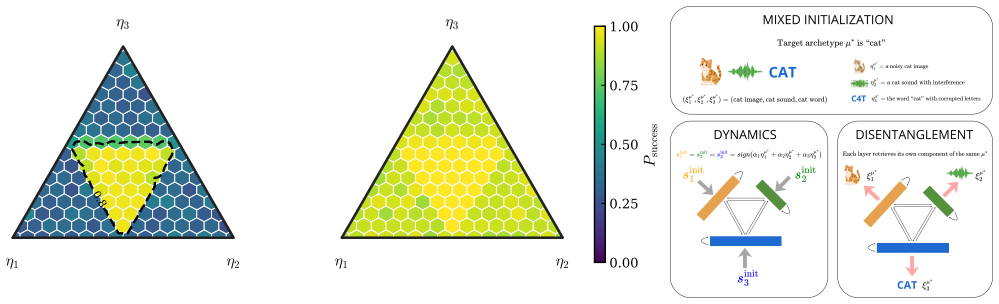
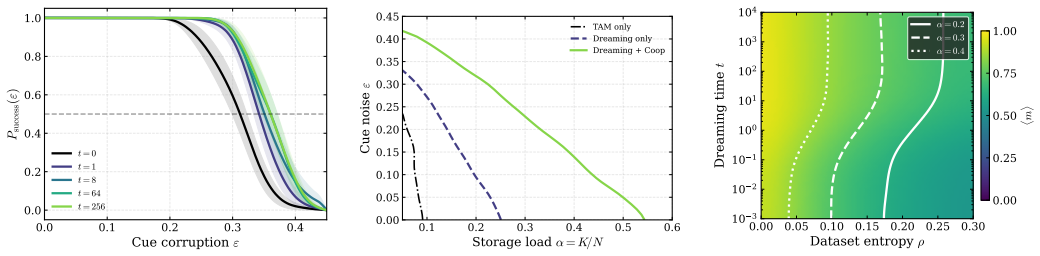
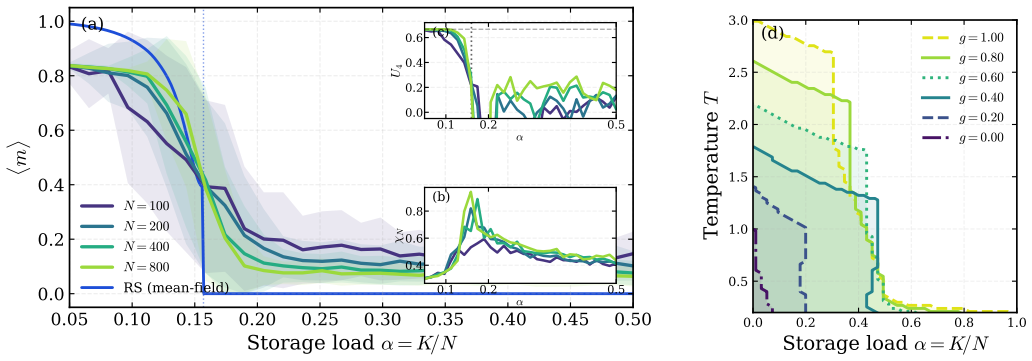
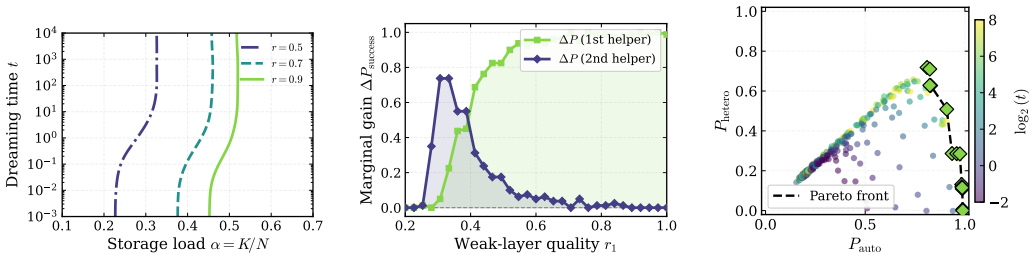
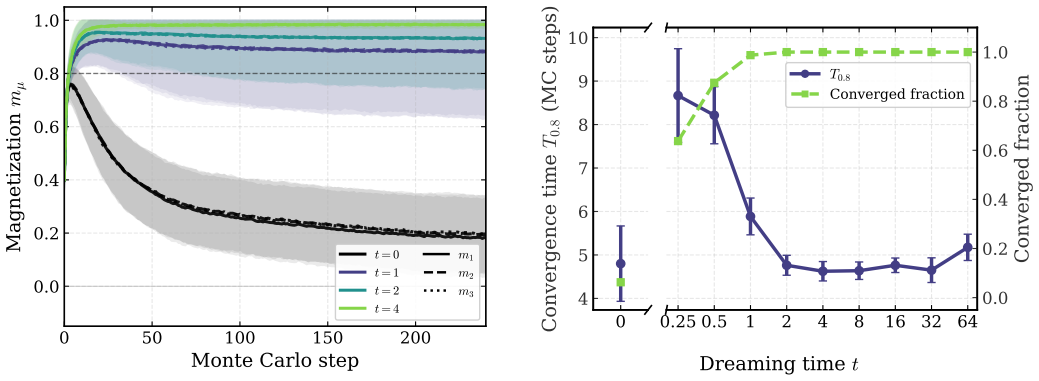
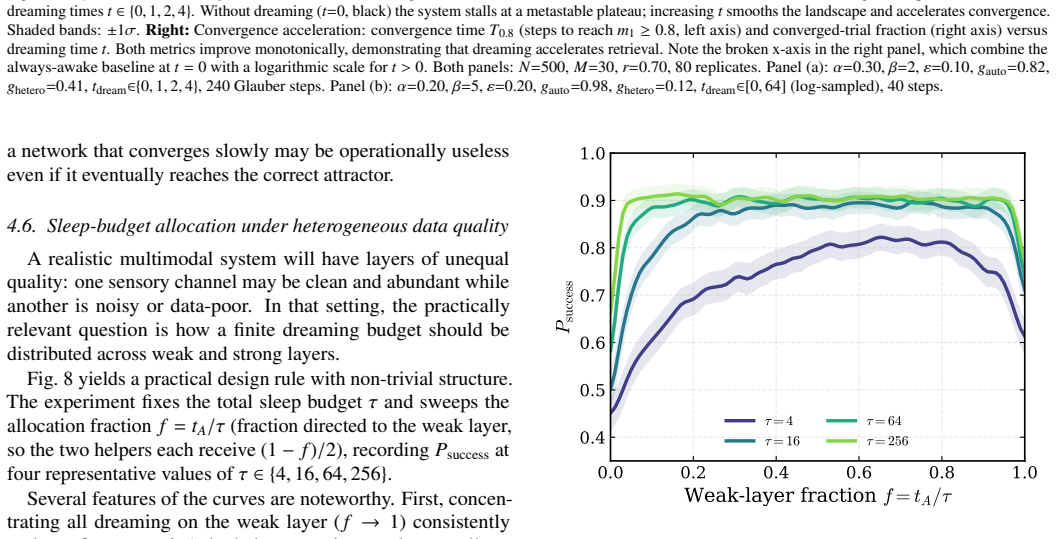
Dreaming improves retrieval by differentially attenuating high-eigenvalue interference modes of the empirical correlation matrix, suppressing inter-pattern crosstalk while preserving the signal. Dreaming and inter-layer coupling prove synergistic, opening retrieval regions unreachable by either mechanism alone, as confirmed by Monte Carlo simulations for L=3. Their interplay is most pronounced on pattern disentanglement: given a mixture state as input, the network splits the constituent patterns one-per-layer, recovering each modality-specific pattern from a common cue that simultaneously blends noisy evidence from all sensory channels.
What carries the argument
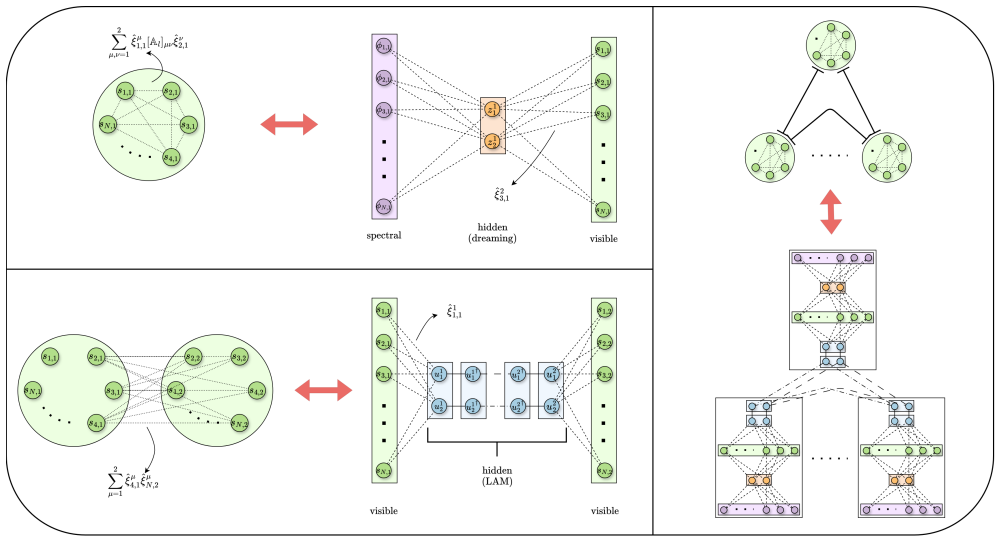
The DLAM energy function that unifies dreaming and supervised heteroassociativity, whose thermodynamics are captured by the replica-symmetric free energy obtained via Guerra interpolation, leading to self-consistency equations for the order parameters.
If this is right
- Dreaming and inter-layer coupling together access retrieval regions unavailable to either alone.
- The network can disentangle mixed patterns by recovering one pattern per layer from a blended cue.
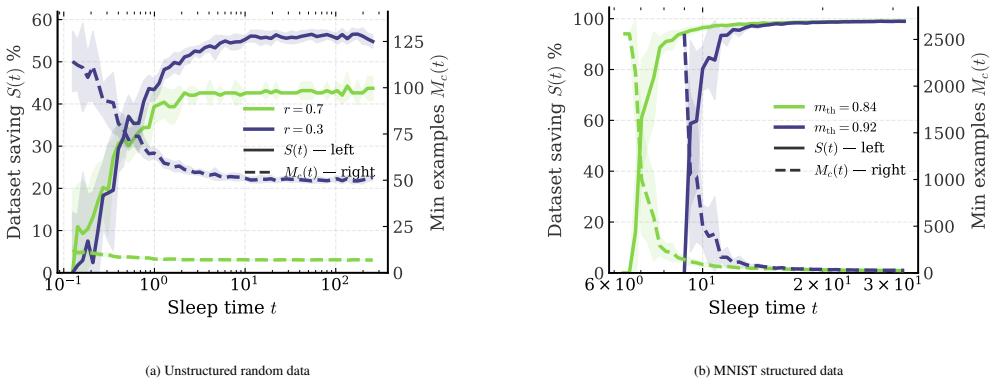
- Off-line dreaming substitutes for additional training data, extending the data-computation trade-off to heteroassociative cases.
- The enriched model supports complex tasks such as multi-modal pattern recovery beyond standard recognition.
Where Pith is reading between the lines
- The eigenvalue attenuation provides a mechanism that could be tested in other associative memory architectures.
- Extending the simulations to larger L or different network topologies would check the robustness of the synergy.
- The trade-off suggests dreaming could be a general way to augment limited datasets in energy-based models.
Load-bearing premise
The replica-symmetric free energy derived via Guerra interpolation accurately captures the thermodynamics of the proposed DLAM energy function across the full control-parameter space.
What would settle it
Monte Carlo simulations for L=3 that fail to reproduce the synergistic retrieval regions or the self-consistency equations for order parameters would falsify the thermodynamic predictions.
Figures
read the original abstract
We introduce the Dreaming $L$-directional Associative Memory (DLAM), a multi-layer Hebbian architecture in which off-line dreaming and supervised heteroassociative coupling coexist within a single energy function, placing our approach within the framework of energy-based models (EBMs). The replica-symmetric free energy, derived via the Guerra interpolation scheme, yields self-consistency equations governing the order parameters across the control-parameter space. The effective local field decomposes into signal, intra-layer dreaming noise, and inter-layer noise. Dreaming improves retrieval by differentially attenuating high-eigenvalue interference modes of the empirical correlation matrix, suppressing inter-pattern crosstalk while preserving the signal. Dreaming and inter-layer coupling prove synergistic, opening retrieval regions unreachable by either mechanism alone, as confirmed by Monte Carlo simulations for $L=3$. Their interplay is most pronounced on pattern disentanglement: given a mixture state as input, the network splits the constituent patterns one-per-layer, recovering each modality-specific pattern from a common cue that simultaneously blends noisy evidence from all sensory channels. Phase diagrams are planar projections of the hyperspace $(\alpha,\beta,\rho,t)$-where $\alpha$ is the storage load, $\beta$ the fast-noise inverse temperature, $\rho$ the dataset entropy, and $t$ the sleeping time. In the $(\rho,t)$-plane, the diagrams reveal a data-computation trade-off: off-line consolidation substitutes for additional training data, extending to heteroassociative architectures a phenomenon previously established for autoassociative networks. Enriching the standard Hopfield model with heteroassociativity and dreaming gives rise to EBMs capable of complex tasks beyond classical pattern recognition, contributing to a modern theory of neural information processing.
Editorial analysis
A structured set of objections, weighed in public.
Referee Report
Summary. The manuscript introduces the Dreaming L-directional Associative Memory (DLAM), a multi-layer Hebbian energy-based model combining off-line dreaming and supervised heteroassociative coupling. It derives the replica-symmetric free energy via Guerra interpolation, yielding self-consistency equations for the order parameters. The effective local field is decomposed into signal, intra-layer dreaming noise, and inter-layer noise terms. The central claims are that dreaming differentially attenuates high-eigenvalue interference modes of the empirical correlation matrix (suppressing crosstalk while preserving signal), that dreaming and inter-layer coupling are synergistic (opening new retrieval regions), and that a data-computation trade-off exists in the (ρ,t) plane, with Monte Carlo simulations for L=3 and phase diagrams in projections of the (α,β,ρ,t) hyperspace supporting the analysis.
Significance. If the replica-symmetric solution remains stable, the work supplies a statistical-mechanical theory for dreaming in multidirectional associative memories, extending autoassociative results to heteroassociative architectures and identifying synergy between dreaming and coupling. The Guerra-interpolation derivation of the free energy and the Monte Carlo confirmation for L=3 constitute clear technical strengths; the mode-attenuation and pattern-disentanglement claims, if robust, would advance the theory of energy-based models beyond classical pattern recognition.
major comments (1)
- [Derivation of the replica-symmetric free energy and self-consistency equations] The replica-symmetric free energy is obtained via Guerra interpolation and the resulting self-consistency equations are used to generate all phase diagrams and claims about mode attenuation and synergy. No replicon-eigenvalue computation or AT-line analysis is supplied to verify stability of the RS saddle point over the full (α,β,ρ,t) domain. In multi-layer associative-memory models the RS assumption is known to fail at moderate-to-high α or low β; without this check the thermodynamic interpretation of the order-parameter equations cannot be guaranteed outside the simulated L=3 regime.
minor comments (2)
- The abstract states that phase diagrams are planar projections of the four-dimensional control space; the manuscript should explicitly indicate which two-parameter slices are shown and how the remaining parameters are fixed.
- Notation for the dataset entropy ρ and sleeping time t is introduced in the abstract but should be restated with clear definitions at the first appearance in the main text.
Simulated Author's Rebuttal
We thank the referee for the careful reading and the important observation on replica-symmetric stability. We address the point directly below.
read point-by-point responses
-
Referee: The replica-symmetric free energy is obtained via Guerra interpolation and the resulting self-consistency equations are used to generate all phase diagrams and claims about mode attenuation and synergy. No replicon-eigenvalue computation or AT-line analysis is supplied to verify stability of the RS saddle point over the full (α,β,ρ,t) domain. In multi-layer associative-memory models the RS assumption is known to fail at moderate-to-high α or low β; without this check the thermodynamic interpretation of the order-parameter equations cannot be guaranteed outside the simulated L=3 regime.
Authors: We agree that a replicon-eigenvalue or AT-line analysis is absent from the manuscript and that its absence limits the guaranteed domain of the RS thermodynamic interpretation. The close quantitative agreement between the RS equations and Monte Carlo simulations for L=3 nevertheless provides empirical support for the RS ansatz inside the simulated regime. In revision we will add an explicit discussion of RS stability, referencing known stability boundaries from related multi-layer and heteroassociative models, and will delineate the (α,β) regions where the RS solution is expected to remain locally stable. This will make the scope of the thermodynamic claims precise without a full new eigenvalue computation. revision: partial
Circularity Check
No significant circularity; derivation self-contained via explicit Hamiltonian and standard Guerra interpolation
full rationale
The paper explicitly constructs the DLAM energy function as an EBM incorporating Hebbian weights, dreaming dynamics, and heteroassociative coupling. It then applies the Guerra interpolation scheme (a standard spin-glass technique) to derive the replica-symmetric free energy, from which the self-consistency equations for order parameters follow directly by saddle-point evaluation. These equations are generated from the defined model rather than fitted post hoc or reduced to prior self-citations. Monte Carlo simulations for L=3 supply independent numerical support outside the analytic derivation. No load-bearing step equates a prediction to its input by construction, and the central claims (mode attenuation, synergy) emerge from the resulting thermodynamics without tautological reduction.
Axiom & Free-Parameter Ledger
free parameters (2)
- storage load alpha
- sleeping time t
axioms (2)
- domain assumption Replica-symmetric ansatz holds for the free energy across the parameter space
- ad hoc to paper The proposed multi-layer energy function correctly encodes both dreaming and heteroassociative coupling
invented entities (1)
-
Dreaming L-directional Associative Memory (DLAM)
no independent evidence
Reference graph
Works this paper leans on
-
[1]
Journal of Statistical Mechanics: Theory and Experiment 2019, 083503
Dreaming neural networks: rigorous results. Journal of Statistical Mechanics: Theory and Experiment 2019, 083503. Agliari, E., Alessandrelli, A., Barra, A., Centonze, M.S., Ricci-Tersenghi, F., 2025a. Generalized hetero-associative neural networks. Journal of Statistical Mechanics: Theory and Experiment 2025, 013302. Agliari, E., Alessandrelli, A., Barra,...
-
[2]
Europhysics Letters 141, 11001
Supervised hebbian learning. Europhysics Letters 141, 11001. Alessandrelli, A., Barra, A., Ladiana, A., Lepre, A., Ricci-Tersenghi, F., 2025a. Beyond disorder: Unveiling cooperativeness in multidirectional associative memories.arXiv:2503.04454. preprint. Alessandrelli, A., Barra, A., Ladiana, A., Lepre, A., Ricci-Tersenghi, F., 2025b. Supervised and unsup...
-
[3]
Barker, G.R.I., Warburton, E.C.,
Vicreg: Variance-invariance-covariance regularization for self-supervised learning, in: ICLR 2022-International Conference on Learning Representations. Barker, G.R.I., Warburton, E.C.,
2022
-
[4]
Journal of Statistical Mechanics: Theory and Experiment 2024, 013302
Eigenvector dreaming. Journal of Statistical Mechanics: Theory and Experiment 2024, 013302. Crick, F., Mitchison, G.,
2024
-
[5]
doi:10.1523/jneurosci.0818-20.2021. Diekelmann, S., Born, J.,
-
[6]
Large Associative Memory Problem in Neurobiology and Ma- chine Learning
Large associative memory problem in neurobiology and machine learning, in: International Conference on Learning Representations (ICLR). URL:https://arxiv.org/abs/2008.06996. Marinari, E., Rossi, S., Zamponi, F.,
-
[7]
Hopfield Networks is All You Need
Hopfield networks is all you need.arXiv:2008.02217. preprint; presented at ICLR
work page internal anchor Pith review Pith/arXiv arXiv 2008
discussion (0)
Sign in with ORCID, Apple, or X to comment. Anyone can read and Pith papers without signing in.