Detecting vortex motion through spatially correlated nonequilibrium noise
Pith reviewed 2026-05-20 07:32 UTC · model grok-4.3
The pith
Covariance magnetometry distinguishes vortex motion from quasiparticle flow in superconductors through noise anisotropy
A machine-rendered reading of the paper's core claim, the machinery that carries it, and where it could break.
Core claim
Resistive transport near a superconducting phase can arise from the motion of normal-state quasiparticles or that of vortices. The conductivity alone does not distinguish between these mechanisms. We propose an unambiguous method for telling them apart, using the recently developed experimental tool of covariance magnetometry, which uses nitrogen-vacancy centers in diamond to probe real-time spatiotemporal correlations in magnetic noise. Our key insight is that, under an applied current, the underlying charge carriers leave a directional fingerprint in the spatially correlated magnetic noise above the sample: ordinary electric carriers drift parallel to the current, whereas vortices, owing,
What carries the argument
Covariance magnetometry with nitrogen-vacancy centers that captures the directional anisotropy in magnetic noise from drifting vortices versus carriers
If this is right
- The anisotropic signal from vortex drift is measurable in thin-film superconductors with existing technology
- This approach unambiguously identifies whether transport is vortex-driven or quasiparticle-driven
- It applies to regimes near the superconducting phase where both mechanisms may contribute to resistance
Where Pith is reading between the lines
- The technique could be adapted to detect motion of other quasiparticles or defects in condensed matter systems
- Future work might combine this with varying magnetic fields to study vortex dynamics in real time
- It suggests that noise correlation methods could probe nonequilibrium states in other materials beyond superconductors
Load-bearing premise
Vortices experience a Magnus force causing perpendicular drift to the current in the thin-film geometry, resulting in observable anisotropic noise correlations
What would settle it
An experiment measuring isotropic magnetic noise correlations or anisotropy parallel to the current in a current-carrying thin-film superconductor would falsify the ability to identify vortex motion this way
Figures

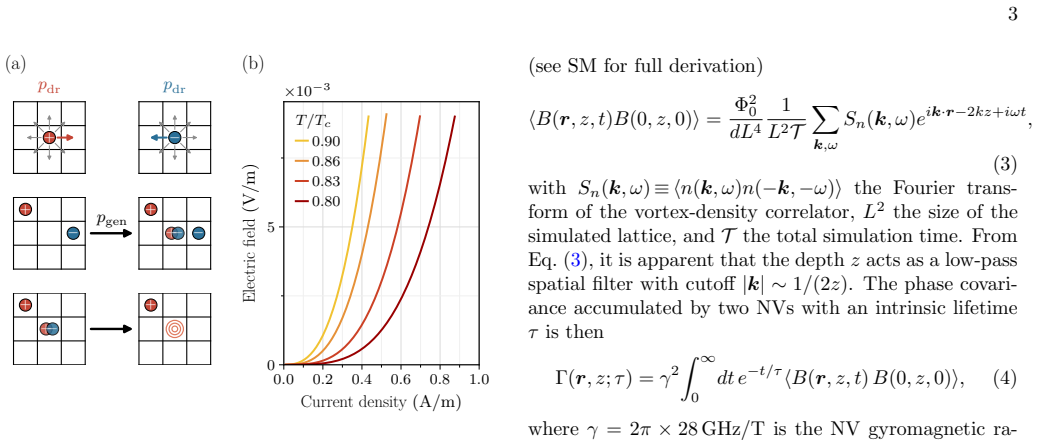

read the original abstract
Resistive transport near a superconducting phase can arise from the motion of normal-state quasiparticles or that of vortices. The conductivity alone does not distinguish between these mechanisms. We propose an unambiguous method for telling them apart, using the recently developed experimental tool of covariance magnetometry, which uses nitrogen-vacancy centers in diamond to probe real-time spatiotemporal correlations in magnetic noise. Our key insight is that, under an applied current, the underlying charge carriers leave a directional fingerprint in the spatially correlated magnetic noise above the sample: ordinary electric carriers drift parallel to the current, whereas vortices, owing to the Magnus force, drift perpendicular to it. The noise covariance detects this anisotropy and identifies the vortex-driven nature of transport. We compute the noise correlations expected for a representative thin-film superconductor and demonstrate that the anisotropic signal is well within the reach of current experimental capabilities.
Editorial analysis
A structured set of objections, weighed in public.
Referee Report
Summary. The manuscript proposes using covariance magnetometry with nitrogen-vacancy centers to distinguish vortex motion from quasiparticle transport in resistive superconducting states. The central idea is that applied current produces anisotropic magnetic noise correlations: quasiparticles drift parallel to the current while vortices, under the Magnus force, drift perpendicular to it. The noise covariance is argued to detect this anisotropy, and explicit computations for a representative thin-film superconductor are presented to show that the signal lies within current experimental reach.
Significance. If the central claim holds, the work supplies a new, directionally sensitive probe of the microscopic origin of dissipation near the superconducting transition that is independent of average conductivity. The explicit computation of expected noise correlations for a thin-film geometry is a concrete strength that makes the proposal falsifiable and directly testable with existing NV-center setups.
major comments (2)
- [Computation of noise correlations for representative thin film] The thin-film calculation of the stray-field noise covariance (described in the section presenting the representative-film results) must employ the screened Biot-Savart kernel appropriate to Pearl-length screening, λ_P = λ²/d. When the NV-to-sample distance or lateral correlation length is comparable to or exceeds λ_P, the far-field pattern of a moving vortex becomes more isotropic; this directly reduces the contrast between parallel and perpendicular drift directions and therefore undermines the quantitative claim that the anisotropic signal is “well within the reach of current experimental capabilities.”
- [Key insight and drift-direction argument] The assumption that vortex velocity is strictly perpendicular to the applied current (invoked in the key-insight paragraph and used to generate the perpendicular-drift noise map) requires explicit justification in the thin-film geometry. Any finite longitudinal component arising from pinning, Hall angle, or edge effects would alter the predicted anisotropy; the manuscript should quantify the robustness of the covariance signature to small deviations from pure perpendicular drift.
minor comments (2)
- [Abstract and representative-film computation] The abstract and methods section should list the numerical values adopted for film thickness d, London depth λ, Pearl length, and NV standoff distance so that the detectability claim can be reproduced.
- [Notation and figures] Notation for the noise covariance tensor C_{ij}(r,τ) and the magnetic-field components should be defined once and used consistently; several figures would benefit from explicit axis labels indicating current direction versus vortex-drift direction.
Simulated Author's Rebuttal
We thank the referee for the detailed and constructive report. The comments highlight important technical aspects of the thin-film calculation and the vortex-drift assumption that will improve the manuscript's rigor and clarity. We address each major comment below and will revise the manuscript accordingly.
read point-by-point responses
-
Referee: The thin-film calculation of the stray-field noise covariance (described in the section presenting the representative-film results) must employ the screened Biot-Savart kernel appropriate to Pearl-length screening, λ_P = λ²/d. When the NV-to-sample distance or lateral correlation length is comparable to or exceeds λ_P, the far-field pattern of a moving vortex becomes more isotropic; this directly reduces the contrast between parallel and perpendicular drift directions and therefore undermines the quantitative claim that the anisotropic signal is “well within the reach of current experimental capabilities.”
Authors: We appreciate the referee's identification of the appropriate kernel for the thin-film geometry. Our original representative-film computation used an unscreened Biot-Savart approximation for computational simplicity. We will revise this section to implement the screened kernel with λ_P = λ²/d. Updated calculations will be presented showing that, although the far-field isotropy increases for NV distances or correlation lengths approaching λ_P, the residual directional contrast in the noise covariance remains detectable above typical experimental noise floors for realistic thin-film parameters (e.g., d ≈ 10 nm, λ ≈ 100 nm). This will be illustrated in a revised figure with error bars corresponding to current NV sensitivities, preserving the claim of experimental accessibility while making the quantitative estimates more accurate. revision: yes
-
Referee: The assumption that vortex velocity is strictly perpendicular to the applied current (invoked in the key-insight paragraph and used to generate the perpendicular-drift noise map) requires explicit justification in the thin-film geometry. Any finite longitudinal component arising from pinning, Hall angle, or edge effects would alter the predicted anisotropy; the manuscript should quantify the robustness of the covariance signature to small deviations from pure perpendicular drift.
Authors: We agree that the perpendicular-drift assumption merits explicit justification and robustness analysis. In the revised manuscript we will expand the key-insight paragraph to include a brief derivation based on the Magnus force in the London limit for thin films, supported by citations to established vortex-dynamics literature. We will also add a new subsection quantifying robustness: the covariance maps will be recomputed for longitudinal velocity components ranging from 0 to 25% of the perpendicular component (modeling weak pinning or small Hall angles). The results show that the anisotropy signature in the noise covariance remains distinguishable from the quasiparticle (parallel-drift) case for deviations below approximately 15%, with only modest reduction in contrast. This analysis will be presented as an additional figure and will clarify the regime of validity for the proposed method. revision: yes
Circularity Check
No significant circularity; derivation rests on standard Magnus-force anisotropy and explicit noise-correlation computation.
full rationale
The paper's central proposal—that spatially correlated magnetic noise covariance can distinguish vortex motion (perpendicular to current via Magnus force) from quasiparticle drift (parallel)—is grounded in established thin-film superconductivity and magnetometry principles rather than any self-definitional loop, fitted parameter renamed as prediction, or load-bearing self-citation. The computation of expected noise correlations for a representative film is presented as a forward calculation demonstrating experimental accessibility, without reducing the anisotropy signal to an input by construction or smuggling an ansatz via prior work. No equations or steps in the derivation chain collapse to tautology or external self-reference; the claim remains independently falsifiable via NV-center measurements.
Axiom & Free-Parameter Ledger
axioms (1)
- domain assumption Vortices experience a Magnus force causing perpendicular drift relative to applied current in thin-film geometry.
Lean theorems connected to this paper
-
IndisputableMonolith/Foundation/RealityFromDistinctionreality_from_one_distinction unclear?
unclearRelation between the paper passage and the cited Recognition theorem.
The noise covariance detects this anisotropy... vortices... drift perpendicular to it.
What do these tags mean?
- matches
- The paper's claim is directly supported by a theorem in the formal canon.
- supports
- The theorem supports part of the paper's argument, but the paper may add assumptions or extra steps.
- extends
- The paper goes beyond the formal theorem; the theorem is a base layer rather than the whole result.
- uses
- The paper appears to rely on the theorem as machinery.
- contradicts
- The paper's claim conflicts with a theorem or certificate in the canon.
- unclear
- Pith found a possible connection, but the passage is too broad, indirect, or ambiguous to say the theorem truly supports the claim.
Reference graph
Works this paper leans on
-
[1]
Nozi` eres,Theory of interacting Fermi systems(CRC Press, 2018)
P. Nozi` eres,Theory of interacting Fermi systems(CRC Press, 2018)
work page 2018
-
[2]
A. Kapitulnik, S. A. Kivelson, and B. Spivak, Collo- quium: Anomalous metals: Failed superconductors, Rev. Mod. Phys.91, 011002 (2019)
work page 2019
-
[3]
S. Sachdev, The foot, the fan, and the cuprate phase diagram: Fermi-volume-changing quantum phase transi- tions, Physica C: Supercond. Appl.633, 1354707 (2025)
work page 2025
-
[4]
S. Sachdev and M. M¨ uller, Quantum criticality and black holes, J. Phys.: Condens. Matter21, 164216 (2009)
work page 2009
-
[5]
L. Chen, D. T. Lowder, E. Bakali, A. M. An- drews, W. Schrenk, M. Waas, R. Svagera, G. Eguchi, L. Prochaska, Y. Wang, C. Setty, S. Sur, Q. Si, S. Paschen, and D. Natelson, Shot noise in a strange metal, Science382, 907 (2023)
work page 2023
- [6]
-
[7]
J. Wang, Z. Tagay, L. Shi, J. Liang, N. K. Duong, Y. Wu, P. M. T. Vianez, F. Ronning, D. G. Rickel, D. G. Schlom, K. M. Shen, S. A. Crooker, and N. P. Armitage, Reconcil- ing strange metal transport in CeCoIn 5 through the dif- ference of optical and cyclotron effective masses, (2026), arXiv:2603.23740 [cond-mat.str-el]
-
[8]
Y. Wang, C. Setty, S. Sur, L. Chen, S. Paschen, D. Na- telson, and Q. Si, Shot noise and universal Fano factor as a characterization of strongly correlated metals, Phys. Rev. Res.6, L042045 (2024)
work page 2024
-
[9]
A. Nikolaenko, S. Sachdev, and A. A. Patel, Theory of shot noise in strange metals, Phys. Rev. Res.5, 043143 (2023)
work page 2023
-
[10]
T. C. Wu and M. S. Foster, Suppression of shot noise in a dirty marginal Fermi liquid, Phys. Rev. B110, L081102 (2024)
work page 2024
-
[11]
A. G. Green, J. E. Moore, S. L. Sondhi, and A. Vish- wanath, Current noise in the vicinity of the 2D superconductor-insulator quantum critical point, Phys. Rev. Lett.97, 227003 (2006)
work page 2006
-
[12]
S. Gopalakrishnan, E. McCulloch, and R. Vasseur, Non- Gaussian diffusive fluctuations in Dirac fluids, Proc. Natl. Acad. Sci. U.S.A.121, e2403327121 (2024)
work page 2024
- [13]
- [14]
- [15]
-
[16]
X. H. Le, P. E. Dolgirev, P. Put, E. L. Peterson, A. Pil- lai, A. A. Zibrov, E. Demler, H. Park, and M. D. Lukin, Wideband covariance magnetometry below the diffrac- tion limit, Phys. Rev. Lett.135, 170803 (2025)
work page 2025
-
[17]
H. Hosseinabadi, P. E. Dolgirev, S. Gopalakrishnan, A. Yacoby, E. Demler, and J. Marino, Theory of Two- QubitT 2 Spectroscopy of Quantum Many-Body Systems, (2026), arXiv:2603.18176 [quant-ph]
-
[18]
P. Phillips and D. Dalidovich, The Elusive Bose Metal, Science302, 243 (2003)
work page 2003
-
[19]
C. Yang, H. Liu, Y. Liu, J. Wang, D. Qiu, S. Wang, Y. Wang, Q. He, X. Li, P. Li, Y. Tang, J. Wang, X. C. Xie, J. M. Valles, J. Xiong, and Y. Li, Signatures of a strange metal in a bosonic system, Nature601, 205 (2022)
work page 2022
-
[20]
Y. Wang, L. Li, and N. P. Ong, Nernst effect in high-T c superconductors, Phys. Rev. B73, 024510 (2006)
work page 2006
-
[21]
V. L. Berezinski˘ ı, Destruction of Long-range Order in One-dimensional and Two-dimensional Systems Possess- ing a Continuous Symmetry Group. II. Quantum Sys- tems, Sov. Phys. JETP34, 610 (1972)
work page 1972
-
[22]
J. M. Kosterlitz and D. J. Thouless, Ordering, metasta- bility and phase transitions in two-dimensional systems, J. Phys. C: Solid State Phys.6, 1181 (1973)
work page 1973
-
[23]
J. M. Kosterlitz, The critical properties of the two- dimensionalxymodel, J. Phys. C: Solid State Phys.7, 1046 (1974)
work page 1974
-
[24]
B. I. Halperin and D. R. Nelson, Resistive transition in superconducting films, J. Low Temp. Phys.36, 599 (1979)
work page 1979
-
[25]
V. Ambegaokar, B. I. Halperin, D. R. Nelson, and E. D. Siggia, Dynamics of superfluid films, Phys. Rev. B21, 1806 (1980)
work page 1980
-
[26]
M. R. Beasley, J. E. Mooij, and T. P. Orlando, Possibility of vortex-antivortex pair dissociation in two-dimensional superconductors, Phys. Rev. Lett.42, 1165 (1979)
work page 1979
-
[27]
P. Minnhagen, The two-dimensional Coulomb gas, vortex unbinding, and superfluid-superconducting films, Rev. Mod. Phys.59, 1001 (1987)
work page 1987
-
[28]
A. F. Hebard and A. T. Fiory, Evidence for the Kosterlitz-Thouless transition in thin superconducting aluminum films, Phys. Rev. Lett.44, 291 (1980)
work page 1980
-
[29]
A. T. Fiory, A. F. Hebard, and W. I. Glaberson, Su- perconducting phase transitions in indium/indium-oxide thin-film composites, Phys. Rev. B28, 5075 (1983)
work page 1983
- [30]
-
[31]
M. M. Ugeda, A. J. Bradley, Y. Zhang, S. Onishi, Y. Chen, W. Ruan, C. Ojeda-Aristizabal, H. Ryu, M. T. Edmonds, H.-Z. Tsai, A. Riss, S.-K. Mo, D. Lee, A. Zettl, Z. Hussain, Z.-X. Shen, and M. F. Crommie, Character- ization of collective ground states in single-layer NbSe 2, Nat. Phys.12, 92 (2016)
work page 2016
- [32]
- [33]
-
[34]
J. F. Barry, J. M. Schloss, E. Bauch, M. J. Turner, C. A. Hart, L. M. Pham, and R. L. Walsworth, Sensitivity op- 6 timization for NV-diamond magnetometry, Rev. Mod. Phys.92, 015004 (2020)
work page 2020
-
[35]
C. L. Degen, F. Reinhard, and P. Cappellaro, Quantum sensing, Rev. Mod. Phys.89, 035002 (2017)
work page 2017
-
[36]
M. Pelliccione, A. Jenkins, P. Ovartchaiyapong, C. Reetz, E. Emmanouilidou, N. Ni, and A. C. Bleszynski Jayich, Scanned probe imaging of nanoscale magnetism at cryo- genic temperatures with a single-spin quantum sensor, Nat. Nanotechnol.11, 700 (2016)
work page 2016
-
[37]
T. I. Andersen, B. L. Dwyer, J. D. Sanchez-Yamagishi, J. F. Rodriguez-Nieva, K. Agarwal, K. Watanabe, T. Taniguchi, E. A. Demler, P. Kim, H. Park, and M. D. Lukin, Electron-phonon instability in graphene revealed by global and local noise probes, Science364, 154 (2019)
work page 2019
-
[38]
M. J. H. Ku, T. X. Zhou, Q. Li, Y. J. Shin, J. K. Shi, C. Burch, L. E. Anderson, A. T. Pierce, Y. Xie, A. Hamo, U. Vool, H. Zhang, F. Casola, T. Taniguchi, K. Watanabe, M. M. Fogler, P. Kim, A. Yacoby, and R. L. Walsworth, Imaging viscous flow of the Dirac fluid in graphene, Nature583, 537 (2020)
work page 2020
-
[39]
U. Vool, A. Hamo, G. Varnavides, Y. Wang, T. X. Zhou, N. Kumar, Y. Dovzhenko, Z. Qiu, C. A. C. Garcia, A. T. Pierce, J. Gooth, P. Anikeeva, C. Felser, P. Narang, and A. Yacoby, Imaging phonon-mediated hydrodynamic flow in WTe2, Nat. Phys.17, 1216 (2021)
work page 2021
-
[40]
A. Jenkins, S. Baumann, H. Zhou, S. A. Meynell, Y. Daipeng, K. Watanabe, T. Taniguchi, A. Lucas, A. F. Young, and A. C. Bleszynski Jayich, Imaging the break- down of Ohmic transport in graphene, Phys. Rev. Lett. 129, 087701 (2022)
work page 2022
-
[41]
A. Ariyaratne, D. Bluvstein, B. A. Myers, and A. C. Bleszynski Jayich, Nanoscale electrical conductivity imaging using a nitrogen-vacancy center in diamond, Nat. Commun.9, 2406 (2018)
work page 2018
-
[42]
S. Kolkowitz, A. Safira, A. A. High, R. C. Devlin, S. Choi, Q. P. Unterreithmeier, D. Patterson, A. S. Zibrov, V. E. Manucharyan, H. Park, and M. D. Lukin, Probing John- son noise and ballistic transport in normal metals with a single-spin qubit, Science347, 1129 (2015)
work page 2015
-
[43]
E. Lee-Wong, R. Xue, F. Ye, A. Kreisel, T. van der Sar, A. Yacoby, and C. R. Du, Nanoscale detection of magnon excitations with variable wavevectors through a quantum spin sensor, Nano Lett.20, 3284 (2020)
work page 2020
-
[44]
T. X. Zhou, J. J. Carmiggelt, L. M. G¨ achter, I. Es- terlis, D. Sels, R. J. St¨ ohr, C. Du, D. Fernandez, J. F. Rodriguez-Nieva, F. B¨ uttner, E. Demler, and A. Yacoby, A magnon scattering platform, Proc. Natl. Acad. Sci. U.S.A.118, e2019473118 (2021)
work page 2021
-
[45]
K. Agarwal, R. Schmidt, B. Halperin, V. Oganesyan, G. Zar´ and, M. D. Lukin, and E. Demler, Magnetic noise spectroscopy as a probe of local electronic correlations in two-dimensional systems, Phys. Rev. B95, 155107 (2017)
work page 2017
-
[46]
J. F. Rodriguez-Nieva, K. Agarwal, T. Giamarchi, B. I. Halperin, M. D. Lukin, and E. Demler, Probing one- dimensional systems via noise magnetometry with single spin qubits, Phys. Rev. B98, 195433 (2018)
work page 2018
-
[47]
F. Machado, E. A. Demler, N. Y. Yao, and S. Chatterjee, Quantum noise spectroscopy of dynamical critical phe- nomena, Phys. Rev. Lett.131, 070801 (2023)
work page 2023
-
[48]
S. Chatterjee, J. F. Rodriguez-Nieva, and E. Demler, Di- agnosing phases of magnetic insulators via noise mag- netometry with spin qubits, Phys. Rev. B99, 104425 (2019)
work page 2019
-
[49]
P. E. Dolgirev, S. Chatterjee, I. Esterlis, A. A. Zibrov, M. D. Lukin, N. Y. Yao, and E. Demler, Characterizing two-dimensional superconductivity via nanoscale noise magnetometry with single-spin qubits, Phys. Rev. B105, 024507 (2022)
work page 2022
-
[50]
J. B. Curtis, N. Maksimovic, N. R. Poniatowski, A. Ya- coby, B. Halperin, P. Narang, and E. Demler, Probing the Berezinskii-Kosterlitz-Thouless vortex unbinding transi- tion in two-dimensional superconductors using local noise magnetometry, Phys. Rev. B110, 144518 (2024)
work page 2024
-
[51]
Pearl, Current distribution in superconducting films carrying quantized fluxoids, Appl
J. Pearl, Current distribution in superconducting films carrying quantized fluxoids, Appl. Phys. Lett.5, 65 (1964)
work page 1964
-
[52]
See Supplemental Material for detailed derivations of the BKT renormalization-group flow, the Fokker–Planck saddle-point analysis of the vortex generation rate, the SEP calibration, and the computation of the vortex cor- relator
-
[53]
J. Bardeen and M. J. Stephen, Theory of the motion of vortices in superconductors, Phys. Rev.140, A1197 (1965)
work page 1965
-
[54]
Tinkham,Introduction to Superconductivity, 2nd ed
M. Tinkham,Introduction to Superconductivity, 2nd ed. (Dover, 2004)
work page 2004
-
[55]
D. Bluvstein, Z. Zhang, C. A. McLellan, N. R. Williams, and A. C. Bleszynski Jayich, Extending the quantum co- herence of a near-surface qubit by coherently driving the paramagnetic surface environment, Phys. Rev. Lett.123, 146804 (2019)
work page 2019
-
[56]
S. Sangtawesin, B. L. Dwyer, S. Srinivasan, J. J. Allred, L. V. P. Rodgers, K. de Greve, A. Stacey, N. Dontschuk, K. M. O’Donnell, D. Hu, D. A. Evans, C. Jaye, D. A. Fis- cher, M. L. Markham, D. J. Twitchen, H. Park, M. D. Lukin, and N. P. de Leon, Origins of diamond surface noise probed by correlating single-spin measurements with surface spectroscopy, P...
work page 2019
-
[57]
S. M¨ uhlbauer, B. Binz, F. Jonietz, C. Pfleiderer, A. Rosch, A. Neubauer, R. Georgii, and P. B¨ oni, Skyrmion lattice in a chiral magnet, Science323, 915 (2009)
work page 2009
-
[58]
X. Z. Yu, Y. Onose, N. Kanazawa, J. H. Park, J. H. Han, Y. Matsui, N. Nagaosa, and Y. Tokura, Real-space ob- servation of a two-dimensional skyrmion crystal, Nature 465, 901 (2010)
work page 2010
-
[59]
N. Nagaosa and Y. Tokura, Topological properties and dynamics of magnetic skyrmions, Nat. Nanotechnol.8, 899 (2013)
work page 2013
- [60]
-
[61]
X. Z. Yu, W. Koshibae, Y. Tokunaga, K. Shibata, Y. Taguchi, N. Nagaosa, and Y. Tokura, Transformation between meron and skyrmion topological spin textures in a chiral magnet, Nature564, 95 (2018)
work page 2018
-
[62]
D. Wei, A. Rubio-Abadal, B. Ye, F. Machado, J. Kemp, K. Srakaew, S. Hollerith, J. Rui, S. Gopalakrishnan, N. Y. Yao, I. Bloch, and J. Zeiher, Quantum gas mi- croscopy of Kardar-Parisi-Zhang superdiffusion, Science 376, 716 (2022)
work page 2022
-
[63]
E. Rosenberg, T. I. Andersen, R. Samajdar, A. Petukhov, J. C. Hoke, D. Abanin, A. Bengtsson, I. K. Drozdov, C. Erickson, P. V. Klimov,et al., Dynamics of magneti- zation at infinite temperature in a Heisenberg spin chain, 7 Science384, 48 (2024)
work page 2024
-
[64]
J. F. Wienand, S. Karch, A. Impertro, C. Schweizer, E. McCulloch, R. Vasseur, S. Gopalakrishnan, M. Aidels- burger, and I. Bloch, Emergence of fluctuating hydrody- namics in chaotic quantum systems, Nat. Phys.20, 1732 (2024)
work page 2024
-
[65]
E. McCulloch, J. De Nardis, S. Gopalakrishnan, and R. Vasseur, Full counting statistics of charge in chaotic many-body quantum systems, Phys. Rev. Lett.131, 210402 (2023)
work page 2023
-
[66]
R. Samajdar, E. McCulloch, V. Khemani, R. Vasseur, and S. Gopalakrishnan, Quantum turnstiles for robust measurement of full counting statistics, Phys. Rev. Lett. 133, 240403 (2024)
work page 2024
-
[67]
ˇZ. Krajnik, E. Ilievski, and T. Prosen, Absence of normal fluctuations in an integrable magnet, Phys. Rev. Lett. 128, 090604 (2022)
work page 2022
-
[68]
S. Gopalakrishnan, A. Morningstar, R. Vasseur, and V. Khemani, Distinct universality classes of diffusive transport from full counting statistics, Phys. Rev. B109, 024417 (2024)
work page 2024
-
[69]
ˇZ. Krajnik, J. Schmidt, V. Pasquier, E. Ilievski, and T. Prosen, Exact anomalous current fluctuations in a deterministic interacting model, Phys. Rev. Lett.128, 160601 (2022)
work page 2022
-
[70]
M. C. Cambria, S. Chand, C. M. Reiter, and S. Kolkowitz, Scalable parallel measurement of individ- ual nitrogen-vacancy centers, Phys. Rev. X15, 031015 (2025)
work page 2025
-
[71]
K.-H. Cheng, Z. Kazi, J. Rovny, B. Zhang, L. S. Nassar, J. D. Thompson, and N. P. de Leon, Massively multi- plexed nanoscale magnetometry with diamond quantum sensors, Phys. Rev. X15, 031014 (2025). Supplemental Material: Detecting vortex motion through spatially correlated nonequilibrium noise Yifan F. Zhang, 1 Rhine Samajdar, 1, 2 and Sarang Gopalakrish...
work page 2025
-
[72]
J. M. Kosterlitz, The critical properties of the two-dimensional xy model, J. Phys. C: Solid State Phys. 7, 1046 (1974)
work page 1974
-
[73]
V. Ambegaokar, B. I. Halperin, D. R. Nelson, and E. D. Siggia, Dynamics of superfluid films, Phys. Rev. B 21, 1806 (1980)
work page 1980
discussion (0)
Sign in with ORCID, Apple, or X to comment. Anyone can read and Pith papers without signing in.