Sky-Plane Velocity Distributions of Interstellar Objects and Implications for Their Detection
Pith reviewed 2026-06-28 03:56 UTC · model grok-4.3
The pith
Interstellar objects can move across the sky faster than surveys link, suggesting many dim ones remain undetected.
A machine-rendered reading of the paper's core claim, the machinery that carries it, and where it could break.
Core claim
The sky motions of the three known interstellar objects are typical for populations of similar absolute magnitude; brighter objects and active comets reach observable magnitudes at lower speeds than dimmer ones; and the velocity distributions possess tails extending to speeds faster than the discovery motion of 1I, indicating that detection and linking challenges may leave additional interstellar objects unobserved.
What carries the argument
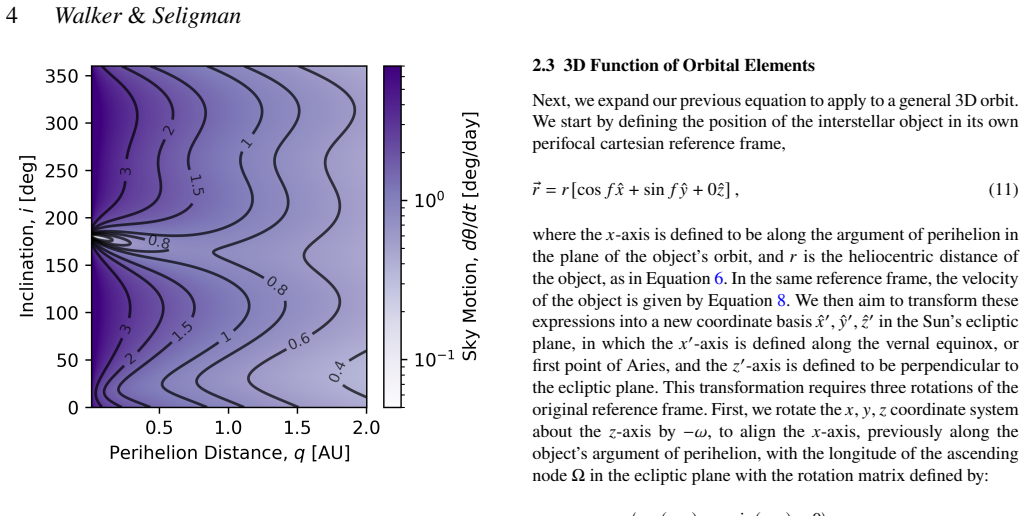
Analytic solution for the apparent sky motion of an arbitrary orbit observed at an arbitrary location, applied to evaluate sky motions within three synthetic populations of interstellar objects.
If this is right
- The sky motions of the three known interstellar objects fall within the characteristic range for populations of comparable absolute magnitude.
- Intrinsically brighter objects reach detection magnitude thresholds at lower speeds than dimmer objects.
- Active comets reach detection thresholds at lower speeds than asteroids for the same apparent magnitude.
- The velocity distributions possess tails that extend to speeds faster than the discovery motion of 1I.
Where Pith is reading between the lines
- Survey linking algorithms tuned only to slower motions would systematically miss the high-velocity tail of the interstellar-object population.
- Revised population estimates that incorporate the missed fast movers would be higher than current counts based on detected objects alone.
- The same analytic motion formula could be reused to assess detection biases for other classes of fast-moving solar-system bodies.
- Improved cadence or software for high-speed object linking would constitute a direct test of whether the undetected fraction is large.
Load-bearing premise
The three synthetic populations of approximately 10^5 interstellar objects placed within heliocentric spheres of 1.2, 3.0, and 5.0 AU radii together with the assumed absolute-magnitude distributions for asteroids and comets are representative of the true underlying population.
What would settle it
A dedicated search either detects or fails to detect interstellar objects with sky-plane speeds substantially higher than the tails of the computed distributions at the rates those tails predict.
Figures



read the original abstract
In the past decade, three macroscopic-scale interstellar objects have been discovered, implying that a larger galactic population exists. In this paper, we investigate the possibility that the rapid sky-plane velocities of interstellar objects may preclude their discovery. We provide an analytic solution for the apparent sky motion of an object on an arbitrary orbit observed at an arbitrary location which (i) is more efficient and (ii) requires less overhead than the numerical approach. This formula is applied to evaluate the typical sky motion of an interstellar object as a function of its orbit and limiting magnitude/distance. We generate three synthetic populations of $\sim10^5$ interstellar objects within heliocentric spheres of radii 1.2, 3.0, and 5.0 AU, and calculate the sky motion for these objects when they reach a range of limiting magnitudes for multiple populations of interstellar asteroids and comets. The sky motions of the three known interstellar objects are broadly characteristic of populations with similar absolute magnitudes. Moreover, the intrinsically brighter objects reach detection magnitude thresholds at lower speeds than the dim objects, and active comets at even lower speeds for the same apparent magnitudes. The tails of these distributions extend to speeds faster than the discovery motion of 1I. Therefore, the difficulties associated with linking rapidly moving interstellar objects, especially those with intrinsically dim properties, could imply that more exist undetected traversing the Solar System.
Editorial analysis
A structured set of objections, weighed in public.
Referee Report
Summary. The paper derives an analytic expression for the sky-plane angular velocity of an object on an arbitrary orbit viewed from an arbitrary location, then applies it to three synthetic populations of ~10^5 interstellar objects placed inside heliocentric spheres of radii 1.2, 3.0 and 5.0 AU. Using assumed absolute-magnitude distributions for interstellar asteroids and comets, it computes sky-motion distributions at various limiting magnitudes and concludes that the high-velocity tails exceed the discovery motion of 1I, implying that many (especially faint) ISOs remain undetected because of rapid apparent motion.
Significance. If the synthetic populations are representative, the work supplies a quantitative framework for assessing ISO detection biases and motivates targeted search strategies for high proper-motion objects. The provision of a closed-form sky-motion formula rather than a purely numerical approach is a clear methodological strength that reduces computational overhead for population studies.
major comments (2)
- [synthetic population generation (abstract and methods)] The central implication that high-speed tails imply many undetected ISOs rests on the representativeness of the three ~10^5-object populations placed inside fixed heliocentric spheres together with the adopted absolute-magnitude distributions. The manuscript provides no explicit description of how galactic velocity vectors, impact parameters, or hyperbolic excess speeds are sampled; if these differ from the true encounter distribution, the tails (and therefore the detection-bias conclusion) can shift without altering the analytic formula itself.
- [results and discussion of sky-motion distributions] No quantitative validation, error analysis, or direct comparison of the computed sky-motion distributions against the three known ISOs (beyond the qualitative statement that they are “broadly characteristic”) is presented. This leaves the strength of the claim that the tails extend beyond 1I’s discovery motion dependent on untested assumptions about the underlying orbital and magnitude distributions.
minor comments (2)
- [abstract] The abstract would benefit from a brief quantitative statement (e.g., fraction or percentile) of objects exceeding the sky motion of 1I at each limiting magnitude.
- [analytic derivation] Notation for the analytic sky-motion formula should be defined once in a dedicated subsection before its application to the populations.
Simulated Author's Rebuttal
We thank the referee for their constructive review and for highlighting the utility of the analytic sky-motion formula. We address the two major comments point by point below, indicating where revisions will be made to improve clarity and strengthen the supporting evidence.
read point-by-point responses
-
Referee: The central implication that high-speed tails imply many undetected ISOs rests on the representativeness of the three ~10^5-object populations placed inside fixed heliocentric spheres together with the adopted absolute-magnitude distributions. The manuscript provides no explicit description of how galactic velocity vectors, impact parameters, or hyperbolic excess speeds are sampled; if these differ from the true encounter distribution, the tails (and therefore the detection-bias conclusion) can shift without altering the analytic formula itself.
Authors: We agree that the sampling procedure requires explicit documentation. In the revised manuscript we will expand the methods section to detail the sampling of galactic velocity vectors (drawn from a Maxwellian distribution consistent with local stellar kinematics), impact parameters (uniform within the heliocentric sphere), and hyperbolic excess speeds (drawn from a distribution informed by prior ISO encounter models). These choices will be justified with references to the literature. The analytic formula remains independent of the specific population model, but the added description will allow readers to evaluate how changes in the encounter distribution would affect the high-velocity tails. revision: yes
-
Referee: No quantitative validation, error analysis, or direct comparison of the computed sky-motion distributions against the three known ISOs (beyond the qualitative statement that they are “broadly characteristic”) is presented. This leaves the strength of the claim that the tails extend beyond 1I’s discovery motion dependent on untested assumptions about the underlying orbital and magnitude distributions.
Authors: We acknowledge the absence of quantitative validation. In revision we will add a new figure and accompanying text that directly compares the sky-motion distributions for synthetic objects with absolute magnitudes matching those of the three known ISOs against their reported discovery motions, including median and percentile statistics. We will also include a brief sensitivity analysis showing how the high-velocity tail changes with modest variations in the adopted magnitude distributions. A full statistical error analysis is limited by the small number of known objects, but the added quantitative metrics will better support the claim that the tails exceed 1I’s motion. revision: partial
Circularity Check
Analytic sky-motion formula is independent of synthetic population inputs
full rationale
The paper derives an analytic expression for sky-plane motion of an arbitrary orbit observed at an arbitrary location from first principles; this formula is then applied to three synthetic populations of ~10^5 objects placed in fixed heliocentric spheres together with separately assumed absolute-magnitude distributions. No equation reduces to a self-definition, no fitted parameter is relabeled as a prediction, and no load-bearing premise rests on a self-citation chain. The central claim about high-speed tails follows directly from applying the independent formula to the external synthetic inputs, making the derivation self-contained.
Axiom & Free-Parameter Ledger
Reference graph
Works this paper leans on
-
[1]
MPEC , year = 2025, month = jul, number =
3I/ATLAS = C/2025 N1 (ATLAS). MPEC , year = 2025, month = jul, number =
2025
-
[2]
Discovery and Preliminary Characterization of a Third Interstellar Object: 3I/ATLAS. , keywords =. doi:10.3847/2041-8213/adf49a , archivePrefix =. 2507.02757 , primaryClass =
-
[3]
Central Bureau Electronic Telegrams , year = 2017, month = oct, volume =
Minor Planets 2017 SN\_33 and 2017 U1. Central Bureau Electronic Telegrams , year = 2017, month = oct, volume =
2017
-
[4]
Central Bureau Electronic Telegrams , year = "2019", month = sep, volume =
Comet C/2019 Q4 (Borisov). Central Bureau Electronic Telegrams , year = "2019", month = sep, volume =
2019
-
[5]
, year = 2017, month = dec, volume =
A brief visit from a red and extremely elongated interstellar asteroid. Nature , year = 2017, month = dec, volume = 552, pages =. doi:10.1038/nature25020 , adsurl =
-
[6]
, archivePrefix = "arXiv", eprint =
1I/2017 U1 (`Oumuamua) is Hot: Imaging, Spectroscopy, and Search of Meteor Activity. , archivePrefix = "arXiv", eprint =. doi:10.3847/2041-8213/aa9a34 , adsurl =
-
[7]
The Astrophysical Journal Letters , abstract =
Interstellar Interloper 1I/2017 U1: Observations from the NOT and WIYN Telescopes. ApJL , archivePrefix = "arXiv", eprint =. doi:10.3847/2041-8213/aa9b2f , adsurl =
-
[8]
, volume=
Spitzer observations of interstellar object 1I/‘Oumuamua , author=. , volume=. 2018 , publisher=
2018
-
[9]
Initial Characterization of Interstellar Comet 2I/2019 Q4 (Borisov). , keywords =. 2019. doi:10.3847/2041-8213/ab530b , archivePrefix =. 1910.02547 , primaryClass =
-
[10]
Outburst and Splitting of Interstellar Comet 2I/Borisov , volume=
Jewitt, David and Kim, Yoonyoung and Mutchler, Max and Weaver, Harold and Agarwal, Jessica and Hui, Man-To , year=. Outburst and Splitting of Interstellar Comet 2I/Borisov , volume=. The Astrophysical Journal Letters , publisher=. doi:10.3847/2041-8213/ab99cb , number=
-
[11]
Masses of long-period comets derived from non-gravitational effects - analysis of the computed results and the consistency and reliability of the non-gravitational parameters. , keywords =. doi:10.1111/j.1365-2966.2011.19111.x , adsurl =
-
[12]
, year = 2010, month = oct, volume =
A three-parameter magnitude phase function for asteroids. , year = 2010, month = oct, volume =. doi:10.1016/j.icarus.2010.04.003 , adsurl =
-
[13]
Detection of CN Gas in Interstellar Object 2I/Borisov. , keywords =. doi:10.3847/2041-8213/ab49fc , archivePrefix =. 1909.12144 , primaryClass =
-
[14]
Pre-discovery Activity of New Interstellar Comet 2I/Borisov beyond 5 au. , keywords =. doi:10.3847/1538-3881/ab659b , archivePrefix =. 1911.05902 , primaryClass =
-
[15]
and Chang, Chin-Shin and Hainaut, Olivier R
Yang, Bin and Li, Aigen and Cordiner, Martin A. and Chang, Chin-Shin and Hainaut, Olivier R. and Williams, Jonathan P. and Meech, Karen J. and Keane, Jacqueline V. and Villard, Eric , Da =. Nature Astronomy , Title =. 2021 , Bdsk-Url-1 =. doi:10.1038/s41550-021-01336-w , Id =
-
[16]
Coma Anisotropy and the Rotation Pole of Interstellar Comet 2I/Borisov. , keywords =. doi:10.3847/2041-8213/ab9228 , archivePrefix =. 2005.02468 , primaryClass =
-
[17]
Detection of a Water Tracer in Interstellar Comet 2I/Borisov. , keywords =. doi:10.3847/2041-8213/ab64ed , archivePrefix =. 1910.12785 , primaryClass =
-
[18]
Initial characterization of interstellar comet 2I/Borisov. Nature Astronomy , keywords =. 2020. doi:10.1038/s41550-019-0931-8 , archivePrefix =. 1909.05851 , primaryClass =
-
[19]
Physical Characterization of Interstellar Comet 2I/2019 Q4 (Borisov). , keywords =. doi:10.3847/1538-3881/ab9df8 , adsurl =
-
[20]
Dust Environment Model of the Interstellar Comet 2I/Borisov. , keywords =. doi:10.3847/2041-8213/ab8455 , adsurl =
-
[21]
Synthetic population of interstellar objects in the Solar System , journal =
Dušan Marčeta , keywords =. Synthetic population of interstellar objects in the Solar System , journal =. 2023 , issn =. doi:https://doi.org/10.1016/j.ascom.2023.100690 , url =
-
[22]
Dynamical Evolution of the Early Solar System
Dynamical Evolution of the Early Solar System. , keywords =. doi:10.1146/annurev-astro-081817-052028 , archivePrefix =. 1807.06647 , primaryClass =
work page internal anchor Pith review Pith/arXiv arXiv doi:10.1146/annurev-astro-081817-052028
-
[23]
Origin of the orbital architecture of the giant planets of the Solar System. , year = "2005", month = "May", volume =. doi:10.1038/nature03539 , adsurl =
-
[24]
Origin of the structure of the Kuiper belt during a dynamical instability in the orbits of Uranus and Neptune. Icarus , keywords =. 2008. doi:10.1016/j.icarus.2007.11.035 , archivePrefix =. 0712.0553 , primaryClass =
work page internal anchor Pith review Pith/arXiv arXiv doi:10.1016/j.icarus.2007.11.035 2008
-
[25]
Orbital Evolution of Planets Embedded in a Planetesimal Disk
Orbital Evolution of Planets Embedded in a Planetesimal Disk. , keywords =. doi:10.1086/300891 , archivePrefix =. astro-ph/9902370 , primaryClass =
work page internal anchor Pith review Pith/arXiv arXiv doi:10.1086/300891
-
[26]
, year = 2004, month = aug, volume =
Planetary migration in a planetesimal disk: why did Neptune stop at 30 AU?. , year = 2004, month = aug, volume =. doi:10.1016/j.icarus.2004.03.011 , adsurl =
-
[27]
, year = 2005, month = may, volume =
Chaotic capture of Jupiter's Trojan asteroids in the early Solar System. , year = 2005, month = may, volume =. doi:10.1038/nature03540 , adsurl =
-
[28]
, archivePrefix = "arXiv", eprint =
Will the Large Synoptic Survey Telescope Detect Extra-Solar Planetesimals Entering the Solar System?. , archivePrefix = "arXiv", eprint =. doi:10.1088/0004-637X/704/1/733 , adsurl =
-
[29]
A Probability of Encounter with Interstellar Comets and the Likelihood of their Existence. , keywords =. doi:10.1016/0019-1035(76)90189-5 , adsurl =
-
[30]
On the Nondetection of Extrasolar Comets. , keywords =. doi:10.1086/185590 , adsurl =
-
[31]
, keywords =
On the missing interstellar comets. , keywords =
-
[32]
Earth Moon and Planets , year = 2003, month = jun, volume =
Project Pan-STARRS and the Outer Solar System. Earth Moon and Planets , year = 2003, month = jun, volume =. doi:10.1023/B:MOON.0000031961.88202.60 , adsurl =
-
[33]
An Observational Upper Limit on the Interstellar Number Density of Asteroids and Comets
An Observational Upper Limit on the Interstellar Number Density of Asteroids and Comets. AJ , keywords =. 2017. doi:10.3847/1538-3881/aa5c8a , archivePrefix =. 1702.02237 , primaryClass =
work page internal anchor Pith review Pith/arXiv arXiv doi:10.3847/1538-3881/aa5c8a 2017
-
[34]
ApJ , archivePrefix = "arXiv", eprint =
Realistic Detectability of Close Interstellar Comets. ApJ , archivePrefix = "arXiv", eprint =. doi:10.3847/0004-637X/825/1/51 , adsurl =
-
[35]
arXiv e-prints , archivePrefix = "arXiv", eprint =
The Pan-STARRS1 Surveys. arXiv e-prints , archivePrefix = "arXiv", eprint =
-
[36]
Implications for planetary system formation from interstellar object 1I/2017 U1 (`Oumuamua)
Implications for Planetary System Formation from Interstellar Object 1I/2017 U1 ( Oumuamua). , keywords =. 2017. doi:10.3847/2041-8213/aa9989 , archivePrefix =. 1711.01344 , primaryClass =
work page internal anchor Pith review Pith/arXiv arXiv doi:10.3847/2041-8213/aa9989 2017
-
[37]
Research Notes of the American Astronomical Society , archivePrefix = "arXiv", eprint =
On the Consequences of the Detection of an Interstellar Asteroid. Research Notes of the American Astronomical Society , archivePrefix = "arXiv", eprint =. doi:10.3847/2515-5172/aaa02b , adsurl =
-
[38]
Interstellar Interlopers: Number Density and Origin of Oumuamua-like Objects. ApJL , archivePrefix = "arXiv", eprint =. doi:10.3847/2041-8213/aaae67 , adsurl =
-
[39]
Origin of 1I/ Oumuamua. I. An Ejected Protoplanetary Disk Object?. , keywords =. doi:10.3847/1538-4357/aadf34 , archivePrefix =. 1810.02148 , primaryClass =
work page internal anchor Pith review Pith/arXiv arXiv doi:10.3847/1538-4357/aadf34
-
[40]
Origin of 1I/ Oumuamua. II. An Ejected Exo-Oort Cloud Object?. , keywords =. doi:10.3847/1538-3881/aafda6 , archivePrefix =. 1811.00023 , primaryClass =
work page internal anchor Pith review Pith/arXiv arXiv doi:10.3847/1538-3881/aafda6
-
[41]
Precovery Observations of 3I/ATLAS from TESS Suggest Possible Distant Activity. , keywords =. doi:10.3847/2041-8213/adfd4d , archivePrefix =. 2507.21967 , primaryClass =
-
[42]
Nucleus and Postperihelion Activity of Interstellar Object 3I/ATLAS Observed by Hubble Space Telescope. arXiv e-prints , keywords =. doi:10.48550/arXiv.2601.21569 , archivePrefix =. 2601.21569 , primaryClass =
-
[43]
The Population of Interstellar Objects Detectable with the LSST and Accessible for In Situ Rendezvous with Various Mission Designs. , keywords =. doi:10.3847/PSJ/ac58fe , archivePrefix =. 2109.10406 , primaryClass =
-
[44]
The Visibility of the \= O tautahi─Oxford Interstellar Object Population Model in LSST. , keywords =. doi:10.3847/PSJ/adf8ca , archivePrefix =. 2502.16741 , primaryClass =
-
[45]
, year = 2018, month = jun, volume =
Non-gravitational acceleration in the trajectory of 1I/2017 U1 ('Oumuamua). , year = 2018, month = jun, volume =. doi:10.1038/s41586-018-0254-4 , adsurl =
-
[46]
ATLAS: A High-Cadence All-Sky Survey System
ATLAS: A High-cadence All-sky Survey System. , keywords =. doi:10.1088/1538-3873/aabadf , archivePrefix =. 1802.00879 , primaryClass =
work page internal anchor Pith review Pith/arXiv arXiv doi:10.1088/1538-3873/aabadf
-
[47]
The ATLAS All-Sky Stellar Reference Catalog
The ATLAS All-Sky Stellar Reference Catalog. , keywords =. doi:10.3847/1538-4357/aae386 , archivePrefix =. 1809.09157 , primaryClass =
work page internal anchor Pith review Pith/arXiv arXiv doi:10.3847/1538-4357/aae386
-
[48]
, volume=
Could 1I/’Oumuamua be an Icy Fractal Aggregate? , author=. , volume=. 2019 , publisher=
2019
-
[49]
The Interstellar Object Oumuamua as a Fractal Dust Aggregate. , keywords =. doi:10.3847/2041-8213/ab4f78 , archivePrefix =. 1910.07135 , primaryClass =
-
[50]
'Oumuamua as a Cometary Fractal Aggregate: The ``Dust Bunny'' Model. , keywords =. doi:10.3847/2041-8213/abafa7 , archivePrefix =. 2008.10083 , primaryClass =
-
[51]
Could Solar Radiation Pressure Explain 'Oumuamua's Peculiar Acceleration?
Could Solar Radiation Pressure Explain Oumuamua s Peculiar Acceleration?. , keywords =. doi:10.3847/2041-8213/aaeda8 , archivePrefix =. 1810.11490 , primaryClass =
work page internal anchor Pith review Pith/arXiv arXiv doi:10.3847/2041-8213/aaeda8 2041
-
[52]
Size and Compositional Constraints , author=
1I/‘Oumuamua as an N2 ice fragment of an exo-Pluto surface: I. Size and Compositional Constraints , author=. Journal of Geophysical Research: Planets , pages=. 2021 , publisher=
2021
-
[53]
Journal of Geophysical Research: Planets , pages=
1I/‘Oumuamua as an N2 ice fragment of an exo-pluto surface II: Generation of N2 ice fragments and the origin of ‘Oumuamua , author=. Journal of Geophysical Research: Planets , pages=. 2021 , publisher=
2021
-
[54]
Astrobiology , year = 2022, month = dec, volume =
Some Pertinent Issues for Interstellar Panspermia Raised after the Discovery of 1I/`Oumuamua. Astrobiology , year = 2022, month = dec, volume =. doi:10.1089/ast.2021.0199 , adsurl =
-
[55]
arXiv e-prints , keywords =
Outgassing As Trigger of 1I/`Oumuamua's Nongravitational Acceleration: Could This Hypothesis Work at All?. arXiv e-prints , keywords =
-
[56]
Evidence that 1I/2017 U1 ('Oumuamua) was Composed of Molecular Hydrogen Ice. , keywords =. doi:10.3847/2041-8213/ab963f , archivePrefix =. 2005.12932 , primaryClass =
-
[57]
Solid H2 in the interstellar medium
Solid H _ 2 in the interstellar medium. , keywords =. doi:10.1051/0004-6361/201731739 , archivePrefix =. 1712.01160 , primaryClass =
work page internal anchor Pith review Pith/arXiv arXiv doi:10.1051/0004-6361/201731739
-
[58]
Assessing the Formation of Solid Hydrogen Objects in Starless Molecular Cloud Cores. , keywords =. doi:10.3847/1538-4357/abec85 , archivePrefix =. 2103.05449 , primaryClass =
-
[59]
Acceleration of 1I/`Oumuamua from radiolytically produced H _ 2 in H _ 2 O ice. , keywords =. doi:10.1038/s41586-022-05687-w , archivePrefix =. 2303.13698 , primaryClass =
-
[60]
Constraints on the Occurrence of 'Oumuamua-Like Objects. , keywords =. doi:10.3847/1538-4357/ac1fe6 , archivePrefix =. 2108.11194 , primaryClass =
-
[61]
Two Distinct Populations of Dark Comets Delineated by Orbits and Sizes
Two distinct populations of dark comets delineated by orbits and sizes. Proceedings of the National Academy of Science , keywords =. doi:10.1073/pnas.2406424121 , archivePrefix =. 2412.07603 , primaryClass =
work page internal anchor Pith review Pith/arXiv arXiv doi:10.1073/pnas.2406424121
-
[62]
Dark Comets? Unexpectedly Large Nongravitational Accelerations on a Sample of Small Asteroids. , keywords =. doi:10.3847/PSJ/acb697 , archivePrefix =. 2212.08115 , primaryClass =
-
[63]
(523599) 2003 RM: The Asteroid that Wanted to be a Comet. , keywords =. doi:10.3847/PSJ/acb25b , archivePrefix =. 2212.08135 , primaryClass =
-
[64]
Snapshot of a new interstellar comet: 3I/ATLAS has a red and featureless spectrum. , keywords =. doi:10.1093/mnrasl/slaf095 , archivePrefix =. 2507.05226 , primaryClass =
-
[65]
Near-discovery Observations of Interstellar Comet 3I/ATLAS with the NASA Infrared Telescope Facility. , keywords =. doi:10.3847/2041-8213/adfbdf , archivePrefix =. 2507.12234 , primaryClass =
-
[66]
The Astronomer's Telegram , keywords =
Interstellar Interloper C/2025 N1 is Active. The Astronomer's Telegram , keywords =
2025
-
[67]
Spectroscopic Characterization of Interstellar Object 3I/ATLAS: Water Ice in the Coma. , keywords =. doi:10.3847/2041-8213/ae08a7 , archivePrefix =. 2507.14916 , primaryClass =
-
[68]
Rubin Observatory Observations of Interstellar Comet 3I/ATLAS (C/2025 N1)
NSF-DOE Vera C. Rubin Observatory Observations of Interstellar Comet 3I/ATLAS (C/2025 N1). arXiv e-prints , keywords =
2025
-
[69]
Research Notes of the American Astronomical Society , keywords =
Palomar and Apache Point Spectrophotometry of Interstellar Comet 3I/ATLAS. Research Notes of the American Astronomical Society , keywords =. doi:10.3847/2515-5172/adf059 , archivePrefix =. 2507.11720 , primaryClass =
-
[70]
Assessing interstellar comet 3I/ATLAS with the 10.4 m Gran Telescopio Canarias and the Two-meter Twin Telescope. , keywords =. doi:10.1051/0004-6361/202556439 , archivePrefix =. 2507.12922 , primaryClass =
-
[71]
The Astronomer's Telegram , keywords =
Deep g'-band Imaging of Interstellar Comet 3I/ATLAS from the Two-meter Twin Telescope (TTT). The Astronomer's Telegram , keywords =
-
[72]
Near-Discovery SOAR Photometry of the Third Interstellar Object: 3I/ATLAS. , keywords =. doi:10.1093/mnras/staf1994 , archivePrefix =. 2509.02813 , primaryClass =
-
[73]
arXiv e-prints , keywords =
Pre-discovery TESS Observations of Interstellar Object 3I/ATLAS. arXiv e-prints , keywords =
-
[74]
The carbon monoxide-rich interstellar comet 2I/Borisov. Nature Astronomy , keywords =. doi:10.1038/s41550-020-1095-2 , archivePrefix =. 2004.08972 , primaryClass =
-
[75]
Unusually high CO abundance of the first active interstellar comet. Nature Astronomy , keywords =. doi:10.1038/s41550-020-1087-2 , archivePrefix =. 2004.09586 , primaryClass =
-
[76]
arXiv e-prints , keywords =
Spatial Profiles of 3I/ATLAS CN and Ni Outgassing from Keck/KCWI Integral Field Spectroscopy. arXiv e-prints , keywords =
-
[77]
JCMT detection of HCN emission from 3I/ATLAS at 2.1 AU. arXiv e-prints , keywords =. doi:10.48550/arXiv.2510.02817 , archivePrefix =. 2510.02817 , primaryClass =
-
[78]
Extreme NiI/FeI abundance ratio in the coma of the interstellar comet 3I/ATLAS. arXiv e-prints , keywords =. doi:10.48550/arXiv.2509.26053 , archivePrefix =. 2509.26053 , primaryClass =
-
[79]
Prediscovery Activity of New Interstellar Object 3I/ATLAS: Rapid Brightening from 6 to 4 au. , keywords =. doi:10.3847/2041-8213/ae147b , archivePrefix =. 2509.08792 , primaryClass =
-
[80]
ATLAS Photometry of Interstellar Object 3I/ATLAS. arXiv e-prints , keywords =. doi:10.48550/arXiv.2509.05562 , archivePrefix =. 2509.05562 , primaryClass =
discussion (0)
Sign in with ORCID, Apple, or X to comment. Anyone can read and Pith papers without signing in.