X-ray luminosity function of Compton-thick AGN in the early Universe (z > 3). Robustness and biases of the CTK population
Pith reviewed 2026-06-27 09:29 UTC · model grok-4.3
The pith
Compton-thick AGN make up a steady 17 percent of the AGN population from redshift 3 to 6.
A machine-rendered reading of the paper's core claim, the machinery that carries it, and where it could break.
Core claim
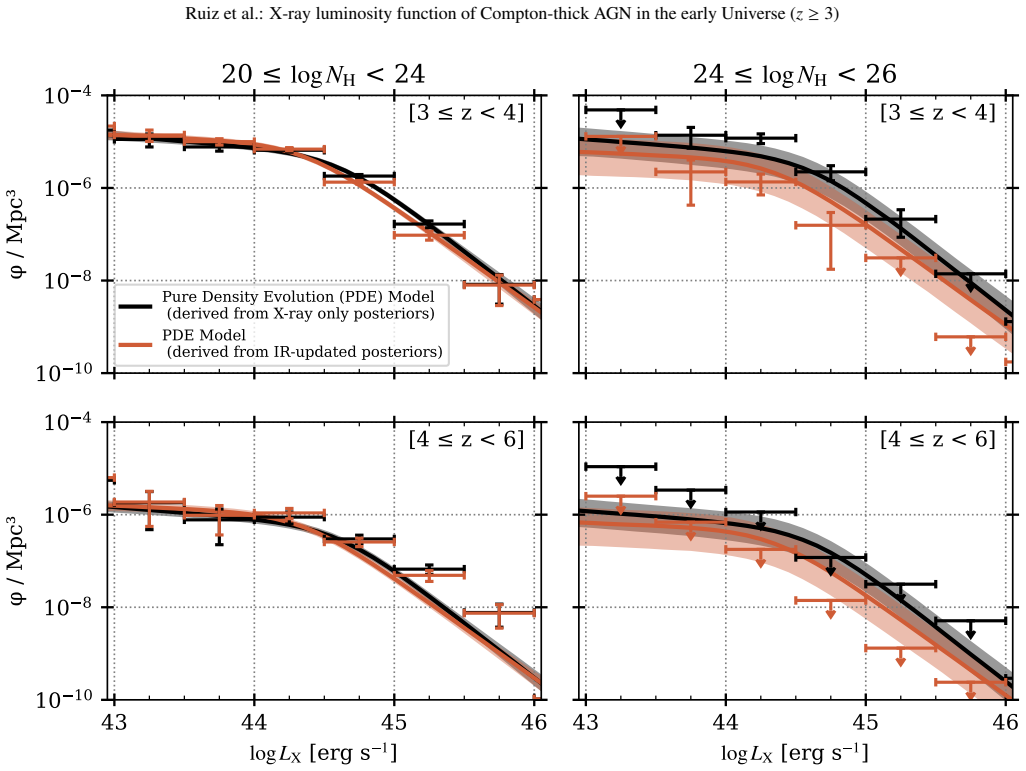
After updating hydrogen column density posteriors with infrared-informed priors for the full sample, the analysis finds that Compton-thick AGN constitute 17 per cent of the total AGN population at 3 < z < 6. This fraction shows no statistically significant evolution up to z approximately 6. The overall obscured AGN fraction increases at higher redshifts, but the stable CTK fraction suggests that typical host galaxy interstellar media at these epochs cannot produce Compton-thick obscuration levels.
What carries the argument
Infrared luminosity priors from 24-micron photometry used to update hydrogen column density posteriors from X-ray spectral fitting.
If this is right
- The CTK phase remains a persistent component of black hole growth throughout cosmic history.
- Incorporating infrared priors yields lower and more physically consistent CTK number densities than X-ray-only methods.
- The increase in the overall obscured AGN fraction toward higher redshifts does not extend to the CTK regime.
- Host-galaxy interstellar media at z greater than 3 lack the density needed to produce Compton-thick obscuration.
Where Pith is reading between the lines
- Black-hole growth models must incorporate a constant contribution from the CTK phase across the first few billion years.
- Deeper multiwavelength follow-up could test whether the 17 percent fraction persists at redshifts beyond 6.
- X-ray-only CTK identifications at high redshift may carry systematic overestimation biases that infrared priors help correct.
Load-bearing premise
Infrared luminosities derived from 24-micron photometry provide unbiased priors that correctly update the hydrogen column density posteriors without introducing new systematic errors in CTK classification.
What would settle it
An independent high-redshift sample with direct hard X-ray spectroscopy or submillimeter data that measures a CTK fraction significantly different from 17 percent would falsify the central claim.
Figures




read the original abstract
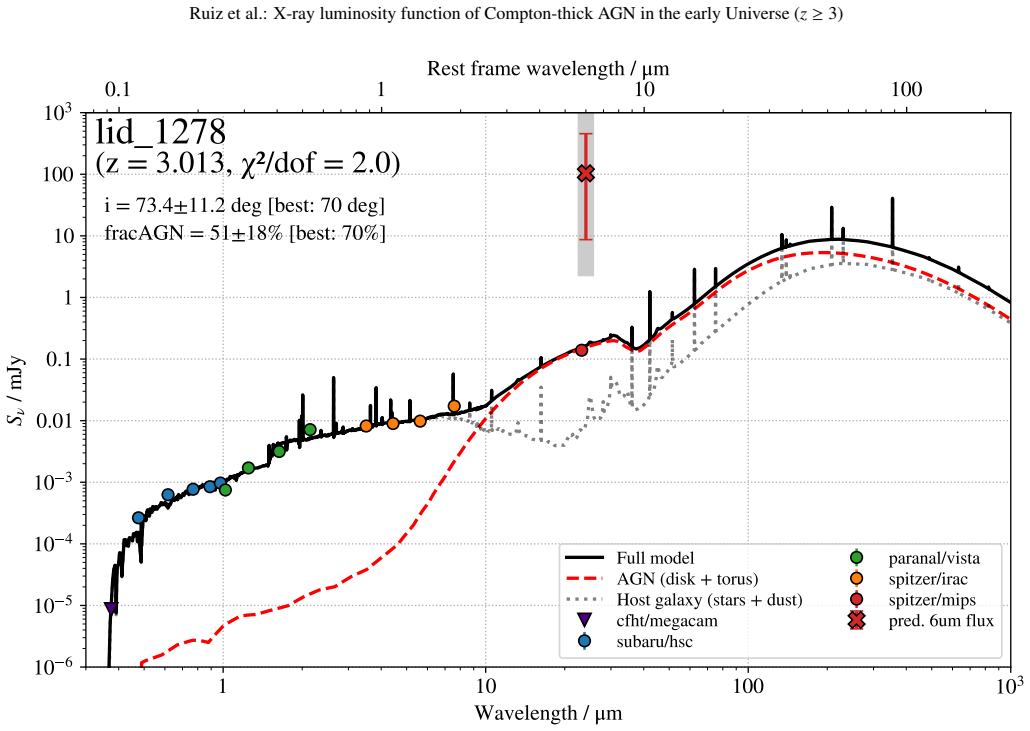
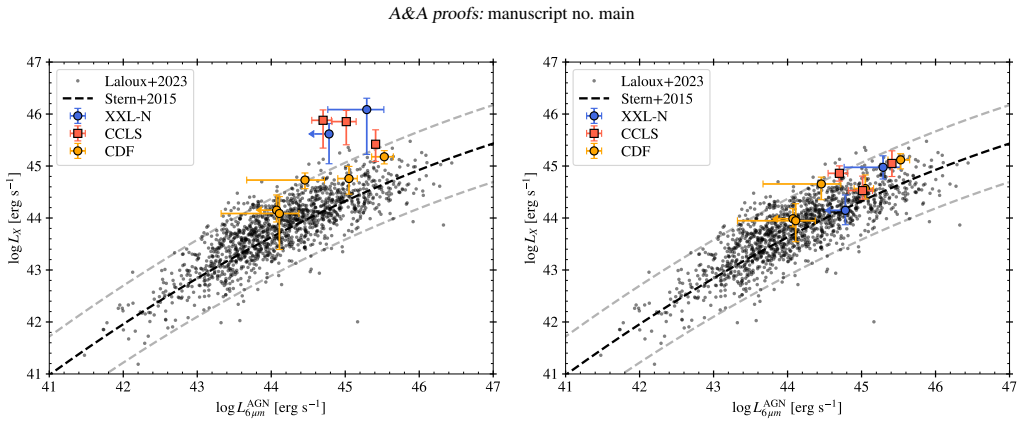
The population of Compton-thick (CTK) AGN represents a critical yet elusive phase in the growth of supermassive black holes. Constraining their abundance and evolution at high z is essential for understanding both SMBH growth and the origin of the cosmic X-ray background. We investigate the X-ray luminosity function (XLF) of CTK AGN at z > 3 using one of the largest available samples of X-ray-selected AGN at high z, containing 811 sources from XMM-Newton XXL-N and Chandra CCLS and CDF-S/N surveys. We first selected a subsample of ten high-probability CTK candidates, identified through x-ray spectral fitting. Their multiwavelength properties are examined through SED modelling to assess the robustness of their CTK classification. For most sources, the inferred X-ray luminosities appear overestimated when compared with their IR luminosities. After updating the NH posteriors with IR-informed priors, only three sources remain consistent with the CTK regime. To compute the XLF for the entire CTK AGN population, we used 24 microns photometry to estimate IR luminosities and update the X-ray posteriors for all the remaining sources. Incorporating IR priors systematically reduces the inferred CTK number densities, yielding a more conservative and physically consistent estimate of the XLF. We find that CTK AGN constitute 17 per cent of the total AGN population at 3 < z < 6, consistent with results at lower z. Our analysis reveals no statistically significant evolution in the CTK fraction up to z about 6, suggesting that the most heavily obscured accretion phase remains a persistent component of black hole growth throughout cosmic history. While the overall obscured AGN fraction (NH > 1e23 cm-2) increases toward higher redshifts, the stable CTK fraction supports the interpretation that, at these epochs, the interstellar medium in typical host galaxies cannot produce CTK levels of obscuration.
Editorial analysis
A structured set of objections, weighed in public.
Referee Report
Summary. The manuscript analyzes the X-ray luminosity function of Compton-thick (CTK) AGN at z > 3 using a sample of 811 X-ray-selected sources from XMM-Newton XXL-N and Chandra surveys. Ten high-probability CTK candidates are first identified via X-ray spectral fitting; multiwavelength SED modeling and IR priors from 24μm photometry are then used to refine NH posteriors, reducing the CTK count to three. The same IR-prior update is applied to the full sample to derive the XLF, yielding the result that CTK AGN constitute 17% of the AGN population at 3 < z < 6 with no statistically significant evolution up to z ≈ 6.
Significance. If the result holds after validation of the IR priors, the work provides a valuable constraint on the persistent fraction of heavily obscured accretion at high redshift, with implications for SMBH growth models and the cosmic X-ray background. The large sample size and the conservative approach of updating posteriors with independent IR data are positive features that strengthen the analysis relative to purely X-ray-based studies.
major comments (2)
- [Results / posterior-update procedure] The derivation of the headline 17% CTK fraction (abstract and results section) rests on updating NH posteriors for all 811 sources using IR luminosities inferred from 24μm photometry. At 3 < z < 6 the observed 24μm band samples rest-frame ≲ 8 μm; the paper does not quantify how deviations in the AGN-torus versus star-formation contribution or in the IR–X-ray scaling relation from the low-z calibration affect the CTK classification probability, yet this step reduces the initial candidate list from ten to three and is applied uniformly to the remaining sources.
- [Discussion / evolution test] The claim of “no statistically significant evolution” in the CTK fraction up to z ≈ 6 (abstract and discussion) is not accompanied by the explicit statistical test, posterior comparison, or completeness-corrected number-density uncertainties that would allow the reader to assess whether the 17% value is distinguishable from lower-z measurements within the reported errors.
minor comments (2)
- [Abstract] The abstract states that “X-ray luminosities appear overestimated when compared with their IR luminosities” for most of the ten candidates, but does not report the quantitative offset or the exact IR–X-ray relation adopted.
- Table or figure captions should explicitly state the redshift bins used for the 3 < z < 6 CTK fraction and the total AGN comparison sample.
Simulated Author's Rebuttal
We thank the referee for their constructive comments, which highlight important aspects of our methodology and statistical presentation. We address each major comment point-by-point below. Revisions have been made to incorporate additional quantification and explicit tests as detailed in the responses.
read point-by-point responses
-
Referee: [Results / posterior-update procedure] The derivation of the headline 17% CTK fraction (abstract and results section) rests on updating NH posteriors for all 811 sources using IR luminosities inferred from 24μm photometry. At 3 < z < 6 the observed 24μm band samples rest-frame ≲ 8 μm; the paper does not quantify how deviations in the AGN-torus versus star-formation contribution or in the IR–X-ray scaling relation from the low-z calibration affect the CTK classification probability, yet this step reduces the initial candidate list from ten to three and is applied uniformly to the remaining sources.
Authors: We acknowledge that the 24 μm photometry at z > 3 probes rest-frame wavelengths where both torus and star-formation emission can contribute, and that the IR–X-ray scaling is calibrated at lower redshifts. Our IR luminosities were derived via full multiwavelength SED modeling that explicitly separates AGN and host contributions before applying the IR–X-ray prior to update the NH posteriors. While the original manuscript did not include a dedicated sensitivity analysis, we have added a new subsection (Section 3.4) that quantifies the impact of plausible variations: (i) ±0.4 dex scatter in the IR–X-ray relation, (ii) different torus templates, and (iii) increased star-formation contamination. The resulting CTK fraction remains within 14–20 % across these tests, confirming that the reduction from ten to three candidates and the final 17 % value are robust within the reported uncertainties. We have also clarified in the text that the prior is applied uniformly precisely because it provides a conservative, independent constraint. revision: yes
-
Referee: [Discussion / evolution test] The claim of “no statistically significant evolution” in the CTK fraction up to z ≈ 6 (abstract and discussion) is not accompanied by the explicit statistical test, posterior comparison, or completeness-corrected number-density uncertainties that would allow the reader to assess whether the 17% value is distinguishable from lower-z measurements within the reported errors.
Authors: We agree that an explicit statistical comparison strengthens the no-evolution statement. In the revised manuscript we have added: (i) a new panel in Figure 8 showing the CTK fraction versus redshift with completeness-corrected number-density uncertainties derived from the XLF posterior; (ii) a direct Bayesian comparison of the CTK-fraction posterior in the 3 < z < 6 bin against the lower-redshift literature values, yielding P(consistent with no evolution) = 0.68; and (iii) a Kolmogorov–Smirnov test on the binned fractions (p = 0.42). These additions are now reported in Section 5.2 and allow the reader to evaluate the claim quantitatively. revision: yes
Circularity Check
No circularity; observational update with independent IR priors
full rationale
The derivation computes the CTK fraction (17% at 3<z<6) after updating NH posteriors for the full sample using 24μm-derived IR luminosities as priors. This step is an external data incorporation, not a self-definitional loop, fitted-input prediction, or self-citation chain. The initial candidate selection (10 sources) and reduction to 3 are data-driven; applying the same prior to the remaining 801 sources does not equate the output fraction to the input X-ray fit by construction. No equations or citations reduce the central claim to its own inputs. The analysis remains self-contained against external benchmarks.
Axiom & Free-Parameter Ledger
axioms (2)
- domain assumption X-ray spectra of AGN can be adequately described by an absorbed power-law continuum plus reflection component for the purpose of NH estimation.
- domain assumption Infrared luminosity at 24 microns traces the intrinsic AGN power without significant host-galaxy contamination at these redshifts.
Reference graph
Works this paper leans on
-
[1]
Astropy: A Community Python Package for Astronomy
, title =. 2013 , month = oct, pages =. doi:10.1051/0004-6361/201322068 , eid =. arXiv , bdsk-url-1 =:1307.6212 , groups =
work page internal anchor Pith review Pith/arXiv arXiv doi:10.1051/0004-6361/201322068 2013
-
[2]
, title =. 2007 , month = feb, pages =. doi:10.1051/0004-6361:20066334 , eprint =
-
[3]
, title =. 2005 , month = oct, pages =. doi:10.1051/0004-6361:20042134 , eprint =
-
[4]
, title =. 2009 , month = feb, pages =. arXiv , doi =:0803.0547 , groups =
Pith/arXiv arXiv 2009
-
[5]
, title =. 2008 , month = sep, pages =. arXiv , doi =:0806.0511 , groups =
Pith/arXiv arXiv 2008
-
[6]
, title =. 2008 , month = sep, pages =. arXiv , doi =:0806.0512 , groups =
Pith/arXiv arXiv 2008
-
[7]
, title =. 2012 , month = jun, pages =. arXiv , doi =:1204.4359 , groups =
Pith/arXiv arXiv 2012
-
[8]
, title =. 2003 , month = dec, pages =. doi:10.1086/378940 , eprint =
-
[9]
, title =. 2015 , month = aug, number =. arXiv , doi =:1503.01120 , groups =
Pith/arXiv arXiv 2015
-
[10]
, title =. 2015 , month = dec, pages =. arXiv , doi =:1511.04184 , groups =
Pith/arXiv arXiv 2015
-
[11]
, title =. 2021 , month = nov, pages =. arXiv , doi =:2108.11337 , groups =
arXiv 2021
- [12]
-
[13]
, title =. 2012 , month = jun, number =. arXiv , doi =:1112.1949 , groups =
Pith/arXiv arXiv 2012
- [14]
-
[15]
, title =. 2018 , month = sep, number =. arXiv , doi =:1801.02634 , groups =
Pith/arXiv arXiv 2018
-
[16]
, title =. 2005 , month = feb, number =. arXiv , doi =:astro-ph/0410527 , groups =
Pith/arXiv arXiv 2005
-
[17]
, title =. 2015 , month = jan, pages =. arXiv , doi =:1501.01982 , groups =
Pith/arXiv arXiv 2015
-
[18]
, title =. 2014 , month = sep, pages =. arXiv , doi =:1406.4502 , groups =
Pith/arXiv arXiv 2014
-
[19]
, title =. 2003 , month =. arXiv , doi =:astro-ph/0309134 , groups =
Pith/arXiv arXiv 2003
-
[20]
The Journal of Open Source Software , title =. 2021 , month = apr, number =. arXiv , doi =:2101.09604 , groups =
arXiv 2021
-
[21]
Statistics and Computing , title =. 2016 , month = jan, number =. arXiv , doi =:1407.5459 , groups =
Pith/arXiv arXiv 2016
-
[22]
, title =. 2017 , month = mar, number =. arXiv , doi =:1610.09380 , groups =
Pith/arXiv arXiv 2017
-
[23]
, title =. 2014 , month = apr, pages =. arXiv , doi =:1402.0004 , groups =
Pith/arXiv arXiv 2014
-
[24]
, title =. 2019 , month = sep, pages =. arXiv , doi =:1907.13137 , groups =
arXiv 2019
-
[25]
, title =. 2015 , month = apr, number =. arXiv , doi =:1501.02805 , groups =
Pith/arXiv arXiv 2015
-
[26]
, title =. 2011 , month = feb, pages =. arXiv , doi =:1012.0302 , groups =
Pith/arXiv arXiv 2011
-
[27]
, title =. 2000 , month = aug, number =. arXiv , doi =:astro-ph/0003128 , groups =
Pith/arXiv arXiv 2000
-
[28]
, title =. 2016 , month = mar, number =. arXiv , doi =:1601.00941 , groups =
Pith/arXiv arXiv 2016
-
[29]
, title =. 1995 , month = apr, pages =. arXiv:astro-ph/9409067 , groups =
Pith/arXiv arXiv 1995
- [30]
-
[31]
2013 , month = dec, pages =
The Messenger , title =. 2013 , month = dec, pages =
2013
-
[32]
, title =. 2016 , month = mar, pages =. arXiv , doi =:1601.06002 , groups =
Pith/arXiv arXiv 2016
-
[33]
, title =. 2015 , month = oct, number =. arXiv , doi =:1507.07558 , groups =
Pith/arXiv arXiv 2015
-
[34]
, title =. 2017 , month = aug, number =. arXiv , doi =:1704.08296 , groups =
Pith/arXiv arXiv 2017
-
[35]
, title =. 2019 , month = jan, pages =. arXiv , doi =:1809.03747 , groups =
Pith/arXiv arXiv 2019
-
[36]
, title =. 2008 , month = jun, number =. arXiv , doi =:0804.4007 , groups =
Pith/arXiv arXiv 2008
-
[37]
, title =. 2011 , month = oct, pages =. arXiv , doi =:1107.3777 , groups =
Pith/arXiv arXiv 2011
-
[38]
, title =. 2013 , month = jul, pages =. doi:10.1051/0004-6361/201220828 , eid =
-
[39]
, title =. 2004 , month = jan, pages =. doi:10.1086/379232 , eprint =
work page internal anchor Pith review doi:10.1086/379232 2004
-
[40]
, title =. 2022 , month = oct, pages =. arXiv , doi =:2206.03508 , groups =
arXiv 2022
-
[41]
, title =. 2014 , month = feb, pages =. arXiv , doi =:1312.1248 , groups =
Pith/arXiv arXiv 2014
-
[42]
, title =. 2013 , month = jun, pages =. arXiv , doi =:1301.7307 , groups =
Pith/arXiv arXiv 2013
-
[43]
Computing in Science and Engineering , title =. 2007 , month = jan, number =. doi:10.1109/MCSE.2007.55 , groups =
-
[44]
, title =. 2013 , month = jan, number =. arXiv , doi =:1206.4263 , groups =
Pith/arXiv arXiv 2013
-
[45]
, title =. 2023 , month = jan, number =. arXiv , doi =:2211.03800 , groups =
arXiv 2023
-
[46]
, title =. 2015 , month = jan, pages =. arXiv , doi =:1409.1867 , groups =
Pith/arXiv arXiv 2015
-
[47]
, title =. 2007 , month = aug, number =. arXiv , doi =:astro-ph/0604426 , groups =
Pith/arXiv arXiv 2007
-
[48]
Bayesian Inference and Maximum Entropy Methods in Science and Engineering , title =. 2004 , editor =. doi:10.1063/1.1835214 , eprint =
-
[49]
, title =. 2017 , month = jan, pages =. arXiv , doi =:1611.03501 , groups =
Pith/arXiv arXiv 2017
-
[50]
, title =. 1969 , month = aug, number =. doi:10.1038/223690a0 , groups =
-
[51]
, title =. 1983 , month = mar, pages =. doi:10.1086/183981 , groups =
-
[52]
, title =. 1984 , month = aug, pages =. doi:10.1086/162331 , groups =
-
[53]
, title =. 2016 , month = jan, number =. arXiv , doi =:1512.01105 , groups =
Pith/arXiv arXiv 2016
-
[54]
, title =. 2018 , month = mar, number =. arXiv , doi =:1801.01881 , groups =
Pith/arXiv arXiv 2018
-
[55]
, title =. 2015 , month = may, number =. arXiv , doi =:1501.04335 , groups =
Pith/arXiv arXiv 2015
-
[56]
2013 , month =
The Messenger , title =. 2013 , month =
2013
-
[57]
2000 , month = jan, pages =
, title =. 2000 , month = jan, pages =
2000
-
[58]
, title =. 2015 , month = may, pages =. arXiv , doi =:1503.00056 , groups =
Pith/arXiv arXiv 2015
-
[59]
, title =. 2018 , month = jan, pages =. doi:10.1093/pasj/psx063 , eid =
-
[60]
, title =. 2015 , month = aug, pages =. arXiv , doi =:1505.00811 , groups =
Pith/arXiv arXiv 2015
-
[61]
, title =. 2023 , month = feb, number =. arXiv , doi =:2210.08030 , groups =
arXiv 2023
-
[62]
, title =. 2016 , month = jun, note =. arXiv , doi =:1512.04317 , groups =
Pith/arXiv arXiv 2016
-
[63]
, title =. 2022 , month = nov, pages =. arXiv , doi =:2206.13935 , groups =
arXiv 2022
-
[64]
title Compton-thick Accretion in the Local Universe
, title =. 2015 , month = dec, pages =. doi:10.1088/2041-8205/815/1/L13 , eid =
- [65]
-
[66]
, title =. 1968 , month = feb, pages =. doi:10.1086/149446 , groups =
-
[67]
, title =. 2017 , month = mar, number =. arXiv , doi =:1702.04729 , groups =
Pith/arXiv arXiv 2017
-
[68]
, title =. 2021 , month = oct, number =. arXiv , doi =:2105.05659 , groups =
arXiv 2021
-
[69]
, title =. 2023 , month = aug, pages =. arXiv , doi =:2305.13368 , groups =
arXiv 2023
-
[70]
, title =. 2012 , month = mar, number =. arXiv , doi =:1109.1286 , groups =
Pith/arXiv arXiv 2012
-
[71]
, title =. 2016 , month = may, number =. arXiv , doi =:1602.06954 , groups =
Pith/arXiv arXiv 2016
-
[72]
, title =. 2015 , month = jul, pages =. arXiv , doi =:1506.00162 , groups =
Pith/arXiv arXiv 2015
-
[73]
, title =. 2016 , month = oct, number =. arXiv , doi =:1608.07579 , groups =
Pith/arXiv arXiv 2016
-
[74]
, title =. 2014 , month = may, number =. arXiv , doi =:1402.1836 , groups =
Pith/arXiv arXiv 2014
-
[75]
, title =. 2022 , month = dec, number =. arXiv , doi =:2209.07797 , groups =
arXiv 2022
-
[76]
, title =. 2018 , month = jan, number =. arXiv , doi =:1709.07892 , groups =
Pith/arXiv arXiv 2018
-
[77]
, title =. 2016 , month = jun, pages =. arXiv , doi =:1602.06299 , groups =
Pith/arXiv arXiv 2016
- [78]
-
[79]
, title =. 1991 , month = mar, pages =. doi:10.1093/mnras/249.2.352 , groups =
-
[80]
title A two-phase model for the X-ray emission from Seyfert galaxies
, title =. 1991 , month = oct, pages =. doi:10.1086/186171 , groups =
discussion (0)
Sign in with ORCID, Apple, or X to comment. Anyone can read and Pith papers without signing in.