Academic Integrity and Emotional Responses to Inappropriate LLM Use in Software Engineering Education
Pith reviewed 2026-06-27 21:04 UTC · model grok-4.3
The pith
Software engineering students report mostly indifference after using LLMs in ways they view as academically inappropriate.
A machine-rendered reading of the paper's core claim, the machinery that carries it, and where it could break.
Core claim
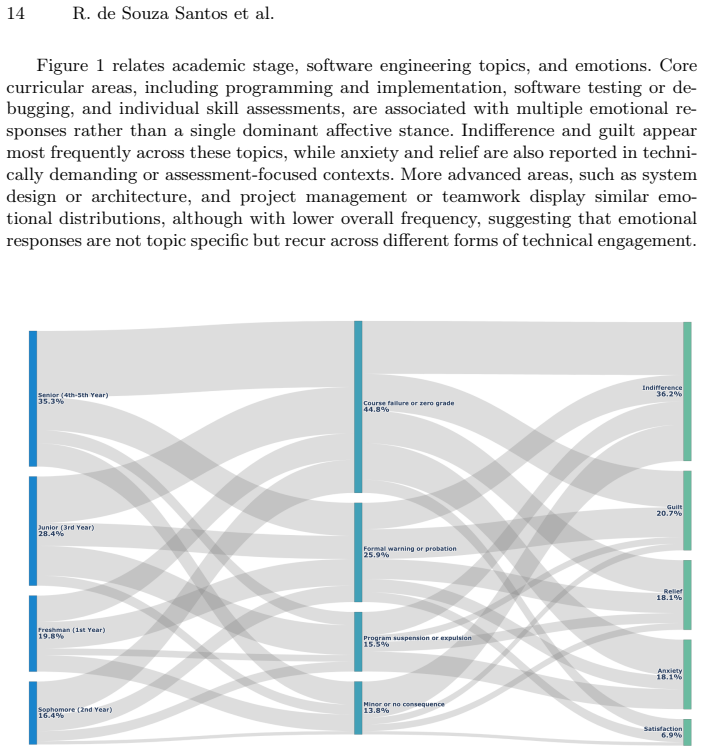
Students describe emotionally heterogeneous responses to inappropriate LLM use. Indifference was most frequent, including among students who recognized risks to learning and academic standing. Guilt and anxiety were reported in relation to moral discomfort and concern about penalties. Relief and satisfaction were evident primarily in deadline-driven contexts and situations of unclear guidance.
What carries the argument
Cross-sectional survey of self-reported emotional experiences tied to perceived inappropriate LLM use in software engineering coursework.
If this is right
- Academic policies may need to address indifference directly rather than assuming moral guilt drives compliance.
- Deadline pressures and ambiguous guidelines can shift emotional responses toward relief and satisfaction.
- Risk awareness alone does not reliably produce negative emotions like guilt or anxiety.
Where Pith is reading between the lines
- Interventions focused only on rule enforcement may miss students who feel neutral about violations.
- Future work could test whether clearer assignment guidelines reduce the relief and satisfaction responses.
- The findings connect to broader questions of how automated tools alter traditional notions of authorship and accountability in education.
Load-bearing premise
Students' single-survey self-reports accurately capture their actual emotions and the 116-student sample represents broader patterns.
What would settle it
A follow-up study that observes actual student behavior or tracks emotions over time and finds no dominance of indifference or different context dependencies.
Figures

read the original abstract
Academic integrity in higher education is increasingly shaped by complex socio-technical environments marked by automated tools, evolving institutional practices, and heightened performance pressures. Within this context, large language models (LLMs) are becoming prevalent in software engineering education, further blurring boundaries around acceptable assistance and authorship. This study investigates how software engineering students describe their emotional experiences after using LLMs in ways they perceive as academically inappropriate. We conducted a cross-sectional survey with 116 undergraduate students. Results show emotionally heterogeneous responses. Indifference was most frequent, including among students who recognized risks to learning and academic standing. Guilt and anxiety were reported in relation to moral discomfort and concern about penalties. Relief and satisfaction were evident primarily in deadline-driven contexts and situations of unclear guidance.
Editorial analysis
A structured set of objections, weighed in public.
Referee Report
Summary. The manuscript reports findings from a cross-sectional survey of 116 undergraduate software engineering students on their emotional responses to using LLMs in ways they perceive as academically inappropriate. It claims emotionally heterogeneous responses: indifference is most frequent (including among students recognizing risks to learning and standing), guilt and anxiety relate to moral discomfort and penalty concerns, and relief/satisfaction appear mainly in deadline-driven or unclear-guidance contexts.
Significance. If the survey data collection and analysis prove robust, the descriptive findings would usefully document the emotional complexity students experience with LLM-assisted work in SE education. This could inform more nuanced academic-integrity policies and teaching practices amid rapid AI adoption. The heterogeneity result challenges overly simplistic narratives of misconduct and highlights contextual factors such as deadlines and guidance clarity.
major comments (3)
- [Methods] Methods: The manuscript provides no details on sampling procedure, response rate, recruitment method, or participant demographics for the 116-student sample. These omissions are load-bearing for the central claim of heterogeneous emotional patterns, as they prevent evaluation of selection bias or generalizability (cf. reader's soundness assessment of 4.0).
- [Methods] Methods: No information is given on survey-instrument development, pilot testing, question wording, anonymity assurances, or any steps to mitigate social-desirability bias in self-reports of academic misconduct. This directly undermines confidence that reported frequencies (e.g., predominance of indifference versus guilt/anxiety) reflect internal experiences rather than measurement artifacts.
- [Results] Results: The abstract asserts that indifference was most frequent even among students recognizing risks, yet the provided description contains no quantitative breakdowns, cross-tabulations, or statistical support for this or the other emotion-context associations. Without such evidence the heterogeneity claim cannot be fully assessed.
minor comments (1)
- [Abstract] Abstract: Adding one sentence on study limitations (e.g., cross-sectional design, self-report nature) would improve balance and reader expectations.
Simulated Author's Rebuttal
We thank the referee for these detailed comments, which highlight important gaps in methodological transparency and evidentiary support. We will revise the manuscript to address each point directly.
read point-by-point responses
-
Referee: [Methods] Methods: The manuscript provides no details on sampling procedure, response rate, recruitment method, or participant demographics for the 116-student sample. These omissions are load-bearing for the central claim of heterogeneous emotional patterns, as they prevent evaluation of selection bias or generalizability (cf. reader's soundness assessment of 4.0).
Authors: We agree these details are essential for assessing bias and generalizability. The revised manuscript will add a dedicated subsection in Methods describing the sampling frame (undergraduate SE courses at one institution), recruitment via course announcements and email, response rate (including total invitations sent), and full demographic breakdown of the 116 respondents (year of study, gender, prior LLM experience). revision: yes
-
Referee: [Methods] Methods: No information is given on survey-instrument development, pilot testing, question wording, anonymity assurances, or any steps to mitigate social-desirability bias in self-reports of academic misconduct. This directly undermines confidence that reported frequencies (e.g., predominance of indifference versus guilt/anxiety) reflect internal experiences rather than measurement artifacts.
Authors: We accept that these elements were insufficiently documented. The revision will expand the Methods section to cover instrument development (iterative drafting based on prior academic-integrity scales), pilot testing with 10 students, verbatim question wording for the emotion and context items, explicit anonymity and confidentiality statements provided to participants, and steps taken to reduce social-desirability bias (neutral item phrasing, no identifying fields, and emphasis on voluntary participation with no academic consequences). revision: yes
-
Referee: [Results] Results: The abstract asserts that indifference was most frequent even among students recognizing risks, yet the provided description contains no quantitative breakdowns, cross-tabulations, or statistical support for this or the other emotion-context associations. Without such evidence the heterogeneity claim cannot be fully assessed.
Authors: The full results section contains frequency counts and some contextual associations, but we agree that explicit quantitative support is needed for the heterogeneity claim. In revision we will add a results table reporting exact percentages for each emotion, cross-tabulations of indifference with risk-recognition items, and any chi-square or similar tests for the deadline/guidance associations, ensuring the abstract claims are directly traceable to the data. revision: yes
Circularity Check
No circularity: purely empirical cross-sectional survey with no derivations or fitted predictions
full rationale
The paper reports results from a one-time survey of 116 undergraduates on self-described emotional responses to LLM use. No equations, parameters, predictions, or derivation chain exist that could reduce to prior results by construction. The central claims are direct descriptions of collected responses (indifference most frequent, guilt/anxiety tied to moral/penalty concerns, relief in deadline contexts). No self-citation load-bearing steps, uniqueness theorems, or ansatzes are invoked. This is self-contained empirical reporting; external validity concerns (bias, representativeness) are separate from circularity.
Axiom & Free-Parameter Ledger
axioms (1)
- domain assumption Self-reported survey responses accurately capture students' emotional experiences.
Reference graph
Works this paper leans on
-
[1]
In: International Conference on Business and Technology
Adnan, A.H.M., Salim, M.S.A.M., Shah, D.S.M., Yusuf, A.H.M., Salim, M.N.F.M., Tahir, M.H.M.: Cheating using ai and copy-pasting from llms: New realities in higher education. In: International Conference on Business and Technology. pp. 399–410. Springer (2025)
2025
-
[2]
In: Proceedings of the 1st IEEE/ACM International Workshop on Methodological Issues with Empirical Studies in Software Engineering
Alami, A., Zahedi, M., Ernst, N.: Are you a real software engineer? best prac- tices in online recruitment for software engineering studies. In: Proceedings of the 1st IEEE/ACM International Workshop on Methodological Issues with Empirical Studies in Software Engineering. pp. 52–57 (2024)
2024
-
[3]
In: 2022 ASEE Annual Conference & Exposition (2022)
Alzahrani, N., Vahid, F.: Detecting possible cheating in programming courses using drastic code change. In: 2022 ASEE Annual Conference & Exposition (2022)
2022
-
[4]
Empirical Software Engineering27(4), 94 (2022)
Baltes, S., Ralph, P.: Sampling in software engineering research: A critical review and guidelines. Empirical Software Engineering27(4), 94 (2022)
2022
-
[5]
Journal of behavior therapy and experimental psychiatry 25(1), 49–59 (1994)
Bradley, M.M., Lang, P.J.: Measuring emotion: the self-assessment manikin and the semantic differential. Journal of behavior therapy and experimental psychiatry 25(1), 49–59 (1994)
1994
-
[6]
Innovations in education and teaching inter- national61(2), 228–239 (2024)
Cotton, D.R., Cotton, P.A., Shipway, J.R.: Chatting and cheating: Ensuring aca- demic integrity in the era of chatgpt. Innovations in education and teaching inter- national61(2), 228–239 (2024)
2024
-
[7]
In: 2011 international symposium on empirical software engineering and measurement
Cruzes, D.S., Dyba, T.: Recommended steps for thematic synthesis in software engineering. In: 2011 international symposium on empirical software engineering and measurement. pp. 275–284. IEEE (2011)
2011
-
[8]
Danilova, A., Naiakshina, A., Horstmann, S., Smith, M.: Do you really code? de- signingandevaluatingscreeningquestionsforonlinesurveyswithprogrammers.In: 2021 IEEE/ACM 43rd International Conference on Software Engineering (ICSE). pp. 537–548. IEEE (2021)
2021
-
[9]
285–311 (2008) Academic Integrity and Emotional Responses to Inappropriate LLM Use 19
Easterbrook, S., Singer, J., Storey, M.A., Damian, D.: Selecting empirical methods forsoftwareengineeringresearch.Guidetoadvancedempiricalsoftwareengineering pp. 285–311 (2008) Academic Integrity and Emotional Responses to Inappropriate LLM Use 19
2008
-
[10]
Canadian Perspectives on Academic Integrity5(2), 34–58 (2023)
Eaton, S.E., Pethrick, H., Turner, K.L.: Academic integrity and student mental well-being: A rapid review. Canadian Perspectives on Academic Integrity5(2), 34–58 (2023)
2023
-
[11]
Information Systems Education Journal22(3), 47–60 (2024)
Firth, D.R., Derendinger, M., Triche, J.: Cheating better with chatgpt: A frame- work for teaching students when to use chatgpt and other generative ai bots. Information Systems Education Journal22(3), 47–60 (2024)
2024
-
[12]
In: IBM SPSS Statistics 25 Step by Step, pp
George, D., Mallery, P.: Descriptive statistics. In: IBM SPSS Statistics 25 Step by Step, pp. 126–134. Routledge (2018)
2018
-
[13]
Harp, J., Taietz, P.: Academic integrity and social structure: A study of cheating among college students. Soc. Probs.13, 365 (1965)
1965
-
[14]
Journal of Applied Sciences14(8), 748–757 (2014)
Hosny, M., Fatima, S.: Attitude of students towards cheating and plagiarism: Uni- versity case study. Journal of Applied Sciences14(8), 748–757 (2014)
2014
-
[15]
College Teaching54(1), 171–176 (2006)
Hutton, P.A.: Understanding student cheating and what educators can do about it. College Teaching54(1), 171–176 (2006)
2006
-
[16]
Jones, D.L.: Academic dishonesty: Are more students cheating? Business commu- nication quarterly74(2), 141–150 (2011)
2011
-
[17]
Computers and Education: Artificial Intelligence7, 100253 (2024)
Lee, V.R., Pope, D., Miles, S., Zárate, R.C.: Cheating in the age of generative ai: A high school survey study of cheating behaviors before and after the release of chatgpt. Computers and Education: Artificial Intelligence7, 100253 (2024)
2024
-
[18]
Linaker, J., Sulaman, S.M., Höst, M., de Mello, R.M.: Guidelines for conducting surveys in software engineering v. 1.1. Lund University50(2015)
2015
-
[19]
Studies in higher education39(2), 339–358 (2014)
Macfarlane, B., Zhang, J., Pun, A.: Academic integrity: A review of the literature. Studies in higher education39(2), 339–358 (2014)
2014
-
[20]
The Journal of Economic Education33(2), 125–135 (2002)
Magnus, J.R., Polterovich, V.M., Danilov, D.L., Savvateev, A.V.: Tolerance of cheating: An analysis across countries. The Journal of Economic Education33(2), 125–135 (2002)
2002
-
[21]
Education sciences14(5), 500 (2024)
Mah, C., Walker, H., Phalen, L., Levine, S., Beck, S.W., Pittman, J.: Beyond cheatbots: Examining tensions in teachers’ and students’ perceptions of cheating and learning with chatgpt. Education sciences14(5), 500 (2024)
2024
-
[22]
Journal of Integrated Design and Process Science0(0) (2026)
Marlowe, T., Ku, C., Laracy, J., Kirova, V., Herbert, K.: A systemic view of a software engineering education curriculum: Requirements and guidelines in the era of generative ai. Journal of Integrated Design and Process Science0(0) (2026). https://doi.org/10.1177/10920617251405471
-
[23]
Ethics & Behavior11(3), 219–232 (2001)
McCabe, D.L., Treviño, L.K., Butterfield, K.D.: Cheating in academic in- stitutions: A decade of research. Ethics & Behavior11(3), 219–232 (2001). https://doi.org/10.1207/S15327019EB1103_2
-
[24]
Molnar,K.K.,Kletke,M.G.:Doesthetypeofcheatinginfluenceundergraduatestu- dents’ perceptions of cheating? Journal of Academic Ethics10(3), 201–212 (2012)
2012
-
[25]
Assessment & Evalua- tion in Higher Education41(3), 482–497 (2016)
Newton, P.: Academic integrity: A quantitative study of confidence and under- standing in students at the start of their higher education. Assessment & Evalua- tion in Higher Education41(3), 482–497 (2016)
2016
-
[26]
Social Psychology of Education28(1), 113 (2025)
Ortiz-Bonnin, S., Blahopoulou, J.: Chat or cheat? academic dishonesty, risk per- ceptions, and chatgpt usage in higher education students. Social Psychology of Education28(1), 113 (2025)
2025
-
[27]
ACM SIGSOFT Software Engineering Notes26(6), 16–18 (2001)
Pfleeger, S.L., Kitchenham, B.A.: Principles of survey research: part 1: turning lemons into lemonade. ACM SIGSOFT Software Engineering Notes26(6), 16–18 (2001)
2001
-
[28]
Empirical standards for software engineering research,
Ralph, P., Ali, N.b., Baltes, S., Bianculli, D., Diaz, J., Dittrich, Y., Ernst, N., Felderer, M., Feldt, R., Filieri, A., et al.: Empirical standards for software engi- neering research. arXiv preprint arXiv:2010.03525 (2020) 20 R. de Souza Santos et al
-
[29]
IEEE Soft- ware41(2), 36–43 (2023)
Randall, N., Wäckerle, D., Stein, N., Goßler, D., Bente, S.: What an ai-embracing software engineering curriculum should look like: An empirical study. IEEE Soft- ware41(2), 36–43 (2023)
2023
-
[30]
arXiv preprint arXiv:2201.05348 (2022)
Reid, B., Wagner, M., d’Amorim, M., Treude, C.: Software engineering user study recruitment on prolific: An experience report. arXiv preprint arXiv:2201.05348 (2022)
-
[31]
AS- CILITE Publications pp
Rios, S., Zhang, Y., Oliveira, E.: Authorship verification in software engineering education: Forget chatgpt and focus on students’ academic writing profiles. AS- CILITE Publications pp. 195–204 (2023)
2023
-
[32]
arXiv preprint arXiv:2203.14695 (2022)
Russo, D.: Recruiting software engineers on prolific. arXiv preprint arXiv:2203.14695 (2022)
-
[33]
In: Proceedings of the 20th International CDIO Conference
Rytilahti, J., Kaila, E.: How easy is it to cheat?-solving programming exercises automatically with ai. In: Proceedings of the 20th International CDIO Conference. Proceedings of the 20th International CDIO Conference (2024)
2024
-
[34]
In: Proceedings of the 2024 Conference on Empirical Methods in Natural Language Processing
Salim, S., Yang, R., Cooper, A., Ray, S., Debray, S., Rahaman, S.: Impeding llm- assisted cheating in introductory programming assignments via adversarial pertur- bation. In: Proceedings of the 2024 Conference on Empirical Methods in Natural Language Processing. pp. 445–463 (2024)
2024
-
[35]
International Journal for Educational Integrity17(1), 21 (2021)
Sanni-Anibire, H., Stoesz, B.M., Gervais, L., Vogt, L.: International students’ knowledge and emotions related to academic integrity at canadian postsecondary institutions. International Journal for Educational Integrity17(1), 21 (2021)
2021
-
[36]
ACM International Conference on the Foundations of Software Engineering (2026)
Santos, R.d.S., Santos, I., Bento, M., Destefanis, G., Magalhães, C., Wessel, M.: Llm use, cheating, and academic integrity in software engineering education. ACM International Conference on the Foundations of Software Engineering (2026)
2026
-
[37]
In: Proceedings of the 7th annual conference on Innovation and technology in computer science education
Sheard, J., Dick, M., Markham, S., Macdonald, I., Walsh, M.: Cheating and plagia- rism: Perceptions and practices of first year it students. In: Proceedings of the 7th annual conference on Innovation and technology in computer science education. pp. 183–187 (2002)
2002
-
[38]
Higher Education Research & Development22(1), 91–108 (2003)
Sheard, J., Markham, S., Dick, M.: Investigating differences in cheating behaviours of it undergraduate and graduate students: The maturity and motivation factors. Higher Education Research & Development22(1), 91–108 (2003)
2003
-
[39]
In: Proceedings of the 2016 ITiCSE working group reports, pp
Simon, Sheard, J., Morgan, M., Petersen, A., Settle, A., Sinclair, J., Cross, G., Riedesel, C.: Negotiating the maze of academic integrity in computing education. In: Proceedings of the 2016 ITiCSE working group reports, pp. 57–80. ACM (2016)
2016
-
[40]
Journal of Academic Ethics21(3), 357–375 (2023)
Stone, A.: Student perceptions of academic integrity: A qualitative study of under- standing, consequences, and impact. Journal of Academic Ethics21(3), 357–375 (2023)
2023
-
[41]
Research in higher education39(3), 235–274 (1998)
Whitley, B.E.: Factors associated with cheating among college students: A review. Research in higher education39(3), 235–274 (1998)
1998
discussion (0)
Sign in with ORCID, Apple, or X to comment. Anyone can read and Pith papers without signing in.