REVIEW 3 major objections 5 minor 1 cited by
This paper claims that two quasi-dyadic parity-check matrix constructions yield high-rate dual-containing CSS LDPC codes whose finite-length logical error rates beat the standard dual-containing benchmark.
Reviewed by Pith at T0; open to challenge. T0 means a machine referee read the full paper against a public rubric. the ladder, T0–T4 →
T0 review · deepseek-v4-flash
2026-08-02 14:54 UTC pith:D7GNQ5NH
load-bearing objection Useful finite-length construction family, but the enabling theorem for Construction B is unproved here and false as stated for v=1, and the headline comparisons are not rate-matched. the 3 major comments →
Design and Analysis of Quantum Dual-Containing CSS LDPC Codes based on Quasi-Dyadic Matrices
The pith
A machine-rendered reading of the paper's core claim, the machinery that carries it, and where it could break.
Core claim
The central claim is that dual-containing CSS LDPC codes can be built from quasi-dyadic parity-check matrices H with two specific shapes, and that these codes outperform the reference dual-containing construction at finite lengths. In Construction A, H is a w by u array of dyadic permutation matrices; the left-hand conveyor belt rule makes HH^T = 0 for w up to 4, with an appendix extension to larger w, yielding DC CSS codes with stabilizer generator weight u. In Construction B, H = [M0 ... M_{u-1}] with distinct dyadic blocks of odd weight v; for even u, the paper asserts that H has full rank, that the code is dual-containing, and that it contains many weight-2v codewords that can serve as s
What carries the argument
The load-bearing object is the quasi-dyadic (QD) parity-check matrix: a block matrix whose blocks are dyadic matrices, each fully determined by a single signature row via dyadic permutations, which are commuting reflections of order two. Dyadic matrices with odd-weight signatures square to the identity and are their own inverses, which is what makes orthogonality conditions like HH^T = 0 cancellations of paired terms. Construction A arranges dyadic permutation matrices with a left-hand conveyor belt (LHCB) rule so that cross-products cancel modulo 2. Construction B relies on Theorem 4, which asserts full rank, dual containment for an even number of blocks, and an abundance of weight-2v codew
Load-bearing premise
For Construction B, every guarantee — full rank, dual containment when the number of dyadic blocks is even, and the existence of many weight-2v codewords — rests on Theorem 4, whose proof is not given in this paper and whose codeword-count statement is false in the allowed v = 1 case.
What would settle it
Build a concrete instance of Construction B, say u = 4, ell = 3, v = 3, with four distinct odd-weight dyadic blocks, and compute rank(H) and H H^T: Theorem 4 predicts rank 8 and H H^T = 0. For v = 1, check whether the promised weight-2 codewords actually exist; a single counterexample to either assertion would falsify the foundation of Construction B.
If this is right
- The dual-containing property enables transversal implementation of the Hadamard gate and lets the codes be decoded with the simpler binary BP2 decoder instead of the quaternary BP4 decoder.
- Construction A can produce nontrivial DC CSS codes with stabilizer generator weight as low as 8, below the minimum of 12 for Construction B codes.
- The proposed heuristic for Construction B — uniform signature supports with pairwise disjoint difference sets — reduces avoidable length-4 cycles and pushes the minimum distance up to its upper bound of 2v.
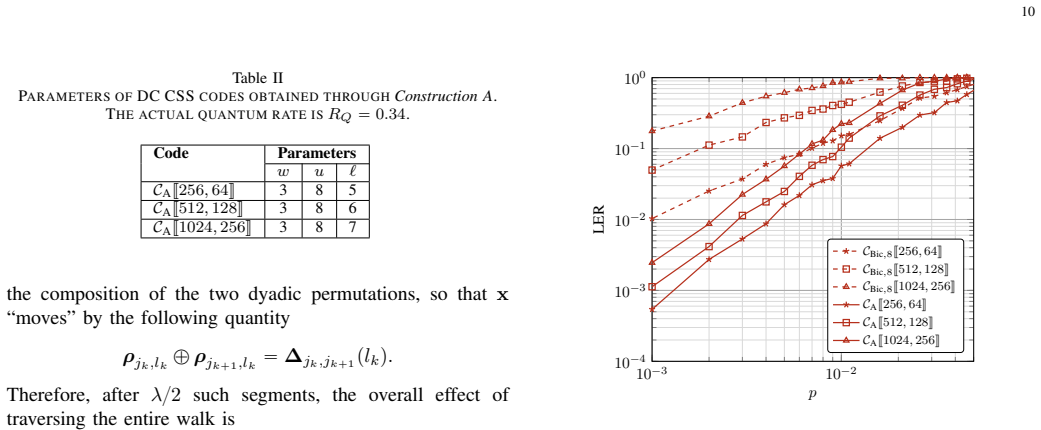
- Simulated logical error rates for both constructions are lower than those of bicycle codes with the same length, quantum rate, stabilizer weight, and girth, and competitive with non-dual-containing quasi-cyclic CSS codes despite the unavoidable girth-4 cycles.
- Because the quantum code inherits the full automorphism group of the underlying classical quasi-dyadic code, these constructions maximize the symmetry relevant for fault-tolerant logical operations.
Where Pith is reading between the lines
- If Theorem 4 can be repaired and proven, Construction B becomes a parameterized family of dual-containing codes closely related to generalized bicycle codes, potentially bridging two active lines of quantum LDPC design.
- The cycle-length XOR condition in the paper is a direct search tool: one could use it to look for quasi-dyadic DPM arrays with girth 8 and no 6-cycles, possibly leading to non-dual-containing constructions with larger girth, which the paper lists as future work.
- The finite-length advantage over bicycle codes is demonstrated by simulation; a natural extension is to test these codes under circuit-level or biased noise models and with automorphism-ensemble decoding, where the large automorphism group may give an additional performance boost.
Editorial analysis
A structured set of objections, weighed in public.
Referee Report
Summary. The paper introduces two constructions of quasi-dyadic (QD) parity-check matrices for high-rate dual-containing (DC) CSS LDPC codes. Construction A arrays dyadic permutation matrices with an anchor block-row and a 'left-hand conveyor belt' rule; Construction B concatenates odd-weight dyadic blocks as in Theorem 4, quoted from a self-cited conference paper. The paper claims DC structure (hence transversal Hadamard), large automorphism groups, several cycle/girth results, and Monte Carlo LER results under depolarizing noise showing better performance than MacKay bicycle codes and competitive performance against non-DC QC-LDPC codes. A heuristic algorithm is also proposed to reduce avoidable length-4 cycles.
Significance. If the central claims are repaired, the paper would provide a practically relevant family of high-rate DC CSS LDPC codes: the algebraic block structure is explicit, the PCMs are sparse, BP2 decoding is justified, and the automorphism group could enable automorphism-ensemble decoding. The cycle analysis in Section V, especially the dyadic analogues of Fossorier-type conditions, is a genuine contribution. The simulations are real and not curve-fitted, and the heuristic optimization is clearly described. However, the advertised finite-length advantage rests on an unproved and, as stated, false theorem (Theorem 4), and the Construction A comparison is explicitly rate-mismatched. The contribution is therefore not yet reliable.
major comments (3)
- [IV.B, Theorem 4 (Eq. (6))] Theorem 4 is the enabling result for Construction B, but it is not proved here ('The proof is available in [1]') and is false as stated for the allowed v=1 case. If v=1, each M_i is a DPM and H is full rank, so C^⊥ is the row space of H, of size 2^{2^ℓ}. Clause 2 promises at least C(u,2)2^{ℓ+1} weight-2 codewords. For u=2, a direct check gives exactly 2^ℓ such words, but the promise is 2^{ℓ+1}; for ℓ=2,u=3 the promised 24 exceeds |C^⊥|=16. Thus the theorem cannot be used as a black box. Since Construction B's rank, dimension, DC property, and the code family used in Section VI.B all depend on it, the central performance claims rest on an unproved and incorrectly stated premise. Please include a complete proof, or state and prove the theorem only for the odd v>1 regime used in simulations.
- [VI.A, Table II and Fig. 2] The text states that the comparison with bicycle codes is fair because 'n,k_Q,R_Q, the stabilizer generators weight, and the girth are identical', but Table II reports actual R_Q=0.34 for the three Construction A codes, while the bicycle codes CBic,8 J256,64K, J512,128K, J1024,256K have R_Q=0.25. Thus k_Q and R_Q are not identical: the actual k_Q values are approximately 87, 174, and 348, not 64, 128, and 256. This invalidates the rate-matched comparison that supports the abstract's claim of 'better ... across different block lengths and code rates.' The comparison should be re-run against rate-0.34 DC bicycle codes, or the Construction A codes should be modified to achieve their nominal rate.
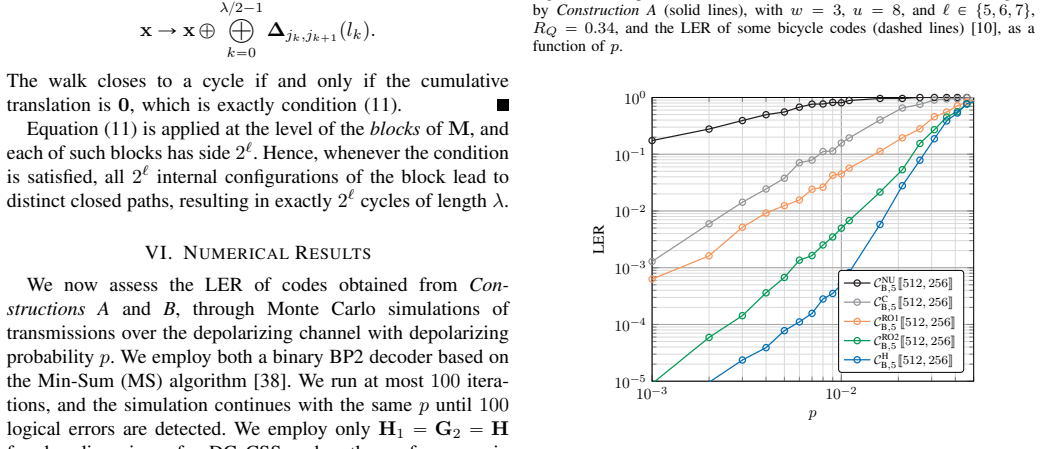
- [VI.B, Table III and Remark 2] The minimum-distance values in Table III and the explanation that 'd(C) grows with v' are presented as established facts, but they are only computer estimates from the tool in [39] adapted to the quantum case. The manuscript does not state the search budget, whether the results are lower or upper bounds, or how the quantum minimum distance is derived from the classical code distance. Since these estimates are used to explain the performance ordering in Figs. 3-5, the method should be described and the claims tempered accordingly.
minor comments (5)
- [Section IV.C, Algorithm 2] The heuristic depends on free parameters MaxAttempts and th, but no concrete values or sensitivity analysis are reported. Please state the values used and whether performance is robust to them.
- [Section VI, Fig. 6 and conclusion] The abstract and introduction are more assertive than the results: Fig. 6 explicitly shows that non-DC QC-LDPC codes from [11] have better performance at low p. The authors should restrict the performance claims to the DC class or otherwise qualify the statements accordingly.
- [Proposition 3] The notation I_{n/2^ℓ} requires n to be divisible by 2^ℓ; this divisibility should be stated explicitly. Also, the proof would be clearer if it first wrote G as a block matrix.
- [Appendix, Corollary 4] The proof of the w>4 orthogonality condition is terse and mixes counts inside sub-blocks with counts across sub-blocks. Please expand the argument, in particular the parity arguments for n_r and n_s, so that the claim is verifiable.
- [Throughout] There are several typographical and notation lapses (e.g., 'CyclicShift' in Algorithm 1, unused variables in the proof of Theorem 3, inconsistent use of h_i/h_j). A careful editorial pass is needed.
Circularity Check
Construction B's enabling theorem is an unproved, load-bearing self-citation; simulations and other results are otherwise independent.
specific steps
-
self citation load bearing
[Section IV-B, Theorem 4 (used in Remark 2, Corollary 2, and all Construction B codes)]
"Construction B arises from the following theorem, already introduced in [1]. Theorem 4. Let u≥2 be an integer and H∈F_2^{2ℓ×u2ℓ} be a QD matrix ... Under such assumptions: 1) H has full rank ... 2) if all blocks M_i are distinct, C contains at least C(u,2)2^{1+ℓ} codewords of weight 2v; 3) if u is even, then C^⊥⊆C, i.e., the code is DC. The proof is available in [1]."
Every Construction B property used in the paper — full rank, dimension k=2ℓ(u−1), the sparse GM in Remark 2, the bound d(C)≤2v, and the DC containment needed for a quantum CSS code — is obtained by invoking Theorem 4. The theorem is not proved here; the only support is [1], a conference paper by three of the same five authors. Thus the headline claim that Construction B yields high-rate DC CSS codes, and hence the simulated B-code advantage over bicycle codes, rests on the authors' own prior assertion rather than on a proof in this paper. This is not an independent, machine-checked, or externally reproduced result, and the theorem as stated is not reliable: for v=1 the blocks are distinct DPMs and each pair of blocks contributes exactly 2^ℓ weight-2 null vectors, not 2^{ℓ+1}, so clause 2 a
full rationale
There is no fitted-value circularity: the Monte Carlo LER curves are genuine simulations, and the heuristic in Section IV-C is not fitting the target logical-error-rate data. Construction A's orthogonality theorem, the cycle lemmas, and the automorphism results are proved in the text. The substantial circularity concern is localized to Construction B: its definition is literally 'the following theorem, already introduced in [1]', and full rank, dual-containment, the weight-2v codeword population, the sparse generator matrix, and the minimum-distance bound all trace to that self-cited theorem. Since the theorem is load-bearing for the Construction B family and is not verified here (and has a false corner case at v=1), the central B-code claim is not fully self-contained. However, the paper still contains independent theoretical and numerical content, so the appropriate score is moderate rather than a reduction-by-construction score.
Axiom & Free-Parameter Ledger
free parameters (1)
- Algorithm 2 thresholds (MaxAttempts, th) =
not reported
axioms (6)
- standard math Odd-weight dyadic matrices are invertible and self-inverse (Lemma 1).
- standard math Dyadic permutation matrices commute and square to identity.
- domain assumption A classical DC code C with C^perp subset C yields a valid CSS code with HH^T=0 and transversal Hadamard.
- ad hoc to paper Theorem 4: QD concatenations of distinct odd-weight dyadic blocks have full rank, contain many weight-2v codewords, and are DC when u is even.
- domain assumption Girth of 2x2 dyadic-permutation arrays is 4 or 8 (Lemma 2 and Theorem 5).
- domain assumption The external MINDIST tool [39] correctly estimates the minimum distance of the listed codes.
read the original abstract
Quantum error correcting codes are essential to achieve fault-tolerant quantum computation. This work introduces two constructions of high-rate, dual-containing (DC) Calderbank--Shor--Steane low-density parity-check (LDPC) codes based on quasi-dyadic matrices. We characterize the automorphism group of such codes, investigate their minimum distance behavior, and provide several theoretical results on their cycle properties. Monte Carlo simulations under depolarizing and phenomenological noise show better finite-length logical error rates than the considered DC benchmark codes and competitive performance against several state-of-the-art quantum LDPC code families. Finally, we employ an automorphism-ensemble belief propagation decoder to improve their decoding performance.
Figures



Forward citations
Cited by 1 Pith paper
-
Quantum XYZ Stabilizer Codes
A structured family of non-CSS quantum stabilizer codes built from three orthogonal classical codes, with rank-based genuineness tests, distance bounds, and finite-length decoding improvements.
Reference graph
Works this paper leans on
-
[1]
Quantum CSS LDPC codes with quasi-dyadic structure,
A. Baldelli, M. Battaglioni, and P. Santini, “Quantum CSS LDPC codes with quasi-dyadic structure,” inProc. 2025 13th International Symposium on Topics in Coding (ISTC), 2025, pp. 1–5
2025
-
[2]
Quantum codes on a lattice with boundary
S. B. Bravyi and A. Y . Kitaev. “Quantum codes on a lattice with boundary. ”[Online]. Available: https://arxiv.org/abs/quant-ph/9811052
-
[3]
Topological quantum memory,
E. Dennis, A. Kitaev, A. Landahl, and J. Preskill, “Topological quantum memory,”Journal of Mathematical Physics, vol. 43, no. 9, pp. 4452–4505, 2002
2002
-
[4]
Quantum error correction with imperfect gates,
A. Y . Kitaev, “Quantum error correction with imperfect gates,” in Quantum Communication, Computing, and Measurement, O. Hirota, A. S. Holevo, and C. M. Caves, Eds. Springer US, 1997, pp. 181–188
1997
-
[5]
Quantum computations: Algorithms and error correc- tion,
A. Y . Kitaev, “Quantum computations: Algorithms and error correc- tion,”Russian Mathematical Surveys, vol. 52, no. 6, pp. 1191–1249, 1997
1997
-
[6]
Projective plane and planar quantum codes,
M. H. Freedman and D. A. Meyer, “Projective plane and planar quantum codes,”Foundations of Computational Mathematics, vol. 1, pp. 325–332, 2001
2001
-
[7]
Confinement-Higgs transition in a disordered gauge theory and the accuracy threshold for quantum memory,
C. Wang, J. Harrington, and J. Preskill, “Confinement-Higgs transition in a disordered gauge theory and the accuracy threshold for quantum memory,”Annals of Physics, vol. 303, no. 1, pp. 31–58, 2003
2003
-
[8]
Surface codes: Towards practical large-scale quantum computation,
A. G. Fowler, M. Mariantoni, J. M. Martinis, and A. N. Cleland, “Surface codes: Towards practical large-scale quantum computation,” Physical Review A, vol. 86, no. 3, pp. 032324-1–032324-48, 2012
2012
-
[9]
Quantum error correction: An introductory guide,
J. Roffe, “Quantum error correction: An introductory guide,”Contem- porary Physics, vol. 60, no. 3, pp. 226–245, 2019
2019
-
[10]
Sparse-graph codes for quantum error correction,
D. MacKay, G. Mitchison, and P. McFadden, “Sparse-graph codes for quantum error correction,”IEEE Transactions on Information Theory, vol. 50, no. 10, pp. 2315–2330, 2004
2004
-
[11]
Quantum quasi-cyclic LDPC codes,
M. Hagiwara and H. Imai, “Quantum quasi-cyclic LDPC codes,” in Proc. 2007 IEEE International Symposium on Information Theory (ISIT), 2007, pp. 806–810
2007
-
[12]
Fifteen years of quantum LDPC coding and improved decoding strategies,
Z. Babar, P. Botsinis, D. Alanis, S. X. Ng, and L. Hanzo, “Fifteen years of quantum LDPC coding and improved decoding strategies,” IEEE Access, vol. 3, pp. 2492–2519, 2015
2015
-
[13]
Quantum LDPC codes with positive rate and minimum distance proportional to the square root of the blocklength,
J.-P. Tillich and G. Zémor, “Quantum LDPC codes with positive rate and minimum distance proportional to the square root of the blocklength,”IEEE Transactions on Information Theory, vol. 60, no. 2, pp. 1193–1202, 2014
2014
-
[14]
Quantum Tanner codes,
A. Leverrier and G. Zémor, “Quantum Tanner codes,” inProc. 2022 IEEE 63rd Annual Symposium on Foundations of Computer Science (FOCS), 2022, pp. 872–883
2022
-
[15]
Quantum LDPC codes with almost linear minimum distance,
P. Panteleev and G. Kalachev, “Quantum LDPC codes with almost linear minimum distance,”IEEE Transactions on Information Theory, vol. 68, no. 1, pp. 213–229, 2022
2022
-
[16]
Asymptotically good quantum and locally testable classical LDPC codes,
P. Panteleev and G. Kalachev, “Asymptotically good quantum and locally testable classical LDPC codes,” inProc. 54th Annual ACM SIGACT Symposium on Theory of Computing, 2022, pp. 375–388. 13
2022
-
[17]
Classical product code constructions for quantum Calderbank-Shor-Steane codes,
D. Ostrev, D. Orsucci, F. Lázaro, and B. Matuz, “Classical product code constructions for quantum Calderbank-Shor-Steane codes,”Quantum, vol. 8, pp. 1420–1446, 2024
2024
-
[18]
High-threshold and low-overhead fault-tolerant quantum memory,
S. Bravyi, A. Cross, J. Gambetta, D. Maslov, P. Rall, and T. Yoder, “High-threshold and low-overhead fault-tolerant quantum memory,” Nature, vol. 627, pp. 778–782, 2024
2024
-
[19]
Self-orthogonal quasi-cyclic codes,
R. Townsend and E. Weldon, “Self-orthogonal quasi-cyclic codes,” IEEE Transactions on Information Theory, vol. 13, no. 2, pp. 183–195, 1967
1967
-
[20]
Degenerate quantum LDPC codes with good finite length performance,
P. Panteleev and G. Kalachev, “Degenerate quantum LDPC codes with good finite length performance,”Quantum, vol. 5, pp. 585–605, 2021
2021
-
[21]
Reproducible families of codes and cryptographic applications,
P. Santini, E. Persichetti, and M. Baldi, “Reproducible families of codes and cryptographic applications,”Journal of Mathematical Cryptology, vol. 16, no. 1, pp. 20–48, 2022
2022
-
[22]
Quasicyclic dyadic codes in Walsh- Hadamard domain,
B. Rajan and M. H. Lee, “Quasicyclic dyadic codes in Walsh- Hadamard domain,” inProc. IEEE International Symposium on In- formation Theory (ISIT), 2001, p. 37
2001
-
[23]
Designing efficient dyadic operations for cryptographic applications,
G. Banegas, P. S. Barreto, E. Persichetti, and P. Santini, “Designing efficient dyadic operations for cryptographic applications,”Journal of Mathematical Cryptology, vol. 14, no. 1, pp. 95–109, 2020
2020
-
[24]
Codes based on dyadic matrices and their generalizations,
M. Martinez, T. Pllaha, and C. A. Kelley, “Codes based on dyadic matrices and their generalizations,”Advances in Mathematics of Com- munications, vol. 19, no. 5, pp. 1277–1300, 2025
2025
-
[25]
Stabilizer codes and quantum error correction,
D. Gottesman, “Stabilizer codes and quantum error correction,” Ph.D. dissertation, California Institute of Technology, 1997. [Online]. Avail- able: https://arxiv.org/abs/quant-ph/9705052
Pith/arXiv arXiv 1997
-
[26]
Quantum Margulis codes,
M. Pacenti and B. Vasi ´c, “Quantum Margulis codes,” inProc. 2024 60th Annual Allerton Conference on Communication, Control, and Computing, 2024, pp. 1–5
2024
-
[27]
Leveraging automorphisms of quantum codes for fault-tolerant quantum computation,
M. Grassl and M. Roetteler, “Leveraging automorphisms of quantum codes for fault-tolerant quantum computation,” inProc. IEEE Interna- tional Symposium on Information Theory (ISIT), 2013, pp. 534–538
2013
-
[28]
M. A. Nielsen and I. L. Chuang,Quantum Computation and Quantum Information: 10th Anniversary Edition. Cambridge University Press, 2010
2010
-
[29]
Good quantum error-correcting codes exist,
A. R. Calderbank and P. W. Shor, “Good quantum error-correcting codes exist,”Physical Review A, vol. 54, no. 2, pp. 1098–1105, 1996
1996
-
[30]
Error correcting codes in quantum theory,
A. M. Steane, “Error correcting codes in quantum theory,”Physical Review Letters, vol. 77, no. 5, pp. 793–797, 1996
1996
-
[31]
Low-density parity-check codes,
R. Gallager, “Low-density parity-check codes,”IRE Transactions on Information Theory, vol. 8, no. 1, pp. 21–28, 1962
1962
-
[32]
A recursive approach to low complexity codes,
M. R. Tanner, “A recursive approach to low complexity codes,”IEEE Transactions on Information Theory, vol. 27, no. 5, pp. 533–547, 1981
1981
-
[33]
The theory of error correcting codes (F. J. MacWilliams and N. J. A. Sloane),
H. F. Mattson Jr., “The theory of error correcting codes (F. J. MacWilliams and N. J. A. Sloane),”SIAM Review, vol. 22, no. 4, pp. 513–519, 1980
1980
-
[34]
On a family of circulant matrices for quasi-cyclic low-density generator matrix codes,
M. Baldi, F. Bambozzi, and F. Chiaraluce, “On a family of circulant matrices for quasi-cyclic low-density generator matrix codes,”IEEE Transactions on Information Theory, vol. 57, no. 9, pp. 6052–6067, 2011
2011
-
[35]
Quantum Kronecker sum-product low-density parity-check codes with finite rate,
A. A. Kovalev and L. P. Pryadko, “Quantum Kronecker sum-product low-density parity-check codes with finite rate,”Physical Review A, vol. 88, no. 1, pp. 1–13, 2013
2013
-
[36]
Minimum distance and other properties of quasi-dyadic parity check codes,
M. Martinez and C. A. Kelley, “Minimum distance and other properties of quasi-dyadic parity check codes,” inProc. IEEE International Symposium on Information Theory (ISIT), 2022, pp. 2118–2123
2022
-
[37]
Quasi-cyclic low-density parity-check codes from circulant permutation matrices,
M. P. C. Fossorier, “Quasi-cyclic low-density parity-check codes from circulant permutation matrices,”IEEE Transactions on Information Theory, vol. 50, no. 8, pp. 1788–1793, 2004
2004
-
[38]
Reduced complexity iterative decoding of low-density parity check codes based on belief propagation,
M. Fossorier, M. Mihaljevic, and H. Imai, “Reduced complexity iterative decoding of low-density parity check codes based on belief propagation,”IEEE Transactions on Communications, vol. 47, no. 5, pp. 673–680, 1999
1999
-
[39]
Source code for approximating the mindist problem of LDPC codes
D. J. C. MacKay. “Source code for approximating the mindist problem of LDPC codes. ”[Online]. Available: http://www.inference.eng.cam. ac.uk/mackay/MINDIST%5C_ECC.html
-
[40]
Au- tomorphism ensemble decoding of quantum LDPC codes
S. Koutsioumpas, H. Sayginel, M. Webster, and D. E. Browne. “Au- tomorphism ensemble decoding of quantum LDPC codes. ”[Online]. Available: https://arxiv.org/abs/2503.01738 APPENDIX Let us generalize the results provided in Section IV-A for wď4to the case4ăwău. For the following theoretical results, the parameteruis chosen as a power of2. Letią0be the even...
discussion (0)
Sign in with ORCID, Apple, or X to comment. Anyone can read and Pith papers without signing in.