Recursive expansion of the matrix step function using polynomials of degree eight
Pith reviewed 2026-06-25 22:49 UTC · model grok-4.3
The pith
Recursive expansion using degree-eight polynomials reduces matrix multiplications for the matrix step function.
A machine-rendered reading of the paper's core claim, the machinery that carries it, and where it could break.
Core claim
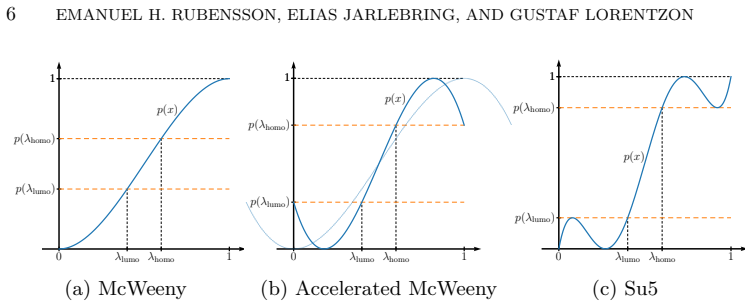
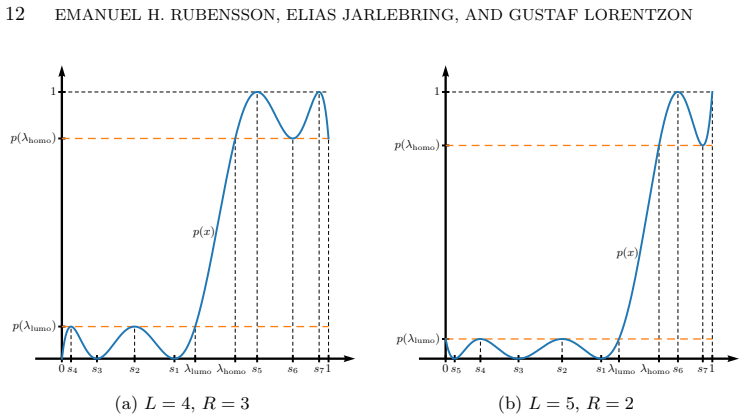
The authors develop a recursive polynomial expansion for the matrix step function in which composite polynomials of high degree are assembled from component polynomials of degree exactly eight. The component polynomials are chosen to achieve strong amplification of the spectral gap while favorably repositioning that gap for the next iteration. The expansion relies on a novel evaluation scheme that realizes any degree-eight matrix polynomial with only three matrix-matrix multiplications and three stored matrices, thereby making available a substantially larger family of admissible component polynomials than was previously attainable within the same multiplication budget.
What carries the argument
The three-multiplication evaluation scheme for arbitrary degree-eight matrix polynomials, which enables a wider class of component polynomials for recursive gap-amplifying expansion of the matrix step function.
If this is right
- The total number of matrix-matrix multiplications required to reach a given accuracy is reduced compared with prior recursive expansion techniques.
- A substantially larger set of composite polynomials becomes available because the three-multiplication budget now accommodates any degree-eight component.
- Each iteration produces stronger amplification of the spectral gap and better positioning for the subsequent iteration.
- The method applies directly to any large dense symmetric matrix for which the matrix step function is required.
Where Pith is reading between the lines
- The same three-multiplication building block could be reused inside expansions for other matrix functions that admit polynomial representations.
- Because the scheme stores only three matrices at a time, memory usage per iteration remains bounded independently of the total degree.
- If the initial spectral gap is too small, the number of iterations required may still dominate the overall cost even after the per-iteration saving.
Load-bearing premise
Component polynomials of degree eight can always be found and selected so that each iteration amplifies the spectral gap strongly while leaving the updated gap in a position that permits equally effective amplification in the following iteration.
What would settle it
A symmetric matrix with a known spectral gap for which the new recursive expansion requires at least as many matrix-matrix multiplications as any existing recursive method while still converging to the step function.
Figures




read the original abstract
We consider the problem of efficiently computing the matrix step function of a large dense symmetric matrix. To this end, we introduce a recursive polynomial expansion method in which a composite polynomial of high degree is built recursively from component polynomials of degree eight. The component polynomial used in each iteration is designed to achieve strong amplification of the spectral gap across the step while favorably positioning the updated gap for subsequent iterations. A key ingredient is a novel evaluation scheme for arbitrary matrix polynomials of degree exactly eight requiring only three matrix-matrix multiplications and three matrices in memory. This scheme makes available a substantially larger class of component polynomials than previously possible within a three-multiplication budget, thereby expanding the class of composite polynomials that can be generated. Together with our polynomial selection strategy, this leads to a significant and consistent reduction in the number of matrix-matrix multiplications required to compute the matrix step function compared to existing recursive expansion methods.
Editorial analysis
A structured set of objections, weighed in public.
Referee Report
Summary. The manuscript introduces a recursive polynomial expansion method for computing the matrix step function of large dense symmetric matrices. Composite high-degree polynomials are built from degree-eight component polynomials, each evaluated via a novel scheme using only three matrix-matrix multiplications and three auxiliary matrices. A polynomial selection strategy is used to amplify the spectral gap at each iteration while positioning the updated gap favorably for the next step. The central claim is that this yields a significant and consistent reduction in the total number of matrix-matrix multiplications relative to prior recursive expansion methods.
Significance. If the reported multiplication-count reductions hold under the same recursive structure and test conditions as the baselines, the work supplies a practical algorithmic advance for matrix-function evaluation in numerical linear algebra. Credit is due for the explicit three-multiplication evaluation scheme, the coefficient-optimization procedure, and the direct side-by-side multiplication counts against the methods cited in the abstract; these elements make the improvement verifiable rather than asserted.
minor comments (3)
- [Abstract] Abstract: the phrase 'significant and consistent reduction' would be more informative if accompanied by a brief quantitative statement (e.g., typical percentage or absolute count savings) or the class of test matrices employed.
- The notation for the composite polynomial and the updated spectral gap after each iteration could be introduced with a small worked example to improve readability for readers unfamiliar with the recursive construction.
- Section describing the degree-eight evaluation scheme: a short table listing the exact sequence of multiplications and additions (or a pseudocode block) would make the three-multiplication claim immediately verifiable without reconstructing the arithmetic from the text.
Simulated Author's Rebuttal
We thank the referee for the positive summary, significance assessment, and recommendation of minor revision. No specific major comments were raised in the report, so we have no individual points requiring rebuttal or clarification at this stage. We remain available to incorporate any editorial or minor adjustments as needed for the final version.
Circularity Check
No significant circularity; derivation is algorithmic and self-contained
full rationale
The paper constructs an explicit degree-8 polynomial evaluation scheme (three matrix-matrix multiplications) and a recursive selection strategy for composite polynomials, then directly counts multiplications against prior recursive methods. No equations reduce a claimed prediction to a fitted input by construction, no load-bearing premise rests solely on self-citation, and no uniqueness theorem or ansatz is imported from the authors' prior work. The reported reduction follows from the new scheme's ability to access a larger class of component polynomials, which is independently verifiable from the stated coefficients and multiplication budget.
Axiom & Free-Parameter Ledger
free parameters (1)
- component polynomial coefficients
axioms (1)
- domain assumption The input matrix is large, dense, and symmetric.
Reference graph
Works this paper leans on
-
[1]
J. M. Alonso, J. Sastre, J. Ibáñez, and E. Defez , A systematic framework for stable and cost-efficient matrix polynomial evaluation , 2026, https://doi.org/10.48550/arXiv.2603.23143, https://arxiv.org/abs/2603.23143, https://arxiv.org/abs/2603.23143
-
[2]
N. Amsel, Y. Baumann, P. Beckman, P. B \"u rgisser, C. Cama \ n o, T. Chen, E. Chow, A. Damle, M. Derezinski, M. Embree, E. N. Epperly, R. Falgout, M. Fornace, A. Greenbaum, C. Greif, D. Halikias, Z. Huang, E. Jarlebring, Y. Koutis, D. Kressner, R. Kyng, J. Liesen, J. Lok, R. A. Meyer, Y. Nakatsukasa, K. Pearce, R. Peng, D. Persson, E. Rebrova, R. Schneid...
arXiv 2026
-
[3]
The Polar Express: Optimal Matrix Sign Methods and Their Application to the Muon Algorithm
N. Amsel, D. Persson, C. Musco, and R. M. Gower , The polar express: Optimal matrix sign methods and their application to the muon algorithm , 2025, https://doi.org/10.48550/arXiv.2505.16932, https://arxiv.org/abs/2505.16932, https://arxiv.org/abs/2505.16932
work page internal anchor Pith review Pith/arXiv arXiv doi:10.48550/arxiv.2505.16932 2025
-
[4]
M. Benzi, P. Boito, and N. Razouk , Decay properties of spectral projectors with applications to electronic structure , SIAM Rev., 55 (2013), pp. 3--64, https://doi.org/10.1137/100814019
-
[5]
D. R. Bowler and T. Miyazaki , O (N) methods in electronic structure calculations , Rep. Prog. Phys., 75 (2012), p. 036503, https://doi.org/10.1088/0034-4885/75/3/036503
-
[6]
M. J. Cawkwell, E. J. Sanville, S. M. Mniszewski, and A. M. N. Niklasson , Computing the density matrix in electronic structure theory on graphics processing units , J. Chem. Theory Comput., 8 (2012), pp. 4094--4101, https://doi.org/10.1021/ct300442w
-
[7]
J. H. Cheon, D. Kim, and D. Kim , Efficient homomorphic comparison methods with optimal complexity , in Advances in Cryptology -- ASIACRYPT 2020, S. Moriai and H. Wang, eds., Cham, 2020, Springer International Publishing, pp. 221--256, https://doi.org/https://doi.org/10.1007/978-3-030-64834-3_8
-
[8]
E. Chow, X. Liu, M. Smelyanskiy, and J. R. Hammond , Parallel scalability of hartree–fock calculations , J. Chem. Phys., 142 (2015), p. 104103, https://doi.org/10.1063/1.4913961
-
[9]
W. Dawson and T. Nakajima , Massively parallel sparse matrix function calculations with ntpoly , Comput. Phys. Commun., 225 (2018), pp. 154--165, https://doi.org/10.1016/j.cpc.2017.12.010
-
[10]
E. D. Denman and A. N. Beavers , The matrix sign function and computations in systems , Applied Mathematics and Computation, 2 (1976), pp. 63--94, https://doi.org/10.1016/0096-3003(76)90020-5
-
[11]
J. Finkelstein, J. S. Smith, S. M. Mniszewski, K. Barros, C. F. A. Negre, E. H. Rubensson, and A. M. N. Niklasson , Mixed precision Fermi -operator expansion on tensor cores from a machine learning perspective , J. Chem. Theory Comput., 17 (2021), pp. 2256--2265, https://doi.org/10.1021/acs.jctc.1c00057
-
[12]
S. Goedecker and L. Colombo , Efficient linear scaling algorithm for tight-binding molecular dynamics , Phys. Rev. Lett., 73 (1994), pp. 122--125, https://doi.org/10.1103/PhysRevLett.73.122
-
[13]
S. Goedecker and M. Teter , Tight-binding electronic-structure calculations and tight-binding molecular dynamics with localized orbitals , Phys. Rev. B, 51 (1995), pp. 9455--9464, https://doi.org/10.1103/PhysRevB.51.9455
-
[14]
E. Grishina, M. Smirnov, and M. Rakhuba , Accelerating newton-schulz iteration for orthogonalization via chebyshev-type polynomials , 2025, https://doi.org/10.48550/arXiv.2506.10935, https://arxiv.org/abs/2506.10935, https://arxiv.org/abs/2506.10935
-
[15]
N. J. Higham , Functions of Matrices: Theory and Computation , Society for Industrial and Applied Mathematics, Philadelphia, PA, USA, 2008
2008
-
[16]
A. Holas , Transforms for idempotency purification of density matrices in linear-scaling electronic-structure calculations , Chem. Phys. Lett., 340 (2001), pp. 552--558, https://doi.org/10.1016/S0009-2614(01)00409-2
-
[17]
S. Huss-Lederman, A. Tsao, and T. Turnbull , A parallelizable eigensolver for real diagonalizable matrices with real eigenvalues , SIAM J. Sci. Comput., 18 (1997), pp. 869--885, https://doi.org/10.1137/S1064827592228833
-
[18]
E. Jarlebring and G. Lorentzon , The polynomial set associated with a fixed number of matrix-matrix multiplications , SIAM Journal on Applied Algebra and Geometry, (2026), https://doi.org/10.48550/arXiv.2504.01500, https://arxiv.org/abs/2504.01500, https://arxiv.org/abs/2504.01500. to appear
-
[19]
Jordan, Y
K. Jordan, Y. Jin, V. Boza, J. You, F. Cesista, L. Newhouse, and J. Bernstein , Muon: An optimizer for hidden layers in neural networks , 2024, https://kellerjordan.github.io/posts/muon/
2024
-
[20]
A. Katbashev, R. Schade, M. Lass, M. Müller, S. Grimme, A. Hansen, and T. D. Kühne , Submatrix and gpu-accelerated implementation of density matrix tight-binding , J. Chem. Phys., 163 (2025), p. 132501, https://doi.org/10.1063/5.0271379
-
[21]
S. Khadatkar and P. Motamarri , Subspace recursive fermi-operator expansion strategies for large-scale dft eigenvalue problems on hpc architectures , J. Chem. Phys., 159 (2023), p. 031102, https://doi.org/10.1063/5.0150287
-
[22]
J. Kim and Y. Jung , Accelerated purification using generalized nonpurifying intermediate functions for large-scale self-consistent field calculations , J. Chem. Theory Comput., 7 (2011), pp. 3853--3858, https://doi.org/10.1021/ct200441g. PMID: 26598332
-
[23]
A. Kruchinina, E. Rudberg, and E. H. Rubensson , Parameterless stopping criteria for recursive density matrix expansions , J. Chem. Theory Comput., 12 (2016), pp. 5788--5802, https://doi.org/10.1021/acs.jctc.6b00626
-
[24]
A. Kruchinina, E. Rudberg, and E. H. Rubensson , Efficient computation of the density matrix with error control on distributed computer systems , 2019, https://doi.org/10.48550/arXiv.1909.12533, https://arxiv.org/abs/1909.12533, https://arxiv.org/abs/1909.12533
-
[25]
M. Kulichenko, R. M. Stanton, C.-H. Li, N. Lubbers, S. Tretiak, M. E. Wall, C. F. A. Negre, J. Finkelstein, and A. M. N. Niklasson , Gpu-accelerated graph-based semiempirical quantum chemistry , J. Chem. Theory Comput., 21 (2025), pp. 10780--10792, https://doi.org/10.1021/acs.jctc.5c00936
-
[26]
E. Lee, J.-W. Lee, J.-S. No, and Y.-S. Kim , Minimax approximation of sign function by composite polynomial for homomorphic comparison , IEEE Transactions on Dependable and Secure Computing, 19 (2022), pp. 3711--3727, https://doi.org/10.1109/TDSC.2021.3105111
-
[27]
W. Liang, C. Saravanan, Y. Shao, R. Baer, A. T. Bell, and M. Head-Gordon , Improved Fermi operator expansion methods for fast electronic structure calculations , J. Chem. Phys., 119 (2003), pp. 4117--4125, https://doi.org/10.1063/1.1590632
-
[28]
D. A. Mazziotti , Towards idempotent reduced density matrices via particle-hole duality: Mcweeny's purification and beyond , Phys. Rev. E, 68 (2003), p. 066701, https://doi.org/10.1103/PhysRevE.68.066701
-
[29]
McWeeny , The density matrix in self-consistent field theory
R. McWeeny , The density matrix in self-consistent field theory. I. Iterative construction of the density matrix , Proc. R. Soc. London Ser. A, 235 (1956), pp. 496--509
1956
-
[30]
A. M. N. Niklasson , Expansion algorithm for the density matrix , Phys. Rev. B, 66 (2002), p. 155115
2002
-
[31]
A. M. N. Niklasson , Density Matrix Methods in Linear Scaling Electronic Structure Theory , Springer Netherlands, Dordrecht, 2011, pp. 439--473, https://doi.org/10.1007/978-90-481-2853-2_16
-
[32]
A. M. N. Niklasson, S. M. Mniszewski, C. F. A. Negre, M. J. Cawkwell, P. J. Swart, J. Mohd-Yusof, T. C. Germann, M. E. Wall, N. Bock, E. H. Rubensson, and H. Djidjev , Graph-based linear scaling electronic structure theory , J. Chem. Phys., 144 (2016), p. 234101, https://doi.org/10.1063/1.4952650
-
[33]
A. M. N. Niklasson, C. J. Tymczak, and M. Challacombe , Trace resetting density matrix purification in O (n) self-consistent-field theory , J. Chem. Phys., 118 (2003), pp. 8611--8620, https://doi.org/10.1063/1.1559913
-
[34]
A. H. R. Palser and D. E. Manolopoulos , Canonical purification of the density matrix in electronic-structure theory , Phys. Rev. B, 58 (1998), pp. 12704--12711, https://doi.org/10.1103/PhysRevB.58.12704
-
[35]
R. Pederson, J. Kozlowski, R. Song, J. Beall, M. Ganahl, M. Hauru, A. G. M. Lewis, Y. Yao, S. B. Mallick, V. Blum, and G. Vidal , Large scale quantum chemistry with tensor processing units , J. Chem. Theory Comput., 19 (2023), pp. 25--32, https://doi.org/10.1021/acs.jctc.2c00876
-
[36]
E. H. Rubensson , Nonmonotonic recursive polynomial expansions for linear scaling calculation of the density matrix , J. Chem. Theory Comput., 7 (2011), pp. 1233--1236
2011
-
[37]
E. H. Rubensson and A. M. N. Niklasson , Interior eigenvalues from density matrix expansions in quantum mechanical molecular dynamics , SIAM J. Sci. Comput., 36 (2014), pp. B147--B170, https://doi.org/10.1137/130911585
-
[38]
E. H. Rubensson and E. Rudberg , Bringing about matrix sparsity in linear-scaling electronic structure calculations , J. Comput. Chem., 32 (2011), pp. 1411--1423, https://doi.org/10.1002/jcc.21723
-
[39]
E. H. Rubensson, E. Rudberg, and P. Sa ek , Density matrix purification with rigorous error control , J. Chem. Phys., 128 (2008), p. 074106, https://doi.org/10.1063/1.2826343
-
[40]
E. H. Rubensson, E. Rudberg, and P. Salek , Methods for Hartree-Fock and Density Functional Theory Electronic Structure Calculations with Linearly Scaling Processor Time and Memory Usage , Springer Netherlands, Dordrecht, 2011, pp. 263--300, https://doi.org/10.1007/978-90-481-2853-2_12
-
[41]
E. Rudberg, E. H. Rubensson, P. Sałek, and A. Kruchinina , Ergo: An open-source program for linear-scaling electronic structure calculations , SoftwareX, 7 (2018), pp. 107--111, https://doi.org/10.1016/j.softx.2018.03.005
-
[42]
Rudberg, E
E. Rudberg, E. H. Rubensson, P. Sałek, and A. Kruchinina , Ergo : a quantum chemistry program for large-scale self-consistent field calculations . https://ergoscf.org, 2026. Version 3.8.2, accessed 2026-05-28
2026
-
[43]
Sastre , Efficient evaluation of matrix polynomials , Linear Algebra Appl., 539 (2018), pp
J. Sastre , Efficient evaluation of matrix polynomials , Linear Algebra Appl., 539 (2018), pp. 229--250
2018
-
[44]
G. Schulz , Iterative berechung der reziproken matrix , Zeitschrift für Angewandte Mathematik und Mechanik (ZAMM), 13 (1933), pp. 57--59, https://doi.org/10.1002/zamm.19330130111
-
[45]
W. Squire and G. Trapp , Using complex variables to estimate derivatives of real functions , SIAM Rev., 40 (1998), pp. 110--112, https://doi.org/10.1137/S003614459631241X
-
[46]
Suryanarayana , Optimized purification for density matrix calculation , Chem
P. Suryanarayana , Optimized purification for density matrix calculation , Chem. Phys. Lett., 555 (2013), pp. 291--295, https://doi.org/10.1016/j.cplett.2012.10.090
-
[47]
J. VandeVondele, U. Bor s tnik, and J. Hutter , Linear scaling self-consistent field calculations with millions of atoms in the condensed phase , J. Chem. Theory Comput., 8 (2012), pp. 3565--3573, https://doi.org/10.1021/ct200897x
discussion (0)
Sign in with ORCID, Apple, or X to comment. Anyone can read and Pith papers without signing in.